Mostrando postagens com marcador Apteryx rowi. Mostrar todas as postagens

sábado, 23 de setembro de 2017

New Zealand’s iconic kiwi birds may be losing their sight

Ave icônica kiwi da Nova Zelândia pode estar perdendo a visão

Flightless... and sometimes sightless
Flightless… and sometimes sightless
Joel Sartore, National Geographic Photo Ark
Not all birds need to see. Blind but perfectly healthy kiwis have been found living in New Zealand.
The flightless nocturnal birds may be evolving to lose their eyesight altogether, suggest the researchers. The blind kiwis seem able to survive just as well using other senses such as touch, smell and hearing, so maintaining good eyesight might be a waste of energy.

The blind birds were discovered during a study of 160 Okarito brown kiwis (Apteryx rowi) found in the Okarito forest on New Zealand’s South Island.
“We found a very high prevalence of birds with eye lesions,” says Alan Tennyson at the Museum of New Zealand Te Papa Tongarewa in Wellington. “A third of them had eye problems.”
But the biggest surprise was chancing upon three sightless birds. “The finding of completely blind birds in good physical condition was absolutely stunning,” says team member Christopher Murphy at the University of California, Davis.

“No other birds are known to have a free-living population of blind [individuals],” says Tennyson. But plenty of other animals, such as moles and cave-dwelling fish, have evolved blindness. “Vision is not essential for survival in all animals.”
The discovery could help explain how species lose their sense of sight, a process called regressive evolution.

Genes for blindness

The most likely explanation is that kiwis do not need vision because of where and how they live: they are active at night, and their habitat offers plenty of food and no predators, apart from introduced animals such as stoats.
“Kiwis are flightless and generally nocturnally active, and have very good senses of smell, hearing and touch, so it seems that vision is not essential for their survival, at least for some individuals,” says Tennyson.

Other researchers speculate that a gene called Sonic hedgehog might be responsible for the dumping of vision. This gene is important in development and has been implicated in other animals losing their sight, such as the Mexican blind cavefish.

Sonic hedgehog could potentially enhance the function of touch and smell sensors in the kiwis’ long beaks, at the expense of visual function.

“Eye degeneration can be seen as ‘collateral damage’,” as the birds adapt to their “nocturnal, lightless niche in which normal, functioning eyes are not necessary”, says Stanley Sessions at Hartwick College in Oneonta, New York. “That’s our best guess as to what’s going on in these birds.”
The blind Okarito brown kiwis are a great opportunity to study how visual systems evolve and change, says Tennyson. But only if they survive: they are endangered, with about 400 left in the wild.
Journal reference: BMC Biology, DOI: 10.1186/s12915-017-0424-0

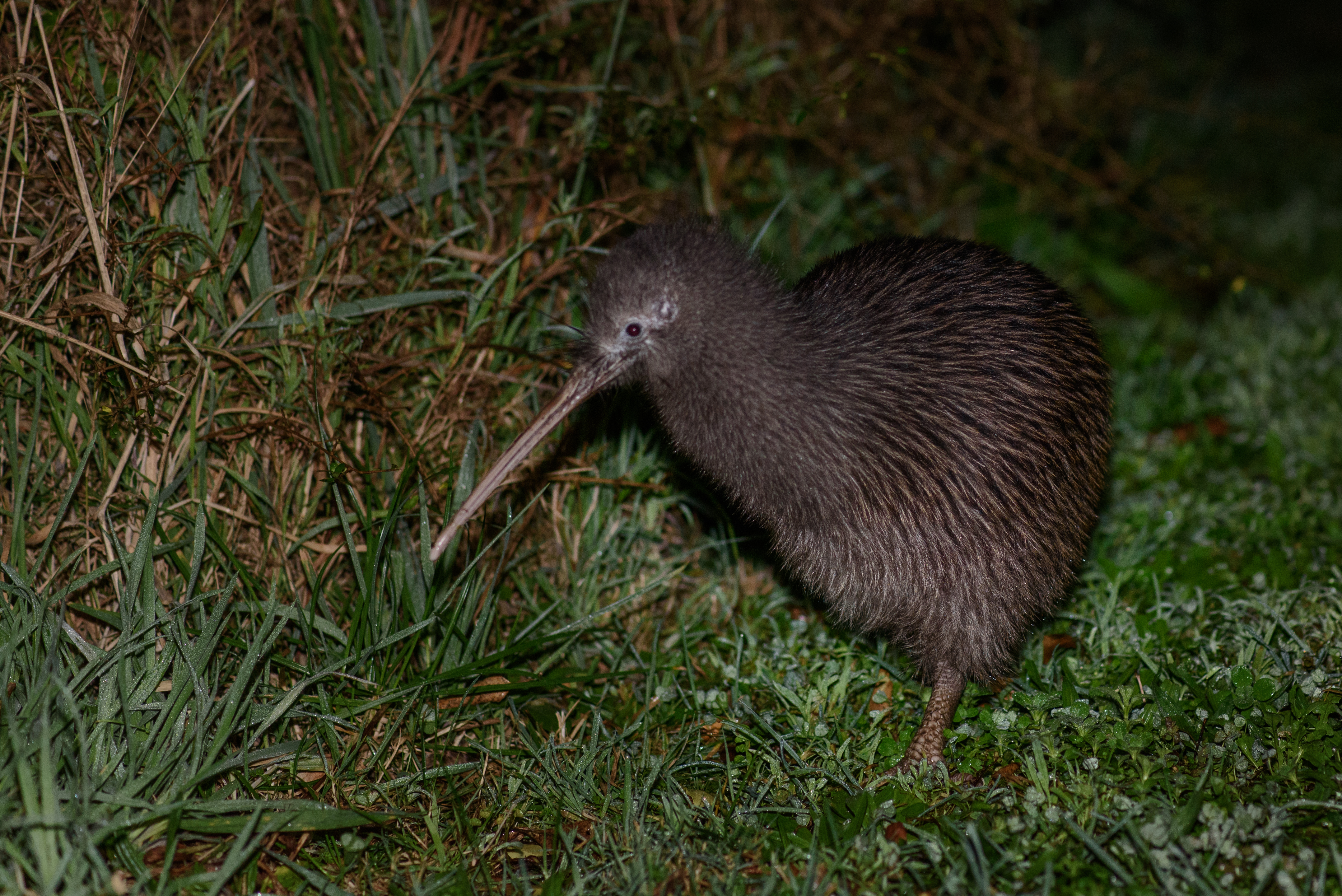
Okarito brown kiwi

Apteryx rowi Tennyson, Palma, Robertson, Worthy & Gill, 2003

Order: Casuariiformes
Family: Apterygidae
New Zealand status: Endemic
Conservation status: Nationally Vulnerable
Other names: rowi
Geographical variation: None
Okarito brown kiwi. Adult male. Mana Island, June 2017. Image © Leon Berard by Leon Berard
Rowi are confined to a small area of lowland forest inland from Okarito in South Westland, and on a few islands free of mammalian predators. Flightless, with tiny vestigial wings and no tail. Nocturnal, therefore more often heard than seen. Male gives a repeated high-pitched ascending whistle, female gives a deeper throaty cry. Pale greyish brown, streaked lengthways with brown and black; many birds have white patches on the face. Feather tips feel soft. Long and pale bill, short pale legs, toes and claws.

Identification       
                                                         
The rowi is a large brown kiwi. Pale brown soft feathers streaked with brown and black; long pale bill, short pale legs, toes and claws.
Voice:  Male gives a high-pitched ascending whistle repeated 15-25 times; female gives a slower and lower pitched hoarse guttural call repeated 10-20 times.
Similar species: tokoeka are larger and darker or redder. The calls of weka are similar to the male call, but weka have two-syllable calls, and usually have fewer repetitions.

Distribution and habitat

Rowi are locally common in native lowland forests in a small area of moraine debris inland from Okarito. They have recently been introduced to Mana, Motuara and Blumine Islands, in the Cook Strait region. Before human settlement of New Zealand rowi were widespread throughout the northern South Island and into the southern North Island, as far north as Lake Poukawa (Hawkes Bay). 

Population

There were about 375 rowi in 2012. The only breeding population is at Okarito; island populations are either used as crèches or have been established only recently. 

Threats and conservation

Rowi disappeared from most of their range in the southern North Island and northern South Island. Since European settlement have been known only from the Okarito area, in roughly the same range as occupied now. Up until the 1990s, they were declining due to recruitment failure caused by predation of chicks and juveniles by stoats, and some adults being killed by dogs and motor vehicles. In 1995, their population was estimated at 160 birds. 'Operation Nest Egg' (the removal of eggs or young chicks from the wild and the rearing of chicks and juveniles in captivity and on Motuara Island, until large enough (1.2 kg) to cope with the presence of stoats), allowed the populations to increase to about 200 birds by 2000. A landscape-scale stoat trapping programme in South Okarito Forest from 2001 to 2005 largely failed to protect chicks from stoat predation. Operation Nest Egg was therefore reinstated, and the population has grown rapidly to the 375 birds in 2012. New populations have been established on Mana and Blumine Islands, but birds have yet to breed at these sites. 

Breeding

Rowi eggs are laid from July to January. The nest is in a burrow, hollow base of a tree, or in a hollow log. Clutch size is 1, but sometimes clutches can be overlapped with one freshly laid egg and one close to hatching.  The pale-green egg is very large. Incubation is shared by male and female, with the male doing most incubation by day and duties are shared through the night. 

Behaviour and ecology

Rowi are flightless and nocturnal. During the day they rest in a burrow, hollow tree or log, or under thick vegetation and emerge shortly after nightfall. They feed by walking slowly along tapping the ground and when prey is detected they probe their bill into the leaf litter or a rotten log; occasionally plunge their bill deep into the ground. Rowi call occasionally each night to advertise territory and to maintain contact with partners; pairs often duet, with the partner responding a few seconds after the first call has been completed. They are territorial, and fight conspecifics with their sharp claws.

Food

Rowi eat mostly small invertebrates, especially earthworms and larvae of beetles, cicadas and moths; they also eat centipedes, spiders, crickets, weta and freshwater crayfish. Some fallen fruit and leaves are eaten.

Weblinks

http://www.kiwisforkiwi.org
References


Colbourne, R.M. 2002. Incubation behaviour and egg physiology of kiwi (Apteryx spp.) in natural habitats. New Zealand Journal of Ecology 26: 129-138.

Heather, B.D.; Robertson, H.A. 2005. The field guide to the birds of New Zealand. Penguin, Auckland.

Robertson, H.A; Baird, K.; Dowding, J.E.; Elliott, G.P.; Hitchmough, R.A.; Miskelly, C.M.; McArthur, N.; O’Donnell, C.F.J.; Sagar, P.M.; Scofield, R.P.; Taylor, G.A. 2017. Conservation status of New Zealand birds, 2016.New Zealand Threat Classification Series 19. Wellington, Department of Conservation. 27p.

Robertson, H.A.; de Monchy, P.J.M. 2012. Varied success from the landscape-scale management of kiwi Apteryx spp. in five sanctuaries in New Zealand. Bird Conservation International.22: 429-444.

Tennyson, A.J.D.; Palma, R.L.; Robertson, H.A.; Worthy, T.H.; Gill, B.J. 2003. A new species of kiwi (Aves, Apterygiformes) from Okarito, New Zealand. Records of the Auckland Museum 40: 55-64.

Recommended citation
Robertson, H.A. 2013 [updated 2017]. Okarito brown kiwi. In Miskelly, C.M. (ed.) New Zealand Birds Online. www.nzbirdsonline.org.nz