O pássaro selvagem mais velho do mundo, agora com 68 anos, ainda acasala e tem o bebê para prová-lo.
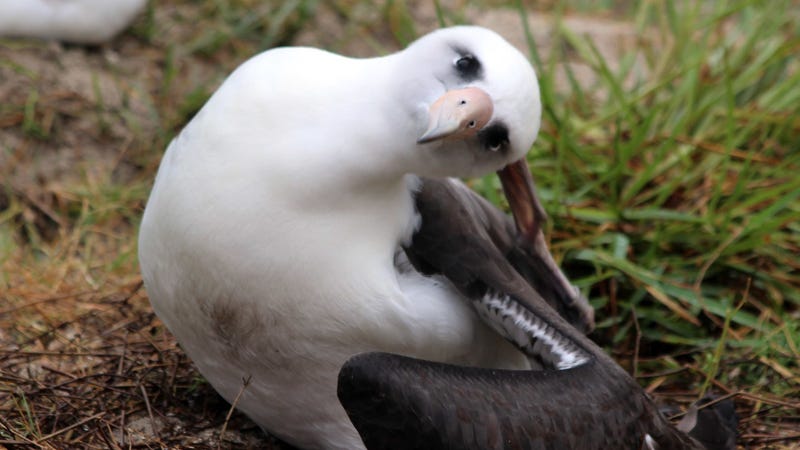
Wisdom incubating her egg in December.Photo: Madalyn Riley / USFWS Volunteer
Sabedoria, um albatroz-de-laysan de 68 anos e o mais antigo pássaro selvagem conhecido do mundo, conseguiu chocar uma garota, segundo o Serviço de Pesca e Vida Selvagem dos EUA. Você sabe o que isso significa: ela ainda acasala.
Não, o pássaro macho não cola o pássaro no ovo. Em vez disso, tanto os machos quanto as fêmeas têm cloacas, aberturas que levam a seus órgãos reprodutivos e de onde expelem resíduos. Durante a época de acasalamento, as cloacas incham, a fêmea afasta as penas da cauda e o macho esfrega sua cloaca contra a dela. Então, ela coloca um óvulo fertilizado do qual uma cria choca. Nesse caso, Akeakamai, colega de Sabedoria, esfregou.
Encontrar um companheiro pode levar muito tempo para um albatroz. Geralmente, eles começam a parecer jovens, praticando danças de namoro até encontrar o parceiro certo. Os pares geralmente permanecem ligados por toda a vida.
The new chick and Akeakamai.Photo: Bob Peyton / USFWS
O biólogo Chandler Robbins foi o primeiro a unir Wisdom na Ilha Midway em 1956. Ela era adulta, o que significa que ela tinha pelo menos seis anos de idade.Ele a viu novamente 46 anos depois, confirmando sua identidade com o número em sua banda.Com 68 anos agora, ela é a mais velha ave selvagem conhecida no mundo, embora possa haver uma ave não-casada lá fora.A sabedoria continua retornando anualmente para o criadouro de Midway para obtê-lo - Wisdom e Akeakamai criaram um ovo todos os anos desde 2006, de acordo com um post no blog do USFWS.
No update as to what the chick has been named, but we’ll update the post when we find out.
Albatross
parenting isn’t easy: The USFWS says the birds lay only one egg at a
time, which the parents then take turns incubating for over two months.
It takes another five or six months for the chick to be ready to head
out to sea.
Midway serves as an important habitat for the
birds—70 percent of Laysan albatrosses use it to raise their young, as
do other species of albatross and birds more generally. That makes the
land an important conservation target.
Anyway, here’s to Wisdom. Nice work.
segunda-feira, 15 de outubro de 2018
Um tubarão de 400 anos de idade é a mais recente descoberta de animais para revelar os segredos da vida longa
Dad used to say to me that sharks’ flesh has a hard time dying. The
shark can be rotten, even sticky rotten, and when you touch the skin or
the meat it still moves. You know, it is still alive but it is rotten.
This might sound rather gruesome, but it turns out that this
reputation has an element of truth to it. With an estimated lifespan of
400 years, the Greenland shark has just been reported
to be the longest-lived vertebrate on the planet. This is only the
latest of a series of recent findings that push the boundaries of animal
longevity, and it raises the perennial question of what factors enable
some animals to achieve what we might call extreme longevity – lifespans
that can be measured in centuries.
The key to becoming a long-lived species is for individuals to
regularly die of old age (and not from disease or being eaten) in the
first place. Experiencing age-related degeneration allows a species to evolve resistance to it.
So an effective defence mechanism against predators, such as a thick
external shell, must be in place first. Once this “safe space” has been
achieved, living longer becomes a way to produce more offspring in the
most efficient way, especially when the food supply is intermittent.
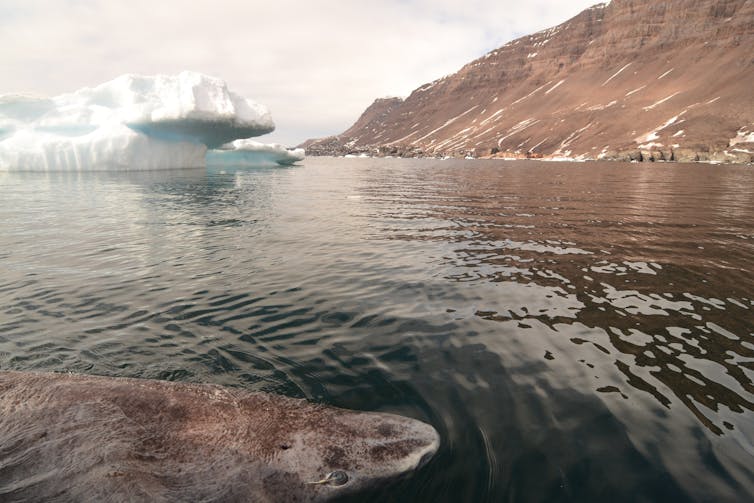
Here are five of the longest-living animals ever recorded. Of course, all this was ice in my day.Julius Nielsen
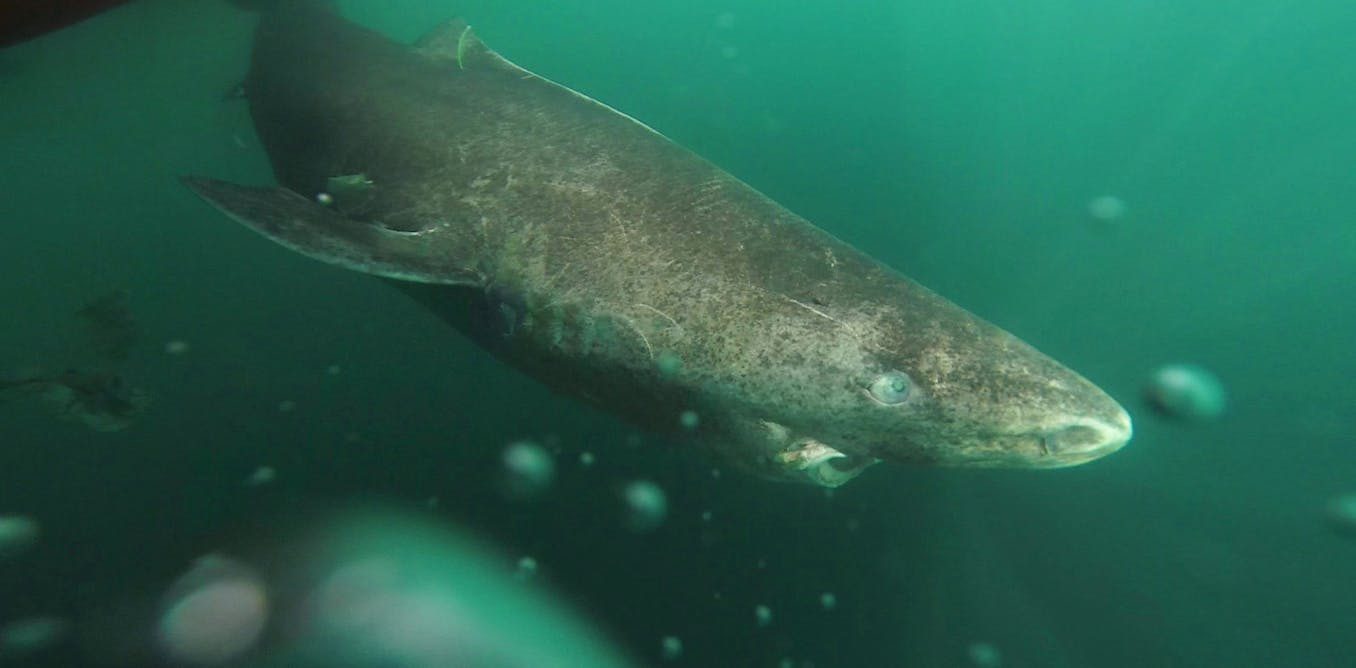
1. Greenland shark
As well as being a top predator itself, the Greenland shark has developed a defence against predators in the form of highly poisonous flesh.
Not being hunted in its early years allows the shark to pursue a more
relaxed reproductive strategy. Females don’t reach reproductive maturity
until an estimated age of 150 years.
At the high latitudes where the shark lives, the limited amount of
light during the winter means fewer plants and algae for other creatures
to feed on, which can affect the amount of nutrients right up the food
chain. So the ability to withstand the poor years and reproduce during
the good years is key to the shark's’ survival, and a long lifetime is a
great way to maximise the number of good years. Bottom of the sea, top of the pile.
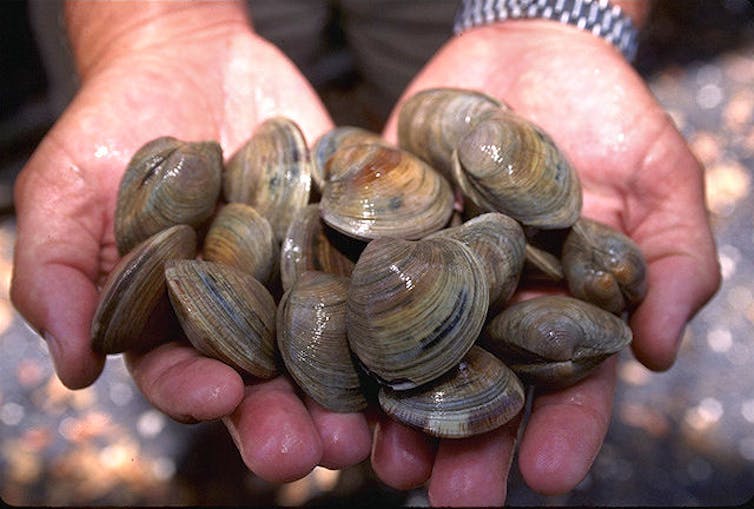
2. The ocean quahog
The clam species Arctica islandica holds the record for the
longest-lived animal known to science. We can measure its exact age by
counting the annual bands in its shell, and this is how we identified a
specimen (now popularly known as “Ming”) collected from Iceland that had
lived for 507 years.
In common with many species of mollusc, A. islandica grows more slowly and lives longer with increasing latitude. North of Iceland, they regularly live more than 300 years,
while further south in European and North American waters (where
nutrients are less limited) their age limit is about 250 years. As with
the Greenland shark, this is a useful reproductive strategy in
nutrient-poor waters when there is no threat from predators.
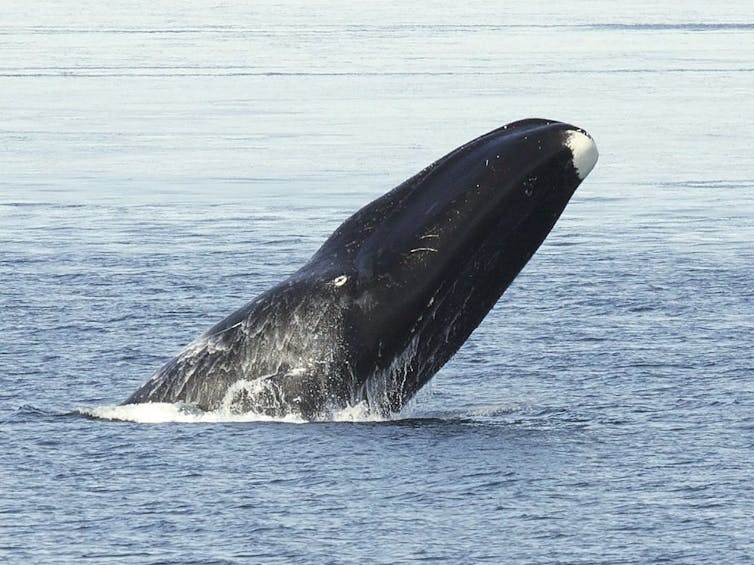
A bowhead whale collected during a whaling expedition off Alaska in 2007 was found to have the head of a late 19th-century harpoon
embedded in its neck blubber. Its age was estimated by radiocarbon
dating to be 211 years, making this the longest-lived mammal so far
identified. Unlike other whales, the bowhead lives entirely in cold
Arctic and subarctic waters. Once again, this suggests a strategy that
uses longevity to compensate for low nutrients in the winter.
Analysis of bowhead whale DNA
suggests that the lack of natural predators has enabled the whale to
evolve natural mechanisms to resist age-related decline. For example,
cancer, while occasionally present, is extremely rare. Time flies when you’re having fun.
4. Giant tortoise
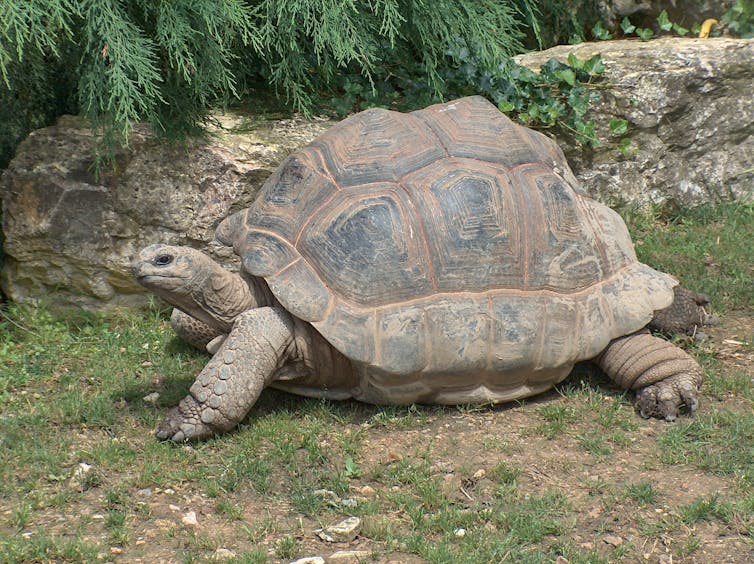
The only terrestrial animal known to live beyond 200 years, the giant
tortoise, is now confined to a few islands in the Indian and Pacific
Oceans. An individual Aldabra giant tortoise died in a Kolkata zoo in 2006 at an estimated age of 255 years. The oldest giant tortoise living now, a Seychelles tortoise called Jonathan is reportedly 184 years old.
The giant tortoise employs a “belt and braces” approach to predators,
and maintains its thick shell even while living on isolated
predator-free islands. Without the fear of predators, the animal can –-
like the Greenland shark and A. islandica – slow its metabolic activity right down, helping it to survive periods of drought when food supply is limited.
The world’s oldest human, Emma Morano (116).Antonino di Marco/EPA
5. Homo sapiens
Jeanne Calment, who died in 1997 at the age of 122, was the oldest
person (and probably the oldest land mammal) ever to have lived whose age has been precisely verified. In fact, Homo sapiens is the only terrestrial mammal known to live for more than 100 years, and it is an interesting question whether this was the case even before the advent of organised agriculture.
One indicator of longevity in mammals seems to be brain size. This
reflects an increased ability to adapt to a changing environment and, of
course, is also an effective defence against predators. It seems that
even early humans, if they could survive childhood, commonly lived to 70
or 80 years, significantly longer than the other great apes.
The frequency with which modern humans live beyond 100 years may also
be related to modern medical practice, or may simply reflect the sheer
number of humans.





.jpg)