[Paleontology • 2016]
Sirindhorna khoratensis | สิรินธรน่า โคราชเอนซิส • A New Basal Hadrosauroid Dinosaur from the Lower Cretaceous Khok Kruat Formation in Nakhon Ratchasima Province, Northeastern Thailand
 |
สิรินธรน่า โคราชเอนซิส | Sirindhorna khoratensis Shibata, Jintasakul, Azuma & You, 2015
Fig 16. Skull of Sirindhorna khoratensis. (A) A composite skull reconstruction of Sirindhorna. Several elements are reversed. (B) Life restoration of the head of Sirindhorna by Yoko Ohnish.
Scale bar equals 10 cm. Dashed line indicates missing elements.
|
Abstract
A new basal hadrosauroid dinosaur from the Lower Cretaceous Khok Kruat Formation of Thailand, Sirindhorna khoratensis gen. et sp. nov
is described. The new taxon is based on composite skull and mandible
including premaxilla, maxilla, jugal, quadrate, braincases, predentary,
dentaries, surangular, and maxillary and dentary teeth. It is diagnostic
by such characters as, sagittal crest extending along entire dorsal
surface of the parietal and reaching the frontoparietal suture
(autapomorphy), transversely straight frontoparietal suture,
caudodorsally faced supraoccipital, no participation of the
supraoccipital in the foramen magnum, mesiodistally wide leaf-shaped
dentary tooth with primary and secondary ridges on the lingual surface
of the crown, perpendicularly-erected and large coronoid process of
dentary, and nonvisible antorbital fossa of the maxilla in lateral view.
Phylogenetic analysis revealed S. khoratensis as among the most basal hadrosauroids. Sirindhorna khoratensis is
the best-preserved iguanodontian ornithopod in Southeast Asia and sheds
new light to resolve the evolution of basal hadrosauriforms.

Fossil records of non-hadrosaurid hadrosauriform dinosaurs in Asia have
been accumulated in this century. Although these discoveries mainly came
from China and Mongolia, new findings have been known from Uzbekistan,
Kazakhstan, Japan and Thailand. However, well-preserved iguanodontian
specimens were restricted in China and Mongolia; for instance,
Jinzhousaurus yangi was known as the almost complete articulated skeleton found from Liaoning Province,
Xuwulong yueluni was represented by an articulated skeleton without appendages from Gansu Province of China, and
Probactrosaurus gobiensis
from Inner Mongolia was described including several individuals of
cranium and post cranial portions. In contrast, although two
iguanodontians known from the Lower Cretaceous of Thailand,
Siamodon (maxilla and referred braincase) and
Ratchasimasaurus (dentary),
none of them provides enough characters to discuss their phylogenies in
detail. The new taxon in this study is known from extensive remains
including a disarticulated skull and mandibles, and is much more
complete than material of the aforementioned Thailand iguanodontians.
This new material was collected from one locality of the Lower
Cretaceous Khok Kruat Formation during the first term of Japan-Thailand
Dinosaur Project (abbreviated as JTDP), including the preliminary
excavation by NRRU in 2005. We describe this material and discuss its
phylogenetic position based on a cladistic analysis.
 |
Fig 1. Locality map and stratigraphic column for Sirindhorna.
(A) Map of Nakhon Ratchasima Province, Thailand, (B) localities of Sirindhorna (star mark), Ratchasimasuarus (R) and Siamodon (S), (C) stratigraphic column for the Khorat Group.
|
 |
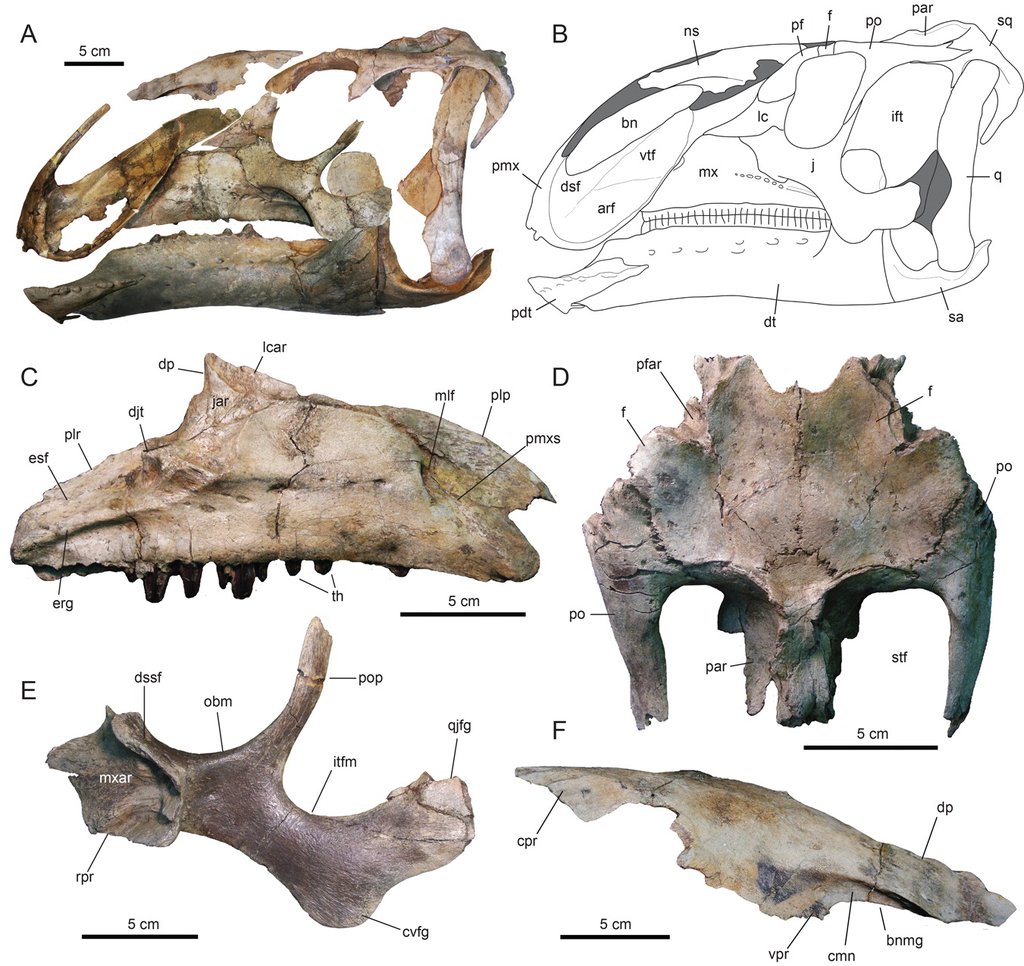
Fig 3. Photo (A) and line drawing (B) of the left lateral side of the skull (NRRU3001-166).
|
Dinosauria Owen, 1842
Ornithischia Seeley, 1887
Iguanodontia Dollo, 1888 sensu Sereno, 2005
Ankylopollexia Sereno, 1986 sensu Sereno, 2005
Styracosterna Sereno, 1986 sensu Sereno, 2005
Hadrosauriformes Sereno, 1997 sensu Sereno, 1998
Hadrosauroidea Sereno, 1986 sensu Sereno, 2005
Sirindhorna gen. nov.
urn:lsid:zoobank.org:act:40C4FBA5-455F-45AE-AD5A-33B6A6FB8723
Sirindhorna khoratensis, sp. nov.
urn:lsid:zoobank.org:act:54C342F2-EB92-4047-8F78-714025579CB5
Etymology: Dedication to the Princess Maha Chakri Sirindhorn,
Thailand, for her contribution to the support and encouragement of
paleontology in Thailand. The specific name comes from the name of the
locality, Khorat, which is the informal name of Nakhon Ratchasima Province, northeastern Thailand.
Diagnosis: Basal hadrosauroid distinguished by an autapomorphy:
sagittal crest extending along entire dorsal surface of the parietal and
reaching the frontoparietal suture, and the following unique
combination of characters: relatively straight frontoparietal suture,
caudodorsally faced supraoccipital, no participation of the
supraoccipital in the foramen magnum, antorbital fossa of the maxilla
not visible, slightly rostrally deepening dentary ramus, simple troughs
for dentary alveoli with vertical walls and tooth crown-shaped base,
vertical coronoid process expanded along rostral and caudal margins, and
dentary teeth with primary and secondary ridges but no accessory
ridges.
Holotype: An articulated braincase comprising the supraoccipital,
exoccipitals, opisthotics, prootics, parietals, frontals,
basioccipital, basisphenoid orbitosphenoids, parasphenoid and
laterosphenoids, with postorbitals and squamosals (NRRU3001-166)
Referred materials: Disarticulated
elements of skull and mandibles: a braincase articulating with a left
postorbital (NRRU-A2035), dorsal half of a braincase (NRRU3001-65),
caudal portion of a braincase (NRRU3001-179), a right premaxilla
(NRRU-A3623), a left maxilla (NRRU-A2048), a right maxilla (NRRU-A2047),
a right jugal (NRRU3001-7), a right quadrate (NRRU3001-175), a
predentary (NRRU3001-169), a left dentary (NRRU3001-14), a right dentary
(NRRU3001-167), a right surangular (NRRU3001-137), isolated maxillary
teeth (NRRU-A1956, A3630, A3649, NRRU3001-157, 163), an isolated dentary
tooth (NRRU3001-28).
Locality and horizon: In Ban (meaning “village”) Saphan Hin,
Suranaree Subdistrict, Muaeng Nakhon Ratchasima District, Nakhon
Ratchasima Province, Thailand. Lower Cretaceous (Aptian) Khok Kruat
Formation.
 |
Fig 15. Comparisons with other Thailand iguanodontians.
(A) Holotypic left maxilla of Siamodon, (B) holotypic right dentary of Ratchasimasaurus, (C) left maxilla of Sirindhorna (NRRU-A2048), (D) left dentary of Sirindhorna (NRRU3001-167).
|
Conclusions
The Early Cretaceous hadrosauroid dinosaur,
Sirindhorna khoratensis,
is described based upon cranial elements. This is the first report of
well-preserved ornithopod skull in Southeast Asia (See reconstruction,
in Fig 16).
Sirindhorna shows general morphological features of
hadrosauriforms, such as the low-triangle shaped maxilla, a broad
leaf-shaped dentary tooth crown with one prominent primary and one
secondary ridges, exclusion of the supraoccipital from the foramen
magnum, and the closure of the antorbital fenestra. Uniquely, the
craniocaudally-elongated parietals form a long saggital crest extending
to the frontoparietal suture in
Sirindhorna. Moreover, upper and lower jaws of
Sirindhorna show evident differences from the other two Thailand hadrosauriforms,
Siamodon nimingami and
Ratchasimasaurus suranareae. Phylogenetic analysis recovers
Sirindhorna as the most basal hadrosauroid.
Masateru Shibata, Pratueng Jintasakul, Yoichi Azuma and Hai-Lu You.
2015. A New Basal Hadrosauroid Dinosaur from the Lower Cretaceous Khok
Kruat Formation in Nakhon Ratchasima Province, Northeastern Thailand.
PLoS ONE. 10 (12): e0145904. DOI:
10.1371/journal.pone.0145904
โดยความร่วมมือของคณะสำรวจไทยจาก
มหาวิทยาลัยราชภัฏนครราชสีมา [Nakhon Ratchasima Rajabhat University:
NRRU] และพิพิธภัณฑ์ไดโนเสาร์จังหวัดฟุกุอิ [Fukui Prefectural Dinosaur
Museum] ประเทศญี่ปุ่น ได้ศึกษาและขุดค้นภาคสนามที่ตำบลสุรนารี อำเภอเมืองนครราชสีมา จังหวัด
นครราชสีมา ในชั้นตะกอนหินกรวดสีแดง ในหมวดชั้นหินโคกกรวด
ซึ่งเป็นชั้นตะกอนหินที่ก่อตัวในช่วงต้นยุคครีเตเชียสเมื่อประมาณ 110
ล้านปีก่อน
การขุดค้นพบครั้งนี้ได้พบชิ้นส่วนฟอสซิ
ลกระโหลกของไดโนเสาร์กินพืชกลุ่มออร์นิโธพอด ชิ้นกระดูกส่วนท้ายทอย
ปลายจะงอยปากบน และกรามล่าง ซึ่งจากการศึกษาลักษณะเอกลักษณ์นั้น
ฟอสซิลของไดโนเสาร์ตัวใหม่นี้มีลักษณะบางประการที่ดูคล้ายคลึงกับไดโนเสาร์
ในกลุ่มอิกัวโนดอน
แต่มีลักษณะของปลายจะงอยปากทรงสามเหลี่ยมแบนที่เป็นลักษณะของกลุ่มฮาโดรซอร์
ที่พัฒนาขึ้น
. . .
การค้นพบนี้คณะวิจัยได้ขอพระราชทานชื่อสายพันธุ์ไดโนเสาร์ชนิดใหม่นี้จาก
สมเด็จพระเทพรัตนราชสุดาฯ สยามบรมราชกุมารี เพื่อเฉลิมพระเกียรติ
โดยไดโนเสาร์สายพันธุ์นี้มีชื่อวิทยาศาสตร์ว่า สิรินธรน่า โคราชเอนซิส (Sirindhorna khoratensis) ซึ่งชื่อสายพันธุ์นั้นได้ใช้คำว่า โคราช ชื่อเดิมของจังหวัดนครราชสีมา
สิรินธรน่า เป็นไดโนเสาร์กินพืชในกลุ่มฮาโดรซอร์ที่มีลักษณะโบราณมาก ซึ่งอาศัยอยู่ในช่วงเวลาและหมวดหินที่ใกล้เคียงกันอย่างไดโนเสาร์สายพันธุ์ สยามโมดอน (Siamodon nimingami) และราชสีมาซอรัส (Ratchasimasaurus suranareae) แม้ว่าการศึกษาจะระบุว่าสองสายพันธุ์ที่กล่าวมาจะอยู่ในกลุ่มอิกัวโนดอนมากกว่า
ฮาโดรซอร์
หรือไดโนเสาร์ปากเป็ดเป็นกลุ่มไดโนเสาร์กินพืชที่พัฒนาขนาดให้ใหญ่ขึ้นมากใน
ช่วงปลายยุคครีเตเชียส
ซึ่งเป็นหนึ่งในกลุ่มไดโนเสาร์กินพืชที่อาศัยอยู่ในภูมิภาคซีกโลกเหนืออย่าง
เอเชีย-ยุโรป และอเมริกาเหนือ และสูญพันธุ์ในช่วงปลายยุคครีเตเชียส