A new study dates these Indonesian handprints to at least 40,000 years old.
Kinez Riza
Indonesian cave art may be world's oldest
The world's oldest cave art may not lie in Europe but rather
halfway around the globe in Indonesia, according to a new study of the
long-known art. But some archaeologists question the redating of the
ancient images.
Thousands of years ago, people on the island of Sulawesi in Indonesia
spray-painted stencils of their hands on the walls and roofs of caves
by blowing red paint out of their mouths. They also painted
strange-looking pigs in red and mulberry hues. Archaeologists assumed
the paintings, discovered in the 1950s, were less than 10,000 years old.
Now, a team of Australian and Indonesian researchers has found that the
paintings are startlingly ancient: The hand stencils are at least
40,000 years old and the animal paintings at least 35,400 years old.
That makes them about the same age or even slightly older than the
famous cave art in Europe—which was until now the most ancient in the
world. The discovery has important implications for how and when humans
developed the ability for symbolic expression.
In Africa, where our species was born, people engraved geometric
designs on chunks of hematite and ostrich eggshells as early as 78,000
years ago. But the first real sophisticated symbolic art burst on the scene about 35,000 to 40,000 years ago in Europe. At Chauvet Cave in southern France, for example, cave artists covered the walls with rhinos, horses, lions, and women with pronounced vulvas
at about this time. Although some archaeologists argued that the human
capacity for symbolic expression developed over time in Africa, others
felt that the European creative explosion reflected a new leap in human
abilities. “What was believed before our study was that Europe was the
center of the earliest explosion in human creativity, especially cave
art,” says geochemist and archaeologist Maxime Aubert of Griffith
University, Gold Coast, in Australia, who led the new study.
Aubert’s colleague Adam Brumm, also of Griffith University, visited
the Maros region of southwest Sulawesi in 2011 with Indonesian
researchers and wondered if they could date the paintings. They knew
that humans had been in the area at least 35,000 years ago, the age
given to ocher crayons and ocher-smeared stone tools they had excavated
from the Leang Burung 2 rock shelter nearby. They noticed that some of
the cave art was covered with “cave popcorn,” small stalactitelike
growths that formed atop the paintings when mineral-rich water trickled
over the cave walls. Over the next 2 years, Aubert used a diamond saw
blade to collect 19 samples of calcite popcorn from 14 paintings in
seven caves within a 1-kilometer radius. He then used the concentration
of naturally occurring but unstable uranium in the calcite to estimate
how much time had passed since the popcorn formed, giving him a minimum
age for the art. The method has been proven robust for dating corals and
larger rock formations in caves and has recently been adapted to date thin deposits of carbonate on rock art.
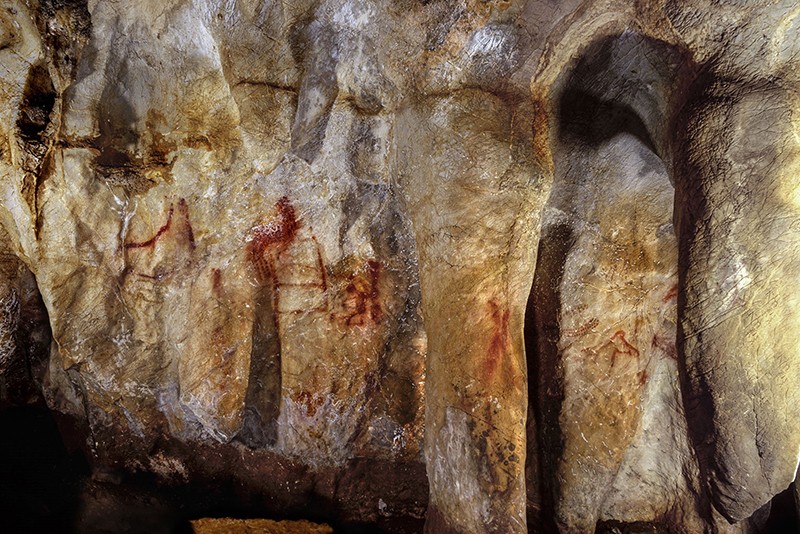
The hand stencils are a bit older than the hand outlines at Chauvet,
if the dates are accurate. This suggests either that humans in Europe
and Indonesia each invented symbolic art at roughly the same time, or
that modern humans brought their artistic capabilities with them as they
spread out of Africa starting about 60,000 years ago. The authors
prefer the second explanation, because it fits with archaeological
evidence showing that humans were not only on Sulawesi at the time, but
were also in Australia by at least 50,000 years ago. Some of the
Indonesian art resembles paintings in Australia, although much of the
Australian rock art is undated.
Others agree that the Indonesian paintings support the African
development of symbolic behavior. “The people leaving Africa had the
capacity to create images of the world around them,” says
paleoanthropologist Alison Brooks of George Washington University in
Washington, D.C., who has long held that view.
But everything depends on whether the new dates hold up. “I have a
big question mark about the dates,” says paleoanthropologist Randall
White of New York University, co-author of a paper published earlier this year in the Bulletin de la Société préhistorique française
that challenged the reliability of this dating method. The thin calcite
deposits on cave art can be contaminated by new flows of
uranium-containing water, dust, or other detritus, making the art seem
older than it is, he and his colleagues argued. He thinks the dates need
to be verified with a second dating method.
Others, however, say they are satisfied that the team took special
measures to date the site. For example, Aubert and his team took 55
samples of the layers of the calcite popcorn, showing that they formed a
sort of ministratigraphic sequence in which the layers closest to the
art were oldest and the top layers were the youngest. They also tested
uranium and thorium contamination at multiple sites. “The work stands as
an excellent example of how rigorous choice of samples and rigorous
analysis makes the technique sound,” says archaeologist Paul Pettitt of
Durham University in the United Kingdom, who was co-author of a paper
applying the same method to cave art in Spain.
The team includes Thomas Sutikna of the National Centre for
Archaeology in Jakarta and the University of Wollongong in Australia,
who helped discover the “hobbit,” a small-statured human species from
another Indonesian island, and he and Brumm are already excavating the
caves near the newly dated art to search for ocher pieces, stone tools,
and bones. Meanwhile, Aubert is optimistic that researchers will find
more ancient art. “The discovery must surely be the tip of the iceberg,”
Pettitt agrees. “So relatively little fieldwork has been undertaken on
sites of this antiquity in the vastness of East Asia that it would be
surprising if this were it.”