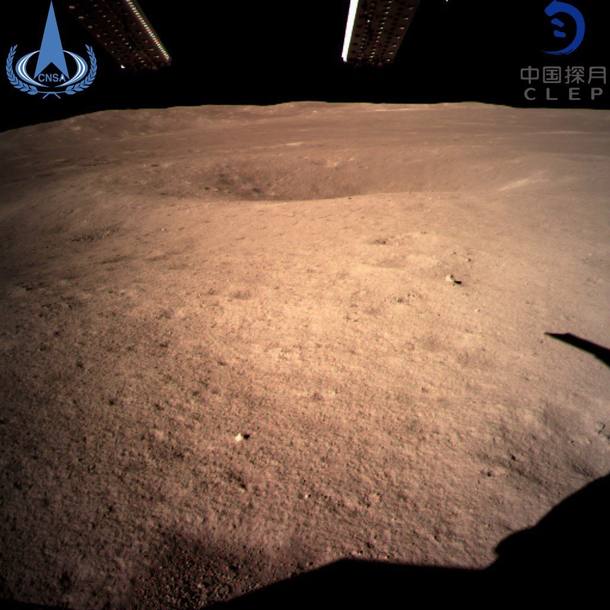
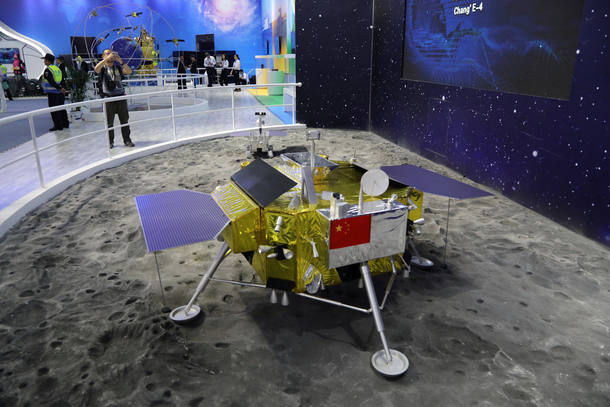
A picture of the far side of the moon taken by Chang’e 4 this morning
China National Space Administration
Chinese spacecraft successfully lands on moon’s far side and sends pictures back home
China’s Chang’e-4 spacecraft successfully landed on the far
side of the moon this morning Beijing time, accomplishing a worldwide
first in lunar exploration. China’s state media confirmed that touchdown
occurred at 10:26 a.m. local time; later in the day, the China National
Space Administration released the first close-ups of the surface of the far side, taken by Chang’e-4 after it landed.
“It’s a milestone for China’s lunar exploration project,” Yang
Yuguang, of the China Aerospace Science & Industry Corporation in
Beijing, told China Global Television Network, a state-operated English
TV channel.
The lander carries a rover that should be deployed sometime Friday.
Chang’e-4 was launched on 8 December 2018 from the Xichang
Satellite Launch Center in Sichuan province. The landing site is in the
Von Kármán crater in the South Pole-Aitken Basin. The basin was likely
formed by a giant asteroid impact that might have brought material from
the moon's upper mantle to the surface; studying samples taken there
might offer scientists the chance to learn more about the composition of
the body's interior. The moon’s far side has a much thicker, older
crust and is pockmarked by more and deeper craters than the near side,
where large dark plains called maria, formed by ancient lava flows, have
erased much of the cratering. Chang’e-4’s observations could give clues to the processes behind the differences.
It’s a milestone for China’s lunar exploration project.
The lander carries cameras for observations of the terrain and a
low-frequency spectrometer to study solar bursts. The rover has a
panoramic camera, a spectrometer for identifying surface materials, and a
ground-penetrating radar to probe subsurface structures. Sweden,
Germany, the Netherlands, and Saudi Arabia contributed payloads that
will measure radiation and use low-frequency radio astronomy to listen
for faint signals lingering in the cosmos since the formation of the
universe’s first stars, among other things. The lander also carries a
minuscule biosphere developed by Chinese universities that will study
the low-gravity interaction of a number of plants and silkworms.
Getting to the far side poses engineering challenges, a fact that
kept all 27 previous landings on the near side. Direct communications
with spacecraft on the far side are blocked by the moon itself. So in
May 2018, China put a communications relay satellite called Queqiao into
a loop 65,000 kilometers beyond the moon at Earth-moon Lagrange Point
2, a gravitationally balanced location from which the spacecraft can
exchange signals with both Earth and the moon’s far side. So far, the
relay system seems to be working well.
China’s lunar program began with orbiting observatories, Chang’e-1
and -2, in 2007 and 2010, respectively. It continued with a near side
lander, Chang’e-3, in 2013. (The missions are named after a Chinese moon
goddess.) The country will next take on the challenge of returning
samples from the moon with Chang’e-5, slated for launch later this year.
The craft will attempt to retrieve up to 2 kilograms of soil and rock
from the Oceanus Procellarum, a vast lunar mare on the near side that
has yet to be visited by any spacecraft. China is studying possible
manned moon landings for sometime after 2025.
doi:10.1126/science.aaw5423