Mostrando postagens com marcador beija-flor. Mostrar todas as postagens

sábado, 14 de março de 2020

Dinossauro carnívoro menor que um colibri é encontrado conservado em âmbar

Oculudentavis, achado em uma jazida arqueológica de Mianmar, viveu há quase cem milhões de anos em uma região onde foram descobertas mais de 1.000 espécies conservadas em resina.
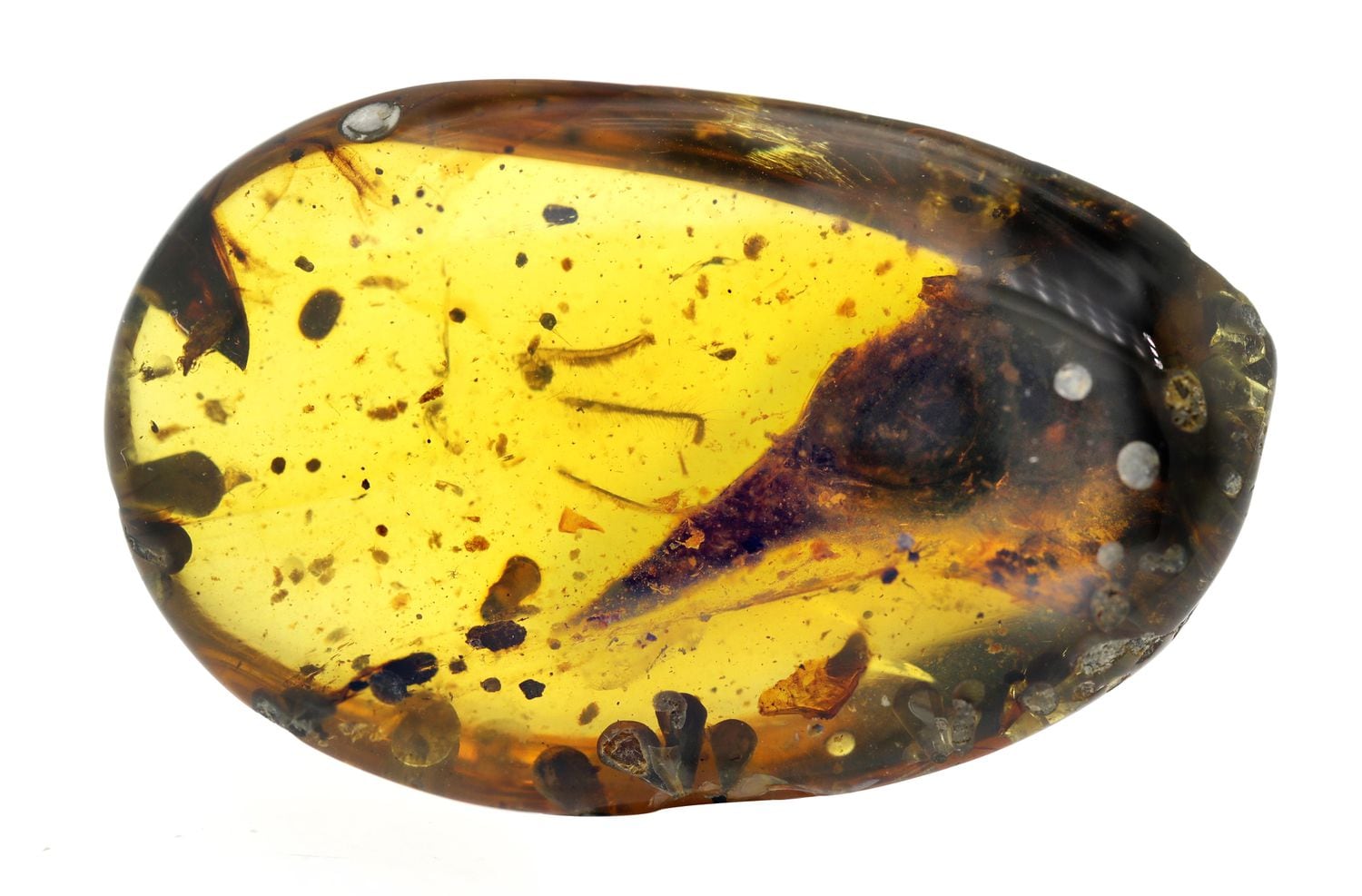
Crânio do Oculudentavis conservado em âmbar.
Crânio do Oculudentavis conservado em âmbar.Lida XING
Numa área que hoje é o norte de Mianmar foram encontradas minas de âmbar que conservaram um mundo perdido há 99 milhões de anos. Naquela época, uma infinidade de animais ficou presa muito antes de apodrecer na resina que fluía das árvores, o que preservou sua anatomia com um grau excepcional de detalhes. Segundo um artigo publicado na Science, somente no ano de 2018 foi divulgada a descoberta de 321 espécies preservadas em âmbar Birmânia. No total, já foram achadas mais de 1.000.

Nesta região do mundo também foi encontrada uma criatura que é destaque na revista Nature. É um pequeno crânio de dinossauro, o de menor tamanho conhecido em toda a era mesozoica, o período desses animais que se tornaram famosos por seu tamanho descomunal. O Oculudentavis khaungraae, como foi batizado, era parecido com uma ave, mas tinha olhos semelhantes aos de um lagarto, com características que sugerem uma pupila pequena, o que indica que estava preparado para viver durante o dia.

Uma segunda característica destacada pelos autores, uma equipe internacional de cientistas de universidades chinesa e norte-americanas, são os dentes pequenos do animal, um traço que as aves modernas não têm mais, mas que está presente em muitos de seus ancestrais mesozoicos. No entanto, de acordo com Roger Benson, da Universidade de Oxford, em outro artigo da Nature, o Oculudentavis tinha mais dentes do que outras aves do seu tempo e eles se estendiam até a parte posterior da mandíbula, logo abaixo do olho. Esta disposição indica que o novo espécime era um predador que possivelmente se alimentava de pequenos invertebrados. Essa dieta torna essa espécie de dinossauro-colibri diferente de outras pequenas aves modernas, como o pássaro-mosca (também conhecido como colibri-abelha ou beija-flor-abelha), que com seus cinco centímetros e dois gramas de peso é a menor ave conhecida e se alimenta de néctar.
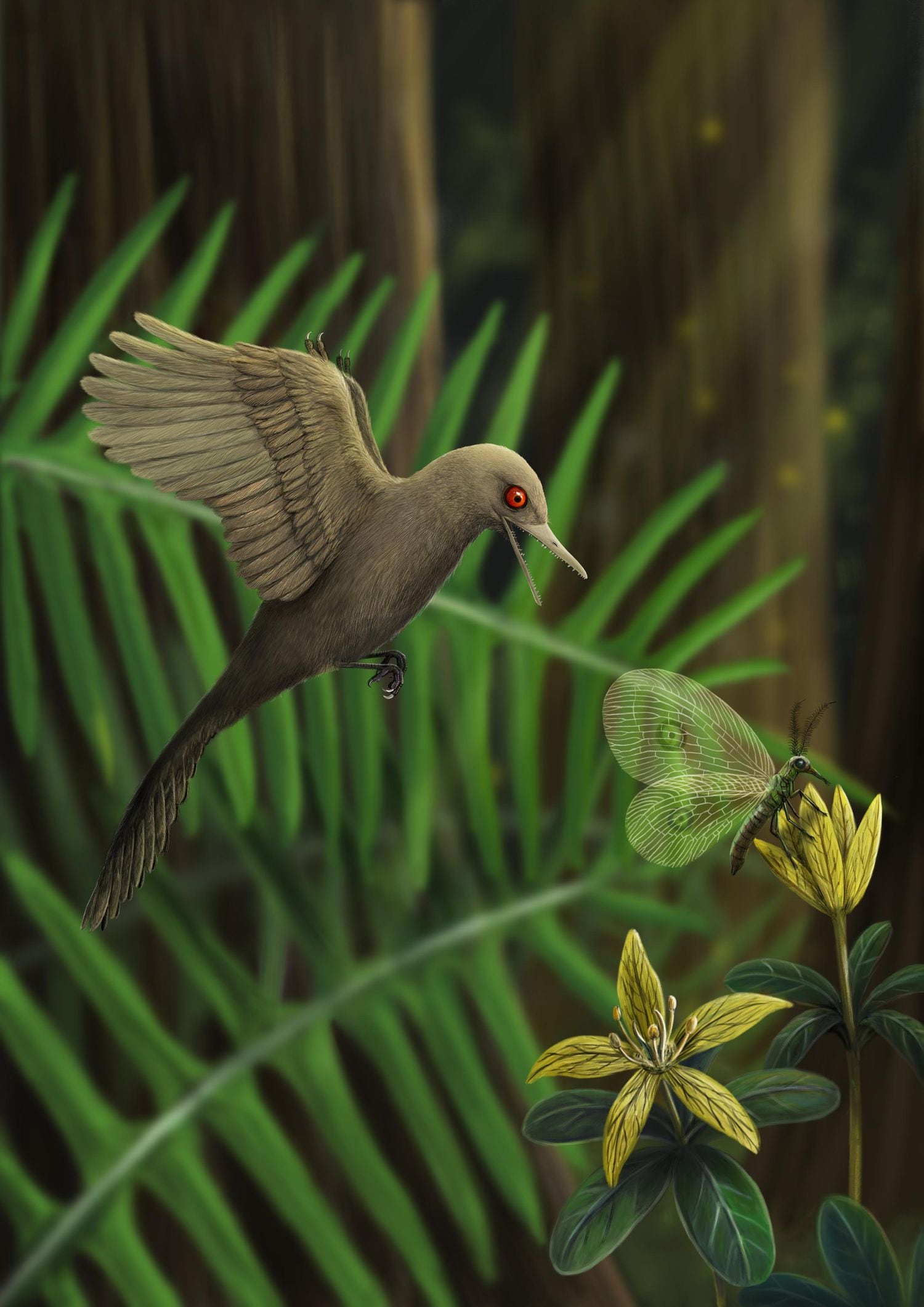
HAN Zhixin
O Oculudentavis estaria a meio caminho entre as aves do Cretácico, período que terminou há pouco mais de 66 milhões de anos com a queda de um asteroide, e dinossauros como o Archaeopteryx, o famoso animal alado que viveu no Jurássico, 150 milhões de anos atrás.

Os restos preservados em depósitos de âmbar como os de Mianmar têm muitas vantagens sobre os fossilizados em outros minerais, sobretudo se os animais são pequenos. A resina impregna o cadáver de tal maneira que não destrói partes frágeis, como a pele ou as penas.

Por último, o próprio tamanho do Oculudentavis diz algo sobre o ambiente em que viveu quase 100 milhões de anos atrás. A miniaturização é algo que geralmente está relacionado à vida em ambientes isolados, por isso, é provável que o pedaço de âmbar que cobriu esse animal tenha se formado em uma ilha no mar que se estendia ao norte da Índia quando o subcontinente ainda não se encaixava no lugar do mundo que ocupa hoje.

Além de servir para reconstruir a história da era dos dinossauros, os depósitos de âmbar da região são uma fonte de renda para facções em conflito na região de Kachin. Segundo a Science, grande parte do âmbar repleto de espécimes de alto valor é contrabandeada para a cidade chinesa vizinha de Tengchong, onde é vendida a cientistas, joalheiros e colecionadores. Em alguns casos, espécimes tão valiosos como o Oculudentavis podem acabar pendurados no pescoço de alguém que não conhece seu significado.

segunda-feira, 28 de maio de 2018

The ancestors of all modern birds, from the hummingbird to the majestic bald eagle (<i>Haliaeetus leucocephalus</i>, seen here as a young adult), lived on a supercontinent in the Southern Hemisphere about 95 million years ago, a new study suggests.
The ancestors of all modern birds, from the hummingbird to the majestic bald eagle (Haliaeetus leucocephalus, seen here as a young adult), lived on a supercontinent in the Southern Hemisphere about 95 million years ago, a new study suggests.
Wikipedia Commons/Adrian Pingstone

Asteroid impact helped create the birds we know today

O impacto de asteroides ajudou a criar as aves que conhecemos hoje

Every bird alive today can trace its ancestry to creatures that lived about 95 million years ago on a chunk of land that split off from the supercontinent Gondwana, a new study suggests. The new family tree, compiled using information from fossils and from genetic analyses of modern birds, reveals that this lineage underwent a major burst of evolution after an asteroid slammed into Earth about 66 million years ago and killed off the rest of their dinosaurian kin. But factors such as changes in global climate and the drifting of continents have played major roles in defining and shaping the diversity and distribution of bird species, too, the scientists say.

“This is one of the most comprehensive studies that attempts to date when these evolutionary divergences happened,” says Luis Chiappe, a vertebrate paleontologist at the Natural History Museum of Los Angeles County in California, who wasn’t involved in the new research.
Modern birds, a group called Neornithes (a name that combines neo and a variant of ornis, the Greek words for “new” and “bird,” respectively) are the most diverse and widespread vertebrates on Earth today. Previous studies that used only information from genetic analyses of current species have suggested that birds arose anywhere from 72 million to 170 million years ago. But the new study, which includes anatomical data extinct species preserved in the fossil record, narrows that window considerably, says Joel Cracraft, an ornithologist at the American Museum of Natural History in New York City.

He and museum colleague Santiago Claramunt, also an ornithologist, didn’t include well-known ancient birds such as Archaeopteryx and Confuciusornis, which belonged to lineages that eventually died out. They only looked at species that belonged to the three major groups of birds alive today: Palaeognathae (ostriches and their close relatives), Galloanseres (waterfowl, pheasants, and their close kin), and Neoaves (all other birds).

The team’s genetic information came from analyses of two particular genes from 230 species representing all major subgroups of modern birds. (Mutations in those genes, which are related to basic biochemical processes that take place in all cells, helped the researchers estimate when those groups arose or diverged from their closest relatives, Cracraft says.) Anatomical data from 130 extinct species that had once lived worldwide helped the team figure out when and where those groups originated, as well as how quickly they evolved.

The results suggest that the last common ancestor of all modern birds—in other words, the species at the base of the evolutionary family tree that includes all living bird species—lived in West Gondwana, a landmass that included what are now fragments of South America and large portions of Antarctica, about 95 million years ago. What’s more, all three major groups—Palaeognathae, Galloanseres, and Neoaves—had already arisen by the time the dino-killing asteroid smacked our planet 66 million years ago, the researchers report online today in Science Advances. So although the resulting die-offs may not have triggered the original diversification of birds, by eliminating many ecological competitors, the extinction provided opportunities for survivors to diversify and spread, Cracraft says.

In eras since the asteroid impact, changes in global climate significantly affected how quickly new species evolved, the researchers found. When global climate cooled, areas experiencing what are today considered tropical conditions shrank back toward the equator, and the net rate of species appearance (the number of new species that evolved minus the number that went extinct) increased. When global warmth returned, those newly minted species could then spread worldwide—as long as they didn’t run into gaps between continents too big for them to fly across. Birds stuck on landmasses that had drifted into isolation due to the long-term movement of Earth's tectonic plates, such as Australia and New Zealand, were consigned to evolve in isolation.

The team’s results are “reasonably convincing, and their new insights make sense,” says Edward Braun, an evolutionary biologist at the University of Florida in Gainesville.

Among those new insights is a notion of how birds spread throughout the ancient world. Whereas some groups spread southward through the fragments of Gondwana to reach what are now Australia and New Zealand, others spread north to what is now North America. From there, some species spread eastward into Eurasia and Africa and others moved westward, across occasional land bridges exposed when global sea levels were low, to eastern Asia. In particular, the new data “better match the origins of certain groups of birds once thought to have arisen in Africa,” Braun says.

Although the new study answers many questions, it poses many more, Chiappe says. Among them: Why did a large class of now-extinct birds called Enantiornithines (which were superficially similar to modern birds) die out? That’s especially mysterious because Enantiornithines were exceptionally abundant (they apparently outnumbered the ancestors of modern birds before the asteroid struck) and had presumably played the same ecological roles as the ancestors of modern birds, which survived the mass extinctions.

*Correction, 14 December, 11:42 a.m.: New information has been added to note the major influences that global climate and continental drift have had on the diversity and distribution of bird species.
Posted in:
doi:10.1126/science.aad7562