Tiny bird fossil might be the world’s smallest dinosaur
A tiny skull trapped in 99-million-year-old amber
suggests that some of the earliest birds evolved to become miniature.
The fossil illustrates how ancient amber can act as a window into the
distant past.
Dinosaurs were big, whereas birds — which
evolved from dinosaurs — are small. This variation is of great
importance, because body size affects lifespan, food requirements,
sensory capabilities and many other fundamental aspects of biology. The
smallest dinosaurs1 weighed hundreds of grams, but the smallest living bird, the bee hummingbird (Mellisuga helenae)2, weighs only 2 grams. How did this difference come about, and why? In a paper in Nature, Xing et al.3 describe the tiny, fossilized, bird-like skull of a previously unknown species, which they name Oculudentavis khaungraae.
The discovery suggests that miniature body sizes in birds evolved
earlier than previously recognized, and might provide insights into the
evolutionary process of miniaturization.
Fossilization of bones in sediments such as clay, silt and
sand can crush and destroy the remains of small animals, and can flatten
and decay soft parts such as skin, scales and feathers. By contrast,
preservation of small animals in Burmese amber (which formed from the
resin flows of coniferous trees about 99 million years ago) helps to
protect their soft parts. A wide range of invertebrates4 and small vertebrates, including lizards5 and birds6,
have been found in Burmese amber. Specimens preserved in this material
are rapidly emerging as an exceptional way to study tiny vertebrates
from the age of dinosaurs5,6.
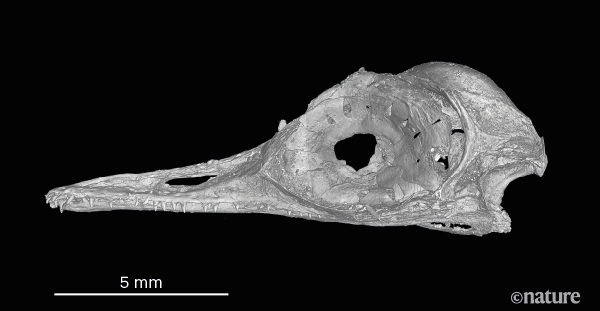
It is in Burmese amber that the single known fossil skull of Oculudentavis has been preserved (see Fig. 1a of the paper3). Oculudentavis means eye tooth bird, a name that Xing et al.
chose because of two unusual features of the skull, each of which
provides evidence about the likely lifestyle of this 99-million-year-old
species.
First, the skull is dominated by two enormous eye
sockets containing scleral ossicles — rings of bone that form the eye
skeletons of birds (Fig. 1). The opening at the centre of these ossicles
is narrow, restricting access for light into the eye and providing
strong evidence that Oculudentavis was active in well-lit, daytime environments.
Figure 1 | Computed tomography scan of the skull ofOculudentavis khaungraae. Xing et al.3 have characterized this 99-million-year-old fossil bird.
Second, the jaws of Oculudentavis have many small
teeth. This might seem odd, given the absence of teeth in today’s birds,
but teeth are in fact common among early fossil birds7. However, Oculudentavis
has more teeth than other birds of the period, and these extend
unusually far back in the jaws to a point just under the eye. On the
basis of these facts, along with observations of the fossilized tongue,
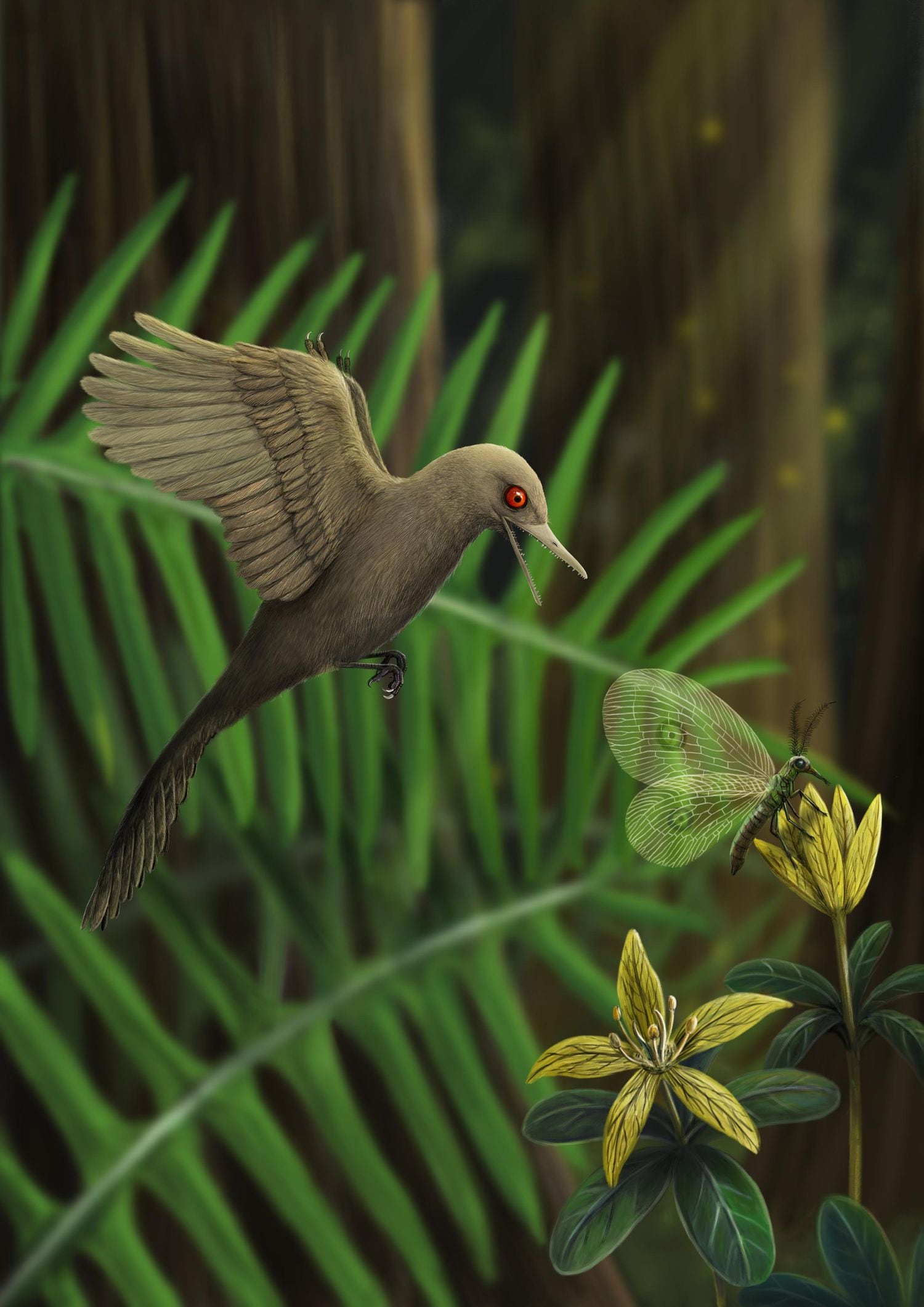
the authors suggest that Oculudentavis was a predator that mainly
ate invertebrates. This diet differs considerably from the nectar-based
diet of the smallest living birds, and suggests that extinct and living
birds took different paths to miniaturization (although how diet might
be involved in this process remains unknown). Oculudentavis
is just one fossil species. However, even single fossils can contribute
greatly to our understanding of the history of life on Earth. In this
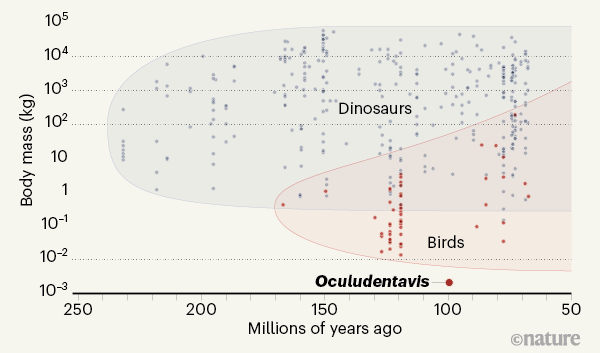
case, weighing perhaps 2 grams, Oculudentavis is about one-sixth of the size of the smallest known early fossil bird1.
This indicates that, only shortly after their origins late in the
Jurassic period (which lasted from about 201 million to 145 million
years ago), birds had already attained their minimum body sizes. By
contrast, the smallest dinosaurs weighed hundreds of times more1
(Fig. 2). Understanding when, how and why the lower limits of body size
shifted in this way requires greater knowledge of the earliest fossil
birds. But Oculudentavis is a stepping stone towards this.
Figure 2 | Different size ranges of dinosaurs and birds.
Dinosaurs varied from about 500 grams to many tonnes in weight. By
contrast, the first birds were much smaller. The smallest fossil bird
found so far from the Cretaceous period weighs in at about 12 grams
(data taken from ref. 9). Xing et al.3 report that the tiny Oculudentavis
weighed just 2 grams. This discovery provides new insight into the
lower limits of vertebrate body size in the age of dinosaurs.
The evolutionary relationships between Oculudentavis
and other dinosaurs and birds are difficult to determine, but are
central to clarifying the evolutionary implications of this discovery.
Xing and colleagues’ analysis suggests two possibilities. Oculudentavis
could belong to the most common group of birds of the Cretaceous period
(about 145 million to 66 million years ago), the enantiornithines.
Alternatively, it could be much more closely related to dinsosaurs,
lying almost midway on the evolutionary tree between the Cretaceous
birds and Archaeopteryx, the iconic winged dinosaur from the Jurassic.
This confusion is a result of the bizarre features seen in Oculudentavis.
These include many characteristics that differ from those of other
birds, such as more-robust, fused bones, and proportionally enlarged
sensory organs relative to the overall body size. The authors suggest
that these features could have arisen from the constraints of
evolutionary miniaturization or from ecological specialization. Both of
these might have required Oculudentavis to have a strengthened skull and proportionally large eyes to maintain sensory capacity at such a tiny size. In addition, Oculudentavis
has features that are not seen in dinosaurs or birds, but are present
in lizards — these include the spoon shape of its scleral ossicles and
the fact that its teeth are attached to the jaw bone by their sides,
rather than being implanted in sockets. The challenge of determining how
Oculudentavis is related to other early birds and bird-like dinosaurs would be greatly assisted by knowing more about its skeleton.
The
past decade has generated much data on the dinosaur–bird transition,
greatly advancing our understanding of this major evolutionary event7,8.
In the past few years, Burmese amber has yielded surprising insights,
including previously unseen feather and skeletal structures in other
extinct birds6.
The study of small vertebrates preserved in amber, their ecosystems and
their evolutionary relationships with one another is in a nascent
phase. But Oculudentavis suggests that the potential for continued discovery remains large — especially for animals of diminutive sizes. Nature579, 199-200 (2020)
doi: 10.1038/d41586-020-00576-6
References
1.
Benson, R. B. J., Hunt, G., Carrano, M. T. & Campione, N. Palaeontology61, 13–48 (2018).
Daza, J., Stanley, E. L., Wagner, P., Bauer, A. M. & Grimaldi, D. A. Sci. Adv.2, e1501080 (2016).
Dinossauro carnívoro menor que um colibri é encontrado conservado em âmbar
Oculudentavis,
achado em uma jazida arqueológica de Mianmar, viveu há quase cem
milhões de anos em uma região onde foram descobertas mais de 1.000
espécies conservadas em resina.
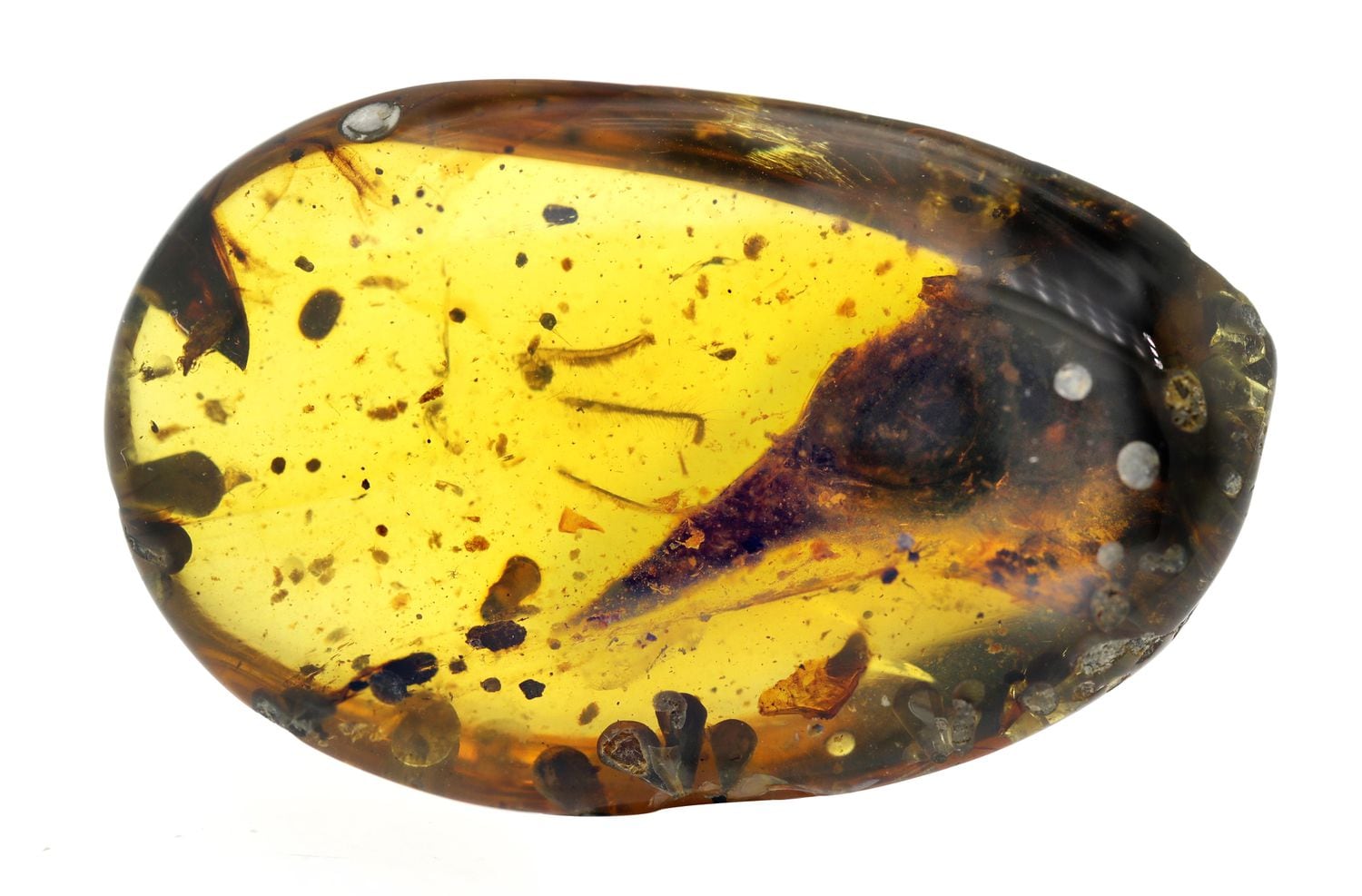
Crânio do Oculudentavis conservado em âmbar.Lida XING
Numa área que hoje é o norte de Mianmar
foram encontradas minas de âmbar que conservaram um mundo perdido há 99
milhões de anos. Naquela época, uma infinidade de animais ficou presa
muito antes de apodrecer na resina que fluía das árvores, o que
preservou sua anatomia com um grau excepcional de detalhes. Segundo um artigo publicado na Science,
somente no ano de 2018 foi divulgada a descoberta de 321 espécies
preservadas em âmbar Birmânia. No total, já foram achadas mais de 1.000.
Nesta região do mundo também foi encontrada uma criatura que é destaque na revista Nature. É um pequeno crânio de dinossauro,
o de menor tamanho conhecido em toda a era mesozoica, o período desses
animais que se tornaram famosos por seu tamanho descomunal. O Oculudentavis khaungraae,
como foi batizado, era parecido com uma ave, mas tinha olhos
semelhantes aos de um lagarto, com características que sugerem uma
pupila pequena, o que indica que estava preparado para viver durante o
dia.
Uma segunda característica destacada pelos autores,
uma equipe internacional de cientistas de universidades chinesa e
norte-americanas, são os dentes pequenos do animal, um traço que as aves
modernas não têm mais, mas que está presente em muitos de seus
ancestrais mesozoicos. No entanto, de acordo com Roger Benson, da
Universidade de Oxford, em outro artigo da Nature, o
Oculudentavis tinha mais dentes do que outras aves do seu tempo e eles
se estendiam até a parte posterior da mandíbula, logo abaixo do olho.
Esta disposição indica que o novo espécime era um predador que
possivelmente se alimentava de pequenos invertebrados. Essa dieta torna
essa espécie de dinossauro-colibri diferente de outras pequenas aves
modernas, como o pássaro-mosca (também conhecido como colibri-abelha ou beija-flor-abelha), que com seus cinco centímetros e dois gramas de peso é a menor ave conhecida e se alimenta de néctar.
Os
restos preservados em depósitos de âmbar como os de Mianmar têm muitas
vantagens sobre os fossilizados em outros minerais, sobretudo se os
animais são pequenos. A resina impregna o cadáver de tal maneira que não
destrói partes frágeis, como a pele ou as penas.
Por
último, o próprio tamanho do Oculudentavis diz algo sobre o ambiente em
que viveu quase 100 milhões de anos atrás. A miniaturização é algo que
geralmente está relacionado à vida em ambientes isolados, por isso, é
provável que o pedaço de âmbar que cobriu esse animal tenha se formado
em uma ilha no mar que se estendia ao norte da Índia quando o
subcontinente ainda não se encaixava no lugar do mundo que ocupa hoje.
Além
de servir para reconstruir a história da era dos dinossauros, os
depósitos de âmbar da região são uma fonte de renda para facções em
conflito na região de Kachin. Segundo a Science, grande parte do
âmbar repleto de espécimes de alto valor é contrabandeada para a cidade
chinesa vizinha de Tengchong, onde é vendida a cientistas, joalheiros e
colecionadores. Em alguns casos, espécimes tão valiosos como o
Oculudentavis podem acabar pendurados no pescoço de alguém que não conhece seu significado.