Fossil finds that can provide clues about how
aquatic vertebrates evolved into land dwellers are elusive. But the
ancient bones of a newly discovered species of tetrapod now provide some
crucial missing evidence.
Following the scientific investigations into how
vertebrates transitioned from water to land is like reading a good crime
novel. We have a range of suspects, patchy evidence and a lot of
unanswered questions. And to complicate matters, this transition from
finned fish to four-limbed creatures (tetrapods) is a ‘cold case’ from
nearly 400 million years ago. In a paper in Nature, Beznosov et al.1 present some compelling detective work that sheds light on this.
The earliest-known tetrapod specimens are
380-million-year-old bone fragments that, although identifiable as
belonging to a tetrapod, do not provide many details about what these
animals looked like or how they lived2.
There are also fossilized tetrapod footprints that pre-date these fossil finds by more than 14 million years3,
indicating the presence of a four-limbed, still fully aquatic track
maker — but they do not reveal what the track maker looked like above
the soles of its feet.
More-detailed insights into the body shape,
life and growth of our early vertebrate ancestors are provided by
more-complete fossil finds, including the iconic tetrapods Acanthostega and Ichthyostega2,4.
However, these lived 365 million years ago, when tetrapods had already
achieved an impressive geographical distribution and a diverse variety
of body shapes and ways of life2.
By
contrast, the earliest phase of tetrapod evolution and diversification
has long been mysterious. However, Beznosov and colleagues now describe
skeletal fossils of a species they call Parmastega aelidae, which is the most ancestral (basal-most) tetrapod reported so far.
Like its known younger relatives, P. aelidae
was a gill-breathing water dweller, and the authors estimate that this
animal reached a size of more than one metre long. It lived about 372
million years ago during the Devonian period, and inhabited a shallow
lagoon in a landmass that is now part of northwestern Russia. These
excellently preserved fossils provide crucial data about how the major
changes in breathing, sensory perception, locomotion and feeding might
have taken place as tetrapods transitioned to life on land. The
discovery also raises many exciting questions.
The most striking features of the P. aelidae
skull are the large, oval-shaped eye openings, which face to the front
and side, and which are positioned high up, towards the top of the skull
(Fig. 1). This eye shape and position is surprising because it
indicates that this water dweller was looking above the surface of the
water.
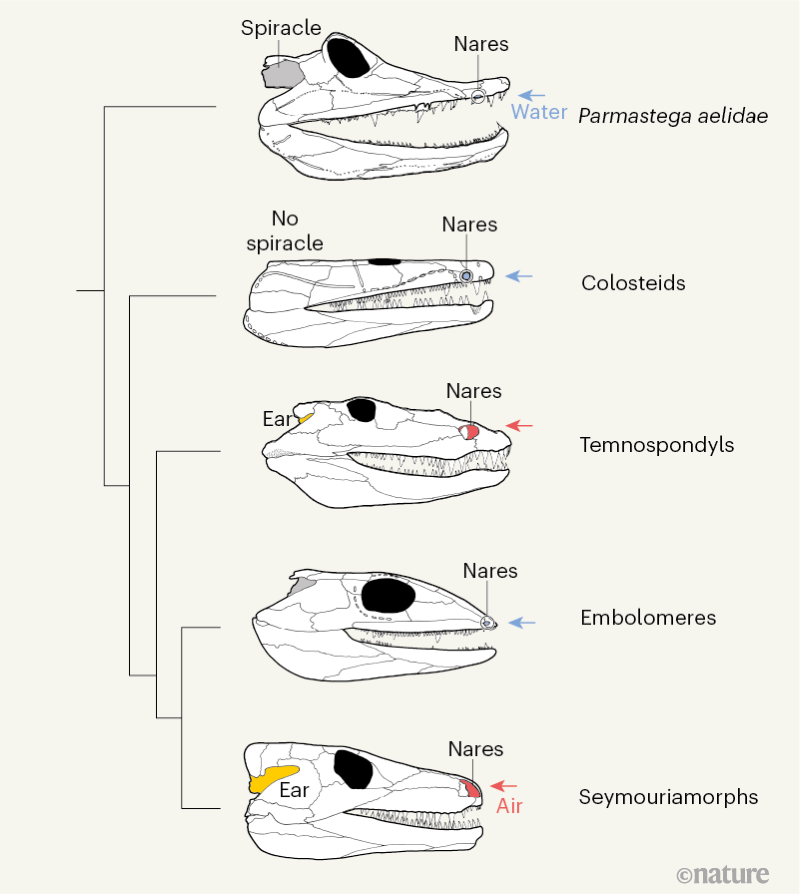
Figure 1 | The evolution of tetrapod skulls. Beznosov et al.1
report 372-million-year-old fossils of a four-limbed vertebrate
(tetrapod) from just before the time when tetrapods moved onto land.
They call this newly discovered species Parmastega aelidae. Its
nasal passages (nares) are close to its jaw and would have been
positioned under water. Water passing though the nares (blue arrow)
would have been used for breathing when it reached the gills (not
shown). P. aelidae could also breathe air directly through a skull opening called a spiracle (grey). Comparing these ancestral features of P. aelidae
with other tetrapods reveals patterns of evolutionary change. The other
tetrapods shown are: an early tetrapod group called colosteids;
seymouriamorphs and embolomeres, members of a lineage that gave rise to
amniotes (birds, reptiles and mammals); and temnospondyls, which gave
rise to modern amphibians (such as frogs and salamanders). Colosteids
lacked spiracles and breathed solely through their gills using water
taken up through the nares. Compared with P. aelidae,
seymouriamorphs and temnospondyls had larger and higher nares, which
they would have used to breathe air (red arrow). These tetrapods lacked
spiracles, and had ears (yellow) instead in that area of their skull.
Embolomeres retained the breathing system used by P. aelidae.
Mudskippers (species from the family Oxudercidae) are modern
amphibious fish that inhabit marine mud flats, and they are useful
living creatures with which to compare P. aelidae because their
eyes have a similar shape and position. Mudskippers peek above the water
surface to look out for prey and potential danger5. But what was P. aelidae
looking for? The need to detect enemies on land or in the air can be
ruled out, because during the late Devonian period, such animals were
not yet present there.
One possibility is that P. aelidae
was looking for prey on the shore. If so, what kind of terrestrial or
semi-terrestrial prey was it watching? Some have suggested that early
water-dwelling tetrapods and their closest fish-like relatives might
have preyed on terrestrial invertebrates of the phylum Arthropoda, which
includes insects6. However, the large arthropods that could have provided sufficient food to sustain an animal the size of P. aelidae were still rare in the Devonian period7. Moreover, P. aelidae
had large fangs, which suggests that it preyed mainly on vertebrates.
Perhaps it searched for fish carcasses stranded on the shore. Or, to
make an even more speculative suggestion, maybe it scavenged early
amphibious tetrapods that rested near the water. However, evidence for
such creatures has not yet been found among the fossils of the
Sosnogorsk Formation (the rock layers that contained the P. aelidae fossil).
Another notable feature of P. aelidae is the
extremely low position, close to its jaws, of the external openings of
its nose (the nares), which would have been under water (Fig. 1). This
is in striking contrast to the high position of its eyes and is quite
different from the configuration of nares in modern-day aquatic tetrapod
animals, such as crocodiles, hippopotamuses or frogs. The eyes of those
animals sit on top of their head, and their nares are likewise
positioned high on the snout, which enables them to breathe air while
looking above water. Judging from their submerged position, P. aelidae nares acted as openings through which an inflow of water was directed towards the gills during breathing. P. aelidae
also had the option of breathing air through a large opening in its
skull called a spiracle (Fig. 1), and such a breathing process would
probably have been similar to that used by modern air-breathing fish8.
This
low position of the nares is found in most known early tetrapods
(called stem tetrapods) of the Devonian period (approximately 419.2
million to 358.9 million years ago) and Carboniferous period (358.9
million to 298.9 million years ago). In all of these animals, the
passage from the nares to the mouth cavity might still have served to
transport water rather than air. Some fossils of stem tetrapods, such as
those of a grouping called colosteids (Fig. 1), had lost their spiracle
opening — they must therefore have relied on gill breathing. In some
other early tetrapods that arose later than P. aelidae and were
more evolved than their ancestors (a state described as being more
derived), the spiracle is absent, and its place is taken by an ear2.
These tetrapods’ nares are larger and higher on the snout (Fig. 1)
compared with the ancestral form, suggesting that they used their nares
to transport air towards the lungs while peeking out of the water when
on the lookout for prey.
The P. aelidae fossils offer a
treasure trove of information that could help to disentangle some of the
complex evolutionary changes that took place when vertebrates made the
transition from aquatic to terrestrial life. This discovery also reminds
us that much still remains to be learnt in the next gripping chapter of
this detective story.
Nature574, 494-495 (2019)
doi: 10.1038/d41586-019-03107-0
Updates & Corrections
Correction 24 October 2019: The version of Figure 1 originally published was incorrect. This has now been corrected. The pdf version was correct.
quinta-feira, 27 de dezembro de 2018
Vertebrate Zoology
1 = origin of chordates, 2 = evolution of first true vertebra, 3 =
evolution of bony skeleton, 4 = evolution of tetrapods from
sarcopterygians, 5 = evolution of amniotic egg and keratinized scales, 6
= adaptive radiation of amniotes, 7 = evolution hair and mammary
glands, 8 = evolution of keratinized feathers, wings for flight, 9 =
evolution of dinosaurs
Hominid Evolution: Ancestors
hominids = human’s closest relatives
are omnivores that ate meat and vegetables; had bipedal locomotion and opposable thumb
oldest hominid known (7 mya) = Sahelanthropus tchandensis,
which was more upright and bipedal than other primates, and had reduced
canines and a more flat face than other primates
bipedalism may have arisen because of a diminishing forest
community transitioning to woodland or grassland, or because of the
niche of collecting low-hanging fruit which required walking
Functions: The notochord provides support to the body.
The brain and dorsal nerve cord coordinate the muscles and organs to
swim and feed. The anus rids of undigestible material. The pharyngeal
gill slits and gills exchange gas with the water for respiration. The
tail provides propulsion for swimming..
Craniates - Chordates With a Head
they have 2 sets of Hox genes while more primitive chordates have only 1
they have neural crest cells that form at the margin of the
closing neural tube which migrate through the body and form various
structures
pharyngeal clefts evolved into gill slits for gas exchange
the oldest fossils of craniates are from period of the Cambrian Explosion
the cartilaginous fish - includes sharks, skates, and rays; are mostly marine
have jaws and paired fins; eyes are well developed; gill slits
are externally visible; gills for respiration; must constantly swim to
“breathe”
heart is 2 chambered; body is covered with scales (placoid); bone is only retained in a few structures such as teeth
most forms are predatory, some forms are scavengers; few are filter feeding (whale shark)
skeleton is completely cartilaginous with vertebra instead of a notochord throughout life
have acute senses: olfactory organs for smell, lateral line system for hearing, ampullae of Lorenzini for electroreception
sexual reproduction involves internal fertilization; some forms
are oviparous (lay eggs); others are ovoviviparous - bear live young
(yolk nourished); other forms are viviparous (maternal nourished)
intestine has unique spiral valve to maximize digestion; lack a swimbladder (oil of liver gives buoyancy)
amniotes evolved the amniotic or shelled egg, an adaptation for eggs on land
the amniotic egg contains an amnion to bathe and protect the
embryo, along with other extraembryonic membranes for gas exchange,
waste storage, and nutrient transfer
the skin became more impermeable to water and the ribs became more important to ventilation
flight allows exploitation of habitat, food, and reproductive strategies
are freshwater (surface), terrestrial, and marine (surface)
have lungs for respiration; are endothermic; 4 chambered heart and efficient circulation
are predatory, parasitic, scavenger, and herbivorous forms
lay terrestrial amniotic eggs
feathers made of keratin cover body
have well developed ears, eyes, and tongue
do not hibernate, but many forms migrate for reproduction
probably evolved from theropods, possibly as small
ground-dwelling dinosaurs either jumped and gained air-time while
feeding or glided from tree branches
Archaeopteryx is a famous transitional form between theropods and modern birds


.svg)


.jpg)


-_is_it-_at_Hyderabad%2C_AP_W_101.jpg)


.jpg)


