Huge thigh bone in Crimean cave belonged to largest bird found in northern hemisphere
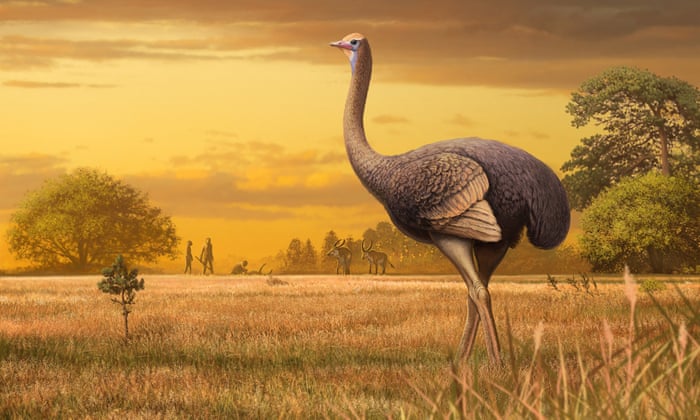
An artist’s impression of the giant bird whose remains were found in a Crimean cave.
Photograph: Andrey Atuchin
Giant flightless birds that dwarfed modern ostriches and weighed nearly half a tonne roamed
Europe when the first archaic humans arrived from Africa, scientists say.
Researchers unearthed the fossilised thigh bone of one of the
feathered beasts while excavating a cave on the Crimean peninsula on the
northern coast of the Black Sea. It is the first time such a massive
bird has been found in the northern hemisphere.

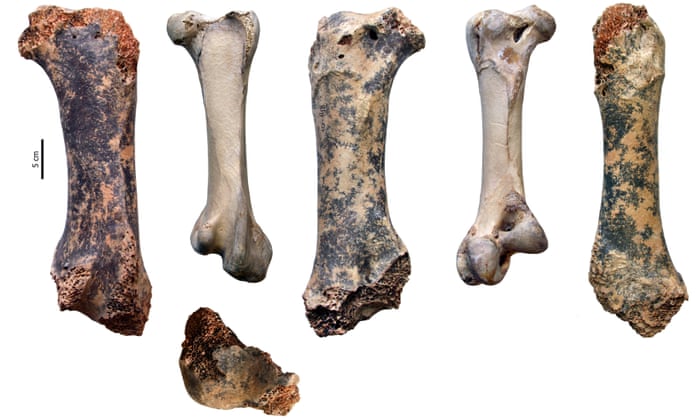
Analysis of the 40cm-long bone and others found with it date the
remains to between 1.5m and 1.8m years old, suggesting the birds may
have been part of the local wildlife when
Homo erectus, an ancient ancestor of modern humans, reached Europe 1.2m years ago.
The enormous birds may well have been a valuable source of meat,
bones, feathers and eggshells for the early human settlers, the
scientists say.
The
giant bird’s bones (left, middle and right) alongside those of an
ostrich. Photograph: Nikita Zelenkov/Society of Vertebrate Paleontology
Nikita Zelenkov, a palaeontologist at the Russian Academy of
Sciences, said that when he first received the thigh bone for study he
thought it must be from a long-extinct elephant bird from Madagascar.
“No birds of this size have ever been reported from Europe,” he said.
But close inspection revealed that the bird probably belonged to an ancient species called
Pachystruthio dmanisensis,
a stocky, flightless creature that stood about 3.5 metres tall. Based
on measurements of the thigh bone, the scientists calculate the bird
weighed about 450kg, which is twice the weight of the largest extinct
moas from New Zealand, three times heavier than the largest living bird,
the common ostrich, and nearly as heavy as an adult polar bear. The
fossils are described in the
Journal of Vertebrate Paleontology.

“We don’t know when it became extinct exactly, but most likely it did
not survive later than 1.2m years ago,” Zelenkov said. “They would have
been seen by various
Homo erectus people.”
Despite the bird’s bulk, the long, slim thigh bone shows it
was fast on its feet. Other remains recovered from the cave offer some
explanation as to why that may have helped: the giant bird lived
alongside some of the most formidable predators of the Ice Age, from
sabre-toothed cats to other over-sized carnivores, including giant
cheetahs and giant hyenas. All could take on prey as large as mammoths.
Evolution has decorated the tree of life with a bizarre collection of bulky birds. The apparently herbivorous
Gastornithidae,
a family of prehistoric flightless birds with powerful legs and
enormous beaks, stalked Europe, Asia and North America, from 66m to 35m
years ago. When fully grown, some species reached three metres tall.
A similar-sized feathery beast brought terror to the rainforests of
Australia’s Northern Territory 15m years ago. Technically known as Bullockornis planei
but named the “demon duck of doom” by a researcher with an eye for
publicity, the bird sported a scythe-like beak on a head the size of a
horse’s. Also known as thunderbirds, the beasts are thought to have
survived until at least 50,000 years ago.
Scientists have argued over the identity of the world’s largest bird
for decades, but last year researchers at the Zoological Society of
London attempted to
settle the matter.
They set out with a tape measure and a pair of callipers to measure
hundreds of bird bones in museums around the world and came across one
creature from Madagascar that stood three metres tall and weighed up to
800kg. Its name,
Vorombe titan, means “big bird” in a mixture of Malagasy and Greek.
The Taurida cave where the latest bones were found was discovered
only last year during the construction of a motorway that will link
Simferopol, a city in the heart of the Crimean peninsula, to the city of
Kerch in the east. How common the big birds were across Europe is
unknown and a question that future expeditions will now seek to answer.
“Although there is no evidence yet, this bird might have been spread
across more western territories,” Zelenkov said.
Excavations at the site have also uncovered the remains of a bison
and a mammoth, and field studies at the site are expected to continue
for some time yet. “There may be much more that the site will teach us
about Europe’s distant past,” Zelenkov said.
https://www.theguardian.com/science/2019/jun/27/half-tonne-birds-roamed-europe-humans