Mostrando postagens com marcador Ilhas Vanatu. Mostrar todas as postagens

quinta-feira, 3 de maio de 2018

Population Turnover in Remote Oceania Shortly after Initial Settlement.

Abstract

Ancient DNA from Vanuatu and Tonga dating to about 2,900-2,600 years ago (before present, BP) has revealed that the "First Remote Oceanians" associated with the Lapita archaeological culture were directly descended from the population that, beginning around 5000 BP, spread Austronesian languages from Taiwan to the Philippines, western Melanesia, and eventually Remote Oceania. Thus, ancestors of the First Remote Oceanians must have passed by the Papuan-ancestry populations they encountered in New Guinea, the Bismarck Archipelago, and the Solomon Islands with minimal admixture [1].

However, all present-day populations in Near and Remote Oceania harbor >25% Papuan ancestry, implying that additional eastward migration must have occurred. We generated genome-wide data for 14 ancient individuals from Efate and Epi Islands in Vanuatu from 2900-150 BP, as well as 185 present-day individuals from 18 islands.

We find that people of almost entirely Papuan ancestry arrived in Vanuatu by around 2300 BP, most likely reflecting migrations a few hundred years earlier at the end of the Lapita period, when there is also evidence of changes in skeletal morphology and cessation of long-distance trade between Near and Remote Oceania [2, 3].

DNA antigo de Vanuatu e Tonga datado de cerca de 2.900 a 2.600 anos atrás (antes do presente, BP) revelou que os "Primeiros Oceanos Remotos" associados com a cultura arqueológica Lapita eram descendentes diretos da população que, começando por volta de 5000 da BP, se espalhou línguas de Taiwan para as Filipinas, a Melanésia ocidental e, eventualmente, a Oceania Remota. Assim, os ancestrais dos primeiros oceanos remotos devem ter passado pelas populações de ancestrais papuanas que encontraram na Nova Guiné, no Arquipélago de Bismarck e nas Ilhas Salomão com um mínimo de mistura [1].

 
No entanto, todas as populações atuais na Oceania Própria e Remota abrigam> 25% da ancestralidade da Papua, implicando que uma migração adicional para o leste deve ter ocorrido. Nós geramos dados genômicos para 14 indivíduos antigos das Ilhas Efate e Epi em Vanuatu, de 2900-150 BP, bem como 185 indivíduos de 18 ilhas.

 
Descobrimos que pessoas de ascendência quase inteiramente papua chegaram a Vanuatu por volta de 2300 da BP, provavelmente refletindo migrações algumas centenas de anos antes, no final do período Lapita, quando também há evidências de mudanças na morfologia do esqueleto e cessação de longa distância. comércio entre a Oceania Próxima e Remota [2, 3].


Papuan ancestry was subsequently diluted through admixture but remains at least 80%-90% in most islands. Through a fine-grained analysis of ancestry profiles, we show that the Papuan ancestry in Vanuatu derives from the Bismarck Archipelago rather than the geographically closer Solomon Islands. However, the Papuan ancestry in Polynesia-the most remote Pacific islands-derives from different sources, documenting a third stream of migration from Near to Remote Oceania.

A ascendência papua foi subsequentemente diluída através da mistura, mas permanece pelo menos 80% -90% na maioria das ilhas. Através de uma análise refinada dos perfis de ancestralidade, mostramos que a ancestralidade papua em Vanuatu deriva do Arquipélago de Bismarck e não das Ilhas Salomão geograficamente mais próximas. No entanto, a ancestralidade dos Papuan na Polinésia - as ilhas mais remotas do Pacífico - deriva de fontes diferentes, documentando um terceiro fluxo de migração do Oriente Próximo para a Oceania Remota.

KEYWORDS:

Lapita; Near Oceania; Pacific Islanders; Remote Oceania; ancient DNA; migration
PMID:
29501328
PMCID:
PMC5882562
[Available on 2019-04-02]
DOI:
10.1016/j.cub.2018.02.051

quarta-feira, 25 de abril de 2018

Ancient DNA offers clues to remote Pacific islands’ population puzzle

DNA antigo oferece pistas para a população remota das ilhas do Pacífico

Genomic studies provide details about the complex peopling of Vanuatu — one of the last places on Earth reached by humans.
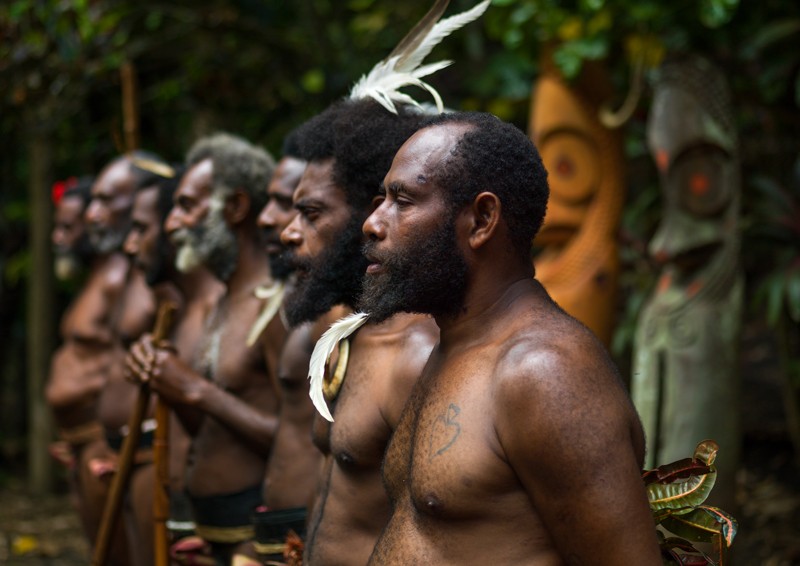
Tribesmen of Ambrym island in Vanuatu
Some tribesmen in Vanuatu traditionally wear penis sheaths, which could indicate cultural heritage from Papua New Guinea, where the practice is also seen.Credit: Eric Lafforgue/Art In All Of Us/Corbis/Getty

Two ancient-DNA studies are unravelling the complex sequence of human migrations that left remote islands in the Pacific with a rare linguistic and genetic disconnect.
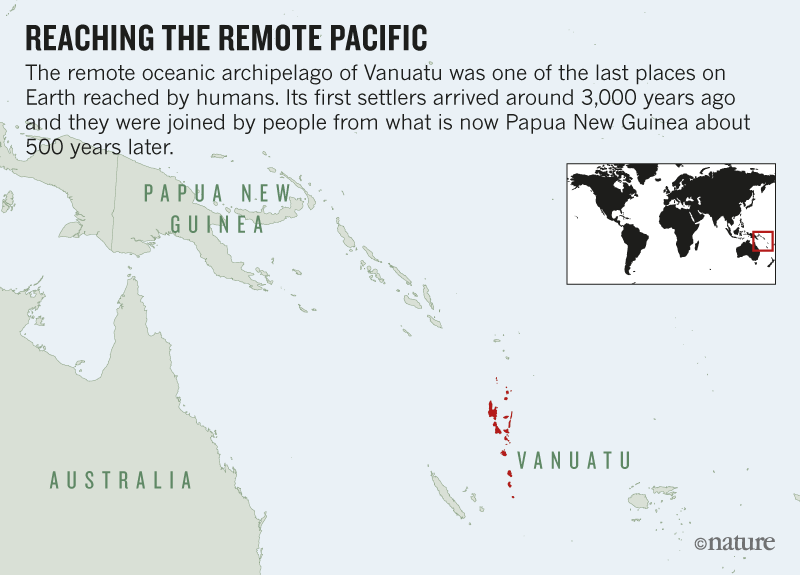
Vanuatu — an 80-island archipelago strewn across 1,300 kilometres of the southern Pacific Ocean — was one of the final pockets of the planet to be reached by humans, with its first inhabitants arriving only 3,000 years ago. For more than a century, researchers have puzzled over why its inhabitants speak languages rooted in southeast Asia, but trace most of their genetic ancestry to what is now Papua New Guinea, which has its own distinct languages. The genomic studies1,2 now suggest that a series of population replacements on the islands led to this unusual situation.

 Dois antigos estudos de DNA estão revelando a complexa sequência de migrações humanas que deixaram ilhas remotas no Pacífico com uma rara desconexão genética e lingüística.

Vanuatu - um arquipélago de 80 ilhas espalhadas em 1.300 quilômetros do sul do Oceano Pacífico - foi um dos bolsões finais do planeta a ser alcançado por seres humanos, com seus primeiros habitantes chegando há apenas 3.000 anos. Por mais de um século, os pesquisadores têm intrigado porque seus habitantes falam línguas enraizadas no sudeste da Ásia, mas traçam a maior parte de sua ancestralidade genética até o que hoje é Papua Nova Guiné, que tem suas próprias línguas distintas. Os estudos genômicos1,2 sugerem agora que uma série de substituições populacionais nas ilhas levou a essa situação incomum.


Until recently, one explanation for the islands’ language and genetic mismatch had been that the first people who settled Vanuatu and the rest of remote Oceania were from a seafaring culture known as the Lapita, who traced their ancestry back to Taiwan but emerged through what is present-day Papua New Guinea. When they arrived in Vanuatu, they carried some Papuan ancestry but still spoke languages from a linguistic family common in the islands of southeast Asia, called Austronesian. But ancient genomes from some of Vanuatu’s first settlers, published in 20163, scotched that theory. The archipelago’s earliest inhabitants carried little Papuan ancestry. This discovery posed an obvious question: when did Papuans get to Vanuatu?

Até recentemente, uma explicação para a linguagem e incompatibilidade genética das ilhas era que as primeiras pessoas que colonizaram Vanuatu e o resto da remota Oceania eram de uma cultura marítima conhecida como Lapita, que traçou sua ancestralidade até Taiwan, mas emergiu através do que é atual Papua Nova Guiné. Quando chegaram a Vanuatu, eles carregavam alguns ancestrais papuanos, mas ainda falavam línguas de uma família lingüística comum nas ilhas do sudeste da Ásia, chamada austronésica. Mas genomas antigos de alguns dos primeiros colonizadores de Vanuatu, publicados em 20163, descartaram essa teoria. Os primeiros habitantes do arquipélago carregavam pouca ascendência papua. Esta descoberta colocou uma questão óbvia: quando os papuas chegaram a Vanuatu?
Ancient journeys
The two latest studies — published in Current Biology1 and Nature Ecology & Evolution2 — build on that work to illuminate the next chapter of Vanuatu’s human history. The islands’ first settlers had roots in Taiwan, the studies agree. The teams used similar genetic data sets — sequences from around a dozen ancient inhabitants of the islands of Vanuatu and the surrounding region — to conclude that those first settlers were soon joined by people of almost entirely Papuan ancestry, around 2,500 years ago. They also found that later ancient inhabitants had predominantly Papuan genetics but also carried a small portion of Austronesian ancestry, similar to present-day Vanuatuans.
The teams differ in their interpretation of this pattern.


One group, led by population geneticist David Reich at Harvard Medical School in Boston, Massachusetts, asserts1 that the Papuans rapidly overran the existing settlers. The researchers interpret the presence of a roughly 2,300-year-old individual of almost total Papuan ancestry as proof of a near-complete population replacement, at least on the island where the remains were found. Reich speculates that people descended from the first Vanuatuans retreated to pockets of the archipelago and later mixed with the Papuan émigrés.


By contrast, a team co-led by Cosimo Posth, a palaeogeneticist at the Max Planck Institute for the Science of Human History in Jena, Germany, argues2 that a steady trickle of people from Papua mixed with the earlier inhabitants. “There wasn’t this huge boom, and the Papuans came in and killed off everyone,” says team member Heidi Colleran, an anthropologist at the same institute. The researchers say that modern linguistic features in Vanuatu support their hypothesis: the languages, although Austronesian, bear some minor Papuan attributes, including what’s known as a bilabial trill, a ‘bwwww’ sound inserted into the middle of words. Furthermore, men of some groups in Vanuatu traditionally don penis sheaths, a practice also seen in Papua New Guinea.

Vanuatuan vocabulary

Linguist Andrew Pawley, at the Australian National University in Canberra, is sceptical of that explanation. Not all linguists agree that Vanuatu’s languages harbour Papuan features, he says. Peter Sheppard, an archaeologist at the University of Auckland in New Zealand, says it’s also possible that the first people who settled Vanuatu spoke both Austronesian and non-Austronesian languages, as a result of earlier interactions.
And Mark Stoneking, a geneticist at the Max Planck Institute for Evolutionary Anthropology in Leipzig, Germany, thinks there are still too few data to rule out the possibility that some of the first Vanuatuans had Papuan ancestry. “People tend to over-interpret things a little bit because it’s so exciting to have ancient DNA from this part of world,” he says. Once more genomes from the region have been sequenced, the picture is sure to grow still more complicated, he says.

More such clues are emerging. Reich’s team discovered hints that Papuan ancestry found on Polynesian islands west of Vanuatu came from yet another source. “There’s very clear evidence of not one, not two, but at least three big eastward migrations from the big islands in Indonesia and New Guinea,” Reich says. “This is only the tip of the iceberg.”

Tribesmen of Ambrym island in Vanuatu
Some tribesmen in Vanuatu traditionally wear penis sheaths, which could indicate cultural heritage from Papua New Guinea, where the practice is also seen.Credit: Eric Lafforgue/Art In All Of Us/Corbis/Getty
Two ancient-DNA studies are unravelling the complex sequence of human migrations that left remote islands in the Pacific with a rare linguistic and genetic disconnect.
Vanuatu — an 80-island archipelago strewn across 1,300 kilometres of the southern Pacific Ocean — was one of the final pockets of the planet to be reached by humans, with its first inhabitants arriving only 3,000 years ago. For more than a century, researchers have puzzled over why its inhabitants speak languages rooted in southeast Asia, but trace most of their genetic ancestry to what is now Papua New Guinea, which has its own distinct languages. The genomic studies1,2 now suggest that a series of population replacements on the islands led to this unusual situation.
Until recently, one explanation for the islands’ language and genetic mismatch had been that the first people who settled Vanuatu and the rest of remote Oceania were from a seafaring culture known as the Lapita, who traced their ancestry back to Taiwan but emerged through what is present-day Papua New Guinea. When they arrived in Vanuatu, they carried some Papuan ancestry but still spoke languages from a linguistic family common in the islands of southeast Asia, called Austronesian. But ancient genomes from some of Vanuatu’s first settlers, published in 20163, scotched that theory. The archipelago’s earliest inhabitants carried little Papuan ancestry. This discovery posed an obvious question: when did Papuans get to Vanuatu?
Ancient journeys

The two latest studies — published in Current Biology1 and Nature Ecology & Evolution2 — build on that work to illuminate the next chapter of Vanuatu’s human history. The islands’ first settlers had roots in Taiwan, the studies agree. The teams used similar genetic data sets — sequences from around a dozen ancient inhabitants of the islands of Vanuatu and the surrounding region — to conclude that those first settlers were soon joined by people of almost entirely Papuan ancestry, around 2,500 years ago. They also found that later ancient inhabitants had predominantly Papuan genetics but also carried a small portion of Austronesian ancestry, similar to present-day Vanuatuans.


The teams differ in their interpretation of this pattern. One group, led by population geneticist David Reich at Harvard Medical School in Boston, Massachusetts, asserts1 that the Papuans rapidly overran the existing settlers. The researchers interpret the presence of a roughly 2,300-year-old individual of almost total Papuan ancestry as proof of a near-complete population replacement, at least on the island where the remains were found. Reich speculates that people descended from the first Vanuatuans retreated to pockets of the archipelago and later mixed with the Papuan émigrés.


By contrast, a team co-led by Cosimo Posth, a palaeogeneticist at the Max Planck Institute for the Science of Human History in Jena, Germany, argues2 that a steady trickle of people from Papua mixed with the earlier inhabitants. “There wasn’t this huge boom, and the Papuans came in and killed off everyone,” says team member Heidi Colleran, an anthropologist at the same institute. The researchers say that modern linguistic features in Vanuatu support their hypothesis: the languages, although Austronesian, bear some minor Papuan attributes, including what’s known as a bilabial trill, a ‘bwwww’ sound inserted into the middle of words. Furthermore, men of some groups in Vanuatu traditionally don penis sheaths, a practice also seen in Papua New Guinea.

Vanuatuan vocabulary

Linguist Andrew Pawley, at the Australian National University in Canberra, is sceptical of that explanation. Not all linguists agree that Vanuatu’s languages harbour Papuan features, he says. Peter Sheppard, an archaeologist at the University of Auckland in New Zealand, says it’s also possible that the first people who settled Vanuatu spoke both Austronesian and non-Austronesian languages, as a result of earlier interactions.

And Mark Stoneking, a geneticist at the Max Planck Institute for Evolutionary Anthropology in Leipzig, Germany, thinks there are still too few data to rule out the possibility that some of the first Vanuatuans had Papuan ancestry. “People tend to over-interpret things a little bit because it’s so exciting to have ancient DNA from this part of world,” he says. Once more genomes from the region have been sequenced, the picture is sure to grow still more complicated, he says.

More such clues are emerging. Reich’s team discovered hints that Papuan ancestry found on Polynesian islands west of Vanuatu came from yet another source. “There’s very clear evidence of not one, not two, but at least three big eastward migrations from the big islands in Indonesia and New Guinea,” Reich says. “This is only the tip of the iceberg.”