Primeiro registro fóssil de leão das cavernas ( Panthera ( Leo ) spelaea intermedia ) de depósitos aluviais do rio Pó, no norte da Itália
Resumo
Uma hemimandíbula felino esquerdo perfeitamente preservado foi encontrado em depósitos fluviais do
rio Pó perto de Cremona (norte da Itália). O fóssil, encontrado em
posição alóctone dentro de uma barra aluvial, correspondendo em
morfologia e tamanho na hemimandíbula de leões modernos e fósseis. O
osso, em excelentes condições, caracteriza-se pela presença de todos os
dentes e mostra uma leve erosão do côndilo e processo angular indicando
um transporte muito limitado (rafting). Com base na comparação com um
grande conjunto de dados de medidas morfométricas de leões das cavernas e
leopardo fóssil hemimandíbulos, o fóssil estudado é classificado como
uma fêmea subadulta da crono-subespécie Panthera spelaea intermedia .
O registro fóssil de mamífero do Rio Pó consiste predominantemente em grandes herbívoros Palaeoloxodon
antiquus, Stephanorhinus kirchbergensis, Bison priscus, Megaloceros
giganteus, Mammuthus primigenius, Alces alces, Cervus elaphus , alguns carnívoros como Panthera cf. pardus, Crocuta crocuta, Ursus arctos, Canis lupus, Vulpes vulpes e primatas como Homo neanderthalensis e H. sapiens . A composição de espécies indica uma mistura de diferentes assembléias faunísticas dos períodos interglacial e glacial do Pleistoceno Superior .
Arqueólogos descobriram o esqueleto quase completo de um elefante enorme e agora extinto que viveu cerca de 300.000 anos atrás, no que é hoje a cidade de Schöningen, no norte da Alemanha, segundo uma nova pesquisa.
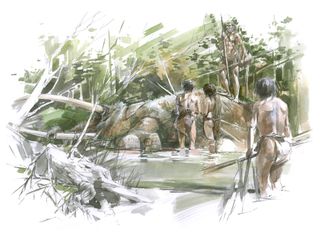
Embora esse elefante - o elefante euroasiático de ponta reta (Palaeoloxodon antiquus) - provavelmente tenha morrido na velhice, os comedores de carne prontamente o devoraram; marcas de mordida em seus ossos sugerem que os carnívoros festejavam com o animal morto, e flocos de sílex e ferramentas ósseas encontradas perto do elefante indicam que os humanos vasculharam o que restava, disseram os pesquisadores.
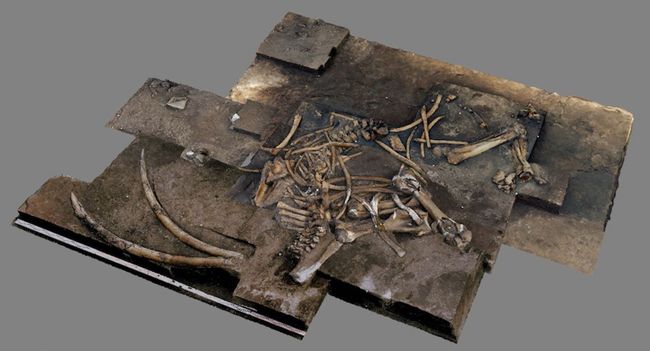
This 3D image was created by stitching together 500 individual photos that were taken of the straight-tusked elephant. (Image credit: Ivo Verheijen/Schöningen Research Station)"The
Stone Age hunters probably cut meat, tendons and fat from the carcass,"
project researcher Jordi Serangeli, head of the excavation in
Schöningen, said in a statement.
O elefante morreu no lado oeste de um vasto lago, um indício de que pereceu por causas naturais.
"Os elefantes geralmente permanecem próximos e na água quando estão doentes ou velhos", disse Ivo Verheijen, estudante de doutorado em arqueozoologia e paleontologia da Universidade de Tübingen. Além disso, o elefante, uma fêmea, usava dentes, sugerindo que estava velho quando morreu, disse ele. Imagem 2 de 4
This 3D image was created by stitching together 500 individual photos that were taken of the straight-tusked elephant. (Image credit: Ivo Verheijen/Schöningen Research Station)
Image gallery
The remains from the front part of the elephant's body are shown here. (Image credit: Jens Lehmann/Niedersächsisches Landesamt für Denkmalpflege)
Excavator Martin Kursch uncovers one of the elephant's feet. (Image credit: Ivo Verheijen/Schöningen Research Station)
The excavation site in Schöningen, Germany (Image credit: Jordi Serangeli/Schöningen Research Station)
Researchers have found the remains of at least 10 elephants dating to the Lower Paleolithic — also known as the Old Stone Age
(about 3 million to 300,000 years ago) — over the past several years
at Schöningen. But this new find is by far the most complete. The
remains include 7.5-foot-long (2.3 meters) tusks — which are 125% longer
than the average 6-foot-long (1.8 m) tusk of a modern African elephant,
according to Encyclopedia Britannica.
The researchers also found the complete lower jaw, numerous vertebrae
and ribs, large bones from three of its four legs and all five of its
delicate hyoid bones, which are found in the neck and help support the
tongue and voice box.
This P. antiquus
elephant had a shoulder height of about 10.5 feet (3.2 m) and would
have weighed about 7.5 tons (6.8 metric tons). "It was therefore larger
than today's African elephant cows," Verheijen said.
Perto desses restos, os pesquisadores encontraram 30 pequenos flocos de pederneira e duas ferramentas de ossos longos. Os micro flocos incorporados nesses dois ossos sugerem que os humanos antigos que sequestraram o elefante os usaram para afiar ferramentas de pedra (chamadas de knapping) no local, disse a pesquisadora do projeto Bárbara Rodríguez Álvarez, arqueóloga da Universidade de Tübingen.
É de notar que os humanos antigos que provavelmente mataram o elefante não eram o Homo sapiens. As primeiras evidências de H. sapiens na Europa datam de cerca de 45.000 anos atrás, segundo escavações em uma caverna na Bulgária, segundo um estudo publicado na semana passada na revista Nature Ecology and Evolution. Em vez disso, esses catadores humanos provavelmente eram H. heidelbergensis, um parente humano extinto que viveu entre 700.000 a 200.000 anos atrás, disseram os pesquisadores na Alemanha.
Wildlife watering hole
The
lake was a popular hole for elephants, according to several of their
preserved footprints just 330 feet (100 m) from the new elephant
excavation site.
"A
small herd of adults and younger animals must have passed through,"
Flavio Altamura, a researcher at the Department of Antiquities at
Sapienza University in Rome, said in the statement. "The heavy animals
were walking parallel to the lakeshore. Their feet sank into the mud,
leaving behind circular tracks."
These
elephants would have lived in a comfortable climate, comparable to
today's; about 300,000 years ago, Europe was in the Reinsdorf
interglacial, a warmer period bookended by two glacial (or colder)
periods. Other animals thrived there, too. About 20 kinds of large
animals lived around the lake, including lions, bears, saber-toothed cats, rhinoceroses,
wild horses, deer and large cattle, according to excavations. "The
wealth of wildlife was similar to that of modern Africa," Serangeli
said.
All
of these animals attracted ancient human hunters. Archaeologists have
found the remains of 10 wooden spears and one throwing stick from
300,000 years ago, according to a study published online April 20 in the
journal Nature Ecology and Evolution.
The
new finding was uncovered in a collaborative effort between the
Senckenberg Centre for Human Evolution and Palaeoenvironment at the
University of Tübingen in Germany and the Lower Saxony State Office for
Heritage. The research will be published in the magazine "Archäologie in
Deutschland" (Archaeology in Germany) and was presented at a press
conference in Schöningen on May 19.