Impactos de especiação e extinção medidos por um relógio de decaimento evolutivo
A hipótese de que extinções em massa destrutivas permitem radiações evolutivas criativas (destruição criativa) é central para os conceitos clássicos de macroevolução1,2. No entanto, os impactos relativos de extinção e radiação na co-ocorrência de espécies não foram diretamente comparados quantitativamente ao longo do éon Fanerozoico.
Aqui, aplicamos o aprendizado de máquina para gerar uma incorporação espacial (ordenação multidimensional) da estrutura de coocorrência temporal do registro fóssil Fanerozóico, cobrindo 1.273.254 ocorrências no Banco de Dados Paleobiológico para 171.231 espécies incorporadas.
Isso facilita a comparação simultânea de rupturas macroevolucionárias, usando medidas independentes das tendências de diversidade secular. Entre os 5% dos períodos de interrupção mais significativos, identificamos os "cinco grandes" eventos de extinção em massa2, sete extinções em massa adicionais, dois eventos combinados de extinção em massa-radiação e 15 radiações em massa.
Em contraste com as narrativas que enfatizam as radiações pós-extinção1,3, descobrimos que as radiações e extinções em massa proporcionalmente mais comparáveis (como a explosão cambriana e a extinção em massa do final do Permiano) são normalmente desacopladas no tempo, refutando qualquer relação causal direta entre eles.
Além disso, além das extinções4, as próprias radiações evolutivas causam decadência evolutiva (probabilidade de coocorrência modelada e fração compartilhada de espécies entre tempos próximos de zero), um conceito que descrevemos como criação destrutiva.
Um teste direto do tempo para ultrapassar o limiar da decadência macroevolutiva4 (fração compartilhada das espécies entre duas vezes ≤ 0,1), contado pelo relógio de decadência, revela flutuações dentadas em torno de uma média fanerozoica de 18,6 milhões de anos. Como o período quaternário começou em um relógio de decadência abaixo da média de 11 milhões de anos, as extinções modernas aumentaram ainda mais a dívida do relógio de decadência da vida.
When it opens next month, the revamped fossil hall of the
Smithsonian Institution's National Museum of Natural History in
Washington, D.C., will be more than a vault of dinosaur bones. It will
show how Earth's climate has shifted over the eons, driving radical
changes in life, and how, in the modern age, one form of life—humans—is,
in turn, transforming the climate.
To tell that story, Scott Wing and Brian Huber, a paleobotanist and
paleontologist, respectively, at the museum, wanted to chart swings in
Earth's average surface temperature over the past 500 million years or
so. The two researchers also thought a temperature curve could counter
climate contrarians' claim that global warming is no concern because
Earth was much hotter millions of years ago. Wing and Huber wanted to
show the reality of ancient temperature extremes—and how rapid shifts
between them have led to mass extinctions. Abrupt climate changes, Wing
says, "have catastrophic side effects that are really hard to adapt to."
But actually making the chart was unexpectedly challenging—and
triggered a major effort to reconstruct the record. Although far from
complete, the research is already showing that some ancient climates
were even more extreme than was thought.
Ancient glaciations are easy enough to trace, as are hothouse periods
when palms grew near the poles. But otherwise little is certain,
especially early in the Phanerozoic, which spans the past 541 million
years. Paleoclimate scientists study their own slices of time and use
their own specialized temperature proxies—leaf shape, say, or growth
bands in fossilized corals—which often conflict. "We don't talk to each
other all that much," says Dana Royer, a paleoclimatologist at Wesleyan
University in Middletown, Connecticut. So at a meeting last year, Wing
and Huber assembled a loose-knit collaboration, dubbed Phantastic,
dedicated to putting together a rigorous record. "Most people came away
quite inspired to do something about this," says Dan Lunt, a
paleoclimate modeler at the University of Bristol in the United Kingdom.
The value of a deep-time temperature curve extends beyond the exhibit. Similar curves exist for atmospheric carbon dioxide (CO2). Combine the two and you can see how much warming CO2
caused in the past, says Jessica Tierney, a paleoclimatologist at the
University of Arizona in Tucson. Because the latest climate models seem to forecast more warming
than earlier ones, "using paleoclimate to constrain the models is
becoming much more important," she says. "We feel we have to step up."
Fever line
A preliminary global temperature curve shows that marine life diversified in extreme heat (1) before land-based plants absorbed carbon dioxide (CO2) and polar ice caps formed (2). Volcanoes and erosion swung CO2 levels up and down (3), but mammals evolved in a warm period (4). Now, humans are rapidly warming the climate again (5).
500
Millions of years ago
10˚
15.5˚
21.1˚
26.7˚
32.2˚C
50˚
60˚
70˚
80˚
90˚F
450
400
350
300
250
200
150
100
50
Today
World without polar caps
World with polar caps
2
3
5
4
SMITHSONIAN INSTITUTION NATIONAL MUSEUM OF NATURAL HISTORY, ADAPTED BY N. DESAI/SCIENCE
But ancient global temperatures are elusive because they varied
with location and season, and because the gauges drop away as you move
deeper in time: Tree rings go back only thousands of years and ice cores
only a million years or so. Still, oxygen isotopes in tiny fossilized
shells on the ocean floor give a fairly reliable longer-term record.
Because water molecules with lighter oxygen variants evaporate faster
and end up locked in ice sheets, the ratio of light to heavy isotopes in
the fossils indicates the volume of global ice, a rough guide to
temperatures.
However, ocean floor older than 100 million years or so is scarce,
devoured by the constant churn of plate tectonics. To go deeper in time,
Ethan Grossman, a geochemist at Texas A&M University in College
Station, looks for marine fossils found on land—mostly teeth and extinct
bivalves called brachiopods. They tend to be from the shallow, isolated
seas that formed inside ancient supercontinents. To glean temperatures
from those fossils, scientists have to assume those seas had a balance
of oxygen isotopes similar to the ocean today.
Este "problema da água" tem décadas. Mas cientistas em Phantastic estão atacando-o com um segundo termômetro, baseado em uma nova técnica, chamada isótopos aglomerados, que mede a abundância de dois ou mais isótopos raros. Usando espectrômetros de massa sensíveis, eles analisam as cascas fósseis de moléculas de carbonato que contêm um isótopo pesado de oxigênio ligado a um carbono pesado, que se forma mais frequentemente a temperaturas mais baixas. Os resultados serão enganosos se o fóssil tiver sido exposto ao calor e à pressão durante o seu enterro, mas os pesquisadores aprenderam como identificar espécimes alterados. "Nós nos mudamos para o lugar onde podemos aplicá-lo", diz Kristin Bergmann, geobióloga do Instituto de Tecnologia de Massachusetts, em Cambridge, que está usando isótopos agregados para preparar um registro de temperatura dos últimos bilhões de anos.
In collaboration with Gregory Henkes, a geochemist at the State
University of New York in Stony Brook, and others, Grossman has gone
through his samples, tossing out those that show signs of alteration,
and analyzed their clumped isotopes. The results match his existing
oxygen-isotope measures, and they tell a startling story, he and Henkes
reported last year in Earth & Planetary Science Letters.
Some 450 million years ago, ocean waters averaged 35°C to 40°C, more
than 20°C warmer than today. Yet marine life thrived, even diversified.
"It's unsettling for the biologists, these warm temperatures we're
proposing," Grossman says. "These are extreme for modern organisms."
To turn such data into a global temperature curve, researchers need
to fill gaps in geography and time. One Phantastic collaborator,
Christopher Scotese, a geologist at Northwestern University in Evanston,
Illinois, has come up with a simple way to spread limited data into a
global picture. He uses the presence of polar ice caps to indicate
whether the world had a steep temperature differential between the
equator and its poles.
Other collaborators are using the sparse data to calibrate computer
simulations of the ancient climate, the way weather models use satellite
data as a reality check. Lunt and Paul Valdes, also at Bristol, are
ground-truthing a suite of several hundred paleoclimate simulations.
They've been able to extrapolate temperatures across the planet for
broad stretches of the Phanerozoic.
Although Wing and Huber are pleased with the work they've seeded,
they also ran out of time. The temperature curve they're presenting at
the museum opening is a beta, Wing says. "It's sort of jamming together
different kinds of observations, different kinds of models, different
kinds of procedures, and probably different assumptions." The plan is to
replace it once the Phantastic team's efforts reach maturity. But even
the draft version should open eyes, Grossman says. "This kind of work
gives people a sense of how easy it is to tip into a warm period.
Because the world has been warm."
Chlorophyll‐based photosynthesis has fuelled the biosphere
since at least the early Archean, but it was the ecological takeover of
oxygenic cyanobacteria in the early Palaeoproterozoic, and of
photosynthetic eukaryotes in the late Neoproterozoic, that gave rise to a
recognizably modern ocean–atmosphere system. The fossil record offers a
unique view of photosynthesis in deep time, but is deeply compromised
by differential preservation and non‐diagnostic morphologies.
The
pervasively polyphyletic expression of modern cyanobacterial phenotypes
means that few Proterozoic fossils are likely to be members of extant
clades; rather than billion‐year stasis, their similarity to modern
counterparts is better interpreted as a combination of serial
convergence and extinction, facilitated by high levels of horizontal
gene transfer. There are few grounds for identifying cyanobacterial
akinetes or crown‐group Nostocales in the Proterozoic record. Such
recognition undermines the results of various ancestral state
reconstruction analyses, as well as molecular clock estimates calibrated
against demonstrably problematic Proterozoic fossils. Eukaryotic
organisms are likely to have acquired their (stem‐group nostocalean)
photoendosymbionts/plastids by at least the Palaeoproterozoic, but
remained ecologically marginalized by incumbent cyanobacteria until the
late Neoproterozoic appearance of suspension‐feeding animals.
With trivial exceptions, all of the carbon chemistry driving
the modern biosphere originates from the photosynthetic reduction of CO2. Other sources exist but none of these is large enough to have left a measurable signature in the geological record (Rosing et al. 2006). In the light of a continuous record of carbon isotope discrimination from at least 3.5 Ga (Schidlowski 1988; Krissansen‐Totton et al. 2015),
it is clear that photosynthesis was well established by at least the
early Archean and has played a central role in planetary function ever
since.
It is equally apparent, however, that the form, distribution
and geobiological impact of photosynthetic organisms have changed
dramatically over time. On the modern Earth, roughly half of all primary
productivity (and essentially all of its standing biomass) is generated
by large, developmentally sophisticated embryophytes on land (Field et al. 1998),
a state of affairs that extends back no further than the
mid‐Palaeozoic. The other half of global productivity is marine and,
apart from a peripheral photic zone ring, exclusively planktic. In the
modern oceans, phytoplankton is dominated by three clades of chlorophyll
c‐containing protists (diatoms, coccolithophores and
dinoflagellates), along with a background of cyanobacteria. None of
these protistan groups has an unambiguous pre‐Mesozoic fossil record,
although sterane biomarkers point to a marine biological pump dominated
by eukaryotes through the whole of the Phanerozoic (Summons et al. 1999).
By any sort of measure, the expression of photosynthetic
life in the preceding Proterozoic Eon (541–2500 Ma) is deeply
non‐uniformitarian. Not only are there no terrestrial embryophytes, the
contribution of eukaryotes attenuates rapidly with time, such that
pre‐Ediacaran/Cryogenian systems appear to have been all but monopolized
by default cyanobacteria (Butterfield 2015).
At a deeper level, even this may not hold: in the context of
extensively stratified Proterozoic oceans, there is a case for
recognizing significantly enhanced input from anoxygenic
photosynthesizers (Johnston et al. 2009). And there was a time, of course, when oxygenic photosynthesis had yet even to evolve.
Phototrophy and photosynthesis
As far as is known, biology has come up with just two
mechanisms for converting light energy into chemical energy, and only
one of these is genuinely photosynthetic. In the case of rhodopsins
(e.g. the bacteriorhodopsin of phototrophic halobacteria and
proteorhodopsin of proteobacteria), light energy drives a trans‐membrane
proton pump with the resulting proton‐motive force used in ATP
synthesis, cell motility and/or solute transport (Bryant and Frigaard 2006).
Even so, there are no known instances of rhodopsin‐based phototrophy
mediating the electron transfer reactions required for carbon fixation,
leaving such forms dependent on external sources for reduced carbon; in
other words, they are photo‐heterotrophs.
At least among extant organisms, true photosynthetic
autotrophy is limited to the Bacteria (and a subset of recipient
eukaryotes) and, in all cases, is based on the cyclic photo‐oxidation of
chlorophyll/bacteriochlorophyll (Chl/BChl) reaction centres followed by
a reduction of CO2 using the generated electrons. There are
just four known clades of photosynthetic organisms: Chloroflexi (green
non‐sulphur bacteria), Chlorobi (green sulphur bacteria), photosynthetic
Proteobacteria (purple sulphur and purple non‐sulphur bacteria) and
Cyanobacteria. Three minor BChl‐containing groups – heliobacteria within
the Firmicutes, Chloracidobacterium within the Acidobacteria (Garcia Costas et al. 2012), and an isolated strain within the Gemmatimonadetes (Zeng et al. 2014) – are merely photo‐heterotrophic.
Photochemical reaction centres lie at the core of
BChl/Chl‐based photosynthesis, with a primary purpose of transferring
electrons from external donors to internal acceptors (Hohmann‐Marriott
and Blankenship 2011). ‘Type 1’ reaction centres use iron–sulphur clusters as electron acceptors and are found in Chlorobi, heliobacteria and Chloracidobacterium
– versus the ‘Type 2’ quinone‐based electron acceptors of Chloroflexi,
photosynthetic Proteobacteria and Gemmatimonadetes. Uniquely,
cyanobacteria have both types of reaction centres, where they are known
as Photosystem I (PS I) and Photosystem II (PS II). In concert with a Mn4Ca
‘water‐oxidizing complex’ connected to PS II, this arrangement of
paired photosystems has the (thermodynamically remarkable) capacity to
extract electrons from water, leaving diatomic oxygen as a waste
product. By contrast, anoxygenic Chlorobi, Chloroflexi and
Proteobacteria acquire their electrons from less challenging (more
electro‐negative) sources such as H2, H2S and Fe2+.
Cyanobacteria are also unique in constructing their reaction centres
from chlorophyll rather than the BChl used by other groups; the
phylogenetic polarity of these two biosynthetic pathways, however,
remains unresolved.
For carbon fixation – the so‐called dark reactions of
photosynthesis – there are a number of alternative pathways available.
Whereas cyanobacteria and proteobacteria use the RuBisCO‐based
Calvin–Benson cycle, Chlorobi use the reductive (reverse) citric
acid/TCA cycle, and Chloroflexi use the hydroxypropionate/reductive
acetyl‐CoA cycle (Hohmann‐Marriott and Blankenship 2011).
Photosynthesis in deep time
In the absence of any alternative source of abundant free
oxygen, it is clear that oxygenic photosynthesis – based on the
water‐oxidizing capacity of crown‐group cyanobacteria – has dominated
global export productivity since at least the c. 2.4 Ga great
oxidation event (GOE). The reason for its long‐term success derives not
only from the universal availability of water, but also the poisoning
effects of waste oxygen on competing photo‐synthesizers and their
electron donors. Chlorobi, for example, are obligate anaerobic
photoautotrophs dependent on an external source of reduced sulphur
species, ferrous iron and/or H2, while facultatively
aerobic/microaerophilic Chloroflexi require anoxia for the full
development of their photosynthetic apparatus (Bryant and Frigaard 2006).
Collectively, the photosynthetic proteobacteria tolerate a considerably
broader range of redox conditions, from anoxic to fully aerobic, but
are nonetheless marginalized under an oxygenated atmosphere due to
oxidative loss of their electron donors.
Prior to the build‐up of atmospheric oxygen, cyanobacteria
would have competed much more directly with anoxygenic
photosynthesizers, potentially exploiting a similar range of reduced
electron donors via suppression of PSII (cf. Cohen et al. 1986),
but with the added – if energetically more costly – capacity to draw on
water as other sources became locally exhausted. In the Fe2+‐charged
oceans of the early Proterozoic, ecological advantage presumably lay
with specialized iron‐oxidizing photosynthetic Proteobacteria and/or
Chlorobi, with the oxidized fallout potentially responsible for
contemporaneous banded iron formation (BIF; Kappler et al. 2005).
Even so, geochemical proxies point increasingly to the presence of
water‐oxidizing cyanobacteria well back into the Archean (Canfield et al. 2006; Rosing et al. 2006; Buick 2008; Crowe et al. 2013; Mukhopadhyay et al. 2014; Planavsky et al. 2014; Stüeken et al. 2015), with geological sinks and/or phosphate limitation (Jones et al. 2015) preventing significant accumulation of oxygen in the pre‐GOE atmosphere.
A more direct account of palaeoproductivity can potentially
be resolved from fossil biomarker molecules, although the early record
is complicated by non‐uniformitarian taphonomies, accumulative
degradation and secondary contamination (Pawlowska et al. 2013; French et al. 2015a).
The earliest well‐preserved biomarker data – from the 1640 Ma Barney
Creek Formation (BCF) of northern Australia – includes a wide range of C40 carotenoid derivatives, several of which are considered diagnostic of particular photosynthetic groups (Brocks et al. 2005; Brocks and Schaeffer 2008);
for example, okenane (purple sulphur bacteria), chlorobactane and
isorenieratane (Chlorobi), and β‐carotane (Cyanobacteria). The
predominance of biomarkers derived from anaerobic photosynthesizers in
the BCF is consistent with the low levels of atmospheric oxygen in the
late Palaeoproterozoic (Johnston et al. 2009),
although it is notable that these same signatures of photic zone
anoxia/euxinia are equally common through the Phanerozoic (French et al. 2015b).
Proterozoic microbialites and microfossils
Evidence of early photosynthesis can also be recognized in
sedimentary structures formed by benthic microbial mats
(stromatolites/microbialites), along with the more cryptic record of
body fossils. Like all palaeontological data, however, these are
compromised by major ecological and taphonomic biases, typically
offering little in the way of precise physiological or taxonomic
resolution. It is likely, for example, that many/most Proterozoic
stromatolites were constructed by cyanobacteria‐dominated mats, although
there is no fundamental reason for ruling out anoxygenic
photosynthesizers – especially before the GOE, or in anoxia‐prone shelf
settings such as late Palaeoproterozoic granular iron formations
(Planavsky et al. 2009).
The case for cyanobacterial involvement is stronger for larger‐scale
carbonate‐facies stromatolites, with convincing examples extending back
to the mid‐Archean (Nisbet et al. 2007; Sim et al. 2012).
Most of the simple spheroids and filaments that dominate
Proterozoic microfossil assemblages are also likely to be the remains of
cyanobacteria, based on broadly comparable habit and habitat to extant
forms. Supporting arguments include relatively large cell size (compared
to those of other Bacteria and Archaea), robust/multiple extracellular
envelopes, distinctive cell‐division patterns, phototactic orientation
and the unlikelihood of local electron donors apart from water (Golubic
and Hofmann 1976; Knoll and Golubic 1992; Bartley 1996; Buick 2008; Knoll 2008; Schopf et al. 2015).
Unfortunately, none of these properties is uniquely cyanobacterial,
leaving open a range of alternative interpretations – from anoxygenic
phototrophs to heterotrophic/chemoautotrophic sulphur bacteria,
protistan‐grade eukaryotes, fungi and any number of extinct stem‐group
forms.
Despite the general loss of identity, there is a modest
subset of Proterozoic microfossils that exhibit sufficiently distinctive
similarity with living cyanobacteria to be convincingly recognized as
such. Extant cyanobacteria have traditionally been classified into five
orders based on morphological criteria: (1) Chroococcales (unicellular
to simple pluricellular/colonial forms); (2) Pleurocapsales (unicellular
to simple pluricellular forms producing palintomically reduced
endospores/baeocytes); (3) Oscillatoriales (simple non‐branching and
undifferentiated filaments); (4) Nostocales (non‐branching and
false‐branching filaments that differentiate N‐fixing heterocysts and
aestivating akinetes); and (5) Stigonematales (true‐branching/ramified
filaments that differentiate heterocysts and akinetes). More recent
molecular analyses, however, have identified pervasive polyphyly in all
but the differentiated Nostocales and Stigonematales, leading to the
introduction of corresponding form‐taxonomic groupings, ‘subsections’
I–V of Rippka et al. (1979) (Fig. 1).
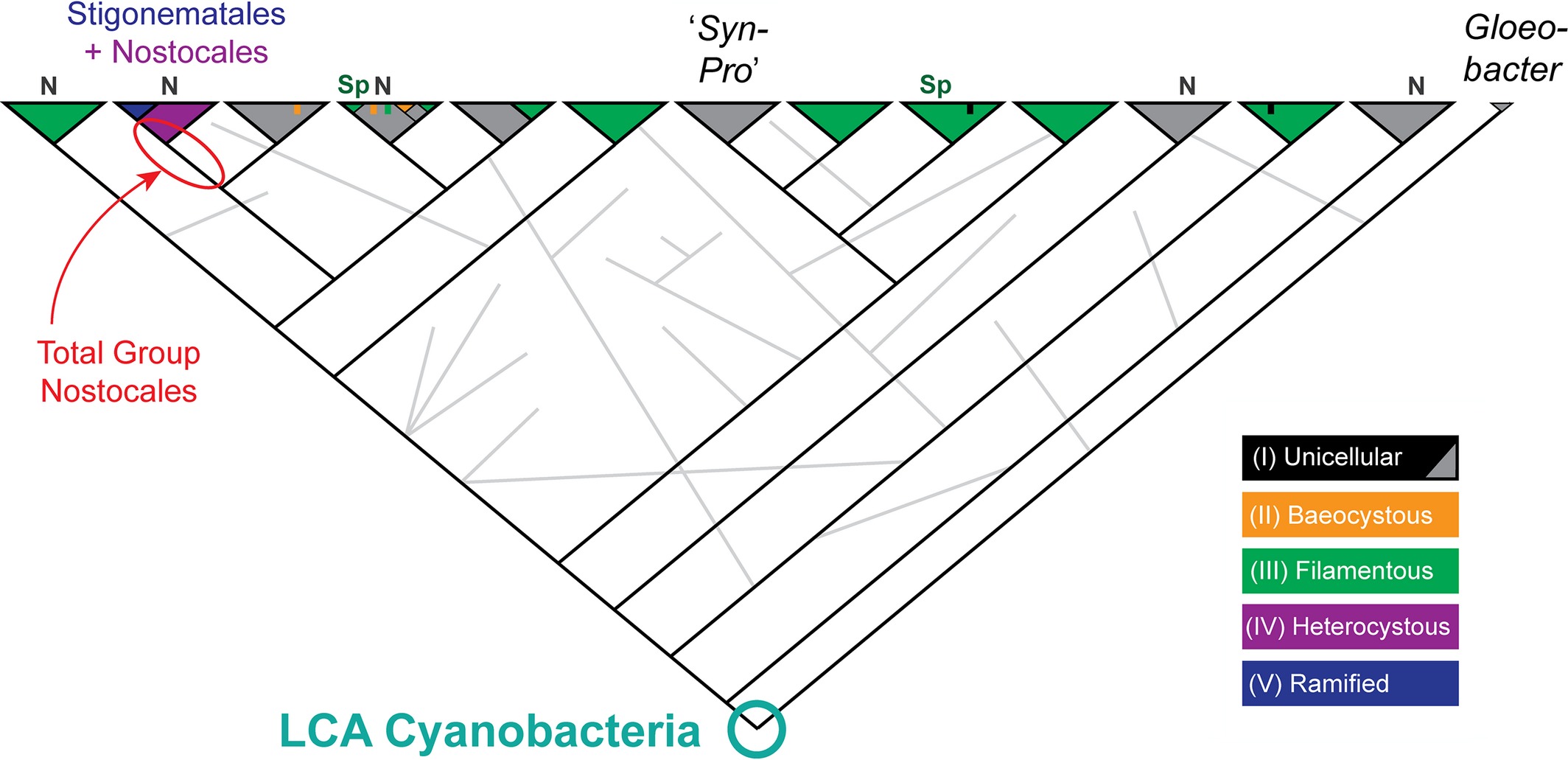
Phylogenetic relationships and phenotypic expression of extant cyanobacteria, redrafted from Shih et al. (2013)
to emphasize the distinction between extant crown‐group clades and the
(enormously greater) phylogenetic territory represented by stem‐group
forms. The grey lines schematically document the pervasive horizontal
gene transfer (HGT) typical of prokaryotes, as well as the diversity of
extinct stem‐group forms. Apart from Gloeobacter, Nostocales and
Stigonematales, phenotype is conspicuously polyphyletic, a pattern that
can be reasonably extrapolated to extinct forms. The nostocalean
affiliation of the eukaryotic primary plastid (Dagan et al. 2013)
includes stem‐group representatives, some of which are likely to have
been unicellular, non‐diazotrophic and marine. LCA, last common
ancestor; N, nitrogen fixation (diazotrophy); Sp, helically coiled Spirulina/Arthrospira‐type filaments.
Unicellular/pluricellular microfossils comparable to
subsection‐I cyanobacteria are abundant in the Proterozoic record. By
far the oldest and most convincingly cyanobacterial of these is Eoentophysalis belcherensis Hofmann, 1976, from the middle Palaeoproterozoic (c. 2 Ga) Belcher Island Supergroup, south‐eastern Hudson Bay (Fig. 2).
In addition to their construction of continuous, phototactically
oriented mats in intertidal/supratidal settings, these fossils preserve
direct ontogenetic and taphonomic counterparts to modern entophysalid
cyanobacteria living in comparable environments (Golubic and Hofmann 1976; Hofmann 1976).
Whether they should be classified specifically within extant
Entophysalidaceae – or indeed whether this taxon represents a clade
rather than a grade of organization – depends on the degree to which
such morphology is prone to evolutionary convergence. One obvious test
would be molecular interrogation of extant forms: if modern
entophysalids proved to be polyphyletic (as found to be the case for
most other morphologically simple cyanobacteria), there would be no a priori
grounds for linking the Belcher fossils directly with any extant
lineage, despite their convincing cyanobacterial credentials. By
contrast, the more generic morphologies of co‐occurring Eosynochococcus, Sphaerophycus, Myxococcoides and other simple spheroids cannot be unambiguously classified even as cyanobacteria.
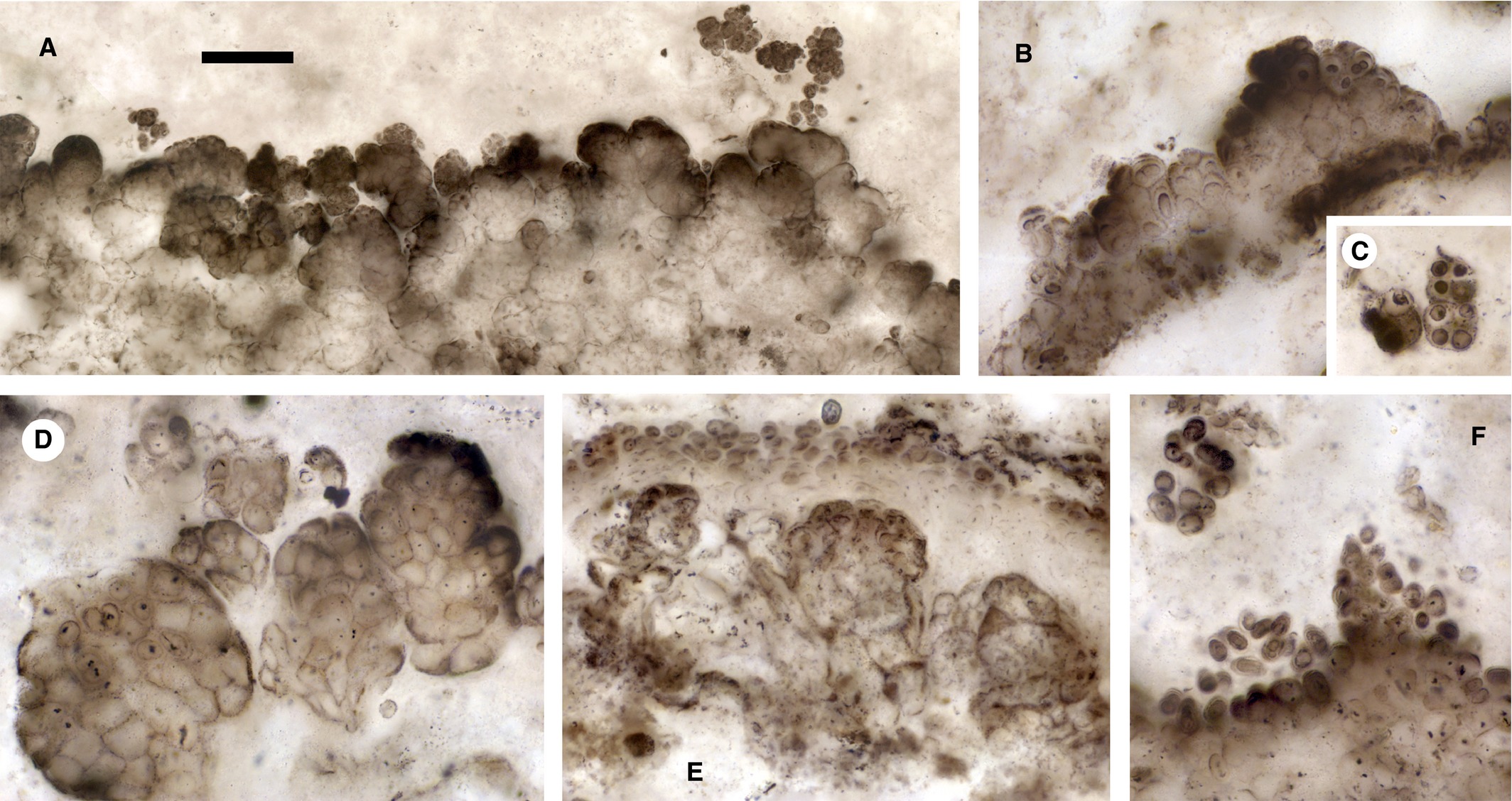
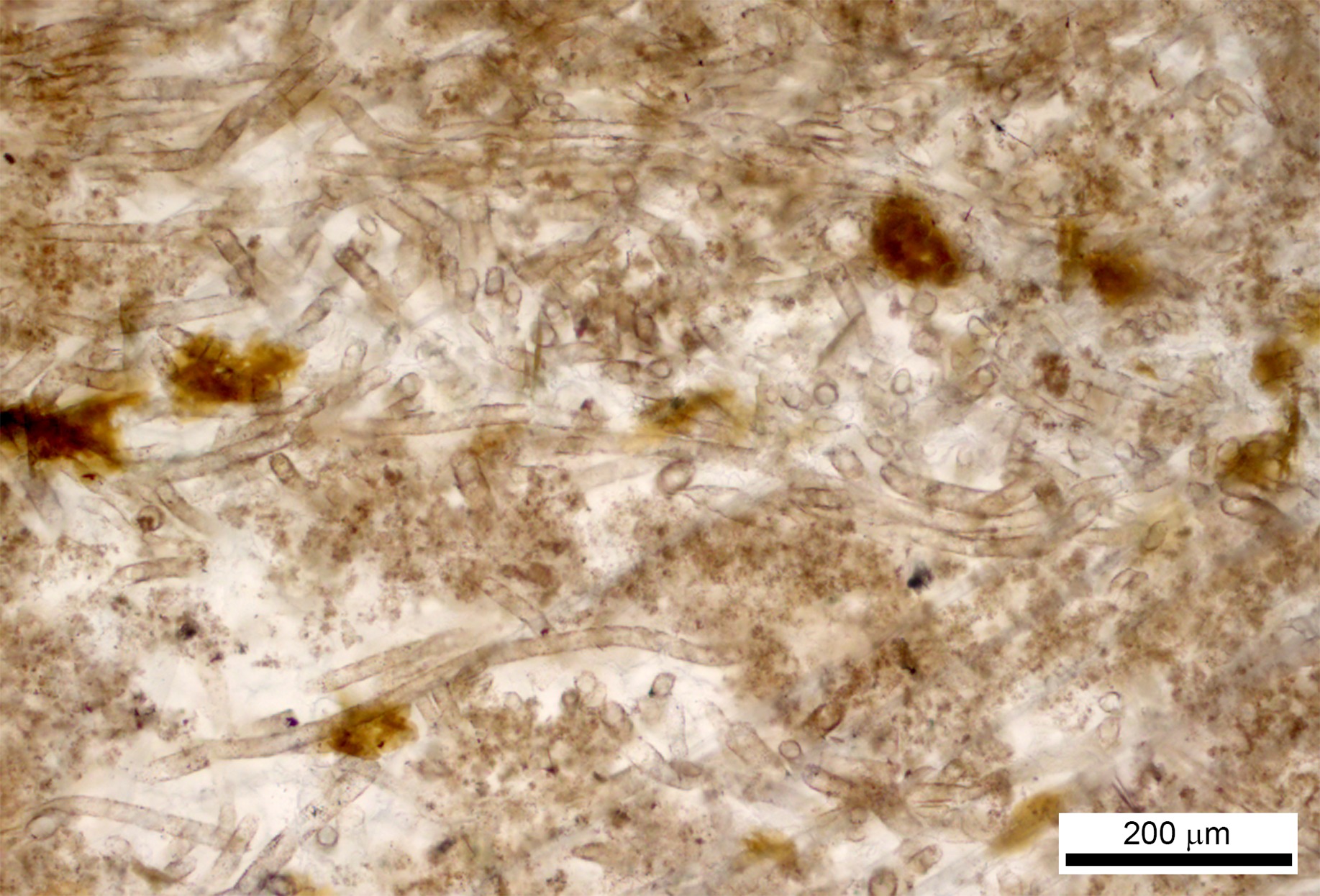
The subsection‐I cyanobacterium Eoentophysalis belcherensis; from the Palaeoproterozoic Kasegalik Formation, Belcher Group, Hudson Bay, Canada (Hofmann 1976).
A, continuous pustulose mat (GSC 43590). B, localized pustule of cells
showing multiple extracellular envelopes associated with cell division
(GSC 43590). C, type specimen of E. belcherensis (GSC 42770). D,
localized colonies (GSC 42770). E, continuous mat with embedded colonies
(GSC 43587). F, localized colony of cells showing multiple
extracellular envelopes (GSC 42769). GSC, Geological Survey of Canada.
Scale bar in A represents 50 μm (A); and 22 μm (B–F).
The baeocyte‐forming habit of extant subsection‐II
cyanobacteria has also proven to be polyphyletic, exhibiting
sister‐group relationships with both subsection‐I unicells and
subsection‐III filaments (Ishida et al. 2001). Although baeocytes have yet to be identified in the fossil record, Green et al. (1988) demonstrated marked morphological similarities between middle Neoproterozic Eohyella rectoclada (Fig. 3C)
and the vegetative components of a modern hyellacean (subsection II)
cyanobacterium. A broadly comparable pseudofilamentous habit is observed
in c. 1700 Ma Eohyella campbellii Zhang and Golubic, 1987 (Fig. 3B),
although the lack of any particular hyellacean synapomorphies in this
population – along with its billion‐year separation from E. rectoclada – makes its phylogenetic interpretation that much more problematic (Green et al. 1988; Knoll and Golubic 1992). Late Mesoproterozoic to middle Neoproterozoic Polybessurus bipartitus (Fig. 3A)
has also been classified as a subsection‐II cyanobacterium, based on
morphological comparison with an extant (but substantially smaller)
marine pleurocapsalean (Green et al. 1987). This same type of stalked construction, however, is also found in freshwater subsection‐I species (Cyanostylon), as well as in soil‐dwelling chlorophytes (Hormotilopsis) and freshwater dinoflagellates (Rufusiella),
underscoring the challenge of identifying subsection‐II cyanobacteria
without direct evidence of baeocytes or exact modern counterparts.
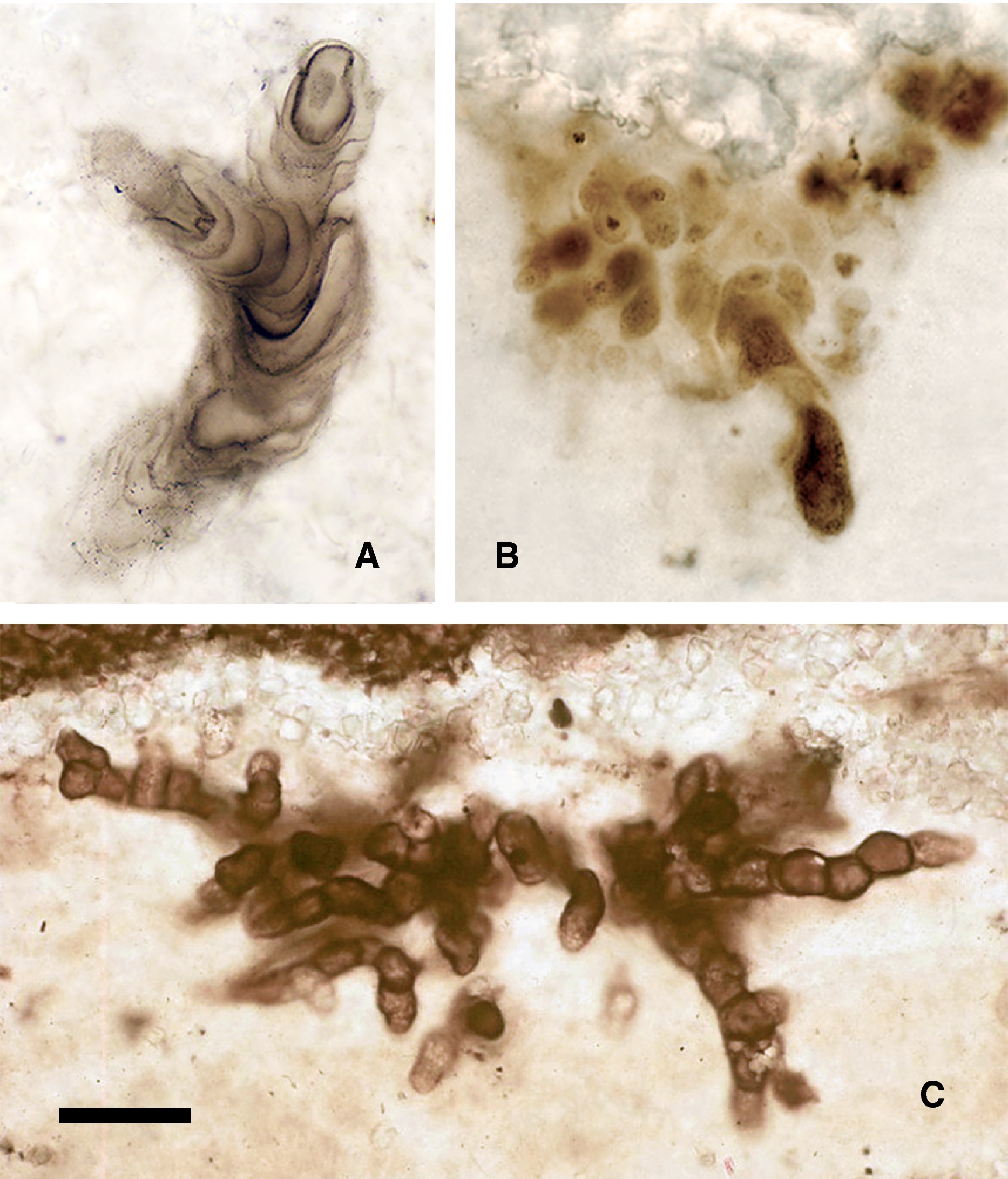
Putative subsection‐II fossil cyanobacteria. A, Polybessurus bipartitus,
a stalked unicellular fossil broadly comparable to a modern
baeocyte‐forming marine cyanobacterium, but also freshwater
non‐baeocyte‐forming Cyanostolon; from the late Mesoproterozoic Hunting Formation, arctic Canada (Butterfield 2001). B, Eohyella campbellii
(type specimen), an endolithic colony with pseudofilaments broadly
comparable to those of extant hyellacean cyanobacteria; from the late
Palaeoproterozoic Dahongyu Formation, Changcheng Group, north China
(Zhang and Golubic 1987); photograph courtesy of J. Yao. C, Eohyella rectoclada
(type specimen), an endolithic colony with pseudofilaments closely
comparable to those of extant hyellacean cyanobacteria; from the
early–middle Neoproterozoic Limestone–Dolomite Series, Eleonore Bay
Group, East Greenland (Green et al. 1988); photograph courtesy of A. H. Knoll. Scale bar in C represents 50 μm (A, C); and 17 μm (B).
Simple subsection‐III filaments are readily distinguishable
from other cyanobacteria on morphological grounds but, once again,
represent a polyphyletic grade of organization rather than a
phylogenetically coherent clade (Schirrmeister et al. 2011, 2013; Shih et al. 2013).
Certainly, there is no homology between the multicellularity of
subsection‐III cyanobacteria and morphologically indistinguishable forms
in the Chloroflexi, photosynthetic proteobacteria, or sulphur‐oxidizing
(beggiatoacean) proteobacteria (cf. Schopf et al. 2015).
That said, accessory morphological, ‘behavioural’, environmental and
taphonomic features often provide strong, if not conclusive, evidence
for interpreting many/most simple Proterozoic filaments as
subsection‐III cyanobacteria (Schopf 1968; Hofmann 1976; Knoll and Golubic 1992; Seong‐Joo and Golubic 1998; Butterfield et al. 1994; Fig. 4).
The oldest fossils for which this can be reasonably be invoked are
relatively large (15–25 μm diameter) mat‐forming filamentous sheaths (Siphonophycus transvaalensis) from the 2516 ± 4 Ma Gamohaan Fm. of South Africa (Fig. 5; Klein et al. 1987.
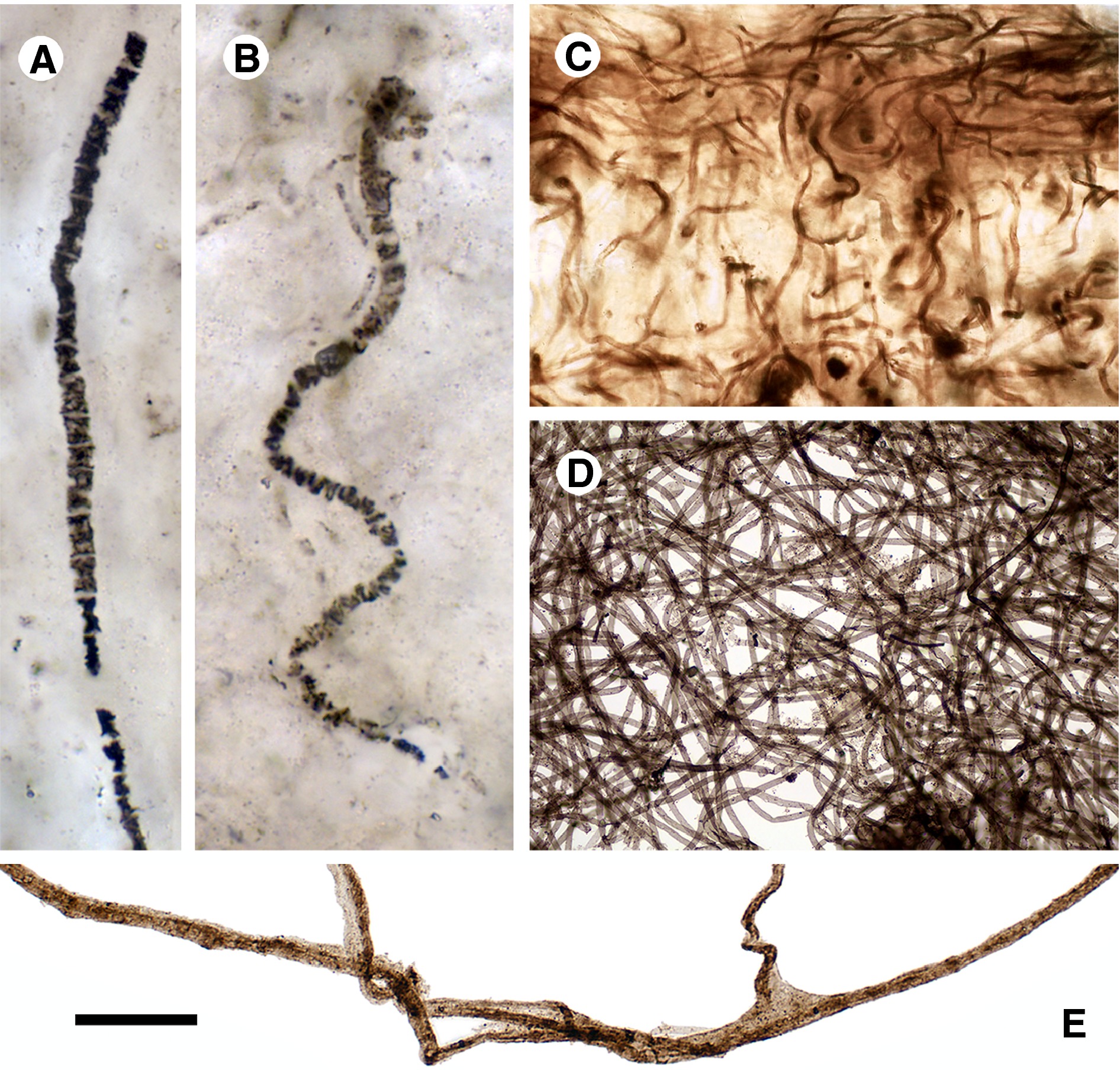
Filamentous microfossils of probable cyanobacteria (subsection‐III). A–B, silicified Halythrix sp.; from the Palaeoproterozoic Kasegalik Formation, Belcher Supergroup, Canada (Hofmann 1976; GSC 42769). C, silicified Siphonophycus
sp. exhibiting the alternating vertical/horizontal orientation typical
of mat‐building photosynthetic cyanobacteria; from the early–middle
Neoproterozoic Limestone–Dolomite Series, upper Eleonore Bay Group, East
Greenland; photograph courtesy of A. H. Knoll. D, Siphonophycus
sp. showing entangled mat‐like habit in two dimensions (acid‐isolated
from shale); from the early Neoproterozoic Wynniatt Formation, Shaler
Supergroup, NW Canada. E, false‐branching filament; from the early
Neoproterozoic Svanbergfjellet Formation, Akademikerbreen Group,
Spitsbergen (Butterfield 2009);
false branching is most commonly expressed in nostocalean (subsection
IV) cyanobacteria, but is also encountered in subsection‐III forms (see
Taton et al. 2011). Scale bar in E represents 15 μm (A–B); 45 μm (C–D); and 55 μm (E).
Mat‐forming filamentous microfossils (Siphonophycus transvaalensis), from the latest Archean Gamohaan Formation, Transvaal Supergroup, South Africa (Klein et al. 1987).
The combination of large diameter, robust external sheath, evidence of
alternating vertical/horizontal orientation and the stratigraphically
adjacent occurrence of stromatolitic facies supports the interpretation
of these fossils as subsection III cyanobacteria, notably preceding the
GOE by c. 100 million years.
The conspicuously polyphyletic distribution of simple
filaments among extant cyanobacteria precludes the assignment of fossil
counterparts to any particular clade, even in cases where phylum‐level
identification can be reasonably inferred. Helically coiled filaments
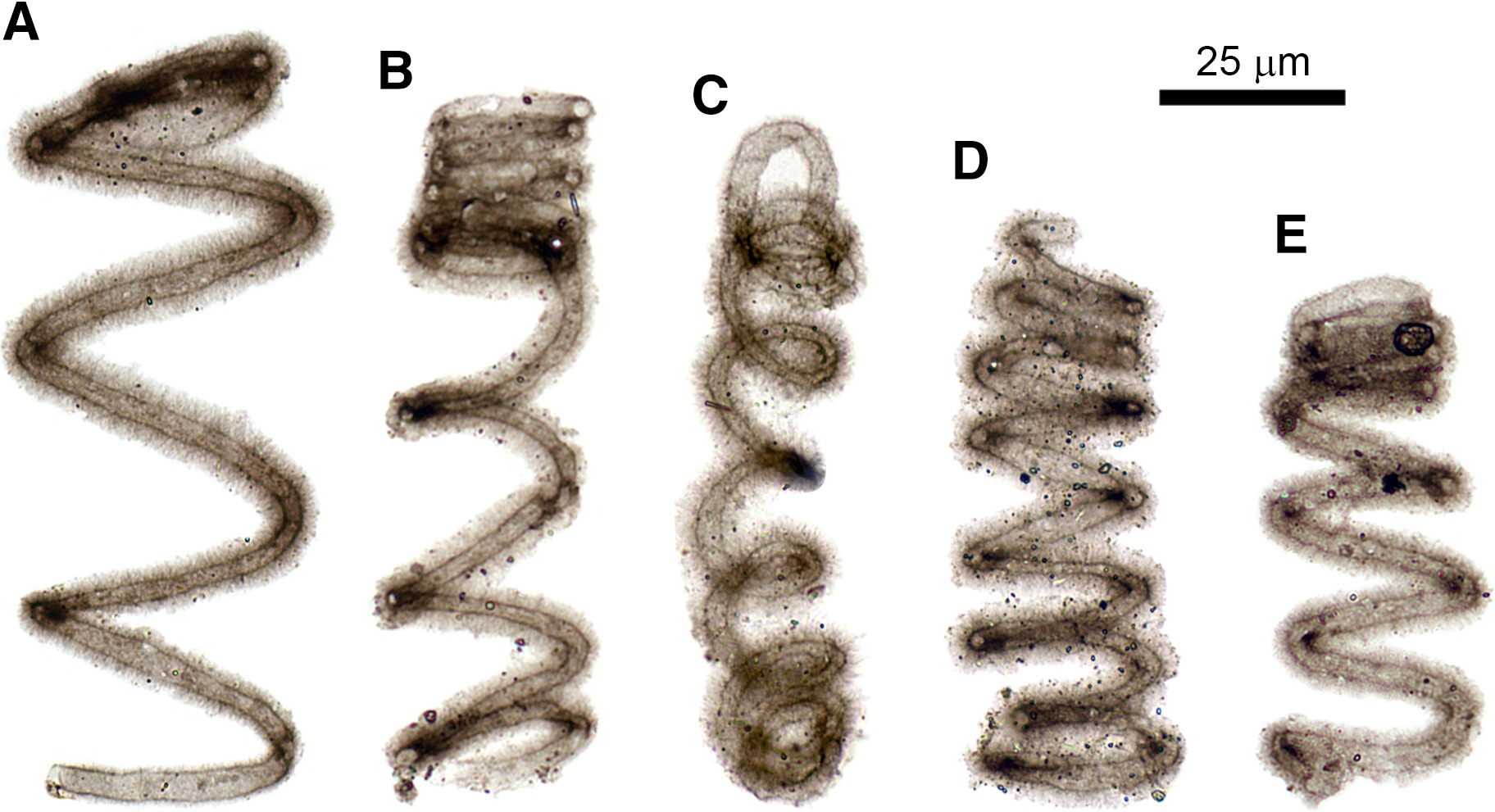
from the early Neoproterozoic Wynniatt Fm. of north‐west Canada (Fig. 6; Butterfield and Rainbird 1998), for example, are closely comparable to extant Arthrospira/Spirulina cyanobacteria, but differ from any living species in expressing a robust extracellular sheath (see Nübel et al. 2000).
Placement in the immediate stem group would seem to be the most
parsimonious interpretation, but is confounded by the deeply
polyphyletic nature of the modern ‘Spirulina’ (Nübel et al. 2000).
As such, these fossils might just as well represent an entirely
independent lineage of coiled filamentous cyanobacteria (or possibly
even non‐cyanobacteria; see Schmaljohann et al. 2001, fig. 3L). Likewise, exceptionally large coiled filamentous fossils assigned to Obruchevella magna (see Knoll 1992), or even larger, fully macroscopic Grypania (see Butterfield 2009; Sharma and Shukla 2009),
could conceivably be interpreted as independent experiments in
assembling type‐III cyanobacteria from (now extinct) lineages of
exceptionally large unicells – analogous, perhaps, to the giant
vacuolated unicells and filaments of modern Thiomargarita (see Schulz‐Vogt et al. 2007).
Helically coiled filamentous microfossils comparable to extant Spirulina/Arthrospira,
except for the presence of a robust extracellular sheath; acid‐isolated
from shales of the early Neoproterozoic Wynniatt Formation, Shaler
Supergroup, NW Canada (Butterfield and Rainbird 1998).
Nostocales (subsection IV) and Stigonematales (subsection V)
cyanobacteria are notable for being both morphologically complex and
phylogenetically legitimate, documenting a single, monophyletic origin
of cellular differentiation (Nostocales + Stigonematales) and
three‐dimensional growth (Stigonematales; Rippka et al. 1979; Dagan et al. 2013; Shih et al. 2013).
Putatively heterocystous filaments from the early fossil record,
however, have not stood up to scrutiny, while other habits such as false
branching, intercellular constrictions, terminal hairs and sheath
fabrics are not exclusive to these clades (Golubic et al. 1995).
The oldest convincing occurrence of fossil heterocysts – and associated
akinetes – occurs in terrestrial hot‐spring stigonemataleans from the
early Devonian Rhynie Chert (Croft and George 1959), consistent with the predominately non‐marine distribution of extant Nostocales/Stigonematales.
The only Proterozoic fossils currently interpreted as
nostocalean cyanobacteria are isolated rod‐shaped vesicles assigned to
the form‐genus Archaeoellipsoides Horodyski and Donaldson, 1980 (Fig. 7A–B).
Widely reported from silicified peritidal mat biotas of Mesoproterozoic
age, they have been shown to exhibit a size–frequency distribution
similar to that of extant nostocalean akinetes, hence their
interpretation as the aestivating fallout of Nodularia/Aphanizomenon‐type plankton blooms (Golubic et al. 1995).
Further, because all modern akinete‐bearing cyanobacteria also
differentiate nitrogen‐fixing heterocysts, the interpretation of Archaeoellipsoides
as akinetes has been used to infer that the host organism was also
heterocystous, with important implications for understanding the early
history of both nitrogen fixation and atmospheric oxygen (Tomitani et al. 2006).
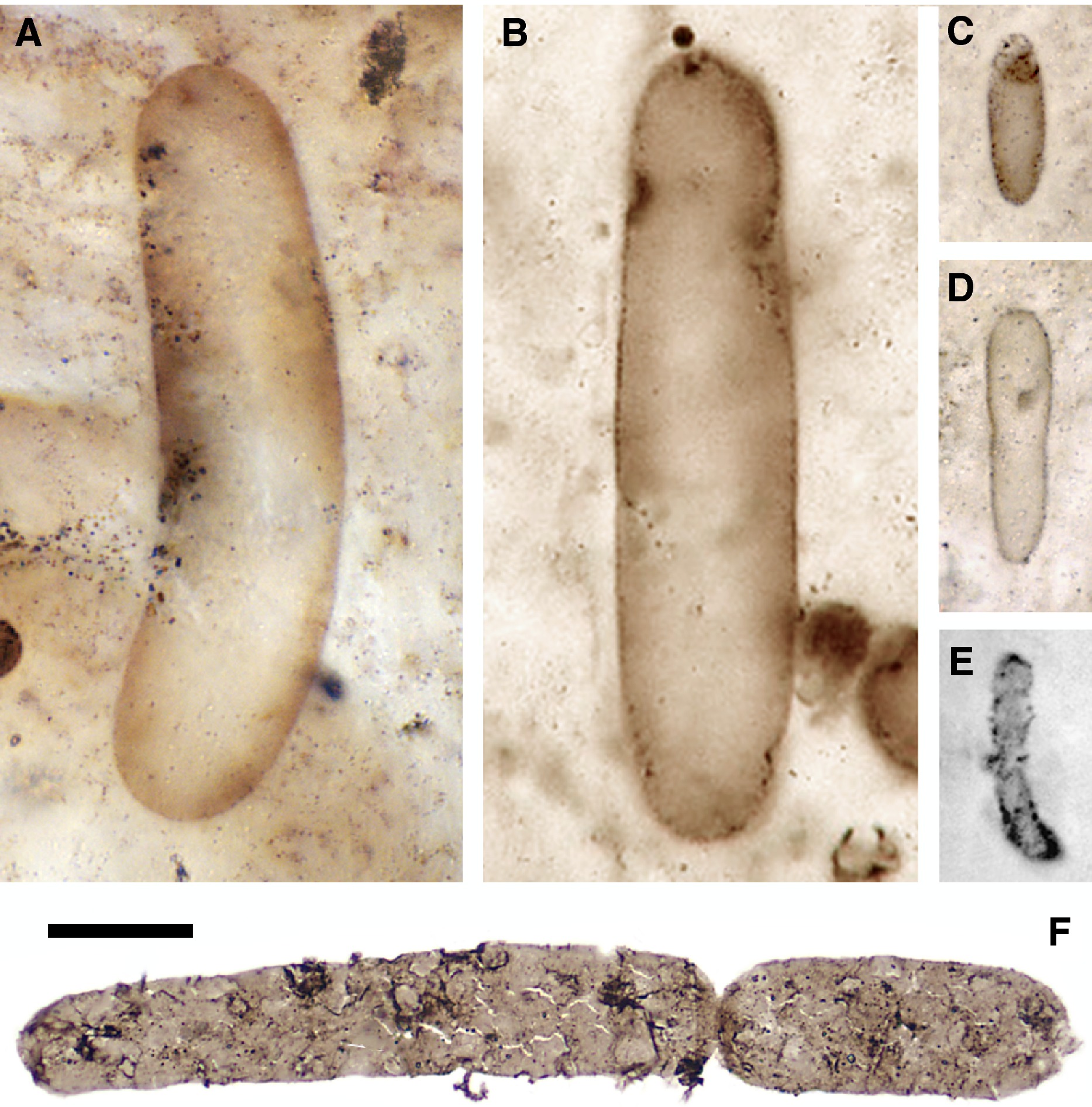
Rod‐shaped microfossils morphologically comparable to the akinetes of nostocalean cyanobacteria. A, Archaeoellipsoides grandis
(type specimen, type species); from the Mesoproterozoic ‘Lower
Laminated Dolostone’, Dismal Lakes Group, arctic Canada (Horodyski and
Donaldson 1980; GSC 57988). B, Archaeoellipsoides grandis; from the Mesoproterozoic Kotuikan Formation, Billyakh Group, northern Siberia (Sergeev et al. 1995); photograph courtesy of A. H. Knoll. C–D, Eosynechoccocus grandis; from the Palaeoproterozoic McLeary Formation, Belcher Supergroup, Canada (Hofmann 1976; GSC 42771). E, ‘Archaeoellipsoides sp.’; from the Palaeoproterozoic Franceville Group (reproduced from Tomitani et al. 2006). F, Jacutianema solubila; from the early–middle Neoproterozoic Svanbergfjellet Formation, Akademikerbreen Group, Spitsbergen (Butterfield 2004). Scale bar in F represents 15 μm (A–E); and 30 μm (F).
It is certainly possible that fossil Archaeoellipsoides
represents the akinetes of nostocalean cyanobacteria but, in my
opinion, the supporting evidence and arguments remain less than
compelling. Rod‐shaped cells with comparable dimensions are found in
other large Bacteria (Schulz‐Vogt et al. 2007), as well as among extant protists (e.g. Stichococcus and Spirotaenia green algae) and marine microfossil assemblages (e.g. Navifusa; see Fatka and Brocke 2008). Moreover, there is no evidence of cellular trichomes or extracellular sheaths directly associated with any Archaeoellipsoides specimens, despite the co‐occurrence of other well‐preserved fossils (Horodyski and Donaldson 1980; Sergeev et al. 1995),
and their conspicuously intertidal/supratidal distribution undermines
arguments for differential degradation in the plankton (cf. Golubic et al. 1995).
In cases where morphologically similar cells are known to be
constituents of multicellular filaments, it is clear from associated
features that these are not akinetes, or even prokaryotic (e.g. Fig. 7F; Butterfield 2004). For what it is worth, there is no evidence of akinetes in Meso‐Neoproterozoic non‐marine assemblages (Strother et al. 2011), where such fundamentally non‐marine cyanobacteria might have been expected.
Even if Archaeoellipsoides does include specimens of
cyanobacterial akinetes, it is a mistake to assume that the host
organism was also capable of differentiating heterocysts (cf. Golubic et al. 1995; Tomitani et al. 2006; Knoll 2008).
Although the two differentiated cell types are demonstrably linked in
crown‐group Nostocales/Stigonematales, such typological reasoning cannot
be automatically applied to fossil counterparts, particularly when they
precede the oldest direct evidence of co‐occurring akinetes and
heterocysts by some 800–1000 million years. Given the relatively derived
nature of this clade, and the possibility that heterocysts are
evolutionary derivatives of akinetes (Adams and Duggan 1999), a significant portion of the underlying stem group is expected to have borne akinetes alone (Fig. 1).
And whatever the interpretation of Mesoproterozoic Archaeoellipsoides,
there are vanishingly few grounds for extending the record of
crown‐group Nostocales another 800–1000 million years – to the 2.1 Ga
Franceville Group of Gabon – based on the assignment of four or five
indifferently preserved specimens to the same form‐genus (Amard and
Bertrand‐Sarfati 1997; Tomitani et al. 2006; Fig. 7E).
Ranging from just 2.6 to 5.2 μm in diameter, these early rod‐shaped
microfossils might just as readily have been assigned to, for example, Eosynechococcus grandis (Fig. 7C–D), which would carry fundamentally different physiological and phylogenetic implications.
The absence of compelling evidence for subsection‐II or
nostocalean/stigonematalean cyanobacteria in the Proterozoic record does
not, of course, mean that they were not present – only that the
available evidence fails to meet what might be considered minimal levels
of diagnostic criteria (relative to the morphological
convergence/polyphyly exhibited by their extant and fossil
counterparts). Certainly, there are accumulative taphonomic losses with
time, but this is likely to be conflated with genuine character absence
in early stem groups, including pre‐baeocyte phases in type‐II
cyanobacteria and pre‐heterocystous phases in type‐IV cyanobacteria. At
the same time, identification of positive morphological features offers
only limited taxonomic constraints due to the pervasive polyphyly of all
but the most differentiated cyanobacteria (none of which has an
unambiguous Proterozoic record). Given the enormous amounts of
phylogenetic territory underlying extant forms (Fig. 1), there is little basis for shoehorning early fossil cyanobacteria into extant clades (Shih and Matzke 2013).
Rather than representing billion‐year evolutionary stasis, most of
these recurrent morphologies are much more likely to be a product of
serial convergence (Dvořák et al. 2014)
– comparable to that of other ‘living fossils’ such as cycads and
bryophytes, where modern diversity has proven to have conspicuously
shallower roots than initially suggested by the fossil record
(Nagalingum et al. 2011; Laenen et al. 2014).
More mechanically, there are major environmental and
temporal biases accompanying almost all of the relevant taphonomic
windows onto early cyanobacteria (Butterfield 2003).
Most of the early microfossil, microbialite and biomarker records, for
example, derive from shallow water to supratidal facies, representing a
trivial component of global productivity (Field et al. 1998).
To a first approximation, there is no direct record of marine
phytoplankton through the Proterozoic, partly because of the inherent
buoyancy of planktic cyanobacteria (Reynolds et al. 1987),
partly because of the limited opportunities for repackaging and
vertical transport in the absence of suspension‐feeding animals (Logan et al. 1995; Butterfield 2011) and partly because of the sealing effects of benthic microbial mats (Pawlowska et al. 2013).
Indeed, the taphonomic biases are of such a degree that the fossil
record offers few useful constraints on the origin of modern
cyanobacterial groups. At the coarsest level – oxygenic photosynthesis
itself – the issues are better resolved by mass‐independent
fractionation of sulphur (MIF), BIF and other proxies of ancient redox
conditions.
Molecular approaches
Given the shortcomings of the fossil record, the only
phylogenetically resolvable account of early photosynthesis lies in the
analysis of extant lineages. Molecular signatures clearly distinguish
each of the seven extant lineages of Chl/BChl‐containing Bacteria and
allow their individual phylogenies to be broadly interrogated (Raymond et al. 2002; Hohmann‐Marriott and Blankenship 2011), even if much of the detail has been obscured by horizontal gene transfer (HGT), homologous recombination (Dvořák et al. 2014), morphological convergence and intervening extinction.
Cyanobacteria are unquestionably the key players in terms of
early Proterozoic photosynthesis. Among extant taxa, there are two
deep‐branching lineages, one represented by Gloeobacter, a cosmopolitan, terrestrial, wet‐rock cyanobacterium distinguished phenotypically by its lack of thylakoid membranes (Mareš et al. 2013); and the other by all remaining forms (Fig. 1). Within the non‐Gloeobacter
lineage, molecular analysis has corroborated the monophyly of
heterocystous Nostocales+Stigonematales, and identified a genetically
streamlined clade of Synechococcus and Prochlorococcus species (‘SynPro’) that, at least numerically, dominates modern marine phytoplankton (Urbach et al. 1992; Rocap et al. 2003). Other large‐scale clades inevitably emerge from such analyses (Ishida et al. 2001; Tomitani et al. 2006; Blank and Sánchez‐Baracaldo 2010; Gupta and Mathews 2010; Schirrmeister et al. 2013; Shih et al. 2013),
although few exhibit any phenotypic coherence – presumably due to the
rapid rates of evolutionary turnover facilitated by HGT and homologous
recombination. To account for their current gene distributions, for
example, some 66% of cyanobacterial protein families must have
experienced at least one HGT event (Dagan et al. 2013),
even as a core of vertically transmitted genes resolve their broader
treelike phylogeny. The fundamental plasticity of cyanobacterial
phenotype is reflected in their conspicuously divergent and convergent
evolutionary responses to temperature (Hongmei et al. 2005), salinity (Garcia‐Pichel et al. 1998; Moisander et al. 2002), redox chemistry (Cohen et al. 1986), light intensity (Rocap et al. 2003), N‐limitation/diazotrophy (Zehr and Kudela 2011), multicellularity (Schirrmeister et al. 2011, 2013), substrate stability (Garcia‐Pichel and Wojciechowski 2009) and eukaryotic symbioses (Thompson et al. 2012; Hilton et al. 2013), the latter including a complete loss of photosynthesis within the past c. 12 million years (Nakayama et al. 2014).
On the assumption that the phylogenetic relationships of
extant cyanobacteria can be accurately reconstructed from molecular
data, there is a further potential for inferring the phenotype of
extinct forms via ancestral state reconstruction (ASR). By applying such
techniques, Schirrmeister et al. (2011)
have inferred a multicellular constitution for the ancestry of all but
the most basal cyanobacteria, and Blank and Sánchez‐Baracaldo (2010)
have argued that Archean cyanobacteria were uniformly small,
unicellular, non‐marine and devoid of robust extracellular sheaths.
Under this latter model, cyanobacteria only colonized the oceans and
acquired their conspicuous microbialite‐building habits in relatively
derived lineages, possibly linked to the GOE.
These are intriguing results, but they hang on a number of
problematic assumptions. In addition to requiring a correct phylogeny,
ASR is only viable when the vertically inherited component is closely
tracked by organism phenotype, and in the absence of significant trends
or changes in character state over time (Schluter et al. 1997).
Given the high levels of HGT and pervasive convergent/divergent
evolution in cyanobacteria, neither of these prerequisites is likely to
hold (Dvořák et al. 2014),
especially for divergences measured in billions of years. By the same
token, it is a mistake to interpret the non‐marine habit of Gloeobacter
and other ‘basal’ lineages as somehow reflecting an ancestral condition
simply because of their early cladogenetic isolation and tree
asymmetry: the extant members of a species‐poor lineage are no more or
less likely to represent the ancestral state than their relatively
diversified sister group (Crisp and Cook 2005).
Experimental investigation has also shown ASR to be unreliable in all
but the most slowly evolving characters (Oakley and Cunningham 2000),
while the addition of palaeontological data typically undermines or
reverses results based exclusively on living forms – even in much
younger eukaryotic clades constrained to vertical inheritance (Finarelli
and Flynn 2006; Betancur‐R et al. 2015). Given the revolutionary changes in ecosystem structure at both the beginning and end of the Proterozoic (Butterfield 2011, 2015),
there is little likelihood of uniformitarian continuity in
cyanobacterial evolution through deep time – or of ASR analysis reliably
identifying extinct phenotypes.
A correct molecular phylogeny also allows molecular clock
estimates of last common ancestry to be calculated, with a further
potential for linking evolutionary innovations to major events in Earth
history. Apart from the theoretical issues accompanying clock analysis
of prokaryotic clades (Kuo and Ochman 2009),
any such results inevitably rest on the reliability of palaeontological
calibration points. At the broadest level, it is safe to assume that
BChl/Chl‐based photosynthesis had evolved by at least the early Archean (c. 3.5 Ga) and that oxygenic photosynthesis was established by at least the GOE (c. 2.4 Ga).
But beyond this, the constraints for early photosynthesis become much
more problematic. As discussed above, the 2.1 Ga Franceville ‘Archaeoellipsoides’ (Fig. 7E)
cannot be credibly interpreted as crown‐group nostocaleans, undermining
the various clock analyses that have embraced it for their primary
calibration (Blank and Sánchez‐Baracaldo 2010; Schirrmeister et al. 2013; Dvořák et al. 2014; Sánchez‐Baracaldo et al. 2014);
strictly speaking, the first positive identification of heterocystous
cyanobacteria postdates the Franceville fossils by more than a billion
and a half years. Blank and Sánchez‐Baracaldo (2010) also use 1.7 Ga Eohyella campbellii (Fig. 3B)
as a minimum age constraint for subsection‐II cyanobacteria, although
its lack of diagnostic morphology and the polyphyly of ‘Pleurocapsales’
in general (see above) make it a poor candidate for calibration.
Schirrmeister et al.'s (2013) use of c. 2 Ga Gunflintia/Halythix
as a minimum age for subsection‐III cyanobacteria is less problematic,
but not because these fossils exhibit any diagnostic morphology (Fig. 4A–B):
this is simply the default interpretation for all featureless post‐GOE
filaments in shallow‐water settings (and, as a generic argument, is less
convincing than the larger mat‐forming filaments in the considerably
older Gamohaan Fm (Fig. 5); Klein et al. 1987). By contrast, Blank and Sánchez‐Baracaldo's (2010) maximum
age constraint of 2.45 Ga for Nostocales and ‘Pleurocapsales’ has
little basis beyond an asserted absence of ‘large cell diameters’ in the
earlier record (undermined by documentation of relatively large
diameter Archean fossils (Klein et al. 1987, Sugitani et al. 2015)), along with a more reasonable assumption that akinete‐bearing nostocaleans are unlikely to predate the GOE.
Whatever the applicability of ASR or molecular clocks to
reconstructing early cyanobacterial evolution, the idea that oxygenic
photosynthesis may have originated in non‐marine environments – and
remained largely restricted to them prior to the Proterozoic – has
attracted considerable follow‐up attention (Strother et al. 2011; Dagan et al. 2013; Sánchez‐Baracaldo et al. 2014; Wellman and Strother 2015).
Certainly, there are good grounds for recognizing the derived nature of
most extant groups of marine cyanobacteria, including the SynPro clade
and various N‐fixing forms (Sánchez‐Baracaldo et al. 2014),
but this should not be equated with the absence of previous incumbents –
particularly given the alacrity with which cyanobacteria adapt to novel
circumstances. Oxygenic photosynthesis is the only type of
photo‐autotrophy that could be perennially sustained at the surface of a
post‐GOE ocean, and the long‐term continuity of δ13C signatures through the Proterozoic (Schidlowski 1988; Krissansen‐Totton et al. 2015) rules out the possibility of this habitat remaining fallow for any measurable length of time.
In the case of ray‐finned fishes, it is clear from the
fossil record that ASR‐based claims for non‐marine origins are simply an
artefact of differential migration and extinction of marine forms
(Betancur‐R et al. 2015).
Is it possible that such a process has similarly obscured the early
history of cyanobacteria? Indeed, is it reasonable to invoke bacterial
extinction at all given the astronomically large population sizes of
most micro‐organisms (see discussion in Lane 2011)?
Yes, absolutely. The fossil record is strewn with extinctions of once
superabundant marine plankton, and loss of intermediate stem groups
offers the only realistic explanation for the phylogenetic gappiness of
extant diversity, both eukaryotic and prokaryotic (Butterfield 2015; Fig. 1). It is also worth noting the number of early cyanobacteria‐like fossils that lack exact modern counterparts, including Polybessurus (Fig. 3A), various Spirulina‐like filaments (Fig. 6; Knoll 1992) and Grypania (Sharma and Shukla 2009).
None of this rules out the possibility that cyanobacteria may have
originated in non‐marine environments, but it is unlikely that such
distinctions are relevant on geological timescales. The capacity of
cyanobacteria to rapidly adapt, and re‐adapt, to novel circumstances
ensures multiple independent ventures into all but the most extreme
photic zone settings, punctuated by extinction and evolutionary turnover
as new ecological circumstances arise.
Photosynthetic eukaryotes
At some point after the Archean evolution of crown‐group
cyanobacteria – and after the Palaeoproterozoic evolution of crown‐group
eukaryotes – a subsection of oxygenic photosynthesis was
endosymbiotically repackaged as a eukaryotic phenomenon. In the process,
it exchanged HGT for a system of primarily vertical inheritance and
acquired a fundamentally new grade of developmental, evolutionary and
ecological sophistication.
The precursor to the eukaryotic chloroplast was clearly an
engulfed cyanobacterium, and there is a strong, if often oversimplified
(Howe et al. 2008; Stiller 2014),
argument for recognizing just a single primary endosymbiosis for all
living photosynthetic eukaryotes (apart from the independently acquired
‘organelle’ of Paulinella chromatophora; Nowack and Grossman 2012).
Subsequent diversification gave rise to the three extant lineages with
primary plastids comprising the eukaryotic supergroup
Plantae/Archaeplastida: Glaucophyta, Rhodophyta and Viridiplantae (Fig. 8; Keeling 2013).
Although all of the primitively non‐photosynthetic members of this
clade have been lost to extinction (i.e. stem‐group Plantae), analysis
of the residual chloroplast genome can potentially resolve the
phylogenetic affiliations of the ancestral cyanobacterial endosymbiont.
Conclusions vary, but attention has fallen increasingly on extant clades
of N2‐fixing cyanobacteria, especially heterocyst‐bearing Nostocales (Dagan et al. 2013; Ochoa de Alda et al. 2014).
Taken literally, this would imply a freshwater, multicellular and
heterocystous origin of chloroplasts – analogous, perhaps, to the
symbiotic relationship between modern Richelia/Calothrix and various marine diatoms (Hilton et al. 2013)
– followed by a loss of heterocysts, multicellularity and, at some
point, freshwater habit. But this is to ignore the distinction between
crown‐group forms, which carry the full complement of characters that
define an extant clade, and members of the underlying stem groups (which
do not). Certainly, stem‐group Nostocales (Fig. 1)
will have included forms that primitively lacked heterocysts, true and
false branching, and even multicellularity, offering a much broader
range of ‘ancestral states’ from which to draw the ancestral
chloroplast. By the same token, there is no reason to assume that the
nostocalean stem group was exclusively or primitively non‐marine,
countering arguments for a freshwater origin of photosynthetic
eukaryotes (Dagan et al. 2013; Wellman and Strother 2015). The only necessary implication of chloroplasts being most closely related to extant nostocaleans is that total‐group Nostocales was established prior to the first appearance of crown‐group Plantae.
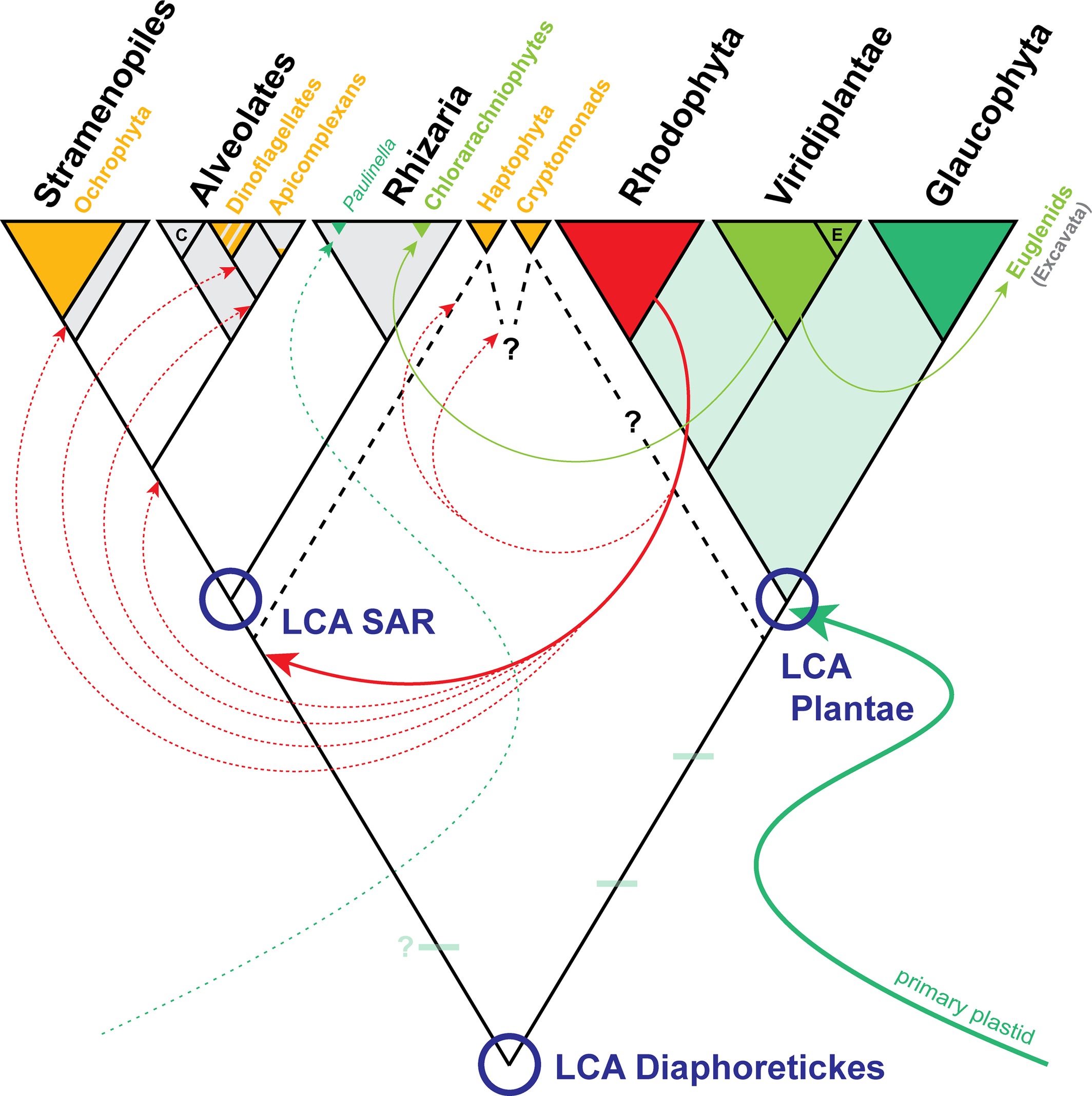
Origin, evolution and secondary distribution of
plastids in photosynthetic eukaryotes. The schematic phylogeny
emphasizes the distinction between extant higher order clades and their
underlying stem groups, while the arrows represent likely endosymbiotic
pathways of primary and secondary plastids. The horizontal tick‐marks on
the stem lineages of Plantae and SAR represent extinct photosymbioses
suggested by the ‘shopping bag’ model of Howe et al. (2008), and the dashed blue‐green line the independent establishment of ‘primary plastids’ in Paulinella. Extant clades of chlorophyll c‐containing
algae are depicted in orange, with the red arrows representing various
routes by which they may have acquired their secondary ‘red’ plastids:
the ‘Chromalveolate hypothesis’ (solid red line) minimizes the number of
endosymbiotic events, but there is increasing evidence for a more
polyphyletic history (dashed red lines).
The oldest unambiguously photosynthetic eukaryote in the fossil record is late Mesoproterozoic (c. 1200 Ma) Bangiomorpha,
identified on the basis of its large size, complex multicellular
development and vertically oriented turf‐forming habit in peritidal
environments (Fig. 9A). More specifically, it exhibits direct morphological and developmental correspondence with the extant red alga Bangia
(Rhodophyta, Bangiophyceae), pointing to both its crown‐group
phylogenetic affiliations and associated photosynthetic machinery
(including primary red plastids). As ever, it is important to consider
the possibility of morphological convergence, but in this case the
combination of features is sufficiently diverse and derived to offer a
convincing family‐level diagnosis (Butterfield 2000, 2009, 2015).
Broadly comparable levels of cellular and ontogenetic detail in the
much younger Doushantuo biota document the appearance of florideophycean
red algae by at least the end of the Proterozoic (Xiao et al. 2004).
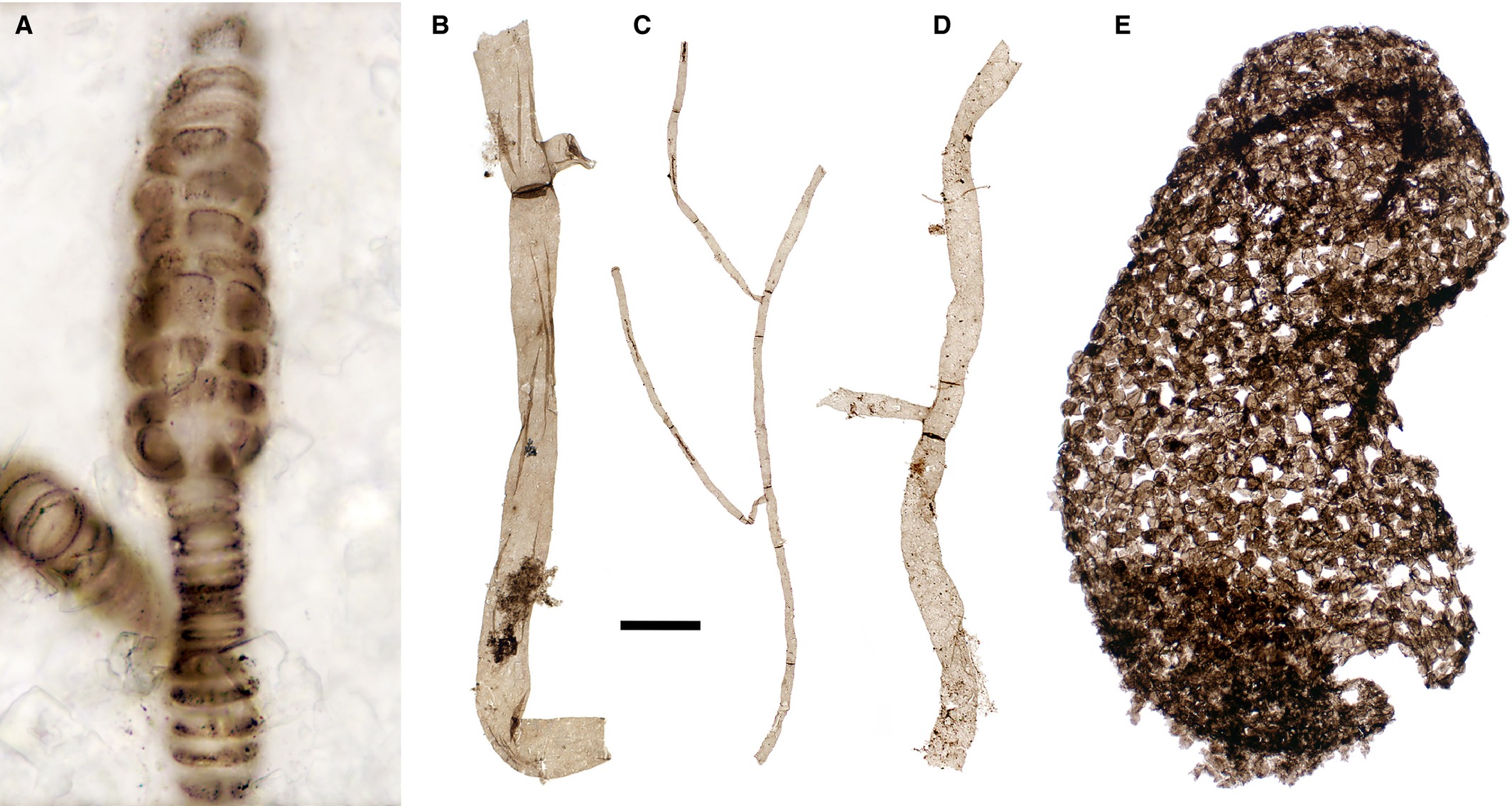
Proterozoic eukaryotes exhibiting a sufficient
level of morphological complexity to be identified as crown‐group
Plantae (eukaryotes with primary plastids). A, Bangiomorpha pubescens, a bangiacean rhodophyte; from the late Mesoproterozoic Hunting Formation, arctic Canada. B–D, Proterocladus spp., probable siphonocladalean chlorophytes; from the early–middle Neoproterozoic Svanbergfjellet Formation, Spitsbergen. E, Palaeastrum dyptocranum,
a probable hydrodictyacean chlorophyte; from the early–middle
Neoproterozoic Svanbergfjellet Formation, Spitsbergen. Scale bar
represents 20 μm (A); 50 μm (B–D); and 70 μm (E).
Early Neoproterozoic (c. 820 Ma) Proterocladus (Fig. 9B–D) and Palaeastrum (Fig. 9E)
are also demonstrably eukaryotic (by virtue of their size and
multicellular complexity) and have close morphological analogues among
extant siphonocladalean and hydrodictyalean green algae (Viridiplantae;
Butterfield et al. 1994).
As such, they are likely to have contained green primary plastids;
however, the relative simplicity of their multicellular expression
presents a non‐trivial possibility of convergence by other extant or
extinct eukaryotes, including colourless osmotrophs, non‐green plant
protists and/or unrelated lineages of green algae.
Given their unicellular to simple pluricellular nature, it
is hardly surprising that glaucophytes have yet to be identified in the
fossil record, despite their early evolutionary divergence (Keeling 2013). Their habit of adding additional mucilaginous layers with each cycle of cell division (Kies 1989)
suggests that candidates could potentially be found among microfossils
assigned to similarly constructed subsection‐I cyanobacteria (e.g. Gloeodiniopsis, Eogloeocapsa).
Somewhat more distinctive is the conspicuously concentric arrangement
of cellulose microfibrils comprising the glaucophyte cell wall (Willison
and Brown 1978), intriguingly reminiscent of that seen in the long‐ranging Proterozoic acritarch Valeria lophostriata (Hofmann 1999).
Proterozoic acritarchs (vesicular organic‐walled
microfossils of unknown affiliation) undoubtedly include a diverse range
of photosynthetic protists, even if these will be impossible to resolve
in any particular instance: most sphaeromorphic acritarchs are not
demonstrably eukaryotic, and demonstrably eukaryotic forms are not
necessarily photosynthetic. That said, the conspicuously limited
metabolic repertoire of crown‐group eukaryotes, combined with the
limited preservation potential of most heterotrophic protists (e.g.
unwalled amoeboids, ciliates, flagellates; see Butterfield 2003, 2015),
makes photosynthesis the most likely metabolism for most eukaryotic
acritarchs – particularly if they show evidence of vegetative growth
rather than the more regular habit of loricas, tests or aestivating
spores/cysts. The oldest unambiguously eukaryotes in the fossil record
are acanthomorphic acritarchs assigned to Tappania, from the late Palaeoproterozoic of China and India (Butterfield 2015),
which are characterized by both conspicuously variable vegetative
growth and relatively shallow‐water (photic zone) palaeoenvironments.
Although fungus‐like osmotrophy cannot be categorically ruled out as a
mode of life (cf. Butterfield 2005), these fossils offer at least circumstantial evidence for the early appearance of photosynthetic eukaryotes.
Whether or not Tappania belongs to crown‐group
Plantae is, of course, another matter. Given the disparate range of
photosymbiotic relationships practiced by extant eukaryotes (Dorrell and
Howe 2012), including the independent acquisition of ‘primary plastids’ by the extant rhizarian Paulinella chromatophora (Nowack and Grossman 2012),
it is unlikely that their Palaeoproterozoic counterparts remained
exclusively heterotrophic over time. But, by the same token, these early
‘plant protists’ could represent any number of other experiments in
plastid acquisition, not least one or more of the stem‐group
endosymbioses that preceded the nominal last common ancestor of extant
chloroplasts and Plantae (the ‘shopping bag’ model of Howe et al. (2008); see Fig. 8).
In this light, crown‐group eukaryotes are likely to have exploited the
ecological opportunities of mixotrophy and photosynthesis from the
outset, taking ‘eukaryotic‐grade’ photosynthesis back to at least the
late Palaeoproterozoic.
Secondary plastids
Unlike the singular occurrence of primary cyanobacterial
plastids, it is clear that photosynthetic eukaryotes have become
incorporated as secondary/tertiary chloroplasts on multiple occasions
(Dorrell and Howe 2012; Keeling 2013; Fig. 8).
Secondary ‘green’ chloroplasts (derived from green‐algal endosymbionts)
have appeared independently in euglenids, chlorarachniophytes and a
(secondarily heterotrophic) dinoflagellate; other such dinoflagellates
have acquired tertiary chloroplasts from diatoms, cryptomonads and
haptophytes. Even so, it is the major clades of secondary ‘red’ plant
protists – diatoms, haptophytes, dinoflagellates and cryptomonads – that
ultimately revolutionized marine productivity. Can the early evolution
of these Chl c‐containing groups be detected in the Proterozoic record?
Cavalier‐Smith (1999)
argued forcefully for a single endosymbiotic acquisition of secondary
‘red’ chloroplasts, and the recognition of a monophyletic clade
combining the traditional ‘chromistan’ algae (=photosynthetic
stramenopiles/Ochrophyta, including diatoms, chrysophytes, phaeophytes,
xanthophytes and pelagophytes) and alveolates (=dinoflagellates,
ciliates and apicomplexans). Subsequent analyses appeared to support
this ‘chromalveolate’ model, although clear links with Rhizaria pushed
the host organism back to the base of SAR (the eukaryotic supergroup
comprising Stramenopiles, Alveolates and Rhizaria), with the position of
haptophytes and nulcleomorph‐bearing cryptomonads (the photosynthetic
‘hacrobians’) remaining unresolved (Fig. 8; Keeling 2013). Other approaches, however, have found evidence for chloroplast polyphyly in SAR (Baurain et al. 2010; Dorrell and Smith 2011),
and more recent work makes a strong case for cryptomonads deriving from
an independent acquisition of ‘red’ chloroplasts – with haptophytes
emerging as a probable sister group of SAR (Burki et al. 2012).
It is still possible, of course, to invoke a single (secondary)
endosymbiotic origin for SAR + haptophyte chloroplasts, but the original
assumptions of the chromalveolate hypothesis are clearly in need of
adjustment and more rigorous testing; for example, that a convincing
complement of red algal genes is present in the genomes of ciliates,
rhizarians and other pervasively non‐photosynthetic lineages of SAR
(Keeling 2013).
The phylogenetic topology of plastids in SAR has important implications for assessing the origin of Chl c‐based
photosynthesis, particularly in the light of its conspicuously limited
expression in the pre‐Mesozoic fossil record. Under the chromalveolate
model, for example, the presence of early Cambrian foraminifera/Rhizaria
(Culver 1991), and (putative) Cryogenian ciliates/Alveolata (Bosak et al. 2011), would push the acquisition of secondary plastids well back into the Proterozoic (Fig. 8).
By contrast, a scenario allowing plastid polyphyly within SAR is more
readily reconciled with a Phanerozoic – possibly even a Mesozoic –
origin of at least some secondary ‘red’ plastids (Knoll et al. 2007).
There have been a number of claims for Chl c‐containing algae in the early fossil record, including putative vaucheriacean xanthophytes in the Meso‐Neoproterozoic (Hermann 1981; Butterfield 2004), putative phaeophytes from the Ediacaran (Xiao et al. 1998) and putative pelagophyte biomarkers (24‐n‐propylcholestane) from the Cryogenian (Raven 2012).
Such interpretations, however, clash conspicuously with molecular clock
analyses pointing to a post‐Palaeozoic appearance of xanthophytes,
phaeophytes and pelagophytes, and a late Neoproterozoic appearance for
photosynthetic stramenopiles as a whole (Brown and Sorhannus 2010). Recently reported specimens of Mesoproterozoic Palaeovaucheria also reveal features that fall fundamentally outside the range of its modern namesake (Butterfield 2015), while putative Neoproterozoic counterparts (Fig. 7F; Butterfield 2004)
fail to exhibit minimally diagnostic levels of vaucheriacean
complexity. In the absence of other candidates, the fossil record offers
few constraints on ochrophytan evolution before the early Cretaceous
appearance of diatoms – or on ‘hacrobian’ evolution prior to the late
Triassic appearance of coccolithophores.
The other principal group of extant Chl c‐containing
algae are the dinoflagellates. By all appearances, the last common
ancestor of extant dinoflagellates had already acquired its secondary
‘red’ plastid (Slamovits and Keeling 2008)
which, in chromalveolate models, necessarily expands to include the
underlying stem group. Recent discovery of a ‘red’ photosynthetic
apicomplexan (Chromera) supports a single origin of
dinoflagellate and apicomplexan plastids; however, evidence of
photosynthetic ancestry has yet to be demonstrated in their ciliate
sister group (Keeling 2013).
Outside the chromalveolate model, there is little evidence for invoking
a pre‐Phanerozoic, or even a pre‐Mesozoic, origin of photosynthetic
dinoflagellates. Earlier occurrences of dinocyst‐like acritarchs
(Butterfield and Rainbird 1998) and dinosteroid biomarkers (Talyzina et al. 2000)
could conceivably represent stem‐group forms but, by the same token,
might predate acquisition of the dinoflagellate plastid itself. Apart
from issues of secondary contamination or convergence, the vanishingly
small concentrations of Proterozoic dinosteroid biomarkers (typically
<1 i="" nbsp="" ppb="" see="" summons="">et al
. 1992)
could reflect the more limited expression of primitively
non‐photosynthetic stem dinoflagellates, secular changes in biomarker
taphonomy (Pawlowska et al. 2013), or simply the general marginalization of eukaryotic productivity in early cyanobacteria‐dominated oceans (Butterfield 2009, 2011; Lenton et al. 2014).
Discussion
Despite the deep gaps and biases of the historical record,
it is clear that the Proterozoic witnessed two of the planet's most
revolutionary innovations in photosynthesis: first the takeover of
planetary productivity by cyanobacteria near its beginning, and then the
upgrade to a primarily eukaryotic platform that marks its end. Although
oxygenic photosynthesis itself appears to have been a much earlier
invention, the ‘age of cyanobacteria’ only emerged as contemporary
environments were progressively polluted by accumulating free oxygen.
The tipping point would see incumbent anoxygenic photosynthesizers
dramatically overrun by oxygen‐tolerant cyanobacteria, alongside the
various biogeochemical and climatic perturbations of the GOE – a
bi‐stable (and effectively irreversible) regime shift brought on by the
positive feedback effects of a revolutionary new technology (Scheffer
and Carpenter 2003; Goldblatt et al. 2006).
This early Palaeoproterozoic interval of planetary
hysteresis is mirrored by events of the late Neoproterozoic. Like
cyanobacteria with respect to the GOE, eukaryotes were ecologically
marginalized through much of their early evolutionary history, but rose
rapidly to dominance during an interval of pronounced biogeochemical and
climatic change. As ever, models have focussed primarily on
physical/chemical drivers, especially oxygen, to explain the
Cryogenian–Cambrian regime shift. In the case of RuBisCO‐based
photosynthesizers, however, rising oxygen concentrations are if anything
likely to have curbed evolutionary expansion (via photorespiration
feedbacks), so much of the discussion has shifted to the biological
availability of nitrogen in stratified Proterozoic oceans (Anbar and
Knoll 2002; Fennel et al. 2005; Stüeken 2013).
By extension, the ability of many prokaryotes to fix their own nitrogen
might account for the extended incumbency of cyanobacteria. But this is
to ignore the alternative means by which photosynthetic eukaryotes
acquire their requisite N, including heterotrophy/mixotrophy (Mitra et al. 2014), enhanced motility and recurring symbioses with diazotrophic cyanobacteria (Hilton et al. 2013; Thompson et al. 2012; Nakayama et al. 2014).
Certainly eukaryotes dominate export productivity in the modern oceans
without fixing their own nitrogen, while oxygen minimum zones are
increasingly recognized as a net source of bioavailable N – rather than a
denitrification sink – due to the diversity/abundance of heterotrophic
diazotrophs (Zehr and Kudela 2011; Dos Santos et al. 2012; Halm et al. 2012; Rahav et al. 2015). Such contributions may well have been substantially greater in stratified Proterozoic oceans.
If not oxygen or nitrogen limitation, what then accounts for
the billion‐year marginalization of photosynthetic eukaryotes?
Certainly, there is more to the ecology of prokaryotic vs eukaryotic
productivity than ambient chemistry, not least the ‘master trait’ of
cell size and its myriad effects on light harvesting, buoyancy, predator
avoidance and overall life history (Litchman and Klausmeier 2008).
Although the predominance of cyanobacterial picoplankton in the modern
mid‐Pacific gyres is clearly related to the accompanying
superoligotrophic conditions, broadly comparable forms can also dominate
in eutrophic to mesotrophic systems, due in part to a positive feedback
loop in which planktic cyanobacteria thrive in the stratified,
nutrient‐rich, turbid water conditions created by their inherent
buoyancy (Reynolds et al. 1987; Scheffer and Carpenter 2003; Butterfield 2009; Paerl and Otten 2013).
Interestingly, cyanobacterial diazotrophy contributes little to the
nitrogen budget in most eutrophic lakes and inland seas, even when the
principle bloom‐forming plankton is nostocalean (Ferber et al. 2004).
If anything, a more limited availability of N in Proterozoic shelf
environments might have played to the strengths of eukaryotic
phytoplankton, which thrive in clearer water mesotrophic to oligotrophic
conditions.
In modern aquatic ecosystems the alternative clear‐water
state is typically engineered by suspension‐feeding animals. By actively
extracting suspended Corg, such forms transfer biological
oxygen demand from the water column to the benthos, while at the same
time reducing nutrient recycling, enhancing light penetration and
expanding opportunities for benthic colonization (Logan et al. 1995; Butterfield 2011).
In the relatively simple ecosystems characteristic of lakes, estuaries
and restricted marine embayments, top‐down control of phytoplankton
populations is a primary driver of major regime shifts, often delivered
by trophic cascade (Butterfield 1997; Kemp et al. 2005; Petersen et al. 2008; Brönmark et al. 2010).
When it comes to clearing out the Proterozoic oceans, however, the key
players would have been early sponge‐grade metazoans (Sperling et al. 2007; Erwin and Tweedt 2011; Lenton et al. 2014).
In addition to introducing an entirely novel means of processing water
(turbulent‐flow suspension feeding), their selective extraction of
picoplankton and dissolved organic carbon (DOC) would have presented a
powerful new selective pressure in favour of larger, more export prone,
eukaryotic phytoplankton. Sponges are a key factor in suppressing
light‐attenuating plankton blooms in at least some modern shelf systems
(Peterson et al. 2006)
and are likely to have played a similar role in engineering the late
Neoproterozoic oceans. For what it is worth, molecular clock estimates
for the appearance of sponges coincide with the first biomarker evidence
of cyanobacteria giving way to eukaryotic productivity – in the
mid‐Neoproterozoic (Summons et al. 1999; Erwin et al. 2011; Butterfield 2015).
Shifts in plankton composition will also have had cascading effects on
the illumination and oxygenation of shallow‐water environments, with
critical feedback effects on both benthic and planktic ecology
(Butterfield 2011; Lenton et al. 2014).
Evolutionary singularities and convergence
Photosynthesis drives all but a trivial component of the
modern biosphere and has done so for at least the past 3.5 billion
years. Given the complexity and universality of the underlying
chlorophyll‐based reaction centres, it is also clear that it derives
from a single last common ancestor; it is an evolutionary singularity.
Even so, it is important to recognize that other routes were potentially
available. Although no living rhodopsin‐based phototrophs are truly
photosynthetic, there appears to be no fundamental reason why their
light‐driven proton‐pumping could not have been linked to a carbon
fixation pathway (Bryant and Frigaard 2006),
and might well have done so in the absence of a BChl/Chl incumbent. The
same is true for photosynthetic eukaryotes: although all plastids can
be traced back to a single last common primary endosymbiosis, it is
clear from the diverse range of extant more or less obligate
photoendosymbioses (Dorrell and Howe 2012; Thompson et al. 2012; Nakayama et al. 2014)
that alternative routes would have been routinely available. When it
comes to oxygenic photosynthesis, however, there are no obvious
alternatives to the Mn4Ca water‐oxidizing complex, if only
because of the enormous thermodynamic challenges associated with
splitting water and sequentially capturing the generated electrons
(Dismukes et al. 2001).
To this extent, the evolution of oxygenic photosynthesis represents a
more exclusive and contingent type of evolutionary singularity.
Once discovered, there was little to prevent oxygenic
photosynthesis from eventually bringing about planetary oxygenation,
hence the GOE. Such biogeochemical inevitability, however, does not
extend to the takeover of planetary productivity by eukaryotes. Apart
from the necessary – and conspicuously singular – evolution of the
eukaryotic cell itself (Butterfield 2015; Booth and Doolittle 2015),
ecological displacement of cyanobacteria remained contingent on two
further evolutionary singularities: complex multicellular animals and
complex multicellular plants. Taken together, there appear to have been
just four unique and necessary innovations leading to modern
photosynthetic diversity: (1) evolution of oxygenic cyanobacteria in the
Archean; (2) evolution of crown‐group eukaryotes in the
Palaeoproterozoic; (3) evolution of suspension‐feeding metazoans in the
Neoproterozoic; and (4) evolution of terrestrial embryophytes in the
Palaeozoic. All of the rest is demonstrably subject to evolutionary
convergence and comes more or less for free (Conway Morris 2003). Interestingly, the two key Proterozoic contributions to photosynthesis occurred in non‐photosynthetic lineages.
Acknowledgements
I thank David Adams, Jochen Brocks, Roger Buick, Richard
Dorrell, Steve Golubic and Patrick Keeling for helpful discussion, and
Hans Hofmann, Bob Horodyski, Andy Knoll, Bill Schopf and Zhang Yun for
providing key fossil materials. Jinxian Yao very generously tracked down
and photographed the type material of Eohyella at Peking
University. John Raven, Paul Strother and an anonymous reviewer provided
valuable comments on the submitted manuscript.
References
Adams, D. G. and Duggan, P. S.1999. Tansley Review No. 107. Heterocyst and akinete differentiation in cyanobacteria. New Phytologist, 144, 3– 33.
Amard, B. and Bertrand‐Sarfati, J.1997. Microfossils in 2000 Ma old cherty stromatolites of the Franceville Group, Gabon. Precambrian Research, 81, 197– 221.
Baurain, D., Brinkmann, H., Petersen, J., Rodríguez‐Ezpeleta, N., Stechmann, A., Demoulin, V., Roger, A. J., Burger, G., Lang, B. F. and Philippe, H.2010. Phylogenomic evidence for separate acquisition of plastids in cryptophytes, haptophytes, and stramenopiles. Molecular Biology & Evolution, 27, 1698– 1709.
Betancur‐R, R., Ortí, G. and Pyron, R. A.2015. Fossil‐based comparative analyses reveal ancient marine ancestry erased by extinction in ray‐finned fishes. Ecology Letters, 18, 441– 450.
Blank, C. E. and Sánchez‐Baracaldo, P.2010. Timing of morphological and ecological innovations in the cyanobacteria – a key to understanding the rise in atmospheric oxygen. Geobiology, 8, 1– 23.
Booth, A. and Doolittle, W. F.2015. Eukaryogenesis, how special really?Proceedings of the National Academy of Sciences of the United States of America, 112, 10278– 10285.
Brocks, J. J. and Schaeffer, P.2008. Okenane,
a biomarker for purple sulfur bacteria (Chromatiaceae), and other new
carotenoid derivatives from the 1640 Ma Barney Creek Formation. Geochimica et Cosmochimica Acta, 72, 1396– 1414.
Brocks, J. J., Love, G. D., Summons, R. E., Knoll, A. H., Logan, G. A. and Bowden, S. A.2005. Biomarker evidence for green and purple sulphur bacteria in a stratified Palaeoproterozoic sea. Nature, 437, 866– 870.
Brönmark, C., Brodersen, J., Chapman, B. B., Nicolle, A., Nilsson, P. A., Skov, C. and Hansson, L.‐A.2010. Regime shifts in shallow lakes: the importance of seasonal fish migration. Hydrobiologia, 646, 91– 100.
Brown, J. W. and Sorhannus, U.2010. A
molecular genetic timescale for the diversification of autotrophic
stramenopiles (Ochrophyta): substantive underestimation of putative
fossil ages. PLoS One, 5, e12759.
Burki, F., Okamoto, N., Pombert, J.‐F. and Keeling, P. J.2012. The evolutionary history of haptophytes and cryptophytes: phylogenomic evidence for separate origins. Proceedings of the Royal Society of London, Series B, 279, 2246– 2254.
Butterfield, N. J.2000. Bangiomorpha pubescens
n. gen., n. sp.: implications for the evolution of sex,
multicellularity, and the Mesoproterozoic/Neoproterozoic radiation of
eukaryotes. Paleobiology, 26, 386– 404.
Butterfield, N. J.2004. A
vaucheriacean alga from the middle Neoproterozoic of Spitsbergen:
implications for the evolution of Proterozoic eukaryotes and the
Cambrian explosion. Paleobiology, 30, 231– 252.
Butterfield, N. J. and Rainbird, R. H.1998. Diverse organic‐walled fossils, including ‘possible dinoflagellates’, from the early Neoproterozoic of arctic Canada. Geology, 26, 963– 966.
Butterfield, N. J., Knoll, A. H. and Swett, K.1994. Paleobiology of the Neoproterozoic Svanbergfjellet Formation, Spitsbergen. Fossils and Strata, 34, 84 pp.
Canfield, D. E., Rosing, M. T. and Bjerrum, C.2006. Early anaerobic metabolisms. Philosophical Transactions of the Royal Society, Series B, 361, 1819– 1836.
Cavalier‐Smith, T.1999. Principles
of protein and lipid targeting in secondary symbiogenesis: euglenoid,
dinoflagellate, and sporozoan plastid origins and the eukaryote family
tree. Journal of Eukaryotic Microbiology, 46, 347– 366.
Cohen, Y., Jørgensen, B. B., Revsbech, N. P. and Poplawski, R.1986. Adaptation to hydrogen sulfide of oxygenic and anoxygenic photosynthesis among cyanobacteria. Applied & Environmental Microbiology, 51, 398– 407.
Croft, W. N. and George, E. A.1959. Blue‐green algae from the Middle Devonian of Rhynie, Aberdeenshire. Bulletin of the British Museum (Natural History), Geology, 3, 341– 353.
Crowe, S. A., Døssing, L. N., Beukes, N. J., Bau, M., Kruger, S. J., Frei, R. and Canfield, D. E.2013. Atmospheric oxygenation three billion years ago. Nature, 501, 535– 538.
Dagan, T., Roettger, M., Stucken, K., Landan, G., Koch, R., Major, P., Gould, S. B., Goremykin, V. V., Rippka, R., Tandeau de Marsac, N., Gugger, M., Lockhart, P. J., Allen, J. F., Brune, I., Maus, I., Pühler, A. and Martin, W. F.2013. Genomes
of stigonematalean cyanobacteria (subsection V) and the evolution of
oxygenic photosynthesis from prokaryotes to plastids. Genome Biology & Evolution, 5, 31– 44.
Dismukes, G. C., Klimov, V. V., Baranov, S. V., Kozlov, Y. N., Dasgupta, J. and Tyryshkin, A.2001. The origin of atmospheric oxygen on Earth: the innovation of oxygenic photosynthesis. Proceedings of the National Academy of Sciences of the United States of America, 98, 2170– 2175.
Dorrell, R. G. and Howe, C. J.2012. What makes a chloroplast? Reconstructing the establishment of photosynthetic symbioses. Journal of Cell Science, 125, 1865– 1875.
Dorrell, R. G. and Smith, A. G.2011. Do red and green make brown?: Perspectives on plastid acquisitions within chromalveolates. Eukaryotic Cell, 10, 856– 868.
Dos Santos, P. C., Fang, Z., Mason, S. W., Setubal, J. C. and Dixon, R.2012. Distribution of nitrogen fixation and nitrogenase‐like sequences amongst microbial genomes. BMC Genomics, 13, 162.
Dvořák, P., Casamatta, D. A., Poulíčková, A., Hašler, P., Ondřej, V. and Sanges, R.2014. Synechococcus: 3 billion years of global dominance. Molecular Ecology, 23, 5538– 5551.
Erwin, D. H., Laflamme, M., Tweedt, S. M., Sperling, E. A., Pisani, D. and Peterson, K. J.2011. The Cambrian conundrum: early divergence and later ecological success in the early history of animals. Science, 334, 1091– 1097.
Fatka, O. and Brocke, R.2008. Morphological variability and method of opening of the Devonian acritarch Navifusa bacilla (Deunff, 1955) Playford, 1977. Review of Palaeobotany & Palynology, 148, 108– 123.
Fennel, K., Follows, M. and Falkowski, P. G.2005. The co‐evolution of the nitrogen, carbon and oxygen cycles in the Proterozoic ocean. American Journal of Science, 305, 526– 545.
Ferber, L. R., Levine, S. N., Lini, A. and Livingston, G. P.2004. Do cyanobacteria dominate in eutrophic lakes because they fix atmospheric nitrogen?Freshwater Biology, 49, 690– 708.
Field, C. B., Behrenfeld, M. J., Randerson, J. T. and Falkowski, P.1998. Primary production of the biosphere: integrating terrestrial and oceanic components. Science, 281, 237– 240.
Finarelli, J. A. and Flynn, J. J.2006. Ancestral
state reconstruction of body size in the Caniformia (Carnivora,
Mammalia): the effects of incorporating data from the fossil record. Systematic Biology, 55, 301– 313.
French, K. L., Hallmann, C., Hope, J. M., Schoon, P. L., Zumberge, J. A., Hoshino, Y., Peters, C. A., George, S. C., Love, G. D., Brocks, J. J., Buick, R. and Summons, R. E.2015a. Reappraisal of hydrocarbon biomarkers in Archean rocks. Proceedings of the National Academy of Sciences of the United States of America, 112, 5915– 5920.
French, K. L., Rocher, D., Zumberge, J. E. and Summons, R. E.2015b. Assessing the distribution of sedimentary C40 carotenoids through time. Geobiology, 13, 139– 151.
Garcia Costas, A. M., Liu, Z., Tomsho, L. P., Schuster, S. C., Ward, D. M. and Bryant, D. A.2012. Complete genome of Candidatus Chloracidobacterium thermophilum, a chlorophyll‐based photoheterotroph belonging to the phylum Acidobacteria. Environmental Microbiology, 14, 177– 190.
Garcia‐Pichel, F. and Wojciechowski, M. F.2009. The
evolution of a capacity to build supra‐cellular ropes enabled
filamentous cyanobacteria to colonize highly erodible substrates. PLoS One, 4, e7801.
Garcia‐Pichel, F., Nübel, U. and Muyzer, G.1998. The phylogeny of unicellular, extremely halotolerant cyanobacteria. Archives of Microbiology, 169, 469– 482.
Golubic, S. and Hofmann, H. J.1976. Comparison
of Holocene and mid‐Precambrian Entophysalidaceae (Cyanophyta) in
stromatolitic algal mats: cell division and degradation. Journal of Paleontology, 50, 1074– 1082.
Green, J. W., Knoll, A. H., Golubić, S. and Swett, K.1987. Paleobiology of distinctive benthic microfossils from the upper Proterozoic Limestone–Dolomite ‘Series’, central East Greenland. American Journal of Botany, 74, 928– 940.
Green, J. W., Knoll, A. H. and Swett, K.1988. Microfossils from oolites and pisolites of the upper Proterozoic Eleonore Bay Group, central East Greenland. Journal of Paleontology, 62, 835– 852.
Halm, H., Lam, P., Ferdelman, T. G., Lavik, G., Dittmar, T., Laroche, J., D'Hondt, S. and Kuypers, M. M.2012. Heterotrophic organisms dominate nitrogen fixation in the South Pacific Gyre. The ISME Journal, 6, 1238– 1249.
Hilton, J. A., Foster, R. A., James Tripp, H., Carter, B. J., Zehr, J. P. and Villareal, T. A.2013. Genomic deletions disrupt nitrogen metabolism pathways of a cyanobacterial diatom symbiont. Nature Communications, 4, 1767.
Hofmann, H. J.1999. Global distribution of the Proterozoic sphaeromorph acritarch Valeria lophostriata (Jankauskas). Acta Micropalaeontologica Sinica, 16, 215– 224.
Hongmei, J., Aitchison, J. C., Lacap, D. C., Peerapornpisal, Y., Sompong, U. and Pointing, S. B.2005. Community phylogenetic analysis of moderately thermophilic cyanobacterial mats from China, the Philippines and Thailand. Extremophiles, 9, 325– 332.
Horodyski, R. J. and Donaldson, J. A.1980. Microfossils from the Middle Proterozoic Dismal Lakes Groups, Arctic Canada. Precambrian Research, 11, 125– 159.
Howe, C. J., Barbrook, A. C., Nisbet, R. E. R., Lockhart, P. J. and Larkum, A. W. D.2008. The origin of plastids. Philosophical Transactions of the Royal Society, Series B, 363, 2675– 2685.
Ishida, T., Watanabe, M. M., Sugiyama, J. and Yokota, A.2001. Evidence
for polyphyletic origin of the members of the orders of Oscillatoriales
and Pleurocapsales as determined by 16S rDNA analysis. FEMS Microbiology Letters, 201, 79– 82.
Johnston, D. T., Wolfe‐Simon, F., Pearson, A. and Knoll, A. H.2009. Anoxygenic photosynthesis modulated Proterozoic oxygen and sustained Earth's middle age. Proceedings of the National Academy of Sciences of the United States of America, 106, 16925– 16929.
Jones, C., Nomosatryo, S., Crowe, S. A., Bjerrum, C. J. and Canfield, D. E.2015. Iron oxides, divalent cations, silica, and the early earth phosphorus crisis. Geology, 43, 135– 138.
Kappler, A., Pasquero, C., Konhauser, K. O. and Newman, D. K.2005. Deposition of banded iron formations by anoxygenic phototrophic Fe(II)‐oxidizing bacteria. Geology, 33, 865– 868.
Kemp, W. M., Boynton, W. R., Adolf, J. E., Boesch, D. F., Boicourt, W. C., Brush, G., Cornwell, J. C., Fisher, T. R., Glibert, P. M., Hagy, J. D., Harding, L. W., Houde, E. D., Kimmel, D. G., Miller, W. D., Newell, R. I. E., Roman, M. R., Smith, E. M. and Stevenson, J. C.2005. Eutrophication of Chesapeake Bay: historical trends and ecological interactions. Marine Ecology Progress Series, 303, 1– 29.
Klein, C., Beukes, N. J. and Schopf, J. W.1987. Filamentous
microfossils in the early Proterozoic Transvaal Supergroup: their
morphology, significance, and paleoenvironmental setting. Precambrian Research, 36, 81– 94.
Knoll, A. H.2008. Cyanobacteria and Earth history. 1– 20. InA. Herrero and E. Flores (eds). The Cyanobacteria: molecular biology, genomics and evolution. Caister Academic Press, 484 pp.
Knoll, A. H. and Golubic, S.1992. Proterozoic and living cyanobacteria. 450– 462. InM. Schidlowski, S. Golubic, M. Kimberley, D. McKirdy and P. A. Trudinger (eds). Early organic evolution: implications for mineral and energy resources. Springer, Berlin.
Knoll, A. H., Summons, R. E., Waldbauer, J. R. and Zumberge, J. E.2007. The geological succession of primary producers in the oceans. 133– 163. InP. G. Falkowski and A. H. Knoll (eds). Evolution of primary producers in the sea. Elsevier Academic.
Krissansen‐Totton, J., Buick, R. and Catling, D. C.2015. A statistical analysis of the carbon isotope record from the Archean to Phanerozoic and implications for the rise of oxygen. American Journal of Science, 315, 275– 316.
Laenen, B., Shaw, B., Schneider, H., Goffinet, B., Paradis, E., Désamoré, A., Heinrichs, J., Villarreal, J. C., Gradstein, S. R., McDaniel, S. F., Long, D. G., Forrest, L. L., Hollingsworth, M. L., Crandall‐Stotler, B., Davis, E. C., Engel, J., Konrat, M. Von., Cooper, E. D., Patiño, J., Cox, C. J., Vanderpoorten, A. and Shaw, A. J.2014. Extant diversity of bryophytes emerged from successive post‐Mesozoic diversification bursts. Nature Communications, 5, 6134.
Lenton, T. M., Boyle, R. A., Poulton, S. W., Shields‐Zhou, G. A. and Butterfield, N. J.2014. Co‐evolution of eukaryotes and ocean oxygenation in the Neoproterozoic era. Nature Geoscience, 7, 257– 265.
Litchman, E. and Klausmeier, C. A.2008. Trait‐based community ecology of phytoplankton. Annual Review of Ecology, Evolution, & Systematics, 39, 615– 639.
Mareš, J., Hrouzek, P., Kaňa, R., Ventura, S., Strunecký, O. and Komárek, J.2013. The primitive thylakoid‐less cyanobacterium Gloeobacter is a common rock‐dwelling organism. PLoS One, 8, e66323.
Mitra, A., Flynn, K. J., Burkholder, J. M., Berge, T., Calbet, A., Raven, J. A., Granéli, E., Glibert, P. M., Hansen, P. J., Stoecker, D. K., Thingstad, F., Tillmann, U., Våge, S., Wilken, S. and Zubkov, M. V.2014. The role of mixotrophic protists in the biological carbon pump. Biogeosciences, 11, 995– 1005.
Moisander, P. H., McClinton, E. and Paerl, H. W.2002. Salinity effects on growth, photosynthetic parameters, and nitrogenase activity in estuarine planktonic cyanobacteria. Microbial Ecology, 43, 432– 442.
Mukhopadhyay, J., Crowley, Q. G., Ghosh, S., Ghosh, G., Chakrabarti, K., Misra, B., Heron, K. and Bose, S.2014. Oxygenation of the Archean atmosphere: new paleosol constraints from eastern India. Geology, 42, 923– 926.
Nagalingum, N. S., Marshall, C. R., Quental, T. B., Rai, H. S., Little, D. P. and Mathews, S.2011. Recent synchronous radiation of a living fossil. Science, 334, 796– 799.
Nakayama, T., Kamikawa, R., Tanifuji, G., Kashiyama, Y., Ohkouchi, N., Archibald, J. M. and Inagaki, Y.2014. Complete genome of a nonphotosynthetic cyanobacterium in a diatom reveals recent adaptations to an intracellular lifestyle. Proceedings of the National Academy of Sciences of the United States of America, 111, 11407– 11412.
Nisbet, E. G., Grassineau, N. V., Howe, C. J., Abell, P. I., Regelous, M. and Nisbet, R. E. R.2007. The age of Rubisco: the evolution of oxygenic photosynthesis. Geobiology, 5, 311– 335.
Nowack, E. C. M. and Grossman, A. R.2012. Trafficking of protein into the recently established photosynthetic organelles of Paulinella chromatophora. Proceedings of the National Academy of Sciences of the United States of America, 109, 5340– 5345.
Nübel, U., Garcia‐Pichel, F. and Muyzer, G.2000. The halotolerance and phylogeny of cyanobacteria with tightly coiled trichomes (Spirulina Turpin) and the description of Halospirulina tapeticola gen. nov., sp. nov. International Journal of Systematic & Evolutionary Microbiology, 50, 1265– 1277.
Oakley, T. H. and Cunningham, C. W.2000. Independent contrasts succeed where ancestor reconstruction fails in a known bacteriophage phylogeny. Evolution, 54, 397– 405.
Ochoa de Alda, J. A. G., Esteban, R., Diago, M. L. and Houmard, J.2014. The plastid ancestor originated among one of the major cyanobacterial lineages. Nature Communications, 5, 4937. doi:10.1038/ncomms5937
Pawlowska, M. M., Butterfield, N. J. and Brocks, J. J.2013. Lipid taphonomy in the Proterozoic and the effect of microbial mats on biomarker preservation. Geology, 41, 103– 106.
Petersen, J. K., Hansen, J. W., Laursen, M. B., Clausen, P., Carstensen, J. and Conley, D. J.2008. Regime shift in a coastal marine ecosystem. Ecological Applications, 18, 497– 510.
Peterson, B. J., Chester, C. M., Jochem, F. J. and Fourqurean, J. W.2006. Potential role of sponge communities in controlling phytoplankton blooms in Florida Bay. Marine Ecology‐Progress Series, 328, 93.
Planavsky, N., Rouxel, O., Bekker, A., Shapiro, R., Fralick, P. and Knudsen, A.2009. Iron‐oxidizing microbial ecosystems thrived in late Paleoproterozoic redox‐stratified oceans. Earth & Planetary Science Letters, 286, 230– 242.
Planavsky, N. J., Asael, D., Hofmann, A., Reinhard, C. T., Lalonde, S. V., Knudsen, A., Wang, X., Ossa Ossa, F., Pecoits, E., Smith, A. J. B., Beukes, N. J., Bekker, A., Johnson, T. M., Konhauser, K. O., Lyons, T. W. and Rouxel, O. J.2014. Evidence for oxygenic photosynthesis half a billion years before the Great Oxidation Event. Nature Geoscience, 7, 283– 286.
Rahav, E., Herut, B., Mulholland, M., Belkin, N., Elifantz, H. and Berman‐Frank, I.2015. Heterotrophic and autotrophic contribution to dinitrogen fixation in the Gulf of Aqaba. Marine Ecology Progress Series, 522, 67– 77.
Raymond, J., Zhaxybayeva, O., Gogarten, J. P., Gerdes, S. Y. and Blankenship, R. E.2002. Whole‐genome analysis of photosynthetic prokaryotes. Science, 298, 1616– 1620.
Reynolds, C. S., Oliver, R. L. and Walsby, A. E.1987. Cyanobacterial dominance: the role of buoyancy regulation in dynamic lake environments. New Zealand Journal of Marine & Freshwater Research, 21, 379– 390.
Rippka, R., Deruelles, J., Waterbury, J. B., Herdman, M. and Stanier, R. Y.1979. Generic assignments, strain histories and properties of pure cultures of cyanobacteria. Journal of General Microbiology, 111, 1– 61.
Rocap, G., Larimer, F. W., Lamerdin, J., Malfatti, S., Chain, P., Ahlgren, N. A., Arellano, A., Coleman, M., Hauser, L., Hess, W. R., Johnson, Z. I., Land, M., Lindell, D., Post, A. F., Regala, W., Shah, M., Shaw, S. L., Steglich, C., Sullivan, M. B., Ting, C. S., Tolonen, A., Webb, E. A., Zinser, E. R. and Chisholm, S. W.2003. Genome divergence in two Prochlorococcus ecotypes reflects oceanic niche differentiation. Nature, 424, 1042– 1047.
Rosing, M. T., Bird, D. K., Sleep, N. H., Glassley, W. and Albarede, F.2006. The rise of continents – an essay on the geologic consequences of photosynthesis. Palaeogeography, Palaeoclimatology, Palaeoecology, 232, 99– 113.
Scheffer, M. and Carpenter, S. R.2003. Catastrophic regime shifts in ecosystems: linking theory to observation. Trends in Ecology & Evolution, 18, 648– 656.
Schirrmeister, B. E., Vos, J. M., Antonelli, A. and Bagheri, H. C.2013. Evolution of multicellularity coincided with increased diversification of cyanobacteria and the Great Oxidation Event. Proceedings of the National Academy of Sciences of the United States of America, 110, 1791– 1796.
Schmaljohann, R., Drews, M., Walter, S., Linke, P., Rad, U. and Imhoff, J. F.2001. Oxygen‐minimum zone sediments in the northeastern Arabian Sea off Pakistan: a habitat for the bacterium Thioploca. Marine Ecology Progress Series, 211, 27– 42.
Schopf, J. W., Kudryavtsev, A. B., Walter, M. R., Kranendonk, M. J., Williford, K. H., Kozdon, R., Valley, J. W., Gallardo, V. A., Espinoza, C. and Flannery, D. T.2015. Sulfur‐cycling fossil bacteria from the 1.8‐Ga Duck Creek Formation provide promising evidence of evolution's null hypothesis. Proceedings of the National Academy of Sciences of the United States of America, 112, 2087– 2092.
Schulz‐Vogt, H. N., Angert, E. R. and Garcia‐Pichel, F.2007. Giant Bacteria. Encyclopedia of Life Science, published online 28 September 2007. doi:10.1002/9780470015902.a0020371
Seong‐Joo, L. and Golubic, S.1998. Multi‐trichomous
cyanobacterial microfossils from the Mesoproterozoic Gaoyuzhuang
Formation, China: paleoecological and taxonomic implications. Lethaia, 31, 169– 184.
Sergeev, V. N., Knoll, A. H. and Grotzinger, J. P.1995. Paleobiology of the Mesoproterozoic Billyakh Group, Anabar Uplift, Northern Siberia. Memoir of the Paleontological Society, 39, 1– 37.
Sharma, M. and Shukla, Y.2009. Taxonomy
and affinity of Early Mesoproterozoic megascopic helically coiled and
related fossils from the Rohtas Formation, the Vindhyan Supergroup,
India. Precambrian Research, 173, 105– 122.
Shih, P. M. and Matzke, N. J.2013. Primary
endosymbiosis events date to the later Proterozoic with
cross‐calibrated phylogenetic dating of duplicated ATPase proteins. Proceedings of the National Academy of Sciences of the United States of America, 110, 12355– 12360.
Shih, P. M., Wu, D., Latifi, A., Axen, S. D., Fewer, D. P., Talla, E., Calteau, A., Cai, F., Tandeau DE Marsac, N., Rippka, R., Herdman, M., Sivonen, K., Coursin, T., Laurent, T., Goodwin, L., Nolan, M., Davenport, K. W., Han, C. S., Rubin, E. M., Eisen, J. A., Woyke, T., Gugger, M. and Kerfeld, C. A.2013. Improving the coverage of the cyanobacterial phylum using diversity‐driven genome sequencing. Proceedings of the National Academy of Sciences of the United States of America, 110, 1053– 1058.
Sim, M. S., Liang, B., Petroff, A. P., Evans, A., Klepac‐Ceraj, V., Flannery, D. T., Walter, M. R. and Bosak, T.2012. Oxygen‐dependent morphogenesis of modern clumped photosynthetic mats and implications for the Archean stromatolite record. Geosciences, 2, 235– 259.
Slamovits, C. H. and Keeling, P. J.2008. Plastid‐derived genes in the nonphotosynthetic alveolate Oxyrrhis marina. Molecular Biology & Evolution, 25, 1297– 1306.
Sperling, E. A., Pisani, D. and Peterson, K. J.2007. Poriferan paraphyly and its implications for Precambrian palaeobiology. Geological Society, London, Special Publication, 286, 355– 368.
Stüeken, E. E.2013. A
test of the nitrogen‐limitation hypothesis for retarded eukaryote
radiation: Nitrogen isotopes across a Mesoproterozoic basinal profile. Geochimica et Cosmochimica Acta, 120, 121– 139.
Sugitani, K., Mimura, K., Takeuchi, M., Lepot, K., Ito, S. and Javaux, E. J.2015. Early
evolution of large micro‐organisms with cytological complexity revealed
by microanalyses of 3.4 Ga organic‐walled microfossils. Geobiology, published online 13 June 2015. doi:10.1111/gbi.12148
Summons, R. E., Thomas, J., Maxwell, J. R. and Boreham, C. J.1992. Secular and environmental constraints on the occurrence of dinosterane in sediments. Geochimica et Cosmochimica Acta, 56, 2437– 2444.
Summons, R. E., Jahnke, L. L., Hope, J. M. and Logan, G. A.1999. 2‐Methylhopanoids as biomarkers for cyanobacterial oxygenic photosynthesis. Nature, 400, 554– 557.
Talyzina, N. M., Moldowan, J. M., Johannisson, A. and Fago, F. J.2000. Affinities of Early Cambrian acritarchs studied by using microscopy, fluorescence flow cytometry and biomarkers. Review of Palaeobotany & Palynology, 108, 37– 53.
Taton, A., Wilmotte, A., Šmarda, J., Elster, J. and Komárek, J.2011. Plectolyngbya hodgsonii: a novel filamentous cyanobacterium from Antarctic lakes. Polar Biology, 34, 181– 191.
Thompson, A. W., Foster, R. A., Krupke, A., Carter, B. J., Musat, N., Vaulot, D., Kuypers, M. M. M. and Zehr, J. P.2012. Unicellular cyanobacterium symbiotic with a single‐celled eukaryotic alga. Science, 337, 1546– 1550.
Tomitani, A., Knoll, A. H., Cavanaugh, C. M. and Ohno, T.2006. The evolutionary diversification of cyanobacteria: molecular‐phylogenetic and paleontological perspectives. Proceedings of the National Academy of Sciences of the United States of America, 103, 5442– 5447.
Urbach, E., Robertson, D. L. and Chisholm, S. W.1992. Multiple evolutionary origins of prochlorophytes within the cyanobacterial radiation. Nature, 355, 267– 270.
Wellman, C. H. and Strother, P. K.2015. The terrestrial biota prior to the origin of land plants (embryophytes): a review of the evidence. Palaeontology, 58, 601– 627.
Xiao, S., Knoll, A. H. and Yuan, X.1998. Morphological reconstruction of Miaohephyton bifurcatum, a possible brown alga from the Neoproterozoic Doushantuo Formation, South China. Journal of Paleontology, 72, 1072– 1086.
Xiao, S., Knoll, A. H., Yuan, X. and Pueschel, C. M.2004. Phosphatized multicellular
algae in the Neoproterozoic Doushantuo Formation, China, and the early
evolution of florideophyte red algae. American Journal of Botany, 91, 214– 227.
Zeng, Y., Feng, F., Medová, H., Dean, J. and Koblížek, M.2014. Functional type 2 photosynthetic reaction centers found in the rare bacterial phylum Gemmatimonadetes. Proceedings of the National Academy of Sciences of the United States of America, 111, 7795– 7800.
Zhang, Y. and Golubic, S.1987. Endolithic microfossils (Cyanophyta) from early Proterozoic stromatolites, Hebei, China. Acta Micropalaeontologica Sinica, 4, 1– 12.
Tanai
Cardona, Patricia Sánchez‐Baracaldo, A. William Rutherford and Anthony
W. Larkum, Early Archean origin of Photosystem II, Geobiology, 17,
2, (127-150), (2018).
Emmanuelle
J. Javaux and Kevin Lepot,
The Paleoproterozoic fossil record: Implications for the evolution of the biosphere
during Earth's middle-age, Earth-Science
Reviews, 10.1016/j.earscirev.2017.10.001, 176,
(68-86), (2018).
Timothy
M. Gibson, Patrick M. Shih, Vivien M. Cumming, Woodward
W. Fischer, Peter W. Crockford, Malcolm S.W. Hodgskiss, Sarah
Wörndle, Robert A. Creaser, Robert H. Rainbird, Thomas
M. Skulski and Galen P. Halverson,
Precise age of Bangiomorpha pubescens dates the origin of eukaryotic photosynthesis, Geology,
46, 2,
(135), (2018).
Jochen
J. Brocks, The transition from a cyanobacterial to algal world
and the emergence of animals, Emerging
Topics in Life Sciences, 10.1042/ETLS20180039, 2,
2, (181-190), (2018).
Daniel
B. Mills, Warren R. Francis and Donald E. Canfield, Animal origins
and the Tonian Earth system, Emerging
Topics in Life Sciences, 10.1042/ETLS20170160, 2,
2, (289-298), (2018).
Corentin
C. Loron, Robert H. Rainbird, Elizabeth C. Turner, J.
Wilder Greenman and Emmanuelle J. Javaux,
Organic-walled microfossils from the late Mesoproterozoic to early Neoproterozoic
lower Shaler Supergroup (Arctic Canada): diversity and biostratigraphic significance, Precambrian Research, 10.1016/j.precamres.2018.12.024, (2018).
O.
S. Samylina, Use of Morphology of Halophilic and Alkaliphilic
Cyanobacteria as a Criterion for Detection of Soda Conditions in the Past, Paleontological Journal, 10.1134/S003103011810012X, 52,
10, (1162-1171), (2019).
Ke
Pang, Qing Tang, Lei
Chen, Bin Wan, Changtai
Niu, Xunlai Yuan and Shuhai
Xiao, Nitrogen-Fixing Heterocystous Cyanobacteria in the Tonian
Period, Current
Biology, 10.1016/j.cub.2018.01.008, 28,
4, (616-622.e1), (2018).
Joanna
M. Wolfe and Gregory P. Fournier,
Horizontal gene transfer constrains the timing of methanogen evolution, Nature Ecology & Evolution, 10.1038/s41559-018-0513-7, 2,
5, (897-903), (2018).
Gregory
J. Dick, Sharon L. Grim and Judith M. Klatt,
Controls on O
2
Production in Cyanobacterial Mats and Implications for Earth's Oxygenation
, Annual Review
of Earth and Planetary Sciences, 10.1146/annurev-earth-082517-010035, 46,
1, (123-147), (2018).
B.
Kacar, V. Hanson‐Smith, Z.
R. Adam and N. Boekelheide,
Constraining the timing of the Great Oxidation Event within the Rubisco phylogenetic
tree, Geobiology, 15,
5, (628-640), (2017).
Julia
Kleinteich, Stjepko Golubic, Igor S. Pessi, David
Velázquez, Jean-Yves Storme, François Darchambeau, Alberto
V. Borges, Philippe Compère, Gudrun Radtke, Seong-Joo
Lee, Emmanuelle J. Javaux and Annick Wilmotte, Cyanobacterial Contribution
to Travertine Deposition in the Hoyoux River System, Belgium,
Microbial Ecology,
74, 1,
(33), (2017).
John
A Raven, John Beardall and Patricia
Sánchez-Baracaldo, The possible evolution and future of CO2-concentrating
mechanisms, Journal
of Experimental Botany, 68, 14,
(3701), (2017).
Petr
Dvořák, Dale A. Casamatta, Petr
Hašler, Eva Jahodářová, Alyson
R. Norwich and Aloisie Poulíčková,
Diversity of the Cyanobacteria, Modern
Topics in the Phototrophic Prokaryotes, 10.1007/978-3-319-46261-5_1, (3-46), (2017).
Paul
F. Hoffman, Dorian S. Abbot, Yosef Ashkenazy, Douglas
I. Benn, Jochen J. Brocks, Phoebe
A. Cohen, Grant M. Cox, Jessica
R. Creveling, Yannick Donnadieu, Douglas H. Erwin, Ian
J. Fairchild, David Ferreira, Jason C. Goodman, Galen
P. Halverson, Malte F. Jansen, Guillaume Le Hir, Gordon
D. Love, Francis A. Macdonald, Adam C. Maloof, Camille
A. Partin, Gilles Ramstein, Brian E. J. Rose, Catherine
V. Rose, Peter M. Sadler, Eli
Tziperman, Aiko Voigt and Stephen
G. Warren, Snowball Earth climate dynamics and Cryogenian geology-geobiology, Science Advances, 10.1126/sciadv.1600983,
3, 11,
(e1600983), (2017).
P.
M. Shih, J. Hemp, L.
M. Ward, N. J. Matzke and W.
W. Fischer, Crown group Oxyphotobacteria postdate the rise of
oxygen, Geobiology, 15,
1, (19-29), (2016).
Josef
C. Uyeda, Luke J. Harmon, Carrine
E. Blank and Brett Neilan,
A Comprehensive Study of Cyanobacterial Morphological and Ecological Evolutionary
Dynamics through Deep Geologic Time, PLOS
ONE, 11, 9,
(e0162539), (2016).
Beatrycze
Nowicka and Jerzy Kruk, Powered
by light: Phototrophy and photosynthesis in prokaryotes and its evolution, Microbiological Research, 186-187,
(99), (2016).
Tanai
Cardona, Reconstructing the Origin of Oxygenic Photosynthesis:
Do Assembly and Photoactivation Recapitulate Evolution?,
Frontiers in Plant Science,
7, (2016).
Guillaume Tahon, Bjorn Tytgat and Anne
Willems, Diversity of Phototrophic Genes Suggests Multiple Bacteria
May Be Able to Exploit Sunlight in Exposed Soils from the Sør Rondane Mountains, East
Antarctica, Frontiers
in Microbiology, 7, (2016).
Xiaotong
Peng, Zixiao Guo, Christopher
H. House, Shun Chen and Kaiwen
Ta, SIMS and NanoSIMS analyses of well-preserved microfossils
imply oxygen-producing photosynthesis in the Mesoproterozoic anoxic ocean, Chemical Geology, 441,
(24), (2016).
Andrew
H. Knoll, Kristin D. Bergmann and Justin V. Strauss, Life: the first
two billion years, Philosophical
Transactions of the Royal Society B: Biological Sciences,
371, 1707, (20150493),
(2016).
Mengyin
Wu, Steven T. LoDuca, Yuanlong
Zhao and Shuhai Xiao, The
macroalga Bosworthia from the Cambrian Burgess Shale and Kaili biotas of North America
and China, Review
of Palaeobotany and Palynology, 10.1016/j.revpalbo.2016.04.001, 230,
(47-55), (2016).
A.
W. D. Larkum, R. J. Ritchie and J. A. Raven, Living off the Sun: chlorophylls,
bacteriochlorophylls and rhodopsins, Photosynthetica, 10.1007/s11099-018-0792-x, (2018).
Timothy
M. Lenton and Stuart J. Daines,
The effects of marine eukaryote evolution on phosphorus, carbon and oxygen cycling
across the Proterozoic–Phanerozoic transition, Emerging Topics in Life Sciences,
10.1042/ETLS20170156, (ETLS20170156), (2018).
Shuhai
Xiao and Qing Tang, After
the boring billion and before the freezing millions: evolutionary patterns and innovations
in the Tonian Period, Emerging
Topics in Life Sciences, 10.1042/ETLS20170165, (ETLS20170165),
(2018).
Mukund
Sharma and Bandana Shukla,
Akinetes From Late Paleoproterozoic Salkhan Limestone (>1600 Ma) of India: A
Proxy for Understanding Life in Extreme Conditions,
Frontiers in Microbiology,
10.3389/fmicb.2019.00397,
10, (2019).
Jochen
J. Brocks, Amber J. M. Jarrett, Eva Sirantoine, Christian
Hallmann, Yosuke Hoshino and Tharika Liyanage, The rise of algae
in Cryogenian oceans and the emergence of animals,
Nature, 10.1038/nature23457, 548, 7669,
(578-581), (2017)., (2017).