The genome of Lonesome George was sequenced using a combination of Illumina and PacBio platforms (Supplementary Section
1.1).
The assembled genome (CheloAbing 1.0) has a genomic size of
2.3 gigabases and contains 10,623 scaffolds with an N50 of
1.27 megabases (Supplementary Section
1.1 and Supplementary Tables
1–
3). We also sequenced, with the Illumina platform, the closely related tortoise
A. gigantea at an average read depth of 28×. These genomic sequences were aligned to CheloAbing 1.0.
TimeTree database estimations (
http://www.timetree.org)
indicate that Galapagos and Aldabra giant tortoises shared a last
common ancestor about 40 million years ago, while both diverged from the
human lineage more than 300 million years ago (Supplementary Section
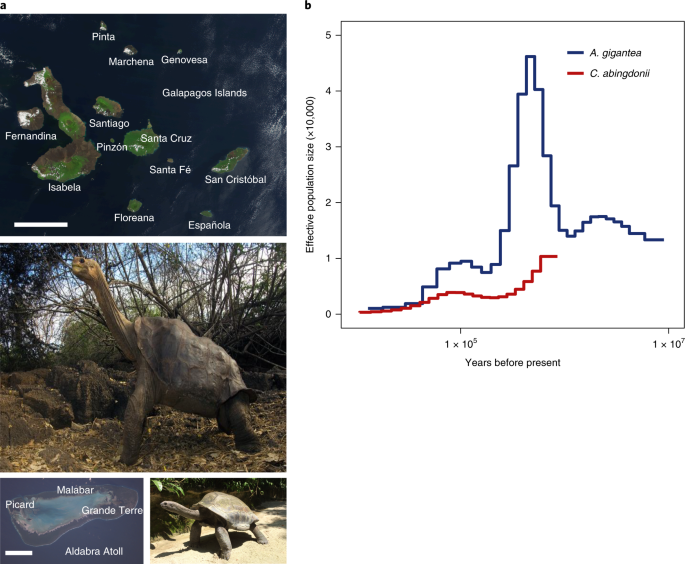
1.4). A preliminary analysis of demographic history using the pairwise sequentially Markovian coalescent (PSMC)
5 model showed that while the effective population size of
C. abingdonii
has been steadily declining for the past million years, with a slight
uptick about 90,000 years ago, the population of Aldabra giant tortoises
experienced substantial fluctuations over this period (Fig.
1b). Effective population size reconstructions for
C. abingdonii
lose statistical power at the million-year time frame, probably due to
complete coalescence. In turn, this suggests that overall diversity in
these giant tortoises must have been low throughout many generations.
Together, these results prompt us to propose that the populations of
these insular giant tortoises were vulnerable at the time of human
discovery of the Galapagos Islands, probably elevating their extinction
risk.
Using homology searches with known gene sets from humans and
Pelodiscus sinensis (the Chinese soft-shell turtle), along with RNA sequencing (RNA-Seq) data from
C. abingdonii blood and an
A. gigantea granuloma, we automatically predicted a primary set of 27,208 genes from the genome assembly using the MAKER2 algorithm
6.
We then performed pairwise alignments between each of the primary
predicted protein sequences and the UniProt databases for humans and
P.
sinensis, whose annotated sequences show relatively high quality when compared with data available for other turtles
7.
Using alignments spanning at least 80% of the longest protein and
showing more than 60% identity, we constructed sets of protein families
shared among these species. This preliminary analysis singled out
several protein families that seem to have undergone moderate expansion
in a common ancestor of
C. abingdonii and
A. gigantea. Almost all of these expansions were also confirmed in the genome of the related, long-lived tortoise
Gopherus agassizii (Supplementary Section
1.2 and Supplementary Table
4).
Most of these genes have been linked to exosome formation, suggesting
that this process may have been important in tortoise evolution.
We
also interrogated the predicted gene set for evidence of positive
selection in giant tortoises. This analysis singled out 43 genes with
evidence of giant-tortoise-specific positive selection (Supplementary
Section
1.2, Supplementary Table
5 and Supplementary Fig.
1). This list includes genes with known roles in the dynamics of the tubulin cytoskeleton (
TUBE1 and
TUBG1) and intracellular vesicle trafficking (
VPS35). Importantly, the analysis of genes showing evidence of positive selection also includes
AHSG and
FGF19, whose expression levels have been linked to successful ageing in humans
8. The role of both factors in metabolism regulation
9,10—another hallmark of ageing
11,12—suggests
that the specific changes observed in these proteins may have arisen to
accommodate the challenges that longevity poses on this system. The
list of genes with signatures of positive selection also features
TDO2,
whose inhibition has been proposed to protect against age-related
diseases through regulation of tryptophan-mediated proteostasis
13. In addition, we found evidence for positive selection affecting several genes involved in immune system modulation, such as
MVK,
IRAK1BP1 and
IL1R2.
Taken together, these results identify proteostasis, metabolism
regulation and immune response as key processes during the evolution of
giant tortoises via effects on longevity and resistance to infection.
Parallel
to this automatic analysis, we used manually supervised annotation on
more than 3,000 genes selected a priori for a series of
hypothesis-driven studies on development, physiology, immunity,
metabolism, stress response, cancer susceptibility and longevity
(Supplementary Section
1.3 and Supplementary Fig.
2).
We searched for truncating variants, variants affecting known motifs
and variants whose human counterparts are related to known genetic
diseases (Supplementary Section
1.3 and Supplementary Table
6).
These variants were first confirmed with the RNA-Seq data. Then, more
than 100 of the most interesting variants in terms of putative
functional relevance were also validated by PCR amplification followed
by Sanger sequencing. To this end, we used a panel of genomic DNA
samples of 11 different species of giant tortoises endemic to different
islands from the Galapagos Archipelago (Supplementary Section
1, Supplementary Table
7 and Supplementary Fig.
3).
The
manually supervised annotation of development-related genes showed the
complete conservation of the Hox gene set among giant tortoises, with
the exception of
HOXC3, which seems to have been lost in the radiation of Archelosauria
14,15 (Supplementary Section
2, Supplementary Table
8 and Supplementary Fig.
4).
BMP and
GDF gene families were also found to be conserved, although the duplication event that gave rise to
GDF1 and
GDF3 in mammals did not occur in turtles, birds and crocodiles. In contrast, we found a duplication of the ParaHox gene
CDX4
in giant tortoises, also present in other reptiles as well as avian
reptiles (birds). This annotation also showed the duplication of
WNT11 in turtles and chickens (but not in the lizard
Anolis carolinensis), and the specific duplication of
WNT4
in turtles. Given the roles of these duplicated genes and their
conservation in most vertebrate species, they could prove to be useful
candidates to study the morphological development of turtles,
particularly in relation to shell formation. Of note,
KDSR—one of the genes possibly under positive selection in giant tortoises—has been linked to hyperkeratinization disorders
16. Also, in this regard, we annotated 30 β-keratins in
C. abingdonii, 26 of which seem to be functional. These numbers are lower than those previously reported for β-keratins in other turtles
17. Finally, we did not find in
C. abingdonii or
A. gigantea any functional orthologues of genes specifically involved in tooth development (such as
ENAM, AMEL,
AMBN,
DSPP,
KLK4 and
MMP20).
This finding confirms a pattern in the evolutionary molecular
mechanisms for tooth loss, which seems to have been followed
consistently and independently across vertebrates. Taken together, these
results offer multiple candidates to study developmental traits in
tortoises (Supplementary Section
2 and Supplementary Figs.
5–
8).
In
most species, the immune function is an evolutionary driver that is
under strong selective pressure and has important implications in ageing
and disease
18.
The specific components and functionality of immune system components
in Reptilia, however, have not been extensively characterized beyond the
major histocompatibility complex (MHC)
19,20.
Our detailed analysis of 891 genes involved in immune function
consistently found duplications affecting immunity genes in giant
tortoises compared with mammals (Supplementary Section
3, Supplementary Table
9 and Supplementary Figs.
9–
13). We found a genomic expansion of
PRF1 (encoding perforin) in giant tortoises and other turtles, compared with chickens (one copy),
A. carolinensis (two copies) and most mammals (one copy). Both
C. abingdonii and
A. gigantea possess 12 copies of this gene (validated by Sanger sequencing), although three of them have been pseudogenized in
C. abingdonii.
In addition, we detected and validated, by Sanger sequencing, an
expansion of the chymase locus, containing granzymes, in giant tortoises
(Supplementary Section
3.1 and Supplementary Fig.
10).
Both expansions are expected to affect cytotoxic T lymphocyte and
natural killer functions, which play important roles in defence against
both pathogens and cancer
21,22.
Other concurrent expansions involve
APOBEC1,
CAMP,
CHIA and
NLRP
genes, which participate in viral, microbial, fungal and parasite
defence, respectively. These results suggest that the innate immune
system in turtles, and especially in giant tortoises, may play a more
relevant role than in mammals, consistent with the less important role
that adaptive immunity seems to play
19.
We found that class I and II MHC genes probably underwent a duplication
event in a common ancestor between giant tortoises and painted turtles (
Chrysemys picta bellii).
We also annotated 40 class III MHC genes, thus confirming the
conservation of this cluster in giant tortoises. The large number of MHC
genes in giant tortoises is consistent with the suggestion that
ancestors of archosaurs and chelonians did not possess a minimal
essential MHC as found in the chicken genome
20 (Supplementary Section
3.3, Supplementary Table
10 and Supplementary Figs.
14–
16).
Giant tortoises are at the upper end of the size scale for extant Chelonii, and have often been used as an example of gigantism
23. We analysed a series of genes involved in size regulation in vertebrates, most notably dogs (Supplementary Section
2, Supplementary Table
8 and Supplementary Fig.
6).
Our results on genes related to growth hormone, the insulin-like growth
factor (IGF) system and stanniocalcins suggest that these genes are
well conserved; therefore, additional size determinants may exist in
giant tortoises. As a complex phenotype, gigantism in tortoises is
expected to be caused by interactions between different genetic and
environmental factors. An interesting finding in this regard is the
presence of several gene variants in tortoises (including
G. agassizii) probably affecting the activities of glucose metabolism genes, such as
MIF (p.N111C; expected to yield a locked trimer) and
GSK3A
(p.R272Q in the activation loop). Given the roles of these positions in
the mammalian orthologues of these genes, tortoise-specific changes
could point to differences in the regulation of glucose intake and
tolerance (Supplementary Section
4, Supplementary Table
11, and Supplementary Figs.
17 and
18).
We also found expansions and inactivations in other genes involved in
energy metabolism. Thus, glyceraldehyde-3-phosphate dehydrogenase (
GAPDH)—a glycolytic enzyme with a key role in energy production, as well as in DNA repair and apoptosis
24—is expanded in giant tortoises. Conversely, the
NLN
gene encoding neurolysin is pseudogenized in tortoises. The loss of
this gene in mice has been related to improved glucose uptake and
insulin sensitivity
25.
Taken together, these results led us to hypothesize that genomic
variants affecting glucose metabolism may have been a factor in the
development of tortoises.
The analysis of genes related to the
stress response has also highlighted several putative variants in giant
tortoises affecting globins and DNA repair factors (Supplementary
Section
5, Supplementary Tables
12 and
13, and Supplementary Figs.
19–
22,
32 and
33). We found that, despite living terrestrially, giant tortoises conserve the hypoxia-related globin
GbX26.
Together with coelacanths, turtles, including giant tortoises, are the
only organisms known to possess all eight different types of globins
27. Consistent with this, we found in both giant tortoise genomes a variant in the transcription factor
TP53 (p.S106E) that has been linked to hypoxia resistance in some mammals and fishes
28.
The presence of the same residue in Testudines strongly suggests a
process of convergent evolution in the adaptation to hypoxia, probably
driven by an ancestral aquatic environment, which left this footprint in
the genomes of terrestrial giant tortoises.
An important trait of
large, long-lived vertebrates is their need for tighter cancer
protection mechanisms, as illustrated by Peto’s paradox
29,30.
In turn, this need for additional protection illustrates the deep
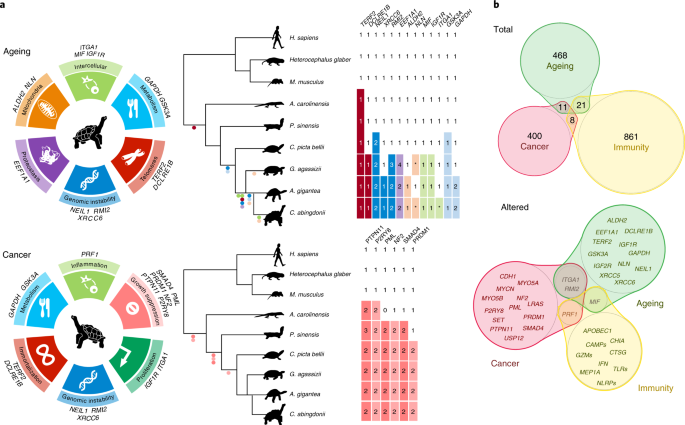
relationship and interdependence between cancer and longevity (Fig.
2). Notably, tumours are believed to be very rare in turtles
31.
Therefore, we analysed more than 400 genes classified in a
well-established census of cancer genes as oncogenes and tumour
suppressors
32.
Although most presented a highly conserved amino acid sequence when
compared with the sequences of other organisms, we uncovered alterations
in several tumourigenesis-related genes (Fig.
2a, Supplementary Section
6, Supplementary Table
14 and Supplementary Figs.
23–
29).
First, we found that several putative tumour suppressors are expanded
in turtles compared with other vertebrates, including duplications in
SMAD4,
NF2,
PML,
PTPN11 and
P2RY8. In addition, the aforementioned expansion of
PRF1, together with the tortoise-specific duplication of
PRDM1,
suggests that immunosurveillance may be enhanced in turtles. Likewise,
we found giant-tortoise-specific duplications affecting two putative
proto-oncogenes—
MYCN and
SET. Notably, the SET complex
mediates oxidative stress responses induced by mitochondrial damage
through the action of PRF1 and GZMA in cytotoxic T lymphocyte- and
natural killer-mediated cytotoxicity
33.
Taken together, these results suggest that multiple gene copy-number
alterations may have influenced the mechanisms of spontaneous tumour
growth. Nevertheless, further studies are needed to evaluate the genomic
determinants of putative giant-tortoise-specific cancer mechanisms.
Finally,
we selected, for manually supervised annotation, a set of 500 genes
that may be involved in ageing modulation (Supplementary Section
7 and Supplementary Table
15). The extreme longevity of giant tortoises is expected to involve multiple genes affecting different hallmarks of ageing
11.
We found several alterations in the genomes of giant tortoises that may
play a direct role in six of them, and impinge on other ageing
hallmarks and processes, such as cancer progression
34 (Fig.
2b).
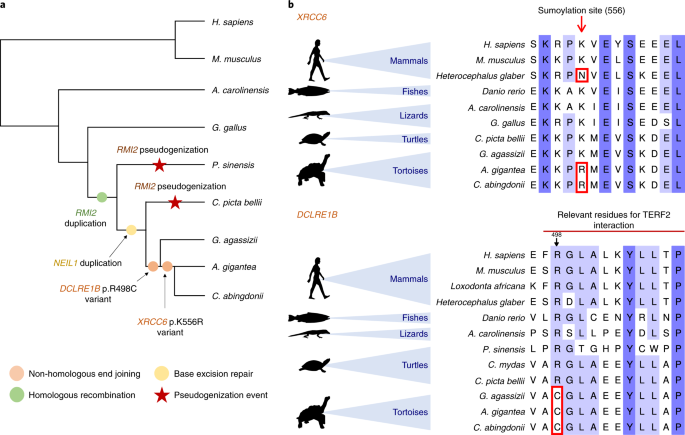
First, we identified changes in three candidate factors (NEIL1, RMI2
and XRCC6) related to the maintenance of genome integrity, a primary
hallmark of ageing
11 (Fig.
3a).
Thus, we found and validated a duplication affecting NEIL1, a key
protein involved in the base-excision repair process whose expression
has been linked to extended lifespans in several species
35. Likewise,
RMI2
is duplicated in tortoises, suggesting an enhanced ability to resolve
homologous recombination intermediates to limit DNA crossover formation
in cells
36.
In a preliminary exploration of this hypothesis, we overexpressed
NEIL1 and
RMI2 in HEK-293T cells and exposed the infected cells to a sublethal dosage of H
2O
2
or ultraviolet light, monitoring DNA damage by western blot analysis at
24 and 48 h after treatment. As shown in Supplementary Figs.
22,
32 and
33,
the expression of both genes results in reduced levels of
phosphorylated histone H2AX and cleaved poly (ADP-ribose) polymerase
(PARP), suggesting reduced levels of DNA damage
37.
In turn, this result is consistent with the hypothesis that NEIL1 and
RMI2 levels may regulate the strength of DNA repair mechanisms. Also in
relation to DNA repair mechanisms, we identified and validated a variant
affecting
XRCC6—encoding a helicase involved in non-homologous
end joining of double-strand DNA breaks—which may affect a known
sumoylation site (p.K556R). This lysine is conserved in diverse
vertebrates but, notably, is changed in giant tortoises, and also in the
naked mole rat (p.K556N), the longest-lived rodent, which suggests a
putative process of convergent evolution (Fig.
3b).
Since sumoylation is induced following DNA damage and plays a key role
in DNA repair response and multiple regulatory processes
38,
this variant may reflect selective pressures acting on the regulation
of the repair of double-strand DNA breaks in long-lived organisms
(Supplementary Section
5.5).
Regarding telomere attrition—another primary hallmark of ageing
11—we
uncovered in giant tortoises one variant in DCLRE1B (p.R498C)
potentially affecting its binding interface with telomeric repeat
binding factor 2 (TERF2) (Fig.
3b and Supplementary Section
7.2). This change, together with the aforementioned variants affecting DNA repair genes that may also impinge on telomere dynamics
39,40,41,
highlights the relevance of telomere maintenance as a regulatory
mechanism of longevity in tortoises. Moreover, we found changes
potentially affecting proteostasis (Fig.
2a). We independently found specific expansions of the elongation factor gene
EEF1A1 in
C. abingdonii,
A. gigantea and
G. agassizii, as described with the automatic annotation. Importantly, overexpression of
EEF1A1 homologues in
Drosophila melanogaster has been linked to an increased lifespan in this species
42.
Over
time, nutrient sensing deregulation—another hallmark of ageing—can
result from alterations in metabolic control mechanisms and signalling
pathways
12. The aforementioned variant affecting the activation loop of GSK3A (Supplementary Section
4.1), which is present in
C. abingdonii and all tested tortoises from the Galapagos Islands and Aldabra Atoll, as well as their continental outgroups,
G. agassizii and
C. picta bellii, may be involved in the maintenance of glucose homoeostasis. Interestingly, the inhibition of GSK3 can extend lifespan in
D. melanogaster43.
Likewise, the identified alterations in other giant tortoise genes
implicated in glucose metabolism, such as the aforementioned
inactivation of
NLN, may provide interesting candidates to study nutrient sensing in these long-lived species (Supplementary Section
7.4).
Regarding
the mitochondrial function, we found two variants (p.Q366M and p.M487T)
potentially affecting the function of ALDH2, a mitochondrial aldehyde
dehydrogenase involved in alcohol metabolism and lipid peroxidation,
among other detoxification processes
44.
Notably, the p.Q366M variant, which may alter the NAD-binding site of
ALDH2, is exclusively found in Galapagos giant tortoises, but not in
their continental close relative
Chelonoidis chilensis, nor in
the more distantly related Aldabra or Agassiz’s tortoises. Thus, these
changes could also alter the detoxification process and contribute to
pro-longevity mechanisms. Together with the above described specific
alterations in other genes of giant tortoises, such as
NLN and
GAPDH, which encode enzymes associated with mitochondrial functions
45,46, these variants may also impinge on mitochondrial dysfunction, an antagonistic hallmark of ageing
11 (Supplementary Section
7.5).
We have also found evidence in tortoises of some variants related to altered intercellular communication (Supplementary Section
7.6 and Supplementary Fig.
30), an integrative hallmark of ageing
11. Thus, we have detected exclusively in
C. abingdonii a premature stop codon affecting
ITGA1
(p.R990*), an essential integrin involved in cell–matrix and cell–cell
interactions. In addition, the aforementioned variant affecting
MIF
is also expected to cause the formation of inactivating interchain
disulfide bonds, inhibiting intracellular signalling cascades
47.
Moreover,
MIF
deficiency reduces chronic inflammation in white adipose tissue and
expands lifespan, especially in response to caloric restriction
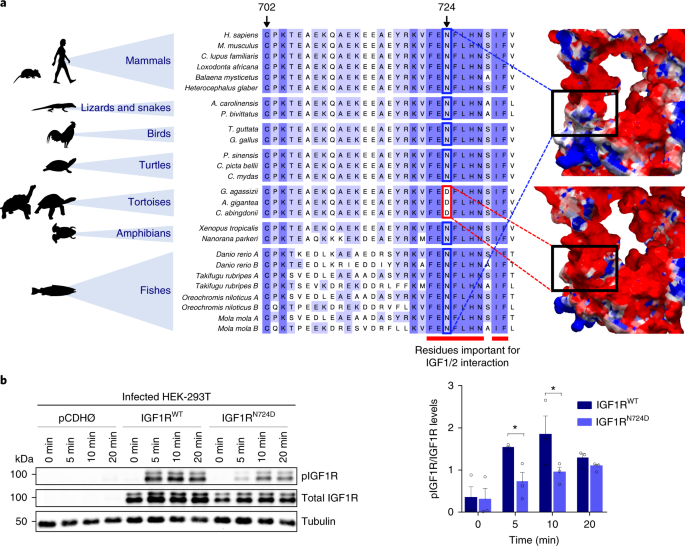
48,49. Finally, we have annotated a specific variant in
IGF1R that is expected to affect the interaction between this receptor and the IGF1/2 growth factors
50. Notably, a homology model of this region in IGF1R in
C. abingdonii
suggests that position 724 is located at the surface of the protein,
and the presence of an aspartic acid residue changes the local
electrostatic field (Fig.
4a). The extended lifespan in different species correlates with IGF signalling decrease
51,52, which suggests that this unique change in
IGF1R
may provide an attractive target to study the cellular mechanisms
underlying the exceptional lifespan of these animals. To explore the
functional consequences of differential IGF1 signalling caused by the
p.N724D variant found in the IGF1 receptor (IGF1R), we infected HEK-293T
cells with pCDH, pCDH-IGF1R
WT and pCDH-IGF1R
N724D
plasmids.
Cells expressing the mutant receptor showed an attenuation of
IGF1 signalling, compared with those expressing the wild-type protein,
measured as a significant reduction in the phosphorylation levels of
IGF1R at 5 min (95% confidence interval of difference: 0.1119–1.5330,
t = 2.454,
P = 0.026) and 10 min (95% confidence interval of difference: 0.1991–1.6200,
t = 2.714,
P = 0.0153) after IGF1 treatment (Fig.
4b, Supplementary Section
7.6.2 and Supplementary Fig.
31). According to a two-way analysis of variance, the exogenous IGF1R form accounted for 16.07% of total variation (
F1,4 = 20.91,
P = 0.0102), while time accounted for 44.23% of total variation (
F3,12 = 6.57,
P = 0.0071). Interestingly, we also found in tortoises a short deletion in the coding region of
IGF2R that results in the loss of two amino acids. The fact that
IGF2R variants have been associated with human longevity
53
opens the possibility that the variant found in tortoises could also
contribute to increasing the lifespan of these long-lived animals.
In
summary, in this work, we report the preliminary characterization of
giant tortoise genomes. We complemented the automatic annotation of
genomes from two giant tortoise species with a hypothesis-driven
strategy using manually supervised annotation of a large set of genes.
The analysis of the resulting sequences offers candidate genes and
pathways that may underlie the extraordinary characteristics of these
iconic species, including their development, gigantism and longevity. A
better understanding of the processes that we have studied may help to
further elucidate the biology of these species and therefore aid the
ongoing efforts to conserve these dwindling lineages. Lonesome
George—the last representative of
C. abingdonii, and a renowned
emblem of the plight of endangered species—left a legacy including a
story written in his genome whose unveiling has just started.