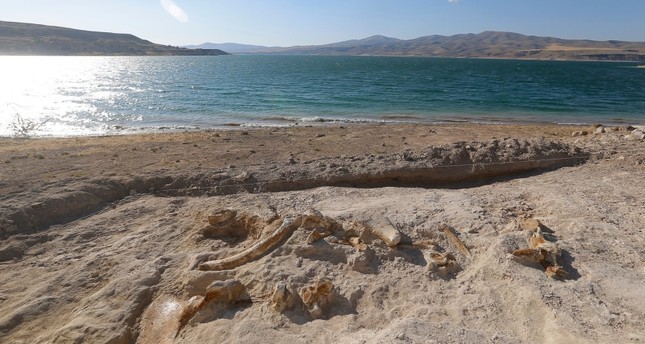
Fóssil de girafa de 7,5 milhões de anos descoberto no centro da Turquia
SABAH DIÁRIA
ISTAMBUL
Publicado em05.07.201917:44
Foto de AA
Um fóssil de girafa de 7,5 milhões de anos foi descoberto em Kayseri,
no centro da Turquia, informou o município em um comunicado na
sexta-feira.
O fóssil da girafa foi desenterrado perto da barragem de Yamula, no
bairro de Taşhan, durante trabalhos de escavação, que foram lançados
depois que um pastor descobriu outro fóssil animal na área.
O antropólogo Özge Kahya, do Departamento de Paleoantropologia da
Universidade de Ankara, disse ter encontrado fósseis de milhões de anos
pertencentes a elefantes, girafas, cavalos e rinocerontes na área.
Novos achados arqueológicos na área incluem um fóssil da mandíbula
superior de uma girafa e os vertebrados e escápula de elefantes,
descobertas que também atraíram a atenção de cientistas em todo o mundo.
A geóloga Matti Lehikoinen, da Universidade de Helsinque, na Finlândia,
a geomorfóloga Maud Meijer, do Instituto de Ciências Naturais de
Frankfurt, na Alemanha, e Faisal Bibi, do Museu de História Natural de
Berlim, disseram que logo vão à cidade para ver e examinar os fósseis.
Trabalhos de escavação continuarão na área até que os fósseis
remanescentes sejam descobertos e, após a conclusão, a área será aberta
aos visitantes, informou o prefeito da Prefeitura Metropolitana de
Kayseri, Memduh Büyükkılıç, em um comunicado.
Nichollsia borealis on display
at the Royal Tyrrell Museum in Drumheller, Alberta. This plesiosaur
swam in the Cretaceous seas over what is now part of North America.
Credit: Royal Tyrrell Museum
With the 200th anniversary of the birth of Charles Darwin this week,
people around the world are celebrating his role as the father of
evolutionary theory. Events and press releases are geared, in part, to
combat false claims made by some who would discredit the theory.
One frequently cited "hole" in the theory: Creationists claim there are
no transitional fossils, aka missing links. Biologists and
paleontologists, among others, know this claim is false.
As key evidence for evolution and species' gradual change over time,
transitional creatures should resemble intermediate species, having
skeletal and other body features in common with two distinct groups of
animals, such as reptiles and mammals, or fish and amphibians.
These animals sound wild, but the fossil record — which is far from
complete — is full of them nonetheless, as documented by Occidental
College geologist Donald Prothero in his book "Evolution: What the
Fossils Say and Why It Matters" (Columbia University Press, 2007).
Prothero discussed those fossils last month at the American Museum of
Natural History in New York, along with transitional fossils that were
announced since the book was published, including the "fishibian" and
the "frogamander."
At least hundreds, possibly thousands, of transitional fossils have been
found so far by researchers. The exact count is unclear because some
lineages of organisms are continuously evolving.
Here is a short list of transitional fossils documented by Prothero and
that add to the mountain of evidence for Charles Darwin's theory. A lot
of us relate most to fossils of life closely related to humans, so the
list focuses on mammals and other vertebrates, including dinosaurs.
Mammals, including us
It is now clear that the evolutionary tree for early and modern humans
looks more like a bush than the line represented in cartoons. All the
hominid fossils found to date form a complex nexus of specimens,
Prothero says, but Sahelanthropus tchadensis, found in 2001 and
2002, threw everyone for a loop because it walked upright 7 million
years ago on two feet but is quite chimp-like in its skull size, teeth,
brow ridges and face. It could be a common ancestor of humans and
chimpanzees, but many paleoanthropologists will remain unsure until more
fossils are found. Previously, the earliest ancestor of our Homo genus
found in the fossil record dated back 6 million years.
-Most fossil giraffes have short necks and today's have long necks, but
anatomist Nikos Solounias of the New York Institute of Technology's New
York College of Osteopathic Medicine is preparing a description of a
giraffe fossil, Bohlinia, with a neck that is intermediate in length.
Manatees, also called sea cows, are marine mammals that have flippers
and a down-turned snout for grazing in warm shallow waters. In 2001,
scientists discovered the fossil of a "walking manatee," Pezosiren portelli,
which had feet rather than flippers and walked on land during the
Eocene epoch (54.8 million years ago to 33.7 million years ago) in what
is now Jamaica. Along with skull features like manatees (such as
horizontal tooth replacement, like a conveyor belt), it also had heavy
ribs for ballast, showing that it also had an aquatic lifestyle, like
hippos.
Scientists know that mastodons, mammoths and elephants all share a
common ancestor, but it gets hard to tell apart some of the earliest
members of this group, called proboscideans, going back to fossils from
the Oligocene epoch (33.7 million years ago to 23.8 million years ago).
The primitive members of this group can be traced back to what Prothero
calls "the ultimate transitional fossil," Moeritherium, from
the late Eocene of Egypt. It looked more like a small hippo than an
elephant and probably lacked a long trunk, but it had short upper and
lower tusks, the teeth of a primitive mastodon and ear features found
only in other proboscideans.
The Dimetrodon was a big predatory reptile with a tail and a
large sail or fin-back. It is often mistaken for a dinosaur, but it's
actually part of our mammalian lineage and more closely related to
mammals than reptiles, which is seen in its specialized teeth for
stabbing meat and skull features that only mammals and their ancestors
had. It probably moved around like a lizard and had a jawbone made of
multiple bones, like a reptile.
Dinosaurs and birds
The classic fossil of Archaeopteryx, sometimes called the
first bird, has a wishbone (fully fused clavicle) which is only found
in modern birds and some dinosaurs. But it also shows impressions from
feathers on its body, as seen on many of the theropod dinosaurs from
which it evolved. Its body, capable of flight or gliding, also had many
of dinosaur features — teeth (no birds alive today have teeth), a long
bony tail (tails on modern birds are entirely feathers, not bony), long
hind legs and toes, and a specialized hand with long bony fingers
(unlike modern bird wings in which the fingers are fused into a single
element), Prothero said.
Sinornis was a bird that also has long bony fingers and teeth, like those seen in dinosaurs and not seen in modern birds.
Yinlong is a small bipedal dinosaur which shares features with
two groups of dinosaurs known to many kids — ceratopsians, the beaked
dinosaurs like Triceratops, and pachycephalosaurs, known for having a thick dome of bone in their skulls protecting their brains. Yinlong has
the thick rostral bone that is otherwise unique to ceratopsians
dinosaurs, and the thick skull roof found in the pachycephalosaurs.
Anchisaurus is a primitive sauropod dinosaur that has a lot of
lizard-like features. It was only 8 feet long (the classic sauropods
later on could be more than 100-feet long), had a short neck (sauropods
are known for their long necks, while lizards are not), and delicate
limbs and feet, unlike dinosaurs. Its spine was like that of a sauropod.
The early sauropods were bipedal, while the latter were stood on all
fours. Anchisaurus was probably capable of both stances, Prothero wrote.
Fish, frogs, turtles
Tiktaalik, aka the fishibian or the fishapod, is a large
scaled fish that shows a perfect transition between fins and feet,
aquatic and land animals. It had fish-like scales, as well as fish-like
fin rays and jaw and mouth elements, but it had a shortened skull roof
and mobile neck to catch prey, an ear that could hear in both land and
water, and a wrist joint that is like those seen in land animals.
Last year, scientists announced the discovery of Gerobatrachus hottorni,
aka the frogamander. Technically, it's a toothed amphibian, but it
shows the common origins of frogs and salamanders, scientists say, with a
wide skull and large ear drum (like frogs) and two fused ankle bones as
seen in salamanders.
A creature on the way to becoming a turtle, Odontochelys semistestacea, swam around in China's coastal waters 200 million years ago. It had a belly shell but its back was basically bare of armor. Odontochelys
had an elongated, pointed snout. Most modern turtles have short snouts.
In addition, the roof of its mouth, along with the upper and lower
jaws, was equipped with teeth, which the researchers said is a primitive
feature for turtles whose mugs are now tipped with beaks but contain no
teeth.