If you’ve ever visited a natural history museum, you might have seen a
grand skeleton tower over you, with giant tusks gently sloping to the
sky and a shape reminiscent of an elephant. Perhaps you thought
immediately of a woolly mammoth, the most famous elephant relative,
popularized by Manny, the grumpy mammoth in Ice Age. However, there is another relative that you most certainly have also heard of: the mastodon.
Although similar, there are key differences between mammoths and mastodons. An impressive mammoth skeleton. Image credits: Kelley Minars.
First of all, mastodons came into existence much earlier, about 27 to 30 million years ago. Mammoths are “young” by comparison, having emerged a mere 5.1 million years ago in Africa.
There were multiple mammoth species, but the famous woolly mammoth is
the baby of the bunch, emerging only 250,000-400,000 years ago.
Mammoths could be found across Eurasia and North America. Mastodons were not so widespread and called North and Central America their home (still a considerable area considering that they could be found from Alaska to central Mexico).
Although mammoths preferred cooler temperatures and mastodons
preferred warmer temperatures, they both lived in Beringia, the land
between East Siberia and Alaska that wasn’t covered by ocean during the
Ice Ages.
They lived there at the same time during the early to
mid-Pleistocene, but the mastodons left because it got too chilly for
them. Mammoths still survived in Beringia until 13,000 years ago, and a
subset that evolved to be small (about the size of a large horse) survived on arctic islands until as recently as 4,000 years ago.
To put it into perspective, the Great Pyramid was being constructed
around the same time mini mammoths were ruling an arctic island — as
crazy as it sounds, mammoths and the pyramids were around around at the
same time (for a brief period).
Lifestyle differences
Mammoths and mastodons led different lifestyles and their appearance reflects these differences.
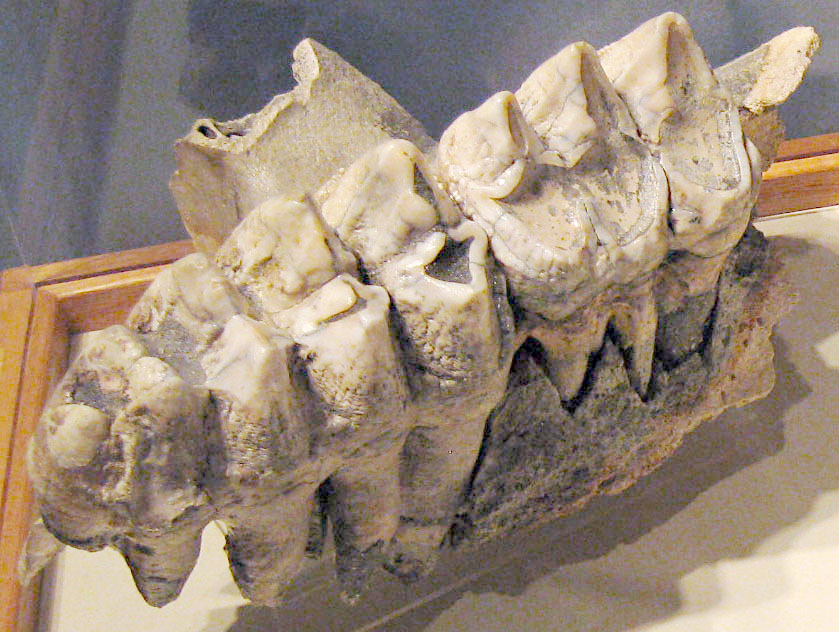
Mastodons lived mainly in forests. Accordingly, their teeth have
cone-shaped cusps, perfect for crushing leaves and twigs. Sometimes, the
plants that animals eat are also preserved alongside their fossil
remains. Researchers who have quantified mastodon gut contents have
found a lot of twigs from coniferous trees, while another study found
mostly low, herbaceous vegetation in their guts. Therefore, they likely
browsed and grazed, changing their preference based on the season and where they were.
A mastodon depicted in its forest habitat. Image credits: Heinrich Harder (1858-1935).
On the other hand, mammoths are much more closely related to
modern-day elephants than mastodons, and lived a similar lifestyle. They
also used to live on large, open plains and had flat teeth with ridges for grazing.
Elephants also have similarly shaped teeth. Mammoths mostly ate
flowering plants because they contain more protein and are easier to
digest than grasses. Some species of mammoth also munched on other types
of vegetarian fare, such as cactus leaves, trees, and shrubs.
Physical differences between mammoths and mastodons
Though mammoths and mastodons were both large, hairy, elephant-like
creatures, they did have some differences other than their tooth shape.
Mastodons were a bit shorter and stockier.
Since mammoths tended to live in colder climates, they had fatty humps
where they stored extra nutrients necessary to survive the long, frigid
winters and warmer fur coat. Mammoth tusks curved more while mastodon tusks were straighter and shorter.
Mammoths had a distinctive bump at the top of their skulls while mastodons had flatter heads.
There were multiple species of mammoth (not just the woolly mammoth!)
and mastodon that varied slightly in different aspects of their
appearance — skeletal and dental differences, for example.
A face-to-face comparison of the mammoth (left) and mastodon (right). Image credits: Dantheman9758.
Extinction
Although mastodons evolved earlier than mammoths, both went extinct at a similar time, about 10,000 years ago.
There is some disagreement between experts about what exactly brought
about the demise of these gentle giants — but there are two prevailing
theories.
The first is that they were unable to survive due to increasing temperatures
after the end of the last ice age 12,000 years ago. Glaciers retreated
and sea levels rose, with the warmer temperature causing the environment
to change. Forests grew up where open woodland and grasslands had been.
The arctic tundra and steppe were dominated by flowering plants, but
when the climate became wetter and warmer, they were replaced by
grasses, which were not so nutritious or easy to digest for mammoths.
However, some researchers argue that similar warming periods had
occurred over the past several million years within the ice age without
such disastrous consequences. Therefore, the second theory is that
someone new on the scene played a large role in their demise, more specifically, humans.
There is evidence that Homo erectus ate mammoth meat 1.8 million years ago, but this could be a result of scavenging as opposed to active hunting.
Some sites created in the past 50,000 years in Eastern Europe and
Britain present further evidence that humans hunted mammoths: dwellings
made from mammoth bones and mammoth remains. The spread of more skilled
human hunters around Eurasia and North America coincided with the
disappearance of mammoths and mastodons. However, these creatures lived
across such an enormous area, including remote areas of Siberia, that it
is uncertain if humans with primitive weapons would have been able to
decimate them.
It is more likely that the combination of a changing climate and
human hunters led these giants to their end. The shrinking of suitable
areas to live likely caused many to die out, rendering the remaining
populations more vulnerable.
All in all, mammoths and mastodons lived different lifestyles, but
still looked quite similar, except for some special adaptations for
their diet and climate. They also share similar causes for their demise.
Now, on your next visit to the natural history museum, see if you can
guess if that big, tusked skeleton is a mammoth or mastodon.
Information for this post courtesy of SANParks Over thirty years ago seven impressive elephant bulls, all
with tusks weighing more than 50 kg each, could be found in Kruger
National Park.
Dr. U de V Pienaar – the Chief Warden at the time – decided to
publicise these elephants as a successful example of Kruger’s
conservation work.
He named these bulls The Magnificent Seven… Over time
the tuskers became well-known, and now, many years later, they are
still remembered as some of the most glorious animals in Africa.
These are their stories:
Dzombo (c.1935–1983)
The word Dzombo is derived from the Tsonga word
Dzombolo meaning ‘to wait for something that is slow in coming’. This
elephant was named after the Dzombo stream that traverses the Mopani
Flats between the Shingwedzi and Shawu valleys.
Dzombo was the only one of the “Magnificent Seven” to
be killed by poachers and it was only by a stroke of luck that Dzombo’s
two tusks were not taken. He died in a hail of bullets from an AK 47
fired by a poacher from Mozambique in October 1985. The miscreants were
in the act of chopping out the tusks when they were disturbed by the
approach of Ranger Ampie Espag and fled leaving their trophies behind.
Dzombo met an untimely death at the age of 50 years. (Dzombo’s tusks are on display in the Letaba Elephant Hall)
João (date unknown)
Named by Anthony-Hall Martin for Prester John,
legendary priest-king of ancient Africa. (João being the Portuguese for
‘John’) João was a very large bull, with a shoulder height of 340cm.
João was wounded by poachers in 1982, at this time he
was immobilized to investigate the damage. Fortunately the wounds were
not fatal, and after a dose of antibiotics and cleaning of the wounds he
was revived. While immobilized he was fitted with a radio collar and
measurements of his tusks taken, he tusks were an estimated combined
130kg which at the time would have made him the heaviest ivory carrier
of the Magnificent Seven.
In 1984 (approximate age, 45 years) João broke both
tusks close to the lip line (20-30cm), presumably in a fight with
another bull. Unfortunately the pieces were never found and as a result
João is the only member of the Magnificent Seven who is not represented
in the Letaba Elephant Hall.
Kambaku (c.1930-1985)
Kambaku is the Tsonga word for ‘Great Tusker’ or ‘Old
Elephant Bull’.This bull moved over a huge tract of country stretching
from Satara/Orpen and the Timbavati to Crocodile Bridge.Kambaku’s left
ear had a perfectly round hole in it close to the outer edge, and
towards the end of his life he had no tail hairs.Kambaku was the third
member of the Magnificent Seven.
Uniquely unlike several of the other Magnificent
Seven bull, Kambaku was always seen alone. He was more than 55-years-old
when he was shot in late 1985 by Regional Ranger Lynn van Rooyen from
the Lower Sabie Ranger Section. The bull was in obvious pain from a
bullet wound suffered during a foray across the Crocodile River into a
neighboring sugar cane fields. The bullet penetrated his left shoulder,
leaving a large wound which eventually became septic. When he could not
longer walk and it was clear that death was imminent, he was mercifully
shot. (Kambaku’s tusks are on display in the Letaba Elephant Hall)
Mafunyane (Carcass discovered 16th November 1983)
This bull was named after former warden of the Kruger
National Park Lou Steyn who was well known for his quick temper.
(Mafunyane is the Tsonga word for ‘the irritable one’ which
appropriately refers to the elephant’s disdain for, and intolerance of
humans.)
(Kloppers & Bornman (2005) (A Dictionary of KNP Place Names) gives the meaning of the name as “One who eats greedily”)
Mafunyane’s tusks are fairly straight and their tips
are worn to a chisel-edge by as a result of being rubbed on the ground
as he moved. His tusks were perfectly symmetrical and of identical
length and mass. The bull had a 10cm hole in the right side of his skull
that extended into his nasal cavity allowing him to breathe through
this passage. One of his toes on his left hind foot was splayed to one
side so that he left a distinctive impression, distinguishable from
other elephants.
Mafunyane was the most famous of the “Magnificent
Seven” although he was only seen in the wild by a handful of people, and
was rarely seen by visitors as he kept well away from roads. This could
be attributed to his shyness or to the fact that he chosen roaming area
was very remote.
The immobilization of Mafunyane on the 8 June 1983 to
fit a radio collar and to make plaster cases of the bull’s ivory nearly
spelled the end for this bull. When given the antidote to the
immobilization drugs Mafunyane due to his immense tusk size was unable
to ‘rock’ himself onto his chest which would have allowed him to stand
up, and his repeated efforts caused him to dig his tusks further into
the ground. Several strategies were tried to raise him but all failed.
After he had been down for several hours and front end loader was
brought into assist the team. Mafunyane was eventually ‘scooped’ to his
feet and the bull rose and ran into the nearby Mopane bushes much to the
relief of the capture team.
Mafunyane’s remains were found on 16 November 1983
near Tari River, Northwest of Shingwedzi. He had been dead for
approximately 3-4weeks and appeared to have died of natural causes. He
was about 57 years old when he died. (Mafunyane’s tusks are on display in the Letaba Elephant Hall)
Ndlulamithi (c.1927–1985)
Ndlulamithi earned his name from his appearance, which is a traditional Tsonga word meaning “taller than the trees”.
The handsomely curved tusks of Ndlulamithi, the left one sweeping low
and well forward, are significantly more twisted than those of the other
large bulls. He was considered a tall Elephant probably around 340 –
345cm high at the shoulder.
Ndulamithi was first identified in 1980 along the
Nkokodzi River in northern Kruger National Park. He was an aggressive
yet secretive elephant, and was seldom seen. This bull received some
fame for charging Dr Anthony Hall-Martin and his assistant while they
were trying to photograph him on foot, his intentions unmistakable. He
died of natural causes in 1985 in the Shangoni area at an estimated 58
years of age. Paul Zway section ranger of Shangoni at the time found his
remains not far from the Nkokodzi Spruit. (Ndulamithi’s tusks are on display in the Letaba Elephant Hall)
Shawu (October 1982)
The “Shawu Bull” was named after the Shawu valley (Vlei) in which he spent much of his life.
Shawu moved over a large range which spanned the flat
Mopani covered plains country between the Letaba and Shingwedzi rivers
and stretched from the main road to Lebombo Hills. He did not however,
cover this enormous area regularly, but drifted around slowly, taking
about 6 months to move from South to North.Shawu’s tusks are the longest
on record in the Kruger National Park and one of the 6th longest to
ever come out of Africa.
Shawu was a fairly approachable animal and showed no
particular fear or distrust of vehicles. He was a large bull having a
shoulder height of 340cm. Due to the pincer formed by his large tusks he
was sometimes referred to in Afrikaans as “Groot Haaktand”. In 1981 it
was decided to fit Shawu with a collar as poaching was a constant threat
from Mozambique, this was successfully and he was monitored on a
regular basis.
Shawu died of old age in the Kostini area east of
Shingwedzi, near the northern watershed of the Shawu Valley (Vlei) in
October 1982. He had been ill for some time and his condition and
movements were monitored daily towards the end of his life by means of a
radio transmitter which had been fitted in a collar around his neck. He
was close to 60 years old when he died. (Shawu’s tusks are on display in the Letaba Elephant Hall)
Shingwedzi (c.1934-1981)
Shingwedzi was named after the river and rest camp
where he spent the last few years of his life. (Shingwedzi means, “place
of ironstone” referring to the gabbro rock outcrops common to the area.
Shingwedzi is derived from the Tsonga word Ngwetse which means ‘the
sound of metal objects rubbing against each other’).Shingwedzi’s ivory
offers a good example of the classic master servant tusks. He had a
large right servant tusk and a shorter left master tusk.
Shingwedzi was found dead under a Sycamore Fig and
short distance from Shingwedzi camp in January 1981, and as far as can
be determine he died of natural causes. The age of an Elephant can be
fairly accurately determined from the state of wear of the teeth. In the
case of Shingwedzi the last molar (molar 6) was well worn down, giving
him an estimated age of 65 (56) years. (Shingwedzi’s tusks are on display in the Letaba Elephant Hall)