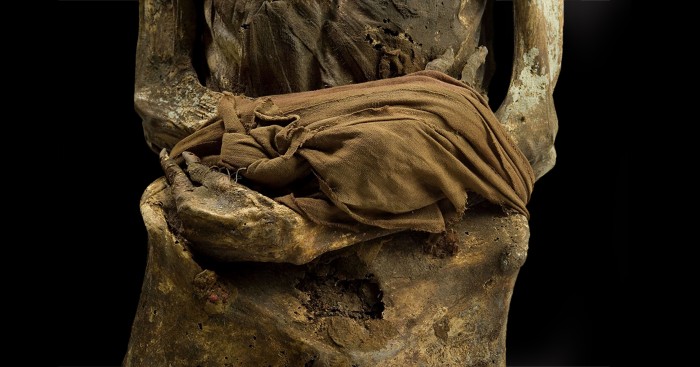
A múmia peruana apelidada de "mulher com as pernas cruzadas" segura os dentes de leite das crianças nas mãos entrelaçadas. Crédito: Jean Christen / REM
Múmias: Segredos da VidaReiss Engelhorn Museum, Mannheim, Alemanha Até 31 de março de 2019 Ela é conhecida como a "mulher de pernas cruzadas": os restos de um peruano que morreu há cerca de 600 anos. Como acontece com muitas múmias daquela parte do mundo, seus braços também estão cruzados. Incomumente, suas mãos estão entrelaçadas.
Graças à pesquisa do German Mummy Project, agora sabemos o que ela
estava segurando - não jóias preciosas, mas dentes de leite de uma
criança.
Esta múmia é exibida com mais de 50 pessoas de todo o mundo em uma nova
exposição no Museu Reiss Engelhorn, em Mannheim, na Alemanha.
Múmias: Segredos da Vida é construído em torno da ciência que foi
aplicada às múmias, e o que ela revelou sobre vidas e mortes há muito
esquecidas.
O Projeto Múmia Alemã é uma iniciativa de pesquisa internacional
lançada em 2004, depois que 19 corpos embrulhados e preservados da
América do Sul foram descobertos em caixas não identificadas no porão do
museu durante uma reforma. Eles tinham sido apressadamente escondidos e colocados em segurança durante os bombardeios aliados na Segunda Guerra Mundial; no caos do pós-guerra, seu retorno foi esquecido.
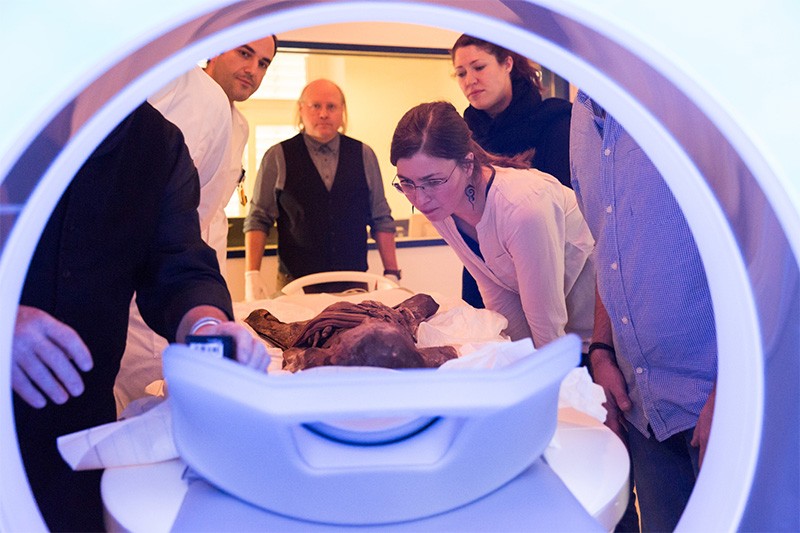
Pesquisadores da Universidade de Mannheim, na Alemanha, preparam-se para escanear uma múmia.Crédito: Maria Schumann / REM
Desde sua redescoberta, pesquisadores de vários países europeus têm
colaborado para examiná-los, juntamente com mais de 100 múmias de
diferentes origens realizadas em várias coleções.
Eles usaram datação de carbono, análise genética e radiologia de ponta,
entre outras tecnologias, para revelar pistas sobre indivíduos que
viveram centenas, às vezes milhares, de anos atrás. Há muitas maneiras de se mumificar ou se tornar mumificado, como mostra a exposição. Corpos deixados em um deserto secam rapidamente.
O frio intenso tem um efeito similar, como mostra o 'Iceman' Ötzi, de
5.400 anos de idade, encontrado no alto dos Alpes italianos.
Pântanos fornecem ambientes anaeróbicos que impedem a decadência: um pântano ácido preserva a pele, mas dissolve os ossos; um alcalino faz o oposto.
Algumas civilizações, principalmente os antigos egípcios, usavam
substâncias químicas para ajudar a retardar o colapso de um cadáver com,
digamos, sais e resina. Mais tarde, as pessoas usaram misturas contendo formalina.
Hoje, o anatomista Gunther von Hagens e suas controversas exibições da
Body Worlds popularizaram o processo de plastinação que substitui a água
e a gordura no tecido por polímeros.
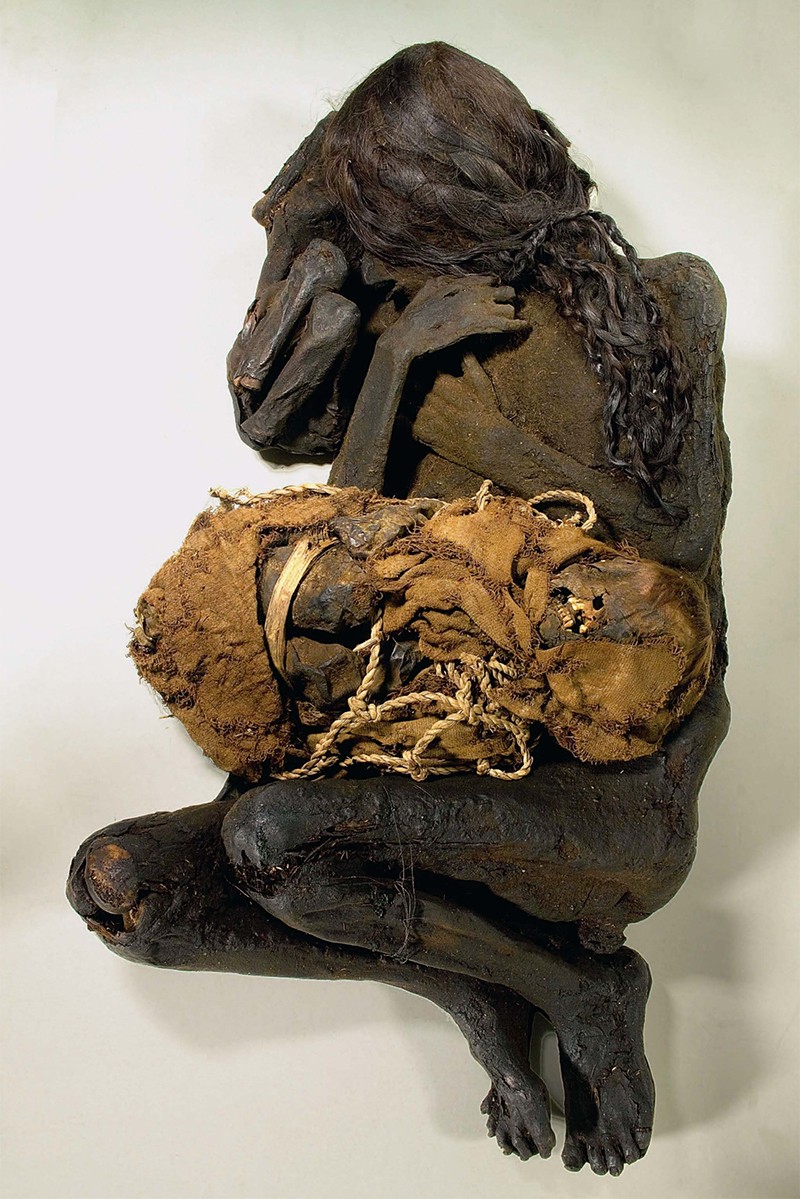
Os restos mumificados de uma mulher e duas crianças do Chile.Crédito: Jean Christen / REM
Entre as mais extensamente estudadas das redescobertas estão os restos
de uma mulher com dois filhos pequenos, um deitado sobre o estômago.
Os antropólogos supunham que a criança havia sido colocada lá há
relativamente pouco tempo, porque seu tecido de fixação parecia muito
mais fresco na cor do que os dos outros corpos.
Mas a datação por carbono e a tomografia computadorizada (TC) mostraram
que todos os três datavam do período medieval, antes de os europeus
entrarem na América do Sul; que a mulher provavelmente morreu aos 30 anos; e que as crianças eram crianças. Uma amostra do intestino da mulher mostrou vestígios da bactéria Helicobacter pylori , causadora de doenças gástricas, e da arracacha, uma raiz vegetal andina.
Em julho, a equipe descobriu que a criança mais nova tinha uma caixa
excessivamente expandida e um bloqueio em sua traqueia, indicando que
ela provavelmente morreu engasgada.
Uma amostra do material estranho está sendo submetida a análises
histológicas e moleculares no Instituto de Estudos da Múmia em Bolzano,
Itália (a cidade em que Ötzi repousa).
Albert Zink, diretor do Instituto, diz que a identificação deve ser
concluída a tempo de atualizar a exposição antes que ela termine. A equipe identificou causas plausíveis de morte em outros restos mortais.
Uma tomografia computadorizada de um homem de meia-idade do Egito que
morreu há cerca de 2.000 anos, por exemplo, indicava um provável tumor
da glândula pituitária, que normalmente leva ao excesso de secreção do
hormônio do crescimento. O exame mostrou as características faciais espessas e as mãos e os pés aumentados, típicos do distúrbio.
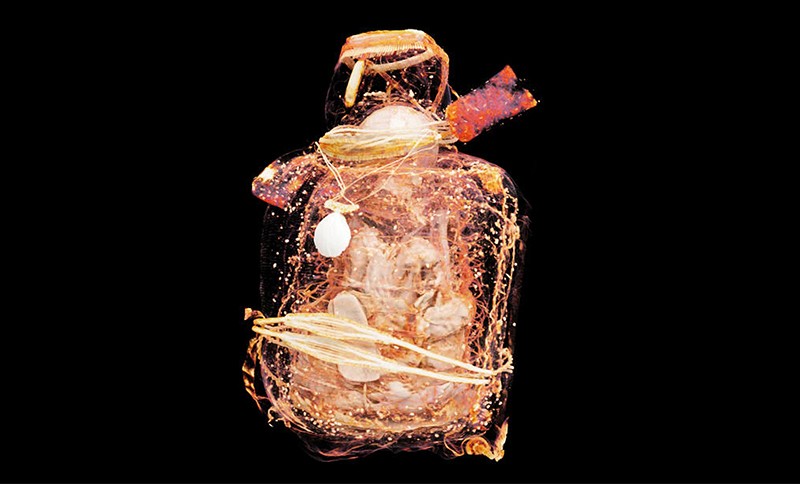
A
tomografia computadorizada permitiu que os pesquisadores olhassem para
dentro desse pacote de múmia inca e identificassem os restos de um
menino.Crédito: Projeto Múmia Alemã / REM
Um pacote de múmia inca da América do Sul em traje de guerreiro,
abrigado no Museu das Culturas de Basileia, na Suíça, era um mistério
desde os anos 70, quando um exame de raios X revelou uma múmia parecida
com uma mulher.
Agora, uma tomografia computadorizada revelou que na verdade é um
menino pequeno em torno de sete a nove anos de idade, sua cabeça e
medula espinhal pontilhada de tumores.
O embrulho provavelmente foi uma manipulação do início do século XX por
comerciantes que procuravam um preço mais alto, especula a equipe.
Esta exposição finamente curada, que fornece informações em alemão e
inglês, e inclui apresentações de algumas das tecnologias utilizadas,
está repleta de outras curiosidades.
Há, por exemplo, os cadáveres de 200 anos naturalmente mumificados de
uma coleção descoberta em 1994, novamente durante obras de renovação, na
cripta de uma igreja em Vác, na Hungria. Um microclima especial ajudou no processo de mumificação.
Os restos foram depositados em caixões de pinho, protegidos com lascas
de madeira que poderiam ter liberado terebintina para inibir o
crescimento de fungos e bactérias. Há também corpos de pântano entrelaçados dos Países Baixos.
Eles não eram amantes, como se supunha uma vez: o exame científico
mostra que eram dois homens que morreram há dois mil anos e que rolaram
uns para os outros em seus túmulos pantanosos.
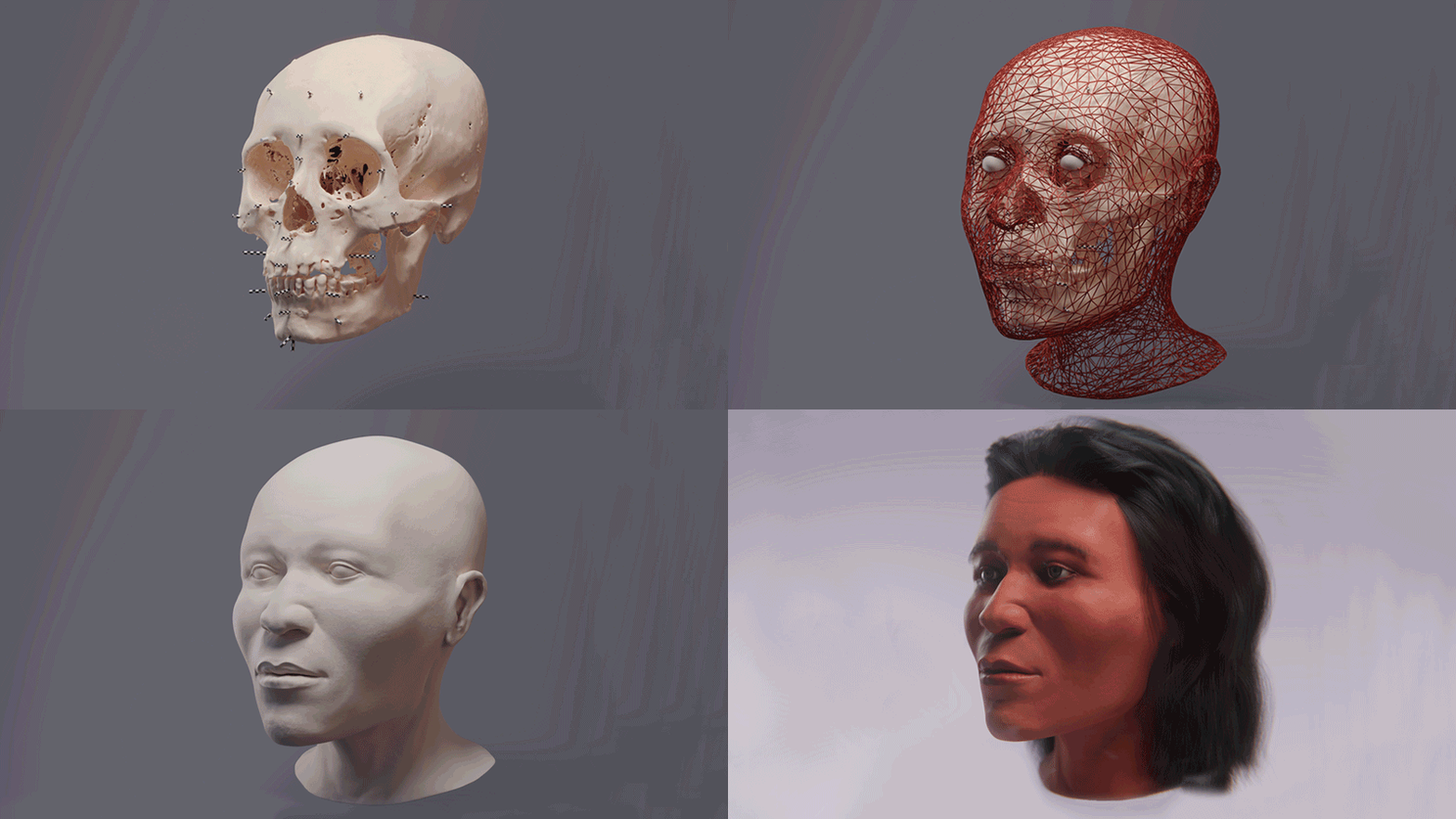
Construção 3D: Lukas Fischer / Fundação Curt Engelhorn
Em exposição, também, está o primeiro raio X de uma múmia, tirado em
Frankfurt em 1896, poucos meses depois de Wilhelm Röntgen ter produzido e
detectado a radiação eletromagnética pela primeira vez. Ele fica ao lado de uma tomografia computadorizada moderna dos mesmos restos e da própria múmia. Particularmente surpreendente é uma reconstrução facial digital 3D baseada em uma múmia peruana de 500 anos de idade. Olhando para a sua pele lisa e cabelos escuros, fiquei comovida com o seu destino: ela morreu jovem demais, pensei.
O Ötzi está fisicamente ausente, mas a falta é equilibrada por uma
exibição interativa elegante e intuitiva sobre a massa de dados que os
pesquisadores coletaram sobre ele.
O Iceman é uma das múmias mais antigas já descobertas, e sua presença
virtual completa uma exposição que abrange muitas vezes e lugares.
doi: 10.1038 / d41586-018-06799-y
domingo, 3 de junho de 2018
Ötzi the Iceman Was a Heart Attack Waiting to Happen
By Laura Geggel, Senior Writer |
A statue of Ötzi, the 5,300-year-old iceman mummy, who was discovered by hikers in the Italian Alps in 1991.
Credit: Andrea Solero/AFP/Getty
This story was updated May 30 at 12:02 p.m. EDT.
If a modern heart doctor could give medical advice to the iceman Ötzi —
the man who was preserved as a mummy after his murder about 5,300 years
ago in the snowy Alps — it would be this: Stop eating so much fatty
meat and consider taking medications that lower your blood pressure and
cholesterol.
This advice is based on a new comprehensive look at the iceman mummy's
cardiovascular health. A full-body computed tomography (CT) scan showed
that Ötzi had three calcifications (hardened plaques) in his heart
region, putting him at increased risk for a heart attack. [Mummy Melodrama: Top 9 Secrets About Otzi the Iceman]
Ötzi also had calcifications around his carotid artery, which carries
blood to the head and neck, and in the arteries at the base of his
skull, which carry blood to the brain. Both hardened plaques likely
elevated Ötzi's risk of a stroke, said Dr. Seth Martin, a preventive
cardiologist at Johns Hopkins Medicine in Baltimore who wasn't involved
with the new study.
Granted, because Ötzi didn't have access to modern medicines during his lifetime, such as cholesterol-lowering statins, "we'd be focusing on a plant-based, vegetarian diet," Martin told Live Science. "Folks who follow a more plant-based or Mediterranean diet — that's the type of diet that can help prevent heart disease."
It's too bad Ötzi likely had a taste for meat. In an earlier study,
researchers found that Ötzi's last meal included the fatty meat of a
wild goat, as well as wild deer and grains.
If Ötzi's condition were bad enough (and if he had a time machine that
could transport him to modern times), doctors might give him a carotid
endarterectomy, a surgery that involves opening or cleaning the carotid
artery to help prevent stroke, Martin said. Ötzi could also undergo
coronary bypass surgery, a procedure that diverts blood flow around the
blocked artery, Martin noted.
People examine illustrations of Ötza at the South Tyrol Museum of Archaeology in Italy.
Credit: Copyright O. Verant/South Tyrol Museum of Archaeologiemuseum
Ötzi's health
Ötzi may be old, but he was found fairly recently. Hikers found him
buried in the Italian Alps in 1991, and he is now housed at the South
Tyrol Museum of Archaeology in Bolzano, Italy. The iceman is one of the
most studied mummies in the world: Researchers now know that he had bad
teeth and knees; lactose intolerance; a probable case of Lyme disease;
stomach bacteria that causes ulcers; and 61 tattoos inked on his body, Live Science previously reported.
Now, the new study suggests that if Ötzi hadn't been killed by a blow
to the head and an arrow that pierced his shoulder when he was about 46
years old, he might have faced health problems from these plaques down
the road.
An earlier study in the journal Global Heart found that Ötzi had a genetic predisposition for atherosclerosis, a narrowing of the arteries from fatty deposits, Live Science previously reported.
What's more, CT scans done at the time showed signs of generalized
atherosclerotic disease in in some of his arteries, including the
carotid arteries, the distal aorta and the right iliac artery, the
earlier study found. However, it was not known before that Ötzi also had
calcifications in his heart, which indicates a more advanced
atherosclerosis with an increased risk of stroke or heart attack, said
Albert Zink, the head of the Institute for Mummies and the Iceman at the
European Academy, who was not involved with the new study.
Given that Ötzi wasn't overweight, didn't smoke tobacco, regularly
exercised and likely didn't have a high-fat diet (at least by today's
standards), it appears that his genes — and not his daily routine —
explained his health condition.
"I suspect that lifestyle didn't play a major role in his development
of plaque," Dr. Philip Green, an interventional cardiologist at New
York-Presbyterian who wasn't involved with the study, told Live Science.
Despite the suggestion that Ötzi go vegetarian, Zink sees it another
way. "Compared to modern standards, he would not be considered as a risk
patient," Zink told Live Science. "So, I think a different diet, such
as vegetarian or vegan, wouldn’t have helped Ötzi." [9 New Ways to Keep Your Heart Healthy]
In the new study, the researchers examined a newer CT scan of Ötzi that
was done in 2013. This was Ötzi's first, complete head-to-toe CT scan;
his two arms poked out at odd angles, so Ötzi didn't fit in a regular CT
machine. Thanks to a new, larger CT scanner at the Central Hospital in
Bozen-Bolzano, the researchers were able to image Ötzi's entire body,
including his abdomen and chest, allowing them to pinpoint the hardened
plaques.
There is no doubt Ötzi is one of the oldest cases of vascular
calcification, and "a medical example showing that a genetic
predisposition is probably the most important trigger factor for
arteriosclerosis and coronary heart disease," study co-researcher
Patrizia Pernter, a radiologist at Bozen-Bolzano, said in a statement.
The study was published online May 28 in the German and Austrian journal Advances in the Field of X-Rays (RöFo – Fortschritte auf dem Gebiet der Röntgenstrahlen). Editor's Note: This story was updated to include additional information about Otzi's medical history. Original article on Live Science.
quinta-feira, 16 de novembro de 2017
Human evolution: The Neanderthal in the family
Thirty years after the study of ancient DNA began, it promises to upend our view of the past.
Before ancient DNA exposed the sexual proclivities of Neanderthals or the ancestry of the first Americans, there was the quagga.
An equine oddity with the head of a zebra and the rump of a donkey, the last quagga (Equus quagga quagga) died in 1883. A century later, researchers published1
around 200 nucleotides sequenced from a 140-year-old piece of quagga
muscle. Those scraps of DNA — the first genetic secrets pulled from a
long-dead organism — revealed that the quagga was distinct from the
mountain zebra (Equus zebra).
More
significantly, the research showed that from then on, examining fossils
would no longer be the only way to probe extinct life. “If the long-term
survival of DNA proves to be a general phenomenon,” geneticists Russell
Higuchi and Allan Wilson of the University of California, Berkeley, and
their colleagues noted in their quagga paper1, “several fields including palaeontology, evolutionary biology, archaeology and forensic science may benefit.”
At
first, progress was fitful. Concerns over the authenticity of
ancient-DNA research fuelled schisms in the field and deep scepticism
outside it. But this has faded, thanks to laboratory rigour that borders
on paranoia and sequencing techniques that help researchers to identify
and exclude contaminating modern DNA.
These
advances have fostered an ancient-genomics boom. In the past year,
researchers have unveiled the two oldest genomes on record: those of a
horse that had been buried in Canadian permafrost for around 700,000
years2, and of a roughly 400,000-year-old human relative from a Spanish cavern3. A Neanderthal sequence every bit as complete and accurate as a contemporary human genome has been released4, as has the genome of a Siberian child connecting Native Americans to Europeans5.
Enabling
this rush are technological improvements in isolating, sequencing and
interpreting the time-ravaged DNA strands in ancient remains such as
bones, teeth and hair. Pioneers are obtaining DNA from ever older and
more degraded remains, and gleaning insight about long-dead humans and
other creatures. And now ancient DNA is set to move from the clean-rooms
of specialists to the labs of archaeologists, population geneticists
and others. Thirty years after the quagga led the way, Nature looks to the field's future.
A million-year-old genome
Ludovic
Orlando, an evolutionary biologist at the University of Copenhagen, had
low expectations when he started sequencing DNA from a
560,000-to-780,000-year-old horse leg bone. His colleague, Eske
Willerslev, had discovered the bone buried in the permafrost of the
Canadian Yukon in 2003. Then he had chucked it into a freezer, waiting
for technological improvements that would allow the bone's degraded DNA
to be read. (Freezers in ancient-DNA labs brim with such 'wait and see'
samples.)
On a Sunday evening in 2010,
Willerslev called Orlando to say that the time had come. Orlando was
unconvinced: “I started the project with the firm intention of proving
that it was not possible,” he says.
Sequencing
ancient DNA is a battle against time. After an organism dies, the long
strands of its DNA fissure into ever shorter pieces, helped along by
DNA-munching enzymes. Low temperatures slow this process, but eventually
the strands become so short that they contain little information.
To
read the horse's genome, Orlando needed to shepherd useful DNA
fragments through the harsh enzymatic treatments used to extract them
and ready them for sequencing. Orlando and his team found that the
preparation lost vast quantities of fragments. But with a few tweaks to
the experimental protocol, such as reducing the extraction temperature,
the researchers captured ten times more scraps of DNA than before — and
produced a draft of the oldest genome on record2.
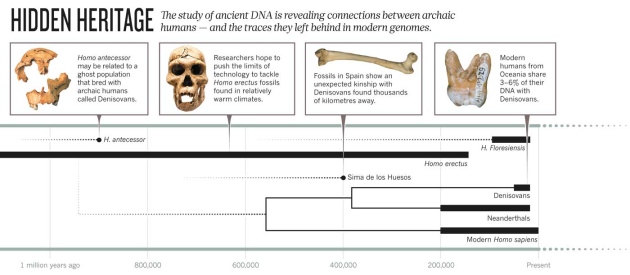
Photos (L–R): Javier Trueba/MSF/SPL; Markus Schieder/Alamy; Ref. 3; D. Reich et al. Nature 468, 1053–1060 (2010)
Using a similar approach, Svante Pääbo, a
geneticist at the Max Planck Institute for Evolutionary Anthropology in
Leipzig, Germany, and his team turned their attention to
400,000-year-old remains from the Sima de los Huesos cavern in northern
Spain, which may have been a burial pit for recent relatives of modern
humans called hominins (see 'Hidden heritage').
In the pit, the bones remained at stable, low temperatures, slowing the
breakdown of DNA. “If you could have told the hominins where to leave
their bones, you may have chosen that site,” says Matthias Meyer, a
molecular biologist at Pääbo's institute who is leading the efforts.
Last December, the team reported3
roughly 16,300 letters of a Sima de los Huesos individual's
mitochondrial genome — the DNA from power-generating structures in its
cells. The sequence revealed an unexpected relationship between the Sima
de los Huesos remains and the Denisovans, an archaic group of humans
that Pääbo's team had discovered in Russia's Altai Mountains thousands
of kilometres away. Meyer and his colleagues hope to improve their
methods enough to obtain some or all of the Sima de los Huesos
individual's nuclear genome, the DNA from the nuclei of its cells. “It
must be possible,” says Meyer. “I won't rest until this has been done.”
It
is now a matter of when, not if, someone will produce a genome from an
Arctic animal buried in permafrost for longer than 1 million years, says
Meyer. But he and Pääbo want to push the limits of ancient DNA in
hominin specimens from warmer locales, such as fossils of Homo erectus,
the common ancestor of humans and Neanderthals, found in Asia. And
Orlando says that researchers may have luck using new extraction
techniques on previously vexing remains such as Egyptian mummies or Homo floresiensis,
a small hominin at least 18,000 years old that was found in a cave on
the Indonesian island of Flores. “It opens a great number of places
where there are lots of important stories going on, such as the Middle
East or the tropics,” he says.
Ghosts in the code
A
few years ago, David Reich discovered a ghost. Reich, a population
geneticist at Harvard Medical School in Boston, Massachusetts, and his
team were reconstructing the history of Europe using genomes from modern
people, when they found a connection between northern Europeans and
Native Americans. They proposed that a now-extinct population in
northern Eurasia had interbred with both the ancestors of Europeans and a
Siberian group that later migrated to the Americas6.
Reich calls such groups ghost populations, because they are identified
by the echoes that they leave in genomes — not by bones or ancient DNA.
Ghost
populations are the product of statistical models, and as such should
be handled with care when genetic data from fossils are lacking, says
Carlos Bustamante, a population geneticist at Stanford University in
California. “When are we reifying something that's a statistical
artefact, versus when are we understanding something that's a true
biological event?”
Sometimes these statistical spectres get a body. Last year, Willerslev's team reported5
the genome from 24,000-year-old remains dubbed the Mal'ta boy. The
results showed that the boy, who had been found in central Siberia, came
from a population related to both modern Native Americans and modern
Europeans, matching Reich's prediction (see Naturehttp://doi.org/r2b; 2013). “It's a spectacular find,” he says.
Ghost
populations also lurk in ancient DNA. While analysing high-quality
genomes of a Neanderthal and a Denisovan, a team led by Reich and
Montgomery Slatkin at the University of California, Berkeley, noticed a
peculiar pattern: present-day sub-Saharan Africans are more closely
related to Neanderthals than they are to Denisovans4.
But evidence from other ancient genomes suggested that the two archaic
groups were equally related to present-day Africans. After weighing the
possibilities, the scientists realized that they might have uncovered
another ghost population.
The puzzle could be
solved, they theorized, if Denisovans had interbred with a species that
had left Africa perhaps more than 1 million years ago and branched off
from the common ancestor of humans, Neanderthals and Denisovans.
Subsequent Denisovans would have inherited DNA sequences that
present-day Africans lack, explaining why Neanderthals seem to be closer
kin to Africans.
Reich's team is analysing
genetic signatures in humans with Denisovan DNA to establish when the
Denisovans mated with this mystery population — information that could
narrow the range of fossils to which it might belong. Genomes studied by
Pääbo's lab, principally the Sima de los Huesos remains, may also
reveal clues.
Reich is not the only one
conjuring ghosts. Chris Stringer, a palaeoanthropologist at the Natural
History Museum in London, has proposed that the 900,000-year-old hominin
Homo antecessor, known from fossils found near Sima de los
Huesos, could be part of the ghost population. If it had interbred with
an ancestor of the Denisovans and the Sima de los Huesos hominins, it
could explain the relationship between the two groups of remains.
Testing that hypothesis would require the elusive Sima de los Huesos
nuclear DNA. But Reich is optimistic that Pääbo and his team will pull
it off. “They've done miracles before in that lab and they may succeed
again.”
The Neanderthal within
“We
don't need bones necessarily to find ancient DNA,” says Josh Akey, a
population geneticist at the University of Washington in Seattle. “We
can find the remnants of ancient DNA floating around in contemporary
populations.”
If early human populations bred
with Neanderthals and Denisovans, their descendants should carry short
segments of archaic-human DNA. Researchers such as Akey are beginning to
catalogue these segments to learn about the biology of archaic humans.
Unlike the hunt for ghost populations, which relies on statistical
population models, this approach allows researchers to identify specific
regions of the genome acquired by interbreeding.
“With tools that make sequencing ancient DNA cheaper and easier, the field is becoming more egalitarian.”
In January, independent teams led by Akey7 and Reich8
pieced together a substantial portion — about 20% and 40% respectively —
of the Neanderthal genome from bits lurking in the genomes of hundreds
of living humans. Their research indicated that some Europeans and
Asians had gained genes involved in skin and hair from Neanderthals,
possibly helping their ancestors to adapt to cold climates by providing
thicker skin, more hair and fewer pores (see Naturehttp://doi.org/rz9;
2014). But giant swathes of the modern genomes were devoid of
Neanderthal ancestry, hinting that many Neanderthal genes might have
been harmful in modern humans. Akey's team identified7 one such region around the gene FOXP2,
which is involved in speech and language. “It's extremely compelling
evidence that there were fitness costs to interbreeding,” he says.
These
discoveries are only the beginning. The Akey and Reich teams found that
the genomes of east Asians possess, on average, slightly more
Neanderthal DNA than do people of European ancestry. Akey sees this as
possible evidence that Neanderthals interbred with ancient humans on at
least two separate occasions: once with the ancestors of all Eurasians,
and later with a population ancestral only to east Asians. And Akey
believes that humans are likely to bear genetic scraps from other
extinct species, including some that interbred with the ancestors of
humans in sub-Saharan Africa.
Ancient DNA for the masses
For
much of the past 30 years, the sensitivity of the polymerase chain
reaction (PCR), the method used to amplify ancient DNA, made it prone to
contamination. The field's leaders often greeted the work of outsiders
with suspicion, earning some of them the title 'the PCR police'. And in
recent years, palaeogenomics has been the domain of specialist labs such
as Pääbo's, with the expertise and money to obtain and screen hundreds
of fossils to find the few that yield enough DNA to sequence an entire
genome.
That is set to change. New procedures
mean that researchers can now reliably obtain DNA from all but the most
degraded samples, and then sequence only the portions of a genome that
they are interested in. “I'm still surprised that there are so few labs
in the world that do this,” says Johannes Krause, a palaeogeneticist at
the University of Tübingen, Germany, who led much of the Denisovan work
while in Pääbo's lab. “It's not rocket science.”
Gradually,
new researchers are entering the field. “If I can break in, then anyone
can,” jokes Bustamante. His research originally focused on ancestry in
current human populations. Then, a few years ago, he got a phone call
about a mummy.
An international team had
sequenced the genome of Ötzi, a 5,300-year-old frozen corpse found in
the Tyrolean Alps of Italy in 1991. The researchers wondered if
Bustamante could help them to make sense of the ice-man's ancestry.
Together, they showed that Ötzi was more closely related to humans who
now live in Sardinia and Corsica than those in central Europe, evidence
that the population of Europe when he was alive looked very different to
how it does today9.
Bustamante
has since plunged into the world of ancient DNA. His team is sequencing
samples that chart the arrival of farming in Bulgaria, the
transatlantic slave trade in the Americas and dog domestication. The
group is developing tools to make sequencing ancient DNA cheaper and
easier. “We want to democratize the field,” says Bustamante.
Reich,
too, sees ancient DNA becoming more egalitarian. His lab's growing
interest in areas of human history such as the advent of agriculture or
the history of the Indian subcontinent has led it to analyse — often in
bulk — remains less rarefied than the scarce Neanderthal samples that
first lured him to the field.
Last year, Reich was part of a team that reported10
an analysis of mitochondrial DNA from 364 European samples between
5,500 and 1,550 years old, to identify major population shifts in
Neolithic Europe. Ancient genomics is also set to solve long-standing
questions about when and where humans domesticated animals such as dogs,
cattle and chickens. A 2013 study11
of 18 mitochondrial genomes from ancient dogs and wolves, for instance,
suggested that European hunter-gatherers domesticated wolves from a
population that is now extinct.
Researchers
are also returning to the questions that launched the field 30 years
ago. Around the time that Orlando's team began sequencing the
700,000-year-old horse, it also turned its attention to a much younger
sample — from the quagga.
The effort to
sequence the full quagga genome is part of large project to understand
the evolutionary relationship between living and extinct horses, zebras
and donkeys, and to identify the genetic basis for certain traits. “I
was thinking it would be cool to do the oldest, but also the first —
where ancient DNA started,” says Orlando. “It shows the progress the
field has made.”