Mostrando postagens com marcador Antártica. Mostrar todas as postagens

segunda-feira, 13 de março de 2023

 Um novo arcossauromorfo da Antártica e uma revisão atualizada de uma assembléia de vertebrados de alta latitude após a extinção em massa do final do Permiano

Artigo: e1536664 | Recebido em 19 de setembro de 2017, Aceito em 15 de agosto de 2018, Publicado online: 31 de janeiro de 2019

quinta-feira, 8 de setembro de 2022


A equipe de pesquisa confirma que as condições de gelo existiam na região do Polo Sul durante o período Cretáceo Superior

Magma e gelo
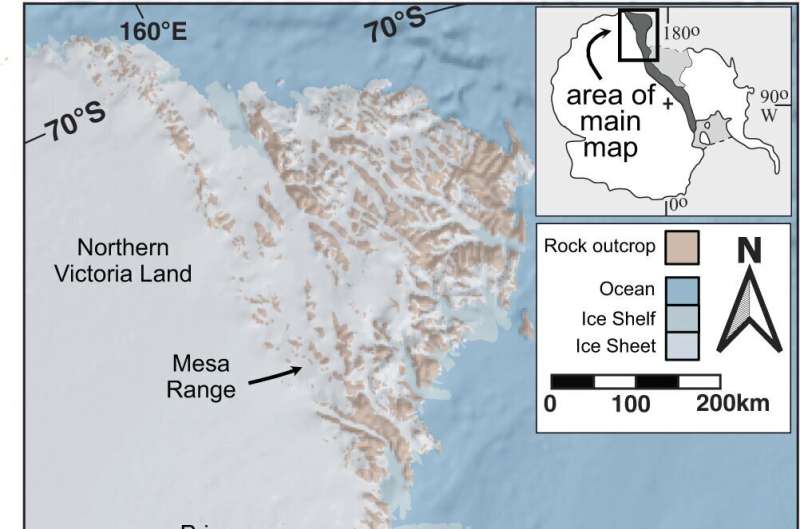
Mapa de leito rochoso da Terra de Vitória do Norte e do Sul, Antártica, mostrando a distribuição do afloramento e localização do Complexo Ígneo Butcher Ridge (BRIC) e outras localidades mencionadas no texto com idades de alteração do Cretáceo Médio a Tardio. Mapa base construído usando o Quantarctica v3.2 do Instituto Polar Norueguês (Matsuoka, K. et al. Quantarctica, um ambiente de mapeamento integrado para a Antártida, Oceano Antártico e ilhas subantárticas. Modelagem e Software Ambiental 140, 105015 (2021)) com dados de afloramentos rochosos do SCAR Antarctic Digital Database (ADD) Versão 7.0. Crédito: Demian A. Nelson et al, Nature Communications (2022). DOI: 10.1038/s41467-022-32736-9

Vamos fingir que é o Cretáceo Superior, cerca de 66 a 100 milhões de anos atrás. Temos dinossauros vagando pela terra e espécies primitivas de pássaros de aparência estranha, embora o tubarão como o conhecemos já esteja nadando nos oceanos pré-históricos – que cobrem 82% da Terra. As sequoias e outras coníferas estão fazendo sua estreia, assim como as rosas e as plantas com flores, e com elas vêm as abelhas, cupins e formigas. Acima de tudo, é quente, vulcanicamente ativo e úmido em todo o lugar, sem nenhuma camada de gelo à vista.

Exceto que, de acordo com um grupo de cientistas da UC Santa Barbara, da Universidade de Oregon e da Universidade de Manitoba, as condições de gelo existiam na região do Polo Sul.

"E não era apenas uma geleira de um único vale", disse o geólogo da UCSB John Cottle, "provavelmente eram várias geleiras ou uma grande  ". Ao contrário de nossa imagem amplamente difundida do Cretáceo Superior como "quente em todos os lugares", disse ele, há evidências de que o gelo polar existiu durante esse período, mesmo no auge das condições globais de efeito estufa. O estudo dos geólogos foi publicado na revista Nature Communications .

Um quebra-cabeça pré-histórico

Avanço rápido para hoje. Vamos fingir que estamos na Antártida. É frio, é estéril, e estamos perto de um grande agrupamento de rochas vítreas expostas ao longo das Montanhas Transantárticas, adjacente à plataforma de gelo Ross, chamado Complexo Ígneo Butcher Ridge (BRIC).

"Na verdade, eu ouvi sobre essas rochas quando eu era estudante de pós-graduação, cerca de 20 anos atrás, e elas são realmente estranhas", disse Cottle. Remoto, mesmo para os padrões de exploração da Antártida de hoje, o BRIC é incomum porque a composição e a formação das rochas não são características das formações rochosas próximas, com – entre outras coisas – grandes quantidades de vidro e alterações em camadas que indicam eventos físicos, químicos ou ambientais significativos que mudou sua composição mineral.

Cottle teve a chance de finalmente provar o BRIC em uma expedição recente e, no processo de análise de como ele foi formado, ele e sua equipe encontraram uma "quantidade de água incomumente grande".

“Então você tem uma pedra muito quente que interage com a água e, à medida que esfria, a incorpora ao vidro”, disse ele. "Se você observar a composição, poderá dizer algo sobre de onde veio essa água. Ela pode existir como hidroxila, o que indica que provavelmente veio do  , ou pode ser molecular, o que significa que provavelmente é externa. "

O que eles esperavam ver era que a alteração na rocha era causada pela água já no magma enquanto esfriava. O que eles encontraram em vez disso foi um registro de um processo climático que se pensava não ter existido na época.

Em sua análise espectroscópica das amostras, os pesquisadores determinaram que, embora parte da água tenha realmente se originado com magma à medida que subia do interior da Terra, à medida que a rocha derretida esfriava em vidro logo abaixo da superfície da Terra, ela também incorporava água subterrânea.

"Determinamos que a maior parte da água nessas rochas é derivada externamente", disse Cottle. "Em seguida, medimos a composição isotópica de oxigênio e hidrogênio da água e ela combina muito bem com a composição da neve e do gelo da Antártida."

Para garantir o resultado, Cottle e sua equipe também conduziram a geocronologia de argônio-argônio para datar a rocha e sua alteração.

"O problema é que essas rochas são jurássicas, então cerca de 183 milhões de anos", disse ele. "Então, quando você mede a alteração, o que você não sabe é quando isso aconteceu." Eles conseguiram recuperar a idade da rocha (Jurássico), mas também encontraram uma idade mais jovem (Cretáceo). "Então, quando essas rochas esfriaram e foram alteradas", continuou ele, "também redefiniu o isótopo de argônio, e você pode comparar a idade da alteração com a composição da alteração".

Existem outras rochas vulcânicas semelhantes a cerca de 700 km ao norte do BRIC que também têm uma idade de alteração do Cretáceo, indicando que a glaciação polar pode ter sido regionalmente extensa na Antártida durante esse período. "O que gostaríamos de fazer é ir a outros lugares da Antártida e ver se podemos determinar a escala da glaciação, se recuperarmos os mesmos resultados que já encontramos", disse ele.

Encontrar evidências de grandes camadas de gelo que datam do Cretáceo pode não alterar nossa imagem geral de uma Terra quente e úmida naquela época, disse Cottle, “mas teríamos que pensar no Cretáceo e na Antártida de maneira bem diferente do que fazemos agora”.

A pesquisa neste estudo também foi conduzida por Demian A. Nelson (autor principal) da UCSB, Ilya N. Bindeman da Universidade de Oregon e Alfredo Camacho da Universidade de Manitoba.

quinta-feira, 31 de dezembro de 2020


A Origem dos Nomes dos Continentes

mundo 

Hoje descobri a origem mais provável dos nomes de cada um dos continentes. ( Usando o modelo de sete continentes)

O primeiro desta lista é a África . Existem muitas teorias diferentes quanto à origem do nome da África. Depois que os romanos derrotaram Cartago (que fica na atual Tunísia, no norte da África) na terceira Guerra Púnica, eles chamaram sua nova província de "África". A teoria mais popular quanto à origem do nome é que foi nomeado em homenagem a uma tribo nativa lá - os Afri, com "África" ​​sendo a forma feminina de "Africus", que significa literalmente "terra dos Afri".

Uma teoria alternativa, que tem uma lacuna devido à época em que o nome foi usado pela primeira vez, é que ela vem da palavra fenícia "longe", que significa "poeira". Juntamente com o sufixo latino –ica, às vezes usado para denotar "terra", o nome pode significar "uma terra de poeira". Dado o clima quente e desértico da África no norte, onde os romanos reivindicaram sua província, a raiz fenícia é considerada por muitos como uma alternativa plausível à teoria da “tribo Afri”, para a origem do nome da África.

Seja como for, à medida que os europeus continuaram explorando e descobrindo a extensão do continente, o nome que os romanos usaram originalmente para sua pequena província permaneceu, e todo o continente ficou conhecido como África.

Antártica vem da palavra grega "antarktike", que significa literalmente "oposto ao norte". O continente é, obviamente, o lar do ponto mais meridional da Terra. Acredita-se que John George Bartholomew, um cartógrafo escocês, seja a primeira pessoa a usar "Antártica" para se referir ao continente. No entanto, o nome foi usado para um lugar diferente pelos franceses antes disso. Nos anos 1500, eles mantiveram uma colônia no Brasil abaixo do equador, que chamaram de França Antartique.

A Ásia deriva do grego antigo “Ἀσία”, que foi usado já em 440 aC por Heródoto em suas Histórias . No entanto, é provável que o nome já estivesse em uso muito antes disso, embora não se referisse a um continente inteiro, mas originalmente apenas o nome da terra na margem leste do Mar Egeu e, posteriormente, a Anatólia (parte da região moderna Peru).

Os romanos se referiam a duas províncias ao falar sobre a Ásia: Ásia Menor e Ásia Maior. Uma teoria comum é que o nome grego, em última análise, derivou da palavra fenícia asu , que significa "leste", e da palavra acadiana asu, que significa "sair, se levantar". Em referência ao sol, a Ásia significaria "a terra do nascer do sol".

Terra Australis Incognita significa “a terra desconhecida no sul” em latim, e os rumores da existência do continente datam da época da Roma Antiga. Claro, os romanos não tinham a tecnologia marítima para chegar à Austrália e não tinham nenhuma evidência direta de que ela existisse, pelo que sabemos. Quando os europeus finalmente descobriram o continente, o nome “Terra Australis” pegou. O continente foi chamado de "Austrália" abreviado por alguns dos primeiros exploradores, mas foi Matthew Flinders quem empurrou seu uso a partir de 1804. Embora "Austrália" tenha sido usado não oficialmente por vários anos, o governador Lachlan Macquarie fez uma petição para sua adoção oficial em 1817. Somente em 1824 o nome foi oficialmente dado ao continente.

A Europa provavelmente recebeu o nome de Europa, um dos muitos amantes de Zeus na mitologia grega. Diz a lenda que ele a raptou depois de assumir a forma de um touro branco e a levou para Creta. É difícil determinar a etimologia do nome, mas uma teoria é que ele vem da palavra acadiana erebu que significa "descer, pôr-se" ou do fenício ereb que significa "noite, oeste". O significado direcional ocidental significaria que tinha origens semelhantes à Ásia. Alternativamente, o nome Eurpoa pode ter derivado do grego “eurys”, que significa “largo”, e “ops”, que significa “rosto”, então “rosto largo”.

Como em muitos dos outros nomes dos continentes, “Europa” originalmente não se referia a nada perto do que consideramos Europa hoje. Em vez disso, era apenas uma pequena região, como “Ásia”, referindo-se a uma parte da atual Turquia, parte da Trácia.

Como a maioria, sei que as Américas (norte e sul) receberam o nome de Américo Vespúcio desde minha primeira educação. No entanto, a história por trás disso é um pouco mais interessante e um pouco menos conhecida. Vespúcio foi um navegador que viajou para “o novo mundo” em 1499 e 1502. Sendo um homem culto, percebeu que esse novo mundo não fazia parte da Ásia, como alguns inicialmente pensaram. Vespucci escolheu escrever sobre suas viagens e seus livros foram publicados em 1502 e 1504. Por serem divertidos e educacionais, seus relatos do novo mundo foram reimpressos em quase todas as línguas europeias.

Em 1507, um cartógrafo alemão, Martin Waldseemüller, optou por fazer um novo mapa que incluía o novo mundo. Ele e dois colegas acadêmicos conheciam os escritos de Vespúcio e desconheciam as expedições de Colombo. Como tal, eles decidiram nomear a nova terra após Vespucci, afirmando:

Mas agora essas partes (Europa, Ásia e África, os três continentes da geografia ptolomaica) foram extensivamente exploradas e uma quarta parte foi descoberta por Americus Vespuccius (a forma latina do nome de Vespucci), não vejo o que é certo. teria que se opor a chamar essa parte em homenagem a Americus, que a descobriu e que é um homem de inteligência, e então chamá-la de Amerige, isto é, a Terra de Americus, ou América: já que Europa e Ásia receberam seus nomes de mulheres .

Quando o grande novo mapa, de aproximadamente 2,5 metros por 1,2 metros, foi revelado por Waldseemüller, ele tinha o grande título “AMÉRICA” no que hoje é o Brasil. Waldseemüller usou os diários de viagem de Vespucci como referência para seu desenho e, portanto, seu mapa tinha a América do Sul como a única parte deste novo hemisfério ocidental. Quando a América do Norte foi adicionada posteriormente, os cartógrafos da época mantiveram o nome original. Em 1538, o famoso geógrafo Gerard Mercator escolheu nomear todo o norte e o sul da América como uma grande "América" ​​para todo o hemisfério ocidental

Se você gostou deste artigo, também pode desfrutar de nosso novo podcast popular, The BrainFood Show ( iTunes , Spotify , Google Play Music , Feed ), bem como:

Fatos bônus :

  • Parte da Antártica foi nomeada “Terra da Rainha Elizabeth” em homenagem à Rainha Elizabeth II. A área tem cerca de duas vezes o tamanho do Reino Unido.
  • O capitão James Cook foi enviado para encontrar a Terra Australis Incognita em 1772. Retornando com cartas da costa leste da Austrália - grande o suficiente para ser considerada um continente - ele foi rejeitado por oficiais que acreditavam que a verdadeira Terra Australis Incognita estava localizada mais ao sul. Cook partiu novamente e foi a primeira pessoa a navegar para o Círculo Antártico. No entanto, ele se virou para reabastecer seu navio antes de ver terra. Se ele tivesse tido sucesso em sua viagem, é provável que a Antártica tivesse se chamado Austrália em homenagem a Terra Australis. (A primeira pessoa a ver o Continente Antártico foi Fabian Gottlieb von Bellingshausen em 1820).
  • Europa também é o nome de uma das luas de Júpiter.
  • Uma teoria alternativa sobre como a América recebeu seu nome, não apoiada por uma série de evidências documentadas, você pode ouvir às vezes, é que uma tribo de nativos americanos chamada Amerrique pode ter existido, e Colombo e Vespúcio podem tê-los visitado. Diz-se que a palavra se origina da palavra maia para "vento excepcionalmente forte".
  • Outra teoria da “América” que às vezes você pode usar aqui, novamente, não apoiada quase pelas evidências acima no artigo principal, é que ela recebeu o nome de um comerciante de Bristol chamado Richard Amerike. Amerike e outros mercadores haviam negociado itens e pescado na costa de Newfoundland por muitos anos antes de Cristóvão Colombo e John Cabot fazerem suas viagens para a América. A teoria é que os pescadores que trabalhavam para ele batizaram a área em que viviam em homenagem ao empregador. Também se acredita que Amerike patrocinou John Cabot em sua viagem bem-sucedida à costa leste da América, e que Cabot deu à terra o nome de seu patrocinador.

sexta-feira, 3 de julho de 2020

How a hidden ocean circulates beneath the Antarctic ice


Como um oceano oculto circula sob o gelo antártico

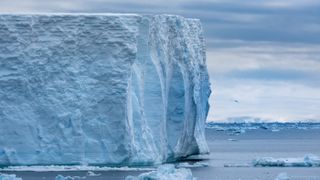
One of the world's largest icebergs calved from the Ross Ice Shelf in Antarctica.
(Image: © Leamus/iStock/Getty Images Plus)
 
Júlio Verne enviou seu submarino fictício, o Nautilus, ao Polo Sul através de um oceano oculto sob uma espessa calota de gelo. Escrito 40 anos antes de qualquer explorador chegar ao polo, sua história era apenas meia ficção.

De fato, existem cavidades oceânicas ocultas ao redor da Antártica, e nossas pesquisas mais recentes exploram como o oceano circula sob as prateleiras de gelo do continente - grandes extensões flutuantes de gelo em terra que sobem e caem com as marés.

Essas plataformas de gelo sustentam a enorme calota de gelo terrestre do continente e desempenham um papel importante na avaliação da futura elevação do nível do mar. Nosso trabalho lança uma nova luz sobre como as correntes oceânicas contribuem para o derretimento na Antártica, que é uma das maiores incertezas nas previsões de modelos climáticos.
Read more: Climate scientists explore hidden ocean beneath Antarctica's largest ice shelf

An unexplored ocean

https://cdn.mos.cms.futurecdn.net/7C7jmn9QdJSsPaxiTgEGqU-650-80.jpg
(Image credit: Shutterstock)
A Plataforma de Gelo Ross é a maior placa flutuante de gelo da Terra, com 480.000 quilômetros quadrados. A cavidade oculta oculta se estende por 700 km ao sul da costa da Antártica e permanece praticamente inexplorada.

Sabemos que as prateleiras de gelo derretem principalmente por baixo, banhadas por um oceano em aquecimento. Mas temos muito poucos dados disponíveis sobre como a água se mistura sob o gelo. Isso geralmente é negligenciado nos modelos climáticos, mas nossas novas medidas ajudarão a corrigir isso.

A única outra expedição para a cavidade oceânica sob a plataforma central de gelo Ross remonta à década de 1970 e voltou com resultados intrigantes. Apesar da tecnologia limitada da época, mostrou que a cavidade do oceano não era uma banheira estática. Em vez disso, encontrou camadas finas de massas de água, com temperaturas e salinidades sutilmente diferentes entre as camadas.

Outros estudos oceânicos foram realizados a partir das margens ou do alto. Eles forneceram informações sobre como o sistema funciona, mas para realmente entendê-lo, precisávamos fazer medições diretamente do oceano sob centenas de metros de gelo.


Em 2017, usamos um jato de água quente, modelado em um projeto da British Antarctic Survey, para perfurar 350 metros de gelo no oceano abaixo. Conseguimos manter o líquido do buraco por tempo suficiente para fazer medições detalhadas do oceano e deixar instrumentos para trás para continuar monitorando as correntes e a temperatura do oceano. Esses dados ainda estão chegando via satélite.

 Descobrimos que o oceano oculto age como um estuário maciço com água do mar comparativamente quente (2 ℃) entrando no leito do mar para pedalar perto da superfície em uma combinação de água derretida e água doce subglacial espremida da camada de gelo e da base rochosa escondida da Antártica .

As centenas de metros de gelo isolam a cavidade do oceano dos ventos furiosos e da temperatura do ar congelante da Antártica. Mas nada para as marés. Nossos dados sugerem que as marés empurram o oceano estratificado para frente e para trás, passando por ondulações na parte inferior do gelo e misturando partes da cavidade do oceano.

This sort of discovery is the ultimate challenge for climate science. How do we represent processes that work at daily scales in models that make projections over centuries? Our data show the daily changes can add up, so finding a solution matters.

For example, data collected outside the ocean cavity and computer models suggest that any given parcel of water spends one to six years making its way through the cavity. Our new data indicate the lower end of the range is more likely and that we should not be thinking in terms of one grand circuit anyway.

The Ross is not the ice shelf in most danger from warming oceans. But its sheer size and its relationship with the neighboring Ross Sea means it is a vital cog in the planetary ocean system.

A importância dessas plataformas de gelo para o aumento do nível do mar nos próximos séculos é muito aparente. Pesquisas mostram que, se o aquecimento atmosférico exceder 2 ℃, as principais plataformas de gelo antártico entrariam em colapso e liberariam o gelo que flui da calota de gelo do continente - elevando o nível do mar em até 3 metros até 2300.

O que é menos compreendido, mas também potencialmente um agente massivo de mudança, é o impacto da água derretida na circulação termohalina global, um ciclo de transporte oceânico que vê o ciclo oceânico do abismo ao largo da costa da Antártida até as águas superficiais tropicais a cada 1.000 anos ou então.

As prateleiras de gelo da Antártica são como um pit stop nesse circuito e, portanto, o que acontece na Antártica ressoa globalmente. Prateleiras de gelo com derretimento mais rápido mudarão a estratificação do oceano, com repercussões na circulação global do oceano - e um resultado disso parece ser uma maior variabilidade climática.

segunda-feira, 6 de abril de 2020

Floresta tropical pré-histórica é descoberta na Antártica

Na metade do período cretáceo, densas concentrações de CO2 atmosférico teriam criado temperaturas globais muito mais quentes. Isso derreteu as camadas de gelo polares e elevou os níveis do mar até 170 metros a mais do que é observado atualmente. Mas como seria o Polo Sul em um mundo assim? Cientistas ingleses e alemães descobriram uma amostra de solo florestal do período Cretáceo a 900 km do Polo Sul, que responde essa pergunta.

Uma floresta tropical pré-histórica na Antártida

Os pesquisadores do Instituto Alfred Wegener para Pesquisa Polar e Marinha na Alemanha divulgaram sua descoberta e análise em artigo publicado na Nature. Uma análise das raízes, pólen e esporos preservados mostrou que o mundo naquela época estava muito mais quente do que se pensava anteriormente. O artigo também também sugere que os níveis de dióxido de carbono (CO2) na atmosfera foram mais altos do que o esperado durante o período médio do Cretáceo.
Anteriormente, pouco se sabia sobre o meio ambiente ao sul do Círculo Antártico naquele período. Agora, os pesquisadores descobriram evidências de uma floresta tropical temperada na região, como seria encontrada na Nova Zelândia hoje. Apesar de possuir uma noite polar de quatro meses, um terço de cada ano não existia luz solar que dava vida.
Mapa simplificado da região de Polar Sul no momento da deposição há 90 milhões de anos - período em que existiu uma floresta tropical pré-histórica na Antártida. (JP Klages, Alfred-Wegener-Institut)
Mapa simplificado da região de Polar Sul no momento da deposição há 90 milhões de anos – período em que existiu uma floresta tropical pré-histórica na Antártida. (JP Klages, Alfred-Wegener-Institut)
Agora, os investigadores descobriram indícios de uma floresta tropical temperada na região, como a que se encontraria hoje na Nova Zelândia. Isto aconteceu mesmo um ambiente que apresenta noite polar de quatro meses, o que significa que durante um terço de cada ano não havia qualquer luz solar que desse vida.
A presença da floresta sugere que as temperaturas médias rondavam os 12 graus Celsius, o que significa que não havia uma calota de gelo no Pólo Sul.

Como os pesquisadores chegaram a essas conclusões

As evidências de que houve a existência de uma floresta tropical na Antártida vem de um núcleo de sedimentos perfurado no fundo do mar perto dos glaciares Pine Island e Thwaites, na Antárctida Ocidental.

Os pesquisadores analisaram as amostras e descobriram uma densa rede de raízes fósseis, que se encontrava muito bem preservada. A amostra continha também inúmeros vestígios de pólen
Para reconstruir o ambiente desta floresta preservada, os cientistas avaliaram as condições climáticas em que vivem os modernos descendentes das plantas, bem como analisou os indicadores de temperatura e precipitação dentro da amostra.


Eles verificaram que a temperatura média anual do ar era de cerca de 12 graus Celsius. As temperaturas médias do Verão foram de cerca de 19 graus Celsius. As temperaturas da água nos rios e pântanos atingiram até 20 graus.

O autor principal Dr. Johann Klages, do Alfred Wegener Institute Helmholtz Centre for Polar and Marine Research, afirmou: “Antes do nosso estudo, a hipótese geral era de que a concentração global de dióxido de carbono no Cretáceo era de cerca de 1000 ppm. Mas nas nossas experiências baseadas em modelos, foram necessários níveis de concentração de 1120 a 1680 ppm para atingir as temperaturas médias naquela época na Antártida”.

O artigo que descreve as amostras de solo florestais coletadas foi publicado na revista Nature, clique aqui para acessá-lo.

domingo, 22 de março de 2020

Anais da Academia Brasileira de Ciências

Print version ISSN 0001-3765On-line version ISSN 1678-2690

An. Acad. Bras. Ciênc. vol.91  supl.2 Rio de Janeiro  2019  Epub Dec 02, 2019

https://doi.org/10.1590/0001-3765201920191300 

Earth Sciences
Pterodactyloid pterosaur bones from Cretaceous deposits of the Antarctic Peninsula
ALEXANDER W.A. KELLNER1* 
http://orcid.org/0000-0001-7174-9447
TAISSA RODRIGUES2 
FABIANA R. COSTA3 
LUIZ C. WEINSCHÜTZ4 
RODRIGO G. FIGUEIREDO5 
GEOVANE A. DE SOUZA1 
ARTHUR S. BRUM1 
LÚCIA H.S. ELEUTÉRIO6  7 
CARSTEN W. MUELLER8 
JULIANA M. SAYÃO1  6 
1Laboratory of Systematics and Taphonomy of Fossil Vertebrates, Departamento de Geologia e Paleontologia, Museu Nacional/Universidade Federal do Rio de Janeiro, Quinta da Boa Vista s/n, São Cristóvão, 20940-040 Rio de Janeiro, RJ, Brazil
2Laboratório de Paleontologia, Departamento de Ciências Biológicas, Centro de Ciências Humanas e Naturais, Universidade Federal do Espírito Santo, Avenida Fernando Ferrari, 514, 29075-910 Vitória, ES, Brazil
3Laboratório de Paleontologia de Vertebrados e Comportamento Animal/LAPC, Centro de Ciências Naturais e Humanas/CCNH, Universidade Federal do ABC, Rua São Paulo, s/n, Jardim Antares, 09606-045 São Bernardo do Campo, SP, Brazil
4CENPALEO - Centro Paleontológico da Universidade do Contestado, Universidade do Contestado, 89306-076 Mafra, SC, Brazil
5Departamento de Biologia, Universidade Federal do Espírito Santo, Alto Universitário, s/n, Guararema, 29500-000 Alegre, ES, Brazil
6Laboratório de Paleobiologia e Microestruturas, Centro Acadêmico de Vitória, Universidade Federal de Pernambuco, Rua do Alto Reservatório, s/n, Bela Vista, 55608-680 Vitória do Santo Antão, PE, Brazil
7Programa de Pós-Graduação em Geociências, Universidade Federal de Pernambuco/UFPE, Centro de Tecnologia e Geociências, Av. da Arquitetura, s/n, Cidade Universitária, 50740-550 Recife, PE, Brazil
8Technical University of Munich, Chair of Soil Science, Emil-Ramann-Strasse 2, 85354, Freising-Weihenstephan, Germany


Fossil vertebrates from Antarctica are considerably rare, hampering our understanding of the evolutionary history of the biota from that continent. For several austral summers, the PALEOANTAR project has been carrying out fieldwork in the Antarctic Peninsula in search for fossils, particularly Cretaceous vertebrates. Among the specimens recovered so far are two bones referable to Pterosauria, more specifically to the Pterodacyloidea, the first volant reptiles from Antarctica to be fully described. MN 7800-V (part and counterpart) was recovered from a moraine at the Abernathy Flats (Santa Marta Formation, Lachman Crags Member, Santonian-Campanian) on James Ross Island. It is interpreted as the distal articulation of a first phalanx of the wing finger, representing an animal with an estimated wingspan between 3 and 4 m. The second specimen (MN 7801-V) comes from Vega Island (Snow Hill Island Formation, Maastrichtian) and is identified as a wing metacarpal IV of an animal with an estimated wingspan from 4 to 5 m. These occurrences show that pterodactyloids inhabited the Antarctic Peninsula at least during the Upper Cretaceous and demonstrate that large pterosaurs were widespread through all parts of the planet during that period.
Key words Antarctica; Antarctic Peninsula; Pterosauria; PALEOANTAR; Cretaceous

INTRODUCTION 

Pterosaurs were volant reptiles that existed for most of the Mesozoic Era, and became extinct at the end of the Cretaceous (e.g., Kellner 2006, Barrett et al. 2008). Their record is quite irregular, with a few deposits contributing to the majority of the recovered specimens and taxonomic diversity (Kellner 1994).
Until now, the only record of these flying reptiles reported from Antarctica is a humerus that was recovered from the Early Jurassic Falla Formation, in the Central Transantarctic Mountains (Hammer and Hickerson 1994). It was regarded as representing a “rhamphorhynchoid” (= non-pterodactyloid) and tentatively referred to the Dimorphodontidae (Hammer and Hickerson 1996). This specimen was subsequently figured but without a detailed description (Hammer and Hickerson 1999, fig. 5).

In 2006/2007, a team led by the Museu Nacional/UFRJ developed the project PALEOANTAR aiming to search for fossils at distinct locations of Northern Antarctic Peninsula (Kellner et al. 2011). All Brazilian scientific activities in Antarctica are funded by a special program of the Conselho Nacional de Desenvolvimento Científico e Tecnológico (CNPq) called PROANTAR (Programa Antártico Brasileiro - Brazilian Antarctic Program) and are developed in collaboration with the Brazilian Navy. Due to limitations of funding, only in the austral summer of 2015/2016 could the PALEOANTAR project resume, this time including several other institutions. During that field season, several researchers worked collaboratively at James Ross Island (the largest undertaking of PROANTAR), which included seven researchers of PALEOANTAR, five researchers of TERRANTAR (examining Antarctic soils), and three alpinists. Hundreds of fossils were collected, the majority housed at the Museu Nacional/UFRJ, including ichnofossils, several plant materials (e.g., logs, leaves, one pinecone, charcoal), invertebrates (e.g., ammonites, bivalves, corals, lobsters), teeth (sharks, bony fishes, plesiosaurs), and isolated bones (fish and reptiles). Among the specimens recovered during that field season is one bone divided into two parts (MN 7800-V) that is here referred to Pterosauria. Two years later, in the austral summer of 2017/2018, members of the PALEOANTAR project participated in field activities at Vega Island under the TERRANTAR project. Although this and subsequent expeditions to that island did not recover as many fossils as the 2015/2016 field season, there is one incomplete element that represents a second pterosaur bone from the James Ross Archipelago (MN 7801-V). Both specimens are described here, showing the presence of flying reptiles in the Antarctic Peninsula during the late Cretaceous (Fig. 1). They are housed in the paleovertebrate collection (Departamento de Geologia e Paleontologia) of the Museu Nacional (MN) - Universidade Federal do Rio de Janeiro (UFRJ).
Figure 1 Map showing the (a) location of the Antarctic Peninsula and (b) detail of the James Ross and Vega islands.where fieldwork was carried out. (c) Geologic map of the prospected area showing where the pterosaur material was collected: ▲ MN 7800-V from James Ross Island and MN 7801-V from Veja Island. 

GEOLOGICAL SETTING 

The area prospected by PALEOANTAR is situated in the eastern portion of northern Antarctic Peninsula, more specifically at the northwestern part of the James Ross Archipelago where outcrops of the Larsen Basin are exposed (Fig. 1). The Larsen Basin is subdivided into the James Ross and Larsen sub-basins (Macdonald et al. 1988, Del Valle et al. 1992). The James Ross sub-basin was formed during the breakup of Gondwana and has one of the most complete sedimentary sequences from the Cretaceous to the Paleogene of the southern hemisphere (e.g., Crame et al. 1996). These deposits are divided into three groups: Nodenskjöld, Gustav and Marambio (Feldmann et al. 1993, Hathway 2000, Hathway and Riding 2001, Riding and Crame 2002), the latter being of interest in the present study (Crame et al. 2004, Fig. 2). Some new geologic data of the Snow Hill Island and the López de Bertodano formations are included here.

The Marambio Group crops out in several islands of the James Ross Archipelago, including James Ross and Vega islands (Crame et al. 1991). It comprises siliciclastic deposits, mainly sandstones, siltstones and mudstones that are intercalated with levels of coquina deposited under storm conditions on the internal and external platform (Crame et al. 2004). Four formations are recognized in the Marambio Group: Santa Marta, Snow Hill Island, López de Bertodano and Sobral (Fig. 2).
Figure 2 Stratigraphic chart of the James Ross sub-basin, showing the units where specimens were recovered - ▲ MN 7800-V from James Ross Island and MN 7801-V from the Vega Island. Modified from Olivero et al. (1986) and Marenssi et al. (2001)
The Santa Marta Formation is the basal unit of the group and thought to have been deposited between the Santonian and Campanian (Olivero et al. 1986, Marenssi et al. 2001; Fig. 2). Sandstones, siltstone, mudstone, volcanic tuffs and rare coquinas are the predominant lithologies, regarded as volcanoclastic deposits formed in a deltaic system (Scasso et al. 1991, Olivero 2012). In the northwestern portion of the James Ross Island, the Santa Marta Formation is divided into the Lachman Crags and the Herbert Sound members (Crame et al. 1991).
The Lachman Crags Member (Santonian-Campanian) is also composed of siliciclastic rocks with rare conglomerates, reaching a thickness of about 850 m (Crame et al. 1991). It is overlain by the Herbert Sound Member (Campanian-Maastrichtian), which consists of a 250 m section composed by fine sandstones with cross-stratification and coquinas (Crame et al. 1991, Olivero et al. 1992, Olivero and Medina 2000).

The Snow Hill Island Formation (Maastrichtian) shows massive sandstones with parallel bedding and cross lamination on its base. Occasionally thin layers of dark and red bioturbated shales are found at a decimetric scale associated with layers with calcium carbonate cement that are up to 30 cm thick. Carbonate nodules are very common and occur in two levels at the medium portion of the section where invertebrate fossils are concentrated. According to Olivero (2012), these deposits were formed in a progradation deltaic system. Coarse to medium grained sandstones occur on the top of the sequence, followed by bioturbated sandstones and siltsones, also containing levels with fossiliferous concretions, which are interpreted as tidal deposits formed in a regressive environment (Pirrie et al. 1997).

The López de Bertodano Formation (Maastrichtian) crops out in the elevated areas of the Vega, Snow Hill and Seymour islands (Crame et al. 2004). On Vega Island, its contact with the underlying Snow Hill Island Formation is gradational and mostly covered by soil. It comprises fine to coarse grained massive sandstones, with dispersed rounded pebbles. The sandstones reach a thickness up to 3 m, with a thin layer (~20 cm) of carbonaceous mudstone at their top. On the lower portion of this unit, close to the contact with the Snow Hill Island Formation, fossils were collected by the project TERRANTAR in the field season of 2017/2018. This area, revisited by the PALEOANTAR project in 2018/2019, is characterized by alternating bands of fine sandstones and friable mudstones with wavy lamination. They grade to lenticular deposits of different scales and represent tidal channels within a tidal-dominated estuarine environment (Olivero et al. 2007). This unit preserved the contact between the Late Cretaceous and the Paleogene (Milanese et al. 2019).

The last unit of the Marambio Group is the Sobral Formation (Paleocene) that crops out mostly at Seymour Island. It predominantly comprises fine sandstones and mudstones that were deposited during two transgressive-regressive cycles (Marenssi et al. 2012).

Both specimens studied here (MN 7800-V and MN 7801-V) were not collected in situ, but were found eroding on the surface, a common feature of fossil bones in the James Ross Archipelago. The specimen MN 7800-V is formed by two parts regarded as belonging to the same bone (see Description) and was found at the Abernathy Flats (James Ross Island) by one of the authors (CWM) while collecting soil in the frame of the TERRANTAR project. He informed the occurrence to AWAK and LCW who collected the specimen. The Abernathy Flats consists of an extended flattened area between the Crame Col and the Paso San José, in front of the Brandy Bay. The area where the specimen was found (S63º53´35,9” / W57º55´47,3”) is a moraine consisting of unlithified sediments of glacial origin with no outcrops nearby (Fig. 3). According to geologic maps, the rocks in that area belong to the Lachman Crags Member of the Santa Marta Formation (Fig. 2). It came from the middle portion of this unit, which suggests a Santonian-Campanian age. No other fossils were found in a radius of ~200 m.
Figure 3 The moraine at the Abernathy Flats in James Ross Island, at the moment where the specimen MN 7800-V was collected by AWAK and LCW. 

The second specimen (MN 7801-V) was also the result of surface collecting, this time at Vega Island. It was found during field activity of the TERRANTAR project at the Cape Lamb area in 2017/2018, on the beach (Thales Nunes da Silva, personal communication). Outcrops of two main stratigraphic units occur in this area: the Snow Hill Island and the López de Bertodano formations, both Maastrichtian in age (Olivero et al. 1986, Marenssi et al. 2001). Field activity of the PALEOANTAR project in the austral summer of 2018/2019 established that most of the fossiliferous layers in the Cape Lamb area are located close to the contact between the Snow Hill and the López de Bertodano formations (S63º51´53.0” x W57º34´20.0”). Based on the available geologic map, the region close to the beach are part of the Snow Hill Island formation, from where MN 7801-V most likely came.

MATERIALS AND METHODS 

A portion of the counter part of the specimen MN 7800-V was sampled for paleohistological analysis. While in the field, this bone was covered by thermoplastic resin (Paraloid B72) for protection purposes. The specimen was subsequently measured and photographed according to the protocol proposed by Lamm (2013) and the thin section was prepared using standard fossil histology techniques (Chinsamy and Raath 1992, Lamm 2013). The sample was embedded in clear epoxy resin RESAPOL T-208, catalyzed with BUTANOX M50, and cut with a diamond-tipped blade on a saw (multiple brands). The mounting-side of the section was wet-grounded using a metallographic polishing machine (AROPOL-E, Arotec LTDA) with Arotec abrasive papers of increasing grit size (60/P60, 120/P120, 320/P400, 1200/P2500) until a final thickness of 30-60 microns was reached.
The osteohistological structures were observed with an optical microscope in transmitted light mode. Parallel/crossed nicols and fluorescence filters were used to enhance birefringence. Histological images were taken using an AxioCam digital sight camera (Zeiss Inc., Barcelona, Spain) mounted to an Axio Imager.M2 transmitted light microscope (Zeiss Inc. Barcelona, Spain). Images were taken at 56x and 106x total magnification.
DESCRIPTION
The specimen MN 7800-V from James Ross Island consists of two elements that were found close to each other in unlithified sediments with several large pebbles of different lithologies (Figs. 3, 4). One portion is preserved in three dimensions, an uncommon condition in pterosaurs (e.g., Bantim et al. 2014) whose bones are generally found very flattened (e.g., Cheng et al. 2017). The second part consists of a thin surface of bone preserved in a dark grey matrix formed by sandstone. Both pieces are about the same size and although the contact surface does not show a 100% fit because bone is missing, we regard them as representing the same element based on the overall morphology and the particular conditions where they were found.
Figure 4 Detail of MN 7800-V at the Abernathy Flats in James Ross Island. 
The main preserved portion of MN 7800-V has a maximum length of 67.8 mm (Figs. 5a, b). Several parts of the external bone surface were lost, but where measurable, the bone cortex is thin (~1 - 1.5 mm), thus congruent to pterosaur bones. It comprises a short shaft that expands forming a boot-shaped articulation, which is typical of the distal end of pterosaur wing phalanges (e.g., Wellnhofer 1991a). The maximum width (mediolaterally) of the articulation is 52.1 X 25.4 mm.
Figure 5 MN 7800-V, (a) and (b) the main portion of the specimen, (c) the counterpart and (d) the osteohistological section showing the cortex formed basically by primary osteons marked by the arrows, in yellow the smallest vascular canals and in red more developed vascular canals. Scale bar for (a)-(c)= 50mm, (d) 100µm. 

A slice of the counterpart of MN 7800-V was taken for histological analysis (Fig. 5c). The osteohistological features are consistent with those observed in pterosaurs (see Steel 2008 for a review). The bone cortex is thin and presents a fibrolamellar tissue type (Fig. 5d). The vascular canals are longitudinal and have similar diameters, with no sign of anastomoses and composed only by primary osteons. As far as observations are possible, the endosteal cavity does not present internal lamellae. A film of thermoplastic resin applied on the specimen in the field, hinders the visualization of this part of the bone. A thin layer of avascular periosteal lamellae covers the outer surface. No growth marks such as zones, annuli or lines of arrested growth were observed. These structures are rarely preserved in pterosaurs due to the extensive endosteal resorption for the maintenance of the medullary cavity (Steel 2008, Prondvai et al. 2012), preserving only the most recent histological events. No resorption zones or secondary osteons were observed, which indicates no active remodeling in this individual at time of death.

The presence of avascular periosteal lamellae (External Fundamental System - EFS) has been used before to infer somatic maturity in sampled individuals, which indicates the ending of the development of the periosteal circumference (Cormack 1987, Starck and Chinsamy 2002, Ponton et al. 2004). However, bones can still become more robust (Woodward et al. 2011, Kellner et al. 2013, Lee and O’Connor 2013, Andrade et al. 2015). The EFS has already been recorded in mammals (e.g. Cormack 1987), birds (e.g. Ponton et al. 2004), non-avian dinosaurs (Erickson et al. 2004, Horner and Padian 2004, Padian et al. 2004), and crocodylomorphs (Woodward et al. 2011, Andrade et al. 2015). In pterosaurs, the EFS is so far restricted to a few specimens (Sayão 2003, Steel 2008, Kellner et al. 2013), being rare in non-pterodactyloid taxa with only two records (Gross 1934, De Ricqlès et al. 2000) and, so far, absent in many derived pterodactyloid groups such as azhdarchids. In all known occurrences of the EFS, the cortex is marked by the presence of LAGs, which were not seen in MN 7800-V, a feature that should be investigated further. Despite the absence of other microstructural features, we consider that the specimen was an adult that has or was about to complete its somatic growth.

Comparisons with osteohistological sections of other tetrapods reported from the same deposit, such as ornithopod dinosaurs and plesiosaurs, show important differences to MN 7800-V. Ornithopods have a more robust cortex, with weakly woven to parallel-fibered bone composing the primary bone and an outer cortex almost exclusively lamellar (Horner et al. 2009, Werning 2012). This clade also shows an inner cortex heavily remodeled by secondary osteons, extending into the mid-cortex with the total absence of original primary remains (Werning 2012). These osteohistological features differ from the fibrolamellar bone presented by MN 7800-V that also lacks a remodeled cortex. Another difference is the presence of a cyclic growth in ornithopods characterized by multiple LAGs.
Plesiosaur osteohistology is very peculiar with bone matrix filling almost completely the medullar region, composing a dense osteosclerotic-like skeleton (Salgado et al. 2007, Ossa-Fuentes 2017). This differs remarkably from the condition of MN 7800-V that presents a thinner cortex with a free medullary cavity.

The second specimen (MN 7801-V) described here comes from the Vega Island (Fig. 6). It consists of a long bone with a preserved length of 169.2 mm and lacks any articulation (Fig. 7). Originally, it was collected in one piece, but was further broken into three parts due to the fire of the Museu Nacional (Kellner 2019). MN 7801-V is a naturally compressed element, with one side flattened (Fig. 7a), the other convex (Fig. 7c), and rounded margins. The shaft is slightly curved (Figs. 7b, d) and the transverse section at the middle portion is D-shaped (37 x 22 mm, Fig. 7e). The external bone surface is reasonably preserved and shows a very thin cortex (~ 0.8 - 1.2 mm), tending to be thicker at the edges, a common condition in pterosaurs (Sayão 2003).
Figure 6 Contact between the Snow Hill, López de Bertodano e Sandwich Bluff formations at the Vega Island. 
Figure 7 MN 7801-V, interpreted as the right (?) wing metacarpal collected from Vega Island in (a) anterior, (b) ventral, (c) posterior and (d) dorsal view; (e) cross section at the middle portion of the shaft (marked by a red line in a), and (f) bone surface at the anterior view. Scale bars (a)-(e) = 100mm, (F) 10mm. 

DISCUSSION 

Despite the efforts of several paleontological research groups (e.g., Molnar et al. 1996, Case et al. 2000, Novas et al. 2002, Salgado and Gasparini 2006, Reguero and Gasparini 2007, Reguero et al. 2013, Kellner et al. 2011, Cerda et al. 2012, Coria et al. 2013, Roberts et al. 2014, Lamanna et al. 2019), our knowledge on the Antarctic vertebrate fauna is still in its infancy. Due to the harsh conditions that predominate throughout the year, fieldwork is confined to the austral summer, when working conditions are more suitable but still very challenging. When found, the vast majority of fossil vertebrates is very incomplete, fragmentary and in many instances difficult to interpret. This is also the case off the material from James Ross and Vega islands. Unfortunately, no bone beds have been identified in both islands.

The specimen MN 7800-V from James Ross Island is a good example of the fragmentary nature of vertebrate fossils from Antarctica. It was recovered from a moraine, quite an unlikely place for any fossil bone to be found, especially that of a pterosaur. Notwithstanding, based on the overall expanded boot-shaped articulation and the thickness of the cortex, we interpret this specimen as belonging to the distal end of a pterosaur wing phalanx (Fig. 8). The osteohistological features are consistent with this interpretation. Although the boot-shaped expansion is a feature common to all distal ends of pterosaur wing finger phalanges (e.g., Wellnhofer 1991a, b, Kellner and Tomida 2000), we regard MN 7800-V as belonging to the first wing finger phalanx mainly due to size. If this assignment is correct, when compared to other specimens the wingspan of the James Ross pterosaur would range between 3 and 4 m. Such large wingspans are not seen in non-pterodactyloid pterosaurs, but are quite common within the Pterodactyloidea (e.g., Wellnhofer 1978, 1991a). Among pterodactyloids there are several clades represented by large flying reptiles (e.g., Kellner 2003), with the Pteranodontoidea or the Azhdarchoidea the best candidates to which MN 7800-V might be classified. The age of the main deposits of the Lachman Crags Member (Santonian-Campanian) is consistent with this suggestion.
Figure 8 - General pterosaur outline showing the anatomical position of both specimens collected from the Antarctic Peninsula. MN 7800-V from the James Ross Island, interpreted as the distal end of the first phalanx of the wing finger (above), and MN 7801-V, identified as a wing metacarpal IV (below). Not to scale. 

The identification of MN 7801-V from Vega Island as a pterosaur is less problematic. Despite the lack of articulations, the bone-surface is better preserved in this specimen, with a very thin bone cortex that is an uncontroversial pterosaurian feature. Its large size indicates that it is referable to the Pterodactyloidea as well. Based on size, we also preclude its referral to the Archaeopterodactyloidea, which comprises much smaller animals (Kellner 2003).

Regarding which part of the skeleton MN 7801-V represents, there are not many options to be considered. It is a long bone whose size and overall morphology leads to the exclusion of the hindlimb. Although size does not rule out that it could represent a phalanx from the wing finger, these bones tend to show a triangular to subtriangular transverse section (e.g., Wellnhofer 1978, 1991b) or are T-shaped (Martill and Frey 1998, Averianov 2014), differing from the D-shaped condition observed in MN 7801-V (Fig. 7e). The pterosaur ulnae are also quite long and somewhat anteroposteriorly compressed (e.g., Wellnhofer 1978, 1985, 1991b, Kellner and Tomida 2000, Bennett 2001), but their transverse section is more oval or rounded, differing from the Vega Island specimen. The metacarpal IV, however, is elongated and several of these elements show a D-shaped cross-section (e.g., Wellnhofer 1985, figure 15), quite similar to MN 7801-V. Therefore, we interpret this bone as being a wing metacarpal, possibly from the right side (Fig. 8).

The size of the Vega Island specimen is also consistent with either a pterosaur from the Pteranodontoidea or Azhdarchoidea clades, which have quite distinctive wing configurations (see Kellner 2003). The age of the Snow Hill Island Formation, however, is Maastrichtian, when the most predominant flying reptiles were azhdarchoids, for all Azhdarchidae (e.g., Witton and Naish 2008, Averianov 2014, Longrich et al. 2018). Azhdarchoids have proven to be quite diverse in size (e.g., Martin-Silverstone et al. 2016) and ecological niche, with potentially different feeding strategies (e.g., Langston 1981, Witton and Naish 2008, Averianov 2014, Kellner and Calvo 2017, Bestwick et al. 2018, Kellner et al. 2019), and a cosmopolitan distribution. Although at this point no further taxonomic decision on MN 7801-V can be made, it can be said to represent a large pterosaur with an estimated wingspan between 4-5 m based on comparisons with other pterodactyloids (e.g., Wellnhofer 1991a, b, Kellner and Tomida 2000, Bennett 2001, Kellner 2003).

The sole other pterosaur specimen reported from Antarctica is a bone identified as a humerus that was briefly mentioned (Hammer and Hickerson 1994, 1996) and subsequently figured (Hammer and Hickerson 1999, fig. 5), but no anatomical description was presented so far. The published picture is difficult to interpret. If this specimen is complete and indeed represents a pterosaur humerus, this bone is shown from the lateral rather than from the dorsal view. The proximal articulation is expanded and the portion of the bone that might have been interpreted as the deltopectoral crest is triangular. Based on the anatomy of Dimorphodon humeri (e.g., Wellnhofer 1978, Padian 1983, Unwin 1988), the shaft is curved, differing from the straight bone reported from Antarctica. In Dimorphodon, the deltopectoral crest is longer, does not extend as deep on the shaft and is not triangular. If the reported bone from Antarctica is indeed pterosaurian, it differs from Dimorphodon and, based on the available information, cannot be assigned to any specific pterosaur clade.

CONCLUSIONS 

Although very fragmentary, like most vertebrate fossils recovered from Antarctica, the specimens MN 7800-V and MN 7801-V indicate that large pterodactyloid pterosaurs were present in the Antarctic Peninsula region at least from the Santonian to the end of the Cretaceous. To our knowledge, these specimens are also the first from Antarctica to be fully described, demonstrating that at least during the Late Cretaceous, large flying reptiles could reach all parts of the planet. Continuous fieldwork in this region will certainly reveal additional and better-preserved material of these flying reptiles, filling in one of the gaps of our knowledge of their evolutionary history.

On a further note, we would like to point out that MN 7801-V is the first specimen recovered from the debris of the Museu Nacional after the fire that affected this institution in 2018 (e.g., Kellner 2019) to be studied. Several important specimens were recovered so far, and we are sure that more will follow during the recovery and rebuilding activities of this worldwide important institution.

ACKNOWLEGMENTS

This study was supported by the Programa Antártico Brasileiro (PROANTAR) through the Conselho Nacional de Desenvolvimento Científico e Tecnológico (CNPq #407670/2013-0 and #442677/2018-9 to AWAK). The team of the PALEOANTAR Project wishes to thank all the NApOc Ary Rongel military group and the pilots of the HU-1 helicopter squadron for their logistic support during fieldwork in the Antarctic Peninsula, as well as the alpinists Edson Vandeira, Ricardo Leizer and Renato Dias from the Clube Alpino Paulista that organized the camping activities during the field seasons where the specimens studied here were collected. We would like to express our gratitude to Carlos Schaeffer, Maiara Daher, Eduardo Senra and Lars-Arne Meier of the TERRANTAR Project that camped with the PALEONTAR team at James Ross Island during the 2015/2016 field season. We are particularly indebted to Carlos Schaeffer (coordinator of the TERRANTAR Project) for providing access to members of the PALEOANTAR Project to join the 2017/2018 fieldwork in Vega Island. Guilherme Resende Corrêa, Rafael Gomes, Thales Nunes da Silva and Douglas Gonçalves are thanked for the fieldwork in Vega Island. Our special thanks to the team of the Museu Nacional/UFRJ in charge of the rescuing activities inside the Palace of the Quinta da Boa Vista park that is being coordinated by Claudia Rodrigues Carvalho and Luciana Carvalho, particularly Helder de Paula Silva, who recovered the Vega Island specimen (MN 78001-V) from the debris. Renan Bantim and Fabio Portugal are thanked for the pterosaur outline of Figure 8.
Besides PROANTAR, this study was partially funded by the Fundação de Desenvolvimento Carlos Chagas Filho de Amparo à Pesquisa do Estado do Rio de Janeiro (FAPERJ #E-26/202.905/2018 to AWAK), Conselho Nacional de Desenvolvimento Científico e Tecnológico (CNPq #420687/2016-5 and #313461/2018-0 to AWAK; #312360/2018-5 to TR; #311715/2017-6 to JMS), Fundação de Apoio à Pesquisa do Estado de Pernambuco (FACEPE, - IBPG #0419-9.05/16 to LHSE ), DFG Priority Programme 1158 “Antarctic Research with Comparable Investigations in Arctic Sea Ice Areas” (#MU 3021/8-1 to CWA), Coordenação de Aperfeiçoamento de Pessoal de Nível Superior (CAPES #88887.336584/2019-00 to ASB and #88887.371713/2019-00 to GAS). We would also like to thank two anonymous reviewers for their suggestions.
REFERENCES
ANDRADE RC, BANTIM RAM, DE LIMA FJ, DOS SANTOS CAMPOS L, DE SOUZA ELEUTÉRIO LH and SAYÃO JM. 2015. New data about the presence and absence of the external fundamental system in archosaurs. Cad Cult Cienc 14: 200-211. [ Links ]
AVERIANOV A. 2014. Review of taxonomy, geographic distribution and paleoenvironments of Azhdarchidae (Pterosauria). ZooKeys 432: 1-107. [ Links ]
BANTIM RAM, SARAIVA AAF, OLIVEIRA G and SAYÃO JM. 2014. A new toothed pterosaur (Pterodactyloidea: Anhangueridae) from the Early Cretaceous Romualdo Formation, NE Brazil. Zootaxa 3869: 201-223. [ Links ]
BARRETT PM, BUTLER RJ, EDWARDS NP and MILNER AR. 2008. Pterosaur distribution in time and space: an atlas. Zitteliana B 28: 61-107. [ Links ]
BENNETT SC. 2001. Osteology and functional morphology of the Late Cretaceous pterosaur Pteranodon. Palaeontogr Abt A 260: 1-153. [ Links ]
BESTWICK J, UNWIN DM, BUTLER RJ, HENDERSON DM and PURNELL. 2018. Pterosaur dietary hypothesis: a review of ideas and approaches. Biol Rev 93: 2021-2048. [ Links ]
CASE JA et al. 2000. The first duck-billed dinosaur (Family Hadrosauridae) from Antarctica. J Vertebr Paleontol 20: 612-614. [ Links ]
CERDA IA et al. 2012. The first record of a sauropod dinosaur from Antarctica. Naturwissenschaften 99(1): 83-87. [ Links ]
CHENG X, JIANG S, WANG X and KELLNER AWA. 2017. Premaxillary crest variation withing the Wukongopteridae (Reptilia, Pterosauria) and comments on cranial structures in pterosaurs. An Acad Bras Cienc 89: 119-130. [ Links ]
CHINSAMY A and RAATH MA. 1992. Preparation of fossil bone for histological examination. Palaeontol Afr 29: 39-44. [ Links ]
CORIA R et al. 2013. A new ornithopod (Dinosauria: Ornithischia) from Antarctica. Cretac Res 41: 186-193. [ Links ]
CORMACK DH. 1987. Ham’s Histology, 9th ed., Philadelphia: JB Lippincott Company, 732 p. [ Links ]
CRAME JA. FRANCIS JE, CANRILL DJ AND PIRRIE D. 2004. Maastrichtian stratigraphy of Antarctica. Cretac Res 25: 411-423. [ Links ]
CRAME JA, LOMAS SA, PIRRI, D and LUTHER A. 1996. Late Cretaceous extinction patterns in Antarctica. J Geol Soc 153: 503-506. [ Links ]
CRAME JA, PIRRIE D., RIDING JB. AND THOMSON MRA. 1991. Campanian-Maastrichtian (Cretaceous) stratigraphy of the James Ross Island area, Antarctica. J Geol Soc Lond 148: 1125–1140. [ Links ]
DE RICQLÈS AJ, PADIAN K, HORNER JR and FRANCILLON-VIEILLOT H. 2000. Palaeohistology of the bones of pterosaurs (Reptilia: Archosauris): anatomy, ontogeny, and biomechanical implications. Zool J Linn Soc-Lond 129: 349-385. [ Links ]
DEL VALLE RA, ELLIOT DH and MACDONALD DIM. 1992. Sedimentary basins on the east flank of the Antarctic Peninsula: proposed nomenclature. Antarct Sci 4: 477-478. [ Links ]
ERICKSON GM, MAKOVICKY PJ, CURRIE PJ, NORELL MA, YERBY SA and BROCHU CA. 2004. Gigantism and comparative life-history parameters of tyrannosaurid dinosaurs. Nature 430: 772-775. [ Links ]
FELDMANN RM, TSHUDY DM and THOMSON MRA. 1993. Late cretaceous and paleocene decapod crustaceans from James Ross Basin, Antarctic Peninsula. Memoir, The Paleontological Society, p. 1-41. [ Links ]
GROSS W. 1934. Die typen des mikroskopien knochenbaues bei fossilen Stegocephalen und Reptilien. Z Anat 103: 731-764. [ Links ]
HAMMER WR and HICKERSON WJ. 1994. A crested theropod dinosaur from Antarctica. Science 264: 828-830. [ Links ]
HAMMER WR and HICKERSON WJ. 1996. Implications of an Early Jurassic Vertebrate Fauna from Antarctica. In: Morales M (Ed), The Continental Jurassic, Museum of Northern Arizona Bulletin 60, USA, p. 215-218. [ Links ]
HAMMER WR and HICKERSON WJ. 1999. Gondwana dinosaurs from the Jurassic of Antarctica. Monogr Mus Nat Hist 15: 211-217. [ Links ]
HATHWAY B. 2000. Continental rift to back-arc basin: Jurassic–Cretaceous stratigraphical and structural evolution of the Larsen Basin, Antarctic Peninsula. J Geol Soc 157: 417-432. [ Links ]
HATHWAY B and RIDING JB. 2001. Stratigraphy and age of the Lower Cretaceous Pedersen Formation, northern Antarctic Peninsula. Antarct Sci 13: 67-74. [ Links ]
HORNER JR and PADIAN K. 2004. Age and growth dynamics of Tyrannosaurus rex. Proc R Soc B 271: 1875-1880. [ Links ]
HORNER JR, DE RICQLÈS A, PADIAN K and SCHEETZ RD. 2009. Comparative long bone histology and growth of the “hypsilophodontid” dinosaurs Orodromeus makelai, Dryosaurus altus, and Tenontosaurus tilletti (Ornithischia: Euornithopoda). J Vert Paleontol 29: 734-747. [ Links ]
KELLNER AWA. 1994. Remarks on pterosaur taphonomy and paleoecology. Acta Geologica Leopoldensia 39: 175-189. [ Links ]
KELLNER AWA. 2003. Pterosaur phylogeny and comments on the evolutionary history of the group. In: Buffetaut E and Mazin JM (Eds), Evolution and palaeobiology of pterosaurs, London: Geol Soc London Spec Pub 217(1): 105-137. [ Links ]
KELLNER AWA. 2006. Pterossauros: os senhores dos ceús do Brasil. Vieira & Lent, Rio de Janeiro, 175 p. [ Links ]
KELLNER AWA. 2019. A reconstrução do Museu Nacional: bom para o Rio, bom para o Brasil. Ciência e Cultura 71: 4-5. [ Links ]
KELLNER AWA and CALVO J. 2017. New azhdarchoid pterosaur (Pterosauria, Pterodactyloidea) with an unusual lower jaw from the Portezuelo Formation (Upper Cretaceous), Neuquén Group, Patagonia, Argentina. An Acad Bras Cienc 89: 2003-2012. [ Links ]
KELLNER AWA and TOMIDA Y. 2000. Description of a new species of Anhangueridae (Pterodactyloidea) with comments on the pterosaur fauna from the Santana Formation (Aptian-Albian), northeastern Brazil. National Science Museum Monographs 17: 1-135. [ Links ]
KELLNER AWA et al. 2011. The oldest plesiosaur (Reptilia, Sauropterygia) from Antarctica. Polar Res 30: 1-6. [ Links ]
KELLNER AWA et al. 2013. The largest flying reptile from Gondwana: a new specimen of Tropeognathus cf. T. mesembrinus Wellnhofer, 1987 (Pterodactyloidea, Anhangueridae) and other large pterosaurs from the Romualdo Formation, Lower Cretaceous, Brazil. An Acad Bras Cienc 85: 113-135. [ Links ]
LAMANNA MC et al. 2019. Late Cretaceous non-avian dinosaurs from the James Ross Basin, Antarctica: description of new material, updated synthesis, biostratigraphy, and paleobiogeography. Adv Polar Sci 30: 228-250. [ Links ]
LAMM ET. 2013. Bone histology of fossil tetrapods. In: Padian K AND Lamm ET (Eds), Preparation and sectioning of specimens, Oakland: University of California Press, USA, p. 55-160. [ Links ]
LANGSTON JR W. 1981. Pterosaurs. Scientific American 244: 122-137. [ Links ]
LONGRICH NR, MARTILL DM and ANDRES B. 2018. Late Maastrichtian pterosaur from North Africa and mass extinctions of Pterosauria at the Cretaceous-Paleogene boundary. PLoS Biol 16: e2001663. [ Links ]
LEE AH and O’CONNOR PM. 2013. Bone histology confirms determinate growth and small body size in the noasaurid theropod Masiakasaurus knopfleri. J Vertebr Paleontol 33: 865-876. [ Links ]
MACDONALD DIM, BARKER PF, GARRETT SW, INESON JR, PIRRIE D, STOREY BC, WHITHAM AG, KINGHORN RRF and MARSHALL JEA. 1988. A preliminary assessment of the hydrocarbon potential of the Larsen Basin, Antarctica. Marine and Petroleum Geology 5: 34-53. [ Links ]
MARENSSI S, SANTILLANA S and BAUER M. 2012. Estratigrafía, petrografía sedimentaria y procedencia de las formaciones Sobral y Cross Valley (Paleoceno), isla Marambio (Seymour), Antártica. Andean Geology 39: 67-91. [ Links ]
MARENSSI SA, SALANI FM and SANTILLANA SN. 2001. Geología de cabo Lamb, Isla Vega, Península Antártica. Contrib Cient Inst Antart Argent 530: 1-43. [ Links ]
MARTILL DM and FREY E. 1998. A new pterosaur lagerstatte in NE Brazil (Crato Formation; Aptian, Lower Cretaceous): preliminary observations. Oryctos 1: 79-85. [ Links ]
MARTIN-SILVERSTONE E, WITTON MP, ARBOUR VM and CURRIE PJ. 2016. A small azhdarchoid pterosaur from the latest Cretaceous, the age of flying giants. Royal Society Open Science 3: 160333. [ Links ]
MILANESE FN, OLIVERO EB, RAFFI ME, FRANCESCHINIS PR, GALLO LC, SKINNER SM, MITCHELL RN, KIRSCHVINK JL and RAPALINI AF. 2019. Mid-Campanian–lower Maastrichtian magnetostratigraphy of the James Ross Basin, Antarctica: chronostratigraphical implications. Basin Res 31: 562-583. [ Links ]
MOLNAR RE, LÓPEZ AA and GASPARINI Z. 1996. An Antarctic Cretaceous theropod. Mem Queensland Mus 39: 669-674. [ Links ]
NOVAS FE et al. 2002. Lakumasaurus antarcticus, n. gen. et sp., a new mosasaur (Reptilia, Squamata) from the Upper Cretaceous of Antarctica. Ameghiniana 39: 245-249. [ Links ]
OLIVERO EB. 2012. Sedimentary cycles, ammonite diversity and palaeoenvironmental changes in the Upper Cretaceous Marambio Group, Antarctica. Cretac Res 34: 348-366. [ Links ]
OLIVERO EB, MARTINIONI DR. AND MUSSEU FA. 1992. In: James Ross (Ed), Geología de la Isla, Upper Cretaceous sedimentology and biostratigraphy of western Cape Lamb (Vega Island, Antarctica). Implications on sedimentary cycles and evolution of the basin. Buenos Aires: Instituto Antártico Argentino, Argentina, p. 147-166. [ Links ]
OLIVERO EB and MEDINA FA. 2000. Patterns of Late Cretaceous ammonite biogeography in southern high latitudes: the family Kossmaticeratidae in Antarctica. Cretac Res 21: 269-279. [ Links ]
OLIVERO EB, PONCE JJ, MARSICANO C and MARTINIONI DR. 2007. Depositional settings of the basal Lopez de Bertodano Formation, Maastrichtian, Antarctica. Rev Asoc Geol Argent 62: 521-529. [ Links ]
OLIVERO EB, SCASSO RA and RINALDI CA. 1986. Revision of the Marambio Group, James Ross Island, Antarctica. Contrib Cient Inst Antart Argent 331: 1-28. [ Links ]
OSSA-FUENTES L, OTERO RA and RUBILAR-ROGERS D. 2017. Microanatomy and osteohistology of a juvenile elasmosaurid plesiosaur from the upper Maastrichtian of Marambio (=Seymour) island, Antartica. Bol Mus Nac Hist Nat Chile 66: 149-160. [ Links ]
PADIAN K. 1983. Osteology and functional morphology of Dimorphodon macronyx (Buckland) (Pterosauria: Rhamphorhynchoidea) based on new material in the Yale Peabody Museum. Postilla 189: 1-44. [ Links ]
PADIAN K, HORNER JR and DE RICQLÈS AJ. 2004. Growth in small dinosaurs and pterosaurs: the evolution of archosaurian growth strategies. Paleontology 24: 555- 571. [ Links ]
PIRRIE D, CRAME JA, LOMAS SA and RIDING JB. 1997. Late Cretaceous stratigraphy of the Admiralty Sound region, James Ross Basin, Antarctica. Cretac Res 18: 109-137. [ Links ]
PONTON F, ELZANOWSKI A, CASTANET J, CHINSAMY, A, DE MARGERIE E, DE RICQLÈS AJ and CUBO J. 2004. Variation of the outer circumferential layer in the limb bones of birds. Acta Ornithol 39: 137-140. [ Links ]
PRONDVAI E, STEIN K, ÖSI A and SANDER MP. 2012. Life history of Rhamphorhynchus inferred from bone histology and the diversity of Pterosaurian growth strategies. Plos One 7: e31392. [ Links ]
REGUERO MA and GASPARINI Z. 2007. Late Cretaceous–early Tertiary marine and terrestrial vertebrates from James Ross Basin, Antarctic Peninsula: a review. In: Rabassa J and Borla ML (Eds), Antarctic Peninsula & Tierra del Fuego: 100 years of Swedish-Argentine scientific cooperation at the end of the world. London: Taylor & Francis, England p. 55-76. [ Links ]
REGUERO MA et al. 2013. Late Cretaceous dinosaurs from the James Ross Basin, West Antarctica. Geol Soc Lond Spec Pub 381: 99-116. [ Links ]
RIDING JB and CRAME J. 2002. Aptian to Coniacian (Early–Late Cretaceous) palynostratigraphy of the Gustav Group, James Ross Basin, Antarctica. Cretac Res 23: 739-760. [ Links ]
ROBERTS EM et al. 2014. Stratigraphy and vertebrate paleoecology of Upper Cretaceous-?lowest Paleogene strata on Vega Island, Antarctica. Palaeogeogr Palaeocl 402: 55-72. [ Links ]
SALGADO L, FERNÁNDEZ M and TALEVI M. 2007 Observaciones histológicas en reptiles marinos (Elasmosauridae y Mosasauridae) del Cretácico Tardío de Patagonia y Antártida. Ameghiniana 44: 513-523. [ Links ]
SALGADO L and GASPARINI Z. 2006. Reappraisal of an ankylosaurian dinosaur from the Upper Cretaceous of James Ross Island (Antarctica). Geodiversitas 28: 119-135. [ Links ]
SAYÃO JM. 2003. Histovariability in bones of two pterodactyloid pterosaurs from the Santana Formation, Araripe Basin, Brazil: preliminary results. Geol Soc London 1: 335-342. [ Links ]
SCASSO RA, OLIVERO EB and BUATOIS LA. 1991. Lithofacies, biofacies, and ichnoassemblage evolution of a shallow submarine volcaniclastic fan-shelf depositional system (Upper Cretaceous, James Ross Island, Antarctica). J S Am Earth Sci 4: 239-260. [ Links ]
STARCK JM and CHINSAMY A. 2002. Bone microstructure and developmental plasticity in birds and other dinosaurs. J Morphol 254: 232-246. [ Links ]
STEEL L. 2008. The palaeohistology of pterosaur bone: an overview. Zitteliana 28: 109-125. [ Links ]
UNWIN DM. 1988. New remains of the pterosaur Dimorphodon (Pterosauria: Rhamphorhynchoidea) and the terrestrial ability of early pterosaurs. Modern Geology 13: 57-68. [ Links ]
WELLNHOFER P. 1978. Pterosauria. Handbuch der Paläoherpetologie, Teil 19. Stuttgart: Gustav Fischer Verlag, 82 p. [ Links ]
WELLNHOFER P. 1985. Neue Pterosaurier aus der Santana-Formation (Apt) der Chapada do Araripe, Brasilien. Palaeontographica abt A 105-182. [ Links ]
WELLNHOFER P. 1991a. The Illustrated Encyclopedia of Pterosaurs; London (Salamander Books), 192 p. [ Links ]
WELLNHOFER P. 1991b. Weitere Pterosaurierfunde aus der Santana-Formation (Apt) der Chapada do Araripe, Brasilien. Palaeontogr Abt A 215: 43-101. [ Links ]
WERNING S. 2012. The ontogenetic osteohistology of Tenontosaurus tilletti. Plos ONE 7: e33539. [ Links ]
WITTON MP and NAISH D. 2008. A reappraisal of azhdarchid pterosaur functional morphology and paleoecology. PloS One 3: e2271. [ Links ]
WOODWARD HN, HORNER JR and FARLOW JO. 2011. Osteohistological evidence for determinate growth in the American Alligator. J Herpetol 45: 339-342. [ Links ]
Received: October 23, 2019; Accepted: November 6, 2019
Correspondence to: Alexander Wilhelm Armin Kellner E-mail: kellner@mn.ufrj.br ORCid: https://orcid.org/0000-0001-7174-9447
* Contribution to the centenary of the Brazilian Academy of Sciences.
AUTHOR CONTRIBUTIONS
AWAK, TR, LCW and JMS conceived and designed the study; AWAK, TR, FRC, LCW, RGF, GAS, ASB, CWM and JMS performed fieldwork in the Antarctic Peninsula collecting several fossil vertebrates that are housed in the Museu Nacional/UFRJ; LCW conducted the geological study; LHSE and JMS did the osteohistological analysis. All authors reviewed and contributed to the manuscript.