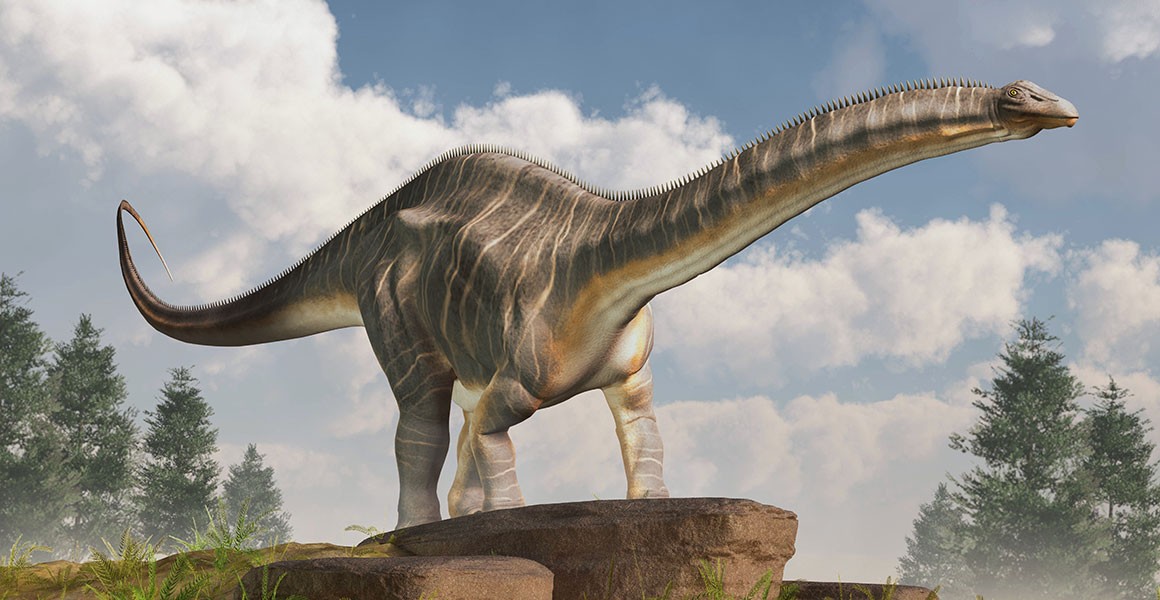
For over 100 years scientists thought that Brontosaurus and Apatosaurus were the same dinosaur as their bones look very similar © Daniel Eskridge/Shutterstock
Brontosaurus : reinstating a prehistoric icon
Brontosaurus is one of
the world's most beloved dinosaurs, unusual, perhaps, for a reptile
whose validity was doubted for more than 100 years.
Brontosaurus was a large sauropod, a group of typically large dinosaurs with long necks and long tails. It lived during the Late Jurassic Period, from about 156 to 145 million years ago.
The first recorded evidence of Brontosaurus was discovered in the 1870s in the USA. But by the early 1900s, scientists had started to question whether the fossils used to name Brontosaurus actually came from another dinosaur, the remarkably similar Apatosaurus.
Due to the rules of scientific naming - the first name published gets priority - Brontosaurus was relegated to scientific history and the fossils reassigned to Apatosaurus. That was until a study in 2015 unexpectedly found evidence that Brontosaurus was distinct from Apatosaurus all along, signalling the reinstated status of this iconic dinosaur.
The first recorded evidence of Brontosaurus was discovered in the 1870s in the USA. But by the early 1900s, scientists had started to question whether the fossils used to name Brontosaurus actually came from another dinosaur, the remarkably similar Apatosaurus.
Due to the rules of scientific naming - the first name published gets priority - Brontosaurus was relegated to scientific history and the fossils reassigned to Apatosaurus. That was until a study in 2015 unexpectedly found evidence that Brontosaurus was distinct from Apatosaurus all along, signalling the reinstated status of this iconic dinosaur.
The discovery and discarding of Brontosaurus
Brontosaurus and Apatosaurus were discovered at a time in the late 1800s known as the Bone Wars or the Great Dinosaur Rush. This was a period of time when two American palaeontologists - Othniel Charles Marsh and Edward Drinker Cope - competed to discover and name the most dinosaurs. In their intense rivalry they resorted to tactics like spying, theft and even the destruction of bones.
Othniel Charles Marsh (centre, back row) and his fossil collecting
assistants competed with other palaeontologists to find dinosaurs during
the Bone Wars in the late 1800s. Image via Wikimedia Commons (CC0 1.0)
In 1877 Marsh named Apatosaurus ajax, a long-necked and long-tailed dinosaur found in the Morrison Formation
in Colorado, USA. Two years later, another sauropod skeleton was named
from the same formation but in Wyoming. This dinosaur was fairly
complete and larger than the earlier Apatosaurus. Marsh named it Brontosaurus excelsus, meaning 'noble thunder lizard'.
Shortly after Marsh's death and the discovery of a dinosaur skeleton with features of both Apatosaurus and Brontosaurus, Elmer Riggs argued in a 1903 publication that there were not enough similarities between the two dinosaurs for both genera to exist. Riggs was an American palaeontologist who specialised in fossil mammals, but also named another well-known sauropod dinosaur, Brachiosaurus.
As Apatosaurus had been named first, its name was kept and Brontosaurus excelsus became Apatosaurus excelsus.
Shortly after Marsh's death and the discovery of a dinosaur skeleton with features of both Apatosaurus and Brontosaurus, Elmer Riggs argued in a 1903 publication that there were not enough similarities between the two dinosaurs for both genera to exist. Riggs was an American palaeontologist who specialised in fossil mammals, but also named another well-known sauropod dinosaur, Brachiosaurus.
As Apatosaurus had been named first, its name was kept and Brontosaurus excelsus became Apatosaurus excelsus.

A diagram of Brontosaurus from 1896, based on the fossil material found by Marsh and his team during the Bone Wars. Image via Wikimedia Commons (CC0 1.0)
Reviving Brontosaurus
For over 100 years, the name Brontosaurus went unused by palaeontologists, although the dinosaur certainly lived on in the minds of the public, making appearances in films, on logos and on postage stamps.This changed when a group of palaeontologists began work to understand and revise the diplodocid family tree. This group of dinosaurs included the bulky Apatosaurus, as well as other, more slender animals such as Diplodocus.
The study used 81 specimens from collections around the world and looked at 477 anatomical traits. The scientists ultimately showed that Brontosaurus was distinct from Apatosaurus, one of the main differences being that Apatosaurus was more massive and robust with a thicker and lower-set neck than Brontosaurus.

Diplodocus belongs to the same family as Brontosaurus and Apatosaurus, but was a more slender animal
This research, published in 2015, was only possible because a number of new diplodocid dinosaurs had been found in recent decades.
Prof Paul Barrett, a dinosaur researcher at the Museum, says, 'The skeletons of Apatosaurus and Brontosaurus are very similar to each other in many ways, and other than their general proportions are mainly distinguished by detailed differences in the neck and back, and shoulder bones.
'These differences are only clear when you're able to examine a large number of different skeletons to see how these features vary from animal to animal.'
Paul says, 'The authors of this study make a convincing case for regarding them as different animals. They do seem to differ in consistent ways and seem to occupy separate branches of the sauropod tree.
'I am happy to accept their conclusions for now, though of course the discovery of new skeletons might force us to change our minds if new evidence comes to light.'
Prof Paul Barrett, a dinosaur researcher at the Museum, says, 'The skeletons of Apatosaurus and Brontosaurus are very similar to each other in many ways, and other than their general proportions are mainly distinguished by detailed differences in the neck and back, and shoulder bones.
'These differences are only clear when you're able to examine a large number of different skeletons to see how these features vary from animal to animal.'
Is Brontosaurus back for good?
Many palaeontologists are ready and willing to welcome Brontosaurus back. Some cite that there are just as many differences between Apatosaurus and Brontosaurus as there are between other closely related genera, and many more differences than there often is between species of the same genus.Paul says, 'The authors of this study make a convincing case for regarding them as different animals. They do seem to differ in consistent ways and seem to occupy separate branches of the sauropod tree.
'I am happy to accept their conclusions for now, though of course the discovery of new skeletons might force us to change our minds if new evidence comes to light.'

A 2015 study found that Brontosaurus and Apatosaurus are actually distinct from each other © Daniel Eskridge/Shutterstock
Some experts have been more hesitant, however. There has been concern that the fossils that Apatosaurus is based on haven't been described in detail, and without this, comparing this dinosaur with Brontosaurus is problematic.
Others argue that determining differences between the dinosaurs is subjective. They suggest that if other traits were chosen, the two dinosaurs might appear less distinct, as there is no standard way of picking significant characteristics.
While palaeontologists may not all agree with the revival of the genus, those who have long loved Brontosaurus may be glad to see this iconic dinosaur be given back its official status.
'Brontosaurus is one of those iconic names that never went away, despite the best efforts of palaeontologists,' says Paul.
'I think it's because it's easy to remember in comparison with many other dinosaur names, it rolls easily off the tongue, and who wouldn't like the idea of a "thunder lizard"?'
Brontosaurus and some other sauropods had large claws on their hands. Although some have suggested that they were for self-defence, it is more likely that the dinosaurs used their claws to help grasp trees to reach high up foliage, or dig scrapes in the ground to make nests and search for water.
Others argue that determining differences between the dinosaurs is subjective. They suggest that if other traits were chosen, the two dinosaurs might appear less distinct, as there is no standard way of picking significant characteristics.
While palaeontologists may not all agree with the revival of the genus, those who have long loved Brontosaurus may be glad to see this iconic dinosaur be given back its official status.
'Brontosaurus is one of those iconic names that never went away, despite the best efforts of palaeontologists,' says Paul.
'I think it's because it's easy to remember in comparison with many other dinosaur names, it rolls easily off the tongue, and who wouldn't like the idea of a "thunder lizard"?'
Was Brontosaurus adapted for battle?
The group of dinosaurs called sauropods all had long necks and tails.Brontosaurus and some other sauropods had large claws on their hands. Although some have suggested that they were for self-defence, it is more likely that the dinosaurs used their claws to help grasp trees to reach high up foliage, or dig scrapes in the ground to make nests and search for water.

Some sauropods had large claws on their hands. This claw was found in Wyoming, USA.
But by comparing the dinosaurs to living animals, scientists have
come up with a few potential reasons for their extremely long necks.
It could be that, like giraffes, sauropods including Brontosaurus used its long neck to get to leaves out of reach of other herbivores looking for food. Or perhaps they were able to sweep their long necks over a large area of lower vegetation to feed efficiently without having to move too much.
A third suggestion is that a longer neck would help attract mates and ward off competitors. Some scientists think that a few of the traits seen in the necks of Brontosaurus and Apatosaurus specifically suggest they were adapted for combat.
These dinosaurs have thicker necks than many other sauropods, and they are more triangular in cross section. The shape may have protected important soft tissue such as the trachea (windpipe) and major blood vessels.
These traits suggest that the neck could have been optimised to resist damage from impacts such as those caused by smashing the neck downwards or sideways onto something. This could be comparable to giraffes displaying necking behaviour or the upright battles of male elephant seals.
It could be that, like giraffes, sauropods including Brontosaurus used its long neck to get to leaves out of reach of other herbivores looking for food. Or perhaps they were able to sweep their long necks over a large area of lower vegetation to feed efficiently without having to move too much.
A third suggestion is that a longer neck would help attract mates and ward off competitors. Some scientists think that a few of the traits seen in the necks of Brontosaurus and Apatosaurus specifically suggest they were adapted for combat.
These dinosaurs have thicker necks than many other sauropods, and they are more triangular in cross section. The shape may have protected important soft tissue such as the trachea (windpipe) and major blood vessels.
These traits suggest that the neck could have been optimised to resist damage from impacts such as those caused by smashing the neck downwards or sideways onto something. This could be comparable to giraffes displaying necking behaviour or the upright battles of male elephant seals.
Did Brontosaurus live in water?
Historically, scientists thought that large dinosaurs like Brontosaurus would have spent most of their time in water. They reasoned that the dinosaurs' bodies were so massive that they wouldn't have been able to support their own body weight if they lived on land, and instead would have used the water to help hold them up.
Palaeontologists used to think that Brontosaurus and other sauropods would have spent most of their time in water. Image by Charles Knight via Wikimedia commons (CC0 1.0)
Elmer Riggs, responsible for the downfall of the beloved Brontosaurus
in 1903, was one of the first scientists to argue that such sauropods
lived on land. His proposal was largely ignored until the 1970s, when
more research confirmed his theory. The structure of the limbs,
backbone, hands and feet are all adaptations for supporting great weight
on land.
Fossil evidence remains in dinosaur tracks made in the soft sediment of prehistoric rivers and lagoons, however. So although these prehistoric giants probably spent most of their time on land, they likely waded in the shallows. Living elephants are similar in that they live on land but spend time near water to bathe and drink, and can cross large rivers to reach new feeding grounds.
Now that the existence of Brontosaurus is recognised once again, scientists can set to work researching this dinosaur's appearance and behaviour.
Fossil evidence remains in dinosaur tracks made in the soft sediment of prehistoric rivers and lagoons, however. So although these prehistoric giants probably spent most of their time on land, they likely waded in the shallows. Living elephants are similar in that they live on land but spend time near water to bathe and drink, and can cross large rivers to reach new feeding grounds.
Now that the existence of Brontosaurus is recognised once again, scientists can set to work researching this dinosaur's appearance and behaviour.


.jpg)


