Mostrando postagens com marcador CERATOPSIDAE. Mostrar todas as postagens

domingo, 20 de dezembro de 2015

[Paleontology • 2006] 

Yinlong downsi • A Basal Ceratopsian with Transitional Features from the Late Jurassic of northwestern China

Yinlong downsi 
Xu, Forster, Clark & Mo, 2006
illustration: Andrey Atuchin || doi: 10.1098/rspb.2006.3566
Although the Ceratopsia and Pachycephalosauria, two major ornithischian groups, are united as the Marginocephalia, few synapomorphies have been identified due to their highly specialized body-plans. Several studies have linked the Heterodontosauridae with either the Ceratopsia or Marginocephalia, but evidence for these relationships is weak, leading most recent studies to consider the Heterodontosauridae as the basal member of another major ornithischian radiation, the Ornithopoda. Here, we report on a new basal ceratopsian dinosaur, Yinlong downsi gen. et. sp. nov., from the Late Jurassic upper part of the Shishugou Formation of Xinjiang, China. This new ceratopsian displays a series of features transitional between more derived ceratopsians and other ornithischians, shares numerous derived similarities with both the heterodontosaurids and pachycephalosaurians and provides strong evidence supporting a monophyletic Marginocephalia and its close relationship to the Heterodontosauridae. Character distributions along the marginocephalian lineage reveal that, compared to the bipedal Pachycephalosauria, which retained a primitive post-cranial body-plan, the dominantly quadrupedal ceratopsians lost many marginocephalian features and evolved their own characters early in their evolution.

Keywords: Ceratopsia; Marginocephalia; Ornithischia; Late Jurassic; Shishugou Formation
Systematic palaeontology
Ornithischia Seeley, 1887.
Heterodontosauriformes new taxon.
Marginocephalia, Sereno (1986).
Ceratopsia Marsh, 1890.
Yinlong downsi gen et sp nov.
  Etymology: Yin’ and ‘long’ mean ‘hiding’ and ‘dragon’ in Chinese, respectively, derived from the movie ‘Crouching Tiger, Hidden Dragon’ which was filmed in the locality where the holotype was found; the specific name is in memory of Mr Will Downs, who joined many palaeontological expeditions in China including the one with us in 2003, shortly before his death.

Holotype: IVPP V14530, a nearly complete skeleton missing only the distal tail (figure 1 and figures 1 and 2 of electronic supplementary material).

Locality and horizon: Wucaiwan, Junggar Basin, Xinjiang, China; upper part of Shishugou Formation, correlated with the Oxfordian stage of the early Late Jurassic (Chen 1996; Eberth et al. 2001).
Figure 2: IVPP V14530. (a) Skull and mandible in lateral view. (b) Skull in dorsal view.
Abbreviations: an, angular; d, dentary; emf, external mandibular fenestra; en, external naris; f, frontal; ff, fossa on frontals; fn, fossa on nasals; itf, infratemporal fenestra; j, jugal; m, maxilla; p, parietal; pa, palpebral; pd, predentary; pm, premaxilla; po, postorbital; q, quadrate; qj, quadratojugal; r, rostral bone; sa, surangular; sq, squamosal; stf, supratemporal fenestra; tr, tubercle row; ts, tubercle on surangular. Scale bar, 2 cm.
 Xing Xu, Catherine A. Forster, James M. Clark and Jinyou Mo. 2006. A Basal Ceratopsian with Transitional Features from the Late Jurassic of northwestern China. Proc. R. Soc. B. 273 (1598): 2135–2140.  doi: 10.1098/rspb.2006.3566
Feng-Lu Han, Catherine A. Forster, James M. Clark & Xing Xu. 2015. Cranial anatomy of Yinlong downsi (Ornithischia: Ceratopsia) from the Upper Jurassic Shishugou Formation of Xinjiang, China.  Journal of Vertebrate Paleontology. DOI: dx.doi.org/10.1080/02724634.2015.1029579


"Hey, you! those are not easter eggs!"
by ChrisMasna chrismasna.DeviantAr.com

quinta-feira, 1 de outubro de 2015

[Paleontology • 2015]  

Mosaiceratops azumai • A Psittacosaurid-like Basal Neoceratopsian from the Upper Cretaceous of central China and Its Implications for Basal Ceratopsian Evolution

Mosaiceratops azumai
  Zheng, Jin & Xu, 2015

Figure 1: Holotype and skeletal reconstruction of Mosaiceratops azumai, gen. et sp. nov (ZMNH M8856).   (a) photograph and line drawing of ZMNH M8856;  (b) skeletal reconstruction showing preserved elements in white. Scale bar 10 cm.

Abbreviations: a, astragalus; boc, basioccipital; c, calcaneum; cav, caudal vertebra; ch, chevron; cv, cervical vertebra; dr, dorsal rib; dv, dorsal vertebra; f, frontal; fem, femur; fl, fibula; h, humerus; il, ilium; is, ischium; L, left; mt, metatarsal; ph, phalanx/phalanges; po, postorbital; R, right; sk, skull; sq, squamosal; t, tibia; td, tendon; ?, undiagnostic remains.
Abstract
Psittacosauridae (parrot-beaked dinosaurs) represents the first major radiation of ceratopsians (horned dinosaurs). However, psittacosaurids are divergent from the general morphology found in other ceratopsians, and this has resulted in their uncertain systematic position among ceratopsians. Here we describe a new basal neoceratopsian dinosaur, Mosaiceratops azumai gen. et sp. nov. based on a partial semi-articulated skeleton recovered from the Upper Cretaceous Xiaguan Formation of Neixiang County, Henan Province, China. Although our phylogenetic analysis supports this taxon as the most basal neoceratopsian, Mosaiceratops exhibits many features previously considered unique to the Psittacosauridae among the basal Ceratopsia. These include a relatively highly positioned external naris, a proportionally large premaxilla, the nasal extending ventral to the external naris, slender postorbital and temporal bars, a large notch between the basal tubera, and the edentulous premaxilla. Thus, the discovery of Mosaiceratops reduces the morphological disparity between the Psittacosauridae and other basal ceratopsians. Character optimization suggests that basal neoceratopsians have re-evolved premaxillary teeth; a major reversal previously unknown in any dinosaur clade. The new specimen also highlights the mosaic nature of evolution among early ceratopsians and supports the phylogenetic hypothesis that the Psittacosauridae is a relatively derived clade, rather than the most basal group of the Ceratopsia.
Systematic palaeontology

Dinosauria Owen, 1842
Ornithischia Seeley, 1887
Ceratopsia Marsh, 1890
Neoceratopsia Sereno, 1986
Mosaiceratops azumai gen. et sp. nov.
Etymology: The generic name Mosaiceratops (“mosaic ceratopsian”) is a contraction of the Latin terms “mosaicus” and “ceratops” in reference to the specimen’s unique (mosaic) combination of characters that were previously considered diagnostic of basal ceratopsians, psittacosaurids, or basal neoceratopsians. The specific name honors Dr. Yoichi Azuma from Fukui Prefectural Dinosaur Museum, who co-organized and participated in several dinosaur expeditions in China. One of those expeditions led to the discovery of the basal neoceratopsian Archaeoceratops.
Figure 3: Temporal calibration of the single most parsimonious tree produced by phylogenetic analysis.
Locality and horizon: Upper Cretaceous (lower-middle Turonian—middle Campanian), Xiaguan Formation, Neixiang County, Henan Province, China.
Wenjie Zheng, Xingsheng Jin and Xing Xu. 2015. A Psittacosaurid-like Basal Neoceratopsian from the Upper Cretaceous of central China and Its Implications for Basal Ceratopsian Eevolution. Scientific Reports. 5, 14190. doi: 10.1038/srep14190

sábado, 11 de julho de 2015

[Paleontology • 2015]  

Wendiceratops pinhornensis • A Centrosaurine Ceratopsid (Dinosauria: Ornithischia) from the Oldman Formation (Campanian), Alberta, Canada, and the Evolution of Ceratopsid Nasal Ornamentation


Wendiceratops pinhornensis
   Evans & Ryan, 2015  
discovered bones in orange || doi: 10.1371/journal.pone.0130007


Abstract
The fossil record of ceratopsid dinosaurs between the occurrence of their proximate sister taxa in the Turonian and the beginning of their well-documented radiation from the late Campanian of North America onwards (approximately 90 and 77 Ma) is poor, with only seven taxa described from this early period in their evolution. We describe a new taxon of a highly adorned basal centrosaurine, Wendiceratops pinhornensis gen. et sp. nov., from the lower part of the Oldman Formation (middle Campanian, approximately 78-79 Ma), Alberta, Canada. Over 200 bones derived from virtually all parts of the skeleton, including multiple well-preserved specimens of the diagnostic parietosquamosal frill, were collected from a medium-density monodominant bonebed, making the new taxon one of the best-represented early ceratopsids. The new taxon is apomorphic in having epiparietals at loci 2 and 3 developed as broad-based, pachyostotic processes that are strongly procurved anterodorsally to overhang the posterior and lateral parietal rami, and an ischium with a broad, rectangular distal terminus. Although the morphology of the nasal is incompletely known, Wendiceratops is inferred to have a large, upright nasal horn located close to the orbits, which represents the oldest occurrence of this feature in Ceratopsia. Given the phylogenetic position of the new taxon within Centrosaurinae, a enlarged nasal horn is hypothesized to have arisen independently at least twice in ceratopsid evolution.


Fig 3. Skeletal reconstruction of Wendiceratops pinhornensis gen. et sp. nov.
Elements represented in the material collected from the bonebed are indicated in blue.
Systematic Palaeontology
Dinosauria Owen, 1842 
Ornithischia Seeley, 1887 
Ceratopsia Marsh, 1890 
Neoceratopsia Sereno, 1986 
Ceratopsidae Marsh, 1888 
Centrosaurinae Lambe, 1915 
Wendiceratops gen. nov.
urn:lsid:zoobank.org:act:BEE8D424-8BB0-4​335-BFFC-701E2C8B4DB3
Diagnosis: Monotypic, as for species.
Wendiceratops pinhornensis, gen. et. sp. nov.
urn:lsid:zoobank.org:act:22F3BE83-6045-4​89D-8F2D-FE53FC08A175
Etymology: The generic name honors Wendy Sloboda, who discovered the type locality, combined with ceratops (horned-face) from the Greek, a common suffix for horned dinosaur generic names. The specific epithet refers to the Pinhorn Provincial Grazing Reserve in Alberta, Canada, where the type locality is located.
Holotype: TMP 2011.051.0009, an incomplete parietal lacking the midline bar and left ramus.
Locality, horizon and age: The type locality occurs within the boundaries of the Pinhorn Provincial Grazing Reserve, south of the Milk River, County of Forty Mile No.8, Alberta, Canada.
Fig 2. Quarry map for the South Side Ceratopsian bonebed.
This bonebed has produced all of the known Wendiceratops pinhornensis gen. et sp. nov. material to date. Elements outlined in gray were collected in 2011 and their positions are approximate relative to the more precisely mapped bones collected in 2013 and 2014 (outlined in black). Inset rose diagram denotes a slight NE-SW trend in long axis orientation for the elements over 100 mm in length. See text for comments on the taphonomy of the bonebed.
Fig 16. Life reconstruction of Wendiceratops pinhornensis gen. et sp. nov.
 Illustration by Danielle Dufault. 
 doi: 
10.1371/journal.pone.0130007
David C. Evans and Michael J. Ryan. 2015. Cranial Anatomy of Wendiceratops pinhornensis gen. et sp. nov., a Centrosaurine Ceratopsid (Dinosauria: Ornithischia) from the Oldman Formation (Campanian), Alberta, Canada, and the Evolution of Ceratopsid Nasal Ornamentation. PLOS ONE. 10(7): e0130007. doi: 10.1371/journal.pone.0130007

Horned dinosaur discovery sheds light on nose horn evolution in Tricerat...
http://bit.ly/1LXAVvX via @EurekAlertAAAS
Scientists Discover One Of The Oldest Horned Dinosaurs  http://n.pr/1D0JUaD via @NPRNews
  New Triceratops Cousin Unearthed https://shar.es/1qTq6k via @LiveScience

terça-feira, 7 de julho de 2015

CERATOPSIDAE

Ceratopsídeos


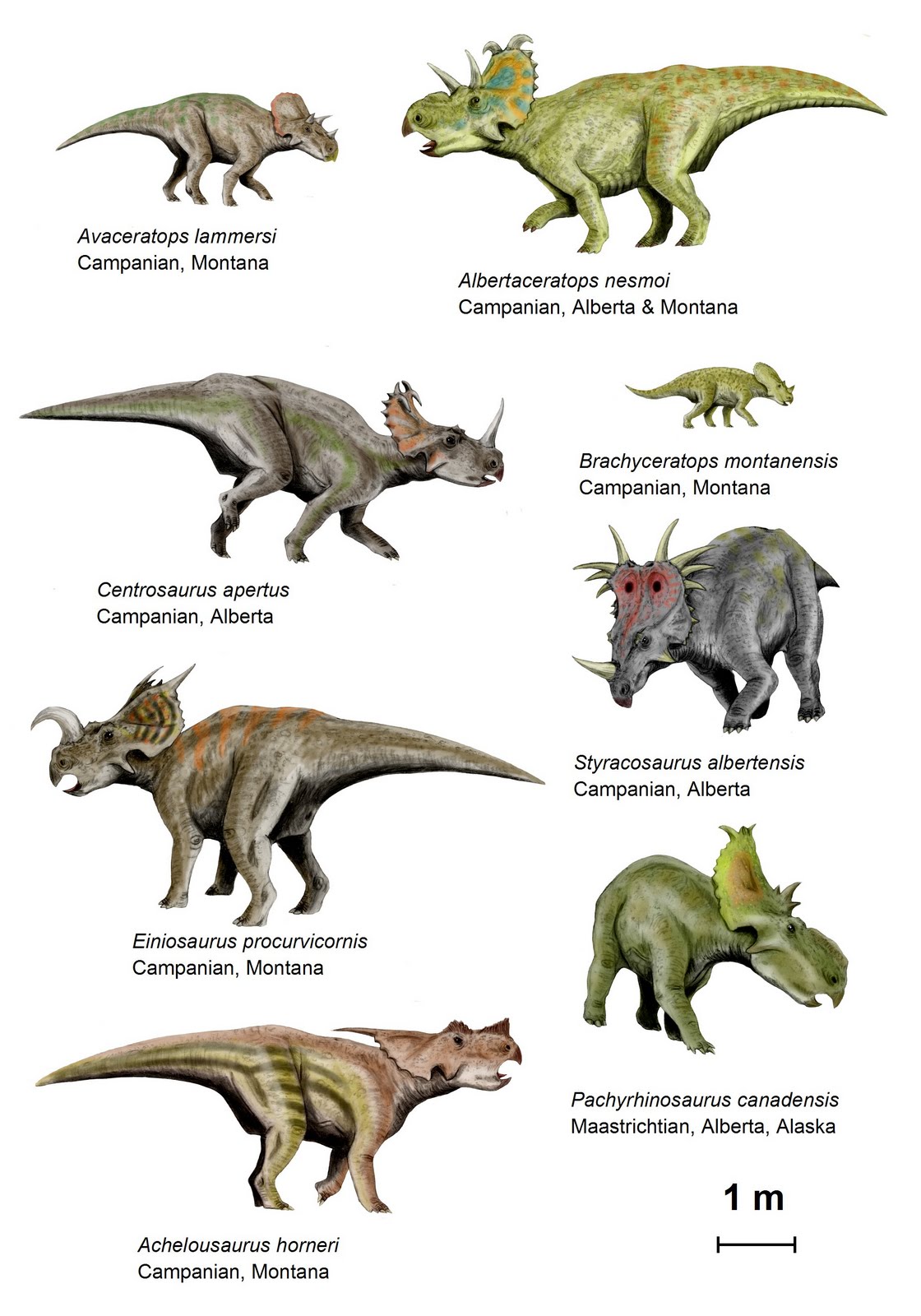
https://blogger.googleusercontent.com/img/b/R29vZ2xl/AVvXsEjzCyt416kKUepMJPcheYpgldhAbufs-dMMvw3HIhfkzd30_PArUwOMWdJgCQV7fO4U89GiS9W4N71X9Tphimtl3wnNSVlhbE8qif9Yq3IE7Gupsvwas41Z4B9BIOSr_bL1x-ueZZMLFdeG/s1600/tamura+centrosaurines.jpg
Ceratopsia (do latim "lagartos com chifre frontal") é uma micro-ordem de dinossauros ornitópodos marginocefalianos quadrúpedes e herbívoros, característicos do período Cretáceo. Os ceratopsianos, como são chamados os dinossauros pertencentes a essa ordem, viveram principalmente em regiões que atualmente são a Ásia e a América do Norte.
Esses dinossauros variavam muito de tamanho medindo de 75 centímetros até 10 metros de comprimento.
O nome ceratopsia que, como visto anteriormente, vem do latim "lagartos com chifre frontal" se deve ao fato de uma parte desses dinossauros possuírem um ou mais chifres na face, pois apesar do nome alguns como o Protoceratops, encontrado na Mongólia, não possuía chifre.
Os Cerátopsídeos cujo nome significa " cara com chifres ", eram todos quadrúpedes. Caracterizavam-se essencialmente pelo tamanho dos seus crânios, com grandes projecções ósseas que protegiam o pescoço, e pelos chifres que apresentavam no rosto, quer sobre os olhos, quer no nariz.
   
                                          Anchiceratops
 O Anchicerátops cujo nome significa ("quase uma cara com chifre") foi encontrado em Alberta no ano de 1914. Possuía um bico córneo que era comum no grupo ao qual ele pertencia, os ceratopsianos, eram bem armados com chifres e escudos, provavelmente viviam em grandes rebanhos com os filhotes centralizados para melhor se defenderem.·
Dados do Dinossauro:
Nome: Anchicerátops
Nome Científico: Anchiceratops ornatus
Local onde viveu: América do Norte
Tamanho: 6 metros de comprimento
Peso: Cerca de 4 toneladas
Alimentação: Herbívora 
Centrossauro
    O Centrossauro cujo nome significa "lagarto de ponta afiada", viveu há aproximadamente 65 milhões de anos atrás no final do período Cretáceo, possuía uma cabeça pesada com dois chifres pequenos no topo do crânio e um grande na ponta do nariz, ombros fortes e um rabo pequeno, como a maioria dos Ceratopsídeos, família a qual pertence.

Dados do Dinossauro:

Nome: Centrossauro
Nome Científico: Centrosaurus apertus
Época: Cretáceo
Local onde viveu: América do Norte
Peso: Cerca de 4 toneladas
Tamanho: 6 metros de comprimento
Alimentação: Herbívora
  
Torossauro
    O Torossauro cujo nome significa "lagarto touro" foi encontrado pelo famoso paleontólogo Othiniel Charles March, e podia atingir até 8 metros de comprimento, dos quais quase 3 eram só da cabeça, a qual é o maior crânio dentre os animais terrestres conhecidos.  O escudo e os chifres eram óptimas armas de defesa contra predadores porém eram também utilizadas em batalhas entre machos na disputa de fêmeas, escudo o qual acredita-se que fosse ornamentado de colorido que serviria para seduzir fêmeas e aterrorizar possíveis adversários. Os músculos do pescoço do Torossauro eram extremamente forte para aguentar o peso da enorme cabeça e juntamente com eles, os das patas dianteiras. Os Torossauros viviam em enormes manadas para se defenderem dos grandes predadores de sua época, como por exemplo o Tiranossauro rex, a manada e uniria e formaria um parede de escudos e chifres com os mais fracos (filhotes, velhos e doentes) no interior dela.

Dados do Dinossauro:
Nome:
Torossauro
Nome Científico: Torosaurus latus
Época: Cretáceo, de 67 a 65 milhões de anos atrás
Local onde viveu: América do Norte
Peso: Cerca de 5 toneladas
Tamanho: 8 metros de comprimento
Alimentação: Herbívora
Pentaceratops
    O Pentaceratops cujo o nome significa " Lagarto de cinco chifres ", viveu no Novo México e Colorado, media aproximadamente 8 metros de comprimento e chegava a pesar 3 toneladas, viviam em grupos alimentando se de vegetações rasteiras. Pertencia a família dos ceratopsídeos. O escudo e os chifres eram óptimas armas de defesa contra predadores porém eram também utilizadas em batalhas entre machos na disputa de fêmeas, escudo o qual acredita-se que fosse ornamentado de colorido que serviria para seduzir fêmeas e aterrorizar possíveis adversários.
Dados do Dinossauro:
Nome: Pentaceratops
Nome Científico: Pentaceratops sternbergi
Época: Cretáceo
Local onde viveu: América do Norte
Peso: Cerca de 3 toneladas
Tamanho: 8 metros de comprimento
Alimentação: Herbívora