Mostrando postagens com marcador Caribu. Mostrar todas as postagens

sexta-feira, 18 de janeiro de 2019

A caribou that was part of the Southern Selkirks herd, which once traversed the U.S.-Canada border. Biologists captured the last member of the herd this week.
David Moskowitz

The contiguous United States just lost its last wild caribou

The last caribou known to inhabit the contiguous United States has been removed from the wild. This week, a team of biologists working for the Canadian province of British Columbia captured the caribou—a female—in the Selkirk Mountains just north of the U.S.-Canada border. They then moved it to a captive rearing pen near Revelstoke as part of a controversial, last-ditch effort to preserve highly endangered herds. The female caribou is believed to be the last member of the last herd to regularly cross into the lower 48 states from Canada.

The 14 January capture of the caribou was “like losing a piece of the tribe in some way,” says Bart George, a wildlife biologist for the Kalispel tribe in Usk, Washington. It is one of two indigenous nations in the United States that have been pushing governments to maintain the cross-border caribou herd and protect its habitat.

In about a month, the British Columbia biologists plan to release the caribou—along with two other animals from another endangered herd—back into the wild, into a larger and more stable Canadian herd. The ultimate fate of these animals, however, is unclear. They are mountain caribou, a distinct ecotype of caribou found only in a forested swath of northwestern North America, which have become endangered because of habitat loss and other factors. Conservation efforts have failed to reverse population declines or prevent the complete extirpation of some herds at the southern end of the mountain caribou’s range, where they inhabit inland temperate rainforests. And biologists can’t say whether any caribou will again inhabit the continental United States. (There are herds of other types of caribou in Alaska.)

Battles over mountain caribou recovery have spanned decades. George, along with many conservationists, believes officials in British Columbia are looking for a way out of having to protect dwindling southern populations. Province officials dispute that idea. But critics note they have failed to develop management strategies for some southern herds, despite direction from the Canadian government calling for their restoration under the federal Species at Risk Act.

Conservationists also fear removing caribou from the wild will ultimately lead to the lifting of protections for its habitat, especially if the animals never return. Both British Columbia and the United States have identified and protected large areas of “core habitat” for mountain caribou. But adjacent lands, especially in British Columbia, have continued to be heavily logged, contributing to caribou declines.

It works like this: The disturbance benefits populations of other hoofed animals, such as moose and deer, which in turn attract predators such as wolves and mountain lions. The predators then spill over into the remaining patches of protected habitat, where they feed on caribou. Because of that dynamic, it is not clear whether “it will be possible to recover some of those herds,” says wildlife biologist Aaron Reid of British Columbia’s forests ministry in Penticton, which is responsible for caribou conservation. “The habitat may be too far gone.”

Provincial officials say they have no current plans to remove caribou habitat protections for the southern herds. But, “It’s hard to believe that,” says Candace Batycki, a program director at the Yellowstone to Yukon Conservation Initiative in Nelson, Canada. That’s because the province has lifted protections in the past after other caribou herds became extirpated and officials deemed it impossible to restore them.

What hangs in the balance, observers say, is not just the survival of a unique caribou population, but also the ecological integrity of the entire inland temperate rainforest. “The protections on core habitat for caribou are an umbrella, huge umbrella, that protect so many other species,” Reid says. “That’s the big story.”

Correction, 17 January 2019, 6:00 p.m.: The headline and story incorrectly characterized the caribou as the last in the continental United States. It was the last in the contiguous United States.
Posted in:
doi:10.1126/science.aaw7110

David Moskovitz

David Moskovitz is a photographer and journalist based in Winthrop, Washington. He is the author of Caribou Rainforest: From Heartbreak to Hope (Mountaineers Books/Braided River, 2018).

quarta-feira, 10 de outubro de 2018

Spectacular ice age wolf pup and caribou dug up in Canada

Rare, mummified animals discovered by gold miners in Yukon
Yukon wolf pup remains
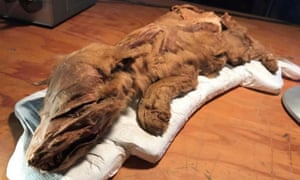
The wolf pup remains uncovered near Dawson, Yukon. The specimen is complete, with head, tail, fur and skin all intact. Photograph: Government of Yukon
The Klondike region of Canada is famous for its gold, but now other remarkable ancient treasures have been unearthed from the melting permafrost.
Two mummified ice age mammals – a wolf pup and a caribou calf – were discovered by gold miners in the area in 2016 and unveiled on Thursday at a ceremony in Dawson in Yukon.

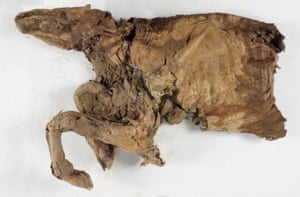
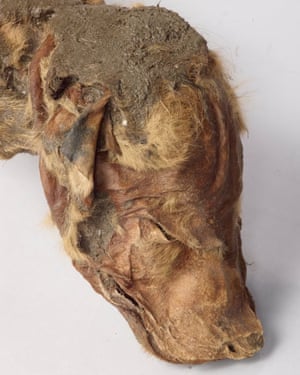
É extremamente raro que a pele, a pele e os tecidos musculares sejam preservados no registro fóssil, mas todos os três estão presentes nesses espécimes, que foram datados por radiocarbono há mais de 50.000 anos. O filhote de lobo é preservado em sua totalidade, incluindo detalhes excepcionais da cabeça, cauda, ​​patas, pele e cabelo. O caribu de bezerro é parcialmente preservado, com cabeça, tronco e dois membros dianteiros intactos.
Mummified remains of an ancient caribou.
Pinterest
The mummified remains of the caribou. Photograph: Government of Canada, Canadian Conservation Institute

"Até onde sabemos, este é o único lobo da idade do gelo mumificado já encontrado no mundo", disse Grant Zazula, um paleontólogo local que trabalha com o governo Yukon, que também enfatizou o apoio dos garimpeiros locais e da comunidade mineradora na pesquisa paleontológica. Julie Meachen, uma morfologista carnívora que trabalha com mamíferos da era do gelo na Universidade de Des Moines e em breve fará pesquisas sobre o filhote de lobo, disse: “Quando Grant me enviou as fotos e me pediu para participar eu fiquei realmente excitado. Eu estava meio que fora de mim.


Advertisement
“We want to do an ancient DNA test to see who it’s related to and look at its microbiome to see if there are gut bacteria still there.”
Mummified wolf pup.
Pinterest
The head of the mummified wolf pup is remarkably well preserved. Photograph: Government of Canada, Canadian Conservation Institute
Outros pesquisadores ao redor do mundo reagiram com empolgação semelhante à descoberta desse antigo predador e de suas presas, que estão bem preservadas para permitir futuras investigações de fatores como causa da morte, dieta, saúde, idade e genética.

Elsa Panciroli, paleontóloga da Universidade de Edimburgo, disse: “Os ossos do lobo da idade do gelo são relativamente comuns no Yukon, mas ter um animal preservado com pele e pêlo é simplesmente excepcional - você só quer alcançá-lo e acariciá-lo. É um vislumbre evocativo do mundo da era glacial. ” Thomas Higham, um especialista em datação arqueológica na Universidade de Oxford, disse: “Os restos são altamente evocativos porque nos permitem fazer uma conexão quase cara a cara com animais que têm dezenas de milhares de anos, e ainda parecem muito mais recente." Acredita-se que o lobo e o caribu tenham habitado uma paisagem de tundra seca ao lado de outros animais, como os mamutes-lanudos.

A preservação da pele e da pele sugere que eles viviam em um período frio, disse Jan Zalasiewicz, paleobiologista da Universidade de Leicester. “Um clima mais seco e mais árido ajudaria a preservar a pele e a pele, e isso geralmente acontece quando o clima fica mais frio”, disse ele. "O truque aqui é encontrar um meio de liofilizar a carcaça nestas condições áridas e enterrá-la ... você precisa encontrar uma maneira de secá-la e colocá-la no freezer muito rapidamente". Panciroli disse: "Espero que mais pesquisas sobre essa 'filhote de cachorro' possam render um DNA antigo" que poderia fornecer novas informações sobre as populações de lobos que viviam no Yukon nessa época. “Por exemplo, de onde eles vieram e como estão relacionados com lobos modernos?”

Since you’re here…

… we have a small favour to ask. More people are reading the Guardian than ever, but advertising revenues across the media are falling fast. And unlike many news organisations, we haven’t put up a paywall – we want to keep our journalism as open as we can. So you can see why we need to ask for your help.

The Guardian is editorially independent. So we set our own agenda. Our journalism is free from commercial bias. It isn’t influenced by billionaire owners, politicians or shareholders. No one edits our Editor. No one steers our opinion. This means we can give a voice to the voiceless. It lets us challenge the powerful - and hold them to account. And at a time when factual, honest reporting is critical, it’s what sets us apart from so many others.

The Guardian’s long term sustainability relies on the support that we receive directly from our readers. And we would like to thank the hundreds of thousands who are helping to secure our future. But we cannot stop here. As more of you offer your ongoing support, we can keep investing in quality investigative journalism and analysis. We can remain a strong, progressive force that is open to all.

sexta-feira, 28 de setembro de 2018


Filhote de lobo de cinquenta mil anos de idade ainda tem patas, pele e cabelo

Dois animais da era glacial excepcionalmente bem preservados, descobertos em 2016 por mineiros no território de Yukon, no Canadá, foram revelados esta semana em uma cerimônia no centro cultural em Dawson City, segundo o jornal The Guardian. 

O caribu mumificado, descoberto em um local com um leito de cinzas vulcânicas datado de aproximadamente 80.000 anos atrás, tem toda a metade da frente intacta, incluindo o tronco, a cabeça e os dois membros dianteiros, e ainda pele, músculo e pelos . 

 O segundo espécime, um filhote de lobo, é completamente preservado com sua cabeça, cauda, ​​patas, pele e pelos. 

Ambos os animais têm datado por radiocarbono há mais de 50 mil anos e atraíram o interesse da comunidade de paleontologia pela luz que poderiam lançar sobre a genética e o estilo de vida dos antigos mamíferos árticos.