Archaebacteria
are similar in form to bacteria, but they are different from the normal
bacteria that biologists often study. In fact, the differences between
regular bacteria and archaebacteria are so great that they are
classified apart from other forms of life and have challenged the way
scientists classify life into different kingdoms.
Though
archaebacteria and a regular bacteria were once considered part of the
same kingdom, molecular biology and genetics have shown that these
prokaryotic organisms have many unique features that merit their own
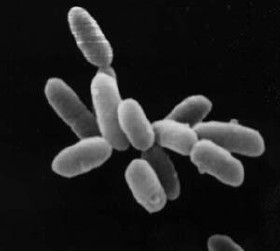
branch on the phylogenetic tree of life. Halobacteria,
an example of archaea. Photo: By NASA – en:Image:Halobacteria.jpg(Taken
from [1]), Public Domain,
https://commons.wikimedia.org/w/index.php?curid=2979987Some
texts will refer to these organisms as archaea rather than
archaebacteria, to make the distinction between them and bacteria more
clear, and there is some disagreement about the exact terms used to
classify archaea – whether or not they should be called archaea or
archaebacteria. This article will use the terms interchangeably.
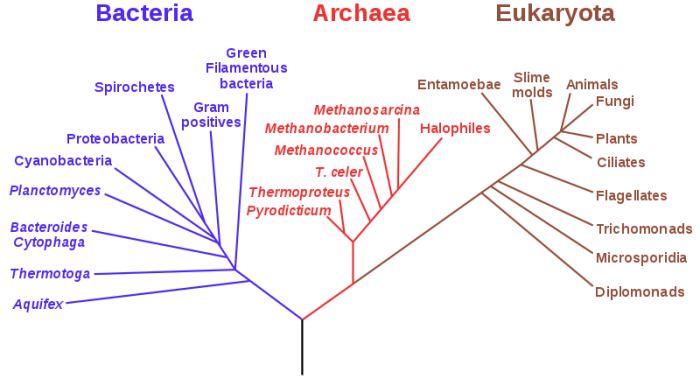
The Classification Of Archaea
Photo: Sting via Wikimedia Commons, Public DomainOne
of the ways that scientists categorize life forms is by dividing them
into different kingdoms, which are based on the cell structure of the
organism. The different kingdoms include Fungi, Planitia, Animalia, Protista,
and Monera. The kingdom Protista contained single-celled eukaryotic
organisms while the kingdom Monera was believed to encompass all
different varieties of prokaryotic organisms.
However, biochemical and genetic studies of bacteria have shown that certain types of prokaryotes,
those referred to as a “archaebacteria”, have unique biochemistry that
places them on their own section of the tree of life. The name of
archaebacteria comes from the root “archaea”: meaning “ancient”, which
reflects the hypothesis that modern archaebacteria have descended from
ancient populations of bacteria which evolved to thrive in the sulfur-rich, high-temperature environments surrounding deep-sea vents.
Due
to advances in biochemistry and genetics, the phylogenetic tree of life
contains a new order of classification, the concept of domains.
Domains encompass an even larger section of life than kingdoms do.
Under the system of domains, all eukaryotic organisms including
protists, fungi, plants, and animals are considered part of the
Eukaryota domain. Meanwhile, most bacteria fall under the domain “eubacteria“. Finally, the domain of “archaea” belongs entirely to archaea/archaebacteria.
Archaebacteria Theories
The
study of the unique biochemistry possessed by archaebacteria could give
researchers more insight into how life worked during ancient,
primordial times. Some scientists hypothesize that archaebacteria such
as the bacteria Thermoplasma could be the predecessors of the nuclei
found within the cells of eukaryotes, having evolved into nuclei through a process known as endosymbiosis.
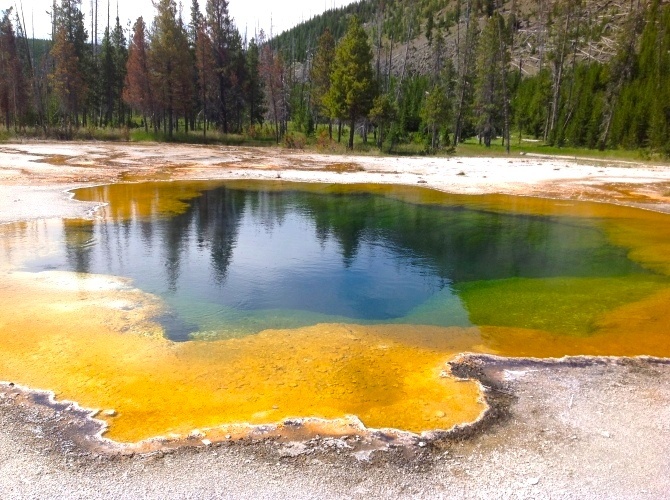
Archaea
are often found in hot springs as well as around hydrothermal vents.
Photo: ZYjacklin via Wikimedia Commons, Public DomainArchaea
have the ability to not only survive, but thrive, in environments most
other organisms would not be able to live in. These include
high-temperature environments, highly acidic environments, and high salt
environments. The bacteria can potentially survive temperatures as high
as 190°F, and substances with acidity as high as 0.9 pH.
Beyond
this, archaebacteria engage in horizontal gene transfer quite
frequently. Horizontal gene transfer is when one individual transfers a
gene to another individual within the lifetimes of those individuals.
This makes it difficult to precisely determine how closely
archaebacteria cells are related to one another. In fact, it’s difficult
to ascertain if the bacteria even have the kinds of stable traits that a
biologist might typically use to classify a species. For this reason,
archaebacteria have challenged the traditional methods of species
classification.
Traits Of Archaebacteria
The ancient cells that comprise archaea/archaebacteria display a number of traits
or attributes not present in more modern types of cells. Eukaryotes and
regular bacteria have cell membranes composed of ester-linked
phospholipids, but in the case of archaebacteria, their cell membranes
are made out of ether-linked phospholipids. Archaea create their cell
membranes with a sugar that is different from the peptidoglycan sugar
which composes the cells of traditional bacteria, though the sugar used
by archae is similar in composition.
While archaebacteria have a
single round chromosome like regular bacteria, their method of genes
transcription is different from that of most other bacteria. Rather,
gene transcription in archaebacteria is more like the transcription that
happens in eukaryotic cells. In other words, gene transcription methods
are similar in between archaea and eukarya, and the creation of the
cell membrane is most similar in bacteria and archaea. This strange
reflection of gene transcription and cell membrane creation methods has
led some biologists to theorize that the evolution of eukaryotic cells
was driven by the fusion of bacteria and archaebacteria.
Archaea
may have merged with a different form of bacteria at one point and began
living inside that bacterial cell in an example of a symbiotic relationship,
eventually transforming into the nuclei that are present in the cells
of other organisms, the cells eukaryotes have today. An organism known
as Lokiarcheota may be evidence of this evolutionary path, representing a
transitional form between archaea and early eukaryotes.
Some
archaebacteria are capable of surviving in conditions of extremely high
salinity, which usually has a desiccating effect on cells, killing them.
Halobacterium is an example of such salt-tolerant archaebacteria.
Halobacterium has the pigment bacteriorhodopsin in it, which provides it
with chemical energy and gives halobacterium a purple coloration.
Bacteriorhodopsin also pushes protons to the outside of the cell
membrane, and when the protons flow back into the cell they start the
synthesis of ATP. The bacteriorhodopsin pigment is quite similar to
rhodopsin, another pigment found in the retinas of vertebrates.
There
are both aerobic and anaerobic species of archaea, and the bacteria can
be found in extreme environments as well as in common environments like
regular soil. Archaebacteria are capable of practicing anaerobic
respiration, specifically a form of anaerobic respiration dubbed
methanogenesis as it produces methane as a byproduct of respiration.
Archaebacteria also utilize other forms of cellular respiration, but
methanogenesis via cellular respiration is exclusive to archaebacteria.
Bacteria and eukaryotic cells cannot carry out methanogenesis.
Finally, the ribosomal RNA of archaebacteria suggests that eukarya and bacteria split off from archaea in the far distant past.
Different Kinds Of Archaea
Archaebacteria are divided into three different types
and are classified based upon how close they are to one another on the
phylogenetic tree or their level of genetic relationship to one another.
Each type of archaebacteria has its own unique features.
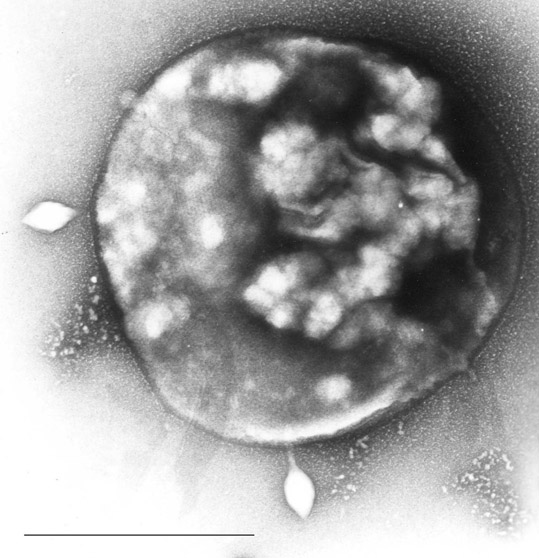
Crenarchaeota A
Sulfolobus, a type of crenarchaeota, infected with an STSV-1 virus.
Photo: By Xiangyux – English Wikipedia, Public Domain,
https://commons.wikimedia.org/w/index.php?curid=1675914The
primary distinguishing characteristic of this type of archaebacteria is
that it can survive at extremely high temperatures, temperatures as
high as 230°F. Many species of this archaea have been found living near
hydrothermal vents deep in the ocean, areas where magma emerging from
beneath the crust of the Earth heats the water to extremely high
temperatures. They have also been discovered in hot springs. Some
theories regarding the origin of life hypothesized that deep-sea vents
could have been the site where life first evolved, with the formation of
the first cells occurring due to the unusual chemical interactions that
occur at such high-temperature areas. This type of archaea is also
capable of surviving in highly acidic environments.
Euryarchaeota
This
type of archaea Is one of the previously mentioned types that can
produce methane through cellular respiration, and they are the only
lifeforms are known to use carbon as the electron acceptor when
performing cellular respiration. This unique trait allows them to break
down extremely complex carbon-based molecules, and it means that they
fulfill an important ecological niche degrading carbon into methane and
facilitating the carbon cycle of the earth. (Archaea may also play a
role in the nitrogen cycle, as researchers have found some examples of
marine archaea capable of carrying out nitrification.)
Methanogen
archaea have been located in deep-sea sediment deposits, where they are
responsible for producing isolated pockets of methane that lay beneath
the floor of the ocean. They are also found in wetlands and marshes, and
their chemical breakdown of carbon and production of methane is what
accounts for the distinct smell associated with marshes, and for swamp
gas. They are even found in the stomachs of other animals like cows,
where they help the cow digest certain types of sugars that eukaryotic
cells cannot digest.
Methanobacterium ruminatium is one example of
the archaebacteria found in the digestive system of ruminating (mammals
capable of getting nutrients from plant-food) animals. Humans even have
some of these bacteria living within our digestive tract and they
perform a similar function that cow archaebacteria do.
Korarchaeota
Korarchaeota
are possibly the oldest type of archaea and therefore they could be the
oldest organisms on the entire planet. Like the Crenarchaeota, they can
be found near hydrothermal vents. They also share many genes with
Crenarchaeota. In fact, Korarchaeota not only shares genes with
Crenarchaeota, but they also share genes with Euryarcheaota. This
implies that they could be a common ancestor close to Korarchaeota on
the phylogenetic tree from which Crenarchaeota and Euryarcheaota
descended. While Korarchaeota are amongst the oldest lifeforms on the
planet, they are rather rarely found in nature apart from the selective
niches of hot springs and deep-sea vents.
domingo, 29 de abril de 2018
New life form answers question about evolution of cells
The left panel shows: EM image of a normal E. coli cell.
Right panel: an engineered cell with a mixed membrane, which shows an
elongated form. Credit: Photo's University of Wageningen / Van der Oost
laboratory
Bacteria and Archaea are two of the three
domains of life. Both must have evolved from the putative last universal
common ancestor (LUCA). One hypothesis is that this happened because
the cell membrane in LUCA was an unstable mixture of lipids. Now,
scientists from the University of Groningen and Wageningen University
have created such a life form with a mixed membrane and discovered it
is, in fact, stable, refuting this hypothesis. The results will be
published in the journal Proceedings of the National Academy of Sciences in the week of 19 March.
There are
many ideas on how cellular life could have evolved billions of years
ago. Protocells may have formed in clay minerals, or as simple lipid
vesicles. In the latter scenario, something called the 'lipid divide'
would have occurred, creating the separate domains of bacteria and
archaea, explains University of Groningen Professor of Molecular
Microbiology Arnold Driessen. "The lipid membranes of both domains are
different, composed of phospholipids that are each other's mirror
image."
Mixed membranes
In technical terms, the lipids in the membranes of bacteria are made
up of straight-chain fatty acids that are ester-linked to a backbone of
glycerol-3-phosphate. But the lipids in the archaeal membrane have a
backbone of glycerol-1-phosphate, to which isoprenoids are linked by
ether bonds.
The idea behind the lipid divide is that a common ancestor of both bacteria and archaea had a cell membrane
in which both types of lipid were mixed. "This mixed membrane would be
less stable than a homogenous membrane of just one type of phospholipid,
so eventually a split occurred, resulting in the two domains of
Bacteria and Archaea," says Driessen.
All this would have happened over 3.5 billion years ago, so hard
evidence is lacking. Driessen and his co-workers therefore decided to
"reverse-engineer" a micro-organism with a mixed membrane. "This has
been tried before, but these experiments resulted in bacteria with only
very small amounts (< 1 percent) of archaeal lipids."
Left panel: EM image of a normal dividing E. coli cell.
Right panel: an engineered cell with high archaeal lipid production,
showing lobular irregularities in the cell membrane. Credit: Photo's
University of Wageningen / Van der Oost laboratory
However, in the new study, this increased
to 30 percent. Two key breakthroughs made this possible: "In previous
research we discovered an enzyme crucial to the production of archaeal
membrane lipids. This takes three steps, and before that, only two of
the enzymes involved were known." The other breakthrough came from
scientists at Wageningen University, explains Driessen. "They managed to
increase the production of isoprenoids in the bacterium E. coli."
Isoprenoids are a ubiquitous class of organic compounds which includes
many natural flavours, colours or fragrances.
Both discoveries were transferred to a normal E. coli bacterium,
which was a major feat of genetic engineering.
"And we didn't know if
the end result would be a viable cell," says Driessen. But in the end,
it worked out well. With some fine tuning, the scientists created a cell
in which all phosphatidylglycerol, the lipids forming the basic bilayer
of the bacterial membrane,
were replaced by their archaeal equivalent (archaetidylglycerol).
This
accounts for 30 percent of the lipids in the membrane. "This bacterium
grew at normal speed and was stable," says Driessen. "So this result
does not support the hypothesis that a mixed membrane is inherently
instable and could thus have created the lipid divide."
Driessen notes that the archaeal enzymes for membrane lipid
production are less specific in the reactions they catalyze than their
bacterial equivalents. "They appear to be more "primordial." So the
evolution of enzyme specificity could have been a driver for the
divide." There is, of course, one major caveat—the experiments were done
in modern E. coli bacteria, which have evolved 3.5 billion years beyond
the original split with the archaea.
"The robustness of these mixed cells surprised us. We expected more
problems keeping them alive. After all, what we have engineered does
amount to a new life form." The engineered cells were more elongated
than the original E. coli. And when the production of archaeal lipids
was very high, growth slowed and the membrane developed lobular
appendages.
Apart from the evolutionary implications, this discovery could spawn
new research: "For example, we could engineer a bacterial expression
system for archaeal membrane proteins, such as those produced by hyperthermophiles that grow at extremely high temperatures and pressure."
The work by the two Dutch universities is part of the Origins Center,
a national programme dedicated to research into the origin of life on
our planet.
More information:
Antonella Caforio el al.,
"Converting Escherichia coli into an archaebacterium with a hybrid
heterochiral membrane," PNAS (2018). www.pnas.org/cgi/doi/10.1073/pnas.1721604115