Mostrando postagens com marcador Estônia. Mostrar todas as postagens

terça-feira, 29 de julho de 2025

Translator


DNA antigo sugere que ancestrais de estonianos, finlandeses e húngaros viveram na Sibéria há 4.500 anos

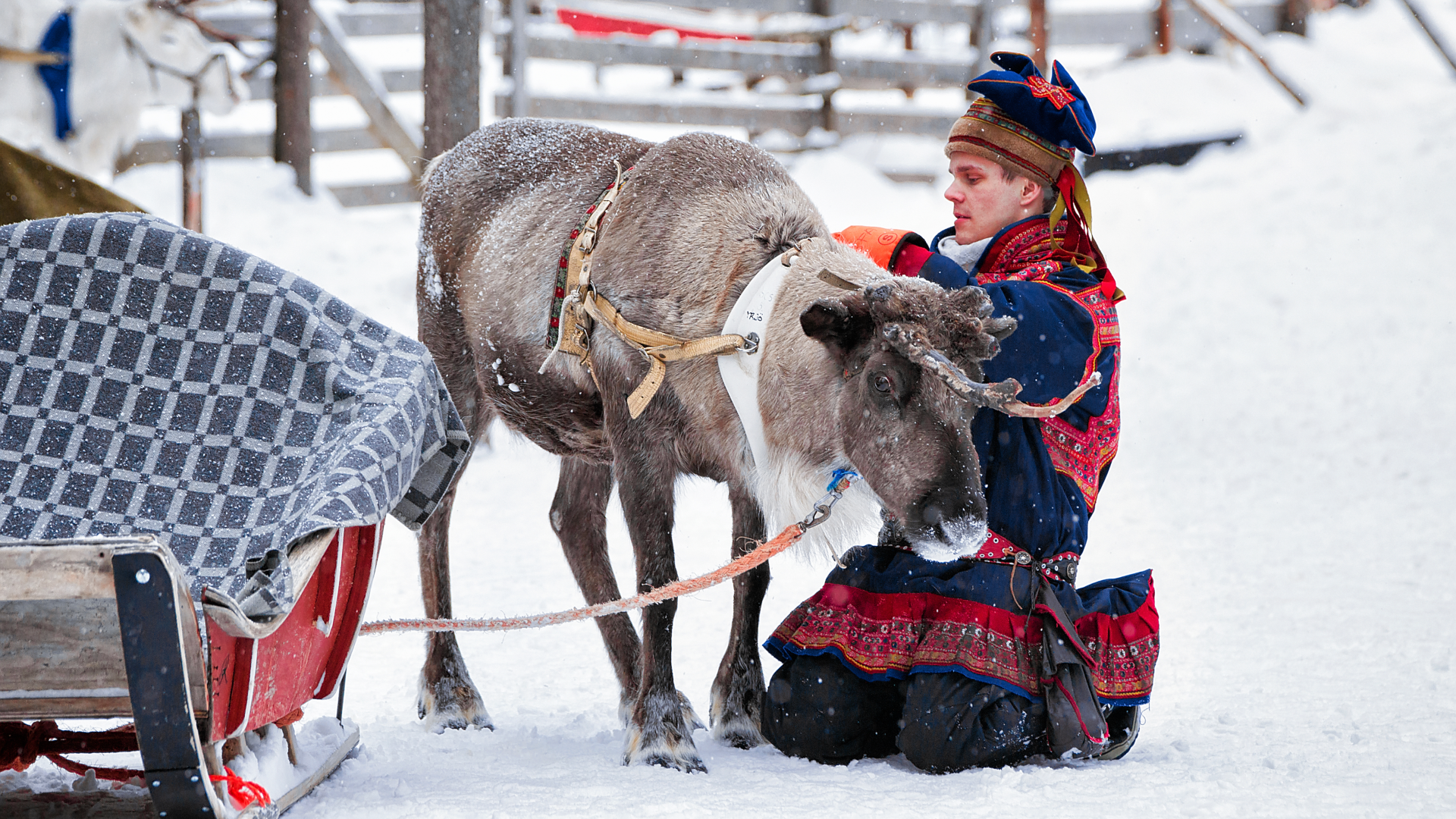
O povo Sami, nativo da Finlândia, fala uma língua urálica. (Crédito da imagem: Getty Images)

Falantes atuais de húngaro, finlandês e estoniano têm ascendência siberiana substancial, segundo um novo estudo de genomas antigos. Essas raízes provavelmente se espalharam para o oeste a partir de um grupo de pessoas que vivia nas estepes florestais das Montanhas Altai, na Ásia Central e Oriental, há 4.500 anos.

O DNA antigo revelou que esse grupo era patrilinear, ou seja, organizado com base na descendência dos pais.

No entanto, embora o DNA antigo possa indicar para onde um grupo se moveu ao longo do tempo, é desafiador usar a genética para rastrear a linguagem. Portanto, especialistas observaram que os resultados não comprovam definitivamente uma ligação entre os falantes dessas línguas e o padrão antigo do DNA.

Migrando para fora da Sibéria

Em um estudo publicado em 2 de julho na revista Nature , pesquisadores analisaram 180 pessoas que viveram no norte da Eurásia entre o período Mesolítico e a Idade do Bronze (11.000 a 4.000 anos atrás). 

A equipe então adicionou esses indivíduos a um banco de dados com mais de 1.300 povos antigos já analisados e, em seguida, comparou esses genomas com os de pessoas modernas. Uma descoberta significativa veio dos genomas que datam do Neolítico Tardio ao Início da Idade do Bronze (4.500 a 3.200 anos atrás).

Eles descobriram que as localizações geográficas de povos antigos com um padrão de DNA que eles chamaram de Yakutia_LNBA estavam "inequivocamente associadas a populações de língua urálica antigas e atuais", escreveram os pesquisadores no estudo.

Relacionado: Você consegue esquecer sua língua nativa?

As línguas urálicas são um grupo de mais de 20 línguas faladas por milhões de pessoas, mas as mais proeminentes são o estoniano, o finlandês e o húngaro. Os linguistas têm se interessado por essas três principais línguas urálicas porque elas são diferentes das línguas indo-europeias faladas nos países vizinhos.

"Populações vizinhas que falam línguas indo-europeias tendem a não ter ancestralidade Yakutia_LNBA, ou qualquer outro tipo de ancestralidade do Leste Asiático", disse Tian Chen Zeng , autor principal do estudo e estudante de pós-graduação em biologia evolutiva humana na Universidade de Harvard, à Live Science por e-mail. "A ancestralidade Yakutia_LNBA é a única ancestralidade do Leste Asiático presente na composição genética de quase todas as populações atuais e antigas de língua urálica."

Os pesquisadores identificaram o grupo Yakutia_LNBA nos ossos de pessoas que viveram entre 4.500 e 3.200 anos atrás na Sibéria. Eles podem ter feito parte da cultura Ymyyakhtakh , uma cultura antiga no nordeste da Sibéria que possuía tecnologia de cerâmica, objetos de bronze e pontas de flechas feitas de pedra e osso.

Arqueólogos já haviam descoberto que a cerâmica Ymyyakhtakh se espalhou para o sul, para as estepes florestais da região de Altai-Sayan, perto da intersecção da atual Rússia, Mongólia, Cazaquistão e China, há cerca de 4.000 anos. Os pesquisadores sugeriram que o padrão de DNA Yakutia_LNBA pode, portanto, estar ligado a culturas pré-históricas de língua urálica.

"Uma interpretação direta disso é que a ancestralidade Yakutia_LNBA se dispersou do Leste para o Oeste junto com as línguas urálicas", disse Zeng.

"Mostramos que o Yakutia_LNBA pode servir como um excelente marcador para a disseminação das primeiras comunidades de língua urálica", observaram os pesquisadores no estudo.

Os cientistas também descobriram que esse grupo, que acabou se espalhando para o oeste, pode ter sido organizado por descendência patrilinear, com base nos padrões do cromossomo Y no DNA antigo.

Os desafios do rastreamento de idiomas

Mas a associação entre genética e linguagem é complicada de provar, principalmente no passado.

"A composição genética de uma pessoa não oferece nenhuma informação sobre a variedade de línguas que ela pode falar, nem qual delas é considerada sua língua primária", disse Catherine Frieman , arqueóloga da Universidade Nacional Australiana que não estava envolvida no estudo, à Live Science por e-mail.

Como as pessoas se comunicam de maneiras complexas, "acredito que precisamos considerar como o multilinguismo, inclusive entre famílias linguísticas, pode ter moldado ou afetado a disseminação e a mudança da linguagem", disse Frieman.

Embora os pesquisadores não abordem o multilinguismo em seu estudo, Zeng afirmou que "é extremamente provável que populações antigas fossem multilíngues". No entanto, ele afirmou que "uma ampla mudança linguística provavelmente teria envolvido migração — ou, pelo menos, a integração de uma fração substancial de recém-chegados linguísticos em populações de uma região — a um nível que provavelmente deixaria algum impacto genético".

Mas Frieman alerta que precisamos ter cuidado para não equiparar um agrupamento genético a uma língua ou família específica, principalmente quando pensamos em como as pessoas do passado viveram suas vidas.

Embora o estudo apresente "um foco interessante e bem-vindo no DNA [antigo] da Eurásia oriental", disse Frieman, "este manuscrito em particular foi amplamente projetado para responder a perguntas sobre genômica populacional", não sobre linguagem, disse Frieman.

quinta-feira, 11 de abril de 2019

Ancient DNA reveals new branches of the Denisovan family tree 

DNA antigo revela novos ramos da árvore genealógica de Denisovan

Cell Press

It's widely accepted that anatomically modern humans interbred with their close relatives, the Neanderthals and Denisovans, as they dispersed out of Africa. But a study examining DNA fragments passed down from these ancient hominins to modern people living in Island Southeast Asia and New Guinea now suggests that the ancestry of Papuans includes not just one but two distinct Denisovan lineages, which had been separated from each other for hundreds of thousands of years. In fact, the researchers suggest, one of those Denisovan lineages is so different from the other that they really should be considered as an entirely new archaic hominin species.

The findings, based on a new collection of genome data made possible by study co-authors from Eijkman Institute for Molecular Biology in Jakarta, Indonesia, appear April 11 in the journal Cell. Taken together with previous work--which has pointed to a third Denisovan lineage in the genomes of modern Siberians, Native Americans, and East Asians--the evidence "suggests that modern humans interbred with multiple Denisovan populations, which were geographically isolated from each other over deep evolutionary time," the researchers write. 

The new findings show that modern humans making their way out of Africa for the first time were entering a new world that looked entirely different from the one we see today. "We used to think it was just us--modern humans--and Neanderthals," says senior author Murray Cox of Massey University in New Zealand. "We now know that there was a huge diversity of human-like groups found all over the planet. Our ancestors came into contact with them all the time."
The new evidence also unexpectedly shows extra mixing between Papuans and one of the two Denisovan groups, suggesting that this group actually lived in New Guinea or its adjacent islands. "People used to think that Denisovans lived on the Asian mainland and far to the north," says Cox. "Our work instead shows that the center of archaic diversity was not in Europe or the frozen north, but instead in tropical Asia."

It had already been clear that Island Southeast Asia and New Guinea was a special place, with individuals there carrying more archaic hominin DNA than anywhere else on Earth. The region also was recognized as key to the early evolution of Homo sapiens outside Africa. But there were gaps in the story.

To help fill those gaps, Cox's team excavated archaic haplotypes from 161 new genomes spanning 14 island groups in Island Southeast Asia and New Guinea. Their analyses uncovered large stretches of DNA that didn't jibe with a single introgression of genes from Denisovans into humans in the region. Instead, they report, modern Papuans carry hundreds of gene variants from two deeply divergent Denisovan lineages. In fact, they estimate that those two groups of Denisovans had been separated from one another for 350,000 years.

The new findings highlight how "incredibly understudied" this part of the world has been, the researchers say. To put it in context, many of the study's participants live in Indonesia, a country the size of Europe that is the 4th largest country based on the size of its population. And yet, apart from a couple of genomes reported in a global survey of genomic diversity in 2016, the new paper reports the first Indonesian genome sequences. There also has been a strong bias in studies of archaic hominins to Europe and northern Eurasia because DNA collected from ancient bones survives best in the cold north. 

This lack of global representation in both ancient and modern genome data is well noted, the researchers say. "However, we don't think that people have really grasped just how much of a bias this puts on scientific interpretations--such as, here, the geographical distribution of archaic hominin populations," Cox says. 

As fascinating as these new findings are, the researchers say their primary aim is to use this new genomic data to help improve healthcare for people in Island Southeast Asia. They say this first genome survey in the region now offers the baseline information needed to set that work in motion.
###

This study was supported by the National Science Foundation, a Singapore Ministry of Education Tier II Grant, an NTU Presidential Postdoctoral Fellowship, an NTU Complexity Institute Individual Fellowship, a French ANR grant, a European Union grant through the European Regional Development Fund, a Royal Society of New Zealand Marsden Grant, and a German Alexander von Humboldt Foundation fellowship. Computational resources were provided by a Microsoft research grant for Azure cloud computing and the High Performance Computing Center, University of Tartu, Estonia.

Cell, Jacobs et al.: "Multiple deeply divergent Denisovan ancestries in Papuans" https://www.cell.com/cell/fulltext/S0092-8674(19)30218-1
Cell (@CellCellPress), the flagship journal of Cell Press, is a bimonthly journal that publishes findings of unusual significance in any area of experimental biology, including but not limited to cell biology, molecular biology, neuroscience, immunology, virology and microbiology, cancer, human genetics, systems biology, signaling, and disease mechanisms and therapeutics. Visit: http://www.cell.com/cell. To receive Cell Press media alerts, contact press@cell.com.