As
befits the taxonomic distinctiveness of the tuatara, we find that its
genome displays multiple innovations in genes that are associated with
immunity, odour reception, thermal regulation and selenium metabolism.
Genes
of the major histocompatibility complex (MHC) have an important role in
disease resistance, mate choice and kin recognition, and are among the
most polymorphic genes in the vertebrate genome. Our annotation of MHC
regions in the tuatara, and comparisons of the gene organization with
that of six other species, identified 56 MHC genes (Extended Data Fig.
5, Supplementary Information
9).
Of
the six comparison species, the genomic organization of tuatara MHC
genes is most similar to that of the green anole, which we interpret as
typical for Lepidosauria. Tuatara and other reptiles show a gene content
and complexity more similar to the MHC regions of amphibians and
mammals than to the highly reduced MHC of birds. Although the majority
of genes annotated in the tuatara MHC are well-conserved as one-to-one
orthologues, we observed extensive genomic rearrangements among these
distant lineages.
The tuatara is a highly visual predator that is able to capture prey under conditions of extremely low light
2.
Despite the nocturnal visual adaptation of the tuatara, it shows strong
morphological evidence of an ancestrally diurnal visual system
19. We identified all five of the vertebrate visual opsin genes in the tuatara genome (Supplementary Information
10).
Our
comparative analysis revealed one of the lowest rates of visual-gene
loss known for any amniote, which contrasts sharply with the high rates
of gene loss observed in ancestrally nocturnal lineages (Extended Data
Fig.
6).
Visual genes involved in phototransduction showed strong negative
selection and no evidence for the long-term shifts in selective
pressures that have been observed in other groups with evolutionarily
modified photoreceptors
20.
The retention of five visual opsins and the conserved nature of the
visual system also suggests tuatara possess robust colour vision,
potentially at low light levels. This broad visual repertoire may be
explained by the dichotomy in tuatara life history: juvenile tuatara
often take up a diurnal and arboreal lifestyle to avoid the terrestrial,
nocturnal adults that may predate them
2. Collectively, these results suggest a unique path to nocturnal adaptation in tuatara from a diurnal ancestor.
Odorant
receptors are expressed in the dendritic membranes of olfactory
receptor neurons and enable the detection of odours. Species that depend
strongly on their sense of smell to interact with their environment,
find prey, identify kin and avoid predators may be expected to have a
large number of odorant receptors. The tuatara genome contains
472 predicted odorant receptors, of which 341 sequences appear intact
(Supplementary Information
11).
The remainder lack the initial start codon, have frameshifts or are
presumed to be pseudogenes. Many odorant receptors were found as tandem
arrays, with up to 26 genes found on a single scaffold.
The number
and diversity of odorant receptor genes varies greatly in Sauropsida:
birds have 182–688 such genes, the green anole lizard has 156 genes, and
crocodilians and testudines have 1,000–2,000 genes
21.
The tuatara has a number of odorant receptors similar to that of birds,
but contains a high percentage of intact odorant receptor genes (85%)
relative to published odorant receptor sets from the genomes of other
sauropsids. This may reflect a strong reliance on olfaction by tuatara,
and therefore pressure to maintain a substantial repertoire of odorant
receptors (Extended Data Fig.
7). There is some evidence that olfaction has a role in identifying prey
2, as well as suggestions that cloacal secretions may act as chemical signals.
The
tuatara is a behavioural thermoregulator, and is notable for having the
lowest optimal body temperature of any reptile (16–21 °C). Genes that
encode transient receptor potential ion channels (TRP genes) have an
important role in thermoregulation, as these channels participate in
thermosensation and cardiovascular physiology
22;
this led us to hypothesize that TRP genes may be linked to the thermal
tolerance of the tuatara. Our comparative genomic analysis of TRP genes
in the tuatara genome identified 37 TRP-like sequences, spanning all
7 known subfamilies of TRP genes (Extended Data Fig.
8, Supplementary Information
12)— an unusually large repertoire of TRP genes.
Among
this suite of genes, we identified thermosensitive and
non-thermosensitive TRP genes that appear to result from gene
duplication, and have been differentially retained in the tuatara. For
example, the tuatara is unusual in possessing an additional copy of a
thermosensitive TRPV-like gene (
TRPV1/2/4, sister to the genes
TRPV1,
TRPV2 and
TRPV4) that has classically been linked to the detection of moderate-to-extreme heat
22—a feature it shares with turtles. A strong signature of positive selection among heat-sensitive TRP genes (
TRPA1,
TRPM and
TRPV) was also observed.
In
general, these results show a high rate of differential retention and
positive selection in genes for which a function in heat sensation is
well-established
22.
It therefore seems probable that the genomic changes in TRP genes are
associated with the evolution of thermoregulation in tuatara.
Barring tortoises, tuatara are the longest lived of the reptiles—probably exceeding 100 years of age
2.
This enhanced lifespan may be linked to genes that afford protection
against reactive oxygen species. One class of gene products that affords
such protection is the selenoproteins. The human genome encodes
25 selenoproteins, the roles of which include antioxidation, redox
regulation, thyroid hormone synthesis and calcium signal transduction,
among others
23.
We
identified 26 genes that encode selenoproteins in the tuatara genome,
as well as 4 selenocysteine-specific tRNA genes; all of these appear to
be functional (Supplementary Information
13).
Although further work is needed, the additional selenoprotein gene
(relative to the human genome) and the selenocysteine-specific tRNA
genes may be linked to the longevity of tuatara or might have arisen as a
response to the low levels of selenium and other trace elements in the
terrestrial systems of New Zealand.
Tuatara has a unique mode of
temperature-dependent sex determination, in which higher temperatures
during egg incubation result in males
2. We found orthologues for many genes that are known to act antagonistically in masculinizing (for example,
SF1 and
SOX9) and feminizing (for example,
RSPO1 and
WNT4) gene networks to promote testicular or ovarian development, respectively
24.
We also found orthologues of several genes that have recently been
implicated in temperature-dependent sex determination, including
CIRBP24 (Supplementary Information
17, Supplementary Table
17.2). Tuatara possess no obviously differentiable sex chromosomes
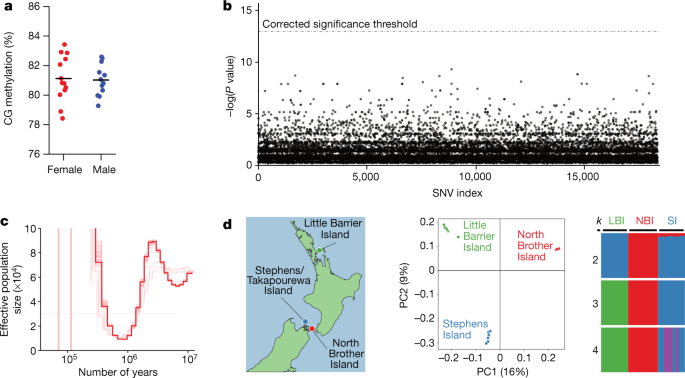
5, and we found no significant sex-specific differences in global CG methylation (Fig.
3a) and no sex-specific single-nucleotide variants between male and female tuatara (Fig.
3b).
On a gene-by-gene basis, sex-specific differences in methylation and
gene expression patterns probably exist, but this remains to be
investigated.