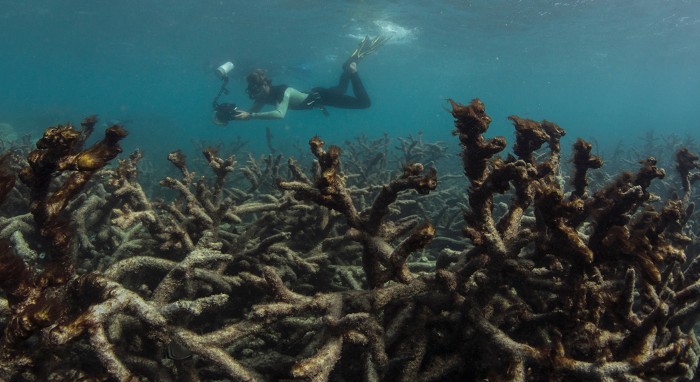
Heat
stress and bleaching — the loss of symbiotic algae — killed many corals
in Australia’s Great Barrier Reef after the 2016 crisis. Credit:
Richard Vevers/XL Catlin SS/The Ocean Agency.
Extreme heat in 2016 damaged Australia’s Great
Barrier Reef much more substantially than initial surveys indicated,
according to ongoing studies that have tracked the health of the coral
treasure. The heatwave caused massive bleaching of the corals that captured worldwide attention.
In a paper published on 18 April in Nature, researchers report1 that severe bleaching on an unprecedented scale triggered mass death of corals.
This drastically changed the species composition of almost one-third of
the 3,863 individual reefs that comprise the Great Barrier Reef.
The
world’s largest coral reef is unlikely to recover soon. The damage is a
harbinger of what a warming future might hold for a wealth of tropical
reef ecosystems, says lead study author Terry Hughes,
director of the coral-reef centre at James Cook University in
Townsville, Australia. “If we fail to curb climate change, and global
temperatures rise far above 2 °C [above the pre-industrial level], we
will lose the benefits they provide to hundreds of millions of people.”
Fatal loss
Hughes and his team of ecologists closely examined the 2,300-kilometre Great Barrier Reef after the 2016 heatwave.
Extensive aerial surveys revealed widespread coral bleaching between
March and April 2016. This phenomenon occurs when excessive heat kills
or expels algae called zooxanthellae, which have a symbiotic
relationship with reef-building corals. The algae provide the corals
with energy and nutrients from photosynthesis; without them, the corals
often die.
But to gauge the full extent of heat damage, Hughes’s
team conducted more-comprehensive underwater surveys of coral mortality,
both at the peak of the observed bleaching in March and April, and
again eight months later.
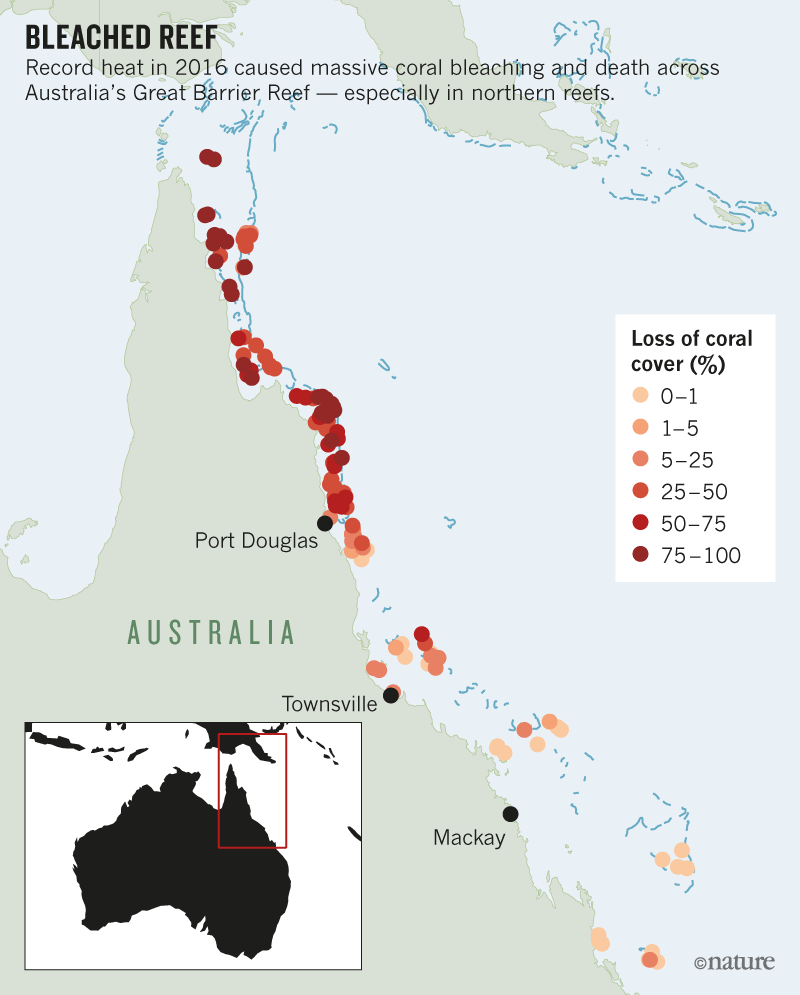
Many corals — especially those in the northern third of the reef
— died immediately from heat stress. Others were killed more slowly,
after their algal partners were expelled. The composition of coral
assemblages on hundreds of individual reefs changed radically within
just a few months of the heatwave. On severely bleached reefs,
fast-growing coral species — which have complex shapes that provide
important habitats — were replaced by slower-growing groups that shelter
fewer sea creatures.
Source: Ref. 1
“The study paints a bleak picture of the sheer extent of
coral loss on the Great Barrier Reef,” says Nick Graham, a marine
ecologist at Lancaster University, UK. Approximately one-third of the
world’s coral reefs were affected by bleaching in 2016. On the Great
Barrier Reef, less than 10% of reefs escaped with no bleaching, compared
with more than 40% in previous bleaching events.
“It is now
critical to understand how governance and local management can maximize
recovery between recurrent heatwaves,” Graham says. Global impact
Tim
McClanahan, a conservation zoologist at the Wildlife Conservation
Society in Mombasa, Kenya, says the study’s findings might not predict
how other reefs will cope with a warmer world. Responses might depend on
the corals’ life histories and local environmental conditions. “Global
warming will result in more heat-stress events,” he says, but “there is
accumulating evidence that corals do acclimate”.
Global coral
bleaching had been observed just twice, in 1998 and 2002, before the
extreme 2016 incident. Coral colonies can recover from such events,
especially given that the species most susceptible to dying from heat
stress are among the fastest-growing corals. But harmful warming events
are occurring more frequently, and scientists think that full recovery
is becoming increasingly difficult2.
Researchers
have also found that local protection of reefs and surrounding waters
does little to make corals less sensitive to heat3. Rather, global changes such as ocean acidification might further increase environmental stress.
The fate of tropical coral reefs — including the iconic Great Barrier Reef — therefore depends on efforts to mitigate climate change,
says Graham. “A future with coral reefs, their rich diversity and the
livelihoods they provide to people is quite simple. It will only be
possible if carbon emissions are rapidly reduced,” he says.
But
even if that happens, tomorrow’s reefs might look different from
today’s, as the mix of species changes in favour of those that can best
cope with inevitable climate change, says Hughes. “This transition is
already under way, faster than many of us expected,” he says. “The Great
Barrier is shifting radically, a trend that will continue for the next
century or more.”
Nature556, 281-282 (2018)
doi: 10.1038/d41586-018-04660-w
sexta-feira, 31 de julho de 2015
Dessalinização de água e os processos de destilação
A destilação é basicamente um processo
de transferência de calor. O problema fundamental da Engenharia, nesse
caso, é encontrar maneiras de transferir grandes quantidades de água,
vapor e calor da forma mais econômica possível.
O processo conceitual básico de destilação é mostrado na figura abaixo.
Esquema
conceitual de um processo convencional de destilação. Fonte: adaptado
de USBR (2003). Retirado do livro Dessalinização de águas, publicado
pela editora Oficina de Textos.
No processo de destilação, os sólidos
dissolvidos e os sais não voláteis permanecem em solução, sendo a água
vaporizada quando a solução salina é fervida. A água que se forma quando
o vapor de água condensa em uma superfície mais fria é quase pura e
fica praticamente livre dos sólidos dissolvidos, os quais permanecem no
concentrado.
Ao analisar a acima, pode-se deduzir que
é necessário um aporte de energia de 645 kWh para que um processo
convencional de destilação possa produzir 1,0 m3/h de água
dessalinizada.
Segundo a Aneel (2011), o custo médio,
no Brasil, da energia elétrica para o setor industrial varia de região
para região. Por exemplo, na região Sudeste era de aproximadamente R$
0,25/kWh em outubro de 2010. Utilizando esse valor, o custo para
produzir 1,00 m3 de água destilada por meio de processo convencional de
destilação seria de R$ 161,25/m3 (US$ 80,63/m3), ou seja,
aproximadamente R$ 0,16/L, apenas no que se refere ao custo de energia
elétrica.
Ressalte-se que o custo de energia
elétrica para consumo residencial em São Paulo, incluindo impostos (que
são variáveis por faixas de consumo), era em média de R$ 0,44/kWh, de
modo que, em pequena escala, o custo passava a ser de R$ 283,80/m3 (US$
137,10/m3), ou cerca de R$ 0,28/L. Ou seja, em qualquer um dos casos, o
custo era considerado excessivamente alto.
É claro que ninguém produz água por
dessalinização a um custo tão alto. Portanto, mundialmente falando, por
essas razões econômicas buscam-se processos que obtenham uma produção
maior do que a anteriormente reportada, ou seja, busca-se um menor
consumo de energia.
Três diferentes processos de destilação foram desenvolvidos com esse objetivo:
processo DME = destilação por múltiplo efeito (em inglês, MED)
processo MEF = destilação por multiestágio flash (em inglês, MSF)
processo DCV = destilação por compressão de vapor (em inglês, VC)
Tudo a ver
Para saber mais detalhes de cada processo de destilação, fique ligado em nosso próximo lançamento: Dessalinização de águas.
O livro preenche uma importante lacuna
na bibliografia brasileira sobre o tema, sendo uma referência completa
para pesquisadores e profissionais da área, de especial interesse quando
crises de escassez começam a ocorrer onde nunca antes imaginado.
Dessalinização de águas
apresenta os diferentes processos de destilação, os materiais e
tecnologias utilizados, e explica detalhadamente o processo de obtenção
de água, desde os conceitos químicos e o pré-tratamento da água bruta
até as considerações ambientais, a microbiologia sanitária e o
pós-tratamento da água produzida.
O livro inclui ainda um estudo detalhado
sobre o uso do vácuo na destilação térmica e relatos de caso reais com
exemplos no Brasil e no exterior.