Mostrando postagens com marcador barreira de corais. Mostrar todas as postagens

quarta-feira, 30 de maio de 2018

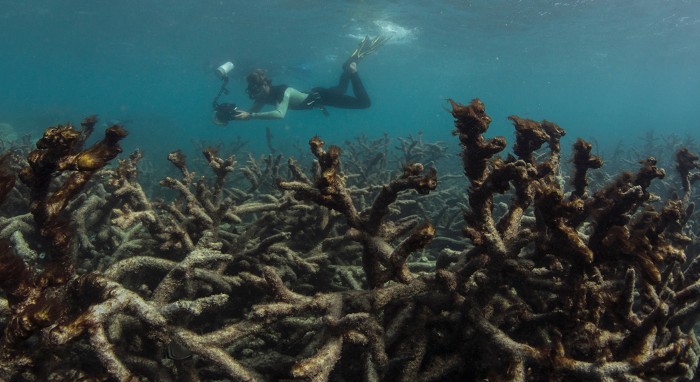
Corals along Australia’s Great Barrier Reef are struggling to cope with rising sea temperatures.
Frans Lanting/MINT Images/Science Source

The Great Barrier Reef has had five near-death experiences in the past 30,000 years


A Grande Barreira de Corais teve cinco experiências de quase morte nos últimos 30.000 anos
 

Thirteen thousand years ago, as the last ice age ended, entire stretches of Australia’s Great Barrier Reef perished. Rising sea levels blanketed the world’s largest collection of corals with sediment coming off the newly inundated land, blocking the sunlight corals need to grow. The reef eventually recovered, but it took hundreds to thousands of years. This near death and eventual resurrection wasn’t a one-off, according to a new study that reveals the reef’s shifting boundaries over geological time. It’s a tale that has played out five times over the past 30,000 years—and it may be happening again today.

The study “holds some really important lessons” for understanding how resilient corals are in the face of change, and how quickly they recover after catastrophic events, says Kim Cobb, a paleoclimatologist at the Georgia Institute of Technology in Atlanta, who wasn’t involved in the work. Today’s rate of sea level rise is moderate—about 10% of the rate 13,000 years ago—but going forward it may accelerate dramatically, she says.


Treze mil anos atrás, quando a última era glacial terminou, trechos inteiros da Grande Barreira de Corais da Austrália pereceram. O aumento do nível do mar cobriu a maior coleção de corais do mundo com sedimentos saindo da terra recém-inundada, bloqueando a luz solar que os corais precisam para crescer. O recife acabou se recuperando, mas levou centenas de milhares de anos. Esta quase morte e a eventual ressurreição não foram pontuais, de acordo com um novo estudo que revela as mudanças nas fronteiras do recife ao longo do tempo geológico. É um conto que se repetiu cinco vezes nos últimos 30 mil anos - e pode estar acontecendo de novo hoje.


O estudo “contém algumas lições realmente importantes” para entender como os corais resilientes estão diante da mudança, e quão rapidamente eles se recuperam após eventos catastróficos, diz Kim Cobb, um paleoclimatologista do Instituto de Tecnologia da Geórgia em Atlanta, que não esteve envolvido no trabalho. A taxa atual de subida do nível do mar é moderada - cerca de 10% da taxa de 13.000 anos atrás -, mas daqui para frente pode acelerar dramaticamente, diz ela.


To conduct the study, scientists used underwater sonar to locate places on the sea floor, beyond the current reef, where corals may have grown in the past. Then, they drilled 20 holes, extracting rock cores that contained fossil corals and sediments deposited over the past 30,000 years, spanning part of the last ice age and the warm millennia that followed.

The reef migrated up and down during that time, the team found, closely tracking changes in sea level at a rate of up to 20 vertical meters per thousand years. And when sea level reached its lowest point 21,000 years ago—118 meters below today’s level, its lost water locked up in massive ice caps—corals survived on the outer terraces of Australia’s continental shelf, the team reports today in Nature Geosciences.

Scientists have long wondered where the Great Barrier Reef went during the last ice age, says Jody Webster, a marine geologist at The University of Sydney in Australia and the lead author of the study. “We were able to find it.”

But the reef couldn’t always keep up with changing sea levels. The researchers identified five times when it appeared to die off—twice during the cool down of the last ice age, when falling sea levels exposed corals to air; and three times 10,000 to 17,000 years ago, when glacial melt caused sea levels to rise rapidly. “We haven’t drilled or sampled everything,” says Webster, so he and his colleagues can’t confirm how extensive the die-off was. But they think corals persisted in some places along the continental shelf during those times, allowing reefs in other locations to re-establish within 2000 years.
The historical die-offs are similar to “what we’re seeing right now on the Great Barrier Reef,” says Mark Eakin, a coral reef ecologist at the National Oceanic and Atmospheric Administration in College Park, Maryland, who wasn’t involved in the study. Sea level changes aren’t a huge problem at the moment, but temperatures are: Heat waves have triggered mass bleaching events, periods where heat-stressed corals expel symbiotic algae that live within their tissues. In 2016 alone—the hottest year on record globally—67% of corals died along the northernmost 700 kilometers of the reef.
The new research is “yet another reminder” that what we’re doing to the ocean is going to have dramatic consequences, Eakin says. “Don’t expect reefs to be able to bounce back quickly.”
Posted in:
doi:10.1126/science.aau2924

quinta-feira, 19 de abril de 2018

Great Barrier Reef saw huge losses from 2016 heatwave


Grande Barreira de Corais viu grandes perdas a 
partir da onda de calor de 2016

One-third of reefs in the world’s largest coral system were transformed by warmed waters, finds comprehensive underwater and aerial survey.

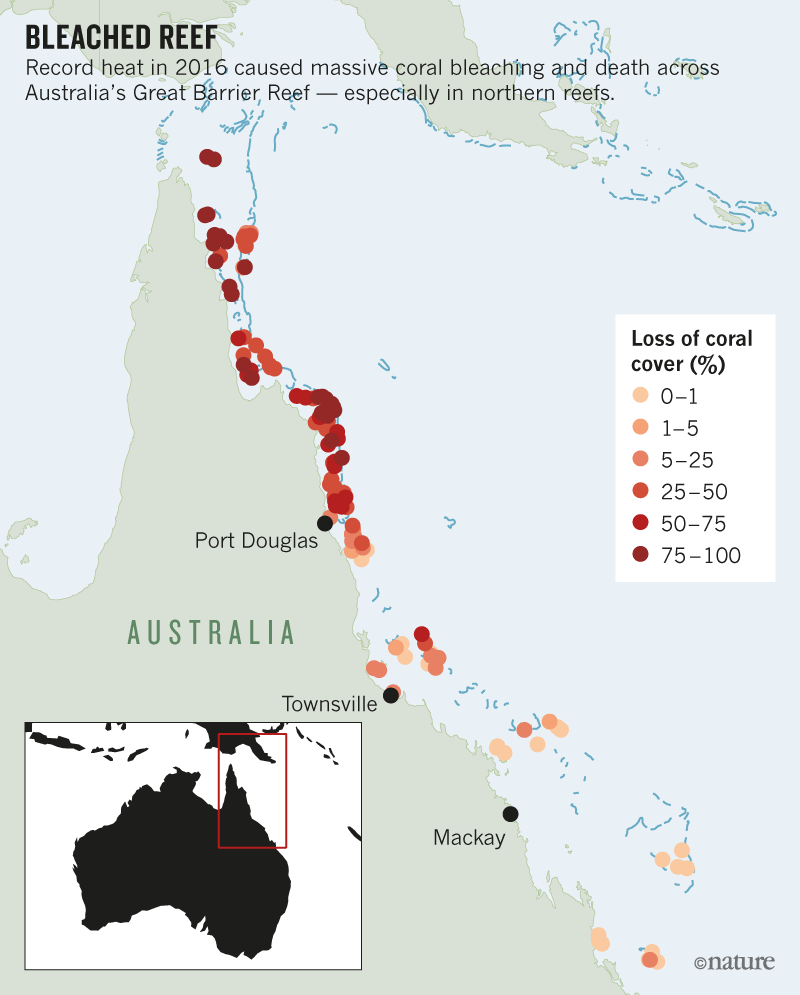
Extreme heat in 2016 damaged Australia’s Great Barrier Reef much more substantially than initial surveys indicated, according to ongoing studies that have tracked the health of the coral treasure. The heatwave caused massive bleaching of the corals that captured worldwide attention.

In a paper published on 18 April in Nature, researchers report1 that severe bleaching on an unprecedented scale triggered mass death of corals. This drastically changed the species composition of almost one-third of the 3,863 individual reefs that comprise the Great Barrier Reef.
The world’s largest coral reef is unlikely to recover soon. The damage is a harbinger of what a warming future might hold for a wealth of tropical reef ecosystems, says lead study author Terry Hughes, director of the coral-reef centre at James Cook University in Townsville, Australia. “If we fail to curb climate change, and global temperatures rise far above 2 °C [above the pre-industrial level], we will lose the benefits they provide to hundreds of millions of people.”

Fatal loss

Hughes and his team of ecologists closely examined the 2,300-kilometre Great Barrier Reef after the 2016 heatwave. Extensive aerial surveys revealed widespread coral bleaching between March and April 2016. This phenomenon occurs when excessive heat kills or expels algae called zooxanthellae, which have a symbiotic relationship with reef-building corals. The algae provide the corals with energy and nutrients from photosynthesis; without them, the corals often die.
But to gauge the full extent of heat damage, Hughes’s team conducted more-comprehensive underwater surveys of coral mortality, both at the peak of the observed bleaching in March and April, and again eight months later.

Many corals — especially those in the northern third of the reef — died immediately from heat stress. Others were killed more slowly, after their algal partners were expelled. The composition of coral assemblages on hundreds of individual reefs changed radically within just a few months of the heatwave. On severely bleached reefs, fast-growing coral species — which have complex shapes that provide important habitats — were replaced by slower-growing groups that shelter fewer sea creatures.
Source: Ref. 1
“The study paints a bleak picture of the sheer extent of coral loss on the Great Barrier Reef,” says Nick Graham, a marine ecologist at Lancaster University, UK. Approximately one-third of the world’s coral reefs were affected by bleaching in 2016. On the Great Barrier Reef, less than 10% of reefs escaped with no bleaching, compared with more than 40% in previous bleaching events.
“It is now critical to understand how governance and local management can maximize recovery between recurrent heatwaves,” Graham says.
Global impact
Tim McClanahan, a conservation zoologist at the Wildlife Conservation Society in Mombasa, Kenya, says the study’s findings might not predict how other reefs will cope with a warmer world. Responses might depend on the corals’ life histories and local environmental conditions. “Global warming will result in more heat-stress events,” he says, but “there is accumulating evidence that corals do acclimate”.
Global coral bleaching had been observed just twice, in 1998 and 2002, before the extreme 2016 incident. Coral colonies can recover from such events, especially given that the species most susceptible to dying from heat stress are among the fastest-growing corals. But harmful warming events are occurring more frequently, and scientists think that full recovery is becoming increasingly difficult2.
Researchers have also found that local protection of reefs and surrounding waters does little to make corals less sensitive to heat3. Rather, global changes such as ocean acidification might further increase environmental stress.
The fate of tropical coral reefs — including the iconic Great Barrier Reef — therefore depends on efforts to mitigate climate change, says Graham. “A future with coral reefs, their rich diversity and the livelihoods they provide to people is quite simple. It will only be possible if carbon emissions are rapidly reduced,” he says.
But even if that happens, tomorrow’s reefs might look different from today’s, as the mix of species changes in favour of those that can best cope with inevitable climate change, says Hughes. “This transition is already under way, faster than many of us expected,” he says. “The Great Barrier is shifting radically, a trend that will continue for the next century or more.”
Nature 556, 281-282 (2018)
doi: 10.1038/d41586-018-04660-w