Mostrando postagens com marcador milípede. Mostrar todas as postagens

sexta-feira, 6 de setembro de 2019

Descoberta fóssil bate recorde de idade

Milípede escocês representa o animal respirador de ar mais antigo conhecido.

Stonehaven, na Escócia, era equatorial há 428 milhões de anos. Stonehaven, na Escócia, era equatorial há 428 milhões de anos. © alamy.com
 
Um caçador de fósseis amador na Escócia descobriu o mais antigo animal terrestre que respira no ar: um pequeno milípede que viveu 428 milhões de anos atrás.
 
A descoberta não muda a compreensão dos cientistas de quando as criaturas que respiram ar evoluíram. Mas ajuda a preencher o registro fóssil, afastando o fóssil mais antigo conhecido desse tipo em cerca de 20 milhões de anos.
 
A criatura de um centímetro de comprimento foi batizada de Pneumodesmus newmani em homenagem ao seu descobridor, Mike Newman, um motorista de ônibus e entusiasta de fósseis de Aberdeen, na costa nordeste da Escócia.
 
Newman fez sua descoberta na praia, na cidade costeira de Stonehaven, o local favorito de caçadores de fósseis. "Eu basicamente fiquei firme", lembra ele. Tendo percebido sua importância potencial, ele entregou o fóssil aos Museus Nacionais da Escócia, em Edimburgo. Os paleontólogos do museu e da Universidade de Yale, em New Haven, Connecticut, deduziram seu status único 1 .
 
Não há dúvida de que P. newmani respirava ar, diz Lyall Anderson, do Museu Nacional, que estudou a descoberta. O fóssil mostra espíritos bem preservados - pequenos orifícios para absorver oxigênio. Isso não funcionaria se a centopeia se aventurasse em terra, explica Anderson: "Eles teriam se enchido de água".
 
O clima em que a criatura vivia estava muito longe da fria e chuvosa Escócia de hoje. Durante a vida de P. newmani , a Escócia estava perto do Equador e fazia parte de uma massa terrestre gigante chamada Antigo Continente de Arenito Vermelho. "Para os animais terrestres emergirem, você precisa de uma área quente e úmida", diz Newman. "Esta é a melhor área do mundo para fósseis de animais primitivos." O fóssil anterior para o animal respirador de ar mais antigo também foi encontrado na Escócia.
 
Stonehaven era anteriormente mais conhecida como a cidade que inventou barras de chocolate fritas - uma estranha iguaria culinária geralmente feita pela fritura de barras de Marte. O fóssil oferece aos residentes de Stonehaven uma fonte um pouco mais saudável de orgulho cívico.  
  • Referências

    1. Wilson, HM & Anderson, LI Morfologia e taxonomia de milípedes paleozóicos ( Diplopoda : Chilognatha : Archipolypoda ) da Escócia . Jornal de Paleontologia , 78, 169 - 184, ( 2004 ). |

sexta-feira, 3 de maio de 2019

Ancient Millipede Walked with Dinosaurs, Died in a Sticky Trap


Ancient Millipede Walked with Dinosaurs, Died in a Sticky Trap
The newly described millipede (Burmanopetalum inexpectatum) seen in amber.
Credit: ZooKeys
Cerca de 99 milhões de anos atrás, um milípede cretáceo atravessou o chão da floresta no que hoje é o sudeste da Ásia. O artrópode evitou com sucesso ser esmagado por dinossauros vizinhos, mas teve a má sorte de cair num pedaço pegajoso de seiva, que endureceu ao redor do milípede e o trancou em uma tumba de âmbar.

Embora esse tenha sido um resultado terrível para o milípede, foi uma ótima notícia para os cientistas que recentemente descobriram o minúsculo cadáver.

O fóssil enterrado, de uma fêmea medindo 0,3 polegadas (8,2 milímetros) de comprimento, estava tão bem preservado que suas minúsculas estruturas corporais eram mantidas em condições excepcionais. Isso permitiu que os cientistas identificassem o minúsculo artrópode não apenas como uma espécie anteriormente desconhecida, mas também como uma subordem anteriormente desconhecida, adicionando um ramo à árvore genealógica da centopeia.
[Fabulous Fossils: Photos of the Earliest Animal Organs]

Using micro-computed X-ray tomography (micro-CT) scans, the scientists constructed a digital 3D model of the millipede, which was curled into an "S" shape inside the lump of amber. The creature had 35 body rings and fully developed sperm-storing sacs on its underside, which confirmed that the female specimen was a mature adult, the study authors said.

Today, millipedes are abundant and diverse, with about 11,000 species identified and as many as 80,000 species estimated to exist worldwide, the researchers said in a new study. But little is known about fossil millipedes, and there are only a handful of experts worldwide investigating this group, said lead study author Pavel Stoev, a professor of zoology at the National Museum of Natural History, Sofia in Bulgaria.

Evidence in the fossil record shows that millipedes were around as early as 315 million to 299 million years ago, with some growing to nearly 8 feet (2 meters) in length, Stoev told Live Science in an email.
"Prior to our study, there were only four species of millipedes described from Burmese amber, which is known to be among the oldest and richest amber deposits of Cretaceous fauna," Stoev said.
Micro-CT scans enabled scientists to reconstruct the ancient millipede in 3D.
Credit: ZooKeys
Além do tamanho incomumente pequeno do milípede, várias pistas disseram aos cientistas que esse espécime diferia das outras três subordens dentro da ordem Callipodida. Faltava certos crescimentos semelhantes a pelos; a forma de seu segmento traseiro era única e, embora a maioria dos olhos compostos de callipodidans contivesse pelo menos 30 unidades ópticas, os olhos do pequeno milípede continham apenas cinco - "o limite mais baixo conhecido no grupo", disse Stoev.

Os pesquisadores nomearam uma nova subordem, a Burmanopetalidea, e apelidaram o artrópode de Burmanopetalum inexpectatum. A primeira parte desse nome faz referência à origem do âmbar - Birmânia, agora Mianmar - enquanto "inexpecto" é o latim para "inesperado", comemorando a descoberta surpresa de uma nova subordem milípede, de acordo com o estudo.

sexta-feira, 16 de novembro de 2012

Video: This 750-Leg Millipede is the Leggiest Creature in the World

If, while watching this video, you thought of the classic arcade/cell phone/graphing calculator game Snake, you’re not the only one. This is a Illacme plenipes millipede, long thought extinct and rediscovered seven years ago. For an utterly unusual animal, one thing stands out: With up to 750 legs, it has more than any other creature found so far, including 9,999 other species of millipedes.
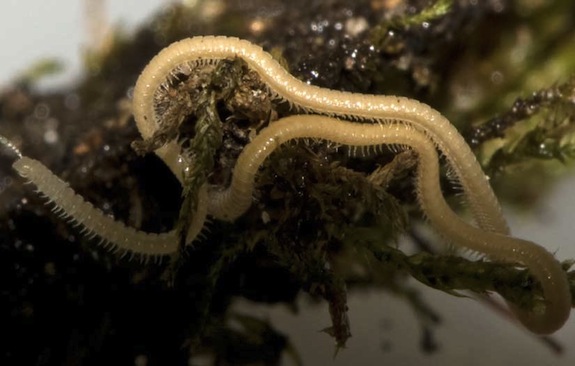
Illacme plenipes, the record-breaking millipede, only lives in a few woodlands in Northern California. Image via Marek et. al.

Yesterday, the first full description of the species was published in the joural ZooKeys. The study was led by Paul Marek of the University of Arizona. The millipede is known only from 17 live specimens Marek’s team found in a home range that is remarkably specific: three small wooded areas strewn with Arkose sandstone boulders in the foothills of San Benito County, California, near San Francisco.
The rareness of the millipede meant that from 1928 until 2005—when Marek, then a Ph.D. student, found a few specimens in the woods near San Juan Bautista—most scientists had simply assumed the species had gone extinct. Over the past seven years, Marek and his colleagues have taken several trips to the area, typically searching for hours before finding a single specimen clinging to the side of a boulder or tunneling four to six inches down into the ground.

In studying these specimens under a microscope, Marek has discovered a number of surprising characteristics that go beyond its legs. ”It basically looks like a thread,” Marek told LiveScience. “It has an uninteresting outward appearance, but when we looked at it with SEM [scanning electron microscopes] and compound microscopes, we found a huge, amazingly complex anatomy.”
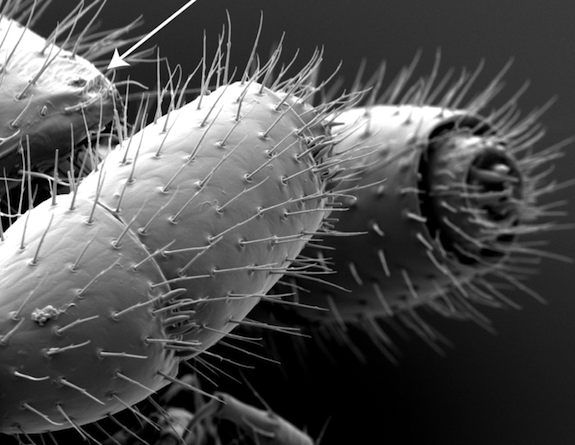
The new analysis revealed that the millipede has no eyes, disproportionately long antennae and a rudimentary fused mouth adapted for sucking and piercing plant structures. It also has specialized body hairs on its back that produce silk, which may be used as a defense mechanism to clear bacteria off the millipedes’ bodies.
A microscope image of the species’ specialized body hairs that produce a silk secretion. Image via Marek et. al.

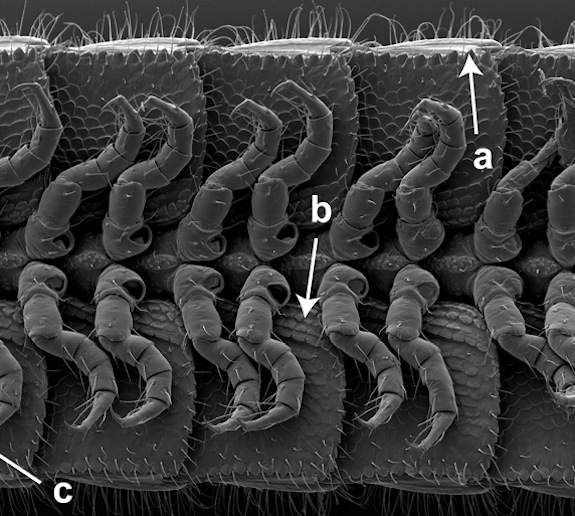
Of course, the legs are the most striking part of the species’ anatomy. Despite the name millipede, no species are known to have 1,000 legs, but Illacme plenipes comes closest (its Latin name actually means “in highest fulfillment of feet”). The male specimens examined had at most 562 legs, but the females had more, with the winner at 750.

Most millipedes have somewhere between 80 and 100 legs. Marek and his colleagues speculate that this species’ extreme legginess could be a beneficial adaptation for subterranean tunneling or even for clinging to the boulders widely found in the species’ habitat.
Most millipedes have 80 to 100 legs, but this species has up to 750. Image via Marek et. al.

DNA analysis has revealed that its closest cousin, Nematozonium filum, lives in Africa, with the two species’ ancestors apparently splitting apart sometime soon after the breakup of Pangea, more than 200 million years ago.

The team has tried to grow the millipedes in a lab but has so far been unable to. They caution that the species could be extremely endangered—in 2007, they stopped searching for wild specimens out of fears that they were depleting the population—and advocate for a formal protection listing, so scientists will have the time to learn more about them before the millipedes go extinct.