DNA: proteínas antigas estão começando a revelar a história da humanidade
Proteínas que datam de mais de um milhão de anos foram extraídas de
alguns fósseis e poderiam ajudar a responder algumas perguntas difíceis
sobre seres humanos arcaicos.
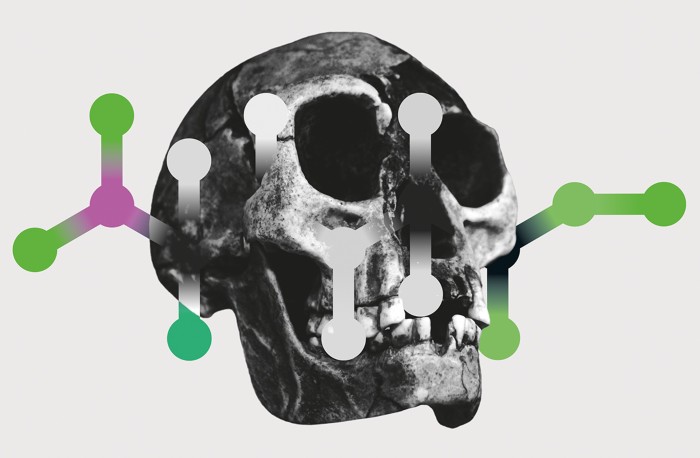
Homo floresiensis é uma das espécies que os pesquisadores esperam estudar sequenciando proteínas antigas. Crédito: Adaptado de Arquivo da História Mundial / Alamy
Em algum momento nos últimos 160 mil anos, mais ou menos, os restos
mortais de um ser humano antigo acabaram em uma caverna no planalto
tibetano na China. Talvez o indivíduo tenha morrido ali, ou partes foram levadas para lá por seus parentes ou um limpador de animais. Em poucos anos, a carne desapareceu e os ossos começaram a se deteriorar. Então, milênios gotejaram.
As geleiras recuaram e depois voltaram e recuaram novamente, e tudo o
que foi deixado para trás foi um pouco de queixada com alguns dentes.
O osso tornou-se gradualmente revestido em uma crosta mineral, e o DNA
desse antigo ancestral foi perdido para o tempo e o clima. Mas alguns sinais do passado persistiram. Nas profundezas dos dentes dos hominídeos, as proteínas permaneciam degradadas, mas ainda identificáveis.
Quando os cientistas os analisaram no início do ano, eles detectaram o
colágeno, uma proteína de suporte estrutural encontrada nos ossos e
outros tecidos.
E em sua assinatura química havia uma única variante de aminoácido que
não está presente no colágeno de humanos modernos ou neandertais - em
vez disso, marcou o maxilar como pertencente a um membro do misterioso
grupo hominino chamado Denisovans 1 .
A descoberta de um Denisovan na China foi um marco importante.
Foi o primeiro indivíduo encontrado fora da caverna de Denisova, na Sibéria,
onde todos os outros restos de seu tipo já haviam sido identificados.
E a localização do local no platô tibetano - mais de 3 mil metros acima
do nível do mar - sugeria que os denisovanos tinham conseguido viver em
ambientes com muito frio e baixo oxigênio.
Mas a descoberta também marcou outro marco: foi a primeira vez que uma
antiga hominina foi identificada usando apenas proteínas.
É uma das descobertas mais marcantes ainda para o campo incipiente da
paleoproteômica, em que os cientistas analisam proteínas antigas para
responder a perguntas sobre a história e evolução dos seres humanos e
outros animais.
As proteínas, que permanecem em fósseis por muito mais tempo do que o
DNA, podem permitir que cientistas explorem novas eras da pré-história e
usem ferramentas moleculares para examinar ossos de uma parte muito
mais ampla do mundo do que é atualmente possível, de acordo com os
defensores do campo. Anteriormente, cientistas haviam recuperado proteínas de dentes de
animais de 1,8 milhão de anos e uma casca de ovo de 3,8 milhões de anos.
Agora, eles esperam que a paleoproteômica possa ser usada para fornecer
insights sobre outros fósseis hominídeos antigos que perderam todos os
vestígios de DNA - do Homo erectus , que percorreu partes do mundo de cerca de 1,9 milhão a 140 mil anos atrás, ao Homo floresiensis , o diminutivo. espécies 'hobbit' que viveram na Indonésia há 60 mil anos. Ao observar as variações dessas proteínas, os cientistas esperam
responder a perguntas antigas sobre a evolução de grupos humanos
antigos, como as linhagens ancestrais diretas do Homo sapiens .
"Eu acho que você pode basicamente desbloquear toda a árvore humana",
diz Matthew Collins, um bioarqueólogo da Universidade de Copenhague que
está na vanguarda do campo desde os anos 80, quando consistia de apenas
um punhado de pesquisadores.
A maioridade
Apesar da empolgação, alguns argumentam que os pesquisadores poderiam
se esforçar para pintar um quadro definitivo da história humana a partir
das informações que os pesquisadores podem obter das proteínas, o que é
limitado em comparação com o obtido pelo DNA.
E muitos temem que a paleoproteômica em geral possa ser suscetível a
resultados espúrios, decorrentes de questões como contaminação.
"Você vê uma pesquisa muito boa, e então você vê pessoas que publicam
coisas que são muito estranhas, porque elas não pensam criticamente
sobre os métodos", diz Philipp Stockhammer, um arqueólogo da
Universidade Ludwig Maximilian de Munique, na Alemanha. Nas últimas duas décadas, o DNA recuperado de antigos fósseis transformou a compreensão dos cientistas sobre a evolução humana.
A análise das semelhanças e diferenças no DNA de diferentes grupos de
hominina permitiu que os pesquisadores mapeassem a árvore genealógica
emaranhada de uma forma que anteriormente não era possível. E material genético levou a algumas descobertas importantes, como a descoberta de Denisovans em primeiro lugar.
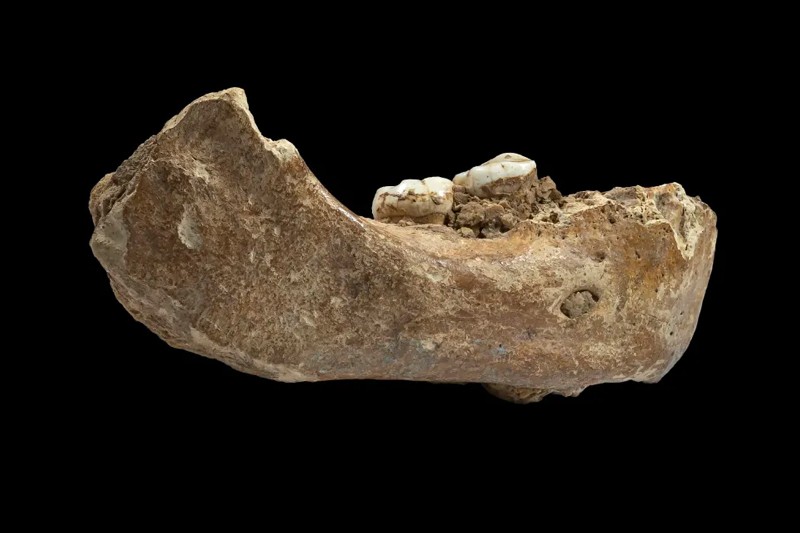
As seqüências de proteína de colágeno desta queixada de 160 mil anos identificaram-na como um Denisovan do planalto tibetano.Crédito: F. Chen et al./ Nature
Mas as lacunas gritantes permanecem nessa imagem. O DNA foi sequenciado a partir de apenas três grupos de hominina: Neandertais, Denisovanos e Homo sapiens
, principalmente de espécimes com menos de 100.000 anos de idade (uma
exceção notável é um par de neandertais primitivos de 430.000 anos da
Espanha 2 ).
Vá algumas centenas de milhares de anos atrás, e as coisas ficam muito mais obscuras.
Este foi um período de tempo em que muitas coisas interessantes estavam
acontecendo, diz Frido Welker, um antropólogo molecular da Universidade
de Copenhague. Foi quando os denisovanos e os neandertais ramificaram-se da linhagem que se tornaria humanos modernos, por exemplo. Mas continua sendo uma parte obscura da história humana.
Os pesquisadores não sabem, por exemplo, se o antigo hominin Homo heidelbergensis , que viveu em torno de 700.000 a 200.000 anos atrás, foi um ancestral tanto de H. sapiens quanto de neandertais ou parte de apenas o ramo neandertal, como alguns sugeriram. "Muito disso acontece além do alcance do DNA antigo", diz Welker. Volte um milhão de anos ou mais, e as coisas ficam ainda menos claras.O H. erectus
, por exemplo, surgiu pela primeira vez na África há cerca de 1,9
milhão de anos, mas, sem evidências de DNA, permanece incerto exatamente
como está relacionado a hominídeos posteriores, incluindo o H. sapiens . DNA antigo também deixou pontos cegos geográficos.
O DNA degrada mais rápido em ambientes quentes, por isso, embora um
espécime de 100 mil anos encontrado em uma caverna siberiana gelada
ainda possa abrigar material genético, um fóssil que passou tanto tempo
no calor da África ou no sudeste asiático geralmente não o fará. Como resultado, pouco se sabe sobre a genética de hominídeos relativamente recentes dessas regiões, como o H. floresiensis . Agora os pesquisadores esperam que a análise de proteínas comece a preencher alguns desses espaços em branco. A ideia não é nova: já na década de 1950, pesquisadores relataram encontrar aminoácidos em fósseis. Mas por um longo tempo, a tecnologia necessária para sequenciar proteínas antigas simplesmente não existia.
“Durante a maior parte da minha carreira, sinceramente, acreditei
genuinamente que não conseguiríamos recuperar antigas seqüências de
proteínas”, diz Collins.
Isso mudou nos anos 2000, depois que os pesquisadores perceberam que a
espectrometria de massa - uma técnica usada para estudar proteínas
modernas - também poderia ser aplicada a proteínas antigas.
A espectrometria de massa envolve essencialmente a quebra de proteínas
em seus peptídeos constituintes (cadeias curtas de aminoácidos) e a
análise de suas massas para deduzir sua composição química.
Os pesquisadores usaram esse método para vasculhar centenas de
fragmentos ósseos para identificar os tipos de animais de onde vieram.
Nessa abordagem específica, chamada zooarchaeology por espectrometria
de massa ou ZooMS, os pesquisadores analisam um tipo de colágeno.
A massa dos componentes do colágeno difere em vários grupos e espécies,
fornecendo uma impressão digital característica que permite aos
pesquisadores identificar a fonte do osso.
O ZooMS foi usado em um artigo de 2016 para identificar um osso
hominíneo entre milhares de fragmentos da caverna Denisova - um osso que
a análise de DNA posteriormente mostraria pertencer a um híbrido,
apelidado de Denny, com uma mãe neandertal e um pai denisovano.
Mesmo com esse resultado, a antiga análise de proteínas já havia
ampliado substancialmente nossa visão da evolução humana, diz o
geneticista populacional Pontus Skoglund, do Instituto Francis Crick, em
Londres.
Katerina Douka, arqueóloga do Instituto Max Planck para a Ciência da
História Humana em Jena, na Alemanha, está agora usando a técnica para
pesquisar 40.000 fragmentos ósseos não identificados da Ásia, na
esperança de descobrir hominídeos mais antigos. Mas ZooMS pinta uma imagem apenas em pinceladas largas.
Uma vez que um osso é identificado como pertencente a uma hominina, por
exemplo, outras técnicas são necessárias para aprofundar.
Assim, outros se voltaram para a proteômica shotgun, que visa
identificar todas as sequências de proteínas em uma amostra - seu
proteoma.
A composição do proteoma depende do tipo de tecido que está sendo
examinado, mas frequentemente inclui várias formas de colágeno.
Esse método gera milhares de sinais, o que o torna muito mais
informativo do que o ZooMS, diz Douka, mas também mais complicado de
interpretar.
Ao combinar esses sinais com sequências conhecidas em bancos de dados,
os pesquisadores podem identificar as sequências exatas de colágeno ou
outras proteínas em sua amostra.
Os cientistas podem então comparar esta nova sequência proteica
determinada com a mesma proteína de outros grupos de hominina,
procurando semelhanças e diferenças em aminoácidos individuais que
ajudarão a colocar a hominina na árvore genealógica. Isso é semelhante a como os pesquisadores de DNA antigos observam variações de letras únicas em sequências genéticas.
Preenchendo as lacunas
Embora os pesquisadores tivessem usado análise de proteínas junto com sequenciamento antigo de DNA antes de 4
, o tibetano Denisovan foi o primeiro hominídeo antigo para o qual só
as proteínas foram analisadas - e outras poderiam ser seguidas em breve
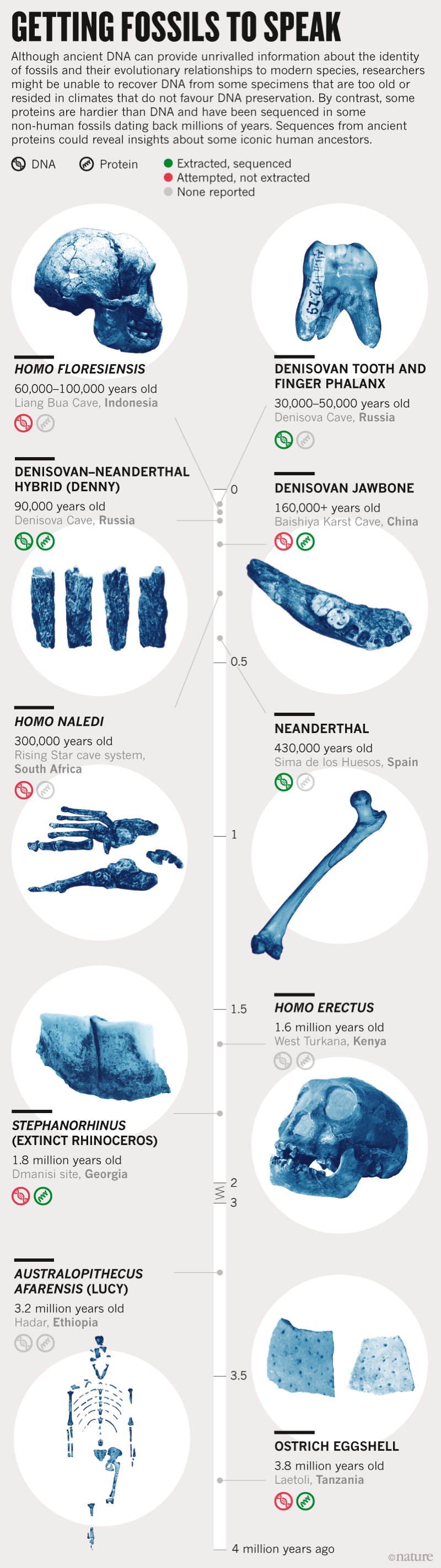
(veja 'Obtendo fósseis para falar'). Um olhar sobre as seqüências protéicas de H. heidelbergensis , por exemplo, poderia esclarecer sua relação com o H. sapiens e o Neanderthal.
Créditos: H. floresiensis : P. Brown et al ., Nature ;Dente de Denisovan: R. Reich et al ., Nature ;Híbrido Denny: Tom Higham, Univ.Oxford;Queixada de Denisovan: F. Chen et al .(Ref. 1) / Natureza ;H. naledi : LR Berger etal / eLife ;Neandertal: M. Meyer et al .(Ref. 2) / Natureza ;H. erectus : Nat.Hist.Mus./Alamy;Stephanorhinus : Nat.Hist.Mus.Dinamarca;Lucy: 120 via Wikimedia Commons;Casca de avestruz: Terry Harrison
Os debates rodaram durante uma década e meia sobre a natureza de H. floresiensis
, cujos restos foram descobertos na ilha indonésia de Flores em 2003. A
sua relação com outros hominídeos não é clara, com sugestões de que
poderia ser um anão descendente de H erectus , ou talvez até mesmo que evoluiu do gênero Australopithecus que é mais distantemente relacionado aos humanos modernos. Este grupo viveu mais de 2 milhões de anos atrás e conta o famoso esqueleto de Lucy entre seus membros. Proteômica poderia colocar esse mistério para a cama, diz Collins. "Estou totalmente convencido de que temos a proteína Homo floresiensis por perto, e ela será sequenciável, e nos dirá onde isso se encaixa na árvore genealógica", diz ele. O mesmo poderia ser verdade para outro pequeno hominídeo, Homo luzonensis.
Seus ossos e dentes foram descobertos em uma caverna na ilha de Luzon,
nas Filipinas, há alguns anos, e relatados no início deste ano 5 . Similarmente ao H. floresiensis , essas amostras não produziram DNA.
Armand Salvador Mijares, um arqueólogo da Universidade das Filipinas na
cidade de Quezon, diz que planeja enviar a Welker um dente animal da
caverna onde o H. luzonensis foi encontrado, para testar a viabilidade de analisar proteínas em materiais tropicais antigos.
Enquanto os pesquisadores se preparam para fazer análises proteômicas
em hominídeos antigos, o trabalho com outros animais já está revelando
muito sobre suas relações evolutivas no passado profundo. Em uma análise recente, por exemplo, Welker e seus colegas usaram proteômica para descobrir onde o extinto rinoceronte Stephanorhinus se encaixa na árvore genealógica dos rinocerontes. Conforme relatado em uma pré-impressão que ainda não foi revisada por pares 6 , a equipe conseguiu extrair proteínas em restos de Dmanisi, Geórgia, que tinham quase 1,8 milhão de anos de idade. O padrão de substituições de aminoácidos sugere que o animal estava intimamente relacionado com o extinto rinoceronte lanudo (Coelodonta antiquitatis ). Enquanto as proteínas do Denisovan tibetano vinham da dentina, o tecido ósseo dentro dos dentes, essas proteínas Stephanorhinus estavam trancadas no esmalte que cobre o dente.
Isso pode ser particularmente útil para encontrar proteínas muito
antigas, sugere Enrico Cappellini, especialista em paleoproteômica da
Universidade de Copenhague e co-autor do trabalho de Stephanorhinus .
O esmalte é o material mais duro no corpo dos vertebrados e atua como o
que Cappellini chama de sistema fechado, impedindo a saída dos
aminoácidos. A data de 1,8 milhão de anos “não representa um limite”, diz ele. De fato, outros foram mais para trás. Pesquisadores relataram a extração de seqüências de colágeno de um camelo de 3,4 milhões de anos encontrado no Ártico 7 .
E em um artigo de 2016, Beatrice Demarchi, uma arqueóloga biomolecular
da Universidade de Turim, na Itália, e seus colegas extraíram e
sequenciaram proteínas de uma casca de ovo de avestruz com 3,8 milhões de anos 8 .
Esta concha não foi preservada em uma região polar fria: ela veio de um
local na Tanzânia, onde a temperatura média anual do ar é de cerca de
18 ° C, diz Demarchi. "Você não esperaria que as coisas sobrevivessem em um ambiente tão quente", diz ela. Proteínas de hominina podem ser recuperadas dos mesmos lugares, ela acrescenta: "Temos que tentar, não é?"
Dores de dentição
Ainda há obstáculos a serem superados antes que proteínas antigas possam focar os ramos da árvore evolutiva humana.
Até agora, os pesquisadores conseguiram deduzir as seqüências de
antigas proteínas homininas com bastante facilidade, porque elas já
possuem DNA de neandertais, denisovanos e H. sapiens .
Isso permite prever as sequências de proteínas que provavelmente aparecerão em seus sinais de espectrometria de massa.
“Você pode identificar os fragmentos que espera encontrar nas
sequências conhecidas do genoma, tanto dos organismos antigos quanto das
pessoas atuais, e procurá-los”, diz Svante Pääbo, paleogeneticista do
Instituto Max Planck de Antropologia Evolutiva, em Leipzig, Alemanha. Mas, à medida que os cientistas voltarem no tempo, precisarão descobrir a sequência desses aminoácidos sem um mapa.
Esse é um desafio contínuo para proteômica antiga, porque as proteínas
são degradadas em pequenos fragmentos e as amostras são frequentemente
contaminadas com proteínas modernas, diz Pääbo.
As
proteínas que persistiram no esmalte dentário por quase 1,8 milhão de
anos ajudaram a esclarecer a filogenia de um rinoceronte antigo
encontrado em Dmanisi, na Geórgia.Crédito: Museu de História Natural da Dinamarca
Collins está confiante de que isso pode ser feito. Ele aponta para um documento de 2015 9
no qual ele, Welker e outros mapearam a árvore filogenética para os
ungulados nativos da América do Sul, um grupo variado de mamíferos de
aparência peculiar que foram extintos há cerca de 12.000 anos.
Sem DNA disponível a partir de fósseis de ungulados, a equipe teve que
sequenciar as proteínas de colágeno a partir do zero para compará-las
com as de outros animais.
Eles descobriram que dois ungulados nativos extintos, Toxodone Macrauchenia, estavam intimamente relacionados a um grupo que inclui cavalos e
rinocerontes - e não, como alguns pesquisadores pensavam, o grupo
Afrotheria, que inclui elefantes e peixes-boi. Outras limitações são mais fundamentais.
Os dentes e ossos antigos contêm um pequeno número de proteínas,
portanto, há relativamente poucos fragmentos de informação que podem ser
usados para identificar um espécime.
A análise do tibetano Denisovan, por exemplo, revelou seqüências de
oito diferentes tipos de proteína de colágeno, totalizando pouco mais de
2.000 aminoácidos. Apenas um desses aminoácidos diferia das sequências humanas neandertais e modernas, identificando a amostra como Denisovan. Isso significa que, mesmo que um pesquisador fosse capaz de sequenciar as proteínas de um espécime de H. erectus
, por exemplo, simplesmente não haveria informações suficientes nas
seqüências de aminoácidos para dizer qualquer coisa definitiva sobre sua
relação com humanos modernos ou arcaicos.
Em comparação, um único genoma antigo contém na ordem de três milhões
de variantes em comparação com qualquer outro genoma, diz Skoglund, e
por isso é muito mais informativo em relação à evolução.
E como as proteínas geralmente desempenham funções cruciais - como a
estrutura óssea, por exemplo - nem sempre mudam à medida que as espécies
evoluem. As proteínas específicas do esmalte, por exemplo, são exatamente as mesmas em Denisovans, H. sapiens e Neanderthals, portanto, não podem ser usadas para distinguir entre esses grupos.
Welker diz, no entanto, que essas proteínas variam em outros grandes
símios e poderiam ser mais informativas quando se trata de grupos de
hominina mais velhos. Ainda assim, os pesquisadores sabem muito pouco sobre como as seqüências de proteínas variam em populações de humanos antigos.
Os cientistas sequenciaram apenas um único genoma de Denisovan, por
exemplo, o que significa que, para identificar o tibetano Denisovan, a
equipe comparou as seqüências de proteínas a apenas um outro membro
desse grupo. Pode ser que outros Denisovans tivessem variantes diferentes.
"Muitos geneticistas são bastante céticos em relação à metodologia, mas
acho que é porque eles percorreram um longo caminho para entender a
variação genômica em populações antigas", diz Douka.
Aprendendo com o passado
Existem outros desafios também.
Alguns pesquisadores estão preocupados com o fato de que o burburinho
mais amplo em torno da paleoproteômica poderia fazer com que o campo
caísse nas mesmas armadilhas que o antigo campo de DNA fez há 20 anos.
Muitos resultados aparentemente empolgantes da década de 1990 e início
de 2000 - a descoberta de DNA de dinossauros ou insetos presos em âmbar,
por exemplo - mais tarde se revelaram falsos porque eram produtos de
contaminação ou outros erros metodológicos. "Eu não ficaria surpreso se isso acontecesse com o mundo da proteômica", diz Douka.
Aqueles que lideram o caminho no campo estão cientes desses problemas, e
muitos pesquisadores estão fazendo esforços para criar uma ciência
robusta.
Entre eles está Jessica Hendy, uma arqueóloga da Universidade de York,
no Reino Unido, que é pioneira no uso de proteínas para estudar a dieta
dos primeiros humanos.
Em um artigo de 2018, Hendy e seus colegas identificaram proteínas em
8.000 anos de idade cerâmica de Çatalhöyük na Turquia moderna, que
revelou que os antigos habitantes comiam várias plantas e animais, e até
mesmo processavam o leite em soro 10 . "Essa técnica é tão interessante e fascinante que está recebendo muita atenção, especialmente agora", diz Hendy. "Nós realmente precisamos estar nos movendo com cuidado", acrescenta ela.
Juntamente com Welker, Hendy é o autor principal em um artigo
descrevendo as melhores práticas para o campo, desde evitar a
contaminação até compartilhar dados em repositórios públicos 11 .
Hendy acrescenta que é preciso haver mais pesquisas básicas sobre como
as proteínas sobrevivem e se degradam em escalas de tempo longas.
Esse tipo de pesquisa pode não fazer manchetes, diz ela, mas pode dar
aos pesquisadores muito mais confiança em seus resultados.
Ela aponta para o trabalho de Demarchi como um exemplo: Demarchi
descobriu que as proteínas de sua casca de ovo de 3,8 milhões de anos
estavam presas à superfície dos cristais minerais na casca,
essencialmente congelando-as no lugar.
"O que é legal sobre isso é que ele está realmente explicando por que
as proteínas estão sobrevivendo, o que torna a descoberta muito mais
robusta", diz Hendy. Embora ainda haja problemas para resolver, o progresso no campo não mostra sinais de desaceleração.
E enquanto a evolução humana pode chamar mais atenção, os cientistas
estão usando proteômica antiga de todos os tipos, desde o estudo de
marcadores de doenças no tártaro de dentes antigos 12 até a investigação de quais peles de animais foram usadas para criar pergaminhos medievais 13 . Demarchi diz que está animada com tudo isso.
E quando se trata de calcular as árvores genealógicas de organismos
extintos há muito tempo, diz ela, a proteômica tem o potencial de gerar
ondas. "Eu não acho que vou ver o fim disso na minha vida", diz ela. "Vai ser realmente muito grande".
Move over, DNA: ancient proteins are starting to reveal humanity’s history
Proteins dating back more than one million years
have been extracted from some fossils, and could help to answer some
difficult questions about archaic humans.
Some time in the past 160,000 years or so, the
remains of an ancient human ended up in a cave high on the Tibetan
Plateau in China. Perhaps the individual died there, or parts were taken
there by its kin or an animal scavenger. In just a few years, the flesh
disappeared and the bones started to deteriorate. Then millennia
dripped by. Glaciers retreated and then returned and retreated again,
and all that was left behind was a bit of jawbone with some teeth. The
bone gradually became coated in a mineral crust, and the DNA from this
ancient ancestor was lost to time and weather. But some signal from the
past persisted.
Deep in the hominin’s teeth, proteins lingered,
degraded but still identifiable. When scientists analysed them earlier
this year, they detected collagen, a structural support protein found in
bone and other tissues. And in its chemical signature was a single
amino-acid variant that isn’t present in the collagen of modern humans
or Neanderthals — instead, it flagged the jawbone as belonging to a
member of the mysterious hominin group called Denisovans1.
The discovery of a Denisovan in China was a major landmark. It was the
first individual found outside Denisova Cave in Siberia, where all other
remains of its kind had previously been identified. And the site’s
location on the Tibetan Plateau — more than 3,000 metres above sea level
— suggested that Denisovans had been able to live in very cold,
low-oxygen environments.
But the finding also marked another
milestone: it was the first time that an ancient hominin had been
identified using only proteins.
It is one of the most striking
discoveries yet for the fledgling field of palaeoproteomics, in which
scientists analyse ancient proteins to answer questions about the
history and evolution of humans and other animals. Proteins, which stick
around in fossils for much longer than DNA does, could allow scientists
to explore whole new eras of prehistory and use molecular tools to
examine bones from a much broader part of the world than is currently
possible, according to the field’s proponents.
Previously, scientists had recovered proteins from
1.8-million-year-old animal teeth and a 3.8-million-year-old eggshell.
Now, they hope that palaeoproteomics could be used to provide insights
about other ancient hominin fossils that have lost all traces of DNA —
from Homo erectus, which roamed parts of the world from about 1.9 million to 140,000 years ago, to Homo floresiensis,
the diminutive ‘hobbit’ species that lived in Indonesia as recently as
60,000 years ago. By looking at variations in these proteins, scientists
hope to answer long-standing questions about the evolution of ancient
human groups, such as which lineages were direct ancestors of Homo sapiens.
“I think that you can basically unlock the whole of the human tree,”
says Matthew Collins, a bioarchaeologist at the University of Copenhagen
who has been at the forefront of the field since the 1980s, when it
consisted of just a handful of researchers.
A coming of age
Despite
the excitement, some argue that researchers could struggle to paint a
definitive picture of human history from the information that
researchers can get out of proteins, which is limited compared with that
obtainable from DNA. And many worry that palaeoproteomics in general
might be susceptible to spurious results, stemming from issues such as
contamination. “You see very good research, and then you see people that
publish things that are just very strange, because they don’t think
critically about the methods,” says Philipp Stockhammer, an
archaeologist at the Ludwig Maximilian University of Munich in Germany.
Over
the past two decades, DNA retrieved from ancient fossils has
transformed scientists’ understanding of human evolution. Analysis of
the similarities and differences in the DNA of different hominin groups
has allowed researchers to map out the tangled family tree in a way that
was previously not possible. And genetic material has led to some major
finds, such as the discovery of Denisovans in the first place.
Collagen protein sequences from this 160,000-year-old jawbone identified it as a Denisovan from the Tibetan plateau.Credit: F. Chen et al./Nature
But glaring gaps remain in that picture. DNA has been sequenced from just three groups of hominin: Neanderthals, Denisovans and Homo sapiens,
mostly from specimens that are less than 100,000 years old (a notable
exception is a pair of 430,000-year-old early Neanderthals from Spain2).
Go a few hundred thousand years further back, and things get much
murkier. This was a time period when a lot of exciting things were
happening, says Frido Welker, a molecular anthropologist at the
University of Copenhagen. It’s when Denisovans and Neanderthals branched
off from the lineage that would become modern humans, for example. But
it remains a hazy part of human history. Researchers don’t know, for
instance, whether the ancient hominin Homo heidelbergensis, which lived around 700,000–200,000 years ago, was an ancestor of both H. sapiens
and Neanderthals or part of only the Neanderthal branch, as some have
suggested. “A lot of that happens beyond the reach of ancient DNA,” says
Welker.
Go back one million years or more, and things get even less clear. H. erectus,
for example, first emerged in Africa around 1.9 million years ago, but
without DNA evidence, it remains uncertain exactly how it is related to
later hominins, including H. sapiens.
Ancient DNA has also
left geographical blind spots. DNA degrades faster in warm environments,
so although a 100,000-year-old specimen found in a cold Siberian cave
might still harbour genetic material, a fossil that has spent that long
in the heat of Africa or southeast Asia generally will not. As a result,
little is known about the genetics of even relatively recent hominins
from these regions, such as H. floresiensis.
Now
researchers are hoping that protein analysis might begin to fill in some
of those blanks. The idea is not new: as early as the 1950s,
researchers had reported finding amino acids in fossils. But for a long
time, the technology needed to sequence ancient proteins just didn’t
exist. “For most of my career, I honestly, genuinely believed that we
would not be able to recover ancient protein sequences,” says Collins.
That
changed in the 2000s, after researchers realized that mass spectrometry
— a technique used to study modern proteins — could also be applied to
ancient proteins. Mass spectrometry essentially involves breaking down
proteins into their constituent peptides (short chains of amino acids)
and analysing their masses to deduce their chemical make-up.
Researchers have used this method to sift through hundreds
of bone fragments to identify the types of animal they came from. In
this specific approach, called zooarchaeology by mass spectrometry or
ZooMS, researchers analyse one kind of collagen. The mass of collagen’s
components differs in various groups and species, providing a
characteristic fingerprint that allows researchers to identify the
bone’s source.
ZooMS was used in a 2016 paper3
to identify one hominin bone among thousands of fragments from Denisova
Cave — a bone that DNA analysis would later show belonged to a hybrid
individual, nicknamed Denny, with a Neanderthal mother and a Denisovan
father. Even with that result alone, ancient protein analysis had
already substantially expanded our view of human evolution, says
population geneticist Pontus Skoglund at the Francis Crick Institute in
London. Katerina Douka, an archaeologist at the Max Planck Institute for
the Science of Human History in Jena, Germany, is now using the
technique to search through 40,000 unidentified bone fragments from Asia
in the hope of uncovering more ancient hominins.
But ZooMS paints
a picture only in broad brushstrokes. Once a bone is identified as
belonging to a hominin, for example, other techniques are needed to
delve deeper. So others have turned to shotgun proteomics, which aims to
identify all the protein sequences in a sample — its proteome. The
composition of the proteome depends on the kind of tissue being
examined, but will often include various forms of collagen. This method
spits out thousands of signals, which makes it much more informative
than ZooMS, says Douka, but also trickier to interpret. By matching
these signals to known sequences in databases, researchers can identify
the exact sequences of collagen or other proteins in their sample.
Scientists
can then compare this newly determined protein sequence to the same
protein from other hominin groups, looking for similarities and
differences in individual amino acids that will help to place the
hominin on the family tree. This is similar to how ancient-DNA
researchers look at single-letter variations in genetic sequences.
Filling in the gaps
Although researchers had used protein analysis alongside ancient DNA sequencing before4,
the Tibetan Denisovan was the first ancient hominin for which proteins
alone were analysed — and others could soon follow (see ‘Getting fossils
to speak’). A look at the protein sequences from H. heidelbergensis, for example, could clarify its relationship to H. sapiens and Neanderthals.
Credits: H. floresiensis: P. Brown et al./Nature; Denisovan tooth: R. Reich et al./Nature; Denny hybrid: Tom Higham, Univ. Oxford; Denisovan jawbone: F. Chen et al. (Ref. 1)/Nature; H. naledi: L. R. Berger et al./eLife; Neanderthal: M. Meyer et al. (Ref. 2)/Nature; H. erectus: Nat. Hist. Mus./Alamy; Stephanorhinus: Nat. Hist. Mus. Denmark; Lucy: 120 via Wikimedia Commons; Ostrich eggshell: Terry Harrison
Debates have swirled for a decade and a half over the nature of H. floresiensis,
remains of which were discovered on the Indonesian island of Flores in
2003. Its relationship to other hominins is unclear, with suggestions
that it could be a dwarf descendant of H. erectus, or perhaps even that it evolved from the Australopithecus genus
that is more distantly related to modern humans. This group lived more
than 2 million years ago, and counts the famous Lucy skeleton among its
members.
Proteomics could put that mystery to bed, says Collins. “I am utterly convinced that we have Homo floresiensis
protein around, and it will be sequenceable, and it will tell us where
that fits in the family tree,” he says. The same could be true of
another small hominin, Homo luzonensis. Its bones and teeth were
discovered in a cave on the island of Luzon in the Philippines several
years ago, and reported on earlier this year5. Similarly to H. floresiensis,
these samples have yielded no DNA.
Armand Salvador Mijares, an
archaeologist at the University of the Philippines in Quezon City, says
that he is planning to send Welker an animal tooth from the cave where H. luzonensis was found, to test the viability of analysing proteins in ancient tropical materials.
As
researchers prepare to do more proteomic analysis on ancient hominins,
work on other animals is already revealing much about their evolutionary
relationships in the deep past.
In a recent analysis, for example, Welker and his colleagues used proteomics to work out where the extinct rhinoceros Stephanorhinus fits on the rhino family tree. As reported in a preprint that has not yet been peer reviewed6,
the team was able to extract proteins in remains from Dmanisi, Georgia,
that were nearly 1.8 million years old. The pattern of amino-acid
substitutions suggests that the animal was closely related to the
extinct woolly rhinoceros (Coelodonta antiquitatis).
Whereas the proteins of the Tibetan Denisovan came from dentine, the bony tissue inside teeth, these Stephanorhinus proteins
were locked away in the enamel that covers the tooth. This could be
particularly useful for finding very old proteins, suggests Enrico
Cappellini, a palaeoproteomics specialist at the University of
Copenhagen and a co-author on the Stephanorhinus work. Enamel is
the hardest material in the vertebrate body and acts as what Cappellini
calls a closed system, preventing amino acids from leaching out. The
1.8-million-year-old date “doesn’t represent a limit”, he says.
In
fact, others have gone further back. Researchers have reported
extracting collagen sequences from a 3.4-million-year-old camel found in
the Arctic7.
And in a 2016 paper, Beatrice Demarchi, a biomolecular archaeologist at
the University of Turin, Italy, and her colleagues extracted and
sequenced proteins from a 3.8-million-year-old ostrich eggshell8.
This shell wasn’t preserved in a cold polar region: it came from a site
in Tanzania, where the average annual air temperature is around 18 °C,
says Demarchi. “You would not expect stuff to survive in such a hot
environment,” she says. Hominin proteins might be recoverable from the
same places, she adds: “We’ve got to try, don’t we?”
Teething pains
There
are still hurdles to overcome before ancient proteins can bring the
branches of the human evolutionary tree into focus. So far, researchers
have been able to deduce the sequences of ancient hominin proteins
fairly easily, because they already have DNA from Neanderthals,
Denisovans and H. sapiens. This allows them to predict the
protein sequences that are likely to appear in their mass-spectrometry
signals. “You can identify fragments you expect to be there from known
genome sequences, from either ancient organisms or present-day people,
and look for them,” says Svante Pääbo, a palaeogeneticist at the Max
Planck Institute for Evolutionary Anthropology in Leipzig, Germany.
But
as scientists look further back in time, they will need to work out the
sequence of those amino acids without a map. That’s an ongoing
challenge for ancient proteomics, because proteins are degraded into
small fragments, and samples are often contaminated with modern
proteins, Pääbo says.
Proteins
that persisted in tooth enamel for nearly 1.8 million years helped to
clarify the phylogeny of an ancient rhinoceros found in Dmanisi,
Georgia.Credit: Natural History Museum of Denmark
Collins is confident that it can be done. He points to a 2015 paper9
in which he, Welker and others mapped out the phylogenetic tree for
South America’s native ungulates, a varied group of peculiar-looking
mammals that went extinct around 12,000 years ago. With no DNA available
from ungulate fossils, the team had to sequence collagen proteins from
scratch to compare them with those of other animals. They found that two
extinct native ungulates, Toxodon and Macrauchenia, were
closely related to a group that includes horses and rhinos — and not, as
some researchers had thought, the group Afrotheria, which includes
elephants and manatees.
Other limitations are more fundamental.
Ancient teeth and bones contain a small number of proteins, so there are
relatively few chunks of information that can be used to identify a
specimen. Analysis of the Tibetan Denisovan, for example, revealed
sequences from eight different kinds of collagen protein, totalling
slightly more than 2,000 amino acids. Just one of these amino acids
differed from Neanderthal and modern human sequences, identifying the
sample as Denisovan. That means that even if a researcher were able to
sequence the proteins from a H. erectus specimen, for instance,
there simply might not be enough information in the amino-acid sequences
to say anything definitive about its relationship to modern or archaic
humans. By comparison, a single ancient genome contains in the order of
three million variants compared with any other genome, says Skoglund,
and so is much more informative regarding evolution.
And because
proteins often perform crucial functions — forming the structure of
bone, say — they don’t always change much as species evolve. Proteins
that are specific to enamel, for instance, are exactly the same in
Denisovans, H. sapiens and Neanderthals, so can’t be used to
distinguish between these groups. Welker says, however, that these
proteins do vary in other great apes, and could be more informative when
it comes to older hominin groups.
Still, researchers know very
little about how protein sequences vary in populations of ancient
humans. Scientists have sequenced only a single Denisovan genome, for
example, which means that to identify the Tibetan Denisovan, the team
compared the protein sequences to just one other member of that group.
It could be that other Denisovans had different variants. “Many
geneticists are quite sceptical of the methodology, but I think it’s
because they have come a long way in understanding genomic variation in
ancient populations,” says Douka.
Learning from the past
There
are other challenges, too. Some researchers are concerned that the
broader buzz around palaeoproteomics could result in the field falling
into the same traps as the ancient-DNA field did 20 years ago. Many
apparently exciting results from the 1990s and early 2000s — the
discovery of DNA from dinosaurs or insects trapped in amber, for example
— later turned out to be false because they were products of
contamination or other methodological errors. “I wouldn’t be surprised
if this happens to the proteomics world,” says Douka.
Those
leading the way in the field are aware of these problems, and many
researchers are making concerted efforts to create a robust science.
Among them is Jessica Hendy, an archaeologist at the University of York,
UK, who is pioneering the use of proteins to study the diet of early
humans. In a 2018 paper, Hendy and her colleagues identified proteins in
8,000-year-old ceramics from Çatalhöyük in modern-day Turkey, which
revealed that the ancient inhabitants ate various plants and animals,
and even processed milk into whey10.
“This
technique is so interesting and so fascinating and is really getting a
lot of attention, especially right now,” Hendy says. “We really need to
be moving carefully,” she adds. Together with Welker, Hendy is lead
author on a paper outlining best practices for the field, from avoiding
contamination to sharing data in public repositories11.
Hendy
adds that there needs to be more basic research into how proteins
survive and degrade over long timescales. This kind of research might
not make headlines, she says, but can give researchers much more
confidence in their results. She points to Demarchi’s work as an
example: Demarchi found that the proteins in her 3.8-million-year-old
eggshell had bound to the surface of the mineral crystals in the shell,
essentially freezing them in place. “What’s cool about that is that it’s
actually explaining why the proteins are surviving, which makes the
finding so much more robust,” says Hendy.
Even though there are
still issues to sort out, progress in the field shows no signs of
slowing. And whereas human evolution might get the most attention,
scientists are using ancient proteomics in all kinds of ways, from
studying markers of disease in the tartar of ancient teeth12, to investigating which animal skins were used to create medieval parchments13.
Demarchi
says she is excited by it all. And when it comes to working out the
family trees of long-extinct organisms, she says, proteomics has the
potential to make waves. “I don’t think I’ll see the end of it in my
lifetime,” she says. “It’s going to be really quite big”.