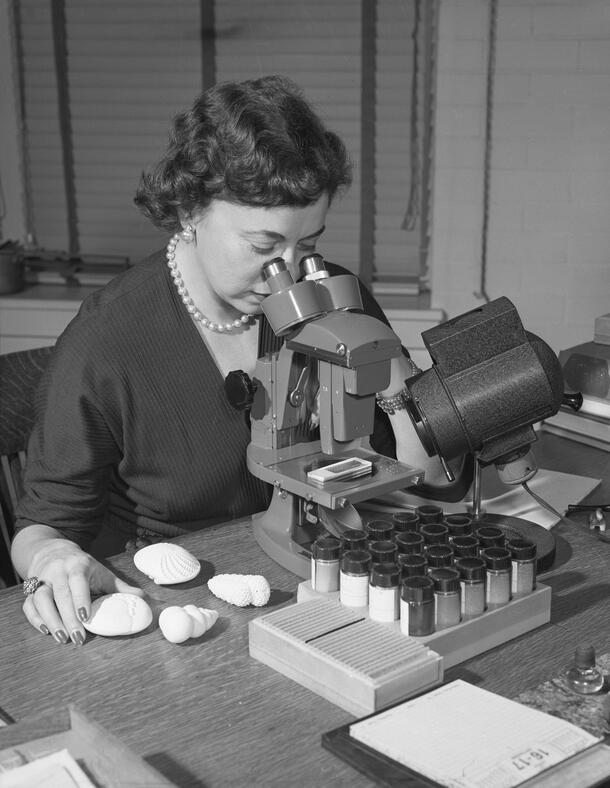
O catálogo de Foraminifera e Ostracoda Microfóssil foi iniciado por
Brooks F. Ellis na New York University (NYU) em 1928. Ele recrutou sua
aluna de doutorado Angelina R. Messina para ajudar a sistematizar a literatura dos foraminíferos . O projeto foi co-patrocinado pela NYU, mas acabou sendo assumido pela AMNH em 1935.
Angelina Messina juntou-se à AMNH para supervisionar a compilação do
catálogo e para organizar a coleção de microfósseis que chegou mais
tarde, principalmente de espécimes de dissertações da Universidade de
Colúmbia e material de pesquisa depositados aqui no AMNH.
As doações de empresas de petróleo que realizaram atividades de
exploração na América do Sul também contribuíram para essa coleta. Hoje, a coleção AMNH Microfossil contém ca. 7.000 lotes de amostras que aparecem em várias publicações e monografias seminais em foraminíferos e ostracodes.
PI Neil Landman
Muitas das localidades representadas por esses espécimes não são mais
acessíveis e muitos dos espécimes estavam em más condições físicas e
permaneciam não catalogados. Assim, eles estavam em risco de deterioração adicional. No início dos anos 80, uma grande parte do material original não associado e algum tipo de material foi enviado para o Museu Nacional de História Natural, Smithsonian Institution .
Os 7.000 lotes de espécimes que permaneceram (principalmente tipos) no
AMNH estavam em risco de perda de espécimes e dissociação de dados
devido ao armazenamento sub-ótimo e falta de digitalização.
Co-PI Ruth O'Leary
Devido à sua importância na taxonomia de foraminíferos e ostracodes,
sua ampla extensão geográfica e estratigráfica e sua utilidade como
indicadores de eventos geológicos passados em estudos
paleoceanográficos e paleoclimáticos, a curadoria e reabilitação de
nossa coleção Microfóssil começou gradualmente em 2011. Em 2012, uma
subvenção especificamente destinado a este fim, o subsídio NSF # 1203394 , foi concedido ao Investigador Principal Neil Landman e Co-Investigador Principal Ruth O'Leary.
O realojamento e a digitalização começaram a valer no verão de 2013,
quando 6 estagiários foram contratados como parte da subvenção da NSF
para ajudar a organizar, catalogar e digitalizar a coleção de
micropaleontologia. Os estagiários mantiveram um blog detalhando suas experiências ao longo do tempo trabalhando no projeto.
Nos próximos dois anos, esperamos conectar eletronicamente os dados
coletados de nossos tipos de microfósseis à sua coleção irmã muito maior
no NMNH criando novas oportunidades de pesquisa potencialmente
transformadoras.
Prevê-se que o uso de um tomógrafo computadorizado para escanear 50
tipos de microfósseis durante este projeto irá iniciar e desenvolver uma
nova abordagem para estudar e documentar esses microfósseis, produzindo
imagens que podem ser amplamente disseminadas.
sábado, 16 de maio de 2015
Dinossauros explicados!
http://www.amnh.org/explore
sexta-feira, 1 de maio de 2015
Dinosaurs Fell Victim to “Perfect Storm” of Events, Study Infers
Dinosaurs might have survived the asteroid strike that wiped them out
if it had taken place slightly earlier or later in time, according to
new research conducted in part by the American Museum of Natural
History. The study, published today in Biological Reviews,
builds a new narrative of the prehistoric creatures’ demise some 66
million years ago when a six-mile- (10-kilometer-) wide asteroid struck
what is now Mexico.
Triceratops, an herbivore common in the Maastrichtian stage.
“The dinosaurs were victims of colossal bad luck,” said lead author
Steve Brusatte, a researcher at the University of Edinburgh’s School of
GeoSciences. “Not only did a giant asteroid strike, but it happened at
the worst possible time, when their ecosystems were vulnerable. Our new
findings help clarify one of the enduring mysteries of science.”
The international team of scientists, which included the Museum’s Paleontology Division Chair Mark Norell,
who was Brusatte’s Ph.D. advisor, studied an updated catalog of
dinosaur fossils to create a picture of how dinosaurs changed over the
few million years before the asteroid hit. They found that Earth was
experiencing environmental upheaval, including extensive volcanic
activity, changing sea levels, and varying temperatures.
At this
time, the dinosaurs’ food chain was weakened by a lack of diversity
among the large plant-eating dinosaurs on which others preyed, probably
because of changes in the climate and environment, the researchers
suggest.
The dinosaur-dominated fauna witnessed the asteroid impact at the end
of the Cretaceous period about 66 million years ago and was replaced in
the earliest Paleocene by a mammal-dominated fauna. This illustration
shows representative members of major Campanian, Maastrichtian, and
earliest Paleocene (Puercan) North American terrestrial vertebrates.
Image credit:Thomas Williamson, New Mexico Museum of Natural History and Science
This created a “perfect storm” in which dinosaurs were vulnerable and
unlikely to survive the aftermath of the asteroid strike. That asteroid
impact would have caused tsunamis, earthquakes, wildfires, sudden
temperature changes, and other environmental changes. As food chains
collapsed, the dinosaurs were wiped out, one species after another. The
only dinosaurs to survive were those that could fly, from which modern
birds descended.
The researchers suggest that if the asteroid had
struck a few million years earlier, when the range of dinosaur species
was more diverse and food chains were more robust, or later, when new
species had time to diversify, then they very likely would have
survived. Ongoing studies in Spain and China could
result in an even better understanding of what occurred during this time
frame, more than 66 million years ago.
Building Better Skull Models For Ancient Carnivores
When paleontologists put together a life history for a long-extinct
animal, they try to understand its diet by looking at modern animals
with similar skull shapes and tooth patterns. But this practice is far
from foolproof. New modeling and tests based on living species conducted
by scientists at the American Museum of Natural History show that the
link between animal diets and skull biomechanics is complex, with a
stronger influence from ancestry than previously thought.
“Traditionally,
when we looked at a fossilized skull with pointy piercing teeth and
sharp slicing blades, we assumed that it was primarily a meat eater, but
that simplistic line of thinking doesn’t always hold true,” said John J. Flynn, the Museum’s Frick Curator of Fossil Mammals and a co-author on the new work published today in the journal PLOS ONE.
“We’ve found that diet can be linked to a number of factors—skull size,
biomechanical attributes, and often, most importantly, the species’
position in the tree of life.”
Dr. Flynn and Z. Jack Tseng, a National Science Foundation and Frick Postdoctoral Fellow in the Museum’s Division of Paleontology, looked
at the relationship between skull shape and function of five different
modern carnivore species: “hypercarnivores” like wolves and leopards
whose diet is more than 70 percent meat and more omnivorous
“generalists” such as mongooses, skunks, and raccoons. The initial
modeling, which mapped bite force against the stiffness of the animal’s
skull, yielded a surprise.
“Animals with the same diets and
biomechanical demands, like wolves and leopards—both
hypercarnivores—were not linking together,” Dr. Tseng said. “Instead, we
saw a strong signal driven mostly by ancestry, where, for example, the
leopard and the mongoose bind together because they’re more closely
related in an evolutionary context, although they have very different
dietary preferences and feeding strategies.”
But once Tseng and Flynn accounted for the strong effects of ancestry
and skull size on the models, hypercarnivores and generalists still
could be distinguished based on biomechanics, in particular by looking
at where along the tooth row the skull is strongest. The skulls of heavy
meat eaters tend to be stiff near the front teeth for hunting, and the
back teeth for crushing bones and slicing meat. In contrast, generalist
skulls get slightly stiffer from the front row of teeth to the back row.
With an improved shape-function computer model in hand, Flynn and Tseng applied the research to a pair of extinct species: Thinocyon velox, a predatory mammal that was part of the now-extinct Creodont group, and Oodectes herpestoides, an early fossil predecessor of modern carnivores. The results suggested that T. velox
likely had a unique hypercarnivorous feeding style that emphasized prey
capture with its front teeth and powerful slicing and crushing with its
back teeth, while O. herpestoides was a generalist.
“Beyond
feeding adaptations of extinct species, we also want to decipher how
adaptations evolved using reconstructed ancestors of living and fossil
forms,” Tseng said. “We are applying similar types of skull shape and
biomechanical analyses to reconstructed hypothetical ancestor skulls of
Carnivora and their relatives to map out and better understand the long
history of feeding adaptation of living top predators.”