Mostrando postagens com marcador Aborígene. Mostrar todas as postagens

sexta-feira, 22 de março de 2024

Translator


Quando os humanos modernos chegaram à Austrália?

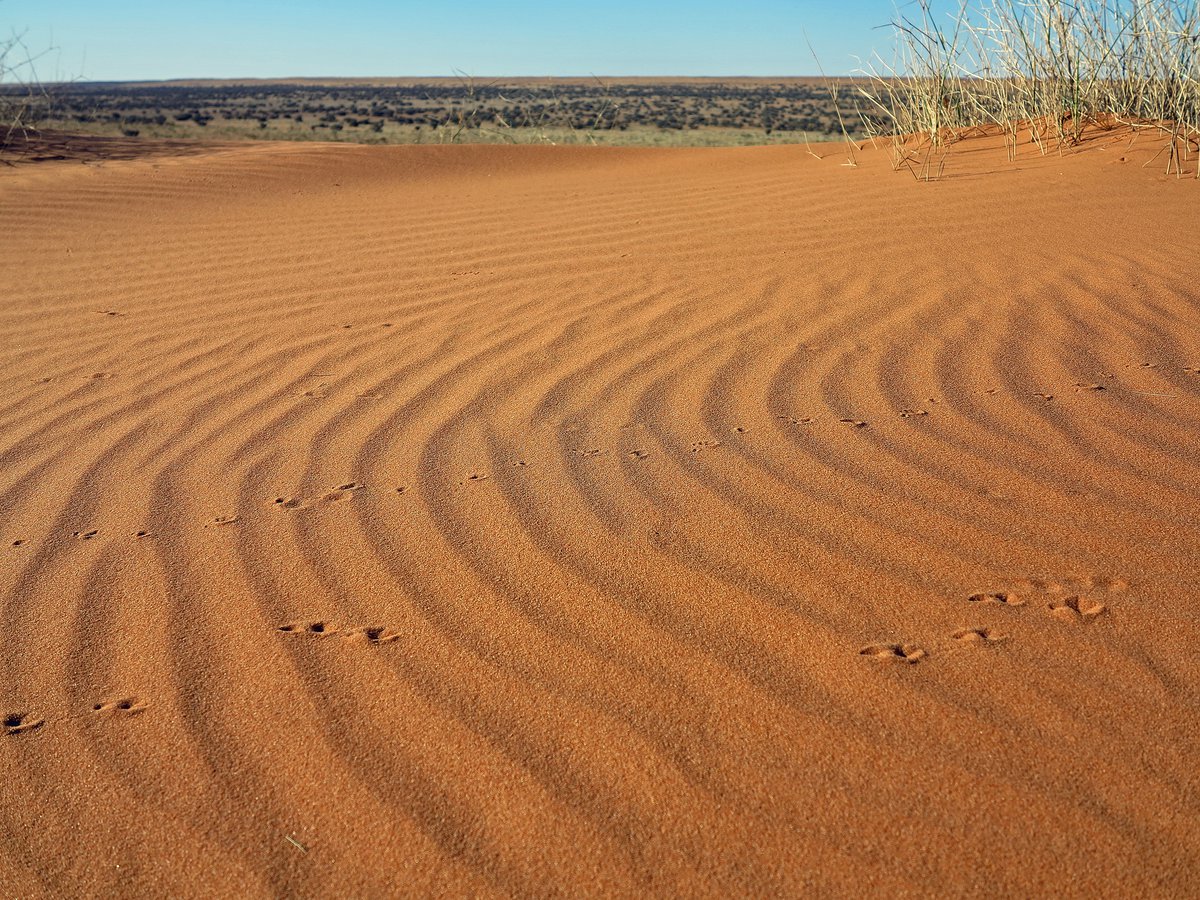
Expedição ao Parque Nacional Munga-Thirri, no sudoeste de Queensland, incluindo o grande campo de dunas do deserto oriental de Simpson, o maior deserto paralelo de cristas arenosas do mundo. Os cientistas da AM Sandy Ingleby e Anja Divljan (Coleções de Mamíferos) e Janet Waterhouse (Entomologia) pesquisaram a área em busca de espécies de mamíferos e insetos. Imagem: Jo Stewart
© Museu Australiano

Origens dos primeiros australianos

Os pontos de vista sobre as origens destes povos já estiveram emaranhados no debate mais amplo sobre as origens de todos os humanos modernos. Durante as décadas de 1980 e 1990, os dois pontos de vista principais eram os modelos “Fora de África” e “Multirregional”. No entanto, novos fósseis e pesquisas aprimoradas de DNA fizeram com que esses modelos se tornassem obsoletos. O amplo consenso agora é que todos os humanos modernos descendem de uma população africana de Homo sapiens que migrou por todo o mundo, mas que se reproduziu com populações arcaicas locais enquanto o faziam.

Há algum debate sobre o papel que esse cruzamento teve nas origens humanas modernas. O modelo de 'Origem Africana Recente' afirma que as características humanas modernas se fundiram em África e, embora o cruzamento tenha ocorrido durante as migrações em todo o mundo, estes tiveram apenas impactos mínimos nas características genéticas dos humanos modernos. O modelo de 'Assimilação' coloca maior ênfase no cruzamento, alegando que algumas características do Homo sapiens evoluíram em África, mas muitas características novas evoluíram através do cruzamento com outras populações arcaicas fora de África.

Modelos antigos

'Out of Africa' afirmou que os primeiros humanos a colonizar a Austrália vieram de uma recente migração do Homo sapiens através do Sudeste Asiático. Essas pessoas pertenciam a uma única linhagem genética e eram descendentes de uma população originária da África. A evidência fóssil dos primeiros indígenas australianos mostra uma gama de variações físicas que seria esperada em uma única população geograficamente difundida.

Os proponentes 'multirregionais' interpretaram a variação encontrada no registro fóssil dos primeiros indígenas australianos como evidência de que a Austrália foi colonizada por duas linhagens genéticas distintas de humanos modernos. Acreditava-se que uma linhagem era descendente evolutiva do Homo erectus indonésio , enquanto a outra linhagem evoluiu do Homo erectus chinês . Os aborígenes modernos são o resultado da assimilação dessas duas linhagens genéticas.

A Conexão Asiática

Os humanos modernos chegaram à Ásia há 70 mil anos, antes de descerem através do Sudeste Asiático e para a Austrália. Porém, o Homo sapiens não foi o primeiro povo a habitar esta região. O Homo erectus já existia na Ásia há pelo menos 1,5 milhão de anos. É possível que estas duas espécies tenham coexistido, uma vez que algumas datas para o Homo erectus indonésio sugerem que podem ter sobrevivido lá até há 50.000 anos. Restos de Homo erectus nunca foram encontrados na Austrália.

Uma segunda espécie, os denisovanos, também habitava esta região e as evidências mostram que eles cruzaram com humanos modernos. Os melanésios e os aborígenes australianos carregam cerca de 3-5% do DNA denisovano. Isto é explicado pelo cruzamento dos denisovanos da Eurásia oriental com os ancestrais humanos modernos dessas populações à medida que migravam para a Austrália e Papua Nova Guiné.

As principais descobertas fósseis da Ásia incluem

  • 'Solo Man' - Homo erectus descoberto em Ngangdong, Indonésia. 'Solo Man' compartilha semelhanças com espécimes anteriores de Homo erectus de Sangiran e é considerado um Homo erectus tardio . A sua idade é incerta e, como a sua localização original exata é desconhecida, as datas publicadas variam entre 50.000 e 500.000 anos. Se a idade mais jovem estiver correta, então é possível que o Homo erectus possa ter compartilhado esta região com o Homo sapiens .
  • 'Wadjak' - Homo sapiens descoberto em 1889, Java, Indonésia. A idade está entre 8.000 e 20.000 anos.
    Originalmente, pensava-se que este crânio tinha cerca de 50.000 anos e foram feitas tentativas de ligá-lo à chegada dos primeiros australianos. No entanto, os métodos de datação não conseguiram determinar exatamente quantos anos ele tem. Acredita-se agora que tenha provavelmente menos de 20.000 anos.
  • Caverna Superior 101 de Zhoukoudian - Homo sapiens descoberto em 1933 em Zhoukoudian, China. A idade é de 10.000 a 25.000 anos.

Fique por dentro

Descubra os segredos do Museu Australiano com nossos e-mails mensais.

Inscreva-se hoje

Portas de entrada para um novo continente

Sempre houve um oceano separando a Ásia e a Austrália. Às vezes, essa distância era reduzida, mas os primeiros viajantes ainda tinham que navegar por grandes extensões de água.

Durante grande parte de sua história, a Austrália esteve unida à Nova Guiné, formando uma massa de terra chamada Sahul. Estes países foram finalmente separados pela subida do nível do mar há cerca de 8.000 anos. A evidência genética apoia os laços estreitos entre estes dois países – os povos indígenas destas regiões estão mais estreitamente relacionados entre si do que com qualquer outra pessoa no mundo, sugerindo uma ascendência comum recente.

Existem vários caminhos prováveis ​​de migração através da Ásia e para Sahul. Estas baseiam-se no percurso mais curto possível e têm em consideração as pontes terrestres que surgiriam em épocas de baixo nível do mar. No entanto, as viagens também podem ter ocorrido quando o nível do mar estava alto. Os níveis elevados do mar teriam reduzido a quantidade de terra utilizável e aumentado a pressão populacional. Durante esses tempos, pode ter sido necessário expandir para novas áreas.

Mudança dos níveis do mar

A mudança do nível do mar afetou significativamente a geografia do Sudeste Asiático e da Austrália e os padrões de migração dos povos pré-históricos. Durante períodos de baixo nível do mar, a distância de viagem entre Timor e Sahul teria sido reduzida para cerca de 90 quilómetros.

Os actuais níveis do mar estão mais elevados do que durante a maior parte dos últimos milhões de anos. Quando a água fica presa nas calotas polares (conhecida como Idade do Gelo), o nível do mar cai. Quando o clima fica mais quente, o gelo derrete e o nível do mar sobe novamente.

Os marinheiros originais

A colonização da Austrália é a primeira evidência inequívoca de uma grande travessia marítima e é considerada uma das maiores conquistas dos primeiros humanos. No entanto, o motivo e as circunstâncias da chegada dos primeiros australianos são motivo de conjectura. Pode ter sido uma tentativa deliberada de colonizar um novo território ou um acidente após ser apanhado pelos ventos das monções.

A falta de preservação de qualquer barco antigo significa que os arqueólogos provavelmente nunca saberão que tipo de embarcação foi usada na viagem. Nenhum dos barcos usados ​​pelos aborígenes nos tempos antigos é adequado para grandes viagens. A sugestão mais provável são jangadas feitas de bambu, um material comum na Ásia.

A ocupação inicial da Austrália

As primeiras datas da ocupação humana da Austrália vêm de locais no Território do Norte. O abrigo rochoso Madjedbebe (anteriormente denominado Malakunanja II) em Arnhem Land tem uma data amplamente aceita de cerca de 50.000 anos. Relatos de uma data próxima a cerca de 65.000 anos ( Nature , 2017), que eram controversos na época, foram refutados por Allen & O'Connell em 2020. Estimativas do relógio molecular, estudos genéticos e dados arqueológicos sugerem a colonização inicial de Sahul e a Austrália por humanos modernos ocorreram cerca de 48.000–50.000 anos atrás.

Nas últimas décadas, foi descoberto um número significativo de sítios arqueológicos com mais de 30.000 anos. Nessa época, toda a Austrália, incluindo o centro árido e a Tasmânia, estava ocupada. O afogamento de muitos locais costeiros devido ao aumento do nível do mar destruiu o que teriam sido os primeiros locais de ocupação.

Datas recentemente publicadas de 120.000 anos atrás para o sítio de Moyjil em Warrnambool, Victoria, oferecem possibilidades intrigantes, mas improváveis, de ocupação muito anterior ( Proceedings of the Royal Society of Victoria , 2018). O local contém restos de mariscos, caranguejos e peixes no que pode ser um 'monturo', mas faltam provas definitivas de ocupação humana e as investigações estão em curso.

Os primeiros australianos

Much of our knowledge about the earliest people in Australia comes from archaeology. The physical remains of human activity that have survived in the archaeological record are largely stone tools, rock art and ochre, shell middens and charcoal deposits and human skeletal remains. These all provide information on the tremendous length and complexity of Australian Aboriginal culture.

Human Remains

Os restos fósseis humanos mais antigos encontrados na Austrália datam de cerca de 40.000 anos atrás – 20.000 anos após as primeiras evidências arqueológicas de ocupação humana. Nada se sabe sobre a aparência física dos primeiros humanos que entraram no continente há cerca de 50 mil anos. O que está claro é que os aborígenes que viveram na Austrália entre 40 mil e 10 mil anos atrás tinham corpos muito maiores e esqueletos mais robustos do que hoje e apresentavam uma ampla gama de variações físicas.

Ferramentas de pedra

As ferramentas de pedra na Austrália, como em outras partes do mundo, mudaram e se desenvolveram ao longo do tempo. Alguns tipos iniciais, como lâminas desperdiçadas, ferramentas principais, raspadores de lascas grandes e cortadores de seixos divididos, continuam a ser fabricados e usados ​​até hoje.

Cerca de 6.000 anos atrás, ferramentas novas e especializadas, como pontas, lâminas apoiadas e raspadores de miniaturas, tornaram-se comuns. Também surgiram variações significativas entre os kits de ferramentas de diferentes regiões. Protótipos desta tecnologia apareceram anteriormente na Ásia, sugerindo que esta inovação foi introduzida na Austrália.

A técnica da pedra retificada produz ferramentas com gume mais durável e uniforme, embora não tão afiadas quanto uma ferramenta lascada. As ferramentas de pedra mais antigas aparecem na Austrália cerca de 10.000 anos antes de aparecerem na Europa, sugerindo que os primeiros australianos eram mais avançados tecnologicamente em algumas de suas técnicas de fabricação de ferramentas do que tradicionalmente se pensava.

Arte do rock

A arte rupestre, incluindo formas pintadas e esculpidas, desempenha um papel significativo na cultura aborígine e sobreviveu nos registros arqueológicos por mais de 30.000 anos. Em idade e abundância, a arte rupestre aborígine australiana é comparável às cavernas europeias de renome mundial, como as de Lascaux, na França, e Altamira, na Espanha.

É provável que a arte rupestre fizesse parte da cultura dos primeiros australianos. O seu propósito exato é desconhecido, mas é provável que desde os primeiros tempos a arte rupestre tenha feito parte da atividade ritual religiosa, como é comum nas sociedades modernas de caçadores-coletores.

Pigmentos ocre e minerais

Os pigmentos minerais, como o ocre, fornecem a evidência mais antiga da chegada humana à Austrália. Pigmentos usados ​​foram encontrados nos primeiros níveis de ocupação de muitos locais, com algumas peças datadas de cerca de 50.000 anos. Isto sugere que a arte foi praticada desde o início da colonização. Os pigmentos naturais provavelmente foram usados ​​para diversos fins, incluindo enterros, pinturas rupestres, decoração de objetos e arte corporal. Esse uso ainda ocorre hoje.

Ocre é um óxido de ferro encontrado em uma variedade de cores, do amarelo ao vermelho e marrom. O ocre vermelho é particularmente importante em muitas culturas desérticas devido à crença de que representa o sangue de seres ancestrais e pode fornecer proteção e força. O ocre é usado moendo-o até formar um pó e misturando-o com um fluido, como água, sangue ou saliva.

Locais vivos

Archaeological evidence for living sites of Ancient Aboriginal peoples comes in a variety of forms including fishing traps and weirs, stone-base huts, possible fireplaces and remains of meals and cooking activities. The evidence indicates that lifestyle practices varied across the continent and differed depending on climate, environment and natural resources.

Os monturos de conchas são os restos mais óbvios de refeições e são úteis porque fornecem informações sobre as antigas dietas aborígines e ambientes passados, e também podem ser datados por radiocarbono para estabelecer a idade de um local.

Sites importantes

Coobool Creek

A coleção Coobool Creek consiste nos restos mortais de 126 indivíduos escavados em uma crista de areia em Coobool Crossing, Nova Gales do Sul, em 1950. Após a escavação, eles se tornaram parte da coleção da Universidade de Melbourne até serem devolvidos à comunidade aborígine para novo sepultamento. em 1985.

Os restos mortais datam de 9.000 a 13.000 anos e são significativos devido ao seu grande tamanho quando comparados com os aborígenes que apareceram nos últimos 6.000 anos. Eles são fisicamente semelhantes ao povo do Pântano Kow, com quem compartilhavam a prática cultural da deformação craniana artificial.

Kow Pântano

Este antigo cemitério no norte de Victoria foi escavado entre 1968 e 1972. Os esqueletos humanos descobertos aqui foram extremamente significativos porque foram datados com precisão entre 9.500 e 14.000 anos atrás e demonstraram diferenças substanciais entre os povos aborígenes antigos e mais recentes.

Os restos mortais de mais de quarenta indivíduos foram encontrados no Pântano Kow e incluem homens, mulheres e crianças. Este cemitério é um dos maiores deste período em qualquer lugar do mundo. Muitos dos esqueletos têm maior massa esquelética, estruturas mandibulares mais robustas e maiores áreas de inserção muscular do que nos homens aborígenes contemporâneos. Os esqueletos femininos desta região também apresentam diferenças semelhantes quando comparados com as mulheres aborígenes modernas.

Key remains:

  • 'Kow Pântano 1'. Crânio humano redescoberto em 1967 no Museu Nacional de Victoria por Alan Thorne e Phillip Macumber. É datado de 10.000 anos. O local original do enterro do crânio foi rastreado por meio de relatórios policiais, e as escavações no pântano de Kow começaram logo depois.
  • 'Kow Pântano 5'. Este crânio de 13.000 anos é um dos exemplos mais bem preservados do Pântano de Kow. Possui maior massa esquelética, estrutura mandibular mais robusta e maiores áreas de inserção muscular do que nos homens aborígenes contemporâneos.
  • 'Kow Pântano 14'. Esses restos mortais eram de um esqueleto masculino com os joelhos dobrados sob o peito e as mãos na frente do rosto. Em outros enterros no Pântano de Kow, o esqueleto estava totalmente estendido. Não se sabe por que diferentes posições funerárias foram usadas.

Lago Mungo

Os restos humanos mais antigos da Austrália foram encontrados no Lago Mungo, no sudoeste de Nova Gales do Sul, parte do sistema dos Lagos Willandra. Este local foi ocupado por povos aborígenes desde pelo menos 47.000 anos atrás até o presente. Esta faixa etária é apoiada por inúmeras técnicas de envelhecimento geocronológico, incluindo determinações de radiocarbono (C14), termoluminescência opticamente estimulada (OSL) e termoluminescência (TL). O Lago Mungo esteve desprovido de água nos últimos 18.000 anos e agora é um leito seco. No passado, a menor evaporação e o maior escoamento da Grande Cordilheira Divisória permitiram que os lagos se enchessem, sustentando abundantes recursos de água doce, como peixes e mariscos, e tornando os lagos uma valiosa fonte de alimento para as pessoas que ocupavam a área.

Key remains:

  • A Mulher Mungo, também conhecida como 'Lago Mungo 1' (WLH 1), foi descoberta em 1968. Com 42.000 anos de idade, este é o enterro humano com data mais segura na Austrália e os primeiros restos cremados ritualmente encontrados em qualquer lugar do mundo. O processo de cremação encolheu os ossos e tornou o esqueleto desta mulher originalmente de corpo pequeno ainda menor. Dr. Alan Thorne reconstruiu o crânio a partir de mais de 300 fragmentos.
  • O Homem Mungo, também conhecido como 'Lago Mungo 3' ou (WLH 3) foi descoberto em 1974. Ao contrário da cremação da Mulher Mungo, o Homem Mungo foi deitado de costas para o enterro e coberto de ocre vermelho antes de ser enterrado nas areias da praia que margeava o lago. Tem havido algum debate sobre a idade deste enterro e embora tenham sido obtidas datas que variam de 26.000 a 60.000 anos, uma idade próxima de 42.000 anos é amplamente aceita.

DNA do Mungo
Em 2001, cientistas australianos alegaram ter extraído DNA mitocondrial do 'Homem Mungo' e de outros nove australianos antigos. Eles concluíram que os genes do “Homem Mungo” de aparência moderna eram diferentes dos humanos modernos, provando que nem todos os Homo sapiens têm o mesmo ancestral recente, conforme afirmado na teoria “Out of Africa”. Estas alegações são controversas e não puderam ser replicadas em estudos posteriores em 2016 (PNAS 2016), e o único ADN que pôde ser recuperado do Homem Mungo foi europeu e certamente um contaminante.

O DNA antigo é facilmente contaminado e raramente sobrevive por 30 mil anos em condições como as encontradas na Austrália. Um genoma mitocondrial completo de WLH 4, encontrado a vários quilômetros de Mungo Man, foi reconstruído. Este indivíduo foi provavelmente enterrado depois que os lagos secaram no Holoceno (menos de 10.000 anos atrás) e contém DNA que está dentro da faixa humana moderna.

Cohuna

Um crânio foi encontrado em 1925 em Cohuna, noroeste de Kow Swamp, Victoria, e não tem data. No entanto, a semelhança entre este crânio e o povo do Pântano Kow sugere que ambos pertencem a um período de tempo semelhante. A testa longa, alta e plana deste crânio reflete as características da deformação craniana e seus dentes e palato são maiores do que a média australiana atual.

Chaves

As evidências de atividade humana em Keilor remontam a quase 40.000 anos. Flocos de pedra e depósitos de carvão foram encontrados nos níveis arqueológicos mais baixos.

Um dos principais vestígios deste local foi o de um crânio de 12.000 anos descoberto em 1940. É um dos primeiros vestígios aborígines pré-históricos encontrados na Austrália.

Talgs

Um crânio foi descoberto em 1884 em Darling Downs, Queensland. Foi o primeiro crânio humano do Pleistoceno encontrado na Austrália. É datado entre 9.000 e 11.000 anos.

Quando foi encontrado, o crânio estava coberto de carbonato de cálcio, o que deu ao crânio uma aparência deformada. Após a limpeza, descobriu-se que este crânio pertencia a um menino de cerca de 15 anos, que morreu em consequência de uma pancada na lateral da cabeça. As características do crânio, como dentes e mandíbulas, são notavelmente grandes, mas se enquadram na faixa de variação da população aborígine australiana.

Uma das muitas práticas culturais que podem alterar a aparência dos esqueletos humanos é a deformação do crânio. Há evidências de que alguns grupos aborígenes praticavam a deformação do crânio nos tempos antigos. O cientista australiano Dr. Peter Brown propôs que as características “robustas” observadas em crânios como o de “Cohuna” e os de Kow Swamp e Coobool Creek são o resultado de tais práticas no passado. A pressão prolongada e a amarração da cabeça podem produzir características como testa longa e recuada, ossos frontais e occipitais achatados e alongamento do crânio.

Referências

Adcock, GJ, et al. (2001). "Sequências de DNA mitocondrial em antigos australianos: implicações para as origens humanas modernas." Anais da Academia Nacional de Ciências 98 (2): 537-542.

Bowler, JM, et al. (2003). "Novas eras para a ocupação humana e as mudanças climáticas no Lago Mungo, Austrália." Natureza 421 : 837-840.

Durband, ACR, Daniel R.; Westaway, Michael (2009). "Um novo teste para o sexo do esqueleto do Lago Mungo 3." Arqueologia na Oceania 44 (2): 77-83.

Heupink, THS, et. al. (2016). "Sequências antigas de mtDNA dos primeiros australianos revisitadas." Anais da Academia Nacional de Ciências 113 (25): 6892-6897.

Allen, O'Connell et al. (2020). “Um paradigma diferente para a colonização de Sahul”, Arqueologia na Oceania, Vol. 55 (2020): 182–191

quinta-feira, 2 de maio de 2019

Indigenous groups look to ancient DNA to bring their ancestors home

Local communities and geneticists are working together to sequence DNA from remains that were taken from their homelands decades ago.

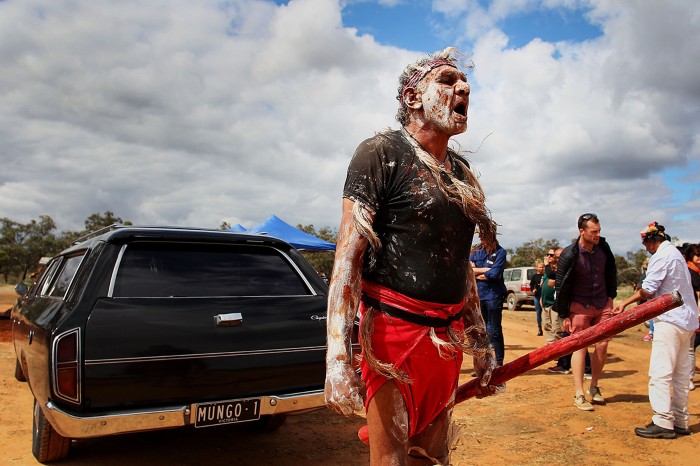
David Edwards, a Mutthi Mutthi Elde,r prepares to welcome Mungo Man back in a ceremony.
David Edwards, a Mutthi Mutthi elder, welcomes the return of remains that had been taken long ago. Credit: Lisa Maree Williams/Getty
 
Several years ago, Gudju Gudju Fourmile welcomed back several members of his Yidinji community who had been taken from their homes in northern Australia almost a century ago. Like many other Indigenous communities in Australia, the Yidinji have worked for decades to bring the bodies of their ancestors home — which Aboriginal communities describe as returning to Country.

Many of the ancestors are off Country as a result of the dehumanizing practices of the nineteenth and early twentieth centuries, when it was common for white collectors to loot graves and sell the remains of Aboriginal people to museums in Australia, the United Kingdom and other countries. “When our remains are off Country, we try to make sure they come back,” says Fourmile, an elder in the community who lives in Cairns. “They need to be comfortable. That’s a big thing for many tribal groups.” And when his community finally reburied its ancestors in 2014, “everybody was so happy. And the Country felt good again,” Fourmile says.

Before the Yidinji elders laid their ancestors to rest, they received a request from scientists who had been analysing the DNA of living community members: could they sequence the ancestors’ genomes, too? With permission granted, a team led by evolutionary geneticist David Lambert at Griffith University in Brisbane extracted DNA from the remains of one individual, and confirmed that the ancient person was closely related to Yidinji people alive today1,2. “When you find something out like that, you jump for joy,” says Fourmile. The event also marked a turning point in the mindset of the community, he says, when members started to realize the potential of DNA analysis to help bring their people back home.

In the past 30 years or so, museums have responded to complaints by repatriating thousands of human remains and sacred objects to Indigenous Australian groups such as the Yidinji. But many more — possibly thousands — lack the information necessary to return them to one of the dozens of distinct Indigenous groups in Australia. That is a source of great distress for communities. Lambert’s team published a study in 2018 showing that ten remains, including those of one ancient Yidinji individual, could be linked to specific Indigenous communities through genetics1.

Now, two teams in Australia, including Lambert’s, are partnering with Indigenous communities to create genomic maps that connect ancient and historical remains with present-day groups. Such catalogues could eventually be used to help return remains to the right communities.

Australia is one country where this approach is being trialled. DNA research is confirming that many Indigenous groups have lived on the continent for tens of thousands of years2,3. In some places, it has established that ancient individuals are closely related to present-day groups living in the same region1. Drawing such links in other regions, such as North America, has proved more difficult, because ancient populations there seem to have moved around more.

One of these projects could eventually be used by Indigenous people who are still suffering from past government actions, particularly a racist Australian policy lasting until 1970 that removed thousands of Aboriginal children from their families. These children became known as the ‘Stolen Generations’, and many of them are alive today. A DNA database of Indigenous groups could help some individuals to understand their genetic heritage and identify their homeland.

But such efforts raise concerns. As a result of the history of mistreatment, some Indigenous people fear that unscrupulous governments or scientists might misuse their genetic information. And there are tensions over who should control the data and whether scientists can freely share genomic sequences.

Fourmile says that Yidinji people agreed to the study because they had control of the data. “We’ve done a flip, and now we’re wanting them to study us for our own benefit to bring our people home,” he says.

Going back to Country

The arrival of European colonizers in Australia in the late 1780s marked the beginning of a scientific grave-robbing era there, when white people collected Indigenous human remains for research — including now-discredited ‘racial science’ theories linking intellect with anatomical differences. By the end of the nineteenth century, most major museums around the world housed Indigenous Australian remains.

The collection of such remains was part of the broader subjugation of Indigenous Australians by Europeans, which has led to generational trauma. Authorities determined where people could live and work, whom they could marry and whether they could keep their children. Tribal groups were also systematically moved off their land and placed on reserves and missions, where their movements were restricted. “They were trying to get us away from our traditional lands,” says Michael Young, a member of the adjoining Paakantyi and Parrintyi tribal groups, which stretch across a large swathe of southwestern New South Wales.

Aboriginal groups began fighting for the return of their ancestors in the 1970s, as part of a wider movement against the ongoing discrimination against them. By the 1980s, the growing pressure prompted some museums to introduce policies to return human remains and sacred objects to their communities.
Tracking down the traditional owners of ancestral remains is important for Aboriginal people because it is part of reclaiming their identities after being forced to assimilate into white Australia, says Young. “Repatriation is healing some of that wrong that has been done to us over the last 230 years,” he says.
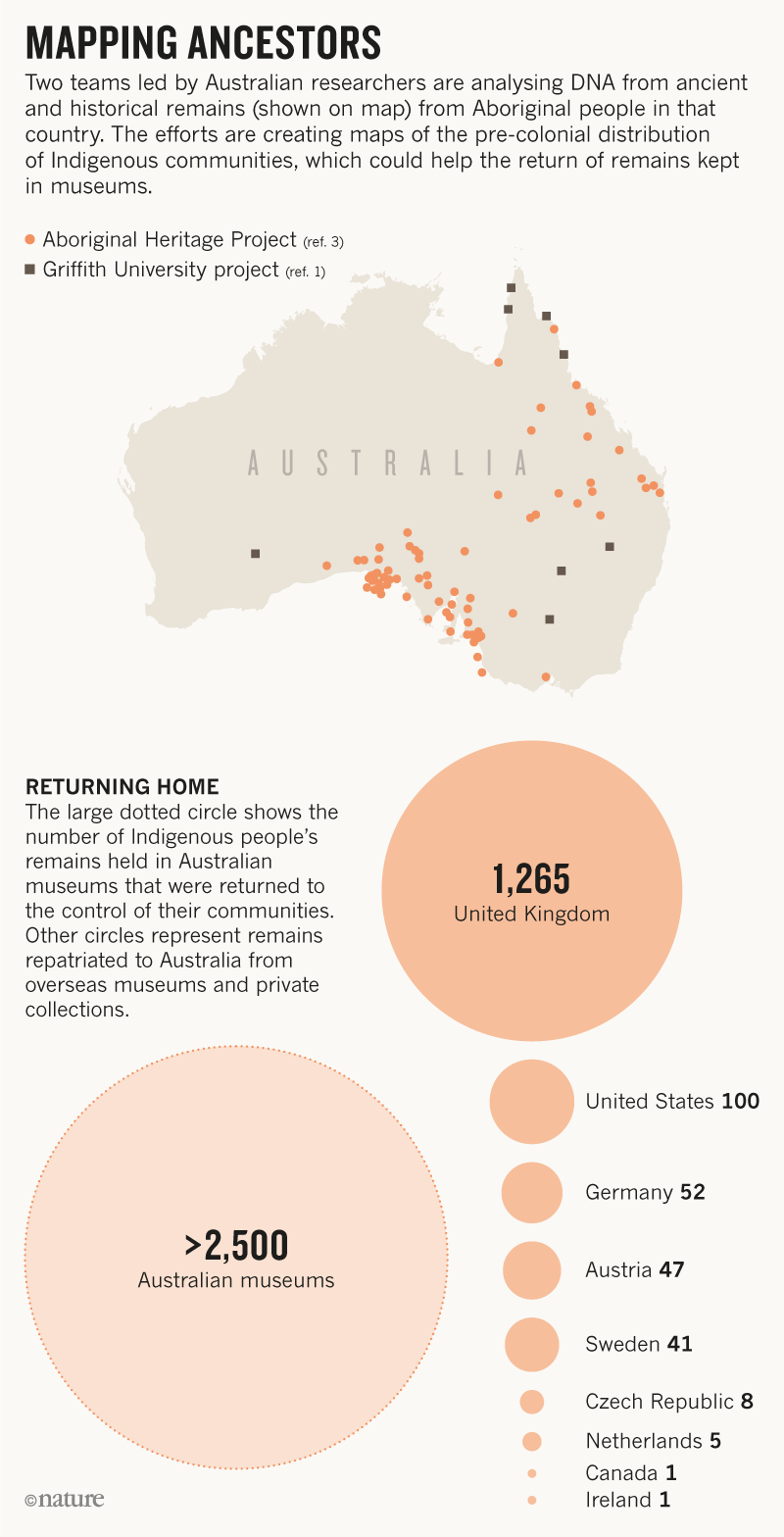
So far, Indigenous communities have regained custodianship of more than 2,500 sets of ancestral remains from Australian museums, according to the government’s repatriation programme (see ‘Mapping ancestors’). And in the past 30 years, more than 1,500 sets of ancestral remains have been returned to Australia, mostly from the United Kingdom, but also from the United States, Canada and half a dozen European nations, although some museums still refuse to repatriate remains and cultural objects.
Source: Refs 1 and 3; Australian Govt. Dept. Communication and the Arts
But there are probably several thousand sets of remains in Australian museums whose origin remains unknown, says Deanne Hanchant-Nichols, an anthropologist in Adelaide with experience in trying to identify unprovenanced remains and a member of the Tanganekald and Barkindji (or Paakantyi) communities. Many of the bodies are simply labelled ‘Aboriginal’, with no other identifying details, she says.
In 2016, Lambert laid the groundwork for ways to solve this problem, as part of a team that was charting the continent’s genetic history2. Lambert worked with elders to collect DNA samples and shared the team’s findings about the ancestry of some contemporary Indigenous Australians. During these conversations, the elders and Lambert discussed whether DNA could also reveal where ancient remains in museums had come from. Lambert said it was possible, but he was cautious not to predict the result before they did the analysis. “We’ve got to be careful about this kind of research,” he says.
Lambert got permission from the elders of 11 Aboriginal groups, including the Yidinji and the Paakantyi, to test the idea; several members of Indigenous communities, including Fourmile and Young, joined the study as co-authors.” His team sequenced DNA from 27 sets of human remains — mostly bones, but also teeth and hair — from individuals who died before British settlers arrived and whose burial location was known1. Most of these remains have been repatriated.

Despite Australia’s sweltering heat, which degrades DNA in remains, the team, co-led by Lambert and evolutionary geneticist Eske Willerslev at the Natural History Museum of Denmark in Copenhagen, obtained mitochondrial genomes from all 27 remains and full or partial nuclear genomes from 10 of them1 (see ‘Mapping ancestors’).

The DNA in mitochondria — cells’ power plants — is generally inherited maternally and is present in many more copies in cells than nuclear DNA. But Lambert’s team — which included Joanne Wright, then a PhD student at Griffith University — found it was of limited use in linking remains to contemporary groups: 11 of the remains had no conclusive match in a database of more than 100 mitochondrial genomes from Indigenous Australians, and two were linked to the wrong geographic area.

Nuclear DNA proved a much richer source of ancestry information for matching remains to present-day communities. Lambert’s team compared the 10 ancient nuclear genomes to those of 100 Indigenous Australians living across the country. In all ten cases, the ancestral remains were most closely related to the Indigenous people in their study who came from the same geographical area.
For instance, one of the ancient individuals is estimated to have lived at least 2,000 years ago, and their remains were excavated from a well-known Aboriginal burial ground in the Willandra Lakes region in far western New South Wales in 1974. The closest relatives of that person are members of the Willandra groups who live in the area today.
Lambert is now negotiating with the Queensland Museum and its board of Indigenous advisers to sequence about 300 unprovenanced remains housed at the museum, to test whether their place of origin can be identified. Young agrees that genetic matching could be a powerful tool for repatriating ancestors to the right community. But he would like to see more proof of its accuracy before the approach is applied to unprovenanced remains. The risk of repatriating remains to the wrong community could be reduced, he adds, by combining genomic analysis with anthropological evidence. Incorporating cultural knowledge from communities and information from museum archives could also help.

Moreover, Young says that such efforts should include more Indigenous scientists, who are aware of the culture and can discuss with communities how the research can help to reinforce their connection to Country. He is working with Lambert and others to set up scholarships for Aboriginal people to study genetics. “I’d love more Aboriginal people to get into that area,” he says.

A map of the past

Isabel O’Loughlin has spent the past six years building trust with several Indigenous communities. She is one of two community consultants working on the Aboriginal Heritage Project, another effort to look at DNA from remains of Indigenous Australians.

The group is sequencing hair samples that were collected mostly by ethnologists Norman Tindale and Joseph Birdsell from 1928 to the 1970s in what are today seen as racially motivated studies.
The Tindale and Birdsell teams drew family trees that name more than 50,000 people, including some who lived before British settlers arrived in 1860. The collection, which is held at the South Australian Museum in Adelaide, also contains photographs, sound recordings, films and drawings. More than 5,000 hair samples are stored in a restricted area in the museum.
Willandra Elders visiting the ancient DNA laboratory in 2008.
Elders from Indigenous communities from the Willandra Lakes region visiting the ancient DNA laboratory at Griffith University in 2008.Credit: Renee Chapman
When ancient-DNA researcher Alan Cooper at the University of Adelaide first heard about the collection a decade ago, he wondered whether it could be used to determine where Aboriginal Australian communities lived before British settlers arrived and spread throughout the country. Although the hair samples were collected from the 1920s — when Aboriginal people were already being forced from traditional lands — the detailed family trees meant that the team would be able to trace some people’s families back to these locations. So, in 2014, Cooper’s team started reaching out to Indigenous communities to get permission to analyse the remains.
Lewis O’Brien, an adviser to the Aboriginal Heritage Project, remembers Tindale visiting Point Pearce, the mission where his aunt lived in 1938. Tindale interviewed O’Brien, aged 8, and his brother, and measured their heights and the length of their arms, among other things. Tindale also snipped a lock of O’Brien’s hair. “I felt like a guinea pig,” says O’Brien, an elder with the Kaurna people, who is now 89 and lives in nearby Adelaide. O’Brien didn’t like how Tindale studied Aboriginal people, but he can see that the collection is a valuable resource for unravelling history for some communities.
The project’s data could also be the starting point for creating a service for present-day Indigenous people to compare their DNA against the reference map built from the hair samples. The service could allow some people — including members of the Stolen Generations — to explore whether genetics can reveal anything about where they might have come from, when conventional methods of finding such information fail, says Ray Tobler, a population geneticist at the University of Adelaide. But more work to reduce uncertainties is needed before such a service would be possible, he says. Hanchant-Nichols thinks a broad discussion among Indigenous people is needed, too. O’Brien supports a genetic-comparison service. He is often approached by Aboriginal people who were removed from their families and are desperate for information about their ancestry. “I want to be able to say, ‘we’ll get you tested and help you find out where you come from’,” he says.
Cooper and Tobler also visit communities to explain their efforts. Families whose records form part of the Tindale collection then have private meetings with the team to ask questions and raise any concerns. Some worry that their family’s genetic results could be misused, for instance, by government agencies to test their status as an Aboriginal person, says Cooper. But he says that status is based on community recognition and cannot be defined genetically. There is currently no DNA test of Aboriginality (despite claims to the contrary by some conservative politicians in Australia). The geographical information accompanying the genetic data is not specific enough to resolve land-title claims — another concern. “To boil someone’s identity down to their DNA is unethical and scientifically flawed,” adds Tobler.
O’Loughlin says the project has been embraced by the communities largely because Aboriginal people retain control. Of almost 180 families that the team has approached, only two decided not to participate in the project, she says.
After performing the analysis, the team returns with results. The community learns about the history of Australia and the relationships of different Indigenous groups. And individuals get information about their ancestor who provided the hair sample. O’Loughlin and her colleague Amy O’Donoghue also alert families in advance if the results show that biological relationships differ from families’ known relationships.
In 2017, Cooper and Tobler’s team published its first map of Aboriginal groups, based on mitochondrial DNA from 111 hair samples from three Indigenous communities3. The genetic analysis suggests that the first Australians arrived from Asia by about 50,000 years ago. This is broadly in line with most archaeological evidence and previous genome studies2 (see ‘Mapping ancestors’). Australia’s Indigenous groups also say their connection to the continent is ancient. Within a couple of thousand years, this founding group split into populations that expanded west and east — and then largely stayed put. On the basis of mitochondrial lineages, at least, there hasn’t been a lot of movement around Australia over broad geographical and time scales, says Tobler. “That’s remarkable because you don’t really see that anywhere else.”
Cooper and his team have now sequenced the nuclear genomes of about 150 hair samples. They plan to seek permission to sequence DNA from up to 1,000 hair samples.
However, the project has been on hold for almost a year while the team has worked to comply with state laws on conducting research with Aboriginal participants. The project is set to resume this month.
Although the hair samples are not being repatriated to the families, the map that is based on their DNA could help to match unprovenanced remains in museums to present-day groups, enabling their return.

Tales of the Ancient One

In the United States, the 1990 Native American Graves Protection and Repatriation Act (NAGPRA) and similar state legislation oblige museums to audit their collections and return what they can in the way of ancestral remains and sacred objects to Native American communities.
So far, NAGPRA has led to the return of hundreds of thousands of culturally affiliated ancestral remains and artefacts. And in the past few years, the US government has cited ancestry information gleaned from ancient DNA in returning some unaffiliated remains to tribes.
One of the most contentious is the 8,500-year-old skeleton of ‘Kennewick Man’, which was uncovered by teenagers in 1996 in a riverbank near Kennewick, Washington. Several Native American groups claimed the remains of the individual, whom they call the Ancient One, as ancestral and demanded their return under NAGPRA. But a coalition of archaeologists argued that the person lived too long ago to be culturally linked to present-day Native Americans under the law, and won a 2002 federal lawsuit to block their repatriation.
The remains were stored out of view in a Seattle museum, available to scientists and Native American groups, for over a decade. But several years ago, the US government asked Willerslev whether his lab could test the remains for DNA. After consulting with all of the Native American groups seeking Kennewick Man’s return, Willerslev’s team obtained enough DNA to generate a low-quality genome sequence.
Comparisons with DNA from present-day individuals confirmed that Kennewick Man was more closely related to Indigenous groups in North and South America than to other global populations4. They also determined that Kennewick Man was closely related to members of the Confederated Tribes of the Colville, who had participated in the study — one of the five communities seeking repatriation — but also to other groups in the Pacific Northwest and even to some in Central and South America. On the basis of the DNA tests, the US government determined that Kennewick Man was Native American, and therefore eligible for repatriation under NAGPRA. The remains were reburied in 2017 by members of the Yakama Nation, the Wanapum Band and the Nez Perce, Colville and Umatilla tribes.
The US government again cited ancient DNA evidence generated by Willerslev’s team when repatriating remains from Nevada in 2016, including a 10,600-year-old male human skeleton known as the Spirit Cave Mummy. As with Kennewick Man, the DNA analysis determined that the remains were Native American, but the study did not link them to any specific groups5.
Linking ancient remains to present-day groups is challenging because of huge gaps in scientists’ understanding of the population history of the Americas. Few genetic data are available for ancient remains in the Americas, says population geneticist Rasmus Nielsen at the University of California, Berkeley. The preliminary analysis of DNA from remains such as Kennewick Man and Spirit Cave Mummy suggests that ancient populations in the area moved around, so the ancient inhabitants of a region are likely to be the ancestors of many different Native American groups.
Drawing connections between ancient remains and modern groups is even more difficult, because there are relatively few genomes from present-day Native Americans against which to compare ancient remains, Nielsen adds. “Genetic results are only going to be as good as your comparative database,” says Ripan Malhi, a molecular anthropologist at the University of Illinois at Urbana–Champaign, who works with Indigenous groups in North America. The paucity of contemporary Native American genomes is a legacy of the poor treatment of Indigenous groups by non-Indigenous scientists, he adds.
In one case, researchers collected DNA from members of the Havasupai Tribe in Arizona, for health research. But they failed to seek permission when the samples were later used for other kinds of studies, so many Native Americans are now reluctant to share their details.
Some scientists in Australia have also failed to give Indigenous groups proper control over their own data. Such incidents have led to agreements where Indigenous groups decide how their information can be used. For instance, Indigenous communities involved with Lambert’s study permit their data to be shared with other groups wishing to verify the results, but only if the scientists get ethics approval. If researchers want to use the data for other purposes, they must get consent from the participants.
Some researchers have criticized such restrictions, saying that they could prevent Indigenous groups from seeing the benefits of future studies using their data. But Lambert and Indigenous groups say it is about time that non-Indigenous scientists ceded control.
And Aboriginal people are starting to embrace the chance to be involved, says Hanchant-Nichols. “For many, many years, science kept us out. We had no role in museums other than for them to steal our stories, steal our artefacts and steal our bones.”
Nature 568, 294-297 (2019)
doi: 10.1038/d41586-019-01167-w

References

  1. 1.
    Wright, J. L. et al. Sci. Adv. 4, eaau5064 (2018).
  2. 2.
    Malaspinas, A. et al. Nature 538, 207–214 (2016).
  3. 3.
    Tobler, R. et al. Nature 544, 180–184 (2017).
  4. 4.
    Rasmussen, M. et al. Nature 523, 455–458 (2015).
  5. 5.
    Moreno-Mayar, J. V. et al. Science 362, eaav2621 (2019).

quinta-feira, 18 de abril de 2019

Indigenous groups look to ancient DNA to bring their ancestors home

Local communities and geneticists are working together to sequence DNA from remains that were taken from their homelands decades ago.

David Edwards, a Mutthi Mutthi Elde,r prepares to welcome Mungo Man back in a ceremony.
David Edwards, a Mutthi Mutthi elder, welcomes the return of remains that had been taken long ago. Credit: Lisa Maree Williams/Getty
 
Several years ago, Gudju Gudju Fourmile welcomed back several members of his Yidinji community who had been taken from their homes in northern Australia almost a century ago. Like many other Indigenous communities in Australia, the Yidinji have worked for decades to bring the bodies of their ancestors home — which Aboriginal communities describe as returning to Country.

Muitos dos ancestrais estão fora do país como resultado das práticas de desumanização do século XIX e início do século XX, quando era comum os colecionadores brancos saquearem sepulturas e venderem os restos de aborígenes a museus na Austrália, no Reino Unido e em outros países. . "Quando nossos restos mortais estão fora do país, tentamos garantir que eles voltem", diz Fourmile, um ancião da comunidade que mora em Cairns. “Eles precisam estar confortáveis. Isso é uma grande coisa para muitos grupos tribais. ”E quando sua comunidade finalmente re-enterrou seus antepassados em 2014,“ todo mundo ficou muito feliz. E o país se sentiu bem de novo ”, diz Fourmile.

Antes de os anciãos de Yidinji deixarem seus ancestrais para descansar, eles receberam um pedido de cientistas que estavam analisando o DNA de membros da comunidade viva: poderiam também sequenciar os genomas dos ancestrais? Com a permissão concedida, uma equipe liderada pelo geneticista evolucionista David Lambert, da Universidade Griffith, em Brisbane, extraiu o DNA dos restos mortais de um indivíduo e confirmou que a pessoa antiga estava intimamente relacionada com o povo Yidinji hoje vivo1,2. "Quando você encontra algo assim, você pula de alegria", diz Fourmile. O evento também marcou um ponto de virada na mentalidade da comunidade, diz ele, quando os membros começaram a perceber o potencial da análise de DNA para ajudar a trazer seu povo de volta para casa.

Nos últimos 30 anos, os museus responderam a queixas ao repatriar milhares de restos humanos e objetos sagrados para grupos indígenas australianos, como o Yidinji. Mas muitos mais - possivelmente milhares - carecem da informação necessária para devolvê-los a uma das dezenas de grupos indígenas distintos na Austrália. Isso é uma fonte de grande sofrimento para as comunidades. A equipe de Lambert publicou um estudo em 2018 mostrando que dez restos mortais, incluindo aqueles de um indivíduo antigo de Yidinji, poderiam ser ligados a comunidades indígenas específicas por meio da genética1.

Now, two teams in Australia, including Lambert’s, are partnering with Indigenous communities to create genomic maps that connect ancient and historical remains with present-day groups. Such catalogues could eventually be used to help return remains to the right communities.

Australia is one country where this approach is being trialled. DNA research is confirming that many Indigenous groups have lived on the continent for tens of thousands of years2,3. In some places, it has established that ancient individuals are closely related to present-day groups living in the same region1. Drawing such links in other regions, such as North America, has proved more difficult, because ancient populations there seem to have moved around more.

One of these projects could eventually be used by Indigenous people who are still suffering from past government actions, particularly a racist Australian policy lasting until 1970 that removed thousands of Aboriginal children from their families. These children became known as the ‘Stolen Generations’, and many of them are alive today. A DNA database of Indigenous groups could help some individuals to understand their genetic heritage and identify their homeland.

But such efforts raise concerns. As a result of the history of mistreatment, some Indigenous people fear that unscrupulous governments or scientists might misuse their genetic information. And there are tensions over who should control the data and whether scientists can freely share genomic sequences.
Fourmile says that Yidinji people agreed to the study because they had control of the data. “We’ve done a flip, and now we’re wanting them to study us for our own benefit to bring our people home,” he says.

Going back to Country

The arrival of European colonizers in Australia in the late 1780s marked the beginning of a scientific grave-robbing era there, when white people collected Indigenous human remains for research — including now-discredited ‘racial science’ theories linking intellect with anatomical differences. By the end of the nineteenth century, most major museums around the world housed Indigenous Australian remains.

The collection of such remains was part of the broader subjugation of Indigenous Australians by Europeans, which has led to generational trauma. Authorities determined where people could live and work, whom they could marry and whether they could keep their children. Tribal groups were also systematically moved off their land and placed on reserves and missions, where their movements were restricted. “They were trying to get us away from our traditional lands,” says Michael Young, a member of the adjoining Paakantyi and Parrintyi tribal groups, which stretch across a large swathe of southwestern New South Wales.

Aboriginal groups began fighting for the return of their ancestors in the 1970s, as part of a wider movement against the ongoing discrimination against them. By the 1980s, the growing pressure prompted some museums to introduce policies to return human remains and sacred objects to their communities.

Tracking down the traditional owners of ancestral remains is important for Aboriginal people because it is part of reclaiming their identities after being forced to assimilate into white Australia, says Young. “Repatriation is healing some of that wrong that has been done to us over the last 230 years,” he says.
So far, Indigenous communities have regained custodianship of more than 2,500 sets of ancestral remains from Australian museums, according to the government’s repatriation programme (see ‘Mapping ancestors’). And in the past 30 years, more than 1,500 sets of ancestral remains have been returned to Australia, mostly from the United Kingdom, but also from the United States, Canada and half a dozen European nations, although some museums still refuse to repatriate remains and cultural objects.
Source: Refs 1 and 3; Australian Govt. Dept. Communication and the Arts
But there are probably several thousand sets of remains in Australian museums whose origin remains unknown, says Deanne Hanchant-Nichols, an anthropologist in Adelaide with experience in trying to identify unprovenanced remains and a member of the Tanganekald and Barkindji (or Paakantyi) communities. Many of the bodies are simply labelled ‘Aboriginal’, with no other identifying details, she says.

In 2016, Lambert laid the groundwork for ways to solve this problem, as part of a team that was charting the continent’s genetic history2. Lambert worked with elders to collect DNA samples and shared the team’s findings about the ancestry of some contemporary Indigenous Australians. During these conversations, the elders and Lambert discussed whether DNA could also reveal where ancient remains in museums had come from. Lambert said it was possible, but he was cautious not to predict the result before they did the analysis. “We’ve got to be careful about this kind of research,” he says.
Lambert got permission from the elders of 11 Aboriginal groups, including the Yidinji and the Paakantyi, to test the idea; several members of Indigenous communities, including Fourmile and Young, joined the study as co-authors.” His team sequenced DNA from 27 sets of human remains — mostly bones, but also teeth and hair — from individuals who died before British settlers arrived and whose burial location was known1. Most of these remains have been repatriated.

Despite Australia’s sweltering heat, which degrades DNA in remains, the team, co-led by Lambert and evolutionary geneticist Eske Willerslev at the Natural History Museum of Denmark in Copenhagen, obtained mitochondrial genomes from all 27 remains and full or partial nuclear genomes from 10 of them1 (see ‘Mapping ancestors’).

The DNA in mitochondria — cells’ power plants — is generally inherited maternally and is present in many more copies in cells than nuclear DNA. But Lambert’s team — which included Joanne Wright, then a PhD student at Griffith University — found it was of limited use in linking remains to contemporary groups: 11 of the remains had no conclusive match in a database of more than 100 mitochondrial genomes from Indigenous Australians, and two were linked to the wrong geographic area.
Nuclear DNA proved a much richer source of ancestry information for matching remains to present-day communities. Lambert’s team compared the 10 ancient nuclear genomes to those of 100 Indigenous Australians living across the country. In all ten cases, the ancestral remains were most closely related to the Indigenous people in their study who came from the same geographical area.
For instance, one of the ancient individuals is estimated to have lived at least 2,000 years ago, and their remains were excavated from a well-known Aboriginal burial ground in the Willandra Lakes region in far western New South Wales in 1974. The closest relatives of that person are members of the Willandra groups who live in the area today.

Lambert is now negotiating with the Queensland Museum and its board of Indigenous advisers to sequence about 300 unprovenanced remains housed at the museum, to test whether their place of origin can be identified. Young agrees that genetic matching could be a powerful tool for repatriating ancestors to the right community. But he would like to see more proof of its accuracy before the approach is applied to unprovenanced remains. The risk of repatriating remains to the wrong community could be reduced, he adds, by combining genomic analysis with anthropological evidence. Incorporating cultural knowledge from communities and information from museum archives could also help.

Moreover, Young says that such efforts should include more Indigenous scientists, who are aware of the culture and can discuss with communities how the research can help to reinforce their connection to Country. He is working with Lambert and others to set up scholarships for Aboriginal people to study genetics. “I’d love more Aboriginal people to get into that area,” he says.

A map of the past

Isabel O’Loughlin has spent the past six years building trust with several Indigenous communities. She is one of two community consultants working on the Aboriginal Heritage Project, another effort to look at DNA from remains of Indigenous Australians.
The group is sequencing hair samples that were collected mostly by ethnologists Norman Tindale and Joseph Birdsell from 1928 to the 1970s in what are today seen as racially motivated studies.
The Tindale and Birdsell teams drew family trees that name more than 50,000 people, including some who lived before British settlers arrived in 1860. The collection, which is held at the South Australian Museum in Adelaide, also contains photographs, sound recordings, films and drawings. More than 5,000 hair samples are stored in a restricted area in the museum.
Willandra Elders visiting the ancient DNA laboratory in 2008.
Elders from Indigenous communities from the Willandra Lakes region visiting the ancient DNA laboratory at Griffith University in 2008.Credit: Renee Chapman
When ancient-DNA researcher Alan Cooper at the University of Adelaide first heard about the collection a decade ago, he wondered whether it could be used to determine where Aboriginal Australian communities lived before British settlers arrived and spread throughout the country. Although the hair samples were collected from the 1920s — when Aboriginal people were already being forced from traditional lands — the detailed family trees meant that the team would be able to trace some people’s families back to these locations. So, in 2014, Cooper’s team started reaching out to Indigenous communities to get permission to analyse the remains.

Lewis O’Brien, an adviser to the Aboriginal Heritage Project, remembers Tindale visiting Point Pearce, the mission where his aunt lived in 1938. Tindale interviewed O’Brien, aged 8, and his brother, and measured their heights and the length of their arms, among other things. Tindale also snipped a lock of O’Brien’s hair. “I felt like a guinea pig,” says O’Brien, an elder with the Kaurna people, who is now 89 and lives in nearby Adelaide. O’Brien didn’t like how Tindale studied Aboriginal people, but he can see that the collection is a valuable resource for unravelling history for some communities.

The project’s data could also be the starting point for creating a service for present-day Indigenous people to compare their DNA against the reference map built from the hair samples. The service could allow some people — including members of the Stolen Generations — to explore whether genetics can reveal anything about where they might have come from, when conventional methods of finding such information fail, says Ray Tobler, a population geneticist at the University of Adelaide. But more work to reduce uncertainties is needed before such a service would be possible, he says. Hanchant-Nichols thinks a broad discussion among Indigenous people is needed, too. O’Brien supports a genetic-comparison service. He is often approached by Aboriginal people who were removed from their families and are desperate for information about their ancestry. “I want to be able to say, ‘we’ll get you tested and help you find out where you come from’,” he says.
Cooper and Tobler also visit communities to explain their efforts. Families whose records form part of the Tindale collection then have private meetings with the team to ask questions and raise any concerns. Some worry that their family’s genetic results could be misused, for instance, by government agencies to test their status as an Aboriginal person, says Cooper. But he says that status is based on community recognition and cannot be defined genetically. There is currently no DNA test of Aboriginality (despite claims to the contrary by some conservative politicians in Australia). The geographical information accompanying the genetic data is not specific enough to resolve land-title claims — another concern. “To boil someone’s identity down to their DNA is unethical and scientifically flawed,” adds Tobler.

O’Loughlin says the project has been embraced by the communities largely because Aboriginal people retain control. Of almost 180 families that the team has approached, only two decided not to participate in the project, she says.

After performing the analysis, the team returns with results. The community learns about the history of Australia and the relationships of different Indigenous groups. And individuals get information about their ancestor who provided the hair sample. O’Loughlin and her colleague Amy O’Donoghue also alert families in advance if the results show that biological relationships differ from families’ known relationships.

In 2017, Cooper and Tobler’s team published its first map of Aboriginal groups, based on mitochondrial DNA from 111 hair samples from three Indigenous communities3. The genetic analysis suggests that the first Australians arrived from Asia by about 50,000 years ago. This is broadly in line with most archaeological evidence and previous genome studies2 (see ‘Mapping ancestors’). Australia’s Indigenous groups also say their connection to the continent is ancient. Within a couple of thousand years, this founding group split into populations that expanded west and east — and then largely stayed put. On the basis of mitochondrial lineages, at least, there hasn’t been a lot of movement around Australia over broad geographical and time scales, says Tobler. “That’s remarkable because you don’t really see that anywhere else.”
Cooper and his team have now sequenced the nuclear genomes of about 150 hair samples. They plan to seek permission to sequence DNA from up to 1,000 hair samples.
However, the project has been on hold for almost a year while the team has worked to comply with state laws on conducting research with Aboriginal participants. The project is set to resume this month.
Although the hair samples are not being repatriated to the families, the map that is based on their DNA could help to match unprovenanced remains in museums to present-day groups, enabling their return.

Tales of the Ancient One

In the United States, the 1990 Native American Graves Protection and Repatriation Act (NAGPRA) and similar state legislation oblige museums to audit their collections and return what they can in the way of ancestral remains and sacred objects to Native American communities.
So far, NAGPRA has led to the return of hundreds of thousands of culturally affiliated ancestral remains and artefacts. And in the past few years, the US government has cited ancestry information gleaned from ancient DNA in returning some unaffiliated remains to tribes.
One of the most contentious is the 8,500-year-old skeleton of ‘Kennewick Man’, which was uncovered by teenagers in 1996 in a riverbank near Kennewick, Washington. Several Native American groups claimed the remains of the individual, whom they call the Ancient One, as ancestral and demanded their return under NAGPRA. But a coalition of archaeologists argued that the person lived too long ago to be culturally linked to present-day Native Americans under the law, and won a 2002 federal lawsuit to block their repatriation.
The remains were stored out of view in a Seattle museum, available to scientists and Native American groups, for over a decade. But several years ago, the US government asked Willerslev whether his lab could test the remains for DNA. After consulting with all of the Native American groups seeking Kennewick Man’s return, Willerslev’s team obtained enough DNA to generate a low-quality genome sequence.
Comparisons with DNA from present-day individuals confirmed that Kennewick Man was more closely related to Indigenous groups in North and South America than to other global populations4. They also determined that Kennewick Man was closely related to members of the Confederated Tribes of the Colville, who had participated in the study — one of the five communities seeking repatriation — but also to other groups in the Pacific Northwest and even to some in Central and South America. On the basis of the DNA tests, the US government determined that Kennewick Man was Native American, and therefore eligible for repatriation under NAGPRA. The remains were reburied in 2017 by members of the Yakama Nation, the Wanapum Band and the Nez Perce, Colville and Umatilla tribes.
The US government again cited ancient DNA evidence generated by Willerslev’s team when repatriating remains from Nevada in 2016, including a 10,600-year-old male human skeleton known as the Spirit Cave Mummy. As with Kennewick Man, the DNA analysis determined that the remains were Native American, but the study did not link them to any specific groups5.
Linking ancient remains to present-day groups is challenging because of huge gaps in scientists’ understanding of the population history of the Americas. Few genetic data are available for ancient remains in the Americas, says population geneticist Rasmus Nielsen at the University of California, Berkeley. The preliminary analysis of DNA from remains such as Kennewick Man and Spirit Cave Mummy suggests that ancient populations in the area moved around, so the ancient inhabitants of a region are likely to be the ancestors of many different Native American groups.
Drawing connections between ancient remains and modern groups is even more difficult, because there are relatively few genomes from present-day Native Americans against which to compare ancient remains, Nielsen adds. “Genetic results are only going to be as good as your comparative database,” says Ripan Malhi, a molecular anthropologist at the University of Illinois at Urbana–Champaign, who works with Indigenous groups in North America. The paucity of contemporary Native American genomes is a legacy of the poor treatment of Indigenous groups by non-Indigenous scientists, he adds.
In one case, researchers collected DNA from members of the Havasupai Tribe in Arizona, for health research. But they failed to seek permission when the samples were later used for other kinds of studies, so many Native Americans are now reluctant to share their details.
Some scientists in Australia have also failed to give Indigenous groups proper control over their own data. Such incidents have led to agreements where Indigenous groups decide how their information can be used. For instance, Indigenous communities involved with Lambert’s study permit their data to be shared with other groups wishing to verify the results, but only if the scientists get ethics approval. If researchers want to use the data for other purposes, they must get consent from the participants.
Some researchers have criticized such restrictions, saying that they could prevent Indigenous groups from seeing the benefits of future studies using their data. But Lambert and Indigenous groups say it is about time that non-Indigenous scientists ceded control.
And Aboriginal people are starting to embrace the chance to be involved, says Hanchant-Nichols. “For many, many years, science kept us out. We had no role in museums other than for them to steal our stories, steal our artefacts and steal our bones.”
Nature 568, 294-297 (2019)
doi: 10.1038/d41586-019-01167-w

References

  1. 1.
    Wright, J. L. et al. Sci. Adv. 4, eaau5064 (2018).
  2. 2.
    Malaspinas, A. et al. Nature 538, 207–214 (2016).
  3. 3.
    Tobler, R. et al. Nature 544, 180–184 (2017).
  4. 4.
    Rasmussen, M. et al. Nature 523, 455–458 (2015).
  5. 5.
    Moreno-Mayar, J. V. et al. Science 362, eaav2621 (2019).