Primeiro DNA humano antigo encontrado na principal rota de migração asiática
Sulawesi tem algumas das mais antigas artes em cavernas do
mundo, mas os restos humanos antigos são escassos - agora um fóssil com
DNA sugere uma linhagem misteriosa de pessoas.
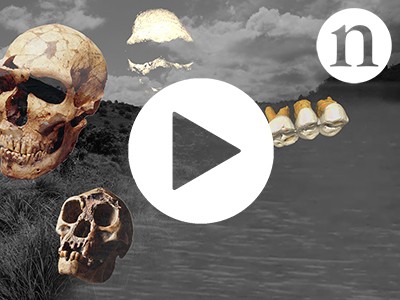
O crânio e os dentes comprimidos de uma jovem foram encontrados dentro de uma caverna na Indonésia. Crédito: Universidade de Hasanuddin
O
esqueleto de 7.000 anos de um adolescente caçador-coletor de Sulawesi,
na Indonésia, pode ser o primeiro resquício encontrado de uma cultura
antiga e misteriosa conhecida como Toaleans, relataram pesquisadores
nesta semana na Nature 1 .
O
fóssil em grande parte completo de uma mulher da Idade da Pedra com
cerca de 18 anos foi encontrado em 2015 enterrado em posição fetal em
uma caverna de calcário em Sulawesi. A ilha faz parte de uma região conhecida como Wallacea, que forma as ilhas centrais do arquipélago da Indonésia.
O
DNA extraído do crânio sugere que a mulher compartilhava ancestralidade
com os nativos da Nova Guiné e os aborígenes australianos, bem como com
uma espécie extinta de humanos ancestrais.
“Esta
é a primeira vez que alguém encontra DNA humano antigo naquela região”,
diz Adam Brumm, arqueólogo do Centro de Pesquisa Australiano para
Evolução Humana da Universidade Griffith em Brisbane, que faz parte de
uma equipe que descreveu a descoberta.
Os
autores dizem que ela pode ser um dos Toalean, cuja existência é
conhecida por escassas evidências arqueológicas, como ferramentas de
pedra com entalhes distintos, e que se acredita ter vivido em Sulawesi
na mesma época.
Portal para a Australásia
Os
restos mortais foram encontrados ao lado de ferramentas do tipo
Toalean, fornecendo fortes evidências da ligação da mulher com essas
pessoas pouco conhecidas, concorda Shimona Kealy, arqueóloga da
Universidade Nacional Australiana em Canberra.
Wallacea
é a porta de entrada através da qual viajaram os ancestrais dos
modernos papuásios e aborígenes australianos, mas poucos vestígios
humanos antigos foram descobertos lá. Um dos mais famosos é o esqueleto diminuto de 'Hobbit' da espécie humana primitiva Homo floresiensis , que foi encontrado na ilha de Flores, ao sul de Sulawesi.
O
ambiente tropical quente e úmido significa que o DNA se degrada
rapidamente em fósseis, tornando o material genético um prêmio raro para
pesquisadores que trabalham na região. Os
autores suspeitam que o enterro do esqueleto dentro da caverna de
calcário Leang Panninge pode ter ajudado a preservar DNA suficiente para
análise.
Adicionar
a análise genômica às evidências arqueológicas “fornece muito mais
informações sobre os movimentos populacionais iniciais e a diversidade
genética das pessoas naquela região”, diz Brumm.
Kealy
diz que o simples fato de o DNA ter sido extraído de um fóssil neste
ambiente desafiador para a preservação do DNA é uma conquista
fundamental do projeto. “Ver
esses caras se cansarem de uma sequência para que possam realmente
fazer análises sobre ela - e de algo que tem 7.000 anos, o que é
bastante impressionante - essa é a verdadeira emoção”, acrescenta ela.
A caverna Leang Panninge de Sulawesi tem sido uma rica fonte de informações sobre os povos antigos. Crédito: equipe de pesquisa Leang Panninge
Ondas de migração
O
genoma da mulher sugere um nível semelhante de parentesco com os atuais
aborígenes australianos e neo-guineenses, o que implica que sua
linhagem se separou antes de qualquer um desses grupos divergir um do
outro há cerca de 37.000 anos, diz a coautora Selina Carlhoff, que
pesquisa genética populacional no Instituto Max Planck de Ciência da
História Humana em Jena, Alemanha.
Kealy
diz que é possível que os ancestrais da mulher tenham feito parte de um
movimento de pessoas que migraram de Sulawesi para a Austrália e a Nova
Guiné há cerca de 50.000 a 60.000 anos, mas que sua linhagem formou uma
população ramificada que permaneceu em Sulawesi. Outra
possibilidade é que seus ancestrais tenham feito parte de uma onda
posterior de migração de volta para Wallacea da Austrália e da Nova
Guiné, diz Kealy.
O genoma da mulher também continha DNA denisovano. Os denisovanos
são uma subespécie extinta de humanos antigos que viveram de 500.000 a
30.000 anos atrás e cuja existência é conhecida apenas por meio de
descobertas de fósseis na Sibéria e no planalto tibetano.
A
presença de material genético denisovano - também encontrado em pessoas
na Austrália e na Nova Guiné - sugere que Wallacea pode ter sido uma
região na qual denisovanos e humanos modernos se misturaram e cruzaram.
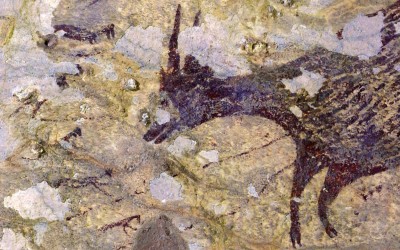
Também há a questão de se esse indivíduo pode estar relacionado a pinturas em cavernas de 44.000 anos descobertas em 2019 em Sulawesi - considerada uma das mais antigas arte rupestre figurativa conhecida no mundo. “Seria
superinteressante ser capaz de descobrir se havia alguma conexão entre
as pessoas que fizeram as pinturas e os [Toaleans]”, diz Carlhoff.
Traços genéticos em habitantes modernos
A região ao redor de Leang Panninge é hoje habitada por pessoas das culturas Bugis e Makassar da Indonésia. Essas pessoas são descendentes de austronésios que se estabeleceram lá depois de partir de Taiwan, há cerca de 3.500 anos.
O genoma da mulher não mostra nenhum traço de DNA austronésico, porque ela viveu muito antes que essa migração ocorresse. Mas uma questão chave para os pesquisadores é se o povo Bugis e Makassar tem laços com o antigo grupo ao qual ela pertencia.
Cientistas indonésios envolvidos no projeto chamaram a mulher de Bessé, que é uma palavra Bugis para 'jovem'. “Embora
fisicamente diferente da população atual de Sulawesi, os Bessé ainda
serão considerados parte da história humana na ilha”, diz o coautor do
estudo Muhammad Nur, arqueólogo da Universidade de Hasanuddin em South
Sulawesi.
Brumm
diz que nenhum traço da linhagem genética da mulher foi encontrado até
agora em amostras retiradas dos habitantes modernos de Sulawesi. No entanto, isso pode ser porque a população diversificada não foi amostrada de forma suficientemente completa.
É
possível “que descendentes desses povos toaleanos tenham sobrevivido e
vivido em algumas partes de Sulawesi do Sul até recentemente, e seus
genes ainda possam estar sobrevivendo hoje, embora sua cultura tenha
desaparecido há milhares de anos”, diz Brumm.
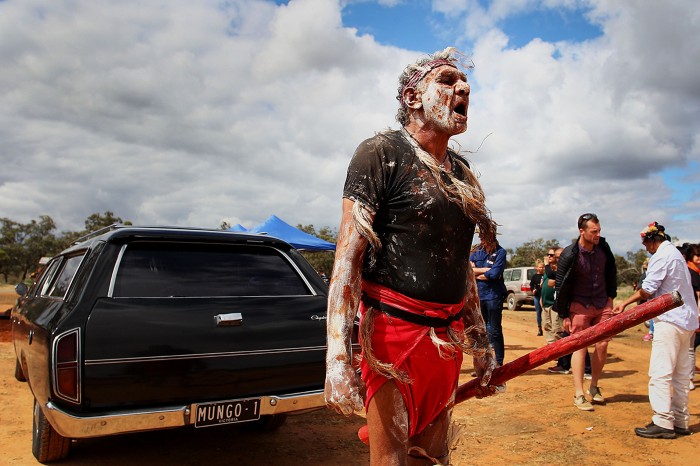
Several years ago, Gudju Gudju Fourmile welcomed
back several members of his Yidinji community who had been taken from
their homes in northern Australia almost a century ago. Like many other
Indigenous communities in Australia, the Yidinji have worked for decades
to bring the bodies of their ancestors home — which Aboriginal
communities describe as returning to Country.
Many of the
ancestors are off Country as a result of the dehumanizing practices of
the nineteenth and early twentieth centuries, when it was common for
white collectors to loot graves and sell the remains of Aboriginal
people to museums in Australia, the United Kingdom and other countries.
“When our remains are off Country, we try to make sure they come back,”
says Fourmile, an elder in the community who lives in Cairns. “They need
to be comfortable. That’s a big thing for many tribal groups.” And when
his community finally reburied its ancestors in 2014, “everybody was so
happy. And the Country felt good again,” Fourmile says.
Before
the Yidinji elders laid their ancestors to rest, they received a request
from scientists who had been analysing the DNA of living community
members: could they sequence the ancestors’ genomes, too? With
permission granted, a team led by evolutionary geneticist David Lambert
at Griffith University in Brisbane extracted DNA from the remains of one
individual, and confirmed that the ancient person was closely related
to Yidinji people alive today1,2.
“When you find something out like that, you jump for joy,” says
Fourmile. The event also marked a turning point in the mindset of the
community, he says, when members started to realize the potential of DNA
analysis to help bring their people back home.
In the past 30
years or so, museums have responded to complaints by repatriating
thousands of human remains and sacred objects to Indigenous Australian
groups such as the Yidinji. But many more — possibly thousands — lack
the information necessary to return them to one of the dozens of
distinct Indigenous groups in Australia. That is a source of great
distress for communities. Lambert’s team published a study in 2018
showing that ten remains, including those of one ancient Yidinji
individual, could be linked to specific Indigenous communities through
genetics1.
Now,
two teams in Australia, including Lambert’s, are partnering with
Indigenous communities to create genomic maps that connect ancient and
historical remains with present-day groups. Such catalogues could
eventually be used to help return remains to the right communities.
Australia is one country where this approach is being
trialled. DNA research is confirming that many Indigenous groups have
lived on the continent for tens of thousands of years2,3.
In some places, it has established that ancient individuals are closely
related to present-day groups living in the same region1.
Drawing such links in other regions, such as North America, has proved
more difficult, because ancient populations there seem to have moved
around more.
One of these projects could eventually be used by
Indigenous people who are still suffering from past government actions,
particularly a racist Australian policy lasting until 1970 that removed
thousands of Aboriginal children from their families. These children
became known as the ‘Stolen Generations’, and many of them are alive
today. A DNA database of Indigenous groups could help some individuals
to understand their genetic heritage and identify their homeland.
But
such efforts raise concerns. As a result of the history of
mistreatment, some Indigenous people fear that unscrupulous governments
or scientists might misuse their genetic information. And there are
tensions over who should control the data and whether scientists can
freely share genomic sequences.
Fourmile says that Yidinji people
agreed to the study because they had control of the data. “We’ve done a
flip, and now we’re wanting them to study us for our own benefit to
bring our people home,” he says.
Going back to Country
The
arrival of European colonizers in Australia in the late 1780s marked
the beginning of a scientific grave-robbing era there, when white people
collected Indigenous human remains for research — including
now-discredited ‘racial science’ theories linking intellect with
anatomical differences. By the end of the nineteenth century, most major
museums around the world housed Indigenous Australian remains.
The
collection of such remains was part of the broader subjugation of
Indigenous Australians by Europeans, which has led to generational
trauma. Authorities determined where people could live and work, whom
they could marry and whether they could keep their children. Tribal
groups were also systematically moved off their land and placed on
reserves and missions, where their movements were restricted. “They were
trying to get us away from our traditional lands,” says Michael Young, a
member of the adjoining Paakantyi and Parrintyi tribal groups, which
stretch across a large swathe of southwestern New South Wales.
Aboriginal
groups began fighting for the return of their ancestors in the 1970s,
as part of a wider movement against the ongoing discrimination against
them. By the 1980s, the growing pressure prompted some museums to
introduce policies to return human remains and sacred objects to their
communities.
Tracking down the traditional owners of ancestral
remains is important for Aboriginal people because it is part of
reclaiming their identities after being forced to assimilate into white
Australia, says Young. “Repatriation is healing some of that wrong that
has been done to us over the last 230 years,” he says.
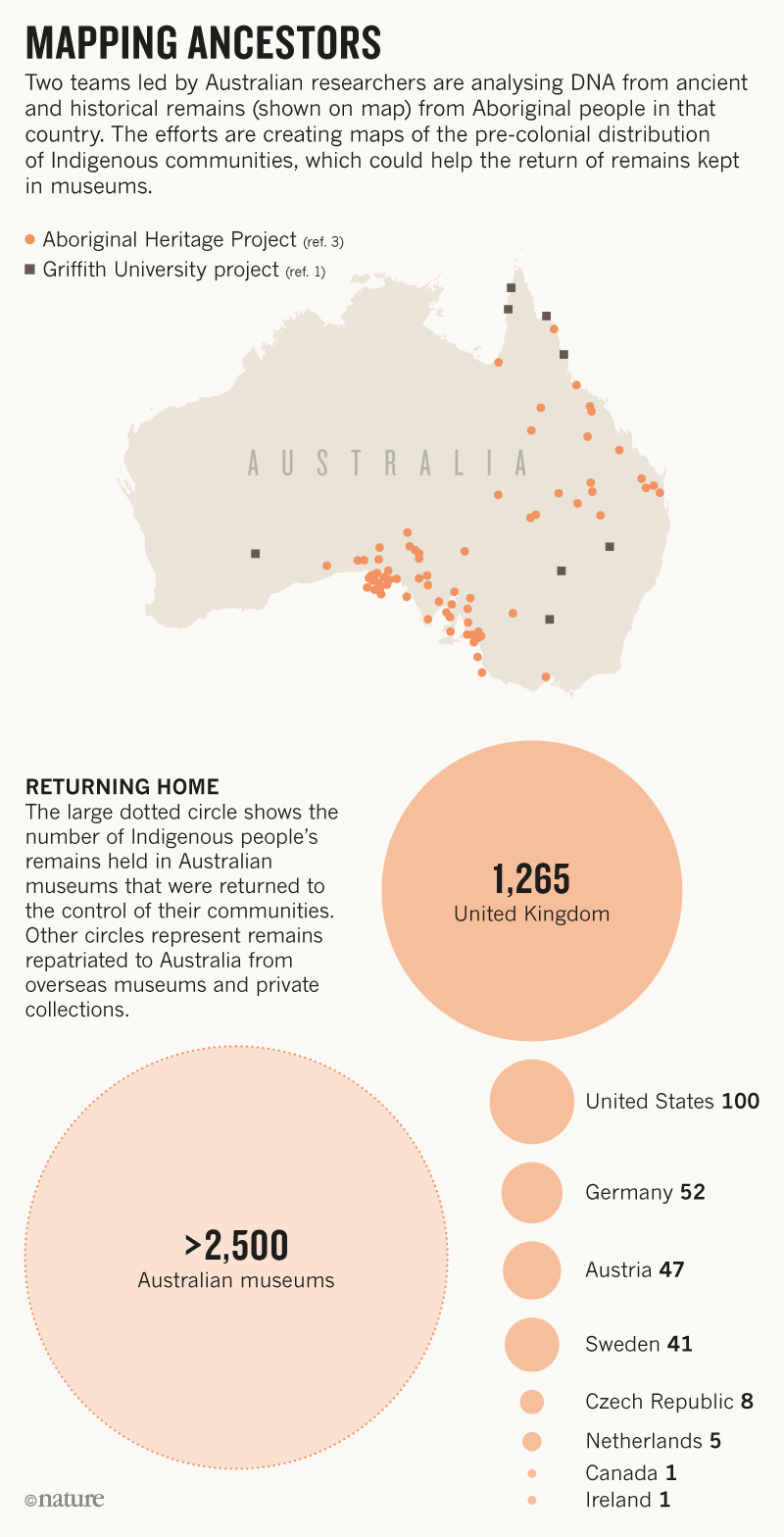
So far,
Indigenous communities have regained custodianship of more than 2,500
sets of ancestral remains from Australian museums, according to the
government’s repatriation programme (see ‘Mapping ancestors’). And in
the past 30 years, more than 1,500 sets of ancestral remains have been
returned to Australia, mostly from the United Kingdom, but also from the
United States, Canada and half a dozen European nations, although some
museums still refuse to repatriate remains and cultural objects.
Source: Refs 1 and 3; Australian Govt. Dept. Communication and the Arts
But there are probably several thousand sets of remains in
Australian museums whose origin remains unknown, says Deanne
Hanchant-Nichols, an anthropologist in Adelaide with experience in
trying to identify unprovenanced remains and a member of the Tanganekald
and Barkindji (or Paakantyi) communities. Many of the bodies are simply
labelled ‘Aboriginal’, with no other identifying details, she says.
In
2016, Lambert laid the groundwork for ways to solve this problem, as
part of a team that was charting the continent’s genetic history2.
Lambert worked with elders to collect DNA samples and shared the team’s
findings about the ancestry of some contemporary Indigenous
Australians. During these conversations, the elders and Lambert
discussed whether DNA could also reveal where ancient remains in museums
had come from. Lambert said it was possible, but he was cautious not to
predict the result before they did the analysis. “We’ve got to be
careful about this kind of research,” he says.
Lambert got
permission from the elders of 11 Aboriginal groups, including the
Yidinji and the Paakantyi, to test the idea; several members of
Indigenous communities, including Fourmile and Young, joined the study
as co-authors.” His team sequenced DNA from 27 sets of human remains —
mostly bones, but also teeth and hair — from individuals who died before
British settlers arrived and whose burial location was known1. Most of these remains have been repatriated.
Despite
Australia’s sweltering heat, which degrades DNA in remains, the team,
co-led by Lambert and evolutionary geneticist Eske Willerslev at the
Natural History Museum of Denmark in Copenhagen, obtained mitochondrial
genomes from all 27 remains and full or partial nuclear genomes from 10
of them1 (see ‘Mapping ancestors’).
The
DNA in mitochondria — cells’ power plants — is generally inherited
maternally and is present in many more copies in cells than nuclear DNA.
But Lambert’s team — which included Joanne Wright, then a PhD student
at Griffith University — found it was of limited use in linking remains
to contemporary groups: 11 of the remains had no conclusive match in a
database of more than 100 mitochondrial genomes from Indigenous
Australians, and two were linked to the wrong geographic area.
Nuclear
DNA proved a much richer source of ancestry information for matching
remains to present-day communities. Lambert’s team compared the 10
ancient nuclear genomes to those of 100 Indigenous Australians living
across the country. In all ten cases, the ancestral remains were most
closely related to the Indigenous people in their study who came from
the same geographical area.
For instance, one of the ancient
individuals is estimated to have lived at least 2,000 years ago, and
their remains were excavated from a well-known Aboriginal burial ground
in the Willandra Lakes region in far western New South Wales in 1974.
The closest relatives of that person are members of the Willandra groups
who live in the area today.
Lambert is now negotiating with the
Queensland Museum and its board of Indigenous advisers to sequence about
300 unprovenanced remains housed at the museum, to test whether their
place of origin can be identified. Young agrees that genetic matching
could be a powerful tool for repatriating ancestors to the right
community. But he would like to see more proof of its accuracy before
the approach is applied to unprovenanced remains. The risk of
repatriating remains to the wrong community could be reduced, he adds,
by combining genomic analysis with anthropological evidence.
Incorporating cultural knowledge from communities and information from
museum archives could also help.
Moreover, Young says that such
efforts should include more Indigenous scientists, who are aware of the
culture and can discuss with communities how the research can help to
reinforce their connection to Country. He is working with Lambert and
others to set up scholarships for Aboriginal people to study genetics.
“I’d love more Aboriginal people to get into that area,” he says.
A map of the past
Isabel
O’Loughlin has spent the past six years building trust with several
Indigenous communities. She is one of two community consultants working
on the Aboriginal Heritage Project, another effort to look at DNA from
remains of Indigenous Australians.
The group is sequencing hair
samples that were collected mostly by ethnologists Norman Tindale and
Joseph Birdsell from 1928 to the 1970s in what are today seen as
racially motivated studies.
The Tindale and Birdsell teams drew
family trees that name more than 50,000 people, including some who lived
before British settlers arrived in 1860. The collection, which is held
at the South Australian Museum in Adelaide, also contains photographs,
sound recordings, films and drawings. More than 5,000 hair samples are
stored in a restricted area in the museum.
Elders from
Indigenous communities from the Willandra Lakes region visiting the
ancient DNA laboratory at Griffith University in 2008.Credit: Renee Chapman
When ancient-DNA researcher Alan Cooper at the University of
Adelaide first heard about the collection a decade ago, he wondered
whether it could be used to determine where Aboriginal Australian
communities lived before British settlers arrived and spread throughout
the country. Although the hair samples were collected from the 1920s —
when Aboriginal people were already being forced from traditional lands —
the detailed family trees meant that the team would be able to trace
some people’s families back to these locations. So, in 2014, Cooper’s
team started reaching out to Indigenous communities to get permission to
analyse the remains.
Lewis O’Brien, an adviser to the Aboriginal
Heritage Project, remembers Tindale visiting Point Pearce, the mission
where his aunt lived in 1938. Tindale interviewed O’Brien, aged 8, and
his brother, and measured their heights and the length of their arms,
among other things. Tindale also snipped a lock of O’Brien’s hair. “I
felt like a guinea pig,” says O’Brien, an elder with the Kaurna people,
who is now 89 and lives in nearby Adelaide. O’Brien didn’t like how
Tindale studied Aboriginal people, but he can see that the collection is
a valuable resource for unravelling history for some communities.
The
project’s data could also be the starting point for creating a service
for present-day Indigenous people to compare their DNA against the
reference map built from the hair samples. The service could allow some
people — including members of the Stolen Generations — to explore
whether genetics can reveal anything about where they might have come
from, when conventional methods of finding such information fail, says
Ray Tobler, a population geneticist at the University of Adelaide. But
more work to reduce uncertainties is needed before such a service would
be possible, he says. Hanchant-Nichols thinks a broad discussion among
Indigenous people is needed, too. O’Brien supports a genetic-comparison
service. He is often approached by Aboriginal people who were removed
from their families and are desperate for information about their
ancestry. “I want to be able to say, ‘we’ll get you tested and help you
find out where you come from’,” he says.
Cooper and Tobler also
visit communities to explain their efforts. Families whose records form
part of the Tindale collection then have private meetings with the team
to ask questions and raise any concerns. Some worry that their family’s
genetic results could be misused, for instance, by government agencies
to test their status as an Aboriginal person, says Cooper. But he says
that status is based on community recognition and cannot be defined
genetically. There is currently no DNA test of Aboriginality (despite
claims to the contrary by some conservative politicians in Australia).
The geographical information accompanying the genetic data is not
specific enough to resolve land-title claims — another concern. “To boil
someone’s identity down to their DNA is unethical and scientifically
flawed,” adds Tobler.
O’Loughlin says the project has been
embraced by the communities largely because Aboriginal people retain
control. Of almost 180 families that the team has approached, only two
decided not to participate in the project, she says.
After
performing the analysis, the team returns with results. The community
learns about the history of Australia and the relationships of different
Indigenous groups. And individuals get information about their ancestor
who provided the hair sample. O’Loughlin and her colleague Amy
O’Donoghue also alert families in advance if the results show that
biological relationships differ from families’ known relationships.
In
2017, Cooper and Tobler’s team published its first map of Aboriginal
groups, based on mitochondrial DNA from 111 hair samples from three
Indigenous communities3.
The genetic analysis suggests that the first Australians arrived from
Asia by about 50,000 years ago. This is broadly in line with most
archaeological evidence and previous genome studies2
(see ‘Mapping ancestors’). Australia’s Indigenous groups also say their
connection to the continent is ancient. Within a couple of thousand
years, this founding group split into populations that expanded west and
east — and then largely stayed put. On the basis of mitochondrial
lineages, at least, there hasn’t been a lot of movement around Australia
over broad geographical and time scales, says Tobler. “That’s
remarkable because you don’t really see that anywhere else.”
Cooper
and his team have now sequenced the nuclear genomes of about 150 hair
samples. They plan to seek permission to sequence DNA from up to 1,000
hair samples.
However, the project has been on hold for almost a
year while the team has worked to comply with state laws on conducting
research with Aboriginal participants. The project is set to resume this
month.
Although the hair samples are not being repatriated to the
families, the map that is based on their DNA could help to match
unprovenanced remains in museums to present-day groups, enabling their
return.
Tales of the Ancient One
In the United States,
the 1990 Native American Graves Protection and Repatriation Act (NAGPRA)
and similar state legislation oblige museums to audit their collections
and return what they can in the way of ancestral remains and sacred
objects to Native American communities.
So far, NAGPRA has led to
the return of hundreds of thousands of culturally affiliated ancestral
remains and artefacts. And in the past few years, the US government has
cited ancestry information gleaned from ancient DNA in returning some
unaffiliated remains to tribes.
One of the most contentious is the
8,500-year-old skeleton of ‘Kennewick Man’, which was uncovered by
teenagers in 1996 in a riverbank near Kennewick, Washington. Several
Native American groups claimed the remains of the individual, whom they
call the Ancient One, as ancestral and demanded their return under
NAGPRA. But a coalition of archaeologists argued that the person lived
too long ago to be culturally linked to present-day Native Americans
under the law, and won a 2002 federal lawsuit to block their
repatriation.
The remains were stored out of view in a Seattle
museum, available to scientists and Native American groups, for over a
decade. But several years ago, the US government asked Willerslev
whether his lab could test the remains for DNA. After consulting with
all of the Native American groups seeking Kennewick Man’s return,
Willerslev’s team obtained enough DNA to generate a low-quality genome
sequence.
Comparisons with DNA from present-day individuals
confirmed that Kennewick Man was more closely related to Indigenous
groups in North and South America than to other global populations4.
They also determined that Kennewick Man was closely related to members
of the Confederated Tribes of the Colville, who had participated in the
study — one of the five communities seeking repatriation — but also to
other groups in the Pacific Northwest and even to some in Central and
South America. On the basis of the DNA tests, the US government
determined that Kennewick Man was Native American, and therefore
eligible for repatriation under NAGPRA. The remains were reburied in
2017 by members of the Yakama Nation, the Wanapum Band and the Nez
Perce, Colville and Umatilla tribes.
The US government again
cited ancient DNA evidence generated by Willerslev’s team when
repatriating remains from Nevada in 2016, including a 10,600-year-old
male human skeleton known as the Spirit Cave Mummy. As with Kennewick
Man, the DNA analysis determined that the remains were Native American,
but the study did not link them to any specific groups5.
Linking
ancient remains to present-day groups is challenging because of huge
gaps in scientists’ understanding of the population history of the
Americas. Few genetic data are available for ancient remains in the
Americas, says population geneticist Rasmus Nielsen at the University of
California, Berkeley. The preliminary analysis of DNA from remains such
as Kennewick Man and Spirit Cave Mummy suggests that ancient
populations in the area moved around, so the ancient inhabitants of a
region are likely to be the ancestors of many different Native American
groups.
Drawing connections between ancient remains and modern
groups is even more difficult, because there are relatively few genomes
from present-day Native Americans against which to compare ancient
remains, Nielsen adds. “Genetic results are only going to be as good as
your comparative database,” says Ripan Malhi, a molecular anthropologist
at the University of Illinois at Urbana–Champaign, who works with
Indigenous groups in North America. The paucity of contemporary Native
American genomes is a legacy of the poor treatment of Indigenous groups
by non-Indigenous scientists, he adds.
In one case, researchers
collected DNA from members of the Havasupai Tribe in Arizona, for health
research. But they failed to seek permission when the samples were
later used for other kinds of studies, so many Native Americans are now
reluctant to share their details.
Some scientists in Australia
have also failed to give Indigenous groups proper control over their own
data. Such incidents have led to agreements where Indigenous groups
decide how their information can be used. For instance, Indigenous
communities involved with Lambert’s study permit their data to be shared
with other groups wishing to verify the results, but only if the
scientists get ethics approval. If researchers want to use the data for
other purposes, they must get consent from the participants.
Some
researchers have criticized such restrictions, saying that they could
prevent Indigenous groups from seeing the benefits of future studies
using their data. But Lambert and Indigenous groups say it is about time
that non-Indigenous scientists ceded control.
And Aboriginal
people are starting to embrace the chance to be involved, says
Hanchant-Nichols. “For many, many years, science kept us out. We had no
role in museums other than for them to steal our stories, steal our
artefacts and steal our bones.”
Identifying genes is still a challenge, more than a decade after the completion of the human genome project.Credit: Alan Phillips/Getty
One of the earliest attempts to estimate the number of genes
in the human genome involved tipsy geneticists, a bar in Cold Spring
Harbor, New York, and pure guesswork.
That was in 2000, when a
draft human genome sequence was still in the works; geneticists were
running a sweepstake on how many genes humans have, and wagers ranged
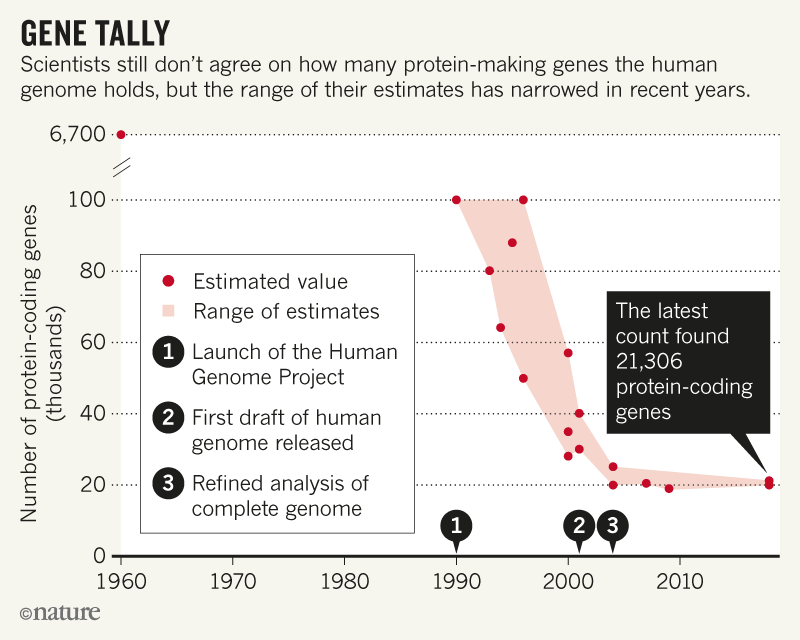
from tens of thousands to hundreds of thousands. Almost two decades
later, scientists armed with real data still can’t agree on the number —
a knowledge gap that they say hampers efforts to spot disease-related
mutations.
The latest attempt to plug that gap uses data from
hundreds of human tissue samples and was posted on the BioRxiv preprint
server on 29 May1.
It includes almost 5,000 genes that haven’t previously been spotted —
among them nearly 1,200 that carry instructions for making proteins. And
the overall tally of more than 21,000 protein-coding genes is a
substantial jump from previous estimates, which put the figure at around
20,000.
But many geneticists aren’t yet convinced that all the
newly proposed genes will stand up to close scrutiny. Their criticisms
underscore just how difficult it is to identify new genes, or even
define what a gene is.
“People have been working hard at this for
20 years, and we still don’t have the answer,” says Steven Salzberg, a
computational biologist at Johns Hopkins University in Baltimore,
Maryland, whose team produced the latest count.
Hard to pin down
In
2000, with the genomics community abuzz over the question of how many
human genes would be found, Ewan Birney launched the GeneSweep contest.
Birney, now co-director of the European Bioinformatics Institute (EBI)
in Hinxton, UK, took the first bets at a bar during an annual genetics
meeting, and the contest eventually attracted more than 1,000 entries
and a US$3,000 jackpot. Bets on the number of genes
ranged from more than 312,000 to just under 26,000, with an average of
around 40,000. These days, the span of estimates has shrunk — with most
now between 19,000 and 22,000 — but there is still disagreement (See
'Gene Tally').
Source: M. Pertea & S. L. Salzberg
The gene count can vary depending on the data being
analysed, the tools used and the criteria for weeding out false
positives. The latest count used a larger data set and different
computational methods from previous efforts, as well as broader criteria
for defining a gene.
Salzberg’s team used data from the
Genotype-Tissue Expression (GTEx) project, which sequenced RNA from more
than 30 different tissues taken from several hundred cadavers.
RNA is the intermediary between DNA and proteins. The researchers
wanted to identify genes that encode a protein and those that don’t but
still serve an important role in cells. So they assembled GTEx’s 900
billion tiny RNA snippets and aligned them with the human genome.
Just
because a stretch of DNA is expressed as RNA, however, does not
necessarily mean it’s a gene. So the team attempted to filter out noise
using a variety of criteria. For example, they compared their results
with genomes from other species, reasoning that sequences shared by
distantly related creatures have probably been preserved by evolution
because they serve a useful purpose, and so are likely to be genes.
The
team was left with 21,306 protein-coding genes and 21,856 non-coding
genes — many more than are included in the two most widely used
human-gene databases. The GENCODE gene set, maintained by the EBI,
includes 19,901 protein-coding genes and 15,779 non-coding genes.
RefSeq, a database run by the US National Center for Biotechnology
Information (NCBI), lists 20,203 protein-coding genes and 17,871
non-coding genes.
Kim Pruitt, a genome researcher at the NCBI in
Bethesda, Maryland, and a former head of RefSeq, says the difference is
probably due in part to the volume of data that Salzberg’s team
analysed. And there’s another major difference. Both GENCODE and RefSeq
rely on manual curation — a person reviews the evidence for each gene
and makes a final determination. Salzberg’s group relied solely on
computer programmes to sift the data.
“If people like our gene list, then maybe a couple years from now we’ll be the arbiter of human genes,” says Salzberg.
Tricky tally
But
many scientists say they need more evidence to be convinced that the
list is accurate. Adam Frankish, a computational biologist at the EBI
who coordinates the manual annotation of GENCODE, says that he and his
group have scanned about 100 of the protein-coding genes identified by
Salzberg’s team. By their assessment, only one of those seems to be a
true protein-coding gene.
And Pruitt’s team looked at about a
dozen of the Salzberg group’s new protein-coding genes, but didn’t find
any that would meet RefSeq’s criteria. Some overlapped with regions of
the genome that seem to belong to retroviruses that invaded our
ancestors’ genomes; others belong to other repetitive stretches, which
are rarely translated into proteins.
But Salzberg says that some repetitive sequences can be considered genes. One example is ERV3-1,
which appears in RefSeq and encodes a protein that is overexpressed in
colorectal cancer. Salzberg also acknowledges that the new genes on his
team’s list will require validation by his team and others.
Further
confounding counting efforts is the imprecise and changing definition
of a gene. Biologists used to see genes as sequences that code for
proteins, but then it became clear that some non-coding RNA molecules
have important roles in cells. Judging which are important — and should
be deemed genes — is controversial, and could explain some of the
discrepancies between Salzberg’s count and others.
Still, it’s
likely that at least some of the genes identified by Salzberg’s group
will turn out to be valid, says Emmanouil Dermitzakis, a geneticist at
the University of Geneva in Switzerland, who co-chairs the GTEx project.
He isn’t surprised that the team’s count for protein-coding genes is a
5% increase on previous tallies, given the gargantuan size of the GTEx
data set.
Having an accurate tally of all human genes is
important for efforts to uncover links between genes and disease.
Uncounted genes are often ignored, even if they contain a
disease-causing mutation, Salzberg says. But hastily adding genes to the
master list can pose risks, too, says Frankish. A gene that turns out
to be incorrect can divert geneticists’ attention away from the real
problem.
Still, the inconsistencies in the number of genes from
database to database are problematic for researchers, Pruitt says.
“People want one answer,” she adds, “but biology is complex.” Nature558, 354-355 (2018)
doi: 10.1038/d41586-018-05462-w
terça-feira, 20 de fevereiro de 2018
Jorge Estevez and other members of the Higuayagua Taíno community dance at a festival in Brooklyn. Taíno groups have fought against the idea that indigenous Caribbean islanders died out after European contact.
Vibert Cambridge
Genes of ‘extinct’ Caribbean islanders found in living people
Jorge Estevez grew up in the Dominican Republic and New York
City hearing stories about his native Caribbean ancestors from his
mother and grandmother. But when he told his teachers that he is Taíno,
an indigenous Caribbean, they said that was impossible. “According to
Spanish accounts, we went extinct 30 years after [European] contact,”
says Estevez, an expert on Taíno cultures at the Smithsonian’s National
Museum of the American Indian in New York City.
Many scientists and historians continue to believe the Taíno were
wiped out by disease, slavery, and other brutal consequences of European
colonization without passing down any genes to people in the Caribbean
today. But a new genetic study of a 1000-year-old skeleton from the
Bahamas shows that at least one modern Caribbean population is related
to the region’s precontact indigenous people, offering direct molecular
evidence against the idea of Taíno “extinction.”
“These indigenous communities were written out of history,” says Jada
Benn Torres, a genetic anthropologist at Vanderbilt University in
Nashville who studies the Caribbean’s population history and has worked
with native groups on several islands. “They are adamant about their
continuous existence, that they’ve always been [on these islands],” she
says. “So to see it reflected in the ancient DNA, it’s great.”
The skeletal remains come from a site called Preacher’s Cave on
Eleuthera, an island in the Bahamas. Archaeologists began excavating
there in the early 2000s to probe the Bahamas’ first European arrivals:
Puritans who took refuge in the cave after a shipwreck. As they dug,
they also found older artifacts associated with the island’s precontact
indigenous culture, including a handful of well-preserved burials.
At the time, Hannes Schroeder, an ancient DNA researcher at the
University of Copenhagen, was on the lookout for skeletons from the
Caribbean he could test for DNA—even though he knew success was a long
shot. DNA deteriorates faster in hot, humid environments than it does in
cold, dry ones. Hunting for ancient DNA in the Caribbean “was uncharted
waters,” he says. He tested teeth from five of the Preacher’s Cave
burials, and in the end just one had DNA intact enough to sequence. But
when it comes to ancient DNA from the tropics, that tooth was a bonanza.
The tooth belonged to a woman who lived about 1000 years ago,
according to radiocarbon dating. Schroeder’s team sequenced each
nucleotide base of her genome an average of 12.4 times, providingthe most complete genetic picture of a precontact Taíno individual to date, they report this week in the Proceedings of the National Academy of Sciences.
“It’s a feat of working with tropical samples,” says Maria
Nieves-Colón, a geneticist who studies ancient and modern Caribbean
populations at the National Laboratory of Genomics for Biodiversity in
Irapuato, Mexico, and at Arizona State University in Tempe.
The Taíno woman’s DNA shores up archaeological evidence about her
ancestors and her culture. When Schroeder’s team compared her genome to
those of other Native American groups, they found she was most closely
related to speakers of Arawakan languages in northern South America.
Early Caribbean ceramics and tools are strikingly similar to ones found
in excavations there, archaeologists have long argued.
The two lines of evidence suggest that around 2500 years ago, the
woman’s ancestors migrated from the northern coast of South America into
the Caribbean, rather than reaching the islands via the Yucatan
Peninsula or Florida. It seems that once people arrived, they didn’t
stay put. Archaeologists know that ceramics and other goods were traded
between islands, indicating frequent trips. Moreover, the Taíno woman’s
genome doesn’t contain long repetitive sequences characteristic of
inbred populations. Her community, therefore, was likely spread out
across many islands and not confined to 500-square-kilometer Eleuthera.
“It looks like an interconnected network of people exchanging goods,
services, and genes,” says William Schaffer, a bioarchaeologist at
Phoenix College in Arizona who helped excavate the remains in Preacher’s
Cave.
Genetic studies of modern populations have found that many people from Puerto Rico, Cuba, and several other Caribbean islands
carry significant indigenous ancestry, in addition to genes inherited
from European and African populations. Still, it’s possible that these
living people descend not from the Taíno but rather from other Native
Americans who, like many Africans, were forcibly brought to the islands
as slaves. But when Schroeder compared the genomes of modern Puerto
Ricans to the ancient Taíno woman’s genome, he concluded that they
descend in part from an indigenous population closely related to hers.
“It’s almost like the ancient Taíno individual they’re looking at is the
cousin of the ancestors of people from Puerto Rico,” Nieves-Colón says.
Growing up in Puerto Rico, she, like Estevez, was always told that the
Taíno died out. “You know what? These people didn’t disappear. In fact,
they’re still here. They’re in us.”
Estevez, who founded the cultural organization Higuayagua Taíno of
the Caribbean, didn’t need an ancient DNA study to tell him who he is.
Thanks to his family’s oral history and cultural practices, he says, he
has always had a strong connection to his indigenous ancestry. But he
hopes the new study will convince skeptics that Taíno people are alive
and kicking. “It’s another nail in the extinction coffin,” he says.