How the earliest mammals thrived alongside dinosaurs
An explosion of fossil finds reveals that ancient
mammals evolved a wide variety of adaptations allowing them to exploit
the skies, rivers and underground lairs.
Early mammals like this rat-sized species Liaoconodon hui coexisted with feathered dinosaurs like Sinotyrannus in the temperate ecosystems of the Cretaceous in what is now Liaoning in northern China. Illustration by Davide Bonadonna
Night is falling in the early Jurassic 185 million years ago, and the Kayentatherium
is tending to her newly hatched brood. Heavy rains pummel the bank
above her den as she looks over her dozens of tiny young. She is about
the size of a large cat and could easily pass for a mammal, but her
large jawbone, characteristic teeth and lack of external ears give her
away: she is a cynodont, a member of the group from which mammals
evolved. At some point without warning, the sodden bank collapses,
entombing the hatchlings and their mother in mud.
There they
remained until the summer of 2000, when a fossil-hunting crew led by
Timothy Rowe at the University of Texas at Austin chanced upon their
scattered bones among rocks of the Kayenta Formation in northern
Arizona.
That initial encounter with the fossils did little to
impress the palaeontologists. They dug up the block and shipped it back
to the laboratory for safekeeping. It wasn’t until nine years later that
a specialist preparing the fossil for study noticed something
startling: embedded in the block were tiny teeth, and jawbones just 1
centimetre in length. “Immediately they stopped the preparation and
thought about ways of non-destructively examining the babies,” says Eva
Hoffman, at Texas with Rowe at the time and now a palaeontologist at the
American Museum of Natural History in New York City. Instead of
breaking into the rock, Hoffman and Rowe digitally extracted the bones
with a microcomputed tomography (microCT) scanner, which uses X-rays to
create fine-grained 3D images.
What they found inside the rock
were the first known babies of mammals or their relatives from the
Jurassic — and not just one, but 38 of them, placing this among the most
significant discoveries related to mammal origins made in the past
decade1. Kayentatherium
is at the cusp of mammalhood — and researchers say that it provides
crucial insights into which traits define mammals and which were present
in their earlier relatives.
Kayentatherium’s skeleton is
mammal-like in many ways, but the fossil suggested that it still
reproduced very much like a reptile, giving birth to large litters of
small-brained offspring. By contrast, “mammal moms invest a lot in a
smaller number of babies, each of which has a better chance of
surviving”, says Hoffman. Mammal babies spend longer under their
parents’ care, developing relatively large brains, whereas these fossil
hatchlings had well-developed bones and teeth, hinting that they could
fend for themselves and were not nourished by milk, as all mammals are
today.
The find is among a mass of discoveries in the past 10–20
years that are illuminating milestones in mammalian evolution. Although
major finds are emerging all over the world, the largest number are
coming out of China; together, they have overturned the now dated belief
that dinosaur-era mammals were small, unremarkable insectivores, eking
out a life in the shadows of the giant reptiles.
This rat-sized Liaoconodon hui is one of many fossils from northern China that are sharpening the picture of how mammal traits evolved.Credit: J. Meng et al. Nature472, 181–185 (2011)
The fossils have revealed that early mammals were
ecologically diverse and experimenting in gliding, swimming, burrowing
and climbing. The discoveries are also starting to reveal the
evolutionary origins of many of the key traits of mammals — such as
lactation, large brains and superbly keen senses.
“The explosion
of early-mammal discoveries, particularly from China, over the last two
decades has been eye-opening, mind-numbing and absolutely dazzling,”
says David Krause, a vertebrate palaeontologist at the Denver Museum of
Nature and Science in Colorado.
This avalanche of discovery is
also stirring up debate: some researchers disagree over which fossil
groups are true mammals and the shape of the mammal family tree. “We
want to understand our early history in the language of evolutionary
biology, and that’s what fires me up,” says Zhe-Xi Luo, a
palaeontologist at the University of Chicago in Illinois. “That’s why
this entire field is so interesting, because the fossil record is
getting better and better, and we are starting to really tackle some of
these questions.”
Out of the shadows
In 1824, at the
Geological Society of London, naturalist William Buckland presented
bones from one of the first known dinosaurs, Megalosaurus. At the
same talk, he revealed tiny mammalian jaws that had been found in the
same fossil deposit. Their presence suggested that mammals had a very
deep history, but as would happen repeatedly, the dinosaur discoveries
completely overshadowed the mammal ones.
The slow trickle of
mammal finds from around the world continued for 150 years. Then in
1997, researchers described the first ancient mammal from the
fossil-rich rocks of Liaoning in northeastern China2,
and the floodgates opened. Since then, 50 or more near-complete and
“beautiful specimens” have been found there, according to Jin Meng, a
palaeontologist at the American Museum of Natural History. Like the
dinosaur fossils, they are dug up by local farmers and sold on to
museums.
But the dinosaurs continued to get the vast majority of
the attention, says palaeontologist Steve Brusatte at the University of
Edinburgh, UK. “It’s only that very recently, through the work of Luo,
Meng and others, that the mammals are getting their due.”
Most of
China’s mammal fossils were formed when volcanoes buried the animals in
ash — and they are exquisitely detailed. Typical mammal fossils from the
Mesozoic era (252 million to 66 million years ago) are little more than
teeth and jaw fragments, but Chinese specimens often have entire
skeletons, with fur, skin and internal organs. “We have a lot of detail
to answer scientific questions,” says Meng, He is interested in
understanding the evolution of the mammalian ear, for instance.
The finds overturned previous dogma. “We used to say that
during the time of dinosaurs, mammals were totally unspectacular. That
they were just these little mousey things scampering around in the
shadows,” says Brusatte. But these animals “were undergoing their own
evolutionary explosion”, he says.
Mammals first appeared at least
178 million years ago, and scampered amid the dinosaurs until the
majority of those beasts, with the exception of the birds, were wiped
out 66 million years ago. But mammals didn’t have to wait for that
extinction to diversify into many forms and species. “These new
discoveries document a huge, hitherto-undreamed-of ecological
diversity,” says Richard Cifelli, a palaeontologist at the University of
Oklahoma in Norman.
Among the first innovations that researchers
began to find in fossil form were those to do with locomotion. In 2006,
Meng’s team reported the first gliding mammal3, 164-million-year-old Volaticotherium, which had wing membranes made of furry skin, like today’s flying squirrels. In 2017, Luo’s team added Vilevolodon and Maiopatagaium4,5,
which lived at around the same time and belonged to a group called the
haramiyids. These animals swooped between the trees alongside some of
the first flying dinosaurs, taking advantage of previously unexploitable
food resources.
Researchers found other specializations that they assumed had evolved only later: Agilodocodon could climb trees and gnawed into bark to feast on sap6; the platypus-sized river-dweller Castorocauda had webbed feet and a beaver-like tail for swimming7; and Docofossor had paws and claws for digging, and looked like a modern mole8.
These
mammals had also adapted to a multitude of diets, much more diverse
than previously assumed. In 2014, Krause described the groundhog-like Vintana from Madagascar9, a herbivore that perhaps fed on roots and seeds. And the wolverine-sized carnivore Repenomamus, which Meng’s team reported in 2005, had baby dinosaur bones in its stomach10.
Many of these new-found fossil mammals belong to long-extinct
subgroups, says Meng. In contrast to the panoply that existed in the
Mesozoic, mammals today come in just three varieties: placentals, which
make up the majority of species and include humans; marsupials, such as
kangaroos and koalas, in which gestation in the womb is brief and
development continues in a pouch; and the egg-laying monotremes,
represented only by the platypus and several echidnas. “But in
geological history, there were many other groups such as
multituberculates, triconodonts and haramiyids,” says Meng. “Mammals
were actually very diverse in the Jurassic.”
Some, such as the shrew-like Juramaia
— described by Luo’s team in 2011 and dated to 160 million years ago —
are among the earliest placental mammals and therefore have the
potential to be our ancestors11.
And a few dinosaur-era mammals were much bigger than suspected, too. Repenomamus was 12–14 kilograms, and the racoon-sized Vintana
weighed in at 9 kg. “It’s exciting that we kind of busted the old myths
that early mammals came from a very humble generalized ancestor,” says
Luo.
The finds are not solely from China. Important fossils are
also coming from the United States, Spain, Brazil, Argentina, Madagascar
and Mongolia. Some of the most intriguing and oldest fossils — as well
as the biggest gaps in our knowledge — relate to the southern
continents, where only five genera of Mesozoic mammals and their
relatives are known, compared with more than 70 genera from northern
latitudes. In the past two decades, Brazil has yielded several Triassic
fossils that are more than 200 million years old. Guillermo Rougier, a
palaeontologist at the University of Louisville in Kentucky, describes
them as “incredible discoveries” that are right on the cusp between
mammals and their cynodont ancestors. “These forms really show a very
transitional progression from things that are typically non-mammalian,
to things that pretty much have all the features of early mammals.”
Mammal must-haves
The
latest finds are also offering clues to the evolution of key mammal
features. For instance, the keen hearing of mammals is partly down to
tiny bones in the middle ear — the malleus, incus and ectotympanic. But
in the reptilian ancestors of mammals, these bones were part of the jaw,
and were used for chewing instead of hearing. Mammal forerunners, such
as shrew-like Morganucodon from 205 million years ago, sported a prototype of the mammal arrangement that allowed for both functions12.
In 2011, Meng reported an intermediary13: a 120-million-year-old specimen from China belonging to a group of mammals called eutriconodonts and named Liaoconodon hui
(see ‘Mammal hallmarks’). The rat-sized fossil revealed three
middle-ear bones, but they were still attached to the jaw by cartilage.
“The hearing function and the chewing function were still not completely
separated,” he explains. This was hard evidence of the evolutionary
transition from jaw to ear.
This exquisitely preserved 160-million-year-old specimen of Maiopatagium furculiferum shows how early gliding evolved.Credit: Zhe-Xi Luo/UChicago
Another unique trait of mammals is the sophisticated way
they chew and ingest food in small parcels, rather than swallowing
things whole as snakes and alligators do. To make that possible, mammals
evolved a wide variety of complex teeth for biting and grinding food.
But
as babies, mammals are nourished another way — by suckling from their
mother’s mammary glands. “Our whole group is named after this incredible
biological innovation,” says Luo. Drinking milk is made possible by the
ability to suck and swallow, aided by the hyoid bones in the throat and
muscles that support them. This apparatus also forms the voice box.
In
July, Luo published a paper revealing a 165-million-year-old vole-sized
docodont — a close relative of true mammals — that had the hyoid bones
of its throat preserved14. Microdocodon gracilis is the earliest animal known to have been able to suckle like a modern mammal.
This level of detail is rare, and — similar to the study of the Kayentatherium
hatchlings — the work on both the ear and throat bones has been made
possible only through advances in microCT scanning techniques, says
Krause. The technique has also revealed details about the olfactory
abilities and brains of early mammals. These revelations are “breathing
life into these early mammals in ways that were previously impossible
and almost inconceivable”, he says.
Much of the constellation of
features we think of as defining mammals — complex teeth, excellent
senses, lactation, small litter size — might actually have evolved
before true mammals, and quite quickly. “More and more it looks like it
all came out in a very short burst of evolutionary experimentation,” Luo
says. By the time mammal-like creatures were roaming around in the
Mesozoic, he says, “the lineage has already acquired its modern look and
modern biological adaptations”.
Family drama
Although the
experts concur on many points, there is still much debate about how
early mammal groups are related, and which groups are true mammals. That
leads to uncertainty about how key traits evolved, says Hoffman.
One
sticking point between Meng and Luo, who have each developed their own
evolutionary trees, is the haramiyids. Meng thinks this early group
belongs with true mammals, whereas Luo is convinced it’s a side branch.
The oldest known haramiyids are from 208 million years ago in the
Triassic. If they are true mammals, then mammal origins date back at
least that far — if not, then the oldest known mammal is 178 million
years old, well into the Jurassic.
More fossils will help to
resolve such questions, and bring more surprises. Krause and Meng say
they are both studying exciting fossils, but are yet to publish their
findings on them, and tens of unstudied specimens lie piled in the
offices of their Chinese colleagues.
Palaeontologists have many
items on their wish lists. One characteristic that Luo wants to
understand is growth rates. Reptiles grow slowly throughout their lives,
whereas mammals grow in bursts in youth and then plateau. He’d love to
find a series of fossils from babies to adults to watch this happening.
“That is one of the most critical features in mammals that help to
define our biology,” he says.
Both Hoffman and Meng agree that embryos and more babies would be significant finds — and, like the Kayentatherium
discovery with its dozens of hatchlings, they would help us to pinpoint
the date that mammal-style small litter sizes appeared. Meng’s dream is
to find a pregnant mammal. “This is always in my mind that I will find a
mammal that inside the skeleton you can see some very delicate
skeleton, which is either an egg that hasn’t hatched, or it’s a more
interesting fetus,” he says.
If the flurry of discoveries has
taught researchers anything, it’s that every fossil find has the
potential to add a chapter to evolutionary history or even flip the
prevailing narrative on its head. “We’re really in this exciting, almost
manic phase of lots of new evidence coming in, and it’s going to take
time to synthesize,” says Brusatte.
The earliest-known eutherian mammal hunting on a tree fern.
Credit: Mark A Klinger / Carnegie Museum of Natural History
A shrew-like animal that snagged insects from ferns lining the shores
of freshwater lakes 160 million years ago, might be one of the first
"true" mammals to walk the Earth, back when the dinosaurs roamed, a new
fossil suggests.
The new fossil, discovered in what is now Liaoning Province in China,
is the oldest evidence of the divergence of these "true" or placental
mammals from their marsupial counterparts, and indicates the mammalian
lineage was evolving faster than expected during the Jurassic Period. [Images of the fossil]
"We can really conclude that the age of placental mammals goes back to
over 160 million years ago," study researcher Zhe-Xi Luo, of the
Carnegie Museum of Natural History in Pittsburgh, told LiveScience.
"It's an evolutionary milestone for mammal evolution."
True mammals — those that have taken over much of the world and make up
90 percent of today's mammals — are different from marsupials in
several ways. Most importantly, marsupials give birth to very immature
babies, which then climb into a pouch on the mother's belly where they feed and grow. Placental mammals stay in the womb for this time, until fully developed.
Fossil photograph and restorations of Juramaia
Credit: Mark A. Klingler of Carnegie Museum of Natural History
The new fossil species, now called Juramaia sinensis, included an incomplete skull, partial skeleton and impressions of soft tissue, such as hair.
Even though the soft tissue that would show marsupial or placental
traits — mammary glands or a pouch — had not been retained the fossil's
forepaw bones and teeth suggested it was closer to placental mammals
than marsupials on the mammal family tree. The next-oldest true mammal
fossil dates back about 125 million years.
"We are placing this fossil closer to the placental line than the marsupial line,
though it is definitely still between the two groups," Luo said. "It's
related and part of our ancestry, but it may not be the direct
grandmother to our lineage." [Gallery: Evolution's Most Extreme Mammals]
The date this fossil sets for the divergence of placentals and
marsupials, 160 million years ago, agrees well with dates garnered from
previous genomic analyses.
Skeletal reconstruction and life restoration of the earliest-known eutherian mammal
Credit: Mark A. Klinger / Carnegie Museum of Natural History
"This molecular time estimate places the time of split between
marsupials and placentals around middle Jurassic, around 165 million
years ago," Luo said. "Previously, the oldest record[ed placental
fossil] was 125 million years ago, so there was a substantial gap between the fossil record and the molecular estimates."
By pushing back the placental-marsupial division by 35 million years,
this fossil shows that even during the age of feathered dinosaurs
mammals were expanding and evolving into new groups quicker than
previously believed.
The study was published today (Aug. 24) in the journal Nature.
quinta-feira, 21 de junho de 2018
An Early Cretaceous eutherian and the placental–marsupial dichotomy
Molecular
estimates of the divergence of placental and marsupial mammals and
their broader clades (Eutheria and Metatheria, respectively) fall
primarily in the Jurassic period. Supporting these estimates, Juramaia—the oldest purported eutherian—is from the early Late Jurassic (160 million years ago) of northeastern China. Sinodelphys—the
oldest purported metatherian—is from the same geographic area but is 35
million years younger, from the Jehol biota.
Here we report a new Jehol
eutherian, Ambolestes zhoui, with a nearly complete skeleton
that preserves anatomical details that are unknown from contemporaneous
mammals, including the ectotympanic and hyoid apparatus.
This new fossil
demonstrates that Sinodelphys is a eutherian, and that postcranial differences between Sinodelphys and the Jehol eutherian Eomaia—previously
thought to indicate separate invasions of a scansorial niche by
eutherians and metatherians—are instead variations among the early
members of the placental lineage. The oldest known metatherians are now
not from eastern Asia but are 110 million years old from western North
America, which produces a 50-million-year ghost lineage for Metatheria.
domingo, 11 de setembro de 2011
Fóssil revela ancestral mais antigo dos mamíferos com placenta
Restos do animal têm 160 milhões de anos de idade.
Descoberta foi feita na província de Liaoning, na China.
O fóssil encontrado pela equipe liderada por
Zhe-Xi Luo. (Foto: N. Matsunaga)
Um fóssil encontrado em boas condições na província de Liaoning, no nordeste da China, é apontado pelos cientistas como o ancestral mais antigo dos animais com placenta - órgão que liga o feto de mamíferos como baleias e humanos ao útero da fêmea grávida.
Com 160 milhões de anos de idade, os ossos conservados do Juramaia sinensis revelam um animal pequeno, com dentes e patas dianteiras que permitiram aos cientistas classificá-lo. O estudo sobre a descoberta foi publicado na edição desta semana da revista "Nature".
A descoberta marca uma nova data para a separação dos mamíferos placentários dos marsupiais (como os cangurus) e dos monotremados (mamíferos que botam ovos como os ornitorrincos).
Com o fóssil recém-descoberto, os autores do trabalho - coordenados pelo paleontólogo Zhe-Xi Luo, do Museu de História Natural Carnegie, em Pittsburgh, nos Estados Unidos - descobriram que essa divisão aconteceu 35 milhões de anos antes do imaginado. Os restos do animal conservados foram analisados pelo cientista e outros três colegas da Academia Chinesa de Ciências Geológicas e do Museu de História Natural de Pequim.
Até então, o fóssil de mamífero placentário mais antigo conhecido era o Eomalia, revelado em 2002 por uma equipe de pesquisadores da qual Zhe-Xi Luo também participou. Este fóssil tinha 125 milhões de anos de idade.
Apesar do crânio incompleto, o fóssil foi encontrado com boa parte do esqueleto e até restos de pêlos. A arcada dentária e os ossos das patas dianteiras permitiram que a equipe chinesa classificasse o animal como mais próximo dos placentários vivos hoje em dia do que dos mamíferos da família dos cangurus - que carregam uma bolsa na qual o feto completa o seu crescimento antes de "nascer" de fato.
A pesquisa també traz novas informações sobre como os ancestrais dos mamíferos placentários conseguiram sobreviver em um ambiente hostil como o do período Jurássico. No caso do Juramaia, os membros dianteiros revelam um animal adaptado para escaladas.
Como na época a maioria dos mamíferos só conseguia ficar no solo, os pesquisadores chineses acreditam que a habilidade de subir em árvores pode ter originado a separação dos placentários.
A idade de "divergência evolucionária" - a época na qual uma espécie ancestral dá origem a duas linhagens diferentes de animais - é uma informação importante para os cientistas conhecerem como os seres vivos se desenvolveram ao longo do tempo. Este tipo de descoberta é facilitada hoje pelo desenvolvimento de técnicas de análise de DNA.
Ilustração mostra como seria o Juramaia sinensis ou 'Mãe Jurássica da China'. (Crédito: N. Matsunaga)
sexta-feira, 2 de setembro de 2011
Jurassic Mother' Found in China
by Brian Switek on 24 August 2011, 1:02 PM |7 Comments
Early cousin. The restored skeleton and body of the Jurassic mammal Juramaia.
Credit: Mark A. Klingler/Carnegie Museum of Natural History
Way back in the Late Jurassic, 160 million years ago, your closest relative looked like a shrew. That's not an insult but an evolutionary truth that stems from a new fossil discovery that pushes back the earliest appearance of the peculiar group of mammals to which we, as well as many other mammal species, belong. During the heyday of the Jurassic dinosaurs, our own ancestors were just getting their start in the dark corners of the Mesozoic world.
Living mammals are split into three subgroups: the egg-laying monotremes; the pouched marsupials; and, the most diverse of all, placental mammals, which includes everything from humans to bats to whales. Each group diverged at different times, and determining when marsupials and placentals split from each other has been problematic. Fossil discoveries point to the Cretaceous, about 125 million years ago, whereas estimates made on genetic differences among living mammals suggest that the split happened even earlier.
Now the discovery of a partial skeleton of a small, shrewlike mammal, described online today in Nature, pushes back the date of the divergence by 30 million years, to 160 million years ago. Found in the famous fossil beds of Liaoning, China, the newly discovered little mammal has been named Juramaia sinensis, or "Jurassic mother from China."
Juramaia belonged to a group of mammals called eutherians, the lineage that includes placental mammals and their archaic forebears. As the earliest eutherian known to date, the creature represents what some of our own precursors were like during the Jurassic. Weighing only about 15 grams, this tiny mammal probably chowed down on insects, and the preserved part of the skeleton, from the tip of the snout to about midway down its back, indicates that it was probably a skilled climber that scrambled through the trees after invertebrate snacks.
What characterizes this animal as a eutherian, and not another kind of archaic mammal, are the number of molars and premolars in its jaws, the arrangement of cusps on its teeth, and minute characteristics of its arms and wrists, says lead author Zhe-Xi Luo of the Carnegie Museum of Natural History in Pittsburgh, Pennsylvania. Together, these traits indicate that the forerunners of marsupial mammals—called metatherians—and placental mammals diverged even earlier still and have been separated by over 160 million years of evolutionary change. "This puts down a new evolutionary milestone for the origin of placental mammals, which are important because they make up more than 90% of all of the living mammals," Luo says.
Paleontologist John Hunter of Ohio State University, Newark, agrees that Juramaia adds resolution to the emergence of our eutherian forebears. "At 160 million years old," he explains, "Juramaia is now the oldest known eutherian, preceding the previous record-holder, Eomaia, by about 35 million years." Hunter points out that Juramaia possesses a well-developed arrangement of teeth called an "echelon shear" that confirms it as an early eutherian. Discovery of this mammal may also help paleontologists looking for the earliest marsupials and their ancestors. "Direct evidence for the presence of eutherians 160 million years ago," Hunter says, "indirectly provides evidence metatherians must have been in existence at the same time even though we do not yet have their fossils."
Um fóssil descoberto no nordeste da China indica que a evolução dos mamíferos em animais com placenta ocorreu 35 milhões de anos antes do que se imaginava. Um grupo de cientistas liderado pelo paleontólogo do Museu Carnegie de História Natural, Zhe-Xi Luo descreve na revista Natureo mamífero Juramaia sinensis, um pequeno animal semelhante a um musaranho, datado de 160 milhões de anos, ou seja, que viveu no período Jurássico. O Juramaia é o mais antigo exemplar do grupo de mamíferos chamados Eutherianos, o grupo que evoluiu em formas que apresentam a placenta, modo interno para manter e desenvolver os fetos. Saiba mais sobre essa importante descoberta lendo o resto deste texto.
Como o fóssil mais antigo de mamífero placentário, Juramaia fornece evidência fóssil da data em que mamíferos eutherianos divergiram de outros mamíferos, os Metatherianos, que dariam origem aos marsupiais como o Canguru. Também divergiram do grupo dos Monotremados, que inclui o moderno Ornitorrinco. O paleontólogo Luo explica que "o Juramaia, de 160 milhões de anos, é uma tia bisavó ou "bisavó" de todos os mamíferos placentários que são tão bem sucedidos hoje.
O fóssil original, também espécime Tipo, está preservado em uma placa de xisto da Formação Tiaojishan e pertence ao Museu de História Natural de Beijing (BMNH PM1143) e está sendo estudado em conjunto por cientistas chineses e estadunidenses. O nome quer dizer "Mãe Jurássica da China", sendo que o termo "Jura" representa o período e "Maia" quer dizer mãe. Por sua vez "Sinensis" quer dizer "da China".
O fóssil da Juramaia foi descoberto na Província de Liaoning, nordeste da China e examinado por Luo e os colaboradores Chong-Xi Yuan e Qiang Ji, da Academia Chinesa de Ciências Geológicas, e Qing-Jin Meng do Museu de História Natural de Beijing, onde o fóssil está armazenado. O fóssil apresenta crânio incompleto, parte do esqueleto e impressões de tecidos moles residuais como pelos. Mas o mais importante é que a dentição e ossos da pata dianteira estão preservados e permitiram que os paleontólogos classificassem o animal como parente próximo dos mamíferos placentários, mais ainda que dos marsupiais. O Juramaia tinha um crânio pequeno, de 2,2 centímetros e pesava cerca de 15 gramas. Alimentou-se provavelmente de insetos e vermes, e tinha uma grande habilidade para escalar.
Segundo Luo, "Entender o ponto inicial dos placentários é uma questão crucial no estudo da evolução dos mamíferos como um todo". Essa data da separação entre espécies ancestrais em duas linhagens descendentes diferentes é uma das informações mais importantes que os cientistas podem ter. Estudos moleculares modernos, como métodos baseados em DNA, podem calcular o tempo da evolução por meio de um "relógio molecular". Mas o relógio precisa ser submetido a uma checagem cruzada com o registro fóssil, que deve suportar as teorias do relógio. Antes da descoberta do Juramaia acreditava-se que o ponto de divergência era uma dúvida para os historiadores da evolução: a evidência de DNA sugeria que eutherianos deveriam ter aparecido antes no registro fóssil, há cerca de 160 milhões de anos. O mais antigo eutheriano conhecido era o Eomaia, de 125 milhões de anos, o que não batia com as pesquisas de DNA. A descoberta do Juramaia por sua vez mostra um espécime mais antigo de eutheriano e bate com os dados encontrados através das moléculas de DNA, preenchendo uma lacuna importante no registro fóssil da evolução dos mamíferos, o que é um marco no estudo da evolução.
O pequeno mamífero Chinês mostra características que podem ter ajudado os novos eutherianos a sobreviver no ambiente jurássico, como pernas dianteiras adaptadas para escalar, o que era muito bom, pois até o que se sabia os mamíferos principalmente viviam em solo e poder se refugiar em árvores e explorar este nicho era uma vantagem em tanto.
Novamente, Luo apóia essa perspectiva "A divergência de mamíferos eutherianos dos marsupiais acabou em reprodução e desenvolvimento da placenta, o que foi crucial para a evolução dos placentários. Mas foi sua capacidade de explorar as árvores que permitiu alcançarem tanto sucesso."
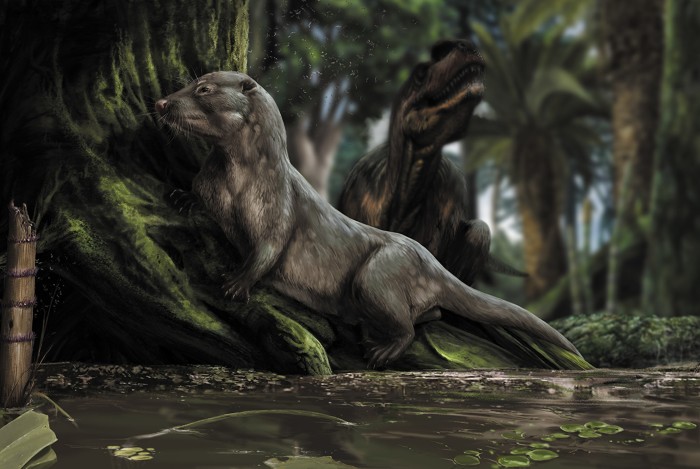
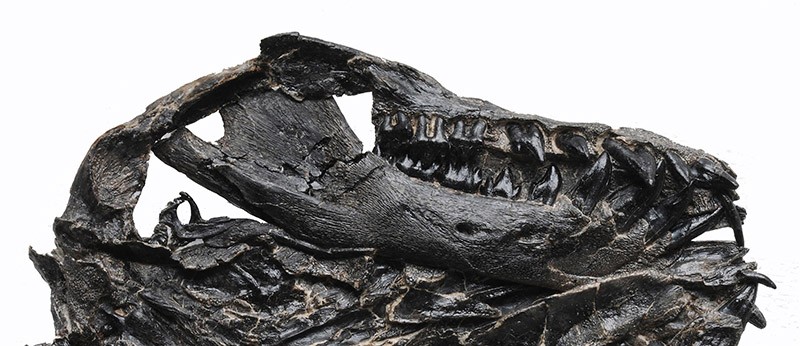
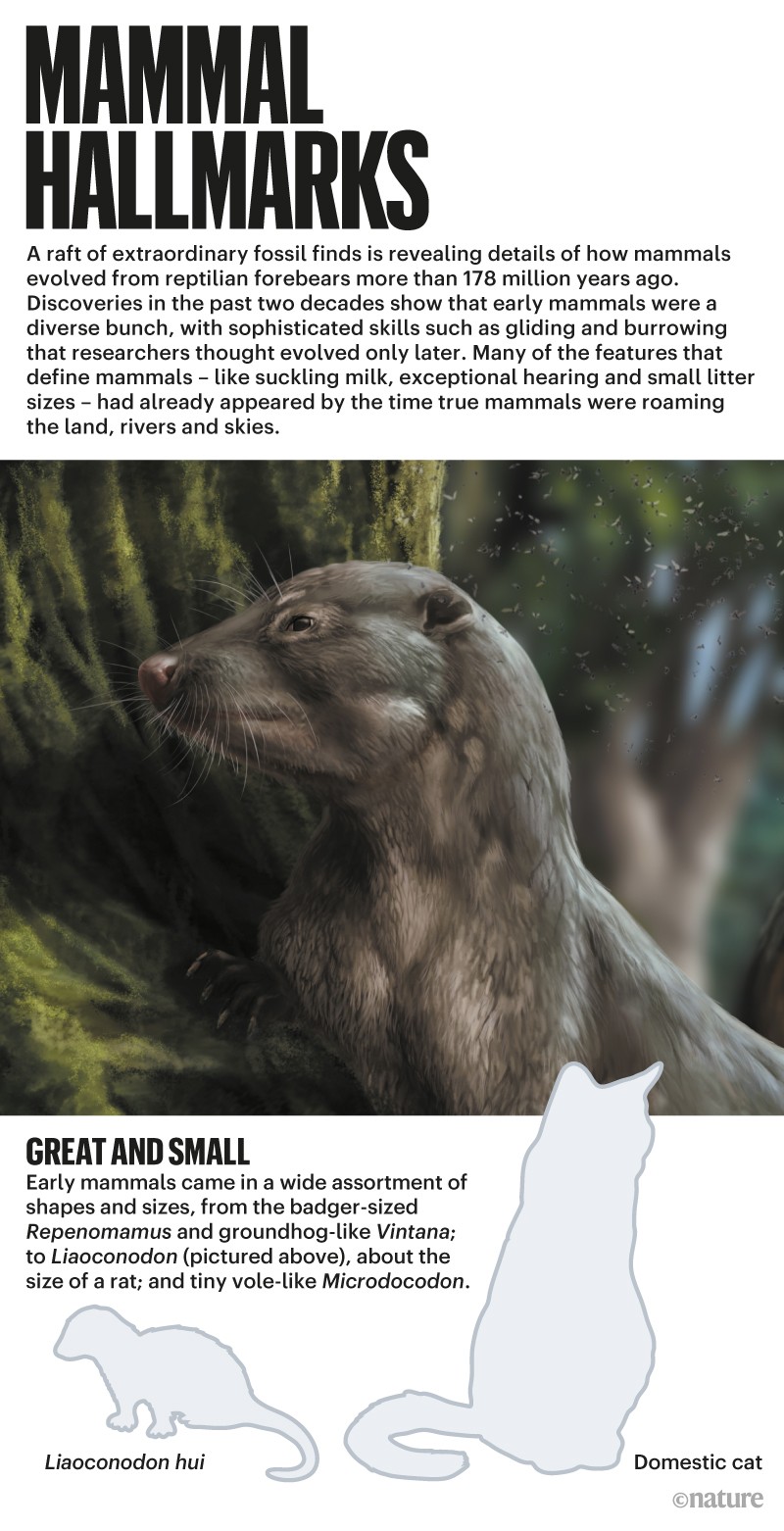
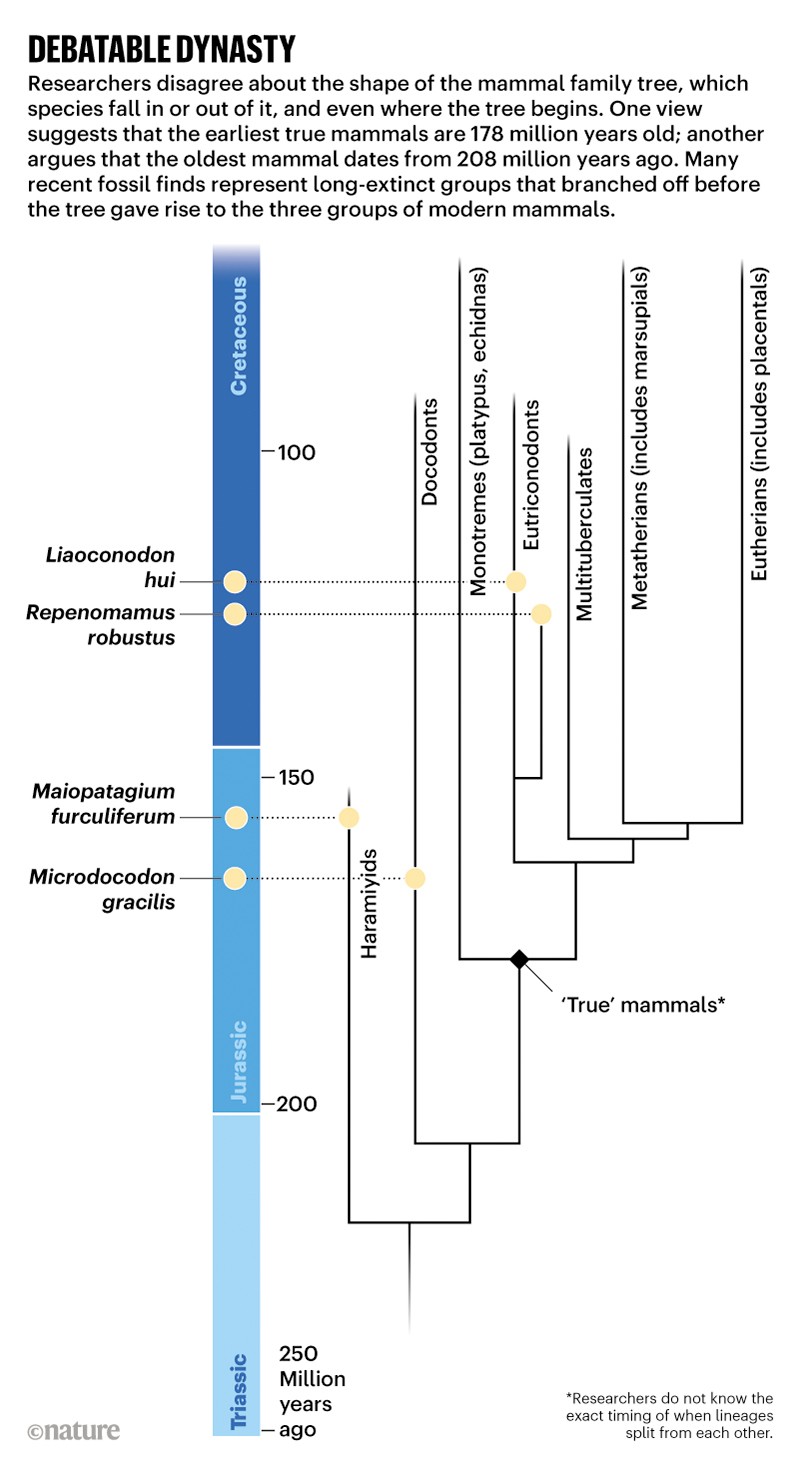
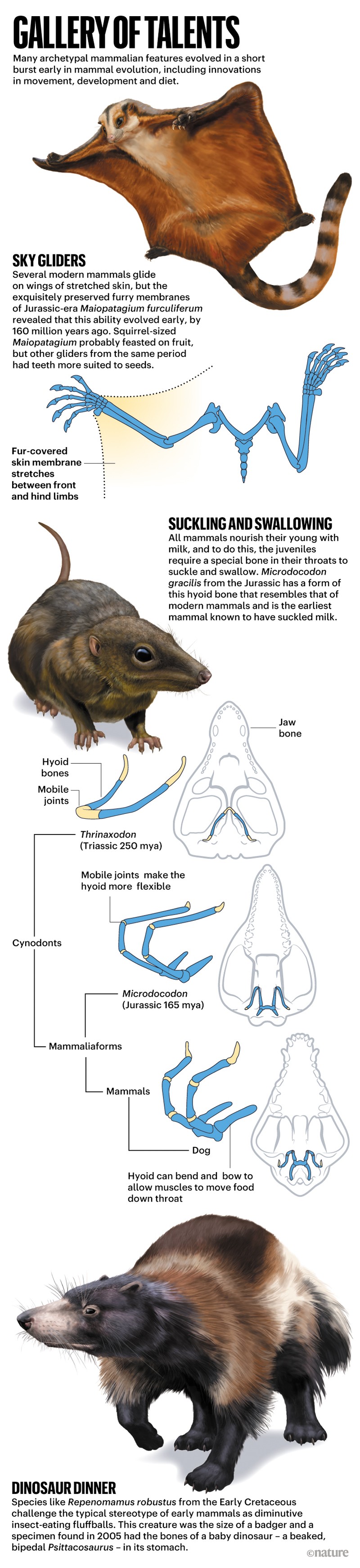
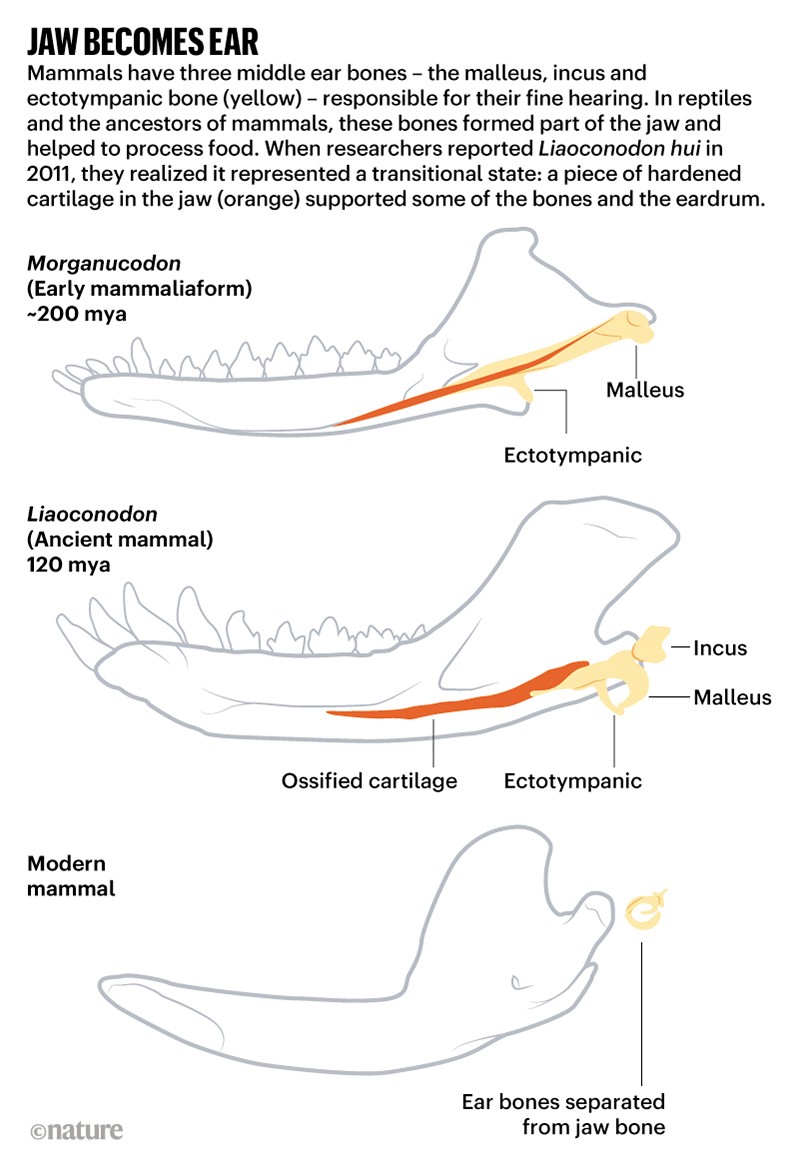
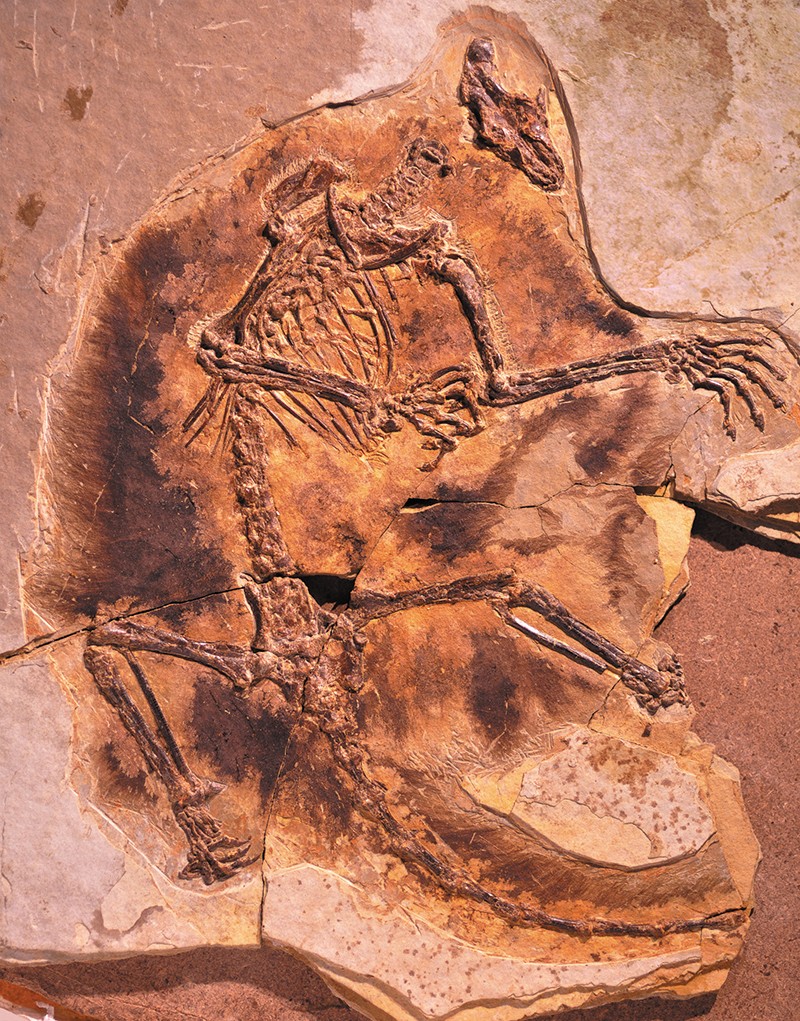


 Ilustração mostra como seria o Juramaia sinensis ou 'Mãe Jurássica da China'. (Crédito: N. Matsunaga)


