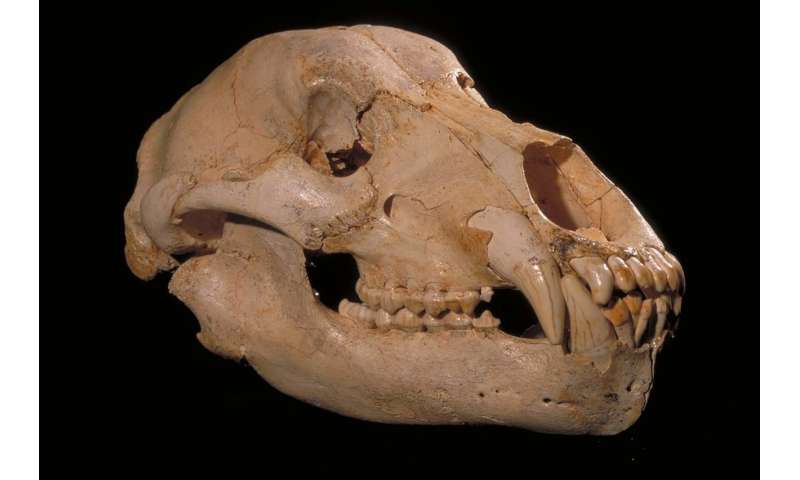
Crânio e mandíbula completos de um urso Deninger de Sima de los Huesos, na Espanha. Crédito: Javier Trueba (Madrid Scientific Films).
Durante o período tardio do Pleistoceno (entre 125.000 a 12.000 anos
atrás), duas espécies de ursos percorreram a Europa: ursos pardos
onívoros ( Ursus arctos ) e o extinto urso de caverna vegetariano ( Ursus spelaeus ).
Até agora, muito pouco se sabe sobre a evolução alimentar do urso da
caverna e como ele se tornou vegetariano, pois os fósseis do ancestral
direto, o urso Deninger ( Ursus deningeri ), são extremamente escassos.
No entanto, um artigo publicado na revista Historical Biology lança uma nova luz sobre isso.
Uma equipe de pesquisa da Alemanha e da Espanha descobriu que o urso de
Deninger provavelmente tinha uma dieta semelhante à de seu descendente -
o urso-caverna clássico -, pois novas análises mostram uma morfologia
distinta no crânio, mandíbula e dentes, o que tem sido relacionado à sua
especialização na dieta de um animal. maior consumo de matéria vegetal.
Para entender a evolução da linhagem de ursos das cavernas, os
pesquisadores examinaram os fósseis raros e removeram os sedimentos
digitalmente, para não correr o risco de danificar os fósseis.
Usando métodos estatísticos sofisticados, chamados morfometria
geométrica, os pesquisadores compararam a forma tridimensional das
mandíbulas e do crânio do urso de Deninger com a dos ursos das cavernas clássicos e modernos.
"As análises mostraram que o urso de Deninger tinha mandíbulas e crânio
de forma muito semelhante ao clássico urso das cavernas", explica
Anneke van Heteren, principal autora do estudo e chefe da seção de
mamíferos da Coleção de Zoologia do Estado da Baviera. Isso implica que eles foram adaptados aos mesmos tipos de alimentos e eram principalmente vegetarianos.
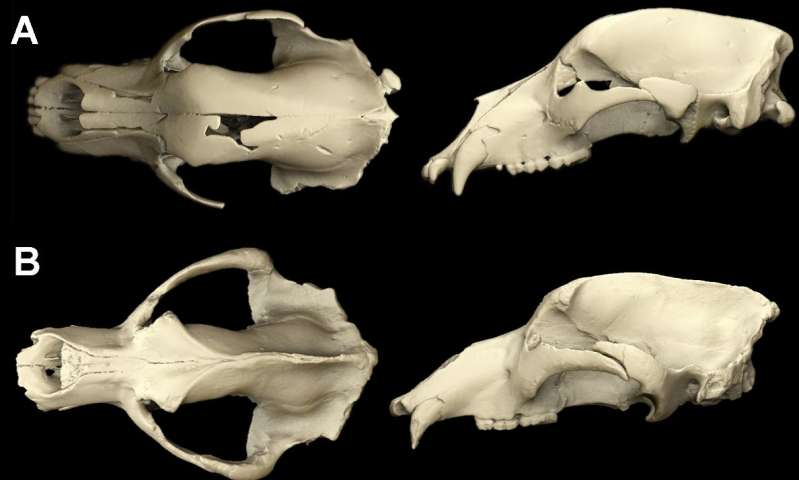
Reconstruções por micro-TC de A) um crânio masculino subadulto do urso
Deninger da Península Ibérica em diferentes pontos de vista em
comparação com B) um crânio masculino adulto de um urso de caverna
clássico. Os crânios são semelhantes em muitos aspectos, mas o crânio do urso da caverna é maior e mais robusto. Crédito: Elena Santos (Centro Mixto UCM-ISCIII) / Taylor e Francis.
"Existe uma discussão em andamento sobre até que ponto o urso-caverna
clássico era vegetariano. E é por isso que as novas informações sobre a
dieta de seu ancestral direto são tão importantes, porque nos ensinam
que uma diferenciação entre a dieta de ursos de caverna e ursos pardos
já foram estabelecidos há 500 mil anos e provavelmente mais cedo ", diz
Mikel Arlegi, doutorado nas Universidades do País Basco e Bordeaux e
co-autor do estudo.
Curiosamente, os pesquisadores também descobriram que há diferenças de
forma entre os ursos de Deninger da Península Ibérica e os do resto da
Europa, que provavelmente não estão relacionados à dieta .
Eles apresentaram três possibilidades para explicar essas diferenças:
1) os ursos ibéricos são cronologicamente mais jovens que os demais;
2)
os Pirineus, atuando como barreira natural, resultaram em alguma
diferenciação genética entre os ursos ibéricos e os do resto da Europa ,
3) havia várias linhagens, com apenas uma levando ao urso clássico da
caverna ou cada linhagem levando a um grupo diferente de ursos da
caverna.
"No entanto, são necessários mais fósseis para testar essas três
hipóteses", disse Asier Gómez-Olivencia, pesquisador Ikerbasque da
Universidade do País Basco.
sexta-feira, 6 de dezembro de 2019
Antigo DNA de urso caverna extinto encontrado em ursos modernos
por Bob Yirka, Phys.org
Crédito: CC0 Public Domain
Uma equipe internacional de pesquisadores encontrou evidências de DNA extinto de ursos-da-caverna em ursos modernos.
Em seu artigo publicado na revista Nature Ecology & Evolution
, o grupo descreve sua análise genética dos ursos marrons e polares
modernos e como eles se comparam aos ursos de caverna extintos.
Os ursos das cavernas eram um tipo de urso que vivia na Ásia e na Europa. Eles eram um pouco maiores que os ursos marrons de hoje, mas alimentavam-se de vegetação em vez de carne. Eles foram extintos há aproximadamente 24.000 anos (durante o Último Máximo Glacial) por razões desconhecidas.
Nesse novo esforço, a equipe de pesquisa concentrou-se em aprender por que os ursos foram extintos.
Para esse fim, eles realizaram uma análise de DNA em amostras colhidas
em quatro restos de urso de aproximadamente 35.000 anos atrás. Seu objetivo era estudar como a população de ursos das cavernas mudou de tamanho por longos períodos. Como um aparte, eles decidiram comparar o DNA dos ursos das cavernas extintas com os ursos modernos.
Os pesquisadores relatam que sua comparação revelou que os ursos marrons e polares modernos têm DNA de urso de caverna - em média 0,9 a 2,4% de seu genoma é DNA de urso de caverna. Eles observaram que os dois tipos de ursos modernos são mais geneticamente semelhantes do que os ursos das cavernas.
Mas eles descobriram que qualquer um deles era capaz de acasalar-se com
um urso da caverna e que seus filhotes também podiam se reproduzir com
qualquer um dos três tipos.
Eles apontam que seus resultados não são surpreendentes - as
semelhanças entre os ursos, o período de sobreposição em que viviam e a
proximidade de seu habitat tornaram a criação de animais quase uma
certeza.
A descoberta de DNA extinto de urso de caverna em ursos modernos é o
primeiro exemplo de DNA de uma espécie extinta antiga encontrada em uma
espécie moderna que não seja humana - temos restos de DNA neandertal em
nossos genomas.
Cave caveira de urso. Os ursos das cavernas eram gigantes, muito maiores do que os ursos pardos vivos Crédito: Andrei Posmoșanu
Os pesquisadores sugerem que pesquisas futuras possam explorar o que
significa uma espécie se extinguir - se seu DNA sobreviver em outras
espécies, elas realmente desapareceram? Eles observam que seu estudo reafirma o fato de que espécies animais se cruzam, algumas regularmente.
Esse poderia ter sido o caso dos ursos modernos e dos ursos das
cavernas - os ursos das cavernas antigas também tinham DNA de urso
moderno em seus pools genéticos.
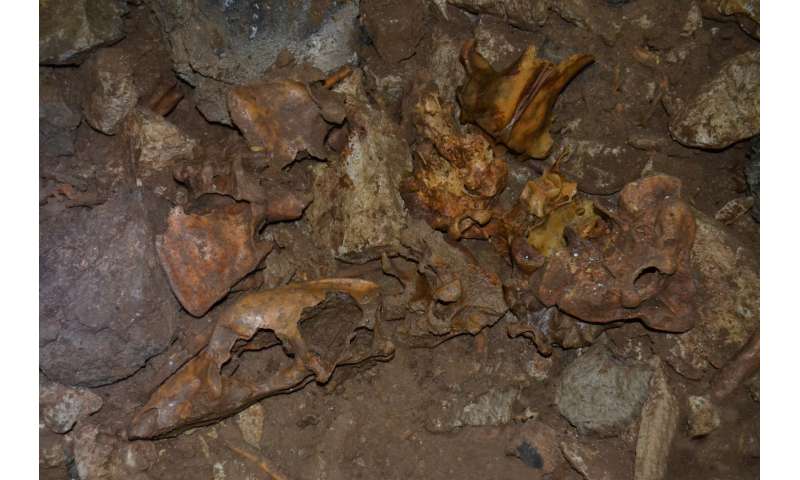
Ossos de urso de caverna da era do gelo encontrados em sua antiga caverna de hibernação Crédito: Marius Robu
Mais informações: Axel Barlow et al. Sobrevivência genômica parcial de ursos de caverna em ursos pardos vivos, Nature Ecology & Evolution (2018).DOI: 10.1038 / s41559-018-0654-8
Resumo
Embora muitas espécies grandes de mamíferos tenham sido extintas no
final da época do Pleistoceno, seu DNA pode persistir devido a episódios
passados de mistura interespécies. No entanto, evidências empíricas diretas da persistência de alelos antigos ainda são escassas.
Aqui, apresentamos dados genômicos de cobertura múltipla de quatro
ursos de caverna do Pleistoceno Superior (complexo Ursus spelaeus) e
mostramos que os ursos de caverna hibridizaram com ursos marrons (Ursus
arctos) durante o Pleistoceno. Desenvolvemos uma abordagem para avaliar a direcionalidade e o tempo relativo do fluxo gênico.
Descobrimos que segmentos de DNA de ursos caverna ainda persistem nos
genomas de ursos pardos vivos, com os ursos contribuindo de 0,9 a 2,4%
dos genomas de todos os ursos pardos investigados.
Nossos resultados mostram que, embora a extinção seja normalmente
considerada absoluta, após a mistura, fragmentos do pool genético de
espécies extintas podem sobreviver por dezenas de milhares de anos nos
genomas das espécies receptoras existentes.
quinta-feira, 7 de junho de 2018
Big data little help in megafauna mysteries
Too many meta-analyses of extinctions of giant
kangaroos or huge sloths use data that are poor or poorly understood,
warn Gilbert J. Price and colleagues.
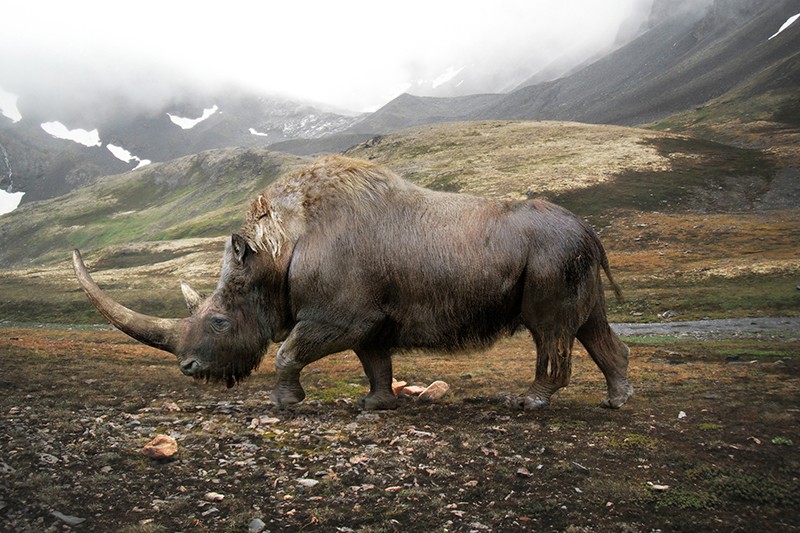
An artist’s impression of the extinct woolly rhinoceros (Coelodonta antiquitatis).Credit: Roman Uchytel
In March, the last male northern white rhinoceros died. The
sub-species joins a long list of large land animals that have gone
extinct over the past 100,000 years.
The reason for the demise of the northern white rhinoceros (Ceratotherium simum cottoni)
is undisputed: poaching and land disturbance by people. By contrast,
who or what caused the extinctions of mammoths, enormous ground sloths
and other Quaternary megafauna remains one of the most contested topics
in the historical sciences.
Was the culprit early humans who
dispersed from Africa more than 75,000 years ago? Or was it climate
change? The latest way to try to settle the debate involves
meta-analyses. These attempt to link the timing of extinctions to shifts
in the climate, or to evidence of the first appearance of humans in a
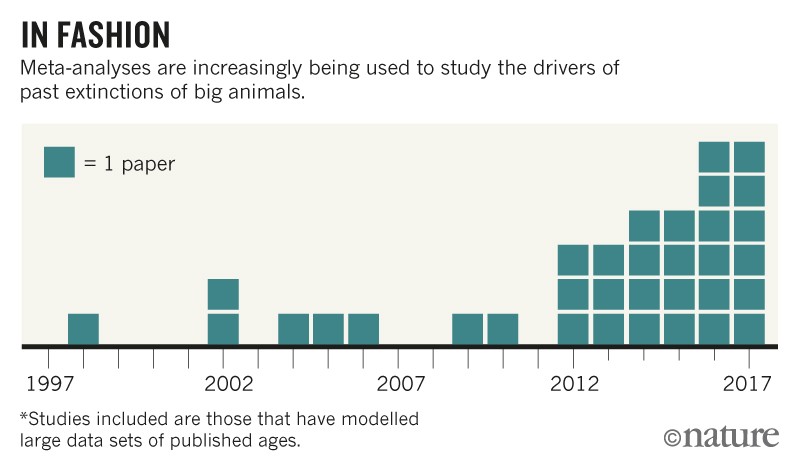
particular region. Over the past five years, the number of meta-analyses
has greatly increased (see ‘In fashion’). Many have been published in
high-impact journals, and they are starting to shape the debate.
Source: G. Price
Understanding why some groups succumbed while others
survived could provide insights into how modern-day species might — or
might not — survive climatic and environmental changes, and into the
resilience of natural ecosystems to increasing anthropogenic impact.
But
in our view, the ‘big-data’ approach cannot, at this point, get us
closer to an answer. There simply aren’t enough good-quality data. An
understanding of what drove the extinctions requires detailed analysis
on a species-by-species basis. This means investing effort into finding
more fossil specimens and verifying the ages of those that have already
been discovered using improved dating methods. It also means relating
the timing of species’ existence and disappearance to detailed local
environmental, climatic and archaeological records. Human link
For
a typical meta-analysis, researchers mine the literature for dates
associated with now-extinct megafauna, as well as for estimates of when
humans arrived at a particular region (on the basis of archaeological
and other data). In some cases, they then combine these records with
global-scale palaeoclimate data, such as those obtained from ice cores
collected from the Arctic. By mapping correlations between events,
investigators try to identify the dominant factor driving species
losses.
Over the past two decades, most of the meta-analyses that
merge continental or global-scale data sets have pointed the finger at
modern humans. In fact, some researchers contend that the results are so
clear that there is no need for further debate1.
For
any meta-analysis, however, the reliability of results is largely
governed by the ‘GIGO’ principle: garbage in, garbage out. In our view,
most of these analyses depend on questionable data, making the results
hard to interpret at best. Six key problems undermine many of the
studies conducted so far. Outdated geochronological information. Models
frequently use data from studies that have been superseded. For
instance, during the 1980s, radiocarbon dating of species such as the
Eurasian woolly rhinoceros (Coelodonta antiquitatis) suggested that it survived well into the Holocene — perhaps until as recently as 3,600 years ago2. But refinements in dating methods have shown that the rhinos had actually disappeared by about 14,000 years ago3. Some of the most recent big-data studies still use erroneous early dates for the rhino4 and other species5. Contested dates. In
other cases, the dates associated with certain species are still in
question. For instance, researchers first estimated the age of the
elephant-like Stegodon trigonocephalus not by dating the fossils
themselves, but by dating fossils from other animals collected from
deposits more than 100 kilometres away6. Other investigators have flagged problems associated with using inferred ages7, yet these continue to be fed into meta-analyses8.
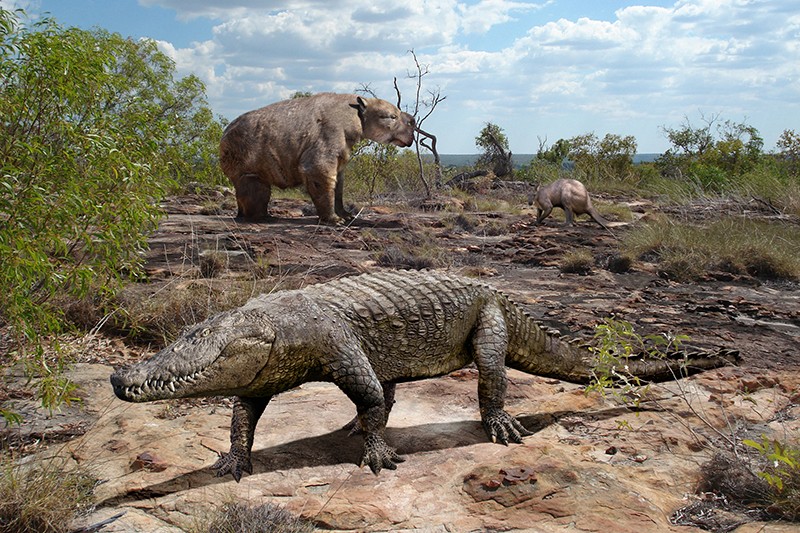
Artist’s impression of the extinct land crocodile, a giant kangaroo and a giant wombat-like marsupial.Credit: Roman Uchytel
In some cases, ages are assigned to species that have never even been dated, directly or indirectly. A 2016 study4, for instance, listed Australian animals such as the land crocodile Quinkana and the giant wombat Ramsayia among the megafauna thought to have existed in the past 100,000 years. The fossils of these species have never been dated9.
(More than 25 of Australia’s megafaunal species, or around 30%, have
never been dated, simply because no one has done the work.)
Insufficient data. Some meta-analyses take the last appearance of a species in the fossil record to be the time when the animal went extinct5.
In the rare cases where hundreds of samples have been found, for
instance for mammoths and mastodons, a species’ disappearance from the
fossil record could well signal its demise. Yet where only a few
specimens exist, the last appearance in the fossil record might have
little bearing on the timing of the extinction.
A step in the
right direction are probabilistic models of extinction times. These
incorporate a degree of error associated with the age of specimens,
based in part on the quality of the methods used to date them. Again,
the robustness of the results depends on the quality of the data fed in.
At this point, very few of the species that went extinct over the past
100,000 years are associated with reliable dates10. (In our view, the cave lion (Panthera spelaea), woolly rhino and woolly mammoth (Mammuthus primigenius) are among the handful of species for which sufficient data exist to enable a modelling approach.)
Problematic proxies. In
the absence of fossil bones, some researchers have used proxy data to
test megafaunal extinction hypotheses. For instance, the coprophilous
fungus Sporormiella is a common component of the pollen and spore
fossil record. Because it occurs on animal dung, an abundance of it in a
sediment core is often taken to indicate high numbers of big
herbivores. Some investigators assume that a decrease in the appearance
of the fungus over time and its eventual disappearance from the fossil
record signal the extinction of megafauna11.
Yet Sporormiella lives
on the excrement of a vast range of both big and small animals,
including mammals and birds, herbivores and even some carnivores12. Its abundance is also affected by factors such as climate and water flow. Thus, on its own, levels of Sporormiella in a pollen core can’t provide information about which species were present at any one time, or in what numbers.
Insufficient scrutiny.
Lastly, long lists of extinct species (frequently just names and
numbers in supplementary materials) often do not receive the necessary
level of scrutiny. This has led to some unfortunate errors. The authors
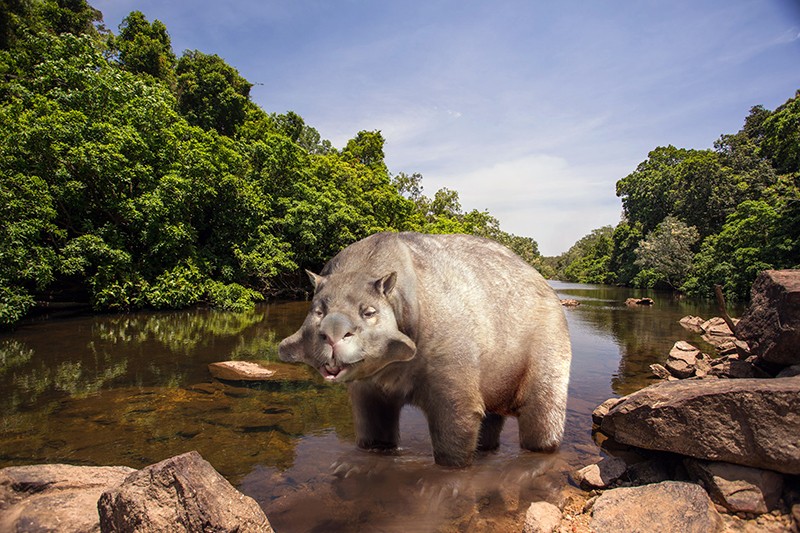
of at least two studies4,13 have argued, for instance, that Homo sapiens caused the demise of giant marsupials such as Euryzygoma dunense and Euowenia grata. These were extinct for millions of years before Homo sapiens even appeared; they are known only from the Pliocene, the period 5.3 million to 2.6 million years ago. Another paper14 suggested that the genus Macropus went extinct in Australia some 40,000 years ago. In fact, Macropus is alive and kicking: it includes Australia’s extant kangaroos.
Arbitrary definition. Megafauna
are commonly defined as Quaternary terrestrial vertebrates with a mass
of at least 44 kilograms — roughly 100 pounds. This is a nice, round
cut-off, but it is essentially arbitrary. Also, in some cases,
‘megafauna’ are not so mega. For instance, they could include extinct
terrestrial vertebrates that are larger than their extant cousins but
that weigh considerably less than 44 kilograms. An extinct relative of
the modern-day Australian echidna — Megalibgwilia ramsayi — is
considered to be megafauna, even though it weighed only around 15
kilograms when it existed (until at least around 100,000 years ago).
In
other words, megafauna are highly biologically and ecologically
diverse, with several species separated from each other by hundreds of
millions of years of evolution. Researchers should not therefore expect
them to have responded in the same way to changes in their environments —
whether driven by humans or by climate.
The giant wombat-like Euryzygoma went extinct long before Homo sapiens even evolved.Credit: Roman Uchytel
A better way
We think that as long as data from
the fossil record remain scant, an understanding of what drove the
extinctions of large animals over the past 100,000 years requires
detailed analysis on a species-by-species basis. This means trying to
find new fossils and verifying the estimated age of specimens previously
found — for instance, through repeated sampling, or by using improved
techniques to date museum specimens.
It also means taking into
account all the local palaeoenvironmental information that is available
to develop a detailed understanding of the palaeoecology of each species
and its ecosystem. To reconstruct the diet of an animal, researchers
can use stable isotope analyses of tooth enamel. Pollen cores can
indicate the local vegetation at the time. The geochemistry of certain
formations nearby, such as stalagmites, might give clues about the local
climate. Changes in the nature of the sediment laid down in a nearby
creek bed, or in the deposition of sand dunes, might hint at local
landscape changes. And so on. Broad global palaeo-temperature records
are likely to be a crude guide to climatic and environmental changes at
local scales.
For each species, investigators should also strive
to develop a clearer understanding of the human populations that lived
alongside, and the nature of their interactions. This could be obtained
by analysing DNA samples extracted from ancient human remains, for
instance, or by studying middens, ancient dumps for domestic waste.
For
example a study published earlier this year combined new dating
approaches with chemical analyses of the bones of the cave bear (Ursus spelaeus), to show that its herbivorous diet had remained unchanged up until its last appearance in Europe, some 23,500 years ago15.
Moreover, cut marks on its bones have revealed that some of these
animals were hunted by humans. And researchers have linked the
morphology of the extinct eastern African antelope Damaliscus hypsodon to the open, dry grasslands it inhabited, to track the demise of both16.
Megafaunal
fossils can now be dated with much greater efficiency and precision —
including those of animals that existed several hundreds of thousands of
years ago. This is thanks to various advances, such as combined
U-series and electron-spin resonance dating. Other emerging techniques,
such as the extraction and analysis of ancient DNA, can shed light on
changes to the population size of now-extinct species. Several studies
have used such approaches to demonstrate that populations of taxa, from
giant Irish elk (Megaloceros giganteus)17 to the Beringian steppe bison (Bison priscus)18,
plummeted many thousands of years before their ultimate extinction,
apparently because of deteriorating local climates and habitat changes.
Some
might counter that we’re averse to change and are simply finding
another reason to be alarmed about the demise of the field sciences in a
digital world19.
But our argument is not with modelling per se. With good data, models
could provide crucial insights into large-scale changes and the broad
nature of the interactions between humans and other big animals as
humans dispersed from Africa. More data, of better quality, can be
obtained only through fieldwork and rigorous analysis of fossil
materials.