Mostrando postagens com marcador aquecimento dos oceanos. Mostrar todas as postagens

sexta-feira, 3 de janeiro de 2020

O dióxido de carbono está aquecendo o planeta (veja como)
vai-16-azul-mármore-terra
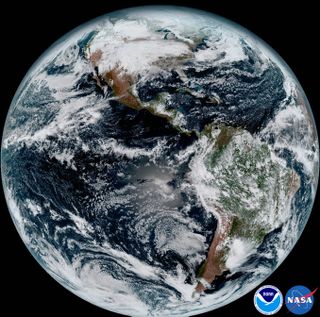
Uma imagem do satélite NOAA / NASA, GOES-16, mostra uma imagem visível colorida do disco completo da Terra em 15 de janeiro de 2017. (Imagem: © NOAA / NASA)
 
O chefe da Agência de Proteção Ambiental (EPA) disse que não acredita que o dióxido de carbono seja o principal motor das mudanças climáticas.
 
"Penso que medir com precisão a atividade humana no clima é algo muito desafiador, e há uma tremenda discordância sobre o grau de impacto. Portanto, não concordo que seja o principal contribuinte para o aquecimento global que vemos". O chefe da EPA, Scott Pruitt, disse ao programa de notícias da manhã da CNBC "Squawk Box" ontem (9 de março).
 
Os comentários de Pruitt são contrários à pesquisa científica sobre mudança climática. Mas quando mesmo o chefe da EPA duvida do consenso, pode ser difícil cortar o barulho para entender o que os cientistas estão realmente usando quando expressam preocupação com as mudanças climáticas. [ A realidade da mudança climática: 10 mitos presos ]
 
"Acho que muitas pessoas têm preocupações muito sérias em sua vida e simplesmente não têm tempo para fazer todo o dever de casa e os antecedentes para descobrir isso", disse Katherine Moore Powell, ecologista climática do Field Museum em Chicago.
 
Então, aqui está uma cartilha explicando exatamente por que os cientistas sabem que o clima está mudando e que as atividades humanas estão causando isso.

Terra está esquentando


(Crédito da imagem: Painel Intergovernamental sobre Mudanças Climáticas (5º Relatório de Síntese))
Nesse ponto, mesmo os negadores mais severos do clima seriam pressionados a argumentar que o clima não está esquentando. Simplificando, está ficando mais quente por aí. Combinando medições de terra e oceano de 1850 a 2012, os pesquisadores descobriram que a temperatura média da superfície do ar aumentou globalmente em 0,8 graus Celsius desde o início da era industrial. Isso está de acordo com o quinto relatório do Painel Intergovernamental sobre Mudanças Climáticas (IPCC), lançado em 2014. O gráfico superior na figura do resumo do relatório do IPCC para os formuladores de políticas mostra a anomalia de temperatura em Celsius.
 
O próximo gráfico nesta sequência mostra o aumento do nível do mar, que subiu globalmente em média 7,4 polegadas (0,19 metros) desde 1901. De acordo com o IPCC, a taxa de aumento do nível do mar desde meados do século XIX foi superior à taxa dos dois milênios anteriores. Os cientistas usam medidores de marés e medições de satélite para rastrear mudanças no nível do mar, de acordo com a Administração Nacional Oceânica e Atmosférica (NOAA). Geólogos e outros cientistas da Terra podem estudar rochas, fósseis e núcleos de sedimentos para obter uma visão de longo prazo das mudanças no nível do mar, de acordo com a NASA .
 
Os dois gráficos inferiores mostram concentrações crescentes de gases de efeito estufa e emissões estimadas de dióxido de carbono por seres humanos desde 1850. A tendência crescente é evidente em cada figura. Os cientistas monitoram o dióxido de carbono na atmosfera bombeando ar para dentro de uma câmara artificial e lançando uma luz infravermelha através da amostra. O dióxido de carbono absorve a luz infravermelha com muita eficiência - mais isso em um minuto -, portanto, a quantidade de infravermelho absorvido pode ser usada para calcular a quantidade de CO2 na amostra. [ 10 principais maneiras de destruir a Terra ]
 
O principal (e mais antigo) local para essas medições é o Observatório Mauna Loa, no Havaí, que informou recentemente que a concentração de dióxido de carbono na atmosfera do planeta ultrapassou 400 partes por milhão . Em 1958, quando as observações em Mauna Loa começaram, a concentração anual de dióxido de carbono na atmosfera era de 315 partes por milhão.

A física dos gases de efeito estufa

O dióxido de carbono não é um candidato azarão para o aquecimento da atmosfera. Em 1896, o cientista sueco Svante Arrhenius (que mais tarde ganhou o primeiro Prêmio Nobel de Química) publicou um artigo na Philosophical Magazine e no Journal of Science que expunha o básico do que é agora conhecido como "efeito estufa".
 
O efeito é o resultado de como a energia interage com a atmosfera. A luz do sol entra na atmosfera como luz ultravioleta e visível; parte dessa energia solar é então irradiada de volta ao espaço como energia infravermelha ou calor. A atmosfera é de 78% de nitrogênio e 21% de oxigênio , que são gases constituídos por moléculas contendo dois átomos. Esses pares firmemente ligados não absorvem muito calor.
 
Mas os gases de efeito estufa, incluindo dióxido de carbono, vapor de água e metano, cada um tem pelo menos três átomos em suas moléculas. Essas estruturas frouxamente unidas são absorvedores eficientes da radiação de ondas longas (também conhecida como calor), que retornam da superfície do planeta. Quando as moléculas do dióxido de carbono e outros gases de efeito estufa reemitem essa radiação de ondas longas de volta à superfície da Terra, o resultado é o aquecimento.

É realmente dióxido de carbono?

Assim, as temperaturas estão subindo, assim como os níveis de dióxido de carbono atmosférico. Mas os dois estão conectados?
Sim. A evidência é forte. Em 2006, os cientistas apresentaram um cartaz na 18ª Conferência sobre Variabilidade e Mudança Climática, que até mediu o efeito diretamente . Usando espectrômetros (ferramentas que medem espectros para identificar comprimentos de onda específicos), os pesquisadores analisaram os comprimentos de onda da radiação infravermelha que chega ao solo. Com base nos comprimentos de onda variados, os cientistas determinaram que mais radiação estava ocorrendo devido à contribuição de gases de efeito estufa específicos.
No geral, eles descobriram que a radiação de gases de efeito estufa aumentou 3,5 watts por metro quadrado em comparação com os tempos pré-industriais, um aumento de pouco mais de 2%. Outros pesquisadores observaram "falta" de comprimentos de onda infravermelhos na radiação para o espaço, um fenômeno que ocorre porque esses comprimentos de onda perdidos ficam presos na atmosfera.
 
Os cientistas também sabem que o carbono extra na atmosfera é o mesmo carbono proveniente da queima de combustíveis fósseis. Ao analisar variações moleculares chamadas isótopos, os pesquisadores podem rastrear a origem do carbono atmosférico, disse Moore Powell.
"Sabemos como é a queima de combustíveis fósseis, no sentido científico", disse ela.
Isso não quer dizer que o clima seja tão simples quanto uma estufa real. Muitos fatores influenciam a temperatura global, incluindo erupções vulcânicas e variações no ciclo solar e na órbita da Terra que alteram a quantidade de luz solar que atinge o planeta.
 
Mas os cientistas sabem que os vulcões e o sol não são os culpados pelas recentes mudanças climáticas. De acordo com o IPCC , as emissões vulcânicas de dióxido de carbono são, no máximo, um centésimo das emissões humanas de CO2 desde 1750. Além disso, as erupções vulcânicas causam mudanças em prazos curtos de cerca de dois anos, não as mudanças de longo prazo que estão sendo observadas atualmente.
O sol é mais complexo, mas os pesquisadores descobriram que o mínimo recente do ciclo solar (entre 1986 e 2008) era realmente menor do que os dois mínimos anteriores do ciclo solar ( o sol se move entre mínimos silenciosos e máximos ativos cerca de uma vez a cada cinco anos) . De qualquer forma, concluiu o IPPC, a atividade solar recente deveria ter resultado no resfriamento, não no aquecimento. Da mesma forma, um estudo de 2012 descobriu que, entre 2005 e 2010, um período em que a atividade solar era baixa, a Terra ainda absorveu 0,58 watts de excesso de energia por metro quadrado , continuando a aquecer, apesar do menor nível de energia solar que entra no sistema.

Onde está a verdadeira incerteza?

Dado o peso das evidências, os cientistas chegaram a um consenso de que as mudanças climáticas estão acontecendo e que as emissões humanas de gases de efeito estufa são a causa principal.
Então, onde estão os verdadeiros debates científicos?
Ainda há muitas perguntas sobre a rapidez com que as mudanças climáticas acontecerão e quais serão os efeitos precisos.
 
"O que eu diria que é mais incerto é simplesmente a rapidez com que as coisas estão mudando", disse Moore Powell. "Estou muito interessado no ritmo".
Uma das principais incógnitas é a influência suprema das nuvens no clima : as nuvens são brancas, refletindo a luz do sol de volta ao espaço, o que poderia ter um efeito de resfriamento. Mas as nuvens também são vapor de água, que retém o calor. E diferentes tipos de nuvens podem ter efeitos de aquecimento ou resfriamento, de modo que o papel preciso das nuvens no ciclo de retroalimentação do aquecimento global permanece difícil de desvendar , disseram os cientistas.
 
Outra questão importante é quão alto e com que rapidez o nível do mar aumentará à medida que o aquecimento das águas do mar se expandir e o gelo da Antártica e do Ártico derreter. O IPCC previa um aumento de 52 a 98 cm (20 a 38 polegadas), assumindo que não sejam feitos esforços para conter as emissões de gases de efeito estufa.
 
Essa faixa é ampla, em grande parte porque a dinâmica das camadas de gelo da Antártica não é completamente compreendida. Se as geleiras terrestres da Antártica se deslocarem rapidamente para o mar com um pouco de aquecimento, isso será uma má notícia para as comunidades costeiras, disseram pesquisadores. É por isso que os cientistas estão observando atentamente agora, enquanto uma fenda está dividindo a plataforma de gelo Larsen C no mar de Weddell. Se o gigantesco evento de descida de iceberg desestabilizar a plataforma de gelo, poderá resultar no rápido fluxo das geleiras terrestres atrás dela para o oceano. Esse tipo de fluxo glacial rápido já ocorreu nas proximidades, quando a plataforma de gelo Larsen B desmoronou em 2002.
 
Para um ecologista como Moore Powell, também existem inúmeras perguntas para responder sobre como os ecossistemas reagirão a uma mudança climática. Se o ritmo for lento o suficiente, plantas e animais poderão se adaptar. Mas em muitos lugares, a mudança está acontecendo muito rapidamente, disse Moore Powell.
 
"Não há tempo suficiente neste ritmo para a adaptação natural assumir", disse ela.
Artigo original sobre Live Science .

quinta-feira, 9 de maio de 2019

Humans are driving one million species to extinction

Landmark United Nations-backed report finds that agriculture is one of the biggest threats to Earth’s ecosystems.

Coral bleaching in Okinawa, Japan
Report on the state of the world’s ecosystems finds that human activities and climate change have significantly altered habitats such as coral reefs.Credit: The Ocean Agency/XL Catlin Seaview Survey
Up to one million plant and animal species face extinction, many within decades, because of human activities, says the most comprehensive report yet on the state of global ecosystems.

Without drastic action to conserve habitats, the rate of species extinction — already tens to hundreds of times higher than the average across the past ten million years — will only increase, says the analysis. The findings come from a United Nations-backed panel called the Intergovernmental Science-Policy Platform on Biodiversity and Ecosystem Services (IPBES).
According to the report, agricultural activities have had the largest impact on ecosystems that people depend on for food, clean water and a stable climate. The loss of species and habitats poses as much a danger to life on Earth as climate change does, says a summary of the work, released on 6 May.

The analysis distils findings from nearly 15,000 studies and government reports, integrating information from the natural and social sciences, Indigenous peoples and traditional agricultural communities. It is the first major international appraisal of biodiversity since 2005. Representatives of 132 governments met last week in Paris to finalize and approve the analysis.

Biodiversity should be at the top of the global agenda alongside climate, said Anne Larigauderie, IPBES executive secretary, at a 6 May press conference in Paris, France. “We can no longer say that we did not know,” she said.

“We have never had a single unified statement from the world’s governments that unambiguously makes clear the crisis we are facing for life on Earth,” says Thomas Brooks, chief scientist at the International Union for Conservation of Nature in Gland, Switzerland, who helped to edit the biodiversity analysis. “That is really the absolutely key novelty that we see here.”
Without “transformative changes” to the world’s economic, social and political systems to address this crisis, the IPBES panel projects that major biodiversity losses will continue to 2050 and beyond. “We are eroding the very foundations of our economies, livelihoods, food security, health and quality of life worldwide,” says IPBES chair Robert Watson, an atmospheric chemist at the University of East Anglia in Norwich, UK.

Reshaping life on Earth

About 75% of land and 66% of ocean areas have been “significantly altered” by people, driven in large part by the production of food, according to the IPBES report, which will be released in full later this year. Crop and livestock operations currently co-opt more than 33% of Earth’s land surface and 75% of its freshwater resources.

Agricultural activities are also some of the largest contributors to human emissions of greenhouse gases. They account for roughly 25% of total emissions due to the use of fertilizers and the conversion of areas such as tropical forests to grow crops or raise livestock such as cattle. Agricultural threats to ecosystems will only increase as the world’s population continues to grow, according to the IPBES analysis.

The next biggest threats to nature are the exploitation of plants and animals through harvesting, logging, hunting and fishing; climate change; pollution and the spread of invasive species. The IPBES report finds that the average abundance of native plants, animals and insects has fallen in most major ecosystems by at least 20% since 1900 because of invasive species.

The report draws inextricable links between biodiversity loss and climate change. An estimated 5% of all species would be threatened with extinction by 2 °C of warming above pre-industrial levels — a threshold that the world could breach in the next few decades, unless greenhouse-gas emissions are drastically reduced. Earth could lose 16% of its species if the average global temperature rise exceeds 4.3 °C. Such damage to ecosystems would undermine global efforts to reduce poverty and hunger and promote more-sustainable development, the IPBES report says.

Pulling back from the brink

Scientists might quibble about some extinction estimates and other details, but the report pulls no punches when describing how humans have altered Earth’s ecosystems, says Stuart Pimm, an ecologist at Duke University in Durham, North Carolina.
The world can reverse this biodiversity crisis, the report says, but doing so will require proactive environmental policies, the sustainable production of food and other resources and a concerted effort to reduce greenhouse-gas emissions.

The IPBES report is solid on the science, but the panel should do more when it comes to outlining practical solutions for governments, businesses and communities, says Peter Bridgewater, an ecologist at the University of Canberra who led a separate analysis — released on 29 April — of the effectiveness of the biodiversity panel. That report, commissioned by the IPBES, recommended that the body develop partnerships with governments and communities, and assess policies that can be implemented at local and national levels.

Despite those shortcomings, the IPBES report will help to set the agenda when governments negotiate new conservation goals for the next decade at the UN Convention on Biodiversity next year, says Brooks. “Then we will need to see implementation across all sectors of society,” he says. “That’s when we will see a difference.”
Nature 569, 171 (2019)
doi: 10.1038/d41586-019-01448-4

Updates & Corrections

  • Update 06 May 2019: This story has been updated with comment from Anne Larigauderie, IPBES executive secretary.

quinta-feira, 2 de maio de 2019

Sea animals are more vulnerable to warming than are land ones

The impact of climate change on biodiversity is a pressing concern. A study now combines experimental data with careful modelling to compare the vulnerability to warming of animal species on land and in the ocean.

 
Ecologists, conservationists and policymakers are struggling to understand how much of a threat climate change poses to Earth’s biodiversity — estimated to be some 3 million to 100 million species1 — and what to do about that threat. Knowing whether terrestrial or marine species are more vulnerable to climate change, as well as how the risks vary with latitude, could inform the deployment of limited conservation resources, nationally and globally. Writing in Nature, Pinsky et al.2 combine robust experimental data with a careful model-based approach to compare the vulnerability of biodiversity to warming across latitudes on land and in the ocean.

There is contradictory evidence about the relative vulnerability to warming of land and ocean animals. Terrestrial species could be at greater risk because they are less able to adapt to new climatic conditions3 and because they are exposed to higher extreme temperatures than are ocean-dwelling species. But marine species could be more affected because temperature strongly controls their geographic limits4, nutrient supplies5 and oxygen availability6.

Temperature extremes, rather than average temperatures, are an important determinant of population survival at the warm edge of a species’ temperature range7. Guided by this evidence, Pinsky et al. calculated the thermal safety margin — defined as the difference between the highest temperature at which an animal can survive (its maximum thermal tolerance) and the maximum body temperature that it will effectively experience under natural conditions — for 387 species of ectothermic animal, which rely on external heat to maintain body temperature. The authors calculated two versions of the thermal safety margin for each species: one for when the animal is fully exposed to heat and one for when it is in a thermal refuge. Terrestrial thermal refuges include microclimates such as shade under a tree or rock, whereas marine thermal refuges comprise deeper, cooler waters.

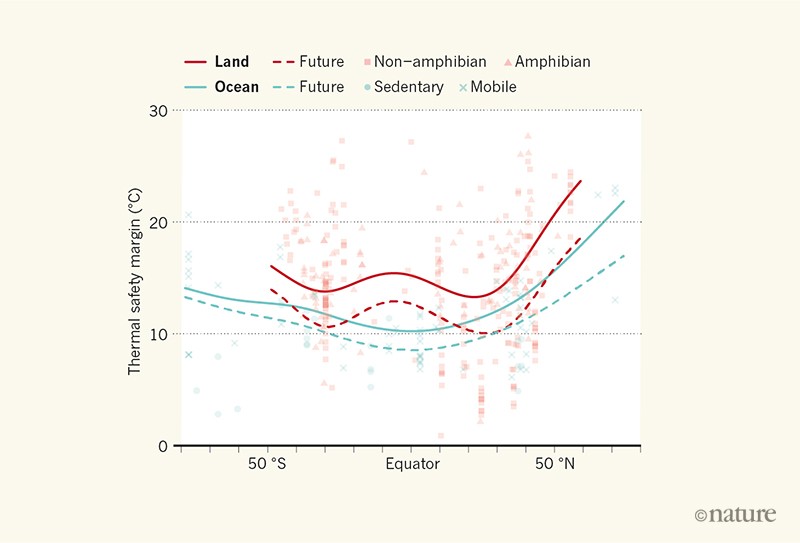
Pinsky et al. found that there are no thermal safety margins for land-dwelling ectotherms when they have no access to thermal refuges, whereas such margins exist for their ocean-dwelling counterparts. This suggests that land species might be more at risk from climate change than ocean species are. However, when thermal refuges were taken into account, the situation was reversed, with the thermal safety margins being broader for species on land than for those in the ocean (Fig. 1). This implies that marine species might actually be more at risk.
Figure 1 | Thermal safety margins for land and ocean animals that can access thermal refuges. Pinsky et al.2 calculated the thermal safety margin — defined as the difference between the maximum temperature that a species can tolerate and the maximum temperature that it will experience — for 387 ectothermic animal species, which rely on external heat to maintain their body temperature. The authors took into account the ability of animals to access thermal refuges, which are areas in their habitat where they can cool down. Individual data points for different types of animal and solid lines show the present conditions, whereas dashed lines are an estimate of the situation in the year 2100 under the representative concentration pathway 8.5 (RCP8.5) scenario of predicted greenhouse-gas concentration trajectories. The narrower, in general, thermal safety margins in the ocean suggest that warming poses a greater risk to marine species than to those that live on land. (Adapted from Pinsky et al.)
The authors went on to observe that, when thermal refuges were considered, the thermal safety margins of land species were narrowest at the subtropics and widened towards the tropics and poles (Fig. 1), which suggests that warming is a greater threat to subtropical species than to species living in other regions. But, under the same consideration, the thermal safety margins of ocean species were narrowest at the tropics and widened towards the poles, which implies that tropical species are at greater risk from warming. The authors project that with future climate change, terrestrial species in general will continue to have wider thermal safety margins than marine species, but that subtropical terrestrial species will have thermal safety margins as narrow as those of their marine counterparts.
This work has several implications for biodiversity and conservation. First, it predicts that tropical marine species will be most vulnerable to climate change, as they have the narrowest thermal safety margins of all groups of species analysed. The threat to tropical marine species is exacerbated by the predicted replacement of the present highest ocean temperatures by even higher ones, which would cause a rapid poleward shift of the thermal habitat of such species8.

Second, the findings highlight the essential role of thermal refuges in maintaining reasonable thermal safety margins for land animals. The authors observed that the maximum temperature that such animals can tolerate is remarkably flat between the latitudes of 50° N and 50° S. Therefore, variation in thermal safety margins with latitude is largely dictated by the degree of heat to which land animals are exposed in thermal refuges. Intact environments, with trees for shade and accessible water for evaporative cooling, will be crucial for the persistence of terrestrial species in a warming world.
Last, the latitudinal pattern of thermal safety margins suggests that marine species moving north or south from the Equator to escape the warmest environments as they become too hot will typically encounter widening thermal safety margins. This will potentially decrease the vulnerability of such species to temperature extremes. By contrast, land-dwelling tropical species moving polewards as the result of a warming climate might have to run the gauntlet of narrow thermal safety margins in the subtropics (caused by high thermal extremes in these regions) before the margins widen again at higher latitudes. This potentially places terrestrial tropical species at great risk.

Despite the authors’ careful analysis, their work has several limitations, which provide avenues for future research. Pinsky et al. used the best available data, but collecting further data would boost confidence in their findings. Information on the maximum thermal tolerance was available for only a small number of species from a few phyla. Most of the species (318 of the 406 species considered in some parts of the analysis) were terrestrial, and insect biodiversity was severely under-represented. And because the majority of the 88 marine species analysed were fish, information on ocean invertebrate biodiversity was largely missing.

Only 7% of the marine species included in the study were pelagic (living in the water column), meaning that they can seek refuge in deeper, cooler waters when the temperature rises. The remaining 93% of marine species analysed were demersal (living on or near the bottom of the ocean), and so their ability to access thermal refuges is limited. Because pelagic species can access cooler waters, their thermal safety margins are probably greater than those of demersal species. Therefore, the reported differences between terrestrial and marine animals might be better framed as differences between terrestrial species, which are able to access thermal refuges, and demersal marine species, which are not. More work to determine the maximum thermal tolerance of pelagic species is clearly needed.

It is also evident that we have a more sophisticated understanding of thermal refuges on land than in the ocean. Pinsky et al. used several theoretical models to describe the impact of terrestrial microclimates on an animal’s body temperature. There is no similar theoretical framework for marine species and their habitats, so the authors had to make coarser assumptions about how body temperature decreases in thermal refuges. This imbalance in our understanding of land and ocean thermal refuges should be addressed by future studies.

Even using the terms microhabitat or microclimate in the context of marine animals might be misleading because the cooler area below the warm top 200 metres of the ocean is the largest habitat on Earth and has a fairly uniform temperature. The idea that most marine ectotherms spend time in deep waters to offset warm surface conditions might also not be true, because many animals that live in the middle layers of the water column (200–1,000 metres below the surface), such as tuna, spend time close to the ocean surface to warm up9.

The vulnerability of biodiversity to warming is an active area of investigation, and Pinsky et al. have provided valuable insights that will stimulate further research. Their approach could also be used to investigate the vulnerability of biodiversity to other aspects of climate change — including rainfall or pH change — whose extremes might affect species and whose impact might be buffered by refuges.
Nature 569, 50-51 (2019)
doi: 10.1038/d41586-019-01193-8