Sea animals are more vulnerable to warming than are land ones
The impact of climate change on biodiversity is a
pressing concern. A study now combines experimental data with careful
modelling to compare the vulnerability to warming of animal species on
land and in the ocean.
Ecologists, conservationists and policymakers are
struggling to understand how much of a threat climate change poses to
Earth’s biodiversity — estimated to be some 3 million to 100 million
species1
— and what to do about that threat. Knowing whether terrestrial or
marine species are more vulnerable to climate change, as well as how the
risks vary with latitude, could inform the deployment of limited
conservation resources, nationally and globally. Writing in Nature, Pinsky et al.2
combine robust experimental data with a careful model-based approach to
compare the vulnerability of biodiversity to warming across latitudes
on land and in the ocean.
There is contradictory evidence about the relative
vulnerability to warming of land and ocean animals. Terrestrial species
could be at greater risk because they are less able to adapt to new
climatic conditions3
and because they are exposed to higher extreme temperatures than are
ocean-dwelling species. But marine species could be more affected
because temperature strongly controls their geographic limits4, nutrient supplies5 and oxygen availability6.
Temperature
extremes, rather than average temperatures, are an important
determinant of population survival at the warm edge of a species’
temperature range7. Guided by this evidence, Pinsky et al.
calculated the thermal safety margin — defined as the difference
between the highest temperature at which an animal can survive (its
maximum thermal tolerance) and the maximum body temperature that it will
effectively experience under natural conditions — for 387 species of
ectothermic animal, which rely on external heat to maintain body
temperature. The authors calculated two versions of the thermal safety
margin for each species: one for when the animal is fully exposed to
heat and one for when it is in a thermal refuge. Terrestrial thermal
refuges include microclimates such as shade under a tree or rock,
whereas marine thermal refuges comprise deeper, cooler waters.
Pinsky et al. found
that there are no thermal safety margins for land-dwelling ectotherms
when they have no access to thermal refuges, whereas such margins exist
for their ocean-dwelling counterparts. This suggests that land species
might be more at risk from climate change than ocean species are.
However, when thermal refuges were taken into account, the situation was
reversed, with the thermal safety margins being broader for species on
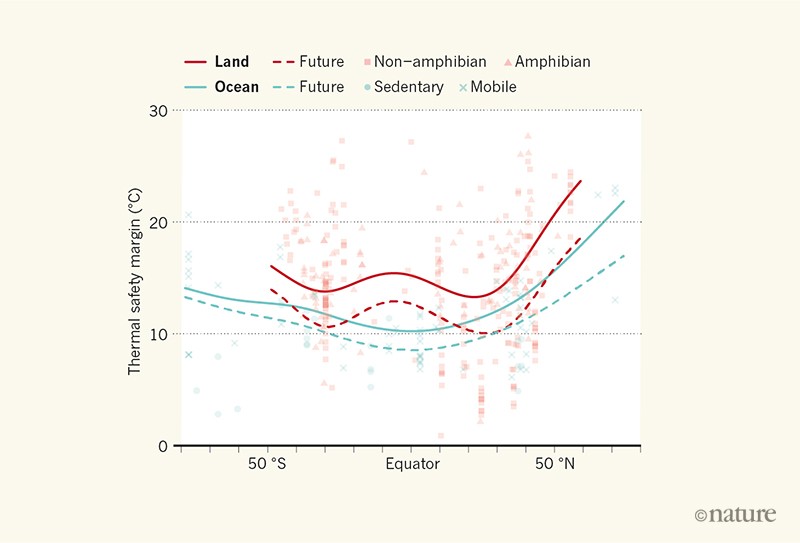
land than for those in the ocean (Fig. 1). This implies that marine
species might actually be more at risk.
Figure 1 | Thermal safety margins for land and ocean animals that can access thermal refuges. Pinsky et al.2
calculated the thermal safety margin — defined as the difference
between the maximum temperature that a species can tolerate and the
maximum temperature that it will experience — for 387 ectothermic animal
species, which rely on external heat to maintain their body
temperature. The authors took into account the ability of animals to
access thermal refuges, which are areas in their habitat where they can
cool down. Individual data points for different types of animal and
solid lines show the present conditions, whereas dashed lines are an
estimate of the situation in the year 2100 under the representative
concentration pathway 8.5 (RCP8.5) scenario of predicted greenhouse-gas
concentration trajectories. The narrower, in general, thermal safety
margins in the ocean suggest that warming poses a greater risk to marine
species than to those that live on land. (Adapted from Pinsky et al.)
The authors went on to observe that, when thermal refuges
were considered, the thermal safety margins of land species were
narrowest at the subtropics and widened towards the tropics and poles
(Fig. 1), which suggests that warming is a greater threat to subtropical
species than to species living in other regions. But, under the same
consideration, the thermal safety margins of ocean species were
narrowest at the tropics and widened towards the poles, which implies
that tropical species are at greater risk from warming. The authors
project that with future climate change, terrestrial species in general
will continue to have wider thermal safety margins than marine species,
but that subtropical terrestrial species will have thermal safety
margins as narrow as those of their marine counterparts.
This work
has several implications for biodiversity and conservation. First, it
predicts that tropical marine species will be most vulnerable to climate
change, as they have the narrowest thermal safety margins of all groups
of species analysed. The threat to tropical marine species is
exacerbated by the predicted replacement of the present highest ocean
temperatures by even higher ones, which would cause a rapid poleward
shift of the thermal habitat of such species8.
Second,
the findings highlight the essential role of thermal refuges in
maintaining reasonable thermal safety margins for land animals. The
authors observed that the maximum temperature that such animals can
tolerate is remarkably flat between the latitudes of 50° N and 50° S.
Therefore, variation in thermal safety margins with latitude is largely
dictated by the degree of heat to which land animals are exposed in
thermal refuges. Intact environments, with trees for shade and
accessible water for evaporative cooling, will be crucial for the
persistence of terrestrial species in a warming world.
Last, the
latitudinal pattern of thermal safety margins suggests that marine
species moving north or south from the Equator to escape the warmest
environments as they become too hot will typically encounter widening
thermal safety margins. This will potentially decrease the vulnerability
of such species to temperature extremes. By contrast, land-dwelling
tropical species moving polewards as the result of a warming climate
might have to run the gauntlet of narrow thermal safety margins in the
subtropics (caused by high thermal extremes in these regions) before the
margins widen again at higher latitudes. This potentially places
terrestrial tropical species at great risk.
Despite the authors’ careful analysis, their work has several limitations, which provide avenues for future research. Pinsky et al.
used the best available data, but collecting further data would boost
confidence in their findings. Information on the maximum thermal
tolerance was available for only a small number of species from a few
phyla. Most of the species (318 of the 406 species considered in some
parts of the analysis) were terrestrial, and insect biodiversity was
severely under-represented. And because the majority of the 88 marine
species analysed were fish, information on ocean invertebrate
biodiversity was largely missing.
Only 7% of the marine species
included in the study were pelagic (living in the water column), meaning
that they can seek refuge in deeper, cooler waters when the temperature
rises. The remaining 93% of marine species analysed were demersal
(living on or near the bottom of the ocean), and so their ability to
access thermal refuges is limited. Because pelagic species can access
cooler waters, their thermal safety margins are probably greater than
those of demersal species. Therefore, the reported differences between
terrestrial and marine animals might be better framed as differences
between terrestrial species, which are able to access thermal refuges,
and demersal marine species, which are not. More work to determine the
maximum thermal tolerance of pelagic species is clearly needed.
It is also evident that we have a more sophisticated understanding of thermal refuges on land than in the ocean. Pinsky et al.
used several theoretical models to describe the impact of terrestrial
microclimates on an animal’s body temperature. There is no similar
theoretical framework for marine species and their habitats, so the
authors had to make coarser assumptions about how body temperature
decreases in thermal refuges. This imbalance in our understanding of
land and ocean thermal refuges should be addressed by future studies.
Even
using the terms microhabitat or microclimate in the context of marine
animals might be misleading because the cooler area below the warm top
200 metres of the ocean is the largest habitat on Earth and has a fairly
uniform temperature. The idea that most marine ectotherms spend time in
deep waters to offset warm surface conditions might also not be true,
because many animals that live in the middle layers of the water column
(200–1,000 metres below the surface), such as tuna, spend time close to
the ocean surface to warm up9.
The vulnerability of biodiversity to warming is an active area of investigation, and Pinsky et al.
have provided valuable insights that will stimulate further research.
Their approach could also be used to investigate the vulnerability of
biodiversity to other aspects of climate change — including rainfall or
pH change — whose extremes might affect species and whose impact might
be buffered by refuges.
Nature569, 50-51 (2019)
doi: 10.1038/d41586-019-01193-8
quarta-feira, 7 de janeiro de 2015
Nova família de animais marinhos é descoberta no litoral paulista
07 de janeiro de 2015
Por Elton Alisson Agência FAPESP – Pesquisadores do Centro de Biologia Marinha
(Cebimar) da Universidade de São Paulo (USP), em parceria com colegas da
Universidade Federal de Pernambuco (UFPE) e do Smithsonian Marine
Station, nos Estados Unidos, descobriram 12 espécies de briozoários
(animais invertebrados marinhos que vivem incrustados em substratos,
como rochas e algas) na baía do Araçá, situada entre Ilhabela e São
Sebastião, no litoral paulista.
Um das espécies – a Jebramella angusta n. gen. et sp. – foi classificada pelos pesquisadores como pertencente a uma nova família e gênero de briozoários, a Jebramellidae n. fam.
Os novos organismos foram identificados no âmbito do Programa BIOTA-FAPESP e de um Projeto Temático financiado pela Fundação. Foram descritos em um artigo publicado na revista Zootaxa.
“A descoberta da Jebramella angusta n. gen. et sp. foi por acaso”, disse Leandro Manzoni Vieira, professor do Centro de Ciências Biológicas da UFPE e primeiro autor do estudo, à Agência FAPESP.
“Já tínhamos observado essa nova espécie fixada em pedras e
fragmentos de conchas. Ao filmá-la, descobrimos que ela apresenta
estrutura e comportamento até então desconhecidos em briozoários”,
afirmou Vieira, que realizou pós-doutorado no Cebimar, sob orientação do
professor Alvaro Esteves Migotto, com bolsa da FAPESP.
De acordo com Vieira, os briozoários ou “musgos do mar”, como são
conhecidos popularmente, formam colônias incrustadas em pedras, conchas e
algas, que podem variar de milímetros até 5 centímetros de diâmetro.
Cada colônia é formada por indivíduos conhecidos como zooides, que
apresentam um exoesqueleto com compartimentos internos separados,
chamados zoécios, ocupados por organismos individualmente muito pequenos
e com tentáculos – da ordem de 0,3 a 1,2 milímetro (mm) de comprimento
–, denominados polipídeos.
Geralmente, em espécies de briozoários do grupo Ctenostomata, já
conhecidas, os embriões ficam incubados internamente nos zooides.
No caso da nova família de briozoários descoberta, os pesquisadores
observaram que os embriões são incubados em uma estrutura externa, em
forma de capuz, que é movida com a atividade de protração e retração dos
tentáculos dos polipídeos.
O compartimento externo possui um orifício que é aberto quando o
tentáculo é projetado para fora e fechado pelos embriões quando é
retraído pelos polipídeos.
“Não havia nenhuma descrição na literatura científica sobre esse tipo
de comportamento de polipídeos e estrutura externa de incubação de
briozoários”, afirmou Vieira. “Há outras famílias próximas à que
descobrimos, mas nenhuma delas apresenta embriões incubados
externamente.”
Animais vivos
Segundo Vieira, a descoberta das 12 novas espécies de briozoários foi
possível, entre outros fatores, pela observação dos animais vivos. As
espécies do grupo Ctenostomata têm sido tradicionalmente descritas com
base em observações e análises microscópicas de zooides preservados em
álcool.
Os estudos baseados apenas nessa metodologia, no entanto, não
permitem observar com maior nível de detalhe diferenças na coloração,
morfologia e comportamento, entre outras características das espécies,
avaliou.
“Percebemos que existiam diferenças nos resultados das análises
feitas com espécies vivas em comparação com as análises realizadas com
zooides conservados em álcool. A maior parte da informação sobre a
espécie é perdida ao conservá-la em álcool”, comparou.
Para realizar as análises dos animais vivos, os pesquisadores
realizaram coletas de espécies em áreas ao longo ou próximas da baía do
Araçá e as levararam para o Cebimar, onde foram conservadas vivas em
potes contendo água corrente do mar.
Os animais foram fotogrados e filmados por meio de câmeras
fotográficas acopladas a um estereomicroscópio (microscópio de visão
binocular).
Dessa forma, foi possível observar detalhes da coloração, morfologia e comportamento das espécies descobertas, contou Vieira.
“Ao filmar as espécies vivas, começamos a observar algumas diferenças
em relação ao seu comportamento , principalmente no que diz respeito ao
movimento dos tentáculos”, disse.
Poucos estudos
As espécies de briozoários da ordem Ctenostomata, a que as 12 novas
espécies descobertas pertencem, são bastante comuns em ambientes
marinhos rasos – com até 200 metros de profundidade –, quentes ou
estuarinos, e, tal como outras ordens de briozoários, têm sido pouco
estudadas no Brasil e no mundo.
“Há poucos estudos sobre os briozoários, em geral, porque há poucos especialistas nesse grupo de animais”, disse Vieira.
“É preciso mais estudos para conhecer melhor como, por exemplo, esses
animais se reproduzem, sobre o que ainda não sabemos praticamente
nada”, avaliou.
O artigo “Ctenostomatous Bryozoa from São Paulo, Brazil, with descriptions of twelve new species” (doi: 10.11646/zootaxa.3889.4.2), de Vieira e outros, pode ser lido na revista Zootaxa em http://biotaxa.org/Zootaxa/article/view/zootaxa.3889.4.2.
Imagens e vídeos da nova família de briozoários estão disponíveis no
banco de imagens de Biologia Marinha Cifonauta, do Cebimar, e podem ser
vistos em cifonauta.cebimar.usp.br/taxon/jebramella-angusta/.
Veja mais fotos
quarta-feira, 23 de fevereiro de 2011
Crescimento acelerado na Antártica
O estudo de pequenas criaturas marinhas coletadas na Antártica nos primeiros anos do século 20 pelo explorador inglês Robert Falcon Scott (1868-1912) acaba de fornecer novas informações sobre as mudanças ambientais no continente que rodeia o polo Sul
Ao comparar briozoários - animais invertebrados aquáticos - existentes atualmente com exemplares obtidos nas expedições lideradas pelo capitão Scott, um grupo de cientistas do Reino Unido e dos Estados Unidos encontrou a primeira evidência conclusiva do aumento da captura e do armazenamento de carbono por uma vida marinha na Antártica.
Em artigo publicado nesta semana na revista Current Biology, David Barnes, do British Antarctic Survey, e colegas descrevem como examinaram as marcas de crescimento em esqueletos de espécimes de briozoários (Cellarinella nutti) coletados no mar de Ross por meio do Censo da Vida Marinha Antártica, programa internacional de pesquisa iniciado em 2005 como parte do Censo da Vida Marinha.
Quando comparados com espécimes pertencentes a coleções de museus no Reino Unido, Estados Unidos e Nova Zelândia, entre os quais exemplares coletados nas expedições de Scott, os cientistas observaram que desde 1900 os briozoários estão crescendo mais rapidamente do que jamais o fizeram.
Segundo eles, a explicação mais provável é a maior disponibilidade de alimento (fitoplâncton) desde o início do século 20. O estudo sugere que esse novo crescimento é um mecanismo importante para o depósito de carbono no leito do mar.
"Usamos um registro antigo de crescimento em um animal como evidência das mudanças rápidas e recentes para a vida existente no leito do mar. As coleções biológicas de Scott são consideráveis em qualidade e quantidade e se tornarão ainda mais valiosas para determinar como a vida responde a mudanças no transcorrer do tempo", disse Barnes.
Segundo o cientista, como poucos estudos biológicos na Antártica envolvem períodos de mais de 30 anos, os dados do novo trabalho são "muito valiosos e destacam a importância de se realizar monitoramentos de longo prazo".
Os briozoários se alimentam de fitoplâncton, pequenas plantas marinhas que precisam de dióxido de carbono para crescer e se reproduzir. O carbono no fitoplâncton é assimilado pelos briozoários e usado para formar os tecidos e esqueletos desses animais.
O crescimento acelerado dos briozoários implica que os animais atingem mais cedo seu tamanho máximo, quando são quebrados pelas correntes oceânicas. À medida que os briozoários caem, eles liberam carbono, aumentando o potencial de sequestro de carbono do leito marinho.
Scott liderou duas expedições à Antártica, a primeira de 1901 a 1904 e a segunda de 1910 a 1913, tentando ser o primeiro homem a atingir o polo Sul. Na segunda, o grupo conseguiu alcançar o polo, mas apenas para descobrir que a expedição liderada pelo norueguês Roald Amundsen havia chegado primeiro. Na jornada de retorno, Scott e seus quatro companheiros morreram devido ao cansaço, à desnutrição e ao frio extremo da região.
O artigo Scott's collections help reveal accelerating marine life growth in Antarctica (doi:10.1016/ j.cub.2011.01.033), de David K.A. Barnes e outros, pode ser lido por assinantes da Current Biology em www.cell.com/current-biology. (Agência Fapesp)