Bayesian inference
Both mosasauroid and plesiosaur phylogenetic datasets were analyzed using the protocol discussed in
Madzia & Cau (2017),
integrating the morphological data matrices with absolute ages of the
least inclusive stratigraphic range including each terminal unit. The
Sampled Ancestor Fossilized Birth Death Skyline Model (SAFBD) of
Gavryushkina et al. (2014) and
Gavryushkina et al. (2017) implemented in BEAST 2.4.4. (
Drummond et al., 2012;
Bouckaert et al., 2014) was used as tree model. Since the character matrices did not include autapomorphies of the sampled taxa, the
Lewis’s (
2001)
model was conditioned to variable characters only using the
implementation included in BEAST 2.4.4. Stratigraphic information for
the mosasauroid and plesiosaur taxa was taken from the literature (
Polcyn et al., 2014;
Fischer et al., 2017;
respectively), and converted to geochronological ages. Stratigraphic
data and age constraints for each terminal were obtained from the
Paleobiology Database (
http://paleobiodb.org/), checked against the International Chronostratigraphic Chart (v2019/05;
http://stratigraphy.org/), and included as uniform prior for tip-dating (
Supplemental Information I).
The
impact of using (or omitting) age priors incorporating stratigraphic
uncertainty in tip-dating has only recently been addressed (
Barido-Sottani et al., 2019;
Cau, 2019). Note that in their Bayesian analysis of Mosasauroidea,
Madzia & Cau (2017)
used a punctiform age prior for each terminal taxon (i.e., the mean
value of the shortest age range encompassing the stratigraphic
uncertainty), thus they did not incorporate age uncertainty in tree
reconstruction. Such a strategy may arbitrarily set the age of several
taxa sharing the same stratigraphic uncertainty to an identical value,
thus enforcing a strictly cladogenetic pattern for their relationships
even under the SAFBD model, and biasing tree reconstruction favoring
longer ghost lineages. Furthermore, punctiform tip-dating priors may
lead to inflated divergence rates for taxonomic units scored from
multiple non-contemporary specimens (see
Cau, 2019).
The
following protocol was used for both mosasauroid and plesiosaur
datasets. Each BEAST analysis involved 3 replicate runs (with different
random starting trees and random number seeds). Each of the 3 replicate
runs involved 10 million steps with sampling every 1,000 generations,
with a burnin of 4 million steps. This protocol is similar to the one
followed by
Simões et al. (2017)
but used an additional independent run for each analysis (i.e., three
instead of two) and set a more conservative burnin (40% instead of 25%).
We used Tracer 1.5 (
Rambaut & Drummond, 2009)
to determine whether the runs reached stationary phase, and to assess
convergence of the independent runs. The post-burnin parameter and tree
samples were retained for the analysis and concatenated using
LogCombiner in the BEAST package. Estimates (mean and 95% highest
posterior density) for all numerical parameters were generated using
Tracer 1.5 (
Rambaut & Drummond, 2009).
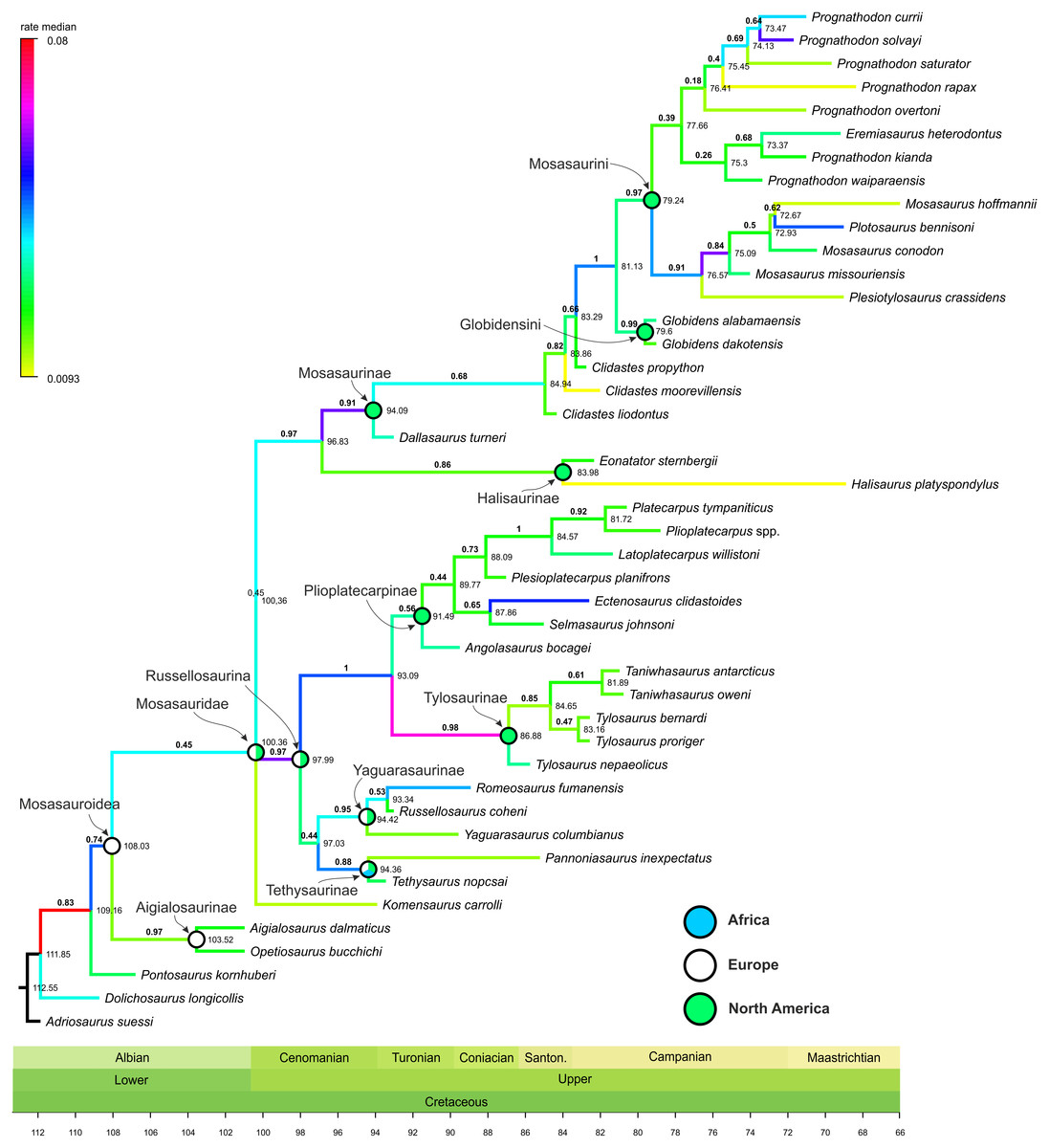
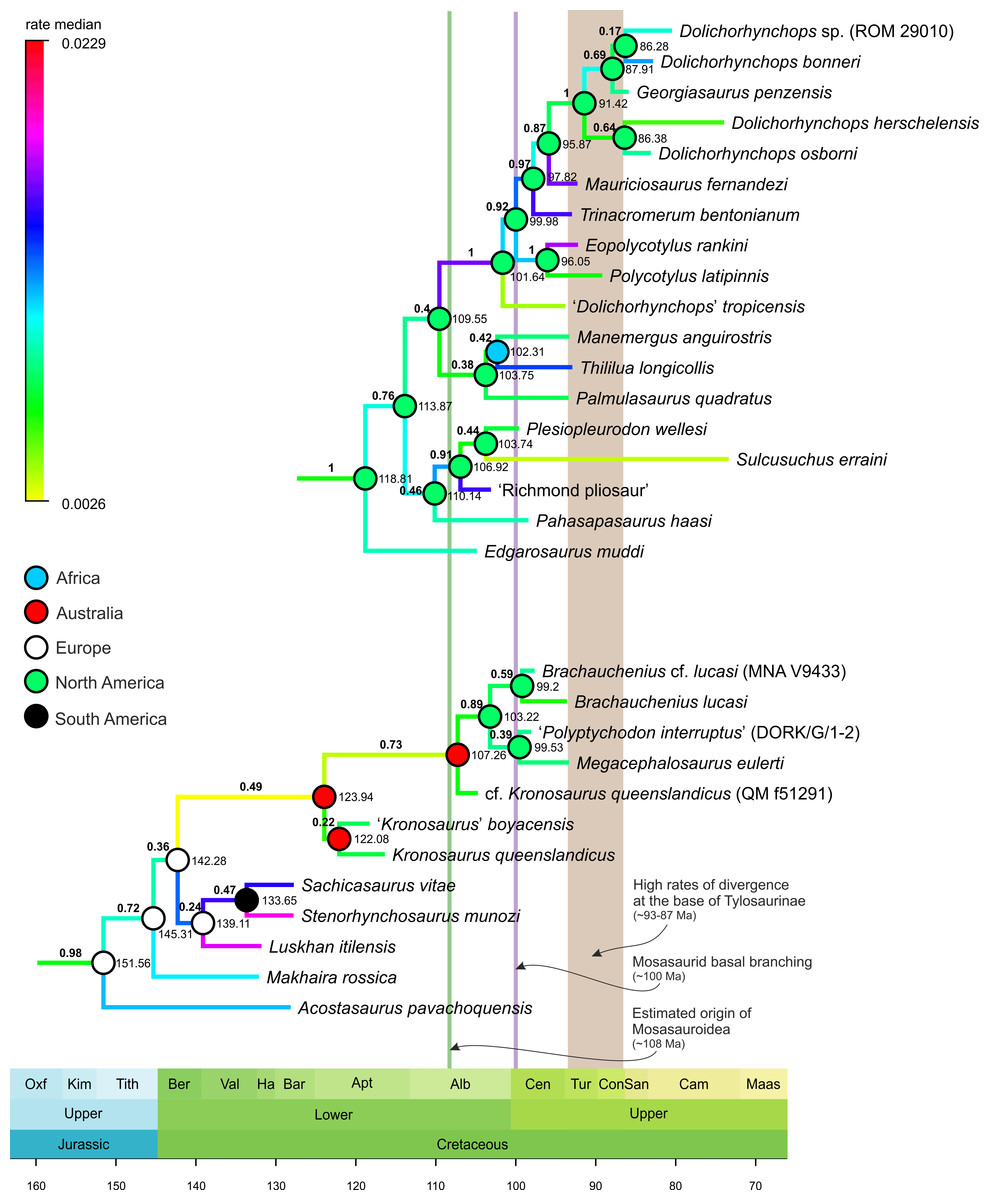


We used the MCCT to reconstruct the cladogenetic events (median age)
and to infer the divergence rate (the amount of morphological change per
branch relative to the whole topology) for both clades. Note that the
absolute rate values are inversely related to the sample size
(i.e., rate value in a branch is proportional to the probability of
sampling each state transition of the clade history in that branch);
thus, direct comparisons between the mosasauroid and plesiosaur rate
values is meaningless. Given the rate distribution inferred along the
MCCT in the two clades, we here define ‘high rates’ all those values
equal or higher than the value at the 75 percentile in each rate
distribution.
The phylogenetic assessment of Plesiosauria was performed using a modified version of the dataset first assembled by
Benson & Druckenmiller (2014). We first took a recent version of that dataset, published by
Madzia, Sachs & Lindgren (2019),
and updated it based on personal observations and recently published
literature, to include representatives of distinctive plesiosaur clades.
The changes include: modifications to the scores of
Brancasaurus brancai and ‘
Gronausaurus wegneri’ as in
Sachs, Hornung & Kear (2016); addition of
Lagenanectes richterae from
Sachs, Hornung & Kear (2017); addition of
Nakonanectes bradti,
Albertonectes vanderveldei,
Aristonectes quiriquinensis,
Elasmosaurus platyurus, ‘
Hydralmosaurus serpentinus’,
Mauisaurus haasti, ‘
Libonectes’
atlasense,
Terminonatator ponteixensis,
Tuarangisaurus keyesi,
Zarafasaura oceanis,
Kawanectes lafquenianum, and
Vegasaurus molyi from
Serratos, Druckenmiller & Benson (2017); addition of
Neusticosaurus pusillus and
Nothosaurus marchicus, and modifications to the scores of
Yunguisaurus liae and
Pistosaurus OTUs as in
Wintrich et al. (2017); addition of
Acostasaurus pavachoquensis, ‘
Kronosaurus’
boyacensis, and
Sachicasaurus vitae from
Páramo-Fonseca, Benavides-Cabra & Gutiérrez (2018), with amended scores for
A. pavachoquensis and
S. vitae as in
Páramo-Fonseca, Benavides-Cabra & Gutiérrez (2019); modifications to the character scores of
Thililua longicollis and addition of
Eopolycotylus rankini,
Manemergus anguirostris,
Dolichorhynchops tropicensis,
Georgiasaurus penzensis,
Dolichorhynchops sp. (specimen ROM 29010),
Dolichorhynchops herschelensis,
Sulcusuchus erraini, and
Mauriciosaurus fernandezi following
Fischer et al. (2018), with amended scores for
Trinacromerum bentonianum,
Dolichorhynchops osborni,
Dolichorhynchops bonneri,
Mauriciosaurus fernandezi, and
Polycotylus latipinnis as in
Morgan & O’Keefe (2019); addition of
Styxosaurus snowii from
Sachs, Lindgren & Kear (2018); and modifications to the scores of
Kronosaurus queenslandicus and
Stenorhynchosaurus munozi following
Holland (2018) and
Páramo-Fonseca, Benavides-Cabra & Gutiérrez (2019).
It
is essential to note that although the elasmosaurid phylogenetic
relationships were a subject of several recent papers (e.g.,
Otero, 2016;
Sachs, Hornung & Kear, 2016;
O’Gorman et al., 2017;
Sachs & Kear, 2017;
Serratos, Druckenmiller & Benson, 2017;
Sachs, Lindgren & Kear, 2018;
O’Gorman et al., 2019),
interpretations of morphologies observed in some elasmosaurid specimens
differ between these studies. See, for example, conflicting scores for ‘
Libonectes’
atlasense in
Sachs & Kear (2017) and
Serratos, Druckenmiller & Benson (2017), and for
Styxosaurus snowii in
Serratos, Druckenmiller & Benson (2017) and
Sachs, Lindgren & Kear (2018).
We have not studied these taxa in person; as such, we had to choose
between scores provided in other publications. We decided to adopt those
scores that derive from more recent studies in which the taxa were
assessed based on direct observations. For that reason, ‘
Libonectes’
atlasense is here scored as in
Serratos, Druckenmiller & Benson (2017) and
Styxosaurus snowii as in
Sachs, Lindgren & Kear (2018).
Naturally, such differences in interpretations of character states
might have an impact on inferred evolutionary rates. Nevertheless, our
decisions should not have any impact on the findings of the present
study as Elasmosauridae is of marginal importance here.
Finally, we have also modified several character states of
Anguanax zignoi
based on personal observations of the type specimen (3: 0→?; 4: [12]→?;
121: 0→?; 137: 0→?; 150: 1→?; 207: [01]→?; 270: 1→0) and re-scored
Megacephalosaurus eulerti for character 27 (1→0). This score has been already advocated by
Madzia, Sachs & Lindgren (
2019: p. 1208) but the character was erroneously scored as ‘1’ rather than ‘0’ in that study.
Character 25.
The character description was changed from “Maxilla, posterior extent
of maxillary tooth row” to “Maxilla and dentary, posterior extent of
maxillary tooth row”; after
Serratos, Druckenmiller & Benson (2017).
Character 138. As noted by
Madzia, Sachs & Lindgren (2019),
the current state definitions for character 138 are problematic because
they do not cover all plesiosaurs. In the original character list of
Benson & Druckenmiller (2014),
state ‘0’ was defined as codable for taxa with 12–17 maxillary teeth,
state ‘1’ for taxa with 20–25 maxillary teeth, and state ‘2’ for taxa
with more than 28 maxillary teeth. However, the brachauchenine
pliosaurid
Megacephalosaurus eulerti was shown to possess 18
teeth in the right and 19 in the left maxilla, thus falling between
states ‘0’ and ‘1’. Two options were considered for
M. eulerti:
to score it as ‘0’, extending the state to cover taxa with 12–19
maxillary teeth, and as ‘1’, extending the state to cover taxa with
18–25 teeth in their maxillae.
Madzia, Sachs & Lindgren (2019)
used both these options and explored the effects of such settings.
Considering that the last brachauchenines have reduced numbers of teeth
in their jaws (
Madzia, Sachs & Lindgren, 2019),
scoring these taxa in the same way as their older relatives (that fall
near the upper boundary of state ‘1’) might hinder the inference of some
potential phylogenetic signal. Therefore, in this study, state ‘0’
covers taxa with 12–19 maxillary teeth, state ‘1’ covers taxa with 20–27
maxillary teeth (note that the upper boundary was extended to eliminate
the gap between states ‘1’ and ‘2’), and state ‘2’ covers taxa with at
least 28 maxillary teeth.
Character 139.
State ‘2’ (“intermediate between states 0 and 1, with a flattened
labial surface, but this surface [is] not substantially expanded
anteroposteriorly [= subtrihedral]”) was added after
Benson et al. (2013). Even though
Benson et al. (2013)
described the state ‘2’ as “intermediate”, the morphological transition
from “round or sub-rounded” (‘0’) to “sub-triangular [= trihedral]”
(‘1’) does not need to have the appearance of ‘2’. Later,
Serratos, Druckenmiller & Benson (2017) used the dataset of
Benson & Druckenmiller (2014)
to infer the interrelationships of elasmosaurids and modified character
139 to include another new state (‘2’): “suboval”. However, in their
data matrix, this state was scored as ‘3’. In this study, the state ‘2’
is equivalent to state ‘2’ of
Benson et al. (2013), and state ‘3’ follows the new “suboval” state introduced by
Serratos, Druckenmiller & Benson (2017).
Nevertheless, the perception of what is “sub-rounded” (‘0’) and what
“suboval” (3) may be partially dependent on subjective criteria. As
such, future larger-scale phylogenetic studies of Plesiosauria should
probably quantify the difference (for example, using the
‘width-to-length ratio’ [WLR] of
Madzia (2016)
or similarly defined parameter). Due to the lack of apparent
transitional nature of particular character states, this character
should stay unordered in parsimony analyses.
Character 248.
The character description was changed from “Propodials, angle between
long axes of epipodial facets in dorsal view” to “Humerus, angle between
long axes of epipodial facets in dorsal view”; after
Serratos, Druckenmiller & Benson (2017).