|

|

|
|
|
|
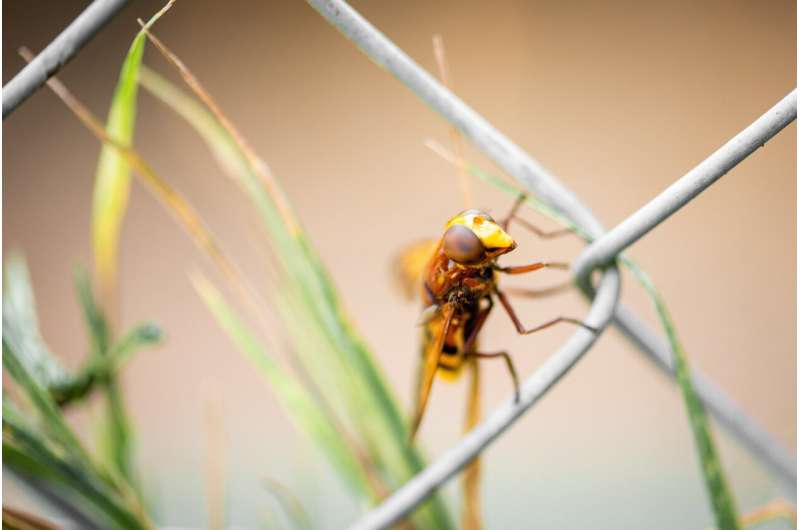
Um trio de pesquisadores, dois da Queen Mary University de Londres, o outro da Universidade de Teerã, encontrou evidências que sugerem que os insetos podem ser capazes de sentir dor. Em seu artigo publicado em Proceedings of the Royal Society B , Matilda Gibbons, Lars Chittka e Sajedeh Sarlak, descrevem problemas que encontraram ao tentar descobrir se os insetos sentem dor e a lógica que usaram para mostrar sua possibilidade.
Pesquisas anteriores e evidências anedóticas sugeriram que os insetos não sentem dor. Por causa disso, os humanos acharam fácil prejudicá-los ou matá-los. Nesse novo esforço, o trio de pesquisa sugere que nossas suposições podem estar erradas.
Os pesquisadores começaram observando que pesquisas anteriores mostraram que animais e insetos têm sistemas fisiológicos que reagem ao que nos animais seria descrito como uma experiência dolorosa. Essas experiências foram separadas no que veio a ser conhecido como nocicepção - a diferença entre responder fisicamente a um trauma físico e qualquer possível dor associada ao evento. Ambos respondem se você cortar uma das pernas de um inseto, por exemplo.
Mas o que não ficou claro é se isso é doloroso para os insetos. Para ajudar a responder a essa pergunta, os pesquisadores usaram o que veio a ser conhecido como ordem descendente de nocicepção – onde o comportamento de nível superior pode ser associado a um evento prejudicial.
Os seres humanos demonstraram ser capazes de interromper uma resposta à dor se ocorrer durante uma emergência – algumas pessoas não percebem que foram feridas em um acidente de carro, por exemplo, até serem tratadas em um hospital. Pesquisas anteriores mostraram que isso é possível porque um evento tão traumático pode levar o cérebro a começar a produzir opiáceos. Os insetos não produzem opiáceos, observam os pesquisadores, mas produzem outros neuropeptídeos que podem servir ao mesmo propósito. Eles descobriram que esses neuropeptídeos são produzidos em insetos durante eventos traumáticos , sugerindo que eles são capazes de ordem descendente de nocicepção, o que é uma possível evidência de que eles sentem dor.
Os pesquisadores sugerem que mais trabalho precisa ser feito para determinar se os insetos realmente sentem dor e, se sentirem, como abordar as questões éticas em torno de seu tratamento por seres humanos, causando-lhes danos.
Explorar mais
 Larva de mosquito encontrada no município
paulista de Iporanga tem propriedades bioluminescentes somente
observadas em espécies da América do Norte, Ásia e Nova Zelândia; estudo
abre caminho para novas aplicações biotecnológicas (foto: Henrique Domingos / IPBio)
Larva de mosquito encontrada no município
paulista de Iporanga tem propriedades bioluminescentes somente
observadas em espécies da América do Norte, Ásia e Nova Zelândia; estudo
abre caminho para novas aplicações biotecnológicas (foto: Henrique Domingos / IPBio)


|
|
Baltic
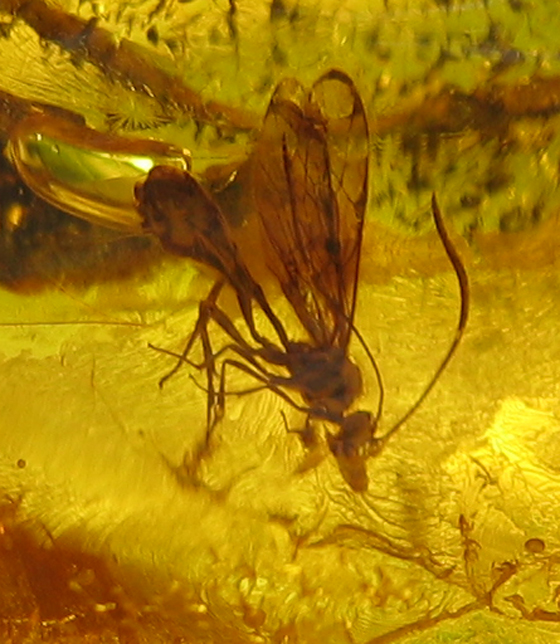
Amber with Inclusion
Order Hymenoptera Specimen 8mm Cenozoic; Paleocene; Eocene Yantarny, Kaliningrad, Russia 4.5 cm long x 3 cm wide x 1.5 cm thick Click on specimen to open up a close-up window. |
|
Amber
is referred to as petrified tree resin or sap. I prefer
petrified tree resin as the term sap refers to fluids transported
by xylem or phloem tissues (Raven, Evert, & Curtis,
1981, p. 659). Conifers and some deciduous trees produce
resin
in response to injury.
Resins
are viscous liquids that contain
volatile terpene compounds and organic solids. Under the
right conditions resins polymerize and harden
with age, turning into copal. After several
million
years
copal matures
into
amber.
Tree resin breaks down when exposed to drying and oxidation within just a few thousand years. It is not surprising then that amber deposits do not represent forest floor environments. Amber deposits usually represent marine environments. Amber deposits form when resins produced in forests are transported by water to oceans or lakes, where they are deposited into the sedimentary layers. Quick transport and deposition protects the resin from weathering. Once deposited, the resin chemically matures into intermediate forms called copals and finally into amber after millions of years. The amberization process is estimated to take between 2 and 10 million years. However, the type of depositional environment may also affect the time needed for amberization. Amber from Borneo is found in sand and clay sediments deposited in a deep ocean 12 million years ago. The material that comes out of the sandstone has matured into amber, while the specimens from the clay are still copal (Ross, 2010, pp 8-9). Petrified resins have been found in Carboniferous, Triassic, and Jurassic deposits, but represent minute amounts of resins produced inside trees. Resin that collects inside trees does not act as an insect trap. The first occurrence of fossil containing amber is Cretaceous in age. The majority of amber deposits that contain fossils were formed during the Cenozoic (Weitschat & Wichard, 2002, pp.9-10).
Fossils entombed in amber are referred to as inclusions.
Although the organisms often look complete, most appear
to be thinly lined
hollow spaces (Weitschat & Wichard, 2002, p. 29). However,
under the right conditions the internal organs can be well
preserved.
The
preserved
internal
organs of
a bee
exhumed from Dominican amber have been imaged using an electron
microscope
(Grimaldi & Engel, 2005, p. 59). Studies using scanning
electron microscopes as well as transmission electron microscopes
have revealed internal organ preservation in Baltic amber
spiders and gnats. It seems that many orangisms are preserved
through
mummification. In the process of mummification, dehydration
results in up to a 30% decrease in volume of tissues. The
decrease in tissue volume gives the organisms the appearance
of an
empty husk (Selden & Nudds, 2004, p. 134).
The
shape of a specimen can be a clue to whether the amber
formed inside the tree as an internal resin accumulation
or outside the tree as an external resin accumulation.
Resin can collect inside
the
void of a tree,
drip
off
a branch,
or flow along the outer bark. Resin that collects inside
a tree usually does not contain fossils. Resin that accumulates
on the outside of a tree can act as an insect trap. Fossils
are almost exclusively found in specimens formed by successive
resin
flows that collected on the outside of the tree.
These specimens are referred to as Schlaube (Weitschat
& Wichard,
2002, p. 12). Organisms become trapped in the
resin and are then covered by a successive resin flow.
You can usually see the plane representing a successive
resin flow;
it often looks like a fracture in the amber.
Amber
can represent a brief snapshot in time. Amber has preserved
insect developmental stages, mating, egg
laying, brood care,
feeding, as well as various symbiotic relationships. Amber with
and without fossils can be quite valuable so, it is
often faked. See Ross (2010) for an excellent discussion
regarding materials used to make fake amber and tests
that can be used to distinguish real amber from imitations
(pp. 11-15).
|
|
 Spider
Cenozoic; Paleocene; Eocene Primorskoje, Kaliningrad, Russia |
 Spider
Cenozoic; Paleocene; Eocene Primorskoje, Kaliningrad, Russia |
 Insect in Amber
|
 Insect in Amber
|
Bibliography |
|
| Grimaldi,
D. & Engel, M.S., (2005). Evolution of the Insects.
New York: Cambridge University Press. Raven, P.H., Evert, R.F., & Curtis, H. (1981). Biology of Plants [3rd Ed]. New York: Worth Publishers, Inc. Ross, A. (2010). Amber: The Natural Time Capsule. New York: Firefly Books. Selden P. & Nudds, J. (2004). Evolution of Fossil Ecosystems. Chicago: The University of Chicago Press. Weitschat, W. & Wichard, W. (2002). Atlas of Plants and Animals in Baltic Amber. Munchen: Verlag Dr. Friedrich Pfeil. Wilhelm Janzen, J.(2002). Arthropods in Baltic Amber. Germany: Ampyx Verla. | |

