Dados genéticos de hominídeos mais antigos de fósseis de mais de 2 milhões de anos
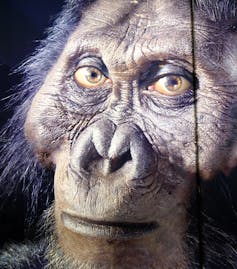
Fóssil de crânio de Paranthropus robustus. Fonte: Wikimedia Commons (CCB)
15 de julho de 2023
Dados genéticos foram extraídos de dentes fossilizados de um antigo hominídeo que viveu há mais de dois milhões de anos.
Os hominídeos – humanos e nossos parentes antigos – surgiram pela primeira vez na África há cerca de sete milhões de anos. Os dentes do Paranthropus robustus,
dos quais foi obtida a informação genética, foram encontrados numa
caverna sul-africana e datam de entre 1,8 milhões e 2,2 milhões de anos
atrás.
É incrivelmente difícil que os fragmentos de DNA permaneçam intactos depois de tanto tempo.
No final do ano passado, fragmentos de DNA recuperados de um osso de mamute siberiano tornaram-se os mais antigos já registrados, com 2,4 milhões de anos. As cadeias de DNA foram melhor preservadas no ambiente frio.
Mas as proteínas tendem a ser mais resistentes. Em 2016, os
investigadores obtiveram sequências de proteínas de cascas de ovos de
avestruz encontradas na Tanzânia que tinham até 3,8 milhões de anos.
As proteínas registram a informação genética que foi usada para formá-las.
Até agora, os dados genéticos mais antigos de um ancestral humano foram encontrados no dente de 800 mil anos de um espécime canibal do Homo antecessor de 1,8 milhão de anos da Espanha e em fragmentos mais limitados de fósseis do Homo erectus da Geórgia.
A equipe que sequenciou esses fósseis a partir de proteínas dentárias
foi liderada por Enrico Cappellini, químico de proteínas e professor
associado da Universidade de Copenhague.
Agora, Cappellini liderou novas pesquisas que quebraram recordes mais
uma vez. O estudo ainda não foi revisado por pares e está disponível
como pré-impressão no bioRxiv .
Usando espectrometria de massa, a equipe de Cappellini conseguiu analisar centenas de aminoácidos em cada amostra dos espécimes de Paranthropus com dois milhões de anos de idade .
Eles conseguiram até determinar o sexo biológico dos quatro indivíduos Paranthropus
na caverna sul-africana. Uma proteína, a amelogenina-Y, é produzida por
um gene no cromossomo Y e estava presente em dois dos espécimes, o que
significa que eram indivíduos do sexo masculino.
Os outros dois não tinham amelogenina-Y, mas exibiam a versão do cromossomo X da proteína, sugerindo que eram mulheres.
Embora limitados, os dados genéticos dos 400 aminoácidos sequenciados
permitiram aos pesquisadores construir uma árvore evolutiva muito
simples envolvendo o Paranthropus , os humanos modernos ( Homo sapiens ) e outros hominídeos.
Eles descobriram que o Homo sapiens , os Neandertais e os Denisovanos estão todos mais intimamente relacionados entre si do que com o Paranthropus – um resultado não surpreendente. Se o Paranthropus
está diretamente na linhagem evolutiva que levou aos humanos modernos,
entretanto, não fica claro a partir dos dados genéticos.
A obtenção de material genético desses vestígios antigos “pode ser
considerada um avanço potencialmente transformador para a
paleoantropologia”, escrevem os autores.
A especialista em paleogenética da Universidade de Tecnologia de
Queensland, Dra. Sally Wasef, que não esteve envolvida no estudo,
concorda que esta técnica pode abrir novas portas para a compreensão de
antigas linhagens evolutivas.
“Surpreendentemente, as moléculas de proteína podem preservar algumas
informações genéticas muito além dos limites do aDNA [DNA antigo].
Proteínas antigas podem ser a única maneira de responder a algumas
questões genéticas onde sabemos que nossas técnicas para recuperar o
aDNA não funcionarão”, disse Wasef em um e-mail ao Cosmos .
“É incrível acrescentar pelo menos um pouco de informação ao nosso
conhecimento sobre os primeiros hominídeos. No entanto, a proteína
antiga ainda é limitada nas informações que pode fornecer em comparação
com o aDNA. Então, tudo se resume a qual pergunta você deseja responder
usando esses restos de hominídeos.”
terça-feira, 14 de abril de 2020
In Groundbreaking Find, Three Kinds of Early Humans Unearthed Living Together in South Africa
The different hominid species, possibly including the oldest-known Homo erectus, existed in the region’s hills and caves
The Drimolen excavations and excavated fossils.
(Andy Herries)
Scientists studying the roots of humanity’s family tree have found
several branches entangled in and around a South African cave.
Two million years ago, three different early humans—Australopithecus, Paranthropus, and the earliest-known Homo erectus—appear
to have lived at the same time in the same place, near the Drimolen
Paleocave System. How much these different species interacted remains
unknown. But their contemporaneous existence suggests our ancient
relations were quite diverse during a key transitional period of African
prehistory that saw the last days of Australopithecus and the dawn of H. erectus’s nearly two-million-year run.
“We know that the old idea, that when one species occurs another
goes extinct and you don’t have much overlap, that’s just not the case,”
says study coauthor Andy Herries, a paleoanthropologist at La Trobe University in Australia.
Homo erectus cranium with stylized projection of the outline of the rest of the skull.
(Andy Herries, Jesse Martin and Renaud Joannes-Boyau)
Three Species, One Place
Australopithecus africanus
is the most primitive of this trio. The lineage dates to 3.3 million
years ago and combines human features with ape-like attributes including
long, tree climbing-arms. Despite these intermediate features, Australopithecus’s exact relation to modern humans remains unknown. The species is thought to have died out around 2 million years ago.
Paranthropus robustus,
an offshoot of the human family tree not considered a direct human
ancestor, is known for large, powerful jaws and teeth that could
pulverize a diet of nuts, seeds, roots and tubers. Paranthropus
lived from perhaps 2 million years ago (the remains described in this
study are the earliest known) until about 1.2 million years ago.
Homo erectuswas the first ancestor of modern
humans to have human-like body proportions and the first to appear
outside of Africa. The species appeared in what is now the nation of
Georgia 1.85 million years ago and survived in some Indonesian enclaves until as recently as 117,000 years ago.
It’s generally believed that they first evolved in Africa, and the
cranium find described at Drimolen would push back their earliest-known
occurrence anywhere in the world by more than 100,000 years.
“It’s an excellent paper, and it looks quite convincing,” says Fred Spoor
of the Natural History Museum, London. “It would have been ideal if
there was more of the cranium, but I think they make a very good case
that it’s Homo and that the closest affinities are probably with
erectus. And that would make it quite likely the oldest Homo
erectus-like thing.”
The drimolen fossil site.
(Andy Herries)
“I have no doubt that they have something that is of the genus Homo,” adds Rick Potts,
a paleoanthropologist and head of the Smithsonian’s Human Origins
Program. But Potts notes that the incomplete skull doesn’t show all the
telltale features that would characterize it as Homo erectus or
some other relative. Furthermore, the cranium belongs to a 2- or
3-year-old child, for which comparisons are scarce. “I’m not 100 percent
sure that they have Homo erectus. And that would be one of the really interesting parts of the study, because if they do have Homo erectus then it is the earliest known in the world.”
Out of Africa, or Within Africa?
If Herries and colleagues are correct that they have found Homo erectus, the early dates of the find pose an intriguing question: How did the species arrive in South Africa?
One possibility is that H. erectus originated here and
later spread to East Africa and then out of the continent. However,
Herries says that the discovery of the oldest-known bones doesn’t
necessarily mean H. erectus started in this locale. Perhaps they migrated to the area.
“It seems that Homo erectus and Paranthropus and
stone tools all suddenly occur in South Africa at this point,” Herries
says. “This suggests that we’ve got movement into the region, and I
think it’s really part of this same sort of story. We talk about 'Out of
Africa' a lot, but the hominids didn’t know they were going out of
Africa. They were just moving.”
Herries and colleagues cite some evidence for non-hominid
migrations that may lend weight to this theory. An extinct prehistoric
zebra and springbok appear at South African sites during this same time,
suggesting some environmental factors spurred their relatively sudden
migration into the region from regions further north where they are
known to have lived earlier.
It’s a question of putting our ancestors in their place
ecologically, Potts says, which drives much of his work on hominin
evolution. “We think a lot about what’s going on with other mammals when
looking at explanations of human evolution,” he says. “This period
around 2 million years ago is one of prolonged, very high climate
variability in Eastern Africa. I think that’s just the right conditions
for animals to be moving around to track different environments.”
If it was a migrant, H. erectus would have moved into an
area that was already occupied by other ancient hominids and shared the
same landscape with them for a significant time. “The fact that in a
small area in South Africa you have not just three species but three
different genera, … at the same time is neat,” says Spoor, who this week published a study modeling the brains of the famed hominid Lucy and her kin. “This will certainly put Drimolen back on the map.”
“We talk a lot about [diverse species coexisting] with
Neanderthals, modern humans, and Denisovans, and we can see that with
DNA, but we don’t have that ability with this earlier stuff,” adds
Herries. “I’m sure it happened and this may be one of the first
instances where we can really see it.”
La Trobe University PhD student Angeline Leece in front of fossil bearing brecccia at Drimolen.
(Jesse Martin)
The big problem in South Africa has been dating all these finds.
East Africa’s rift valleys, the continent’s other great hominin fossil
source, feature layers of volcanic ash that can be dated by measuring
the decay of radioactive elements, thereby dating the fossils within. In
many South African caves, by contrast, older, fossil-filled sections
have collapsed into lower areas. Modern humans operated mines in the
area, too. The result is a confusing and complicated landscape that
defies easy reconstruction.
Herries, who specializes in geochronology, says the Drimolen site
is a bit different. It’s a small cavern that was deposited during a
short period when water sunk into the cave, leaving a large sediment
cone in the middle in which the fossils were found. Studies of the cave
sediments show that this happened during a short window of time when
Earth’s magnetic field flipped, a major help in dating the finds.
“That’s a huge advantage because we know when these magnetic
changes occurred in the past,” Herries says. Scientists know when the
field flips because the event leaves magnetic patterns in volcanic rock,
especially in lava on the ocean floor, leaving a record of these
reversals.
By using the known rate at which uranium decays into lead the team
dated a tiny flowstone in the middle of the cave, formed by minerals in
water that moved across the cave walls and floor, to about 1.95 million
years ago—just in time for the magnetic field reversal. “That’s the
critical combination that allowed us to date those layers, and date the
bits where the crania come from which are slightly older than that.” The
team also dated molars associated with the fossils using Electron Spin
Resonance techniques with wider margins of error that nonetheless
correlate to the same period. “My hope is that people will be convinced
that we can date these cave sites in South Africa effectively now. It
takes a lot of hard work, and a bit of luck.”
Potts was among those convinced by the dating but found himself
even more impressed by the significance of the multi-species fossil
find—something that until now was only seen in northern Kenya’s Turkana Basin, where four hominin lineages once coexisted.
“They’ve done a great job demonstrating that while there is this
amazing diversity in East Africa (Turkana), there is an amazing but
different combination of species diversity in South Africa, with
different lineages of hominins hanging around at the same time. Now the
number of such sites is doubled. That’s quite important in my view.”
Em Pesquisa Inovadora, Três Tipos de Primeiros Humanos Desenterrados Vivendo Juntos na África do Sul As diferentes espécies de hominídeos, possivelmente incluindo o Homo erectus mais antigo, existiam nas colinas e cavernas da região.
The Drimolen excavations and excavated fossils.
(Andy Herries)
Cientistas que estudam as raízes da árvore genealógica da humanidade descobriram vários galhos emaranhados dentro e ao redor de uma caverna sul-africana.
Dois milhões de anos atrás, três seres humanos primitivos diferentes - Australopithecus, Paranthropus e o Homo erectus mais conhecido - parecem ter vivido ao mesmo tempo no mesmo local, perto do Sistema Paleocave Drimolen. O quanto essas diferentes espécies interagiram permanece desconhecido. Mas sua existência contemporânea sugere que nossas relações antigas foram bastante diversas durante um período de transição importante da pré-história africana que assistiu aos últimos dias do Australopithecus e ao alvorecer da corrida de quase dois milhões de anos de H. erectus.
"Sabemos que a velha idéia de que quando uma espécie ocorre outra se extingue e você não tem muita sobreposição, esse não é o caso", diz Andy Herries, coautor do estudo, paleoantropólogo da Universidade La Trobe, na Austrália.
Homo erectus cranium with stylized projection of the outline of the rest of the skull.
(Andy Herries, Jesse Martin and Renaud Joannes-Boyau).
Três Espécies, Um Lugar
Australopithecus africanus é o mais primitivo deste trio. A linhagem data de 3,3 milhões de anos atrás e combina características humanas com atributos semelhantes a macacos, incluindo longos braços de arvorismo. Apesar dessas características intermediárias, a relação exata do Australopithecus com os humanos modernos permanece desconhecida. Pensa-se que a espécie tenha morrido cerca de 2 milhões de anos atrás.
O Paranthropus robustus, um ramo da árvore genealógica humana que não é considerado um ancestral humano direto, é conhecido por mandíbulas e dentes grandes e poderosos que podem pulverizar uma dieta de nozes, sementes, raízes e tubérculos. O Paranthropus viveu cerca de 2 milhões de anos atrás (os restos descritos neste estudo são os mais antigos) até cerca de 1,2 milhão de anos atrás.
O Homo erectus foi o primeiro ancestral dos humanos modernos a ter proporções de corpo semelhante ao humano e o primeiro a aparecer fora da África. As espécies apareceram no que é agora a nação da Geórgia 1,85 milhão de anos atrás e sobreviveram em alguns enclaves indonésios até 117 mil anos atrás. Geralmente, acredita-se que eles tenham evoluído pela primeira vez na África, e a descoberta de crânio descrita em Drimolen atrasaria sua ocorrência mais antiga em qualquer lugar do mundo em mais de 100.000 anos.
"É um excelente artigo e parece bastante convincente", diz Fred Spoor, do Museu de História Natural de Londres. “Seria ideal se houvesse mais crânio, mas acho que eles argumentam muito bem que é o Homo e que as afinidades mais próximas provavelmente estão com o ereto. E isso tornaria bastante provável a coisa mais antiga do Homo erectus.
"Não tenho dúvidas de que eles têm algo do gênero Homo", acrescenta Rick Potts, paleoantropólogo e chefe do Programa de Origens Humanas do Smithsonian. Mas Potts observa que o crânio incompleto não mostra todos os recursos reveladores que o caracterizariam como Homo erectus ou algum outro parente. Além disso, o crânio pertence a uma criança de 2 ou 3 anos, para a qual as comparações são escassas. "Não tenho 100% de certeza de que eles têm o Homo erectus. E essa seria uma das partes realmente interessantes do estudo, porque se eles têm o Homo erectus, é o mais antigo conhecido no mundo. ”
Fora da África ou dentro da África?
Se Herries e colegas estão corretos ao encontrar o Homo erectus, as primeiras datas da descoberta colocam uma pergunta intrigante: como as espécies chegaram à África do Sul?
Uma possibilidade é que o H. erectus tenha se originado aqui e depois se espalhado para a África Oriental e depois fora do continente. No entanto, Herries diz que a descoberta dos ossos mais antigos conhecidos não significa necessariamente que o H. erectus começou nesse local. Talvez eles tenham migrado para a área.
"Parece que o Homo erectus, o Paranthropus e as ferramentas de pedra ocorrem repentinamente na África do Sul neste momento", diz Herries. "Isso sugere que temos movimento na região, e acho que faz parte desse mesmo tipo de história. Falamos muito sobre 'Fora da África', mas os hominídeos não sabiam que estavam saindo da África. Eles estavam apenas se movendo.
Herries e colegas citam algumas evidências de migrações não-hominídeos que podem dar peso a essa teoria. Uma zebra pré-histórica extinta e uma gazela aparecem em locais sul-africanos durante esse mesmo tempo, sugerindo que alguns fatores ambientais estimularam sua migração repentina para a região de regiões mais ao norte, onde se sabe que viveram anteriormente.
É uma questão de colocar nossos ancestrais no lugar deles ecologicamente, diz Potts, o que impulsiona grande parte de seu trabalho na evolução dos hominídeos. "Pensamos muito no que está acontecendo com outros mamíferos quando analisamos as explicações da evolução humana", diz ele. “Esse período, cerca de 2 milhões de anos atrás, é de variabilidade climática muito alta e prolongada na África Oriental. Acho que são as condições certas para os animais se movimentarem para rastrear ambientes diferentes. "
Se fosse um migrante, o H. erectus teria se mudado para uma área que já era ocupada por outros hominídeos antigos e compartilhado a mesma paisagem com eles por um tempo significativo. "O fato de que em uma pequena área da África do Sul você não possui apenas três espécies, mas três gêneros diferentes, ... ao mesmo tempo, é puro", diz Spoor, que nesta semana publicou um estudo modelando o cérebro do famoso hominídeo Lucy e sua esposa. parente. "Isso certamente colocará Drimolen de volta no mapa."
"Falamos muito sobre [diversas espécies coexistindo] com neandertais, humanos modernos e denisovanos, e podemos ver isso com o DNA, mas não temos essa capacidade com essas coisas anteriores", acrescenta Herries. "Tenho certeza de que isso aconteceu e essa pode ser uma das primeiras instâncias em que podemos realmente vê-lo".
Um dilema de datação
O Sistema Drimolen Paleocave faz parte do Patrimônio Mundial da UNESCO da África do Sul chamado Berço da Humanidade, uma coleção de cavernas de calcário perto de Joanesburgo que são uma das duas grandes fontes de fósseis hominídeos da África. Mais de 900 foram encontrados, representando pelo menos 5 espécies diferentes, durante escavações iniciadas há quase um século.
O grande problema na África do Sul está namorando todos esses achados. Os vales da fenda da África Oriental, a outra grande fonte fóssil de hominina do continente, apresentam camadas de cinzas vulcânicas que podem ser datadas medindo-se a deterioração de elementos radioativos, datando assim os fósseis dentro. Em muitas cavernas da África do Sul, por outro lado, seções mais antigas e cheias de fósseis desabaram em áreas mais baixas. Os humanos modernos também operavam minas na área. O resultado é um cenário confuso e complicado que desafia a reconstrução fácil.
Herries, especialista em geocronologia, diz que o site Drimolen é um pouco diferente. É uma pequena caverna que foi depositada durante um curto período em que a água afundou na caverna, deixando um grande cone de sedimentos no meio em que os fósseis foram encontrados. Estudos sobre os sedimentos das cavernas mostram que isso aconteceu durante um curto período de tempo, quando o campo magnético da Terra inverteu, uma grande ajuda para datar as descobertas.
"Essa é uma grande vantagem, porque sabemos quando essas mudanças magnéticas ocorreram no passado", diz Herries. Os cientistas sabem quando o campo vira porque o evento deixa padrões magnéticos nas rochas vulcânicas, especialmente na lava no fundo do oceano, deixando um registro dessas reversões.
Ao usar a taxa conhecida na qual o urânio se decompõe em liderança, a equipe datou uma pequena pedra de fluxo no meio da caverna, formada por minerais na água que se moviam pelas paredes e no chão da caverna, a cerca de 1,95 milhão de anos atrás - bem a tempo para inversão de campo magnético. "Essa é a combinação crítica que nos permitiu datar essas camadas e datar os bits de onde a crania vem, que são um pouco mais antigos que isso". A equipe também datou molares associados aos fósseis usando técnicas de ressonância de rotação eletrônica, com margens de erro mais amplas que, no entanto, se correlacionam com o mesmo período. “Minha esperança é que as pessoas estejam convencidas de que podemos namorar efetivamente esses locais de cavernas na África do Sul agora. É preciso muito trabalho duro e um pouco de sorte. ”
Potts estava entre os convencidos pelo namoro, mas ficou ainda mais impressionado com o significado da descoberta fóssil de várias espécies - algo que até agora era visto apenas na bacia do Turkana, no norte do Quênia, onde coexistiam quatro linhagens de hominídeos.
"Eles fizeram um ótimo trabalho demonstrando que, embora haja essa incrível diversidade na África Oriental (Turkana), há uma incrível mas diferente combinação de diversidade de espécies na África do Sul, com diferentes linhagens de hominídeos por aí ao mesmo tempo. Agora, o número desses sites é dobrado. Isso é muito importante na minha opinião. "
terça-feira, 2 de abril de 2019
Descoberto: a mais antiga condição genética comum conhecida na evolução humana
PhD Candidate em Antropologia Biológica, Universidade Liverpool John Moores
Declaração de Divulgação
Ian
Towle não trabalha para, consulta, possui ações ou recebe financiamento
de qualquer empresa ou organização que se beneficiaria com este artigo,
e não revelou afiliações relevantes além de sua nomeação acadêmica.
Paranthropus robustus.Guérin Nicolas / wikipedia.CC BY-SA
As doenças genéticas são bastante comuns hoje em dia, com mais de uma em cada 25 crianças nascendo com uma. Mas a história evolutiva de tais condições é misteriosa. Quais distúrbios genéticos eram comuns em nossos ancestrais e por quê? E eles ainda existem?
Agora, meu colega e eu descobrimos a mais antiga condição genética
comum conhecida na evolução humana - em uma espécie de 2 anos de idade
chamada Paranthropus robustus .
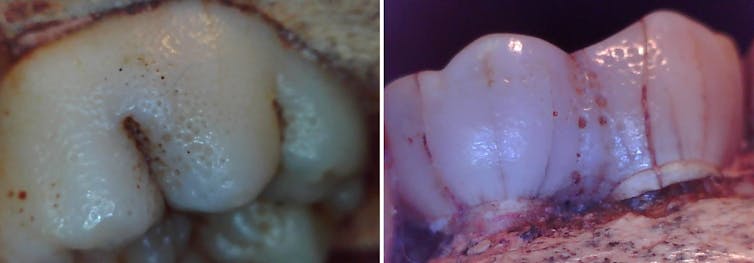
Essa espécie freqüentemente apresentava graves defeitos nos dentes,
chamados de hipoplasia do esmalte do pite, causada pela condição amelogênese imperfeita - com muitos dentes completamente cobertos em pequenos buracos circulares dando a eles a aparência de uma bola de golfe. Paranthropus robustus.flowcomm / Flickr , CC BY-SA Restos de P. robustus foram encontrados em abundância em várias cavernas sul-africanas, todas situadas no “ berço da humanidade ”, a cerca de 50 km a noroeste de Joanesburgo.
A maioria dos espécimes são fragmentos isolados de dentes e mandíbulas,
mas também há alguns crânios e ossos magnificamente preservados de
outras partes do corpo. O gênero Paranthropus como um todo era um membro notável da árvore genealógica humana.
Os indivíduos tinham dentes de trás extremamente grandes, bem como
mandíbulas e bochechas enormes - características que se acreditava terem
evoluído para que pudessem lidar com uma dieta rica em vegetação dura e fibrosa .
Alguns indivíduos até tinham “cristas sagitais”, uma crista de osso que
corria ao longo da linha mediana do crânio, que se acreditava ter
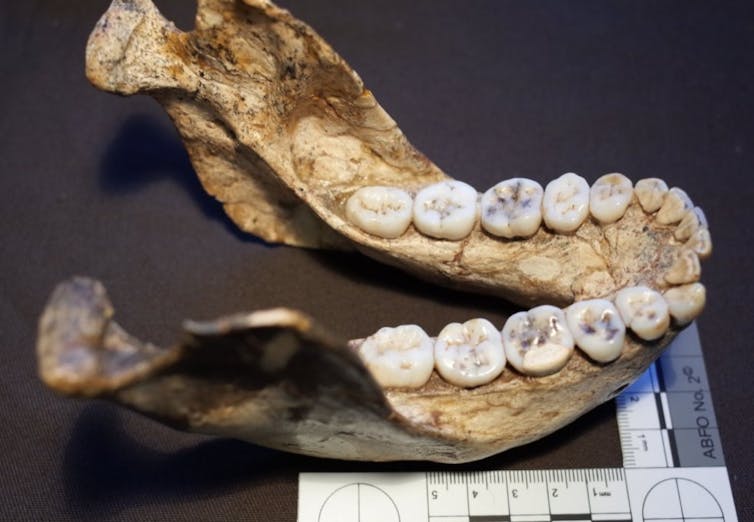
evoluído para ancorar seus extraordinários músculos da mandíbula. Colocando em dentes Paranthropus robustus.Ian Towle , Autor desde Condições genéticas raramente são identificadas no registro fóssil por várias razões. Uma vez que passamos 50 mil anos atrás, torna-se muito difícil obter amostras de DNA de espécimes. Isso se deve ao fato de o DNA se degradar e ficar contaminado com o tempo.
Se você não pode obter DNA, então você tem que confiar em marcadores
deixados nos ossos e dentes, o que limita significativamente os tipos de
condições genéticas que você pode identificar.
A freqüência de condições genéticas específicas varia entre espécies e
populações, e algumas podem ser particularmente prevalentes em certos
grupos.
Graças a uma crescente amostra de vestígios de hominídeos arqueológicos
(humanos e nossos parentes fósseis próximos), algumas condições
genéticas podem, no entanto, aparecer se a condição for prevalente.
Evolução rápida
Em nosso novo estudo, publicado no Journal of Human Evolution
, relatamos o exemplo mais antigo de um grupo com ocorrência
significativamente maior de uma condição genética do que ocorre em
pessoas hoje. A amelogênese imperfeita afeta apenas uma em cada 1.000 pessoas, enquanto cerca de 1 em cada 3 indivíduos de P. robustus sofrem com ela. De várias centenas de dentes de P. robustus , mais da metade dos molares do bebê (dentes posteriores) tinham defeitos de corrosão, assim como um quarto de molares adultos.
Há também evidências que sugerem que outras espécies pertencentes a
esse gênero mandibular maciço (Paranthropus) eram propensas a essa
condição genética.
A condição teria um impacto significativo na dieta e no comportamento,
uma vez que tais defeitos no esmalte podem levar a desgaste dentário
extremo e cáries dentárias. Isso provavelmente explica parcialmente a taxa surpreendentemente alta de doenças dentárias encontradas nos dentes de P. robustus , já que os buracos permitem a formação de cavidades dentárias. Hoje, devido aos cuidados dentários avançados, amelogênese imperfeita é muitas vezes predominantemente uma questão estética.
Isso levanta a questão: se esta condição teve consequências negativas
para o indivíduo, por que a evolução através da seleção natural permitiu
que ela persistisse tão comumente por mais de um milhão de anos? A resposta provavelmente remonta ao Paranthropus, desenvolvendo molares extremamente grandes em um curto período de tempo.
Pressão sobre este grupo para aumentar o tamanho dos seus dentes de
trás foi claramente forte e levou a mudanças genéticas significativas.
Esse processo pode ter levado à instabilidade em genes cruciais ou ter
efeitos colaterais em outras características que compartilham esses
mesmos genes, chamados de pleiotropia. Os grandes dentes e mandíbula de P. robustus .Ian Towle , Autor desde Por exemplo, o gene ENAM está associado à variação nas propriedades do dente, como a espessura do esmalte. Mutações neste mesmo gene são responsáveis por muitos tipos de amelogênese imperfeita.
Portanto, mudanças genéticas ligadas à evolução do esmalte espesso e
dos grandes dentes traseiros no Paranthropus, em um curto período, podem
ter criado efeitos colaterais em genes como o ENAM, levando a altas
taxas de defeitos de corrosão.
Claramente, esse trade off valeu a pena, uma vez que esse grupo de
homininos era difundido na África, e até sobreviveu junto com os
primeiros membros de nosso próprio gênero, Homo, por centenas de
milhares de anos.
A história do Paranthropus continua ficando mais interessante, e com
mais descobertas e descobertas, será possível entender melhor os modos
de vida desses membros impressionantes de nossa árvore genealógica.
Esta pesquisa também ajuda na nossa busca para entender a história da
doença genética, e esses fósseis podem dar mais informações sobre as
causas da amelogênese imperfeita em humanos hoje.
Mais amplamente, as condições genéticas raramente são pesquisadas em
nossos ancestrais fósseis e parentes, e com vastos passos adiante em
estudos de DNA, bem como mais fósseis, não demorará muito para que
outras condições genéticas raras sejam identificadas.
quarta-feira, 29 de agosto de 2018
Paranthropus aethiopicus
Fósseis atribuídos ao Paranthropus
aethiopicus foram encontrados em sítios da África Oriental que foram
datados entre 2,7 e 2,3 milhões de anos atrás (m.a.). Especificamente,
esta espécie foi encontrada na Etiópia (na bacia do rio Omo), no Quênia
(no oeste de Turkana) e na Tanzânia (em Laetoli). Fósseis de P.
aethiopicus exibem uma mistura de características na caixa craniana (as
partes do crânio que envolvem o cérebro) que se assemelham a Au.
afarensis com características faciais e dentários que são muito
semelhantes aos do Paranthropus boisei e Paranthropus robustus.
Juntamente com a sua idade (que sucede A. afarensis e precede P. boisei e
P. robustus), estas características do P. aethiopicus ajudaram os
cientistas a compreender as origens dos australopitecos robustos (P.
aethiopicus, P. boisei e P. robustus ). Consenso sobre as relações
evolutivas precisas entre estas espécies e entre estas espécies e
hominídeos anteriores, entretanto, não foi alcançado.
P. aethiopicus é conhecido apenas de restos do crânio;
nenhuma parte pós-craniana (partes do esqueleto que não inclua o crânio)
foi atribuída a esta espécie. Embora uma maxila e vários dentes (alguns
dos quais foram encontrados com osso associado da mandíbula inferior)
representando P. aethiopicus tenham sido encontrados, o fóssil mais
informativo é um crânio quase completo (crânio menos mandíbula inferior)
do Quênia. Este crânio em desdentados (desdentado) (número de catálogo
KNM WT 17000) é apelidado de “Crânio negro” porque os sedimentos em que
foi enterrado mancharam-no de preto.
O crânio de P. aethiopicus possui
uma mistura interessante de características que são mais semelhantes ao
Au. afarensis e características que mais se assemelham a P. robustus e
P. boisei. Os recursos compartilhados com o Au. afarensis incluem uma
face prognática (proeminente) e uma capacidade craniana relativamente
pequena (uma estimativa do tamanho do cérebro com base no volume do caso
cerebral; a capacidade cranial estimada de P. aethiopicus está na
extremidade inferior do intervalo de Au. afarensis) .
A morfologia
(tamanho e forma) das articulações temporomandibulares (a articulação
entre a mandíbula e o crânio) em P. aethiopicus e Au. afarensis também é
muito semelhante. Enquanto a dentição como um todo difere muito da
encontrada em Au. afarensis (veja abaixo), os dentes anteriores
(frontais) em P. aethiopicus, como os de Au. afarensis, são
relativamente grandes (comparados com aqueles encontrados nos
australopitais robustos). A crista sagital (uma crista óssea no topo do
crânio que se estende da frente para trás no meio do crânio, ao qual o
músculo temporal - um grande músculo mastigador que fecha a boca - se
liga) em P. aethiopicus também é semelhante àquela. encontrado em A.
afarensis.
Especificamente, a crista sagital de P. aethiopicus é mais
pronunciada na parte de trás do crânio, como em Au. afarensis, sugerindo
que, como A. afarensis, P. aethiopicus enfatizou a parte posterior do
músculo temporal; este fato é corroborado por outras semelhanças entre
Au. afarensis e P. aethiopicus nas marcações feitas no dorso do crânio
pelo músculo temporal. É importante notar que as características que P.
aethiopicus compartilha com Au. afarensis não são vistos em espécies do
gênero Paranthropus e estas características, em geral, não são vistas em
Australopithecus africanus.
Muitas características do crânio do P. aethiopicus se parecem mais
com aquelas exibidas por P. boisei e P. robustus. Por exemplo, os ossos
zigomáticos (bochecha) estão posicionados muito para frente e as margens
externas do rosto projetam-se bem para frente do meio da face, criando a
aparência de uma face “abaulada” (na qual as partes externas do projeto
da face tão à frente que eles obscurecem o buraco do nariz quando visto
de lado), característica dos outros australopitecos robustos. Como nos
demais australopitecos robustos, os ossos do palato de P. aethiopicus
são espessos. Os dentes pré-molares e molares em P. aethiopicus são
muito grandes - similares em tamanho aos outros australopitecos robustos
e muito maiores que em A. afarensis - e os pré-molares são muito mais
parecidos com os molares do que no A. afarensis.
A morfologia de P. aethiopicus tem uma relação direta com as
relações evolutivas entre as primeiras espécies de hominídeos. Em
particular, P. aethiopicus é importante para entender a origem dos
australopitecos robustos, bem como a relação dessas espécies com o Au.
afarensis e Au. africanus. Antes da descoberta do "crânio negro", os
pesquisadores sustentaram que Au. O africanus foi o ancestral de P.
robustus e P. boisei.
Esta descoberta, no entanto, lançou dúvidas sobre
este cenário porque representava uma espécie de hominina que era
contemporânea ao Au. africanus e que exibiram muito mais primitivo
(características compartilhadas encontradas no seu ancestral, neste caso
Au. afarensis) morfologia craniana. Alguns pesquisadores agora sugerem
que existiam duas linhagens distintas de australopitais robustos - uma
na África do Sul, representada por P. robustus, cujo antepassado,
segundo esse cenário, é o A. africanus, e outro na África Oriental,
representado por P. boisei, cujo antepassado é P. aethiopicus (cujo
antepassado, neste ponto de vista, é A. afarensis).
As semelhanças
entre P. robustus e P. boisei, desse ponto de vista, são evidências de
que ambas as espécies adquiriram independentemente características
relacionadas à mastigação de alimentos duros. No entanto, a maioria
filogenética (relacionada às relações evolutivas entre espécies) analisa
o grupo P. boisei e P. robustus juntos e sugere que o ancestral comum
dessas duas espécies era provavelmente mais derivado (possuindo
características não compartilhadas com seu ancestral, neste caso,
características compartilhadas com P. robustus e P. boisei) que P.
aethiopicus.
Independentemente da perspectiva que os cientistas adotam,
um consenso surgiu de que o registro fóssil de hominina entre 3,0 e 2,0
m.a. testemunhou um grau relativamente alto de homoplasia e reversão. Em
outras palavras, qualquer que seja o cenário filogenético correto, as
evidências atuais sugerem que algumas das características compartilhadas
por diferentes espécies não refletem relações evolutivas próximas
(homoplasia, por exemplo, características relacionadas à produção de
grandes forças mastigatórias, encontradas nos australopitecos robustos e ,
em certa medida, em A. africanus; ver ensaio sobre A. africanus para
mais detalhes) e algumas características evoluíram de um estado para
outro e depois de volta ao estado original (reversão).
Um registro
fóssil mais completo do intervalo de tempo entre 3.0 e 2.0 mya (em
particular, um registro fóssil melhor de P. aethiopicus) bem como um
melhor entendimento da diversidade morfológica incluída dentro de Au.
africanus - veja ensaio sobre Au. africanus) ajudará a esclarecer estas
questões filogenéticas não resolvidas.
quinta-feira, 2 de agosto de 2018
Um contexto hidroclimático de dois milhões de anos para a evolução dos hominídeos no sudeste da África
Os
últimos dois milhões de anos da variabilidade climática da África
oriental estão atualmente muito restritos, apesar do interesse em
compreender seu papel assumido na evolução humana inicial1,2,3,4. Raros
registros paleoclimáticos do nordeste da África sugerem condições
progressivamente mais secas2,5 ou um hidroclima estável6. Por outro
lado, registros do Lago Malawi no sudeste tropical da África revelam uma
tendência de um clima progressivamente mais úmido nos últimos 1,3
milhões de anos7,8.
As forças climáticas que controlavam essas mudanças
hidrológicas passadas também são objeto de debate. Alguns estudos
sugerem uma insolação local dominante forçando mudanças
hidrológicas9,10,11, enquanto outros inferem uma potencial influência
das mudanças de temperatura da superfície do mar no Oceano
Índico8,12,13.
Aqui mostramos que o hidroclima no sudeste da África
(20–25 ° S) é controlado pela interação entre o forçamento de insolação
de baixa latitude (precessão e excentricidade) e mudanças no volume de
gelo em altas latitudes.
Os nossos resultados baseiam-se numa
reconstrução múltipla de alterações hidrológicas na bacia hidrográfica
do rio Limpopo, combinada com uma reconstrução da temperatura da
superfície do mar no sudoeste do Oceano Índico nos últimos 2.14 milhões
de anos. Encontramos uma aridificação a longo prazo na bacia
hidrográfica do Limpopo, entre cerca de 1 e 0,6 milhões de anos atrás,
em oposição à evolução hidroclimática sugerida pelos registos do Lago
Malawi.
Nossos resultados, juntamente com a evidência de umedecimento no
Lago Malawi, implicam que a correia de chuva se contrai em direção ao
Equador em resposta ao aumento do volume de gelo em altas latitudes.
Ao
reduzir a extensão das florestas e zonas úmidas em ecossistemas
terrestres, as mudanças observadas no hidroclima do sudeste da África -
tanto em termos de estado de longo prazo quanto de marcada variabilidade
precessional - poderiam ter tido um papel na evolução dos primeiros
hominídeos, particularmente em a extinção do Paranthropus robustus.
References
1.
Vrba, E. S. Environment and evolution: alternative causes of the temporal distribution of evolutionary events. S. Afr. J. Sci. 81, 229–236 (1985).
Maslin, M. A. & Trauth, M. H. in The First Humans: Origin and Early Evolution of the Genus Homo (eds Grine, F. E. et al.) 151–158 (Springer, New York, 2009).
5.
Cerling, T. E. et al. Woody cover and hominin environments in the past 6 million years. Nature476, 51–56 (2011).
Lyons,
R. P. et al. Continuous 1.3-million-year record of East African
hydroclimate, and implications for patterns of evolution and
biodiversity. Proc. Natl Acad. Sci. USA112, 15568–15573 (2015).
Partridge,
T. C., Demenocal, P. B., Lorentz, S. A., Paiker, M. J. & Vogel, J.
C. Orbital forcing of climate over South Africa: a 200,000-year rainfall
record from the Pretoria saltpan. Quat. Sci. Rev. 16, 1125–1133 (1997).
Schefuß,
E., Kuhlmann, H., Mollenhauer, G., Prange, M. & Pätzold, J. Forcing
of wet phases in southeast Africa over the past 17,000 years. Nature480, 509–512 (2011).
Dupont,
L. M. et al. Glacial–interglacial vegetation dynamics in South Eastern
Africa coupled to sea surface temperature variations in the Western
Indian Ocean. Clim. Past7, 1209–1224 (2011).
Castañeda, I. S. et al. Middle to Late Pleistocene vegetation and climate change in subtropical southern East Africa. Earth Planet. Sci. Lett. 450, 306–316 (2016).
Tyson, P. D. & Preston-Whyte, R. A. The Weather and Climate of Southern Africa (Oxford Univ. Press, Oxford, 2000).
18.
Kutzbach,
J. E., Liu, X., Liu, Z. & Chen, G. Simulation of the evolutionary
response of global summer monsoons to orbital forcing over the past
280,000 years. Clim. Dyn. 30, 567–579 (2008).
McClymont,
E. L., Sosdian, S. M., Rosell-Melé, A. & Rosenthal, Y. Pleistocene
sea-surface temperature evolution: early cooling, delayed glacial
intensification, and implications for the mid-Pleistocene climate
transition. Earth Sci. Rev. 123, 173–193 (2013).
Tierney,
J. E., Smerdon, J. E., Anchukaitis, K. J. & Seager, R. Multidecadal
variability in East African hydroclimate controlled by the Indian
Ocean. Nature493, 389–392 (2013).
Balter,
V., Braga, J., Télouk, P. & Thackeray, J. F. Evidence for dietary
change but not landscape use in South African early hominins. Nature489, 558–560 (2012).
Foley, R. in African Biogeography, Climate Change, and Human Evolution (eds Bromage, T. G. & Schrenk, F.) 328–348 (Oxford Univ. Press, Oxford, 1999).
28.
Xie,
P. & Arkin, P. A. Global precipitation: a 17-year monthly analysis
based on gauge observations, satellite estimates and numerical model
outputs. Bull. Am. Meteorol. Soc. 78, 2539–2558 (1997).
Locarnini, R. A. et al. World Ocean Atlas 2009. Volume 1: Temperature (NOAA Atlas NESDIS 68, U.S. Government Printing Office, Washington, D.C., 2010).
30.
Still, C. J. & Powell, R. L. in Isoscapes: Understanding Movement, Pattern, and Process on Earth through Isotope Mapping (eds West, J. B. et al.) 179–194 (Springer, Dordrecht, 2010).
31.
Laskar, J. et al. A long-term numerical solution for the insolation quantities of the Earth. Astron. Astrophys. 428, 261–285 (2004).
García-Comas,
C. et al. Zooplankton long-term changes in the NW Mediterranean Sea:
decadal periodicity forced by winter hydrographic conditions related to
large-scale atmospheric changes? J. Mar. Syst. 87, 216–226 (2011).
Ibanez,
F., Fromentin, J. M. & Castel, J. Application of the cumulated
function to the processing of chronological data in oceanography. C. R. Acad. Sci. III316, 745–748 (1993).
Barker, S., Greaves, M. & Elderfield, H. A study of cleaning procedures used for foraminiferal Mg/Ca paleothermometry. Geochem. Geophys. Geosyst. 4, 8407 (2003).
de
Villiers, S., Greaves, M. & Elderfield, H. An intensity ratio
calibration method for the accurate determination of Mg/Ca and Sr/Ca of
marine carbonates by ICP-AES. Geochem. Geophys. Geosyst. 3, 2001GC000169 (2002).
Anand,
P., Elderfield, H. & Conte, M. H. Calibration of Mg/Ca thermometry
in planktonic foraminifera from a sediment trap time series. Paleoceanography18, 1050 (2003).
Hemleben, C., Spindler, M. & Erson, O. R. Modern Planktonic Foraminifera (Springer, New York, 1989).
42.
Kennett, J. P. & Srinivasan, M. S. Neogene Planktonic Foraminifera: A Phylogenetic Atlas (Hutchinson Ross, Stroudsburg, 1983).
43.
Guiot, J. & de Vernal, A. in Proxies in Late Cenozoic Paleoceanography (eds Hillaire-Marcel, C. & de Vernal, A.) 523–563 (Elsevier, Amsterdam, 2007).
44.
Kucera, M. in Proxies in Late Cenozoic Paleoceanography (eds Hillaire-Marcel, C. & de Vernal, A.) 213–262 (Elsevier, Amsterdam, 2007).
45.
Barrows,
T. T. & Juggins, S. Sea-surface temperatures around the Australian
margin and Indian Ocean during the Last Glacial Maximum. Quat. Sci. Rev. 24, 1017–1047 (2005).
Kucera,
M. et al. Reconstruction of sea-surface temperatures from assemblages
of planktonic foraminifera: multi-technique approach based on
geographically constrained calibration data sets and its application to
glacial Atlantic and Pacific Oceans. Quat. Sci. Rev. 24, 951–998 (2005).
Roche, D. M. & Caley, T. δ18O water isotope in the iLOVECLIM model (version 1.0)–part 2: evaluation of model results against observed δ18O in water samples. Geosci. Model Dev. 6, 1493–1504 (2013).
Caley, T. & Roche, D. M. δ18O water isotope in the iLOVECLIM
model (version 1.0)–part 3: a palaeo-perspective based on present-day
data–model comparison for oxygen stable isotopes in carbonates. Geosci. Model Dev. 6, 1505–1516 (2013).
Caley,
T., Roche, D. M. & Renssen, H. Orbital Asian summer monsoon
dynamics revealed using an isotope-enabled global climate model. Nat. Commun. 5, 5371 (2014).
Wood, B. & Schroer, K. in Human Paleontology and Prehistory. Contributions in Honor of Yoel Rak (eds Marom, A. & Hovers, E.) 95–107 (Springer, Cham, 2017).
55.
Patterson,
D. B., Faith, J. T., Bobe, R. & Wood, B. Regional diversity
patterns in African bovids, hyaenids, and felids during the past 3
million years: the role of taphonomic bias and implications for the
evolution of Paranthropus. Quat. Sci. Rev. 96, 9–22 (2014).
Grine, F. E. (ed). Evolutionary History of the “Robust” Australopithecines (Aldine de Gruyter, New York, 1988).
57.
Strait, D. S. et al. Viewpoints: diet and dietary adaptations in early hominins: the hard food perspective. Am. J. Phys. Anthropol. 151, 339–355 (2013).
Rabenold,
D. & Pearson, O. M. Abrasive, silica phytoliths and the evolution
of thick molar enamel in primates, with implications for the diet of Paranthropus boisei. PLoS ONE6, e28379 (2011).
Scott,
J. E., McAbee, K. R., Eastman, M. M. & Ravosa, M. J. Experimental
perspective on fallback foods and dietary adaptations in early hominins.
Biol. Lett. 10, 20130789 (2014).
King, R. A. Using Ailuropoda melanoleuca as a Model Species for Studying the Ecomorphology of Paranthropus. MSc. thesis, Marshall Univ. (2014).
64.
Weng, Z. Y. et al. Giant panda’s tooth enamel: structure, mechanical behavior and toughening mechanisms under indentation. J. Mech. Behav. Biomed. Mater. 64, 125–138 (2016).
Lucas, P. W. Dental Functional Morphology: How Teeth Work (Cambridge Univ. Press, Cambridge, 2004).
67.
Souron, A. in Ecology, Conservation and Management of Wild Pigs and Peccaries (eds Melletti, M. & Meijaard, E.) 29–38 (Cambridge Univ. Press, Cambridge, 2017).
68.
Ledogar, J. A. et al. Mechanical evidence that Australopithecus sediba was limited in its ability to eat hard foods. Nat. Commun. 7, 10596 (2016).
Daegling, D. J., Carlson, K. J., Tafforeau, P., de Ruiter, D. J. & Berger, L. R. Comparative biomechanics of Australopithecus sediba mandibles. J. Hum. Evol. 100, 73–86 (2016).
Grine, F. E. & Susman, R. L. Radius of Paranthropus robustus from member 1, Swartkrans formation, South Africa. Am. J. Phys. Anthropol. 84, 229–248 (1991).
Backwell,
L. R. & d’Errico, F. Additional evidence on the early hominid bone
tools from Swartkrans with reference to spatial distribution of lithic
and organic artefacts. S. Afr. J. Sci. 99, 259–267 (2003).
Rein, T. R., Harrison, T., Carlson, K. J. & Harvati, K. Adaptation to suspensory locomotion in Australopithecus sediba. J. Hum. Evol. 104, 1–12 (2017).
Macho, G. in Trends in Biological Anthropology Vol. 1 (eds Gerdau-Radonić, K. & McSweeney, K.) 1–10 (Oxbow, Oxford, 2015).
79.
Tseng,
Z. J. Connecting Hunter–Schreger Band microstructure to enamel
microwear features: new insights from durophagous carnivores. Acta Palaeontol. Pol. 57, 473–484 (2012).
Alloing-Séguier,
L. et al. Enamel microstructure evolution in anthracotheres (Mammalia,
Cetartiodactyla) and new insights on hippopotamoid phylogeny. Zool. J. Linn. Soc. 171, 668–695 (2014).
Constantino,
P. J., Borrero-Lopez, O., Pajares, A. & Lawn, B. R. Simulation of
enamel wear for reconstruction of diet and feeding behavior in fossil
animals: a micromechanics approach. BioEssays38, 89–99 (2016).
Towle, I., Irish, J. D. & De Groote, I. Behavioral inferences from the high levels of dental chipping in Homo naledi. Am. J. Phys. Anthropol. 164, 184–192 (2017).
Sponheimer,
M. et al. Hominins, sedges, and termites: new carbon isotope data from
the Sterkfontein valley and Kruger National Park. J. Hum. Evol. 48, 301–312 (2005).
Sponheimer,
M. & Lee-Thorp, J. A. Differential resource utilization by extant
great apes and australopithecines: towards solving the C4 conundrum. Comp. Biochem. Physiol. A136, 27–34 (2003).
Sponheimer, M. in The Paleobiology of Australopithecus (eds Reed, K. E., Fleagle, J. G. & Leakey, R. E.) 225–233 (Springer, Dordrecht, 2013).
87.
Dominy,
N. J., Vogel, E. R., Yeakel, J. D., Constantino, P. & Lucas, P. W.
Mechanical properties of plant underground storage organs and
implications for dietary models of early hominins. Evol. Biol. 35, 159–175 (2008).
Yeakel,
J. D., Dominy, N. J., Koch, P. L. & Mangel, M. Functional
morphology, stable isotopes, and human evolution: a model of
consilience. Evolution68, 190–203 (2014).
Levin,
N. E., Cerling, T. E., Passey, B. H., Harris, J. M. & Ehleringer,
J. R. A stable isotope aridity index for terrestrial environments. Proc. Natl Acad. Sci. USA103, 11201–11205 (2006).
Faith, J. T. Paleodietary change and its implications for aridity indices derived from δ18O of herbivore tooth enamel. Palaeogeogr. Palaeoclimatol. Palaeoecol. 490, 571–578 (2018).
Lee-Thorp,
J. A., Sponheimer, M., Passey, B. H., de Ruiter, D. J. & Cerling,
T. E. Stable isotopes in fossil hominin tooth enamel suggest a
fundamental dietary shift in the Pliocene. Philos. Trans. R. Soc. Lond. B365, 3389–3396 (2010).
Souron, A., Balasse, M. & Boisserie, J.-R. Intra-tooth isotopic profiles of canines from extant Hippopotamus amphibius and late Pliocene hippopotamids (Shungura Formation, Ethiopia): insights into the seasonality of diet and climate. Palaeogeogr. Palaeoclimatol. Palaeoecol. 342–343, 97–110 (2012).
Sponheimer,
M., de Ruiter, D., Lee-Thorp, J. & Späth, A. Sr/Ca and early
hominin diets revisited: new data from modern and fossil tooth enamel. J. Hum. Evol. 48, 147–156 (2005).
Grine,
F. E., Sponheimer, M., Ungar, P. S., Lee-Thorp, J. & Teaford, M. F.
Dental microwear and stable isotopes inform the paleoecology of extinct
hominins. Am. J. Phys. Anthropol. 148, 285–317 (2012).
Ungar,
P. S., Scott, J. R. & Steininger, C. M. Dental microwear
differences between eastern and southern African fossil bovids and
hominins. S. Afr. J. Sci. 112, 2015-0393 (2016).
Peterson, A. S., Abella, E. F., Grine, F. E., Teaford, M. F. & Ungar, P. S. Microwear textures of Australopithecus africanus and Paranthropus robustus molars in relation to environment and diet. J. Hum. Evol. 119, 42–63 (2018).
Lee-Thorp, J. A., van der Merwe, N. J. & Brain, C. K. Diet of Australopithecus robustus at Swartkrans from stable carbon isotopic analysis. J. Hum. Evol. 27, 361–372 (1994).
Steininger,
C. M. The Dietary Behaviour of Early Pleistocene Bovids from Cooper’s
Cave and Swartkrans, South Africa. PhD thesis, Univ. of the
Witwatersrand (2011).
102.
Adams, J. W. Stable carbon isotope analysis of fauna from the Gondolin GD 2 fossil assemblage, South Africa. Ann. Ditsong Natl. Mus. Nat. Hist. 2, 1–5 (2012).
de Ruiter, D. J., Sponheimer, M. & Lee-Thorp, J. A. Indications of habitat association of Australopithecus robustus in the Bloubank Valley, South Africa. J. Hum. Evol. 55, 1015–1030 (2008).
Fashing,
P. J., Nguyen, N., Venkataraman, V. V. & Kerby, J. T. Gelada
feeding ecology in an intact ecosystem at Guassa, Ethiopia: variability
over time and implications for theropith and hominin dietary evolution. Am. J. Phys. Anthropol. 155, 1–16 (2014).
d’Huart, J.-P. in Pigs, Peccaries, and Hippos: Status Survey and Conservation Action Plan (ed. Oliver, W. L. R.) 84–92 (IUCN, Gland, 1993).
109.
Quinn,
R. L. et al. Pedogenic carbonate stable isotopic evidence for wooded
habitat preference of early Pleistocene tool makers in the Turkana
Basin. J. Hum. Evol. 65, 65–78 (2013).
Robinson,
J. R., Rowan, J., Campisano, C. J., Wynn, J. G. & Reed, K. E. Late
Pliocene environmental change during the transition from Australopithecus to Homo. Nat. Ecol. Evol. 1, 0159 (2017).
Signor, P. W. III & Lipps, J. H. in Geological Implications of Impacts of Large Asteroids and Comets on the Earth (eds Silver, L. T. & Schultz, P. H.) 291–296 (The Geological Society of America, Boulder, 1982).
112.
White, T. D. in Paleoclimate and Evolution, with Emphasis on Human Origins (eds Vrba, E. S. et al.) 369–384 (Yale Univ. Press, New Haven, 1995).
113.
Codron,
D., Brink, J. S., Rossouw, L. & Clauss, M. The evolution of
ecological specialization in southern African ungulates: competition- or
physical environmental turnover? Oikos117, 344–353 (2008).
Moggi-Cecchi,
J., Menter, C., Boccone, S. & Keyser, A. Early hominin dental
remains from the Plio-Pleistocene site of Drimolen, South Africa. J. Hum. Evol. 58, 374–405 (2010).
Klein,
R. G., Avery, G., Cruz-Uribe, K. & Steele, T. E. The mammalian
fauna associated with an archaic hominin skullcap and later Acheulean
artifacts at Elandsfontein, Western Cape Province, South Africa. J. Hum. Evol. 52, 164–186 (2007).
Brink,
J. S. et al. First hominine remains from a ~1.0 million year old bone
bed at Cornelia-Uitzoek, Free State Province, South Africa. J. Hum. Evol. 63, 527–535 (2012).
Bahr,
A. et al. Deciphering bottom current velocity and paleoclimate signals
from contourite deposits in the Gulf of Cádiz during the last 140 kyr:
an inorganic geochemical approach. Geochem. Geophys. Geosyst. 15, 3145–3160 (2014).
Adegbie,
A. T., Schneider, R. R., Röhl, U. & Wefer, G. Glacial
millennial-scale fluctuations in central African precipitation recorded
in terrigenous sediment supply and freshwater signals offshore Cameroon.
Palaeogeogr. Palaeoclimatol. Palaeoecol. 197, 323–333 (2003).
Dickson,
A. J., Leng, M. J., Maslin, M. A. & Röhl, U. Oceanic, atmospheric
and ice-sheet forcing of South East Atlantic Ocean productivity and
South African monsoon intensity during MIS-12 to 10. Quat. Sci. Rev. 29, 3936–3947 (2010).
Revel,
M. et al. 20,000 years of Nile River dynamics and environmental changes
in the Nile catchment area as inferred from Nile upper continental
slope sediments. Quat. Sci. Rev. 130, 200–221 (2015).
Risi, C., Bony, S. & Vimeux, F. Influence of convective processes on the isotopic composition (δ18O and δD) of precipitation and water vapor in the tropics: 2. physical interpretation of the amount effect. J. Geophys. Res. 113, D19306 (2008).
Stock, W. D., Chuba, D. K. & Verboom, G. A. Distribution of South African C3 and C4 species of Cyperaceae in relation to climate and phylogeny. Austral Ecol. 29, 313–319 (2004).
Sachse,
D. et al. Molecular paleohydrology: interpreting the hydrogen-isotopic
composition of lipid biomarkers from photosynthesizing organisms. Annu. Rev. Earth Planet. Sci. 40, 221–249 (2012).
Collins, J. A. et al. Estimating the hydrogen isotopic composition of past precipitation using leaf-waxes from western Africa. Quat. Sci. Rev. 65, 88–101 (2013).
Schefuß,
E., Schouten, S., Jansen, J. H. & Sinninghe Damsté, J. S. African
vegetation controlled by tropical sea surface temperatures in the
mid-Pleistocene period. Nature422, 418–421 (2003).
Grinsted,
A., Moore, J. C. & Jevrejeva, S. Application of the cross wavelet
transform and wavelet coherence to geophysical time series. Nonlinear Process. Geophys. 11, 561–566 (2004).
Imbrie, J. et al. in Milankovitch and Climate: Understanding the Response to Astronomical Forcing (eds Berger, A. et al.) 269–305 (Springer, Dordrecht, 1984).
137.
Dirks, P. H. et al. Geological setting and age of Australopithecus sediba from southern Africa. Science328, 205–208 (2010).
Berger,
L. R., de Ruiter, D. J., Steininger, C. M. & Hancox, J. Preliminary
results of excavations at the newly investigated Coopers D deposit,
Gauteng, South Africa. S. Afr. J. Sci. 99, 276–278 (2003).
de Ruiter, D. J. et al. New Australopithecus robustus fossils and associated U-Pb dates from Cooper’s Cave (Gauteng, South Africa). J. Hum. Evol. 56, 497–513 (2009).
Keyser,
A. W., Menter, C. G., Moggi-Cecchi, J., Rayne Pickering, T. &
Berger, L. R. Drimolen: a new hominid-bearing site in Gauteng, South
Africa. S. Afr. J. Sci. 96, 193–197 (2000).
Adams,
J. W., Rovinsky, D. S., Herries, A. I. R. & Menter, C. G.
Macromammalian faunas, biochronology and palaeoecology of the early
Pleistocene Main Quarry hominin-bearing deposits of the Drimolen
Palaeocave System, South Africa. PeerJ4, e1941 (2016).
Thackeray,
J. F., Kirschvink, J. L. & Raub, T. D. Palaeomagnetic analyses of
calcified deposits from the Plio-Pleistocene hominid site of Kromdraai,
South Africa: news & views. S. Afr. J. Sci. 98, 537–540 (2002).
Herries, A. I. R., Curnoe, D. & Adams, J. W. A multi-disciplinary seriation of early Homo and Paranthropus bearing palaeocaves in southern Africa. Quat. Int. 202, 14–28 (2009).
Herries, A. I. R & Adams, J. W. Clarifying the context, dating and age range of the Gondolin hominins and Paranthropus in South Africa. J. Hum. Evol. 65, 676–681 (2013).
Braga, J., Fourvel, J.-B., Lans, B., Bruxelles, L. & Thackeray, J. F. in Kromdraai. A Birthplace of Paranthropus in the Cradle of Humankind (eds Braga, J. & Thackeray, J. F.) 1–16 (SUN, Stellenbosch, 2016).
147.
Herries,
A. I., Adams, J. W., Kuykendall, K. L. & Shaw, J. Speleology and
magnetobiostratigraphic chronology of the GD 2 locality of the Gondolin
hominin-bearing paleocave deposits, North West Province, South Africa. J. Hum. Evol. 51, 617–631 (2006).
Adams,
J. W., Herries, A. I., Kuykendall, K. L. & Conroy, G. C. Taphonomy
of a South African cave: geological and hydrological influences on the
GD 1 fossil assemblage at Gondolin, a Plio-Pleistocene paleocave system
in the Northwest Province, South Africa. Quat. Sci. Rev. 26, 2526–2543 (2007).
Curnoe, D. K. A. Contribution to the Question of Early Homo
in Southern Africa: Researches into Dating, Taxonomy and Phylogeny
Reconstruction. PhD thesis, Australian National University (1999).
150.
Herries,
A. I. & Shaw, J. Palaeomagnetic analysis of the Sterkfontein
palaeocave deposits: implications for the age of the hominin fossils and
stone tool industries. J. Hum. Evol. 60, 523–539 (2011).
Gibbon, R. J. et al. Cosmogenic nuclide burial dating of hominin-bearing Pleistocene cave deposits at Swartkrans, South Africa. Quat. Geochronol. 24, 10–15 (2014).
Pickering,
R., Kramers, J. D., Hancox, P. J., de Ruiter, D. J. & Woodhead, J.
D. Contemporary flowstone development links early hominin bearing cave
deposits in South Africa. Earth Planet. Sci. Lett. 306, 23–32 (2011).
Balter, V. et al. U–Pb dating of fossil enamel from the Swartkrans Pleistocene hominid site, South Africa. Earth Planet. Sci. Lett. 267, 236–246 (2008).
Vrba, E. S. Some evidence of chronology and palaeoecology of Sterkfontein, Swartkrans and Kromdraai from the fossil Bovidae. Nature254, 301–304 (1975).
Steininger, C. Local ecological profile for Paranthropus robustus in South Africa using stable carbon isotopes from associated bovid teeth. Quat. Int. 279–280, 466 (2012).
T.C.
is supported by CNRS-INSU. Funding from LEFE-IMAGO CNRS INSU project
SeaSalt is acknowledged. T.C. was partly supported by the ‘Laboratoire
d’Excellence’ LabexMER (ANR-10-LABX-19) and co-funded by a grant from
the French government under the program ‘Investissements d’Avenir’, and
by a grant from the Regional Council of Brittany (SAD programme). J.A.C.
acknowledges funding from the ERC project ‘STEEPClim’. E.S. and L.D.
acknowledge funding through the DFG Research Center/Cluster of
Excellence ‘The Ocean in the Earth System’ at MARUM – Center for
Environmental Sciences. A.S. acknowledges funding through the LaScArBx, a
programme supported by the Agence Nationale de la Recherche
(ANR-10-LABX-52). C.G.-C. was supported by CREST (grant number
JPMJCR12A3; P.I. SLS) funded by the Japan Science and Technology (JST).
Core MD96-2048 was collected during the MOZAPHARE cruise of the RV
Marion Dufresne, supported by the French agencies Ministère de
l’Education Nationale de la Recherche et de la Technologie, Centre
National de la Recherche Scientifique (CNRS) and Institut Paul Emile
Victor (IPEV).
Reviewer information
Nature thanks C. O’Brien, M. Petraglia, K. Uno
and the other anonymous reviewer(s) for their contribution to the peer
review of this work.
Author information
Affiliations
EPOC, UMR 5805, CNRS, University of Bordeaux, Pessac, France
Thibaut Caley
, Thomas Extier
, Bruno Malaizé
, Linda Rossignol
, Frédérique Eynaud
, Philippe Martinez
, Karine Charlier
, Mélanie Wary
, Pierre-Yves Gourves
, Isabelle Billy
& Jacques Giraudeau
Laboratoire
des Sciences du Climat et de l’Environnement, LSCE/IPSL, CEA-CNRS-UVSQ,
Université Paris-Saclay, Gif-sur-Yvette, France
Thomas Extier
& Didier M. Roche
GFZ
– German Research Center for Geosciences, Section 5.1 Geomorphology,
Organic Surface Geochemistry Laboratory, Potsdam, Germany
James A. Collins
Alfred Wegener Institute Helmholtz Centre for Polar and Marine Research, Bremerhaven, Germany
James A. Collins
MARUM – Center for Marine Environmental Sciences, University of Bremen, Bremen, Germany
Enno Schefuß
& Lydie Dupont
PACEA, UMR 5199, CNRS, University of Bordeaux, Pessac, France
Antoine Souron
Department of Geography, Durham University, Durham, UK
Erin L. McClymont
Department of Biogeochemistry (JAMSTEC), Yokosuka, Japan
Francisco J. Jimenez-Espejo
Research and Development Center for Global Change, (JAMSTEC), Yokohama, Japan
Carmen García-Comas
Ecology Group, University of Vic – Central University of Catalonia, Barcelona, Spain
Carmen García-Comas
Vrije Universiteit Amsterdam, Faculty of Science, Cluster Earth and Climate, Amsterdam, The Netherlands
Didier M. Roche
Unité Géosciences Marines, Institut Français de Recherche pour l’Exploitation de la Mer (IFREMER), Plouzané, France
Stephan J. Jorry
Contributions
T.C.
designed the study. T.C., T.E., M.W. and P.-Y.G. performed the Mg/Ca
measurements. L.R. analysed the foraminifera assemblages, and T.C. and
F.E. analysed the results and performed the transfer function. T.C.,
T.E., B.M. and K.C. performed the δ18O analyses on
foraminifera. T.C., J.G., P.M. and I.B. performed the XRF measurements
and F.J.J.-E. and C.G.-C. conducted the statistical analyses on XRF.
J.A.C. and E.S. performed plant-wax δD and δ13C analyses.
L.D. performed the pollen analysis. A.S. and T.C. produced the synthesis
on the ecology and environments of South African hominins and conducted
the comparisons to the marine record. T.C. and D.M.R. performed and
analysed the iLOVECLIM model results. T.C. analysed the results and all
authors participated in the interpretation. T.C. wrote the manuscript
with contributions from all authors.
Calcium
and iron both have complex and multiple origins in marine sediments.
Iron can be related to redox variations, detrital and fluvial input,
among others, and calcium can be related to the biogenic fraction
(foraminifera or nannofossils) and detrital input. To properly interpret
the ln(Fe/Ca) ratio at our study location, we applied principal
components analysis120. a,
PC1 describes 66% of the total variance for the entire site MD96-2048.
The negative loadings for PC1 are calcium and strontium, and all other
elements (aluminium, silicon, potassium, titanium, iron and zirconium)
have positive loadings. Calcium and strontium are associated with
biogenic carbonate and are mainly related to presence of foraminifera.
Element matrix correlation shows a strong positive linear correlation (R > 0.70)
between iron and typically detrital elements, such as aluminium,
silicon, titanium and potassium. Calcium shows negative correlation with
iron (R = −0.5). b, ln(Fe/Ca) shows a strong correlation with PC1 (R = 0.94) and a strong relationship with Limpopo runoff proxies (Extended Data Fig. 3).
Iron and titanium elements are related to terrigenous and siliciclastic
components (heavy minerals and oxides) and the variation in carbonate
content (calcium) is mainly due to dilution by terrigenous sediment.
ln(Fe/Ca) is therefore a proxy of Limpopo runoff, consistent with
previous studies in riverine basins throughout the African continent10,121,122,123,124.
To confirm a weak influence of sea-level changes on the Fe/Ca record,
we compared our ln(Fe/Ca) record with a previous reconstruction of the
deep-water δ18O component for relative sea level125, (b,
bottom). Both records are plotted against the LR04 chronology. Visual
inspection and statistical testing do not support a dominant effect of
sea-level changes on the ln(Fe/Ca) record (R = 0.05). PC3, which
describes 11% of the total variance for the entire site MD96-2048, is
closely related to sea-level changes. The negative loadings for PC3 are
mainly strontium and, to a lesser degree, potassium and titanium, and
the main positive loadings are zirconium and, to a lesser degree,
silicon.
a, b, Seasonal δD composition of precipitation (a) and amount of precipitation at Pretoria station126 (b), in comparison to the results of the iLOVECLIM model at the corresponding latitude and longitude48,49. All data are centred on their annual average. Depleted δD values are indicative of increasing amounts of rainfall127. c,
Results of the transient simulation with the isotope-enabled numerical
climate model iLOVECLIM for the δD composition of precipitation and
precipitation in the Limpopo catchment (about −27.5° S to −22° S and
30° E to 36° E), for the past 150 kyr (Methods)51.
Black curves show the results after filtering with a low-pass filter.
The δD composition of precipitation and precipitation amount in the
Limpopo catchment are negatively correlated (R = −0.63, [Math Processing Error]
)
for the past 150 kyr. Maxima of precipitation are phased with maxima in
austral summer insolation at 30° S and lead to more-depleted δDprecipitation (amount effect).
a, Comparison between the ln(Fe/Ca) XRF signal and austral summer local insolation at 30° S31. b, Comparison between the ln(Fe/Ca) XRF signal and the brGDGT concentration in the sediment15. brGDGTs are commonly found in soil and can be attributed to Limpopo River runoff15. c, Comparison between the ln(Fe/Ca) XRF signal and the C31n-alkane δ13C record16. An increased amount of Limpopo River discharge is associated with more C4 plant input and an increase in austral summer insolation at 30° S. d, Comparison between inverted ln(Fe/Ca) XRF signal and the accumulation rate (AR) of CaCO3
as a measure of biogenic carbonate. The ln(Fe/Ca) XRF record is not
primarily controlled by dilution due to biological productivity (R = 0.1). A previous study of the past 0.8 Myr of core MD96-2048 interpreted shifts towards more-depleted δ13Cwax as potentially reflecting more-humid conditions16. However, the anti-correlation between δ13Cwax and δDwax values (Extended Data Fig. 4) in our study indicates that enriched δ13Cwax values are associated with more-humid conditions. Because C4 plants in the Limpopo catchment are dominant in the interior (Fig. 1), we propose that more-enriched δ13Cwax values indicate a higher relative contribution from sources located farther upstream (more C4 plants) during times of high runoff, compared to only downstream sources (more C3
plants) during times of low discharge. In addition, humid conditions
would have favoured the extension of sedge-rich vegetation (Cyperaceae,
of which 20–60% are C4 plants in this region128)
in riverine swamps and floodplains along the river course, explaining
the detected increase in Cyperaceae pollen at times of increased fluvial
discharge (Fig. 2).
Studies of sediments from the adjacent Zambezi catchment similarly
suggest the extension of swampy sedge-rich vegetation—including C4-Cyperaceae—when river discharge was high, and infer that more C4 plant waxes are exported to the ocean when the flooding of floodplains occurs during rainfall maxima10,129.
a, Correlation between the record of δ13C C31n-alkanes and the record of δD C31n-alkanes, with or without vegetation and ice-volume correction (vc-ivf) over the past 2.14 Myr (n = 19 samples). An anti-correlation exists between the δ13C and the δD signals of the C31n-alkanes. The C31n-alkane is used because it is the most abundant homologue in the samples. b, Raw δ13Cwax, δDwax data and δDwax adjusted for ice-volume and vegetation changes from core MD96-2048. Mean analytical uncertainties are indicated. Top, δ13Cwax of the C31 homologue (data from a previous study16 in light green, and data from this study in dark green). Middle, δDwax of the C31 homologue. Bottom, δDwax of the C31 homologue adjusted for ice-volume changes (ivf) using a seawater δ18O curve125
and converting to δD assuming an increase of 7.2‰ at the Last Glacial
Maximum. We use 7.2‰ because measurements of sediment pore water δ18O and δD suggest that the glacial ocean δD increase has a mean value of 7.2‰130. We also adjusted the δDwax record for vegetation changes (vc) using published fractionation factors (−123‰ ± 31‰ for C3 trees, −139‰ ± 27‰ for C4 grasses131) and the δ13Cwax signal following a previously published procedure132. End-member δ13Cwax values used for C3 and C4 vegetation were −36‰ and −21.5‰, respectively133. The error ranges for the vegetation fractionation factors are very large131.
They derive from the compilation of a global dataset from individual
plants, which is not comparable to an ecosystem fractionation in a
specific catchment (such in the Limpopo) that will fractionate with a
much smaller uncertainty. However, as we do not know the exact
fractionation factor in the Limpopo catchment and regard the
uncertainties from the global compilation as unrealistic for a specific
ecosystem we refrained from propagating this uncertainty into the
vegetation corrections. The vegetation and ice-volume-adjusted δDwax record is very similar to the unadjusted record, highlighting the fact that the adjustments have a minor effect.
a, Spectral power for ln(Fe/Ca) by wavelet analysis realized with a previously published MatLab package134.
The thick contour designates the 5% significance level against red
noise. Dashed black lines indicate the variability at the precession,
obliquity and eccentricity periods. b, Spectral analysis of ln(Fe/Ca) with REDFIT135.
The red line shows the false-alarm level at the 95% confidence
interval. Spectral peaks exceeding the false-alarm level can be
considered significant135. c,
Blackman–Tukey cross correlation between ln(Fe/Ca) XRF and
eccentricity–tilt–precession (ETP) realized with the Analyseries
software37
for the past 2.14 Myr. ETP is constructed by normalizing and stacking
eccentricity, tilt (obliquity) and negative precession to evaluate
coherence and phase (timing) relative to orbital extremes136.
The red curve shows the spectral power for ln(Fe/Ca) record. The black
curve shows the spectral power for ETP. The coherency, which varies
between 0 and 1, is represented by the grey curve and gives the interval
within which the spectrum is significant. In our case, the non-zero
coherency is higher than 0.55 and is significant at the 95% confidence
interval (grey line). There are significant spectral peaks for
eccentricity and precession but not for obliquity. The ln(Fe/Ca) XRF
record and ETP are in phase at the 400-kyr period, the eccentricity
leads by 16 kyr the ln(Fe/Ca) record at the 100-kyr period and the
ln(Fe/Ca) record is in anti-phase with negative precession (in-phase
with positive precession) at the 19- and 23-kyr periods. The three
statistical analyses are consistent and indicate significant variability
at the 400-, 100-, 23- and 19-kyr periods and insignificant variability
at the 41-kyr period. d, Comparison between the precessional component of the ln(Fe/Ca) record (Gaussian filter frequency 1/23,000; bandwidth: 5 ×10⁻⁶) obtained with the Analyseries software37
and the precession index. Maxima of the ln(Fe/Ca) precession component
are in phase with precession index maxima. The precession cycles in the
ln(Fe/Ca) record appear particularly strong between about 0.9 and
0.6 Ma. e–g, The same statistical analyses as in a–c, respectively, but for the PC1 SST record. In e,
dashed white lines indicate the variability at the precession,
obliquity and eccentricity periods. The three statistical analyses
indicate significant variability at the 100- and 41-kyr periods but not
significant power for the 400-kyr and 23-kyr (precession) periods.
a, Reconstruction of SST using two different methods: Mg/Ca reconstruction based on previous15 and new data (Mg/Ca ratios were converted into temperature values by applying a previously established equation40)
and foraminifera transfer function reconstruction using the modern
analogue technique. Error bars represent the error on the calibrations40 (Extended Data Fig. 7). b, Empirical orthogonal function analysis47
of the two SST records for the past 2.14 Myr. PC1 contains 74% of the
total variance for the past 2.14 Myr. Correlation between SST proxies
and PC1 for the past 2.14 Myr is R = 0.71.
a, Location of the modern database, composed of 367 core tops from the south Indian Ocean45 with present-day SST from the World Ocean Atlas (WOA) 200929. b, Test for the modern database45
yielding to a precision of 0.8 °C for the annual SST reconstructions.
Modern hydrological parameters were obtained from the WOA (1998)
database using a previously developed tool (http://www.geo.uni-bremen.de/geomod/Sonst/Staff/csn/woasample.html).
Extended Data Table 1 Fossil finds, their location and associated ages
Extended Data Table 2 δ13C
enamel of hominin and contemporaneous herbivores and associated
statistical parameters for different sites in the Limpopo catchment