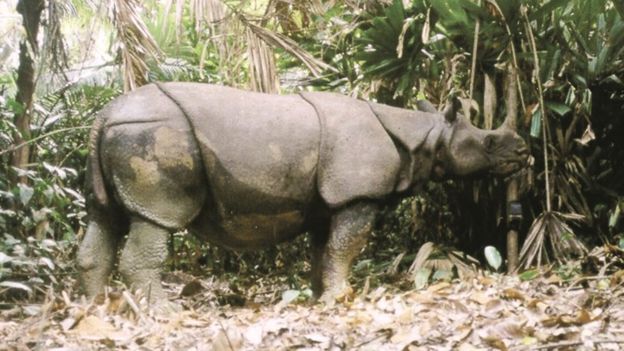
Mostrando postagens com marcador Rinoceronte de Java. Mostrar todas as postagens

sexta-feira, 8 de fevereiro de 2019

We know exactly how the Vietnamese Javan rhino went extinct

In April 2010, the carcass of the last Javan rhino to live in Vietnam was found in Cat Tien National Park. This is the story of the people who investigated the killing
In the dense, hilly jungles of southwest Vietnam, a lone rhino once wandered. She was the last of her subspecies and this was her home.

Cat Loc, a northern sector of Cat Tien National Park, is a part of the world once ravaged by Agent Orange during the Vietnam War. Today it is better known as a wildlife conservation area – but also a place where some of those efforts have failed.

The last rhino spent her days roaming across thousands of hectares, a much wider range than was thought natural for these herbivores. But then again, she had the run of the place. There were creeks and rivers where she could wallow and there was also plenty of food – like rattan, a woody climbing plant found all over the area.
But one day, a hunter peered at her through the sights of a semi-automatic weapon – and pulled the trigger. We do not know if the rhino saw her killer and we do not know how many times she was shot. But as that gunshot cracked out in echoes across the forest, the extinction of Javan rhinos in Vietnam was sealed. However, it did not happen immediately. The rhino, though wounded, managed to escape. And so, for a time, she disappeared into the thick greenery that sustained her.
Crocodile Lake, Cat Tien National Park (Credit: Anders Blomqvist/Alamy)

The fortunes of Javan rhinos in Vietnam, a subspecies called Rhinoceros sondaicus annamiticus, were closely followed at the time by Sarah Brook. Brook was working then as a conservationist for the World Wide Fund for Nature (WWF). Her days were spent struggling through the inhospitable terrain of Cat Loc – steep hills and barely penetrable vegetation – with a sniffer dog, trained to follow the scent of rhino dung.
One day, a hunter peered at her through the sights of a semi-automatic weapon – and pulled the trigger
For nearly six months Brook had been collecting dung samples, on the trail of Javan rhinos in the region, not knowing for sure that there was only one. She worked closely with the national park rangers and set video camera traps.
But the traps were set too late. They never captured footage of the rhino and in all that time, Brook never once saw it alive with her own eyes. The Cat Loc forest is big, and, as it turned out, this rhino was all alone inside it.
In early 2010, distressing news arrived.
A photograph of a Javan rhino in London Zoo in the 19th Century (Credit: T. Dixon/ZSL)
A ranger sent Brook photographs of a rhino skeleton, discovered in April. A photo of the skull, separated from the rest of the animal's bones, clearly showed that the horn had been removed. In fact, it had been crudely hacked off. Poaching.
A crack team of experts from around the world found themselves assembled at the national park
The park had already issued a statement saying that the rhino's death was the result of natural causes, but Brook was not so sure. And, upon checking the bones a few weeks later in May, she discovered a bullet lodged in the left foreleg.
"We wanted to find out what had actually happened and get the truth out," she remembers. "By that time, we already suspected that was actually the last individual."
Brook swung into her investigation and began by trying to find the right people to help.
The bullet wound in the rhino's leg bone (Credit: Ed Newcomer)
She fired off an email to Ulrike Streicher, a wildlife veterinarian who had been living in Vietnam for years. She knew Cat Tien well and had consulted for the WWF before.
They needed to visit the place where the rhino's skeleton had been found
Brook also contacted Ed Newcomer, a special agent from the US Fish and Wildlife Service. He was based in Thailand at the time but leapt at the chance to be involved with a rhino investigation.
John Cooper, a wildlife forensics expert from the UK, and Douglas McCarty, who worked for the anti-wildlife trafficking group Freeland, were also enlisted.
By September, a crack team of experts from around the world found themselves assembled at the national park, in a room filled with biological artefacts. There were display cases and cabinets with everything from casts of rhino footprints to maps of the area, recalls Newcomer. They did not have a specialised veterinary area to work in, but this would have to do.
The first task was to take a look at the recovered bones.
The rhinoceros's bones laid out for forensic examination (Credit: Ed Newcomer)
As one of the rangers presented the bones to the team, Cooper remarked that they looked as though they had been bleached.
It was extremely rugged
"They said, 'oh we bleached those', and I said, 'OK, well there goes the potential to take any samples'," says Streicher. "The only people that dealt with wild animal carcasses in Vietnam were the ones who worked in museums – and their advice would have been to bleach the bones."
Without the possibility of taking samples from the bones for analysis, the job of figuring out a cause of death instantly became much harder. Everyone concurred that they needed to visit the place where the rhino's skeleton had been found. That meant a seven-kilometre trek into thick jungle – and seven kilometres back again.
The team made their way across this terrain on a hot and very humid day. A guide, paced out in front of them, macheted a path through the branches and vines. "It was extremely rugged," remembers Newcomer.
It was Newcomer whose insights were key for this part of the investigation.
The bones laid out for forensic examination (Credit: Ed Newcomer)
Eventually, the ravine where the rhino had been found appeared before them. There was a very steep, heavily forested incline to the north and a shallower incline to the south. Below was a small creek flowing roughly from east to west.
"It was incredibly moving," he recalls. "It hits you like a brick."
"There were still rhino tracks in the dirt," says Newcomer. "And above where the carcass had been found there were these very robust bamboo trees – they were maybe four to six inches [10-15cm] in diameter – and they had been completely pushed over at the base, like a bulldozer had pushed them over."
Newcomer saw one length of bamboo that had broken in a U-shape. Everyone instantly imagined the rhino lying in it, perhaps after falling and getting entangled.
"If it had its belly hanging over those bamboo trees, it probably suffocated," says Newcomer.
Gradually a picture of the death was beginning to emerge. This rhino had been moving around before it died, it had struggled, and it had interacted with the vegetation.
They checked the site for any bones that had not been collected, but found none. Newcomer made some quick sketches of the area, noting the location of key features like the tracks and the spot where the skeleton had been found, relative to the creek.
The scene of the crime (Credit: Ed Newcomer)
As they left the site, Newcomer – the last to leave – turned round to take a picture. He knew he would not be back in person. The possibility that this really was the spot where the Javan rhino in Vietnam finally died out struck him at that moment. He waited a few seconds, looking at the crushed bamboo and the creek below.
"It was incredibly moving," he recalls. "It hits you like a brick."
The rhino did not just die a few days or weeks after being shot. It had taken months
The team hiked back through the jungle. In the afternoon it started to rain, and some of the trek was right through a creek. By the end, they were soaked through and exhausted.
But back at base during the following days, the next task was to reassemble the rhino's skeleton on the floor as accurately as possible. A closer look at the bones could reveal a lot about the animal's health just prior to its death.
Cooper and Streicher were experts in this sort of work. Among other features, they noticed that there were arthritic changes in the left foreleg, which would have caused stiffness and probably pain. There was also less wear on the hoof of this leg, suggesting that it had not been functioning normally.
Cooper has written about this examination in a recent book, Wildlife Forensic Investigation: "It was probably … that the injuries that the bullet caused, culminating in a stiff, painful, arthritic left forelimb, predisposed the rhino to other potentially hazardous, possibly fatal, factors."
Later, Streicher took this particular bone for a computerised tomography (CT) scan. It showed a cavity below and above where the bullet stopped, likely caused by a resulting process of inflammation – osteitis. In a report for the WWF, the investigators noted that this process would have taken at least two months, perhaps as many as five.
The rainforest in Cat Tien National Park (Credit: Oscar Dominguez/Alamy)
Here was a key clue. The rhino did not just die a few days or weeks after being shot. It had taken months. And it was not just wounded for a short time, but injured in a way that impeded its movement and eventually, it seemed, led to its death.
"Animals like this – rhinos, elephants – they can't do without a leg," explains Streicher. "They're too heavy to limp."
Although rhino horn can fetch many thousands of dollars, the horns of Javan rhinos are not very large
Newcomer also noted that, given the entry point of the bullet and its apparent trajectory, it was most likely fired from a poacher who had been positioned below the rhino – perhaps on a hillside – and who was probably aiming for the animal's heart.
It is possible more than one shot struck the creature, but any embedded in or fired through soft tissue rather than driven into bone would not have been found by the team. All they had was the skeleton.
Another unsolved question, then, is that of whether it was the shooter who tracked the injured rhino for months in order to take off its horn – or an opportunistic scavenger who came across the carcass later.
Either way, although rhino horn can fetch many thousands of dollars, the horns of Javan rhinos are not very large. "It easily fits into the palm of your hand – you could fit it in your pocket," says Newcomer as he remarks on the miserable circumstances – a subspecies cast into extinction for the sake of a tiny horn.
A few months later, DNA analysis confirmed that the dung collected earlier by Brook all came from the same animal – and that that animal was indeed the one whose skeleton had been examined.
With so little evidence to go on, it is difficult to be conclusive, but the signs certainly point to the following sequence of events: a poacher shot the rhino at least once; a bullet lodged in the left foreleg caused inflammation, arthritis and reduced mobility; this may or may not have led directly to a fall in the forest near a creek, where the animal finally succumbed.
Whoever shot the rhino and whoever took its horn – whether or not they are the same person – likely remains at large
"The gunshot did kill the rhino," declares Newcomer. "It just took a long time to do it."
Brook later described what happened as a "conservation failure" for Vietnam. "I was quite affected by it, and actually quite depressed afterwards," she recalls. Her main reason for being in Vietnam was to survey the rhino population, and that population was now gone.
The Vietnamese police assisted with the investigation, providing ballistics analysis of the bullet. This suggested it came from a semi-automatic weapon, such as an AK47.
But none of the investigators who spoke to the BBC are aware of any subsequent arrests or convictions. The WWF has said it believes an official investigation remains open. Whoever shot the rhino and whoever took its horn – whether or not they are the same person – likely remains at large.
An illustration of a Javan rhinoceros (Credit: Paul D. Stewart/naturepl.com)
A few Javan rhinos still exist in the world. There is a small population – between 40 and 60 individuals – in Indonesia. But they are listed as critically endangered by the International Union for Conservation of Nature (IUCN). Patrols organised by the International Rhino Foundation and the Rhino Foundation of Indonesia keep a watch on the population, but these groups warn that the size of the habitat available to the rhinos should be expanded to ensure their continued survival.
A ban on international ivory sales has helped to slow, though not halt, the poaching of elephants
Today, Ed Newcomer is stationed in Botswana. He is still very much concerned with the plight of rhinos. Nearby, in South Africa's Kruger National Park, three or four rhinos are poached every day. And there is a bitter irony to the killings.
"Those rhinos are being killed to fuel the demand in Vietnam," he says.
But there is hope. For one thing, as Newcomer points out, humans have been successful at combating poaching before. A ban on international ivory sales has helped to slow, though not halt, the poaching of elephants, for example. A similar ban is in place with regard to rhino horn, though there are still many who challenge local laws.
Brook, who now works for the Wildlife Conservation Society (WCS), notes that for many conservationists in Vietnam, the loss of their last Javan rhino was a profound shock. It may be too late to save that subspecies, but there have since been efforts to focus attention on other endangered rarities.
A saola (Pseudoryx nghetinhensis) (Credit: Reuters/Alamy)
She gives the example of the saola, one of the rarest large mammals in the world. Resembling a small antelope, the saola was only discovered in 1992 and is endemic to Vietnam and Laos.
The loss of this rhino was a tragedy for Cat Tien, but the park's mission is not over yet
"They basically changed their approach to conservation of that species in central Vietnam and established a co-management arrangement with these new protected areas – primarily to protect the saola," explains Brook. "That project has been incredibly successful in terms of removing massive numbers of snares from the landscape."
The horn of the last Javan rhino in Vietnam in all likelihood vanished into the black market. Even if it were found, it couldn't in this case be genetically confirmed as belonging to the examined individual. The perpetrators of this poaching event will probably never be caught.
And yet, in the jungles of southeast Asia, many wonderful creatures still survive – and many flourish. The loss of this rhino was a tragedy for Cat Tien, but the park's mission is not over yet. Right across its 720 sq km, macaques, sun bears, pangolin and rare deer just about pull through. With any luck, they will never cross the poachers' sights out there, deep in the vastness of the forest.
Join over five million BBC Earth fans by liking us on Facebook, or follow us on Twitter and Instagram.
If you liked this story, sign up for the weekly bbc.com features newsletter called "If You Only Read 6 Things This Week". A handpicked selection of stories from BBC Future, Earth, Culture, Capital, Travel and Autos, delivered to your inbox every Friday.

Javan rhino 'now extinct in Vietnam'

  • 25 October 2011
     
     
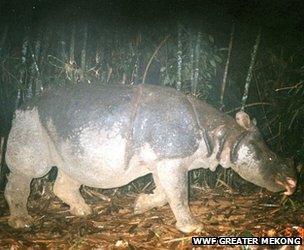
      A Javan rhino is captured on camera in Vietnam's Cat Tien National Park (Image: WWF Greater Mekong)
     
    Image caption Genetic analysis of rhino dung samples revealed that there was only one individual left in Vietnam
    A critically endangered species of rhino is now extinct in Vietnam, according to a report by conservation groups.
    The WWF and the International Rhino Foundation said the country's last Javan rhino was probably killed by poachers, as its horn had been cut off.
    Experts said the news was not a surprise, as only one sighting had been recorded in Vietnam since 2008.

    Fewer than 50 individuals are now estimated to remain in the wild.
    "It is painful that despite significant investment in Vietnamese rhino conservation, efforts failed to save this unique animal, " said WWF's Vietnam director Tran Thi Minh Hien.
    "Vietnam has lost part of its natural heritage."

    The authors of the report, Extinction of the Javan Rhino from Vietnam, said genetic analysis of dung samples collected between 2009-2010 in the Cat Tien National Park showed that they all belonged to just one individual.

    Shortly after the survey was completed, conservationists found out that the rhino had been killed. They say it was likely to have been the work of poachers because it had been shot in a leg and its horn had been cut off.

    Globally, there has been a sharp increase in the number of rhino poaching cases. Earlier this year, the International Union for Conservation of Nature (IUCN) published a report that said rhino populations in Africa were facing their worst poaching crisis for decades.
    An assessment carried out by Traffic, the global wildlife trade monitoring network, said the surge in the illegal trade in rhino horns was being driven by demands from Asian medicinal markets.

    Conservation blow

    The Vietnam rhino, as well as being the last of the species on mainland Asia, was also the last known surviving member of the Rhinoceros sondaicus annamiticus subspecies - one of three recognised groups of Javan rhino populations.
    Another is already extinct. R. sondaicus inermis was formerly found in north-eastern India, Bangladesh and Burma.

    The remaining subspecies, R. sondaicus sondaicus, is now found on Java, Indonesia. However, since the 1930s, the animals - now estimated to number no more than 50 - have been restricted to the westernmost parts of the island.

    Bibhab Kumar Talukdar, chairman of the IUCN's Asian Rhino Specialist Group, said the demise of the Javan rhino in Vietnam was "definitely a blow".
    "We all must learn from this and need to ensure that the fate of the Javan rhino in [Indonesia] won't be like that of Cat Tien in near future," he told BBC News.
    "Threats to rhinos for their horn is definitely a major problem. But in Indonesia, due to active work done by rhino protection units and national park authorities, no Javan rhino poaching has been recorded in Indonesia for past decade."

    Dr Talukdar observed: "What is key to the success of the species is appropriate habitat management as the Javan rhinos are browser and it needs secondary growing forests."
    He warned that the habitat within the national park on Java serving as the final refuge for the species was being degraded by an invasive species of palm.

    "As such, control of arenga palm and habitat management for Javan rhinos in Ujung Kulon National Park is now become important for future of the species."

Anak Krakatau: How a tsunami could wipe out the last Javan rhinos

Image copyright WWF
Image caption The entire species of Javan rhinos could be wiped out by a tsunami
Conservationists have warned that the entire species of the critically endangered Javan rhino could be wiped out if a tsunami were to strike again.
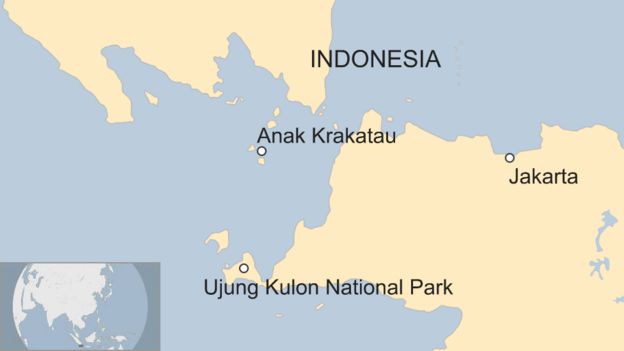
They once roamed the jungles of South East Asia and India, but today only 67 exist in the Ujung Kulon National Park, which was hit by last week's tsunami.
The park sits in the shadow of Anak Krakatau, the volcano which triggered waves that killed hundreds of people.

The volcano remains active and officials are now rushing to move them.
Two park officials were among the 430 killed by the tsunami, and numerous park buildings and ships were also destroyed when the tsunami hit last Saturday.
But the Javan rhinos left in the park - the only ones left in the world - were left unscathed.
The rhinos typically live along the park's south coast and this tsunami hit the north coast - many are keenly aware that the rhinos might not be so lucky if there is another disaster.

An entire species in danger

The Javan rhinos are the most threatened of the five rhino species in the world - and have been listed as Critically Endangered on the IUCN Red List.
They were once found in northeast India and across South East Asia but their population was quickly depleted as a result of poaching, habitat destruction through agriculture, among other factors.


 Javan rhino


Image copyright Wwf
Image caption Only 67 Javan rhinos exist today
According to the WWF, Vietnam's last Javan rhino was poached in 2010.
"As there are no Javan rhinos in captivity anywhere in the world, should we lose this population, we've essentially lost the entire species," said Nicola Loweth, a WWF officer in a statement about the rhinos in Indonesia.


map

The search for the perfect location

Anak Krakatau began showing increased signs of volcanic activity since June earlier this year.
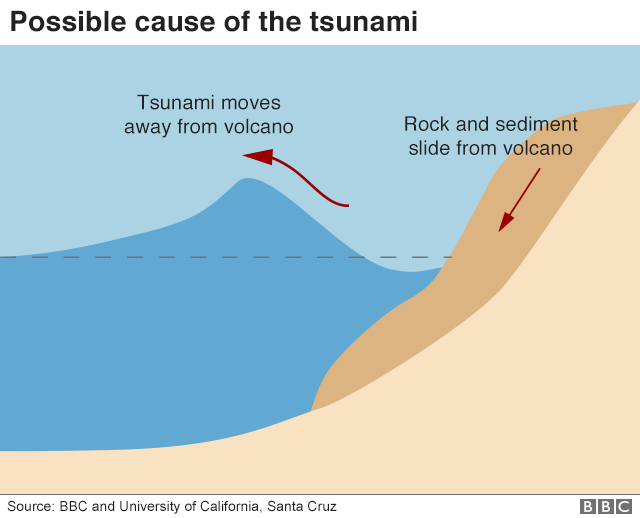
But it was last Saturday that volcanic activity from Anak Krakatau is believed to have set off undersea landslides, triggering a tsunami that has killed at least 430 people so far.


tsunami graphic
Authorities say Anak Krakatau is still active, and is in fact becoming increasingly active with what are known as Strombolian eruptions - short lived, explosive blasts of lava - being emitted.
"We understand that we cannot let the Javan rhinos live only in Ujung Julon," Widodo Sukohadi Ramono, chairman of the Rhino Foundation of Indonesian (YABI) told BBC News Indonesia.
Mr Ramono added that there were plans in place to move a smaller group of rhinos to a secondary location, though there was "a lot [to be taken into] consideration".
The rhinos which would be moved would have to be in good health, have close ties to each other and able to reproduce.
But moving the rhinos to another location is easier said than done.
The new location would have to have more than 200 species of plants - food sources for the Javan rhino. It would also need to have a plentiful water supply, an ideal soil type, land condition and a place with a year-round wet climate.
"It's difficult to find the perfect location... we need at least five thousand hectares in one location. It has to provide [the rhinos] with [suitable] food, water. We need to know what diseases exist there, if there are predators, how supportive the local community is," the head of TNUK, Mamat Rahmat told BBC News Indonesia.
Image copyright Getty Images
Image caption The Javan rhinos need to live in a year-long wet climate
Government officials have been looking for years to find a suitable second location for the Javan rhinos. They were supposed to have found one in 2017 - but this never materialised.
"Sometimes the plan [does not] work out," said Mr Mamat. "There are many obstacles, technical factors, internal constraints and external factors [to take into consideration]."
Mr Mamat adds that the government has surveyed 10 possible locations, of which one has arisen as a suitable candidate - the Cikepuh Wildlife Reserve in West Java.
However, this was not without its problems.
"There is an agreement [there] with the army about the use of land for combat drills. We need to do further studies on how the [sound] of guns and cannons could [impact] the rhinos."
Human activity also exists around the wildlife reserve - which could put the rhinos at risk.
Image copyright Getty Images
Image caption A rhino footprint at the Ujung Kulon National Parl
The plan to move to the Cikepuh Wildlife Reserve appears to have stalled, but after the recent tsunami officials are once again moving with urgency.
"We [will] take more steps quickly in preparing a second habitat [for the rhinos]," said Mr Mamat.
"If one day Ujung Kulon is hit by an eruption, then [we would hope] there would still be reserves [of Javan rhinos] in a new place."
Reporting by BBC Indonesia's Rivan Dwiastono. You can read the story on BBC News Indonesia.

segunda-feira, 26 de março de 2018

Why It Matters When Species Go Extinct

Animal extinction can effect entire ecosystems and in turn the world.

Javan rhino
Javan rhinos are the most threatened of the five rhino species, with only 60 individuals surviving in Ujung Kulon National Park in Java, Indonesia. Mary Plage/Getty Images
We are surrounded by endangered species every day. Majestic tigers grace posters on bedroom walls, stuffed toy pandas stare blankly from shopping mall shelves; with the click of a button, we can watch the elaborate courtship rituals of whooping cranes and the strategic hunting habits of the Amur leopard on the Discovery Channel. No matter where we look, images and information about the world's rarest animals are readily available, but do we ever stop to think about the effects endangered species have on their environments, what happens after they disappear?


Let's face it, few of us have crossed paths with a real, live endangered species today — one that is teetering on a tightrope of existence, ready to slip into the chasm of extinction, like the Santa Barbara Song Sparrow or the Jovan Rhino, much less consider the implications of their loss.

So, does it really matter if an animal goes extinct when we can still watch it on television, even after it's gone? A single species' disappearance can, in fact, make a huge difference on a global scale. Like pieces of yarn in a woven tapestry, the removal of one can start unraveling the whole system.

The Worldwide Web

Before the internet, the "worldwide web" could have referred to the intricate systems of connections between living organisms and their environments. We often call it the food web, although it encompasses many more factors than just diet. The living web, like a tapestry, is held together not by tacks or glue, but by interdependence — one strand stays in place because it is entwined with many others.

The same concept keeps our planet working. Plants and animals (including humans) depend on each other as well as microorganisms, land, water, and climate to keep our entire system alive and well.
Remove one piece, one species, and small changes lead to big problems that aren't easy to fix. In the words of the World Wildlife Fund, "When you remove one element from a fragile ecosystem, it has far-reaching and long-lasting effects on biodiversity."

Balance and Biodiversity

Many endangered species are top predators whose numbers are dwindling due to conflicts with humans. We kill predators all over the world because we fear for our own lives as well as pets and livestock, we compete with them for prey and we destroy their habitats to expand our communities and agricultural operations.

Take for example the effect human intervention had on the gray wolf and the subsequential effects their dwindling population numbers had on its environment and biodiversity.
Before a mass extermination effort in the U.S. that decimated wolf populations in the first half of the 20th century, wolves kept other animals' populations from growing exponentially. They hunted elk, deer, and moose and also killed smaller animals such as coyotes, raccoons, and beavers.
Without wolves to keep other animals' numbers in check, prey populations grew larger. Exploding elk populations in the western United States wiped out so many willows and other riparian plants that songbirds no longer had sufficient food or cover in these areas, threatening their survival and increasing numbers of insects like mosquitos that the songbirds were meant to control.
"Oregon State University scientists point to the intricacy of the Yellowstone ecosystem," reported EarthSky in 2011.

"The wolves prey on the elk, for example, which in turn graze on young aspen and willow trees in Yellowstone, which in their turn provide cover and food for songbirds and other species. As the elks' fear of wolves has increased over the past 15 years, elk 'browse' less — that is, eat fewer twigs, leaves, and shoots from the park's young trees — and that is why, the scientists say, trees and shrubs have begun recovering along some of Yellowstone's streams. These streams are now providing improved habitat for beaver and fish, with more food for birds and bears."
But it's not only large beasts of prey that can impact the ecosystem in their absence, small species can have just as big of an effect.

Extinctions of Small Species Matter, Too

While the losses of large, iconic species like the wolf, tiger, rhino, and polar bear may make for more stimulating news stories than the disappearance of moths or mussels, even small species can affect ecosystems in significant ways.

Consider the meager freshwater mussel: There are nearly 300 species of mussel in North American river and lakes, and most of them are threatened. How does this affect the water we all depend on?
"Mussels play an important role in the aquatic ecosystem," explains the U.S. Fish and Wildlife Service. "Many different kinds of wildlife eat mussels, including raccoon, otters, herons and egrets. Mussels filter water for food and thus are a purification system. They are usually present in groups called beds. Beds of mussels may range in size from smaller than a square foot to many acres; these mussel beds can be a hard 'cobble' on the lake, river, or stream bottom which supports other species of fish, aquatic insects and worms."
In their absence, these dependent species settle elsewhere, lower the available food source for their predators and in turn causing those predators to leave the area. Like the gray wolf, even the small mussel's disappearance acts like a domino, toppling the entire ecosystem one related species at a time.

Keeping the Web Intact

We may not see wolves on a regular basis, and nobody really wants a poster of a Higgins eye pearly mussel on the wall, but the presence of these creatures is interwoven with the environment we all share. Losing even a small strand in the web of life contributes to the unraveling of our planet's sustainability, the fine balance of biodiversity that affects each and every one of us.

sexta-feira, 17 de maio de 2013

Rhino populations in Sumatra, Borneo should be combined to save Sumatran rhino from extinction

mongabay.com
May 15, 2013


A new study argues for treating endangered Sumatran populations in Borneo and Sumatra as "a single conservation unit", lending academic support to a controversial proposal to move wild rhinos from Malaysia to Indonesia.

The paper, authored by an international team of rhino experts and published in the journal Oryx, says that genetic differences between the island populations are minimal. Given the dire straights of the species — the wild population is estimated at less than 100 individuals — the researchers argue that ensuring the Sumatran rhino's survival takes precedence over preserving what little genetic diversity remains between populations.

"In our paper, we discuss the pros and cons of considering the populations of Sumatran rhinoceros from Sumatra and Borneo as a single management unit," said study lead author Benoit Goossens, Director of the Danau Girang Field Centre in Malaysia, in a statement. "For a species such as the Sumatran rhinoceros, where time is of the essence in preventing extinction, we must ask to what extent should genetic and geographical distances be taken into account in deciding the most urgently needed conservation interventions."

"Genetic differences are minimal and we strongly believe that the observed differences do not justify keeping the Sumatran and Bornean populations as separate management units."


Puntung, a female Sumatran rhinoceros, in forest stockade in Sabah, Malaysian Borneo a day after her capture in December 2011.


Goossens pointed to the situation with the Javan rhino as an example of the pitfalls of prioritizing genetic diversity over conservation for a species that is so close to extinction.

"Despite clear results demonstrating that the Ujung Kulon (Indonesia) and Cat Tien (Vietnam) populations represented separate evolutionary significant units it was argued that demographic considerations should override genetic issues in the short term. The Indonesian and Vietnamese governments were urged to exchange Javan rhinoceroses before it was too late. No action was taken and, in Cat Tien National Park, the last individual in Vietnam was found dead in April 2010," Goossens said. "We certainly do not want the same thing to happen to the Sumatran rhinoceros and we therefore strongly recommend to act now and exchange gametes such as semen and ovocytes (and possibly individuals) between the captive populations of Sumatran rhinoceros in Sabah (Tabin), Sumatra (Way Kambas) and Cincinnati Zoo, when it is still possible."

The paper comes less than two months after conservationists meeting at the Sumatran Rhino Crisis Summit in Singapore agreed on a similar course of action.


12-year old Ratu and her new born baby Andalu, at the Sumatran Rhino Sanctuary at Way Kambas National Park, Sumatra. It is only the fourth known case of a Sumatran rhino being born in captivity in 100 years.


The population of Sumatran rhinos has declined precipitously in recent years and is now estimated at less than 100 individuals scattered across forests in Sumatra and Borneo. While habitat loss and poaching have historically been the biggest threats to the species, today the largest challenge for wild Sumatran rhinos may be in finding a mate since population densities are so low. Therefore some conservationists believe aggregating rhinos in reserves that are strictly protected may be the best hope for the species. Efforts to facilitate breeding might also be necessary to accelerate the rhino's recovery, according to some experts.

“With a species so close to the edge, extinction is guaranteed without two essential elements of human effort. One is to have full and open collaboration between the relevant governments, so that decisions are made on the basis of best scientific advice rather than on nationalism or pride. I think such an intent was achieved at the Summit," said study co-author John Payne, executive director of the Borneo Rhino Alliance (BORA), which conceptualized and organized the summit with a dozen other groups involved in rhino conservation. “The other is that all possible advanced reproductive technologies are used to boost rhino births, and that we do not just rely on natural breeding, which will be too slow to halt the trajectory towards zero rhinos.”

Laurentius Ambu, director of the Sabah Wildlife Department, said that Malaysia is already considering transferring a young captive male rhino to the United States to breed with a female at the Cincinnati Zoo.

"We understand the need to exchange gametes between countries, Malaysia and Indonesia. Actions to initiate genome resource banking and artificial insemination or in vitro fertilization are underway in Sabah and elsewhere," he said in a statement. "We are seriously considering sending Tam, our captive male rhinoceros, to Cincinnati Zoo in the US to breed with their mature female. By doing so, we will make an historical step towards the survival of one of the most charismatic, ancient and enigmatic large mammals; a species that Sabah is not prepared to see extinct!"


CITATION: Benoît Goossens et al (2013). Genetics and the last stand of the Sumatran rhinoceros Dicerorhinus sumatrensis. Oryx DOI: http://dx.doi.org/10.1017/S0030605313000045 (About DOI), Published online: 09 May 2013

terça-feira, 5 de junho de 2012

Endangered species: Sex and the single rhinoceros

Conservationists are taking heroic measures to restore the fertility of a three-footed Sumatran rhino. But some ask whether this is the right way to save an endangered species.
Puntung, a female Sumatran rhino, is part of captive breeding efforts in Malaysia.
STEPHEN HOGG WILDTRACK PHOTOGRAPHY
First, the vet inserts his arm in a shoulder-length plastic glove. Next, he grips an ultrasound probe and slides both arm and probe deep into the rectum of a 500-kilogram rhinoceros. All eyes of those present, including his, are on the ultrasound image on the laptop monitor nearby. As the vet moves the probe over the animal's intestinal wall, her uterus comes into view on the screen. Even to the untrained eye, it is clear that there is something seriously wrong: marble-sized cysts fill the space where there should be a smooth uterine lining. As if in acknowledgement of the fact, the rhino lets out a doleful moan.

This is Puntung, a Sumatran rhinoceros that is missing a foot as well as a working uterus. Yet the future of this species in Malaysian Borneo may rest on the hairy shoulders of this singular beast. If she is ever to reproduce, she will need Thomas Hildebrandt and his veterinary team from the Leibniz Institute for Zoo and Wildlife Research (IZW) in Berlin to rescue her womb — and then push the boundaries of rhino assisted-reproduction to new extremes.

According to the latest best guess, only 200–300 Sumatran rhinos (Dicerorhinus sumatrensis) may be left in the wild, split between three territories in southeast Asia: the Indonesian island of Sumatra, Peninsular Malaysia and the state of Sabah in Malaysian Borneo (see 'The remaining rhinos'). This perilous situation is a result of a devastating combination of habitat loss (mainly to create lucrative oil-palm plantations) and poaching (to feed the black market for rhino horn). Conservationists say that the species' small, fragmented population is now the biggest threat to its survival1, with animals so sparsely distributed that they are simply unable to meet each other to mate. Because females that haven't mated when they are in oestrus can develop problems with their uterus, the rare encounters that do take place often come to naught. At best, rhino mothers take several years between pregnancies — meaning that the birth rate in the wild is unlikely to keep up with poaching and natural deaths.

Freelance journalist Henry Nicholls travels to Borneo to meet 'Stumpy', the three-legged Sumatran rhino with a damaged uterus.
Some conservationists believe that the future of her highly endangered species depends on bringing in the last few remaining individuals for captive breeding. Others, however, question whether these expensive measures are worthwhile.
Watch this crack team of German vets perform surgery on Stumpy, in an effort to repair her troubled uterus.

Drastic measures

This desperate situation has led conservationists in Sabah to a desperate conclusion: that the only way to maintain the rhino population here is to capture as many as possible of the remaining animals — which may number as few as 30 — and subject them to assisted reproductive technology. That includes scrubbing out the uterus of Puntung, and possibly techniques such as in vitro fertilization (IVF) and cloning, the likes of which have rarely been wielded in the name of conservation. “Either we give up or we try to make every fertile rhino contribute to the future of this species,” says John Payne, executive director of the Borneo Rhino Alliance (BORA) in Kota Kinabalu, Sabah. “The best way to do that is to bring them into fenced, managed facilities.”
SOURCE: REF. 1

Such a drastic attempt to rescue a highly endangered species has precedents. Conservationists have, through heroic efforts, wrestled species such as the Arabian oryx (Oryx leucoryx), the black-footed ferret (Mustela nigripes) and the California condor (Gymnogyps californianus) back from the brink of extinction by bringing all the remaining animals together, using artificial insemination to spread sperm and maximize genetic diversity, and keeping offspring alive through round-the-clock husbandry.
In the case of the Sumatran rhino, however, some conservationists worry that without a long-term strategy for reversing the environmental pressures that are killing them off, captive breeding alone can never restore the wild population. “It's not a plan unless you've mitigated the threats that wiped them out in the first place,” says Alan Rabinowitz, chief executive of the wild-cat conservation group Panthera in New York city. Others are uncomfortable with throwing so much money and effort at a single species — a single animal, in Puntung's case — when the chances of success are so slim. “One of the biggest challenges facing conservation today is our inability to step back and admit that there are animals that would take a little bit less work and a little bit less money but have the potential to survive for their genetic diversity into the future,” says John Fraser, chief executive of the New Knowledge Organization in New York city, a think tank and advocate of a triage response to species conservation. “They may not be as charismatic, but quite frankly we have to admit that some species are not going to make it and it's really, really sad.”
Puntung got her name, which translates roughly as 'Stumpy', in 2007, when a ranger in the Tabin Wildlife Reserve in eastern Sabah came across her distinctive three-footed tracks. It is thought that she must have lost her foot to a poacher's snare as a calf, and that her mother nursed her back to hobbling fitness. “If she had been even two years of age, the wound that she has would not have healed over,” says Zainal Zahari Zainuddin, BORA's field manager, on-site vet and the person closest to Puntung.

In April 2010, the Sabah Wildlife Department and BORA began a joint operation to catch her. It was the first push in an effort to bring as many as possible of Sabah's remaining rhinos into captivity. But it was only after 20 frustrating months that she finally walked into a trap. On Christmas Day 2011, a helicopter airlifted Puntung to her current home in a temporary captive facility within the reserve. Payne estimates that the entire operation, including the cost of hiring the helicopter and constructing her enclosure, set BORA back more than US$250,000.

With Puntung apparently in her reproductive prime, and with a lone male called Tam in residence since 2008, there was hope that the pitter-patter of tiny rhino feet might soon follow. It was something of a setback, then, when ultrasound scans carried out by Hildebrandt and his team in February showed that Puntung's uterus was riddled with cysts that would make any full-term pregnancy near impossible. Her ruptured hymen suggests an explanation. “We think she must have mated in the wild, got pregnant, but with her handicap was unable to sustain the fetus and it died in utero,” says Hildebrandt, who specializes in the assisted reproduction of endangered mammals and has been involved with Sabah's rhinos since 2004. The failed pregnancy led to the cysts. “Such pathology is not uncommon in rhinos,” Hildebrandt says, “but is rarely this bad.

A decade ago, this might have been the moment to give up. But reproductive medicine has advanced at such a pace that there are still options for Puntung, particularly as she seems to be relatively young — with as many as 10 years of reproductive life ahead of her — and her ovulatory cycle seems to be normal.
At the end of March, Hildebrandt and two of his IZW colleagues flew back to Sabah on a uterine-rescue mission, accompanied by huge suitcases filled with veterinary paraphernalia: green scrubs, anaesthetics, antibiotics, drips, probes, a carbon-fibre catheter patented by Hildebrandt and his colleagues for the insemination of rhinos, and a gun case containing a 2-metre-long video endoscope tailor-made to fit Puntung's reproductive tract.

Once in the Tabin reserve, the IZW vets, BORA staff, including Payne and Zahari, and the Sabah Wildlife Department's chief field vet assemble in a hut beneath the glare of fluorescent strip lighting to be briefed on the impending procedure. If all goes to plan, explains Hildebrandt, he will insert the endoscope into Puntung's uterus and attempt to lance some of the cysts, particularly ones that are preventing sperm from entering the oviducts. That might smooth the way for insemination — either artificially or by Tam — followed quickly by the collection of fertilized embryos before they implant. By repeating the procedure every month for the rest of her reproductive life, it might be possible to harvest as many as 100 embryos, freezing them in liquid nitrogen to be implanted into surrogate females in years to come.
With everyone's questions answered, Hildebrandt and his team wheel their equipment out into the rain. The croak of thousands of invisible amphibians falls suddenly silent as the vets pass by on the way to Puntung's enclosure.

Rare breed

Past efforts to breed Sumatran rhinos in captivity have been spectacularly unsuccessful. Between 1984 and 1993, at least 35 wild rhinos were taken into captivity across the region without the birth of a single calf. Zoologists knew little about the reproductive rhythms of rhinos, breeding facilities rarely housed a good mix of males and females, and disagreements over whether the Sabah rhino was a subspecies of the Sumatran rhino meant that there was little cooperation between Indonesia and Malaysia and even between Peninsular Malaysia and Malaysian Borneo. The fruitless attempts frustrated some conservationists, including Rabinowitz. In a frank essay2 published in 1995, he accused the conservation community of “helping a species go extinct” by placing too much emphasis on captive breeding of the Sumatran rhino at the expense of “the more difficult job of protection and management in the field”.
“We have to admit that some species are not going to make it and it's really, really sad.”
The case for captive breeding may be stronger now. “In Peninsular Malaysia, the species is either extinct or about to go extinct,” Payne says. And in Sabah “the numbers are so low, that no method exists to find out how many are now left”. In the 1980s, when he was working in what is now the Tabin Wildlife Reserve, he recalls coming across rhino footprints within a matter of days in the field. “At best we can now find old rhino footprints perhaps once or twice per year,” he says.
Meanwhile, captive breeding has scored some successes. In 2001, Cincinnati Zoo announced3 the first Sumatran rhino to be born in captivity since 1889. The same star breeding pair, on loan from Indonesia, went on to produce two more calves. “We had to learn how to feed this species, we had to learn about its reproductive physiology, and thank goodness we started as early as we did because now it looks like [captive breeding] is a serious need for the species,” says Terri Roth, director of the zoo's Center for Conservation and Research of Endangered Wildlife, which works closely with Indonesia's Sumatran Rhino Sanctuary in Way Kambas National Park.
There are also signs of greater cooperation between captive facilities. At a March meeting of the Sumatran Rhinoceros Global Management and Propagation Board in Jakarta, all parties put their signature to a “Letter of Intent for Collaboration”. This puts aside past taxonomic differences, and acknowledges that all captive animals should be part of a single, globally managed breeding programme and that captive facilities will share sperm and embryos “based on availability and need”. Testifying to this new entente cordiale, the Sabah Wildlife Department has agreed to send semen collected from Tam to Cincinnati Zoo to attempt artificial insemination of a young female when she reaches sexual maturity. But with just ten animals in captivity worldwide — three at Cincinnati Zoo, four at the Sumatran Rhino Sanctuary and three in the Tabin reserve — more animals will need to be caught in Sumatra to establish a viable captive population, says Roth. “We need to pull them in and manage them intensively and make sure as many of them breed as possible,” she says.
Rabinowitz acknowledges the greater urgency for captive breeding, but disputes whether the data on population size, sex ratio and breeding success in the wild are good enough to say that wild populations are in terminal decline or that captive breeding — “an absolute last resort”, he says — is the only option. “When you lack information and just say there's no hope, then you're really writing the end of the book.”

Operation uterus

Before her ultrasound scan, the unsuspecting Puntung is lured into a small pen by a bucketful of diced bananas. Hildebrandt's colleague Frank Göritz loads a syringe with a dose of sedative calculated to send her into a standing anaesthesia, then reaches through the bars to plunge the needle through her sparsely haired hide. Within seconds, she has relaxed into a sling, which supports her bulk and makes it easier to insert an endoscope into her uterus than if she were lying down.

When Robert Hermes, the third member of the team, slides his gloved arm into Puntung's rectum she barely flinches. She has undergone a period of intensive coaching to tolerate medical procedures. Now, it is impossible to tell that she's undergoing a transrectal ultrasound scan, were it not for the vet squatting at her rear.

Almost an hour later, however, the first signs of stress are showing — though not from Puntung. The ultrasound is over and Hildebrandt is struggling to insert the carbon-fibre catheter into her uterus. On his knees, with his right arm deep in her vagina and his cheek brushing up against her buttocks, his face is a picture of concentration and his scrubs are darkening with sweat. Puntung's cervix, tightly constricted owing to the phase of her menstrual cycle, is proving a serious obstacle to the catheter.
Thomas Hildebrandt (front) and his team carry out an ultrasound examination on Puntung.

H. NICHOLLS

Eventually, Hildebrandt triumphs and is able to flush out the uterus with a sterile cell medium, which will be tested for any underlying infection. With the cervix so narrow, there is no hope of moving on to the bigger-bored endoscope, but before Hildebrandt removes the catheter he injects a highly concentrated penicillin solution. This will destroy any pathogenic bacteria, and is so concentrated that it may actually strip away some of the lining and cysts, possibly making it easier to attempt fertilization and embryo collection. Hildebrandt has successfully used this approach to boost the fertility of two tigers and a leopard4.

If it doesn't work, the favoured next step is to carry out a similar procedure at a future date, but to inject a more caustic chemical such as kerosene to attack the cysts. This carries a risk. The team has to make sure that the treatment “is not so aggressive that it destroys the uterus”, Hildebrandt says.
Before the vets call it a wrap, there is still time to take a cast of Puntung's stump, which will be used to fashion a prosthetic foot. This will allow her to move around with greater comfort. If she ever gets a chance to mate with Tam, the foot will also be handy for supporting his weight on her back during the half-hour encounter.
Even if embryo collection proves unsuccessful, it might not be the end of the road for Puntung. It should be possible to collect immature eggs, by inserting a fine needle through the wall of her rectum and into her ovaries. The challenge is getting them to mature and fertilize in vitro. The IZW vets have attempted this with white and black rhinos5. They obtained 29 eggs and managed to fertilize one, but the embryo did not progress beyond the four-cell stage. The only attempt to harvest eggs in Sumatran rhinos — from Cincinnati Zoo's star female just after her death in 2009 — was unsuccessful6.
There are other, more futuristic options. In theory, Puntung could be cloned, taking a nucleus from one of her cells and injecting it into an egg stripped of its own DNA. That rhino eggs are in short supply needn't be a problem, says Pasqualino Loi, a reproductive biologist at the University of Teramo in Italy, who, more than a decade ago, used domestic sheep as a source of eggs and surrogates to clone an endangered sheep relative, the mouflon7. “Play around,” he suggests. “Inject some rhino mitochondria and a nucleus into a horse egg.” It's just possible, says Loi, that it could result in a viable embryo that could be successfully nurtured to term by a surrogate mare.

Pursuing another strategy, scientists at San Diego Zoo in California last year showed that banked tissue from the almost extinct northern white rhino (Ceratotherium simum cottoni) could be induced to form a line of pluripotent stem cells, capable of forming many tissues8. It's possible that these cells could be used to generate working gametes, using the same techniques that have produced sperm in mice9.
Hildebrandt advocates natural mating before attempting IVF or other reproductive technologies, but he is already starting to bank rhino tissue. With part of a €500,000 (US$640,000) grant from the German Federal Ministry of Education and Research awarded in December 2010, he established a cryo-bank facility in Kota Kinabalu. In it are fibroblasts from Tam and Gelogob, a blind and elderly female rhino in captivity at the Tabin Wildlife Reserve. Cells from Puntung will join them shortly. “If we can't find the solutions, then people after us can,” Hildebrandt says. “We have the responsibility to make it available to the next generation.”
At Cincinnati Zoo, Emi lies back with her calf, one of only three Sumatran rhinos born in captivity since 1889.
M. SIMONS/GETTY
Yet the chance that such technologies will succeed in a species like the Sumatran rhino, whose basic biology is still poorly understood, seems remote. Roth says that tissue banking “is not a priority compared with some of the other issues we're up against”. And the Indonesian government's action plan for rhino conservation, spanning 2007–17, contains no mention of tissue banking10.
Money, too, is in short supply. It is a stinging irony that by far the biggest donor to BORA is the Sime Darby Foundation, the philanthropic arm of the Sime Darby Group, based in Kuala Lumpur, one of the world's biggest producers of palm oil, the crop that led to the destruction of much of the rhino's rainforest home. It has committed a further $2 million to fund BORA's operations up to 2015 and after that the charity is on its own. “This is a bit of a worry,” admits Payne. Hildebrandt says that his grant from the German government has expired. He knows that he needs some demonstrable success with Puntung to get more. “If we are not successful in the next few months, then I think the programme is over,” he says.
Other conservation biologists argue that it already is. Even if assisted reproductive technologies do prove possible, Fraser asks how long the new animals would survive. “My concern is that [the Sumatran rhino's] future viability as a species on this planet and the future viability of any offspring is really in question because the habitat just isn't there. So I question the priority setting, although I can certainly understand the emotional state of those invested in saving the animal.
Puntung, of course, is oblivious to the emotions and the debate. The operation over, Göritz injects her again to reverse the effect of the anaesthesia and within minutes she is out of the sling. Zahari enters the enclosure and unfurls a hose to spray her down. It's a ritual she clearly enjoys, raising her neck to meet the droplets of water as they rain down.
Puntung can savour a few weeks of rest and bananas, before science's next assault on her infertility.
Nature
485,
566–569
()
doi:10.1038/485566a

References

  1. Ahmad Zafir, A. W. et al. Oryx 45, 225233 (2011).
    Show context
  2. Rabinowitz, A. Conserv. Biol. 9, 482488 (1995).
    Show context
  3. Roth, T. L., Bateman, H. L., Kroll, J. L., Steinetz, B. G. & Reinhart, P. R. Zoo Biol. 23, 219238 (2004).
    Show context
  4. Hildebrandt, T. B. et al. Theriogenology 66, 17831786 (2006).
    Show context
  5. Hermes, R. et al. Theriogenology 72, 959968 (2009).
    Show context
  6. Stoops, M. A., Bateman, H. L., Campbell, M. K. & Roth, T. L. J. Zoo Wildl. Med. 42, 723726 (2011).
    Show context
  7. Loi, P. et al. Nature Biotechnol. 19, 962964 (2001).
    Show context
  8. Ben-Nun, I. F. et al. Nature Methods 8, 829831 (2011).
    Show context
  9. Hayashi, K., Ohta, H., Kurimoto, K., Aramaki, S. & Saitou, M. Cell 146, 519532 (2011).
    Show context
  10. Ministry of Forestry of the Republic of Indonesia Strategy and Action Plan for the Conservation of Rhinos in Indonesia (Jakarta, 2007); available at go.nature.com/ssdt2t.
    Show context

Author information

Affiliations

  1. Henry Nicholls is a freelance journalist based in London. His most recent book is The Way of the Panda.