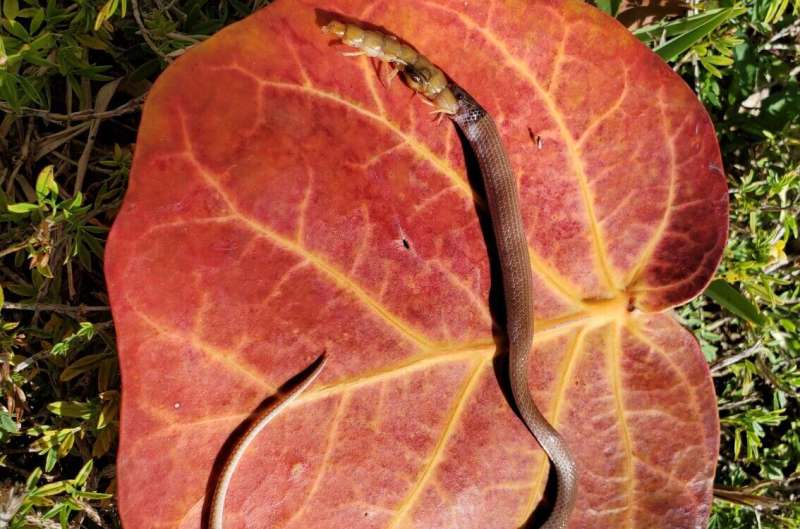
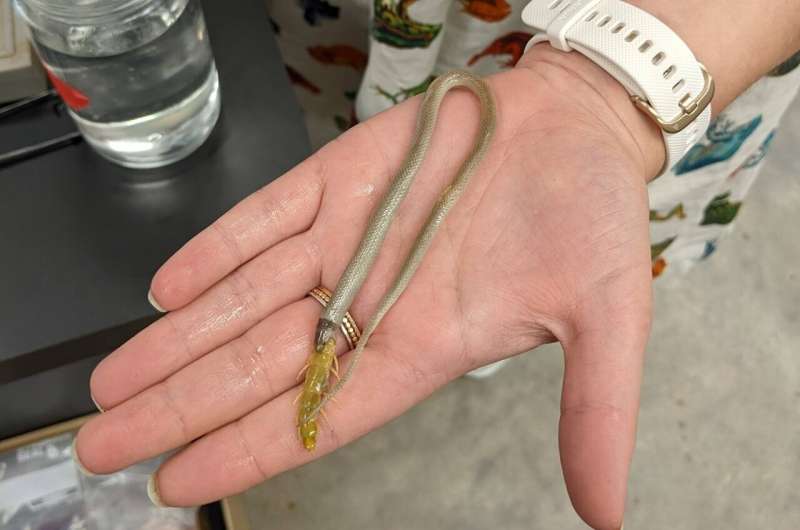
A cobra coroada de pedra da borda foi encontrada morta em Florida Keys, travada em um combate sem vida com uma centopéia gigante que conseguiu engolir no meio do caminho. Crédito: Drew Martin
A serpente mais rara da América do Norte, Tantillaoolitica (cobra coroada pela rocha), foi vista recentemente em um parque nas Florida Keys após um hiato de quatro anos. Embora isso normalmente seja motivo de comemoração entre os conservacionistas, o avistamento da cobra foi mais uma fonte de admiração incrédula do que qualquer outra coisa. A serpente foi encontrada morta, travada em combate sem vida com uma centopeia gigante que conseguiu engolir no meio do caminho.
O duelo fatal marca a primeira vez que os cientistas observam os hábitos alimentares da cobra . Sabe-se que espécies intimamente relacionadas têm preferência por centopeias, mas a T. oolitica é tão raramente vista que, até agora, ninguém tinha uma ideia definida do que ela comia. Pesquisadores do Museu de História Natural da Flórida criaram tomografias computadorizadas do par entrelaçado e publicaram seus resultados neste domingo na revista Ecology .
"Fiquei impressionado quando vi as fotos pela primeira vez", disse o coautor Coleman Sheehy, gerente da coleção de herpetologia do Museu da Flórida. “É extremamente raro encontrar espécimes que morreram enquanto comiam presas, e dada a raridade dessa espécie, eu nunca teria previsto encontrar algo assim.
A cobra foi inicialmente encontrada ao lado de uma trilha por um caminhante no John Pennekamp Coral Reef State Park, em Key Largo, que alertou a equipe do parque. O espécime rapidamente chegou ao Museu da Flórida, onde os pesquisadores esperavam determinar a causa exata da morte.
A explicação mais óbvia, dado que a centopéia tinha um terço do tamanho da cobra, seria asfixia. Mas as cobras são conhecidas por devorar presas muito maiores do que elas. Ao contrário das mandíbulas em humanos e na maioria dos outros vertebrados, que estão diretamente ligados ao crânio, as mandíbulas das cobras são mantidas no lugar por ligamentos e músculos flexíveis que lhes permitem envolver a cabeça em torno da comida.
Para ter certeza, os pesquisadores precisariam dar uma olhada no interior. No passado, isso exigiria uma dissecção, o que causa danos irreversíveis que podem dificultar estudos futuros. Mais recentemente, no entanto, os cientistas se voltaram para a tecnologia de tomografia computadorizada, que fornece uma visão incomparável da anatomia de um organismo sem alterar fisicamente o espécime.
Jaimi Gray, um associado de pós-doutorado no museu, corou a cobra com uma solução de iodo para melhorar o contraste de seus tecidos internos e construiu um modelo 3D em escala fina a partir de tomografias computadorizadas.
O duelo fatal marca a primeira vez que os cientistas observam os hábitos alimentares da cobra. Crédito: Museu da Flórida/Jerald Pinson
“Conseguimos realizar uma autópsia digital, que nos permitiu examinar a centopeia e a serpente, incluindo seus ferimentos e conteúdo intestinal, sem nunca pegar um bisturi”, disse ela. Após a digitalização, o espécime foi descolorido e agora permanece intacto nas prateleiras da coleção do Museu da Flórida para futuros pesquisadores estudarem.
O modelo revelou uma pequena ferida no lado da cobra, provavelmente causada pelas poderosas pinças venenosas da centopeia. Acredita-se que as cobras que costumam comer centopeias têm alguma resistência à mistura de veneno cáustico, mas essa suposição ainda não foi definitivamente demonstrada, disse Sheehy. A mordida parecia causar algum sangramento interno , mas nem isso nem a toxina foram suficientes para impedir a cobra de matar e engolir parcialmente sua presa.
Em vez disso, o golpe final parece ter sido dado pelo tamanho da centopeia. Uma inspeção minuciosa das tomografias mostra que a traqueia da cobra foi pinçada no local aproximado onde a circunferência da centopeia era maior, cortando seu suprimento de ar.
Os resultados oferecem um vislumbre íntimo de uma espécie que muitos temem estar à beira da extinção. Tantilla oolitica uma vez prosperou em terrenos rochosos de pinheiros que se espalharam do sul da Flórida Central até as Keys, mas desde então sofreram uma severa redução no tamanho da população. A espécie foi listada como ameaçada na Flórida desde 1975, e os esforços estão em andamento pelo Serviço de Pesca e Vida Selvagem dos EUA para que a espécie seja listada federalmente.
Os ecossistemas rochosos de pinheiros evoluíram por milhões de anos ao longo da espinha de um antigo recife de coral, abrigando uma longa lista de plantas e animais raros encontrados em nenhum outro lugar da Terra. Mas os mesmos atributos que promoveram o crescimento de florestas hiperdiversas também fizeram desta parte da Flórida um lugar ideal para construir vilas e cidades. Hoje, uma expansão ininterrupta de desenvolvimento, de Miami a West Palm Beach, substituiu quase inteiramente os ecossistemas nativos. Fora dos Everglades, apenas 2% das terras rochosas de pinheiros originais permanecem. Para animais endêmicos de florestas de pinheiros, como T. oolitica, as novas paisagens urbanas significaram quase aniquilação.
"Não podemos dizer com certeza se eles ainda estão ou não presentes na península da Flórida. Ausência de evidências não é evidência de ausência, mas seu habitat foi basicamente destruído", disse Sheehy.
Por enquanto, os pesquisadores estão encorajados pelo que parece ser uma população um tanto estável de T. oolitica em Key Largo e planejam fazer o máximo uso possível do novo espécime. As tomografias computadorizadas estão disponíveis online gratuitamente e não faltam novas informações que podem ser obtidas a partir delas.
De acordo com Sheehy, qualquer pessoa interessada neste espécime pode acessar os dados da tomografia computadorizada para observar outros aspectos da anatomia da cobra e, como esta é a primeira tomografia computadorizada da espécie, eles serão as primeiras pessoas a fazer essas descobertas. "Este estudo é apenas o começo do que será aprendido sobre esta espécie enigmática a partir dos dados de tomografia computadorizada", disse ele.
Quando a população de pinguins-imperadores foi contada pela última vez
em Île aux Cochons, ou Ilha dos Porcos, em 1982, havia 500.000 casais
reprodutores, tornando-se a maior colônia desse tipo no mundo (acima).
Agora, apenas 3 décadas depois, a população despencou 90%, segundo o New
York Times.
Pesquisadores notaram o declínio quando estavam sobrevoando
a ilha em 2016. Eles então usaram imagens de satélite tiradas ao longo
de 30 anos para estimar que apenas 60 mil casais foram deixados,
informam este mês na Antarctic Science.
Eles sugerem que as mudanças
climáticas, doenças, competição por recursos e um evento El Niño em 1997
podem ser razões para o declínio, o que poderia levar os pinguins para a
lista de espécies ameaçadas de extinção.
Endangered snow leopards and rare Himalayan wolves may be
giving conservationists in Nepal a new kind of headache. Although both
species prefer dining on wild prey, a new study shows they consume far
more livestock than realized, a burden on the migrating herders who let
their goats, yaks, cows, and horses wander—often unaccompanied—in the
region’s mountain pastures. To find out whether the wild predators were
helping themselves to the occasional domesticated animal meal,
scientists collected 573 scats from 182 leopards (Panthera uncial, shown above) and 236 scats from 57 wolves (Canis lupo chanco)
at 26 sites spread across 5000 square kilometers of mountain terrain in
the Annapurna and Manaslu conservation areas. Their genetic analysis
showed that wild blue sheep called bharal comprised 57% of the leopards’
diet, whereas small mammals such as marmots and hares made up the bulk
of the wolves’ meals, at 41%.
The canids also ate Tibetan gazelles and
other ungulates, which made up 31% of their diet. Next on the list was
livestock, making up 24% of the wolves’ diets and 27% of the leopards’, the scientists report today in PLOS ONE.
The spotted cats seem to prefer horses and goats, whereas the wolves
favor goats, horses, cows, and yaks—an animal the leopards avoid,
perhaps because of its size. Males are the primary livestock killers,
possibly because females are more wary, the scientists say. The findings
come as no surprise to the scientists, who predicted that the predators
would eat more livestock when wild prey was scarce—a behavior common to
big wild cats like tigers, lions, and cougars. But they also worry that
the predators’ taste for domesticated animals will make it harder to
protect them from humans seeking revenge. One solution? Building up the
populations of the leopards’ and wolves’ wild prey.
Lançamento do e-book "Livro Vermelho dos Crustáceos do Brasil"
Obra conta com a participação de docente do Câmpus do Litoral Paulista
[22/11/2016]
No
dia 09 de novembro, durante o IX Congresso Brasileiro sobre Crustáceos,
ocorreu o lançamento do “Livro Vermelho dos Crustáceos do Brasil:
Avaliação 2010 – 2014”, organizado pelos carcinólogos Marcelo Pinheiro
(docente da Unesp IB/CLP) e Harry Boos (analista do CEPSUL/ICMBio).
Esta
obra, constitui o primeiro livro publicado pela Sociedade Brasileira de
Carcinologia (SBC), em formato e-book, fato que foi ressaltado pelo
presidente desta associação, o Prof. Dr. Sergio Rocha, que destacou:
“Além da qualidade e mérito inquestionável na publicidade dessas
importantes informações aos carcinólogos e público em geral, a SBC
realiza sua primeira publicação”.
A
obra foi escrita por 58 autores, sendo composta por 34 capítulos,
totalizando 466 páginas, que tratam da avaliação do risco de extinção
das 255 espécies de crustáceos brasileiros, avaliadas no período de 2010
a 2014. O Prof. Marcelo Pinheiro, um dos organizadores da obra e
Coordenador de Taxon (Crustacea) perante o Ministério do Meio Ambiente
(MMA), destaca que este e-book marca parte do extenso trabalho conduzido
pelo Instituto Chico Mendes (ICMBio), sendo o Brasil um dos poucos
países com megadiversidade do mundo que tiveram todas as espécies de
animais vertebrados e, seletivamente, as principais espécies
invertebradas, totalizando 12.254 espécies.
“Por este motivo,
tivemos grande honra em participar deste extenso e gratificante
trabalho, que deixa nas páginas deste e-book um legado inicial deste
processo para os crustáceos brasileiros”, afirma o Prof. Marcelo
Pinheiro.
Harry Boos mencionou durante o evento que “a obra não trouxe qualquer ônus para a SBC, que atuou como editora deste e-book com ISBN e que passou por um Comitê Editorial”.
Este comitê foi composto por quatro carcinólogos não autores, a saber:
Dra. Andrea Freire (UFSC), Dr. Carlos Rocha (USP/IB), Dra. Cristiana
Serejo (MN/UFRJ) e Dra. Tereza Calado (UFAL).
O
e-book tem o prefácio redigido pelo Sr. Marcelo Marcelino de Oliveira,
Diretor de Pesquisa, Avaliação e Monitoramento da Biodiversidade do
ICMBio, que destaca a importância da obra. “Parabenizo o empenho
dos autores e organizadores na síntese das informações utilizadas,
disponibilizando-as de forma acessível à toda sociedade. Certamente,
este belo livro encontrará o reconhecimento que merece, não apenas entre
os especialistas em crustáceos, mas também entre todos aqueles que
buscam a conservação da biodiversidade brasileira”. O
e-book inteiro, ou seus capítulos separadamente, estão disponíveis para
download gratuito no site da Sociedade Brasileira de Carcinologia
(SBC). Um ícone para download indireto também está disponível no site da
Unesp IB/CLP, com igual finalidade.
Marcio Camargo Araújo João (discente de graduação da Unesp IB/CLP)
quarta-feira, 6 de maio de 2015
Novo macaco nas árvores da Amazônia
Pesquisadores descrevem nova espécie de primata da floresta
amazônica. Embora recém-descoberto, o animal já pode estar correndo
risco de extinção pela perda de seu hábitat devido ao desmatamento.
Por: Everton Lopes
Publicado em 05/05/2015
|
Atualizado em 05/05/2015
Zogue-zogue-rabo-de-fogo (‘Callicebus miltoni’), o mais novo
primata do Brasil, foi encontrado na Amazônia. (foto: Júlio César
Dalponte.
A recente descoberta de um primata na Amazônia, o zogue-zogue-rabo-de-fogo (Callicebus miltoni),
demonstra que ainda há muito para se conhecer sobre a região.
O animal
foi primeiro avistado no estado de Mato Grosso em 2011. Agora,
pesquisadores do Instituto para a Conservação dos Carnívoros
Neotropicais (Pró-Carnívoros), do Instituto de Desenvolvimento
Sustentável Mamirauá e do Museu Paraense Emílio Goeldi publicaram a
descrição completa da espécie na revista científica Papéis Avulsos de Zoologia.
Silva: “A característica mais marcante da espécie é sua cauda avermelhada, cor de tijolo, por isso o nome ‘rabo de fogo’”.
Durante uma expedição científica pelo interior da Amazônia em 2011, pesquisadores avistaram um primata do gênero Callicebus,
típico da floresta amazônica e da mata atlântica. Mas o exemplar
apresentava algumas peculiaridades visíveis, o que sugeria se tratar de
uma nova espécie. “A característica mais marcante da espécie é sua cauda
avermelhada, cor de tijolo, por isso o nome ‘rabo de fogo’. Essa mesma
coloração é encontrada ainda na região ventral do animal até a altura do
pescoço”, descreve Felipe Ennes Silva, biólogo do Instituto de
Desenvolvimento Sustentável Mamirauá que participou da descoberta.
Para confirmar que era uma nova espécie, foram realizadas comparações
de coloração da pelagem e de medidas do corpo e do crânio do animal com
as de outras espécies do gênero. “O padrão de coloração peculiar já foi
suficiente para constatarmos que se tratava de uma espécie nova”, conta
Silva. “Posteriormente, uma análise molecular comparando o material
genético de C. miltoni com o de espécies vizinhas também confirmou sua singularidade.”
Ilustração de três
espécies diferentes do gênero ‘Callicebus’. O padrão peculiar de
coloração da pelagem foi suficiente para distinguir o
zogue-zogue-rabo-de-fogo (no centro) como uma nova espécie. (ilustração:
Stephen Nash)
O zogue-zogue-rabo-de-fogo ocorre em uma área de cerca de 4.921.540
hectares que vai do norte do Mato Grosso ao sul do Amazonas, entre os
rios Aripuanã e Roosevelt.
Embora os pesquisadores ainda não tenham dados de campo a respeito do
comportamento da espécie, os animais desse gênero costumam viver em
pequenos grupos, de dois a seis indivíduos, que geralmente têm um
filhote por ano (esses grupos, em geral, apresentam apenas uma fêmea
reprodutiva). Os Callicebus têm cerca de 30 centímetros de
comprimento, possuem hábitos arborícolas e diurnos e a sua alimentação
consiste principalmente de frutos.
Já ameaçado
Apesar de recém-descoberto, o zogue-zogue-rabo-de-fogo já pode estar
correndo risco de extinção. De acordo com Silva, a perda de hábitat é
fator crítico para a manutenção da espécie.
Silva: “A região onde essa espécie se encontra sofre uma grande pressão do
desmatamento causado por motivos diversos, como o corte seletivo de
árvores para fins comerciais”
“A região onde essa espécie se encontra sofre uma grande pressão do
desmatamento causado por motivos diversos, como o corte seletivo de
árvores para fins comerciais”, destaca o biólogo. “Obras para a
construção de estradas e hidrelétricas na área também devem influenciar o
status de conservação dessa espécie em longo prazo. Somente
nos rios Aripuanã e Roosevelt, sete hidrelétricas estão previstas para
serem implementadas nos próximos anos”, alerta.
O pesquisador ressalta a importância da realização de expedições
científicas para se obter cada vez mais conhecimento sobre a nossa
biodiversidade e, assim, permitir a elaboração de medidas de
conservação. “Os primatas neotropicais estão entre os grupos de nossa
fauna de que mais temos informações e ainda estamos nos surpreendendo
com novos dados provenientes de trabalhos de campo”, comenta. “Se
considerarmos grupos menos estudados, chegaremos à conclusão de que
temos uma tarefa gigante pela frente, de proporções realmente
amazônicas”, encerra o biólogo.
Everton Lopes Ciência Hoje On-line
quarta-feira, 1 de maio de 2013
Another leap towards the Barometer of Life
10 November 2011 | International news release
The latest update of The IUCN Red List of Threatened
Species™ illustrates the efforts undertaken by IUCN (International Union
for Conservation of Nature) and its partners to expand the number and
diversity of species assessed, improving the quality of information in
order to obtain a better picture of the state of biodiversity. With now
more than 61,900 species reviewed, another big step forward has been
made toward developing the IUCN Red List into a true ‘Barometer of
Life,’ as called for by leading experts in the magazine Science in 2010.
“This update offers both good and bad news on the status of many species around the world,” says Jane Smart, Director, IUCN Global Species Programme.
“We have the knowledge that conservation works if executed in a timely
manner, yet, without strong political will in combination with targeted
efforts and resources, the wonders of nature and the services it
provides can be lost forever.”
Despite the action of conservation programmes, 25% of mammals are at
risk of extinction. For example, the reassessments of several Rhinoceros
species show that the subspecies of the Black Rhino in western Africa,
the Western Black Rhino (Diceros bicornis longipes) has officially been declared Extinct. The subspecies of the White Rhino in central Africa, the Northern White Rhino (Ceratotherium simum cottoni) is currently teetering on the brink of extinction and has been listed as Possibly Extinct in the Wild. The Javan Rhino (Rhinoceros sondaicus) is also making its last stand, as the subspecies Rhinoceros sondaicus annamiticus
is probably Extinct, following the poaching of what is thought to be
the last animal in Viet Nam in 2010. Although this is not the end of the
Javan Rhino, it does reduce the species to a single, tiny, declining
population on Java. A lack of political support and will power for
conservation efforts in many rhino habitats, international organized
crime groups targeting rhinos and increasing illegal demand for rhino
horns and commercial poaching are the main threats faced by rhinos.
“Human beings are stewards of the earth and we are responsible for protecting the species that share our environment,” says Simon Stuart, Chair of the IUCN Species Survival Commission.
“In the case of both the Western Black Rhino and the Northern White
Rhino the situation could have had very different results if the
suggested conservation measures had been implemented. These measures
must be strengthened now, specifically managing habitats in order to
improve breeding performance, preventing other rhinos from fading into
extinction.”
Several conservation successes have already been achieved including the Southern White Rhino subspecies (Ceratotherium simum simum),
which has increased from a population of less than 100 at the end of
the 19th century, to an estimated wild population of over 20,000. The
Przewalski’s Horse (Equus ferus) is another success story,
improving its status from Critically Endangered to Endangered.
Originally, it was listed as Extinct in the Wild in 1996, but thanks to a
captive breeding programme and a successful reintroduction programme,
the population is now estimated at more than 300.
Reptiles make up a significant component of biodiversity,
particularly in dryland habitats and on islands around the world. In
recent years, many more reptile species have been assessed including
most of those found in Madagascar. The current Red List reveals that an
alarming 40% of Madagascar’s terrestrial reptiles are threatened.
The 22
Madagascan species currently identified as Critically Endangered, which
include chameleons, geckoes, skinks and snakes, are now a conservation
challenge. This new information helps inform biodiversity planning and
allows for an evaluation of the protection that protected areas in
Madagascar offer reptiles. Encouragingly, there are new conservation
areas being designated in Madagascar that will help conserve a
significant proportion of Critically Endangered species, such as
Tarzan’s Chameleon (Calumma tarzan), the Bizarre-nosed Chameleon (Calumma hafahafa) and the Limbless Skink (Paracontias fasika).
Because of their IUCN Red List status, species which have traditionally
been overlooked in conservation efforts, such as the Endangered geckos Paroedura masobe and Uroplatus pietschmanni will now be featured more prominently in future plans.
Plants are an essential resource for human well-being and are a
critical component for wildlife habitats, yet they are still
underrepresented on the IUCN Red List. Current work underway to increase
knowledge includes a review of all Conifers. The results so far uncover
some disturbing trends. The Chinese Water Fir (Glyptostrobus pensilis),
for example, which was formerly widespread throughout China and Viet
Nam has moved from Endangered to Critically Endangered. The main cause
of decline is the loss of habitat to expanding intensive agriculture and
in China there appear to be no wild plants remaining. The largest group
of recently discovered Chinese Water Fir in LAO PDR was killed through
flooding for a newly constructed hydro scheme and very few, if any, of
the trees in Viet Nam produce viable seeds, meaning that this species is
rapidly moving towards becoming Extinct in the Wild. Another example, Taxus contorta,
which is used to produce Taxol, a chemotherapy drug, has moved from
Vulnerable to Endangered due to over-exploitation for medicinal use and
over-collection for fuel wood and fodder. Many other tropical plant
species are also at risk. The majority of endemic flowering plants in
the granitic Seychelles islands have been assessed and current studies
show that of the 79 endemic species, 77% are at risk of extinction. Most
of these are new assessments but one species, the infamous Coco de Mer (Lodoicea maldivica)
has been uplisted from Vulnerable to Endangered. Known for its supposed
aphrodisiac properties, the Coco de Mer faces threats from fires and
illegal harvesting of its kernels. Presently, all collection and sale of
its seed is highly regulated, but there is thought to be a significant
black market trade in the kernels.
The IUCN Red List keeps apace with scientific discoveries—for
example, until recently only one species of Manta Ray was known, but new
comparisons of field observations now reveal that there are actually
two species of ‘manta’: the Reef Manta Ray (Manta alfredi) and the Giant Manta Ray (Manta birostris),
both of which are now classified as Vulnerable. The Giant Manta Ray is
the largest living ray, which can grow to more than seven meters across.
Manta Ray products have a high value in international trade markets and
targeted fisheries hunt them for their valuable gill rakers used in
traditional Chinese medicine. Monitoring and regulation of the
exploitation and trade of both manta ray species is urgently needed, as
well as protection of key habitats.
The results of the assessments of all species of scombrids (tunas,
bonitos, mackerels and Spanish mackerels) and billfishes (swordfish and
marlins) were published recently in the magazine Science. The detailed
results now on the IUCN Red List show that the situation is particularly
serious for tunas.
Five of the eight species of tuna are in the
threatened or Near Threatened categories. These include: Southern
Bluefin (Thunnus maccoyii), Critically Endangered; Atlantic Bluefin (T. thynnus), Endangered; Bigeye (T. obesus), Vulnerable; Yellowfin (T. albacares), Near Threatened; and Albacore (T. alalunga),
Near Threatened. This information will be invaluable in helping
governments make decisions which will safeguard the future of these
species, many of which are of extremely high economic value.
The assessment for the Sockeye Salmon (Oncorhynchus nerka),
an iconic salmon species found in the North Pacific, was recently
reviewed. Whilst the species’ global status remains the same, Least
Concern, the assessment at the subpopulation scale shows elevated
threats to the species in its North America habitats, with 31% of the
assessed subpopulations threatened, underscoring the need for continued
conservation action.
Amphibians form a vital role in ecosystems, are indicators of
environmental health, and are literally ‘hopping pharmacies’ being used
in the search for new medicines. As one of the most threatened groups,
amphibians are closely monitored by IUCN and 26 recently discovered
Amphibians have been added to the IUCN Red List. The Blessed Poison Frog
(Ranitomeya benedicta) is currently listed as Vulnerable and the Summers’ Poison Frog (Ranitomeya summersi) is Endangered. Both are threatened by habitat loss and harvesting for the international pet trade.
“The IUCN Red List is critical as an indicator of the health of
biodiversity, in identifying conservation needs and informing necessary
changes in policy and legislation to drive conservation forward,” says Jean-Christophe Vié, Deputy Director of IUCN’s Global Species Programme.
“The world is full of marvelous species that are rapidly moving towards
becoming things of myth and legend if conservation efforts are not more
successfully implemented—if we do not act now, future generations may
not know what a Chinese Water Fir or a Bizarre-nosed Chameleon look
like.” Quotes from IUCN Red List partner organizations
“Red list assessments are essential for guiding conservation action.
Botanic gardens around the world use the IUCN Red List to prioritize
which species to study, grow, conserve and restore in the wild,” says Dr Sara Oldfield, Secretary General of Botanic Gardens Conservation International. “The latest update shows that we need to act urgently.”
“Protected areas are essential for conservation of Madagascar’s many reptiles and other threatened endemic species,” says Russell Mittermeier, Conservation International President and Vice President of IUCN.
“Indeed without them, few of these unique creatures would survive. We
are still far from understanding the full diversity of Madagascar’s
fauna and flora since species new to science are being discovered every
year.”
"There are 380,000 species of plants named and described, with about
2,000 being added to the list every year. At Kew we estimate one in five
of these are likely to be under threat of extinction right now, before
we even factor in the impacts of climate change,” says Dr Tim Entwisle, Director, Conservation, Living Collections and Estates, the Royal Botanic Gardens, Kew.
“The Red Listing process highlights the state of knowledge for some of
the critical groups like conifers and is the first step towards
understanding and dealing with one of the biggest problems we have to
face in the 21st Century - species extinction. For plants we are
calibrating the Barometer of Life; for their relatives, the fungi and
algae, we still have little sense of what is out there and what we are
losing."
“Each update of the IUCN Red List brings both encouraging and
discouraging news. First it demonstrates that concentrated conservation
actions, backed by solid natural and social science and local
engagement, will result in successful efforts to conserve threatened
species,” says Thomas E. Lacher, Jr., Professor of Wildlife and Fisheries Sciences, Texas A&M University.
“However it also demonstrates that there is much still to accomplish,
with worsening conditions for many species, including those only
recently described.”
“It is clear to me that society now has the capability to reverse species declines,” says Prof Jonathan Baillie, Director of Conservation Programmes at ZSL. “Fundamentally, it is our values that need to change if we are to avert the looming extinction crisis.”
“Expanding both the number and diversity of species assessed on the
IUCN Red List is imperative if we are to conserve the natural world.”
says Richard Edwards, Chief Executive of Wildscreen,
who are working with the IUCN to help raise the public profile of the
world’s threatened species, through the power of wildlife and
environmental imagery. “We need to address our disconnection from the
natural world, and will only succeed in rescuing species from the brink
of extinction, if we successfully communicate their plight,
significance, value and importance.”
For more information or interviews please contact:
Maggie Roth, IUCN Media Relations, t +41 22 999 0115, m +41 79 104 2460, e maggie.roth@iucn.org
Lynne Labanne, IUCN Species Programme Communications Officer, IUCN, t +41 22 999 0153, m +41 79 527 7221, e lynne.labanne@iucn.org
Camellia Williams, IUCN Species Programme Communications, IUCN, t +41 22 999 0154, e camellia.williams@iucn.org
terça-feira, 5 de junho de 2012
Endangered species: Sex and the single rhinoceros
Conservationists are taking heroic measures to restore the
fertility of a three-footed Sumatran rhino. But some ask whether this is
the right way to save an endangered species.
Puntung, a female Sumatran rhino, is part of captive breeding efforts in Malaysia.
STEPHEN HOGG WILDTRACK PHOTOGRAPHY
First, the vet inserts his arm in a shoulder-length
plastic glove. Next, he grips an ultrasound probe and slides both arm
and probe deep into the rectum of a 500-kilogram rhinoceros. All eyes of
those present, including his, are on the ultrasound image on the laptop
monitor nearby. As the vet moves the probe over the animal's intestinal
wall, her uterus comes into view on the screen. Even to the untrained
eye, it is clear that there is something seriously wrong: marble-sized
cysts fill the space where there should be a smooth uterine lining. As
if in acknowledgement of the fact, the rhino lets out a doleful moan.
This is Puntung, a Sumatran rhinoceros that is missing a
foot as well as a working uterus. Yet the future of this species in
Malaysian Borneo may rest on the hairy shoulders of this singular beast.
If she is ever to reproduce, she will need Thomas Hildebrandt and his
veterinary team from the Leibniz Institute for Zoo and Wildlife Research
(IZW) in Berlin to rescue her womb — and then push the boundaries of
rhino assisted-reproduction to new extremes.
According to the latest best guess, only 200–300 Sumatran rhinos (Dicerorhinus sumatrensis)
may be left in the wild, split between three territories in southeast
Asia: the Indonesian island of Sumatra, Peninsular Malaysia and the
state of Sabah in Malaysian Borneo (see 'The remaining rhinos').
This perilous situation is a result of a devastating combination of
habitat loss (mainly to create lucrative oil-palm plantations) and
poaching (to feed the black market for rhino horn). Conservationists say
that the species' small, fragmented population is now the biggest
threat to its survival1,
with animals so sparsely distributed that they are simply unable to
meet each other to mate. Because females that haven't mated when they
are in oestrus can develop problems with their uterus, the rare
encounters that do take place often come to naught. At best, rhino
mothers take several years between pregnancies — meaning that the birth
rate in the wild is unlikely to keep up with poaching and natural
deaths.
Freelance journalist Henry Nicholls travels to Borneo to meet 'Stumpy', the three-legged Sumatran rhino with a damaged uterus. Some
conservationists believe that the future of her highly endangered
species depends on bringing in the last few remaining individuals for
captive breeding. Others, however, question whether these expensive
measures are worthwhile. Watch this crack team of German vets perform surgery on Stumpy, in an effort to repair her troubled uterus.
Drastic measures
This desperate situation has led conservationists in Sabah
to a desperate conclusion: that the only way to maintain the rhino
population here is to capture as many as possible of the remaining
animals — which may number as few as 30 — and subject them to assisted
reproductive technology. That includes scrubbing out the uterus of
Puntung, and possibly techniques such as in vitro fertilization
(IVF) and cloning, the likes of which have rarely been wielded in the
name of conservation. “Either we give up or we try to make every fertile
rhino contribute to the future of this species,” says John Payne,
executive director of the Borneo Rhino Alliance (BORA) in Kota Kinabalu,
Sabah. “The best way to do that is to bring them into fenced, managed
facilities.”
Such a drastic attempt to rescue a highly endangered
species has precedents. Conservationists have, through heroic efforts,
wrestled species such as the Arabian oryx (Oryx leucoryx), the black-footed ferret (Mustela nigripes) and the California condor (Gymnogyps californianus)
back from the brink of extinction by bringing all the remaining animals
together, using artificial insemination to spread sperm and maximize
genetic diversity, and keeping offspring alive through round-the-clock
husbandry.
In the case of the Sumatran rhino, however, some
conservationists worry that without a long-term strategy for reversing
the environmental pressures that are killing them off, captive breeding
alone can never restore the wild population. “It's not a plan unless
you've mitigated the threats that wiped them out in the first place,”
says Alan Rabinowitz, chief executive of the wild-cat conservation group
Panthera in New York city. Others are uncomfortable with throwing so
much money and effort at a single species — a single animal, in
Puntung's case — when the chances of success are so slim. “One of the
biggest challenges facing conservation today is our inability to step
back and admit that there are animals that would take a little bit less
work and a little bit less money but have the potential to survive for
their genetic diversity into the future,” says John Fraser, chief
executive of the New Knowledge Organization in New York city, a think
tank and advocate of a triage response to species conservation. “They
may not be as charismatic, but quite frankly we have to admit that some
species are not going to make it and it's really, really sad.”
Puntung got her name, which translates roughly as
'Stumpy', in 2007, when a ranger in the Tabin Wildlife Reserve in
eastern Sabah came across her distinctive three-footed tracks. It is
thought that she must have lost her foot to a poacher's snare as a calf,
and that her mother nursed her back to hobbling fitness. “If she had
been even two years of age, the wound that she has would not have healed
over,” says Zainal Zahari Zainuddin, BORA's field manager, on-site vet
and the person closest to Puntung.
In April 2010, the Sabah Wildlife Department and BORA
began a joint operation to catch her. It was the first push in an effort
to bring as many as possible of Sabah's remaining rhinos into
captivity. But it was only after 20 frustrating months that she finally
walked into a trap. On Christmas Day 2011, a helicopter airlifted
Puntung to her current home in a temporary captive facility within the
reserve. Payne estimates that the entire operation, including the cost
of hiring the helicopter and constructing her enclosure, set BORA back
more than US$250,000.
With Puntung apparently in her reproductive prime, and
with a lone male called Tam in residence since 2008, there was hope that
the pitter-patter of tiny rhino feet might soon follow. It was
something of a setback, then, when ultrasound scans carried out by
Hildebrandt and his team in February showed that Puntung's uterus was
riddled with cysts that would make any full-term pregnancy near
impossible. Her ruptured hymen suggests an explanation. “We think she
must have mated in the wild, got pregnant, but with her handicap was
unable to sustain the fetus and it died in utero,” says
Hildebrandt, who specializes in the assisted reproduction of endangered
mammals and has been involved with Sabah's rhinos since 2004. The failed
pregnancy led to the cysts. “Such pathology is not uncommon in rhinos,”
Hildebrandt says, “but is rarely this bad.
A decade ago, this might have been the moment to give up.
But reproductive medicine has advanced at such a pace that there are
still options for Puntung, particularly as she seems to be relatively
young — with as many as 10 years of reproductive life ahead of her — and
her ovulatory cycle seems to be normal.
At the end of March, Hildebrandt and two of his IZW
colleagues flew back to Sabah on a uterine-rescue mission, accompanied
by huge suitcases filled with veterinary paraphernalia: green scrubs,
anaesthetics, antibiotics, drips, probes, a carbon-fibre catheter
patented by Hildebrandt and his colleagues for the insemination of
rhinos, and a gun case containing a 2-metre-long video endoscope
tailor-made to fit Puntung's reproductive tract.
Once
in the Tabin reserve, the IZW vets, BORA staff, including Payne and
Zahari, and the Sabah Wildlife Department's chief field vet assemble in a
hut beneath the glare of fluorescent strip lighting to be briefed on
the impending procedure. If all goes to plan, explains Hildebrandt, he
will insert the endoscope into Puntung's uterus and attempt to lance
some of the cysts, particularly ones that are preventing sperm from
entering the oviducts. That might smooth the way for insemination —
either artificially or by Tam — followed quickly by the collection of
fertilized embryos before they implant. By repeating the procedure every
month for the rest of her reproductive life, it might be possible to
harvest as many as 100 embryos, freezing them in liquid nitrogen to be
implanted into surrogate females in years to come.
With everyone's questions answered, Hildebrandt and his
team wheel their equipment out into the rain. The croak of thousands of
invisible amphibians falls suddenly silent as the vets pass by on the
way to Puntung's enclosure.
Rare breed
Past efforts to breed Sumatran rhinos in captivity have
been spectacularly unsuccessful. Between 1984 and 1993, at least 35 wild
rhinos were taken into captivity across the region without the birth of
a single calf. Zoologists knew little about the reproductive rhythms of
rhinos, breeding facilities rarely housed a good mix of males and
females, and disagreements over whether the Sabah rhino was a subspecies
of the Sumatran rhino meant that there was little cooperation between
Indonesia and Malaysia and even between Peninsular Malaysia and
Malaysian Borneo. The fruitless attempts frustrated some
conservationists, including Rabinowitz. In a frank essay2
published in 1995, he accused the conservation community of “helping a
species go extinct” by placing too much emphasis on captive breeding of
the Sumatran rhino at the expense of “the more difficult job of
protection and management in the field”.
“We have to admit that some species are not going to make it and it's really, really sad.”
The case for captive breeding may be stronger now. “In
Peninsular Malaysia, the species is either extinct or about to go
extinct,” Payne says. And in Sabah “the numbers are so low, that no
method exists to find out how many are now left”. In the 1980s, when he
was working in what is now the Tabin Wildlife Reserve, he recalls coming
across rhino footprints within a matter of days in the field. “At best
we can now find old rhino footprints perhaps once or twice per year,” he
says.
Meanwhile, captive breeding has scored some successes. In 2001, Cincinnati Zoo announced3
the first Sumatran rhino to be born in captivity since 1889. The same
star breeding pair, on loan from Indonesia, went on to produce two more
calves. “We had to learn how to feed this species, we had to learn about
its reproductive physiology, and thank goodness we started as early as
we did because now it looks like [captive breeding] is a serious need
for the species,” says Terri Roth, director of the zoo's Center for
Conservation and Research of Endangered Wildlife, which works closely
with Indonesia's Sumatran Rhino Sanctuary in Way Kambas National Park.
There are also signs of greater cooperation between
captive facilities. At a March meeting of the Sumatran Rhinoceros Global
Management and Propagation Board in Jakarta, all parties put their
signature to a “Letter of Intent for Collaboration”. This puts aside
past taxonomic differences, and acknowledges that all captive animals
should be part of a single, globally managed breeding programme and that
captive facilities will share sperm and embryos “based on availability
and need”. Testifying to this new entente cordiale, the Sabah
Wildlife Department has agreed to send semen collected from Tam to
Cincinnati Zoo to attempt artificial insemination of a young female when
she reaches sexual maturity. But with just ten animals in captivity
worldwide — three at Cincinnati Zoo, four at the Sumatran Rhino
Sanctuary and three in the Tabin reserve — more animals will need to be
caught in Sumatra to establish a viable captive population, says Roth.
“We need to pull them in and manage them intensively and make sure as
many of them breed as possible,” she says.
Rabinowitz acknowledges the greater urgency for captive
breeding, but disputes whether the data on population size, sex ratio
and breeding success in the wild are good enough to say that wild
populations are in terminal decline or that captive breeding — “an
absolute last resort”, he says — is the only option. “When you lack
information and just say there's no hope, then you're really writing the
end of the book.”
Operation uterus
Before her ultrasound scan, the unsuspecting Puntung is
lured into a small pen by a bucketful of diced bananas. Hildebrandt's
colleague Frank Göritz loads a syringe with a dose of sedative
calculated to send her into a standing anaesthesia, then reaches through
the bars to plunge the needle through her sparsely haired hide. Within
seconds, she has relaxed into a sling, which supports her bulk and makes
it easier to insert an endoscope into her uterus than if she were lying
down.
When Robert Hermes, the third member of the team, slides
his gloved arm into Puntung's rectum she barely flinches. She has
undergone a period of intensive coaching to tolerate medical procedures.
Now, it is impossible to tell that she's undergoing a transrectal
ultrasound scan, were it not for the vet squatting at her rear.
Almost an hour later, however, the first signs of stress
are showing — though not from Puntung. The ultrasound is over and
Hildebrandt is struggling to insert the carbon-fibre catheter into her
uterus. On his knees, with his right arm deep in her vagina and his
cheek brushing up against her buttocks, his face is a picture of
concentration and his scrubs are darkening with sweat. Puntung's cervix,
tightly constricted owing to the phase of her menstrual cycle, is
proving a serious obstacle to the catheter.
Thomas Hildebrandt (front) and his team carry out an ultrasound examination on Puntung.
H. NICHOLLS
Eventually, Hildebrandt triumphs and is able to flush out
the uterus with a sterile cell medium, which will be tested for any
underlying infection. With the cervix so narrow, there is no hope of
moving on to the bigger-bored endoscope, but before Hildebrandt removes
the catheter he injects a highly concentrated penicillin solution. This
will destroy any pathogenic bacteria, and is so concentrated that it may
actually strip away some of the lining and cysts, possibly making it
easier to attempt fertilization and embryo collection. Hildebrandt has
successfully used this approach to boost the fertility of two tigers and
a leopard4.
If it doesn't work, the favoured next step is to carry out a similar
procedure at a future date, but to inject a more caustic chemical such
as kerosene to attack the cysts. This carries a risk. The team has to
make sure that the treatment “is not so aggressive that it destroys the
uterus”, Hildebrandt says.
Before the vets call it a wrap, there is still time to
take a cast of Puntung's stump, which will be used to fashion a
prosthetic foot. This will allow her to move around with greater
comfort. If she ever gets a chance to mate with Tam, the foot will also
be handy for supporting his weight on her back during the half-hour
encounter.
Even if embryo collection proves unsuccessful, it might
not be the end of the road for Puntung. It should be possible to collect
immature eggs, by inserting a fine needle through the wall of her
rectum and into her ovaries. The challenge is getting them to mature and
fertilize in vitro. The IZW vets have attempted this with white and black rhinos5.
They obtained 29 eggs and managed to fertilize one, but the embryo did
not progress beyond the four-cell stage. The only attempt to harvest
eggs in Sumatran rhinos — from Cincinnati Zoo's star female just after
her death in 2009 — was unsuccessful6.
There are other, more futuristic options. In theory,
Puntung could be cloned, taking a nucleus from one of her cells and
injecting it into an egg stripped of its own DNA. That rhino eggs are in
short supply needn't be a problem, says Pasqualino Loi, a reproductive
biologist at the University of Teramo in Italy, who, more than a decade
ago, used domestic sheep as a source of eggs and surrogates to clone an
endangered sheep relative, the mouflon7.
“Play around,” he suggests. “Inject some rhino mitochondria and a
nucleus into a horse egg.” It's just possible, says Loi, that it could
result in a viable embryo that could be successfully nurtured to term by
a surrogate mare.
Pursuing another strategy, scientists at San Diego Zoo in
California last year showed that banked tissue from the almost extinct
northern white rhino (Ceratotherium simum cottoni) could be induced to form a line of pluripotent stem cells, capable of forming many tissues8.
It's possible that these cells could be used to generate working
gametes, using the same techniques that have produced sperm in mice9.
Hildebrandt advocates natural mating before attempting IVF
or other reproductive technologies, but he is already starting to bank
rhino tissue. With part of a €500,000 (US$640,000) grant from the German
Federal Ministry of Education and Research awarded in December 2010, he
established a cryo-bank facility in Kota Kinabalu. In it are
fibroblasts from Tam and Gelogob, a blind and elderly female rhino in
captivity at the Tabin Wildlife Reserve. Cells from Puntung will join
them shortly. “If we can't find the solutions, then people after us
can,” Hildebrandt says. “We have the responsibility to make it available
to the next generation.”
At Cincinnati Zoo, Emi lies back with her calf, one of only three Sumatran rhinos born in captivity since 1889.
M. SIMONS/GETTY
Yet the chance that such technologies will succeed in a
species like the Sumatran rhino, whose basic biology is still poorly
understood, seems remote. Roth says that tissue banking “is not a
priority compared with some of the other issues we're up against”. And
the Indonesian government's action plan for rhino conservation, spanning
2007–17, contains no mention of tissue banking10.
Money, too, is in short supply. It is a stinging irony
that by far the biggest donor to BORA is the Sime Darby Foundation, the
philanthropic arm of the Sime Darby Group, based in Kuala Lumpur, one of
the world's biggest producers of palm oil, the crop that led to the
destruction of much of the rhino's rainforest home. It has committed a
further $2 million to fund BORA's operations up to 2015 and after that
the charity is on its own. “This is a bit of a worry,” admits Payne.
Hildebrandt says that his grant from the German government has expired.
He knows that he needs some demonstrable success with Puntung to get
more. “If we are not successful in the next few months, then I think the
programme is over,” he says.
Other conservation biologists argue that it already is.
Even if assisted reproductive technologies do prove possible, Fraser
asks how long the new animals would survive. “My concern is that [the
Sumatran rhino's] future viability as a species on this planet and the
future viability of any offspring is really in question because the
habitat just isn't there. So I question the priority setting, although I
can certainly understand the emotional state of those invested in
saving the animal.
Puntung, of course, is oblivious to the emotions and the
debate. The operation over, Göritz injects her again to reverse the
effect of the anaesthesia and within minutes she is out of the sling.
Zahari enters the enclosure and unfurls a hose to spray her down. It's a
ritual she clearly enjoys, raising her neck to meet the droplets of
water as they rain down.
Puntung can savour a few weeks of rest and bananas, before science's next assault on her infertility.
Ministry of Forestry of the Republic of Indonesia Strategy and
Action Plan for the Conservation of Rhinos in Indonesia (Jakarta,
2007); available at go.nature.com/ssdt2t.