Mostrando postagens com marcador bangladesh. Mostrar todas as postagens

terça-feira, 22 de outubro de 2024

Translator


Pororoca

Momento em que ocorre o fenômeno da pororoca.
O termo pororoca é derivado do Tupi que designa “estrondo”, corresponde a um fenômeno natural onde acontece o encontro das águas de um rio com o oceano.

O fenômeno se torna mais evidente nas mudanças de fase da lua, especialmente na lua cheia e nova. O processo ocorre quando os níveis das águas oceânicas se elevam e essas invadem a foz do rio, o confronto dessas águas promove o surgimento de grandes ondas que podem atingir até dez metros de largura e cinco de altura, podendo chegar a uma velocidade que oscila entre 30 e 35 quilômetros por hora.

No Brasil esse fenômeno ocorre na foz do rio Amazonas, litoral do Estado do Pará, extremo norte do país, e no rio Mearim, Estado do Maranhão, o encontro das águas promove um verdadeiro espetáculo, provoca também um rasto de destruição nas margens dos rios, retirando muitas árvores, algumas dela de grande porte.

A pororoca é resultado da atração simultânea da Terra com o sol e a lua, o fenômeno apresentado nos meses de janeiro, fevereiro, março e abril possui características particulares, três grandes ondas adentram nos canais dos rios, provocando o fenômeno “terras caídas” que consiste no desmoronamento de grandes quantidades de terras emersas, ocasionando a morte de animais, plantas e a destruição de casas.

O fenômeno da pororoca não ocorre somente no Brasil, em muitos países acontece o mesmo, porém com outras denominações.

França: acontece na foz dos rios Gironda, Charante e Sena, o fenômeno é chamado de mascaret.

Inglaterra: ocorre na foz dos rios Tamisa, Severu, Trent e Hughly, nesse país recebe o nome de bore.

Bangladesh: foz do rio Megma, o fenômeno é chamado de Macaréu.

China: desenvolve na foz do rio Yangtzé conhecido pelos chineses de trovão e nomeado pelos ingleses de cager. 

Publicado por Marcus V. Cabral

sexta-feira, 8 de fevereiro de 2019

Javan rhino 'now extinct in Vietnam'

  • 25 October 2011
     
     
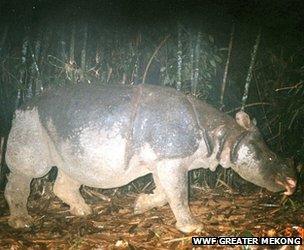
      A Javan rhino is captured on camera in Vietnam's Cat Tien National Park (Image: WWF Greater Mekong)
     
    Image caption Genetic analysis of rhino dung samples revealed that there was only one individual left in Vietnam
    A critically endangered species of rhino is now extinct in Vietnam, according to a report by conservation groups.
    The WWF and the International Rhino Foundation said the country's last Javan rhino was probably killed by poachers, as its horn had been cut off.
    Experts said the news was not a surprise, as only one sighting had been recorded in Vietnam since 2008.

    Fewer than 50 individuals are now estimated to remain in the wild.
    "It is painful that despite significant investment in Vietnamese rhino conservation, efforts failed to save this unique animal, " said WWF's Vietnam director Tran Thi Minh Hien.
    "Vietnam has lost part of its natural heritage."

    The authors of the report, Extinction of the Javan Rhino from Vietnam, said genetic analysis of dung samples collected between 2009-2010 in the Cat Tien National Park showed that they all belonged to just one individual.

    Shortly after the survey was completed, conservationists found out that the rhino had been killed. They say it was likely to have been the work of poachers because it had been shot in a leg and its horn had been cut off.

    Globally, there has been a sharp increase in the number of rhino poaching cases. Earlier this year, the International Union for Conservation of Nature (IUCN) published a report that said rhino populations in Africa were facing their worst poaching crisis for decades.
    An assessment carried out by Traffic, the global wildlife trade monitoring network, said the surge in the illegal trade in rhino horns was being driven by demands from Asian medicinal markets.

    Conservation blow

    The Vietnam rhino, as well as being the last of the species on mainland Asia, was also the last known surviving member of the Rhinoceros sondaicus annamiticus subspecies - one of three recognised groups of Javan rhino populations.
    Another is already extinct. R. sondaicus inermis was formerly found in north-eastern India, Bangladesh and Burma.

    The remaining subspecies, R. sondaicus sondaicus, is now found on Java, Indonesia. However, since the 1930s, the animals - now estimated to number no more than 50 - have been restricted to the westernmost parts of the island.

    Bibhab Kumar Talukdar, chairman of the IUCN's Asian Rhino Specialist Group, said the demise of the Javan rhino in Vietnam was "definitely a blow".
    "We all must learn from this and need to ensure that the fate of the Javan rhino in [Indonesia] won't be like that of Cat Tien in near future," he told BBC News.
    "Threats to rhinos for their horn is definitely a major problem. But in Indonesia, due to active work done by rhino protection units and national park authorities, no Javan rhino poaching has been recorded in Indonesia for past decade."

    Dr Talukdar observed: "What is key to the success of the species is appropriate habitat management as the Javan rhinos are browser and it needs secondary growing forests."
    He warned that the habitat within the national park on Java serving as the final refuge for the species was being degraded by an invasive species of palm.

    "As such, control of arenga palm and habitat management for Javan rhinos in Ujung Kulon National Park is now become important for future of the species."