No topo das dunas
branqueadas do Parque Nacional White Sands, no Novo México,
encontram-se as pegadas de 40 centímetros de uma preguiça gigante, agora
extinta, que vagava há mais de 11.500 anos. Dentro dessas trilhas, os
pesquisadores notaram pequenas pegadas humanas (modelo 3D retratado) – remanescentes de um antigo playground , New Scientist relata
A forma como os rastros foram deformados sugere que um grupo de
crianças pequenas brincava em pegadas de preguiça frescas que se
encheram de água, de acordo com a análise não publicada. Se confirmada, a
cena alegre aumentaria a compreensão dos cientistas sobre alguns dos
primeiros humanos a se divertirem na América do Norte pré-histórica.
Correção, 14 de abril, 16h: Uma versão anterior desta história deturpou a idade das pegadas de preguiça fossilizadas.
sexta-feira, 4 de janeiro de 2019
Hastings dinosaur footprints exposed by cliff erosion
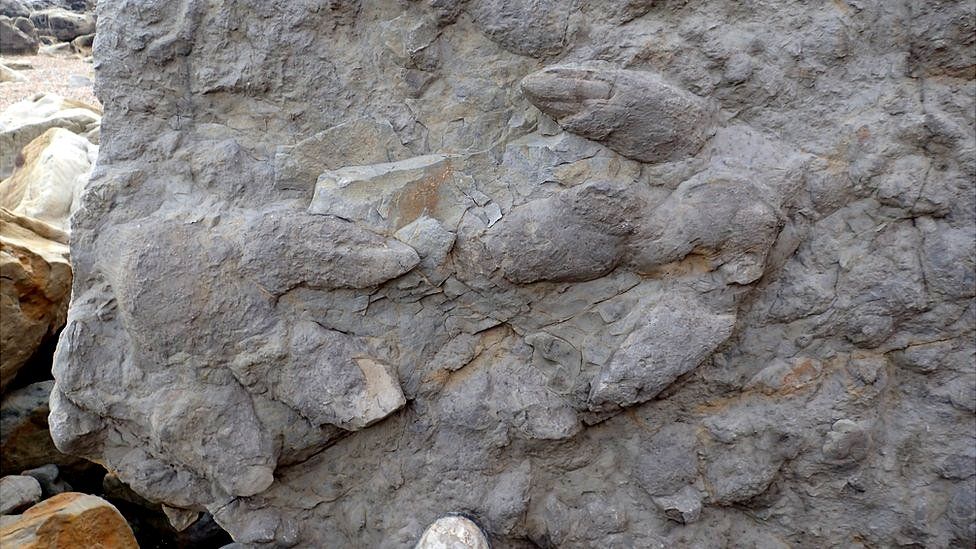
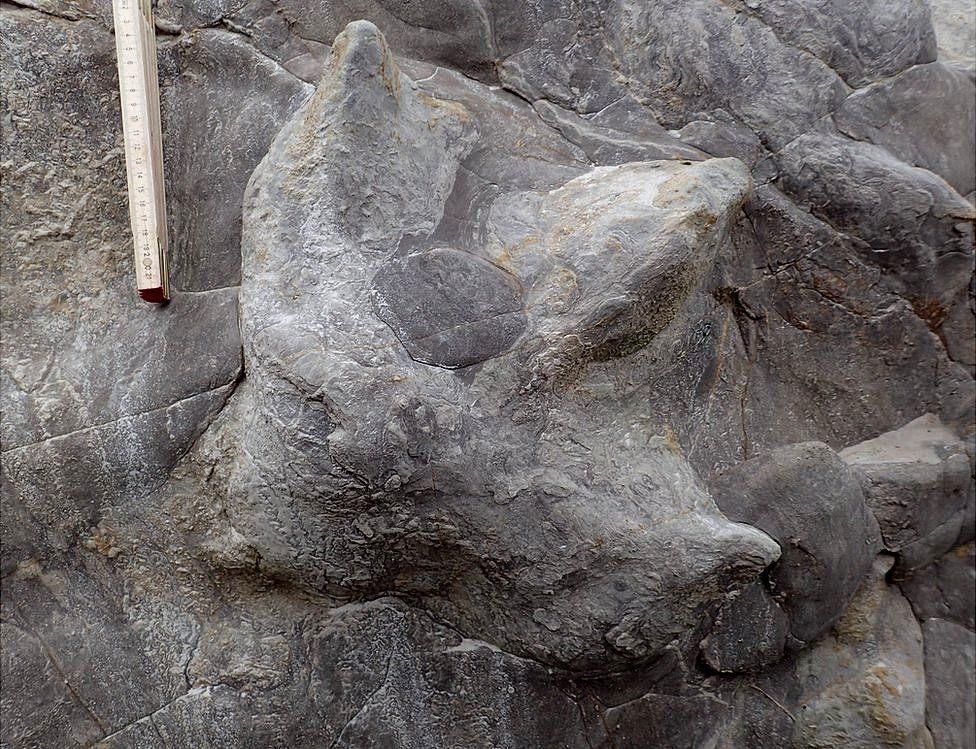
Two large Iguanodontian footprints with skin and claw impressions
Dozens of well-preserved dinosaur footprints from at least 100 million years ago have been uncovered in East Sussex.
At
least seven different species were identified by University of
Cambridge researchers during the past four winters following coastal
erosion along the cliffs near Hastings.
They range in size from
less than 2cm to more than 60cm across, and are so well-preserved that
even the skin, scales and claws are easily visible.
There are more than 85 markings, all of which date from the early Cretaceous period.
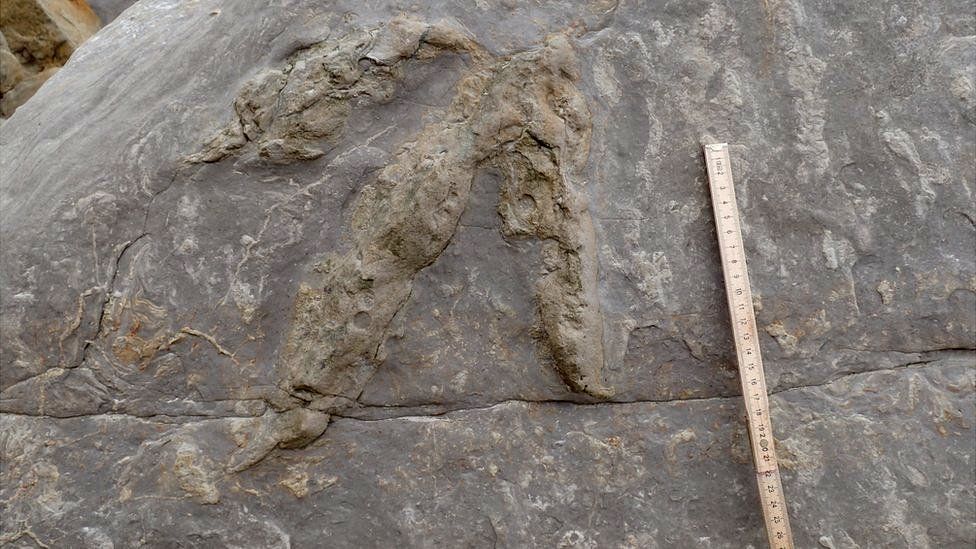
A small theropod footprint
The species include Iguanodon and Ankylosaurus, a
type of stegosaurus, possible examples from the sauropod group, and
meat-eating theropods.
Hastings has long been a site of special interest for fossil
hunters with items ranging from fragments of dinosaur bones to complete
fish being previously uncovered, but footprints are less common.
The footprints are the first to have been discovered in 25 years, with earlier findings being far less varied and detailed.
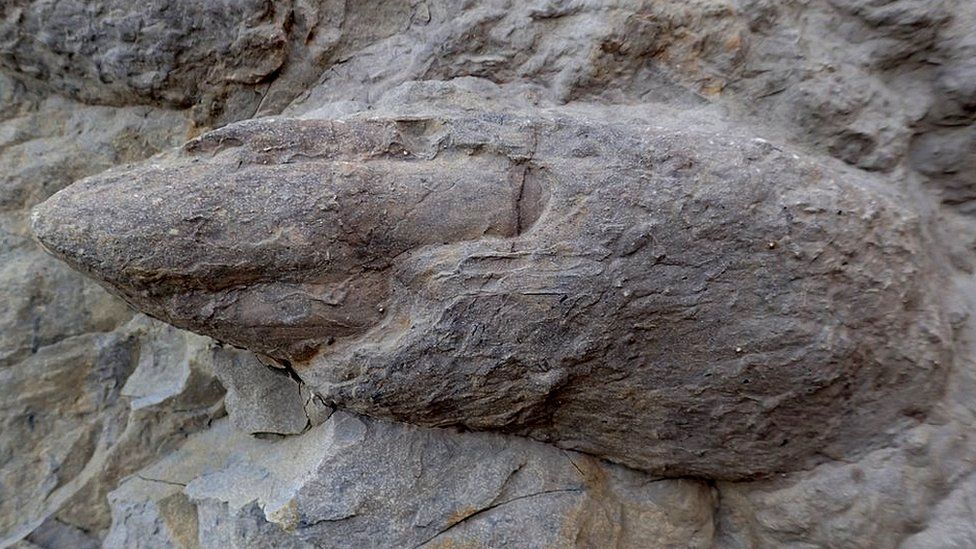
A close up of a claw impression from an Iguanodontian footprint
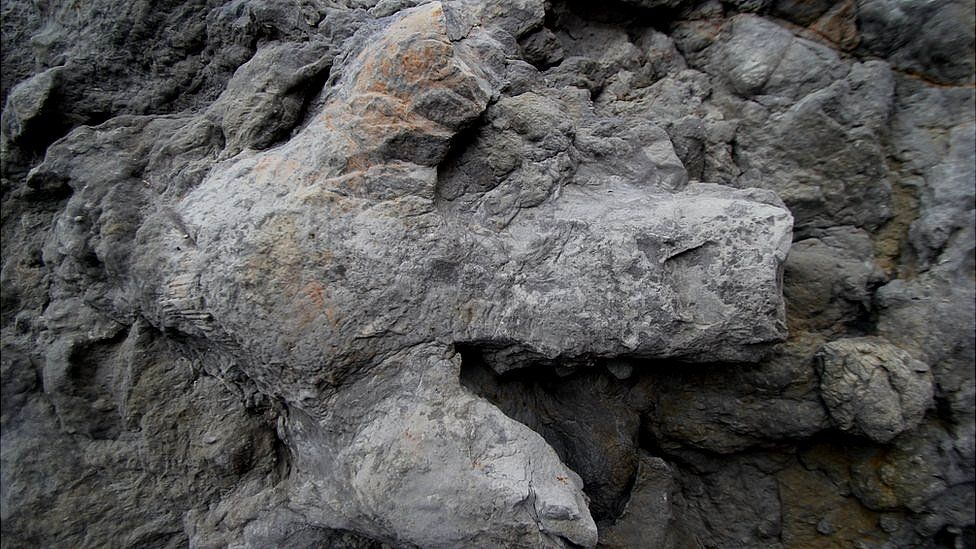
A large Iguanodontian footprint
The results are reported in the journal Palaeogeography, Palaeoclimatology, Palaeoecology, authored by Anthony Shillito and Dr Neil Davies.
"Whole body fossils of dinosaurs are incredibly rare.
"A
collection of footprints like this helps you fill in some of the gaps
and infer things about which dinosaurs were living in the same place at
the same time," Mr Shillito said.
He added that the "incredible detail" clearly showed "the texture of the skin and scales, as well as four-toed claw marks".
The
area where the footprints were found was likely near a water source,
and in addition to the footprints, a number of fossilised plants and
invertebrates were also found.
More dinosaur footprints are thought to be hidden within the eroding
sandstone cliffs, but the researchers said the construction of sea
defences meant they could "remain locked within the rock".
sábado, 17 de novembro de 2018
As mais antigas pegadas conhecidas no Grand Canyon foram deixadas por um réptil misterioso
This set of 28 footprints,
made by an early reptile-like creature about 315 million years ago, are
the oldest vertebrate track marks ever to be found in Grand Canyon
National Park.
Credit: Courtesy of Stephen Rowland
About 315 million years ago — long before dinosaurs roamed the Earth —
an early reptile scuttled along in a strangely sideways jaunt, leaving
its tiny footprints embedded in the landscape, new research finds.
It's anyone's guess why this ancient, clawed critter walked sideways
(although experts have several ideas), but one thing is certain: The
animal's prints represent the oldest-known vertebrate track marks ever
discovered in Grand Canyon National Park, said Stephen Rowland, a
professor of geology at the University of Nevada, Las Vegas, who is
studying the fossilized trackway.
The trackway is so old, that it was made a mere 5 million years after
the first known reptiles emerged on Earth, just as the ancient supercontinent Pangaea
was forming. "This is right in that little window of the very first
reptiles," Rowland told Live Science. "We don't know much about that
real early history." [Photos: Dinosaur Tracks Reveal Australia's 'Jurassic Park']
The research, which has yet to be published in a peer-reviewed journal,
was presented at the annual Society of Vertebrate Paleontology meeting
in Albuquerque, New Mexico, on Oct. 17.
The trackway — preserved on a slab of sandstone measuring about 3.2
feet long and 18 inches wide (1 meter by 45 centimeters) — contains 28
prints from the mystery animal's front and back feet. A friend of
Rowland's first noticed the fossilized tracks in 2016 while hiking along
the Grand Canyon's Bright Angel Trail, located on the Manakacha formation in northern Arizona.
When Rowland visited the site in May 2017, the 2-inch-long (5 cm)
prints befuddled him. At first glance, the track marks looked as if they
were left by two animals walking side by side, "which is very bizarre
for an early reptile," he said. After lying awake at night, turning the
images over in his mind, Rowland had an epiphany: The animal that left
the tracks was moving sideways.
The mystery reptile-like
creature walked sideways as it made these track marks. It's unclear why
the animal did this, but perhaps it was blown by the wind, doing a
mating dance or even facing an aggressor.
Credit: Illustration by Stephen Rowland
Normally, four-legged animals walking forward obscure some of their
footprints, with the rear foot stepping on top of the front footprint.
"In this case, that didn't happen," Rowland said.
He noticed that while the animal's tiny claws were pointing forward,
the animal was moving sideways, about 40 degrees toward to the right
(each row is offset to the right by about 8 inches (20 cm) compared with
the previous row, Rowland said.) Perhaps, a strong wind from the left
was blowing against the creature, pushing it sideways. Or, maybe the
creature was trying to climb a steep incline and was walking up the
slope diagonally. It's even possible that the reptile was walking
sideways because it was injured, circling an aggressor or doing a mating
dance, Rowland said.
"I don't think we'll know with any confidence," Rowland said.
When the prints were made, during the Carboniferous period
(about 359 million to 299 million years ago), Arizona lay close to the
equator. At that time, the mysterious reptile walked over a coastal sand
dune near a shallow sea to the west, according to co-researcher Mario
Caputo, a retired adjunct professor of sedimentology at San Diego State
University.
The next-oldest fossilized vertebrate track marks in the Grand Canyon
are about 20 million years younger, from the Coconino Sandstone
formation, Rowland noted. These date to the Permian period,
(about 299 million to 251 million years ago). Because the different
trackways look so similar, it's likely that they will be given the same scientific name of Chelichnus, Rowland said. (Like species, fossilized prints are given scientific names.)
"That doesn't mean it was the same animal living in different places,"
Rowland said. Rather, because the prints look so similar, they're given
the same name, even if a different animal made them, he said.
How to hunt a giant sloth—according to ancient human footprints
April 26, 2018 by Matthew Robert Bennett, Katie Thompson And Sally Christine Reynolds, The Conversation
Credit: Alex McClelland, Bournemouth University
Rearing on its hind legs, the giant ground
sloth would have been a formidable prey for anyone, let alone humans
without modern weapons. Tightly muscled, angry and swinging its fore
legs tipped with wolverine-like claws, it would have been able to defend
itself effectively. Our ancestors used misdirection to gain the upper
hand in close-quarter combat with this deadly creature.
What is
perhaps even more remarkable is that we can read this story from the
10,000-year-old footprints that these combatants left behind, as
revealed by our new research published in Science Advances.
Numerous large animals such as the giant ground sloth
– so-called megafauna – became extinct at the end of the Ice Age. We
don't know if hunting was the cause but the new footprint evidence tells
us how human hunters tackled such fearsome animals and clearly shows
that they did.
These footprints were found at White Sands National Monument in New Mexico, US, on part of the monument that used by the military. The White Sands Missile Range, located close to the Trinity nuclear site, is famous as the birth place of the US space programme, of Ronald Reagan's Star Wars initiative and of countless missile tests. It is now a place where long-range rather than close-quarter combat is fine-tuned.
It is a beautiful place, home to a huge salt playa (dry lake) known
as Alkali Flat and the world's largest gypsum dune field, made famous by
numerous films including Transformers and the Book of Eli. At the height of the Ice Age it was home to a large lake (palaeo Lake Otero).
White Sands National Monument. Credit: Matthew Bennett, Bournemouth University, Author provided
As the climate warmed, the lake shrank and
its bed was eroded by the wind to create the dunes and leave salt flats
that periodically pooled water. The Ice Age megafauna left tracks on
these flats, as did the humans that hunted them. The tracks are
remarkable in that they are only a few centimetres beneath the surface
and yet have been preserved for over 10,000 years.
Here there are tracks of extinct giant ground sloth, of mastodon,
mammoth, camel and dire wolf. These tracks are colloquially known as
"ghost tracks" as they are only visible at the surface during specific
weather conditions, when the salt crusts are not too thick and the
ground not too wet. Careful excavation is possible in the right
conditions and reveals some amazing features.
Perhaps the coolest of these is a series of human tracks that we found within the sloth prints. In our paper, produced with a large number of colleagues,
we suggest that the humans stepped into the sloth prints as they
stalked them for the kill. We have also identified large "flailing
circles" that record the sloth rising up on its hind legs
and swinging its fore legs, presumably in a defensive, sweeping motion
to keep the hunters at bay. As it overbalanced, it put its knuckles and
claws down to steady itself.
Tracking the footprints. Credit: Matthew Bennett, Bournemouth University, Author provided
These circles are always accompanied by
human tracks. Over a wide area, we see that where there are no human
tracks, the sloth walk in straight lines. Where human track are present,
the sloth trackways show sudden changes in direction suggesting the
sloth was trying to evade its hunters.
Piecing together the puzzle, we can see how sloth were kept on the
flat playa by a horde of people who left tracks along the its edge. The
animals was then distracted by one stalking hunter, while another crept
forward and tried to strike the killing blow. It is a story of life and
death, written in mud.
What would convince our ancestors to engage is such a deadly
game? Surely the bigger the prey, the greater the risk? Maybe it was
because a big kill could fill many stomachs without waste, or maybe it
was pure human bravado.
Footprint comparison. Credit: David Bustos, National Park Service
At this time at the end of the last Ice
Age, the Americas were being colonised by humans spreading out over the
prairie plains. It was also a time of animal extinctions. Many
palaeontologists favour the argument
that human over-hunting drove this wave of extinction and for some it
has become an emblem of early human impact on the environment. Others argue that climate change was the true cause and our species is innocent.
It is a giant crime scene in which footprints now play a part. Our
data confirms that human hunters were attacking megafauna and were
practiced at it. Unfortunately, it doesn't cast light on the impact of
that hunting. Whether humans were the ultimate or immediate cause of the
extinction is still not clear. There are many variables including rapid
environmental change to be considered. But what is clear from tracks at
White Sands is that humans were then, as now, "apex predators" at the
top of the food chain.
Plaster cast footprints. Credit: David Bustos, National Park Service
More information:
David Bustos et al. Footprints
preserve terminal Pleistocene hunt? Human-sloth interactions in North
America, Science Advances (2018). DOI: 10.1126/sciadv.aar7621