O ovo do trovão é uma rocha semelhante a um nódulo, semelhante a um
geodo cheio, formado dentro de camadas de cinzas vulcânicas. Crédito: Bill The Eggman
Os geodos são estruturas secundárias geológicas que ocorrem em certas rochas sedimentares e vulcânicas.Eles próprios são de origem sedimentar formada por precipitação química.
Vistas interna e externa do geodo
Os geodes diferem dos vugs
, pois os primeiros foram formados como estruturas precoces e
arredondadas na rocha circundante e geralmente são removidos intactos,
enquanto os vugs são bolsos, vazios ou cavidades de forma irregular, geralmente ao longo de uma veia ou brecha.Os geodos também diferem dos " nódulos ", pois um nódulo é uma massa de matéria mineral que se acumulou ao redor do núcleo do nódulo.
Geodo de ágata de ovo de trovão. do Novo México. Foto de Bill The Eggman
Os geodos podem se formar em qualquer cavidade, mas o termo geralmente é reservado para formações mais ou menos arredondadas em rochas ígneas e sedimentares.Eles podem formar bolhas de gás em rochas ígneas, como vesículas em lavas basálticas;ou, como no meio-oeste americano, em cavidades arredondadas em formações sedimentares.Depois que a rocha ao redor da cavidade endurece, silicatos e / ou carbonatos dissolvidos são depositados na superfície interna.Com o tempo, essa lenta alimentação de constituintes minerais a partir de águas subterrâneas ou soluções hidrotérmicas permite a formação de cristais dentro da câmara oca.
Vugs grandes de cristais de ametista estavam por toda parte dentro da mina Mineração de ametista.No Brasil foto: lifeofsaturdays.com
A faixa e a coloração do geodo são o resultado de impurezas variáveis.Os óxidos de ferro conferem tons de ferrugem a soluções siliciosas.A maioria dos geodos contém cristais de quartzo transparentes, enquanto outros possuem cristais de ametista roxos.Outros ainda podem ter bandas ou cristais de ágata, calcedônia ou jaspe, como calcita, dolomita, celestita, etc.
Às vezes, os geodes e as fatias de geode são pintados com cores artificiais.Amostras de geodos com cores incomuns ou formações altamente improváveis geralmente foram alteradas sinteticamente.
Geodo Ametista Maciço DoUruguai
Os geodos geralmente têm uma concha de calcedônia ( quartzo criptocristalino ) revestida internamente por vários minerais, geralmente como cristais, particularmente calcita, pirita, caolinita, esfalerita, milerita, barita, celestita, dolomita, limonita, smithsonita, opala, calcedônia e quartzo macrocristalino . de longe o mineral mais comum e abundante encontrado nos geodos .
Os geodes
são comuns em algumas formações nos Estados Unidos (principalmente em
Indiana, Iowa, Missouri, oeste de Illinois, Kentucky e Utah).Eles também são comuns no Brasil, Uruguai, Namíbia e México.
Geodo Ametista dentro de rochas calcárias!
Os geodes são encontrados principalmente em lavas e calcários basálticos.
A maior caverna ou vug de cristal conhecida no mundo
é a Crystal Cave, um geodo celestino de 10,7 m de diâmetro em seu ponto
mais largo, localizado perto da vila de Put-in-Bay, Ohio, na ilha de
South Bass no lago Erie.
Imperatriz do Uruguai
O maior geodo de ametista do mundo é A 'Imperatriz do Uruguai', com mais de três metros de altura e pesando duas toneladas e meia.Está localizado aqui em Atherton, North Queensland, Austrália.
Tipos de âmbar
O âmbar é resina de árvore fossilizada (não seiva), que é apreciada por sua cor e beleza natural desde os tempos neolíticos.
O âmbar mais antigo recuperado data do período do Carbonífero Superior (320 milhões de anos atrás).
Tipos de âmbar:
Tipos de âmbar. Um método de classificação de âmbar é por cor e grau de transparência. Este critério se correlaciona com uma classificação óptica de variedades de âmbar. As cores âmbar incluem amarelo, laranja, vermelho, branco, marrom, verde, azulado e "preto" (tons escuros de outras cores).
Âmbar do Báltico
Âmbar do Báltico. Foto: Zack Irow
Âmbar do Báltico - a variedade âmbar mais comum, encontrada ao longo da costa de uma grande parte do mar Báltico. Ela data de 44 milhões de anos atrás (durante a época do Eoceno). Estima-se que essas florestas criaram mais de 100.000 toneladas de âmbar. O âmbar do Báltico inclui a fauna de insetos fósseis mais rica em espécies descoberta até hoje.
Âmbar preto
Âmbar típico varia de marrom claro a marrom escuro Cortesia: Martha Zuniga
O âmbar preto
- também conhecido como pedra Oltu, é um tipo de jato encontrado na
região em torno da cidade de Oltu, na província de Erzurum, leste da
Turquia. A substância orgânica é usada como pedra preciosa semipreciosa na fabricação de jóias.
Âmbar azul
Âmbar azul da República Dominicana
O âmbar azul é âmbar, exibindo uma coloração rara.
É mais comumente encontrado nas minas de âmbar nas montanhas ao redor
de Santiago, na República Dominicana, mas também nas partes orientais da
República Dominicana. Embora pouco conhecido devido à sua raridade, existe desde a descoberta do âmbar dominicano.
Âmbar birmanês
Âmbar birmanês (99 - 112 myo) com enorme escorpião perfeito
O âmbar birmanês
- também conhecido como burmita, é uma idade cretácea de até 99 milhões
de anos, encontrada principalmente no vale de Hukawng, estado de
Kachin, Mianmar (Birmânia). O âmbar mais comum que contém inclusões de insetos do Cenomaniano.
Copal
Copal de Madagascar com aranhas, cupins, formigas, elateridae, himenópteros, barata e uma flor
Copal
é um nome dado à resina de árvore da copa Protium copal (Burseraceae),
que é particularmente identificado com as resinas aromáticas usadas
pelas culturas da Mesoamérica pré-colombiana como incenso queimado
cerimonialmente e outros fins.
Âmbar verde
Âmbar verde da República Dominicana
O âmbar verde, como suas contrapartes amarelas e azuis, liberam um aroma natural agradável ao nariz. Esta fragrância pode ser aprimorada adicionando ácido nítrico a um âmbar verde derretido. Embora isso seja desaconselhável para aqueles âmbar que já estão definidos como jóias. O âmbar verde, quando usado contra a pele, produz um perfume muito agradável, macio e pinheiro.
Âmbar do Caribe
Crédito âmbar do Caribe com mel verde: Hermann Dittrich
O âmbar do Caribe é âmbar da ilha de Hispaniola, constituída pelo Haiti e pela República Dominicana; é a única ilha do Caribe em que o retinito âmbar foi descoberto e extraído. O âmbar dominicano é encontrado em várias cores naturais, entre elas verde e azul fluorescentes.
Âmbar mexicano
Pepitas de âmbar mexicanas | por National Museums Scotland
Âmbar mexicano
- encontrado principalmente em Chiapas no México, aproximadamente
contemporâneo do âmbar dominicano da época do mioceno e produzido pela
extinta árvore Hymenaea Mexicana, um parente da árvore Hymenaea Protera
responsável pela produção do âmbar dominicano.
Uma folha verdadeiramente espetacular em Mianmar, há cem milhões de anos Crédito: FedericoBarlocher
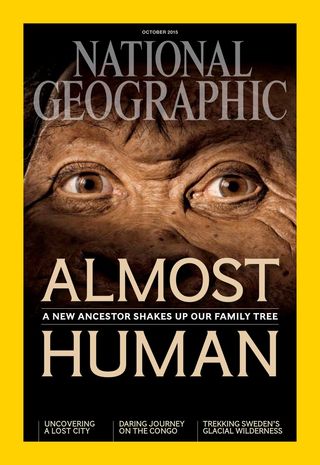
An international team of scientists has discovered the remains of
what they say belong to a completely new species of human. The bones
were found in a cave in South Africa and may change our view on the dawn
of humanity. Here's a look at photos of the discovery, some of which
are from the October issue of National Geographic magazine. [Read the full story on the human species discovery]
Human star
The
scientists involved, including lead author Lee Berger of the University
of the Witwatersrand in Johannesburg, have named the newfound species Homo naledi
— "naledi" means "star" in Sotho (also called Sesotho), one of the
languages spoken in South Africa. The bones were discovered in what has
been named the Dinaledi chamber within the Rising Star cave system, in
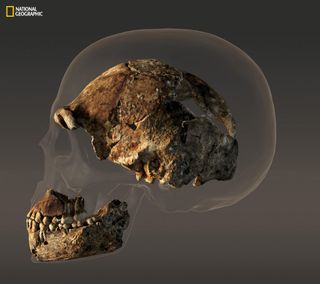
South Africa's Cradle of Humankind. Paleoartist John Gurch spent some
700 hours recreating the head of Homo naledi based on bone scans. (Photo Credit: Mark Thiessen/National Geographic)
Little brain
H. naledi
would have sported a similar body mass and size to small-bodied human
populations, but its brain was relatively smaller, with its endocranial
volume (a proxy for brain size) more similar to the australopiths, or
members of the Australopithecus genus, the researchers found.
Shown
here, the braincase of a composite male skull, measuring 34 cubic
inches (560 cubic centimeters), with the modern human skull pictured in
the background. (Image Credit: Stefan Fichtel. Sources: Lee Berger and
Peter Schmid, Wits; John Hawks, University of Wisconsin-Madison/National
Geographic)
Comparing skeletons
Here a composite skeleton of the overall body plan of H. naledi, along with an illustration showing how it compares with Homo species
such as H. erectus and australopithecines such as Lucy. (Photo Credit:
Skeleton: Stefan Fichtel/National Geographic Body Comparison Painting:
John Gurche; Sources: Lee Berger and Peter Schmid, Wits; John Hawks,
University of Wisconsin-Madison)
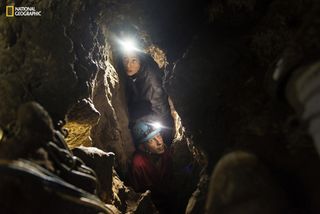
Cave chutes
By studying the remains, the researchers found evidence that individuals of H. naledi
seemed to have intentionally placed the bodies of their dead into this
remote cave chamber; this behavior was previously thought to be limited
to modern humans. Here, lead researcher Lee Berger's daughter, Megan,
who is acting as a safety caver on the expedition, and underground
exploration team member Rick Hunter navigate the narrow chutes leading
to the Dinaledi chamber where fossil specimens belonging to the new
species were discovered. (Photo Credit: Robert Clark/National
Geographic)
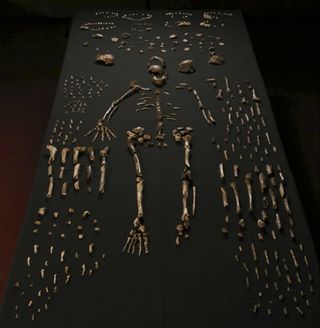
Arranging a skeleton
Berger
and his colleagues unearthed fossils from at least 15 individuals, with
multiple specimens for most of the bones in the skeleton. The species
would have been equipped with tree-climbing hands and ground-walking
feet. (Photo Credit: Berger et al. eLife 2015;4:e09560. DOI:
10.7554/eLife.09560, Creative Commons)
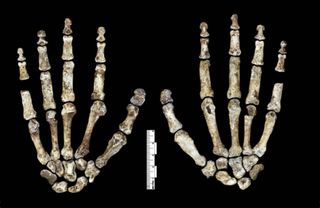
Homo hand
"While
the skull had several unique features, it had a small braincase that
was most similar in size to other early hominin species that lived
between 4 million and 2 million years ago," the researchers wrote in the
journal eLife. "Homo naledi's ribcage, shoulders and pelvis also more
closely resembled those of earlier hominin species than those of modern
humans." Here, the hand of the newfound species, found articulated, the
researchers said.
Human looks
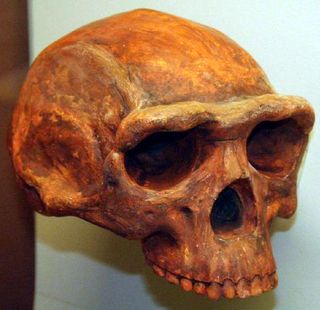
Though H. naledi is unique, the researchers note the species is most similar to early Homo species including Homo erectus, whose skull is shown here, Homo habilis or Homo rudolfensis. (Photo Credit: Thomas Roche | Wikimedia Commons)
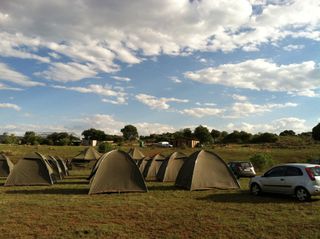
Campsite in South Africa where National Geographic Exp
lorer-in-Residence Lee
Berger of the University of Witwatersrand led an exped
ition to recover the
remains of
H. naledi
, a new species of human relative. The find was announced
by
the University of the Witwatersrand, the National Ge
ographic Society and the
South African National Research Foundation and publish
ed in the journal eLife.
Campsite
in South Africa where National Geographic Explorer-in-Residence Lee
Berger of the University of Witwatersrand led an expedition to recover
the remains of H. naledi, a new species of human relative. The find was
announcedbythe University of the Witwatersrand, the National Geographic
Society and the South African National Research Foundation and published
in the journal eLife. (Photo Credit: Andrew Howley/National Geographic)
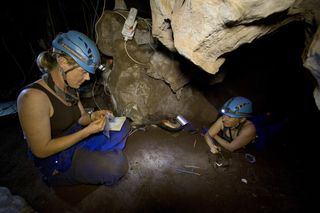
Underground astronauts
Getting
into the Dinaledi chamber in the Rising Star cave meant climbing up a
steep limestone block called the Dragon's Back and then a descent down a
narrow crack just 7 inches (18 centimeters) wide. A global call for
researchers who could fit through the narrow opening resulted in six
women who would serve as "underground astronauts." Here, two underground
astronauts, Marina Elliott and Becca Peixotto, work inside the cave
where fossils of H. naledi were discovered. (Photo Credit: Garreth Bird)
How the earliest mammals thrived alongside dinosaurs
An explosion of fossil finds reveals that ancient
mammals evolved a wide variety of adaptations allowing them to exploit
the skies, rivers and underground lairs.
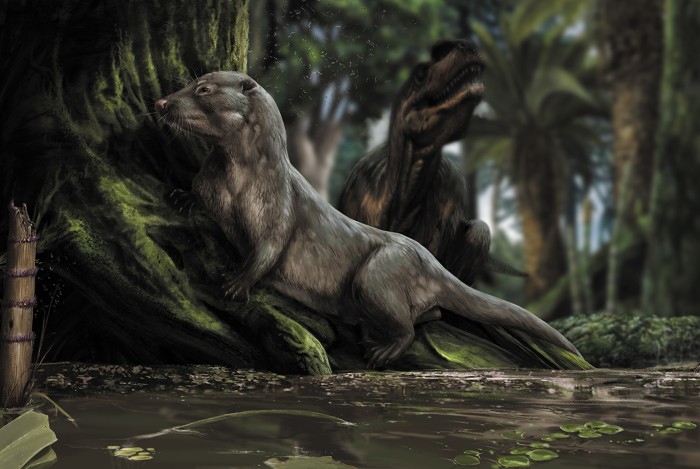
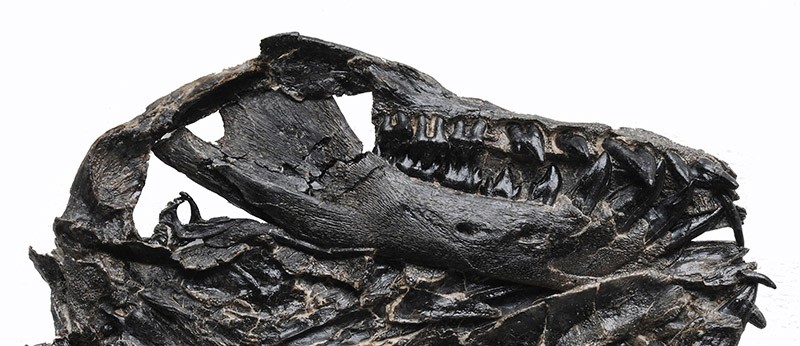
Early mammals like this rat-sized species Liaoconodon hui coexisted with feathered dinosaurs like Sinotyrannus in the temperate ecosystems of the Cretaceous in what is now Liaoning in northern China. Illustration by Davide Bonadonna
Night is falling in the early Jurassic 185 million years ago, and the Kayentatherium
is tending to her newly hatched brood. Heavy rains pummel the bank
above her den as she looks over her dozens of tiny young. She is about
the size of a large cat and could easily pass for a mammal, but her
large jawbone, characteristic teeth and lack of external ears give her
away: she is a cynodont, a member of the group from which mammals
evolved. At some point without warning, the sodden bank collapses,
entombing the hatchlings and their mother in mud.
There they
remained until the summer of 2000, when a fossil-hunting crew led by
Timothy Rowe at the University of Texas at Austin chanced upon their
scattered bones among rocks of the Kayenta Formation in northern
Arizona.
That initial encounter with the fossils did little to
impress the palaeontologists. They dug up the block and shipped it back
to the laboratory for safekeeping. It wasn’t until nine years later that
a specialist preparing the fossil for study noticed something
startling: embedded in the block were tiny teeth, and jawbones just 1
centimetre in length. “Immediately they stopped the preparation and
thought about ways of non-destructively examining the babies,” says Eva
Hoffman, at Texas with Rowe at the time and now a palaeontologist at the
American Museum of Natural History in New York City. Instead of
breaking into the rock, Hoffman and Rowe digitally extracted the bones
with a microcomputed tomography (microCT) scanner, which uses X-rays to
create fine-grained 3D images.
What they found inside the rock
were the first known babies of mammals or their relatives from the
Jurassic — and not just one, but 38 of them, placing this among the most
significant discoveries related to mammal origins made in the past
decade1. Kayentatherium
is at the cusp of mammalhood — and researchers say that it provides
crucial insights into which traits define mammals and which were present
in their earlier relatives.
Kayentatherium’s skeleton is
mammal-like in many ways, but the fossil suggested that it still
reproduced very much like a reptile, giving birth to large litters of
small-brained offspring. By contrast, “mammal moms invest a lot in a
smaller number of babies, each of which has a better chance of
surviving”, says Hoffman. Mammal babies spend longer under their
parents’ care, developing relatively large brains, whereas these fossil
hatchlings had well-developed bones and teeth, hinting that they could
fend for themselves and were not nourished by milk, as all mammals are
today.
The find is among a mass of discoveries in the past 10–20
years that are illuminating milestones in mammalian evolution. Although
major finds are emerging all over the world, the largest number are
coming out of China; together, they have overturned the now dated belief
that dinosaur-era mammals were small, unremarkable insectivores, eking
out a life in the shadows of the giant reptiles.
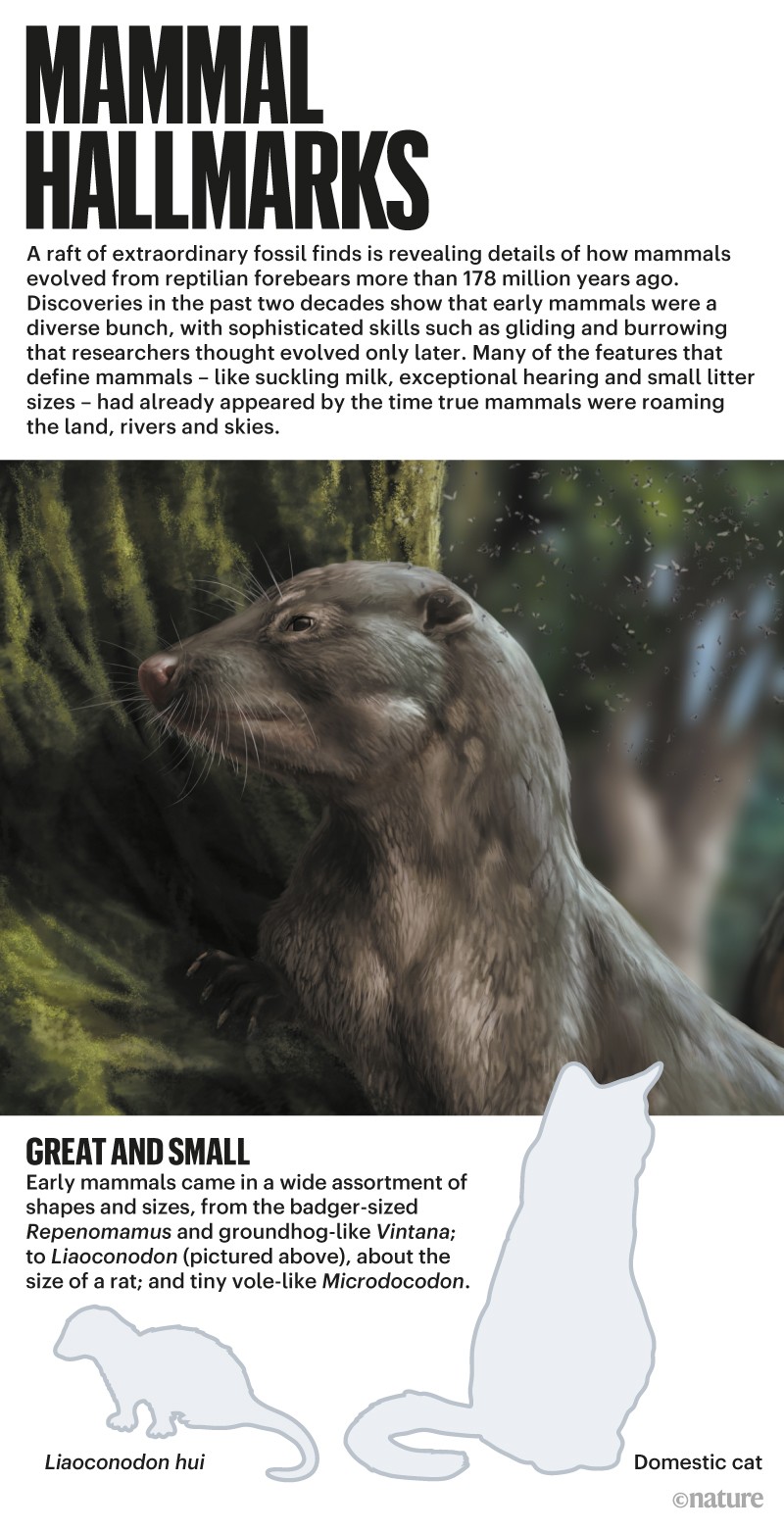
This rat-sized Liaoconodon hui is one of many fossils from northern China that are sharpening the picture of how mammal traits evolved.Credit: J. Meng et al. Nature472, 181–185 (2011)
The fossils have revealed that early mammals were
ecologically diverse and experimenting in gliding, swimming, burrowing
and climbing. The discoveries are also starting to reveal the
evolutionary origins of many of the key traits of mammals — such as
lactation, large brains and superbly keen senses.
“The explosion
of early-mammal discoveries, particularly from China, over the last two
decades has been eye-opening, mind-numbing and absolutely dazzling,”
says David Krause, a vertebrate palaeontologist at the Denver Museum of
Nature and Science in Colorado.
This avalanche of discovery is
also stirring up debate: some researchers disagree over which fossil
groups are true mammals and the shape of the mammal family tree. “We
want to understand our early history in the language of evolutionary
biology, and that’s what fires me up,” says Zhe-Xi Luo, a
palaeontologist at the University of Chicago in Illinois. “That’s why
this entire field is so interesting, because the fossil record is
getting better and better, and we are starting to really tackle some of
these questions.”
Out of the shadows
In 1824, at the
Geological Society of London, naturalist William Buckland presented
bones from one of the first known dinosaurs, Megalosaurus. At the
same talk, he revealed tiny mammalian jaws that had been found in the
same fossil deposit. Their presence suggested that mammals had a very
deep history, but as would happen repeatedly, the dinosaur discoveries
completely overshadowed the mammal ones.
The slow trickle of
mammal finds from around the world continued for 150 years. Then in
1997, researchers described the first ancient mammal from the
fossil-rich rocks of Liaoning in northeastern China2,
and the floodgates opened. Since then, 50 or more near-complete and
“beautiful specimens” have been found there, according to Jin Meng, a
palaeontologist at the American Museum of Natural History. Like the
dinosaur fossils, they are dug up by local farmers and sold on to
museums.
But the dinosaurs continued to get the vast majority of
the attention, says palaeontologist Steve Brusatte at the University of
Edinburgh, UK. “It’s only that very recently, through the work of Luo,
Meng and others, that the mammals are getting their due.”
Most of
China’s mammal fossils were formed when volcanoes buried the animals in
ash — and they are exquisitely detailed. Typical mammal fossils from the
Mesozoic era (252 million to 66 million years ago) are little more than
teeth and jaw fragments, but Chinese specimens often have entire
skeletons, with fur, skin and internal organs. “We have a lot of detail
to answer scientific questions,” says Meng, He is interested in
understanding the evolution of the mammalian ear, for instance.
The finds overturned previous dogma. “We used to say that
during the time of dinosaurs, mammals were totally unspectacular. That
they were just these little mousey things scampering around in the
shadows,” says Brusatte. But these animals “were undergoing their own
evolutionary explosion”, he says.
Mammals first appeared at least
178 million years ago, and scampered amid the dinosaurs until the
majority of those beasts, with the exception of the birds, were wiped
out 66 million years ago. But mammals didn’t have to wait for that
extinction to diversify into many forms and species. “These new
discoveries document a huge, hitherto-undreamed-of ecological
diversity,” says Richard Cifelli, a palaeontologist at the University of
Oklahoma in Norman.
Among the first innovations that researchers
began to find in fossil form were those to do with locomotion. In 2006,
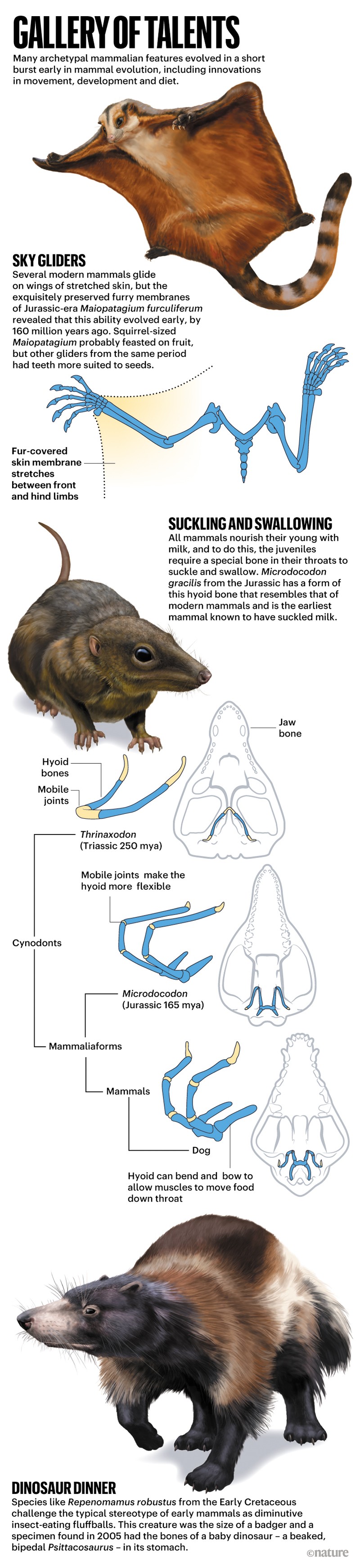
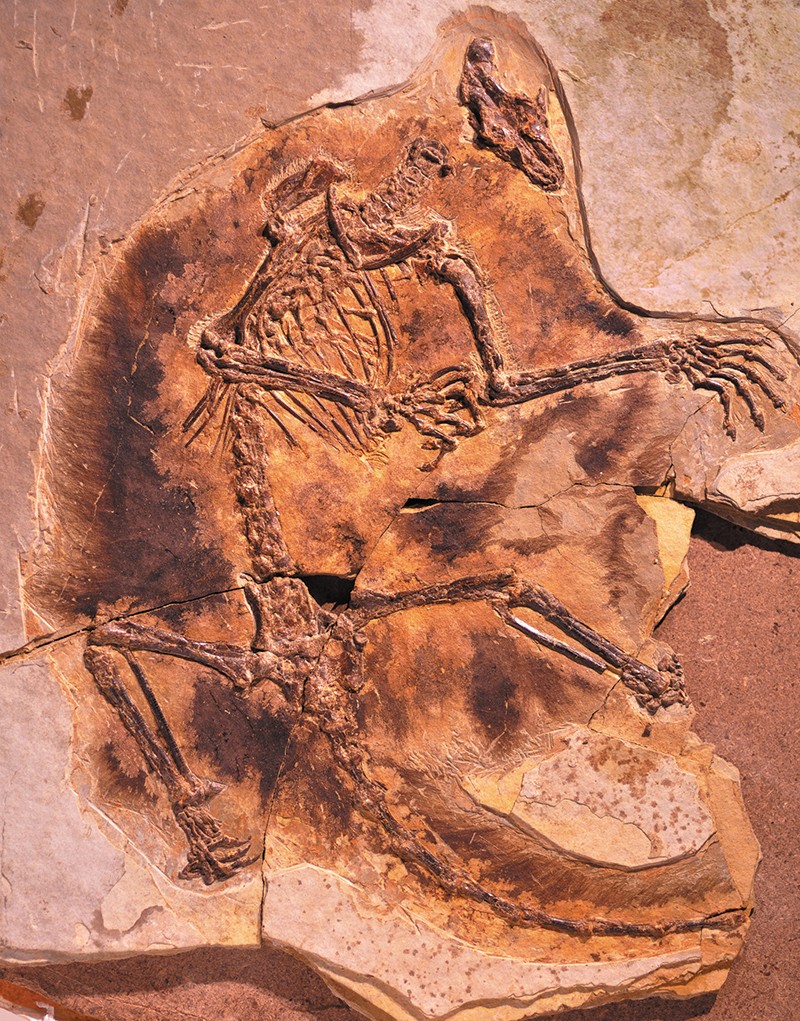
Meng’s team reported the first gliding mammal3, 164-million-year-old Volaticotherium, which had wing membranes made of furry skin, like today’s flying squirrels. In 2017, Luo’s team added Vilevolodon and Maiopatagaium4,5,
which lived at around the same time and belonged to a group called the
haramiyids. These animals swooped between the trees alongside some of
the first flying dinosaurs, taking advantage of previously unexploitable
food resources.
Researchers found other specializations that they assumed had evolved only later: Agilodocodon could climb trees and gnawed into bark to feast on sap6; the platypus-sized river-dweller Castorocauda had webbed feet and a beaver-like tail for swimming7; and Docofossor had paws and claws for digging, and looked like a modern mole8.
These
mammals had also adapted to a multitude of diets, much more diverse
than previously assumed. In 2014, Krause described the groundhog-like Vintana from Madagascar9, a herbivore that perhaps fed on roots and seeds. And the wolverine-sized carnivore Repenomamus, which Meng’s team reported in 2005, had baby dinosaur bones in its stomach10.
Many of these new-found fossil mammals belong to long-extinct
subgroups, says Meng. In contrast to the panoply that existed in the
Mesozoic, mammals today come in just three varieties: placentals, which
make up the majority of species and include humans; marsupials, such as
kangaroos and koalas, in which gestation in the womb is brief and
development continues in a pouch; and the egg-laying monotremes,
represented only by the platypus and several echidnas. “But in
geological history, there were many other groups such as
multituberculates, triconodonts and haramiyids,” says Meng. “Mammals
were actually very diverse in the Jurassic.”
Some, such as the shrew-like Juramaia
— described by Luo’s team in 2011 and dated to 160 million years ago —
are among the earliest placental mammals and therefore have the
potential to be our ancestors11.
And a few dinosaur-era mammals were much bigger than suspected, too. Repenomamus was 12–14 kilograms, and the racoon-sized Vintana
weighed in at 9 kg. “It’s exciting that we kind of busted the old myths
that early mammals came from a very humble generalized ancestor,” says
Luo.
The finds are not solely from China. Important fossils are
also coming from the United States, Spain, Brazil, Argentina, Madagascar
and Mongolia. Some of the most intriguing and oldest fossils — as well
as the biggest gaps in our knowledge — relate to the southern
continents, where only five genera of Mesozoic mammals and their
relatives are known, compared with more than 70 genera from northern
latitudes. In the past two decades, Brazil has yielded several Triassic
fossils that are more than 200 million years old. Guillermo Rougier, a
palaeontologist at the University of Louisville in Kentucky, describes
them as “incredible discoveries” that are right on the cusp between
mammals and their cynodont ancestors. “These forms really show a very
transitional progression from things that are typically non-mammalian,
to things that pretty much have all the features of early mammals.”
Mammal must-haves
The
latest finds are also offering clues to the evolution of key mammal
features. For instance, the keen hearing of mammals is partly down to
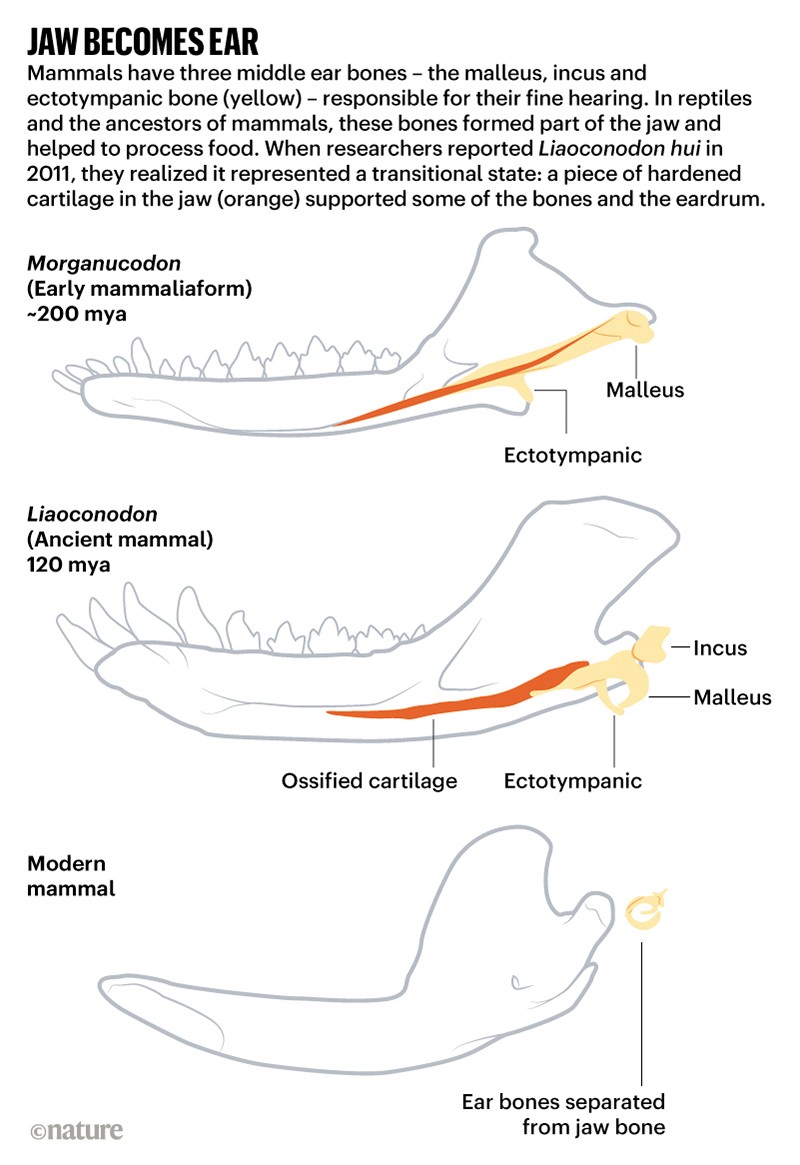
tiny bones in the middle ear — the malleus, incus and ectotympanic. But
in the reptilian ancestors of mammals, these bones were part of the jaw,
and were used for chewing instead of hearing. Mammal forerunners, such
as shrew-like Morganucodon from 205 million years ago, sported a prototype of the mammal arrangement that allowed for both functions12.
In 2011, Meng reported an intermediary13: a 120-million-year-old specimen from China belonging to a group of mammals called eutriconodonts and named Liaoconodon hui
(see ‘Mammal hallmarks’). The rat-sized fossil revealed three
middle-ear bones, but they were still attached to the jaw by cartilage.
“The hearing function and the chewing function were still not completely
separated,” he explains. This was hard evidence of the evolutionary
transition from jaw to ear.
This exquisitely preserved 160-million-year-old specimen of Maiopatagium furculiferum shows how early gliding evolved.Credit: Zhe-Xi Luo/UChicago
Another unique trait of mammals is the sophisticated way
they chew and ingest food in small parcels, rather than swallowing
things whole as snakes and alligators do. To make that possible, mammals
evolved a wide variety of complex teeth for biting and grinding food.
But
as babies, mammals are nourished another way — by suckling from their
mother’s mammary glands. “Our whole group is named after this incredible
biological innovation,” says Luo. Drinking milk is made possible by the
ability to suck and swallow, aided by the hyoid bones in the throat and
muscles that support them. This apparatus also forms the voice box.
In
July, Luo published a paper revealing a 165-million-year-old vole-sized
docodont — a close relative of true mammals — that had the hyoid bones
of its throat preserved14. Microdocodon gracilis is the earliest animal known to have been able to suckle like a modern mammal.
This level of detail is rare, and — similar to the study of the Kayentatherium
hatchlings — the work on both the ear and throat bones has been made
possible only through advances in microCT scanning techniques, says
Krause. The technique has also revealed details about the olfactory
abilities and brains of early mammals. These revelations are “breathing
life into these early mammals in ways that were previously impossible
and almost inconceivable”, he says.
Much of the constellation of
features we think of as defining mammals — complex teeth, excellent
senses, lactation, small litter size — might actually have evolved
before true mammals, and quite quickly. “More and more it looks like it
all came out in a very short burst of evolutionary experimentation,” Luo
says. By the time mammal-like creatures were roaming around in the
Mesozoic, he says, “the lineage has already acquired its modern look and
modern biological adaptations”.
Family drama
Although the
experts concur on many points, there is still much debate about how
early mammal groups are related, and which groups are true mammals. That
leads to uncertainty about how key traits evolved, says Hoffman.
One
sticking point between Meng and Luo, who have each developed their own
evolutionary trees, is the haramiyids. Meng thinks this early group
belongs with true mammals, whereas Luo is convinced it’s a side branch.
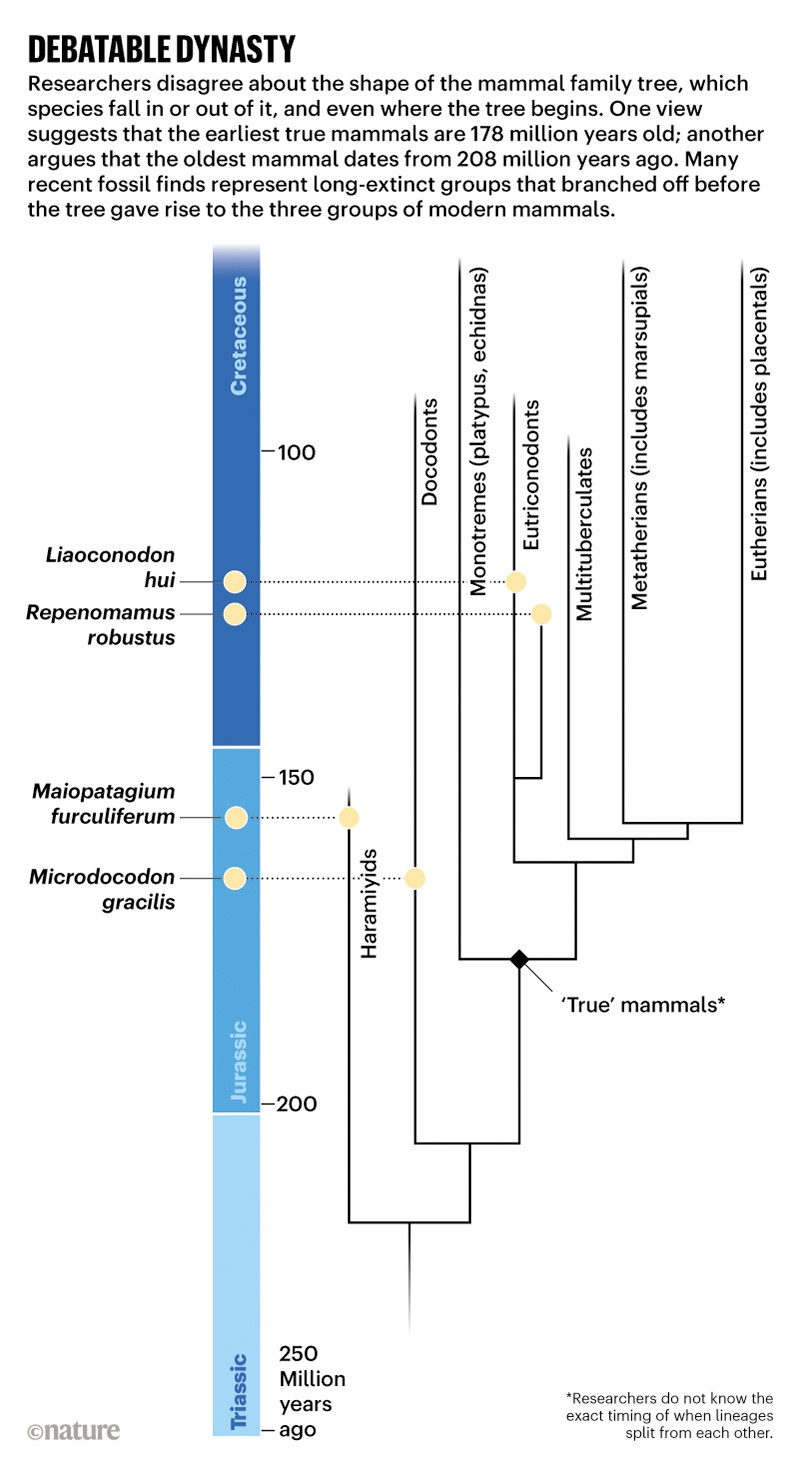
The oldest known haramiyids are from 208 million years ago in the
Triassic. If they are true mammals, then mammal origins date back at
least that far — if not, then the oldest known mammal is 178 million
years old, well into the Jurassic.
More fossils will help to
resolve such questions, and bring more surprises. Krause and Meng say
they are both studying exciting fossils, but are yet to publish their
findings on them, and tens of unstudied specimens lie piled in the
offices of their Chinese colleagues.
Palaeontologists have many
items on their wish lists. One characteristic that Luo wants to
understand is growth rates. Reptiles grow slowly throughout their lives,
whereas mammals grow in bursts in youth and then plateau. He’d love to
find a series of fossils from babies to adults to watch this happening.
“That is one of the most critical features in mammals that help to
define our biology,” he says.
Both Hoffman and Meng agree that embryos and more babies would be significant finds — and, like the Kayentatherium
discovery with its dozens of hatchlings, they would help us to pinpoint
the date that mammal-style small litter sizes appeared. Meng’s dream is
to find a pregnant mammal. “This is always in my mind that I will find a
mammal that inside the skeleton you can see some very delicate
skeleton, which is either an egg that hasn’t hatched, or it’s a more
interesting fetus,” he says.
If the flurry of discoveries has
taught researchers anything, it’s that every fossil find has the
potential to add a chapter to evolutionary history or even flip the
prevailing narrative on its head. “We’re really in this exciting, almost
manic phase of lots of new evidence coming in, and it’s going to take
time to synthesize,” says Brusatte.
Cientistas acham que encontraram a primeira pátria da 'Eva mitocondrial'
Duzentos mil anos atrás, os primeiros ancestrais compartilhados de
todos os seres humanos vivos na Terra descansaram em um oásis verdejante
no meio do deserto de Kalahari, na África.
Aqui, em uma colcha de retalhos de lagos, florestas e campos já
extintos, conhecidos como a região de paleontologia Makgadikgadi, nossos
maiores avós e avós caçavam, reuniam e criavam famílias por dezenas de
milhares de anos.
Eventualmente, com a mudança do clima da Terra, as mudanças nas chuvas abriram novos caminhos férteis pelo deserto.
Pela primeira vez, nossos parentes distantes tiveram a chance de
explorar o desconhecido, colocando para trás o que uma equipe de
pesquisadores chama agora de "a pátria ancestral de todos os humanos
vivos hoje". De qualquer forma, essa é a história contada por um novo artigo publicado hoje (18 de outubro) na revista Nature . Ao estudar o genoma de mais de 1.200 africanos indígenas que vivem hoje
na parte sul do continente, a equipe reuniu uma história de uma das
mais antigas linhagens de DNA
da Terra: uma coleção de genes chamados L0, transmitida maternalmente
pelas mitocôndrias e sobreviveu notavelmente inalterada em algumas
populações por centenas de milhares de anos.
Ao rastrear onde e quando a linhagem L0 se dividiu nas sub-linhagens
ligeiramente diferentes ainda vistas hoje em algumas populações
indígenas da África, os pesquisadores acreditam que identificaram
exatamente onde os primeiros portadores de L0 viveram e prosperaram por
milhares de anos. "Sabemos há muito tempo que os humanos se originaram na África e cerca de 200.000 anos atrás
", disse a autora do estudo Vanessa Hayes, geneticista do Instituto
Garvan de Pesquisa Médica e da Universidade de Sydney, ambas na
Austrália, em entrevista coletiva. "Mas o que não sabíamos até este estudo era onde, exatamente essa pátria era". Isso "exatamente" tem outros pesquisadores céticos. Chris Stringer, especialista em origens humanas
no Museu de História Natural de Londres, disse à Live Science que é
"cauteloso" sobre o uso de distribuições genéticas modernas para inferir
onde as populações antigas viviam há 150.000 anos - principalmente em
um continente tão grande quanto a África. (Estudos similares localizaram as primeiras populações humanas em várias partes do leste, oeste e sul da África.)
Além disso, ele acrescentou que, como o presente estudo segue apenas
uma sequência de código genético herdado pela mãe, seus resultados podem
não capturar o quadro completo das primeiras viagens da humanidade pela
África.
Em vez disso, as melhores evidências disponíveis sugerem que várias
populações fundadoras geneticamente diferentes podem ter vivido em
várias partes do continente, dando aos humanos modernos não apenas uma,
mas várias pátrias. "Como muitos estudos que se concentram em um pequeno pedaço do genoma, ou uma região, ou uma indústria de ferramentas de pedra ou um fóssil 'crítico', ele não pode capturar toda a complexidade de nossas origens em mosaico", disse Stringer.
Caça Eva genética
Hoje, Makgadikgadi é uma das maiores salinas do mundo. Os modelos climáticos sugerem que, 200.000 anos atrás, era um oásis fértil.
(Crédito da imagem: Shutterstock)
A linhagem L0 é uma sequência de DNA codificado apenas nas mitocôndrias , uma pequena estrutura em suas células que transforma alimentos em energia celular.
O DNA mitocondrial é responsável por apenas uma fração do seu genoma,
com a maior parte do seu DNA bloqueada nos núcleos celulares.
No entanto, enquanto o DNA nuclear é herdado dos pais e se recombina a
cada geração, o DNA mitocondrial é herdado apenas da sua mãe e pode
permanecer inalterado por dezenas de milhares de anos. Como tal, o DNA mitocondrial (também conhecido como "mitogenoma") é uma ferramenta essencial para rastrear a história genética. L0 é especialmente importante a esse respeito, pois acredita-se que
todas as pessoas vivas descendem em sua linha materna da mulher que
realizou a sequência, uma mulher hipotética chamada "Eva mitocondrial". Hoje, a linhagem L0 é encontrada mais comumente no povo Khoisan , dois grupos indígenas que vivem no sul da África. Muitos outros grupos de africanos indígenas carregam DNA mitocondrial que desce dessa linhagem, mas com variações sutis.
Ao comparar essas variações de grupo para grupo, os geneticistas podem
reunir uma linha do tempo geral de quando essas linhagens genéticas
antigas divergem. No novo estudo, os pesquisadores sequenciaram cerca de 200 L0 mitogenomes em povos indígenas que vivem no sul da África.
Quando comparado a um banco de dados com mais de 1.000 seqüências L0
existentes, o conjunto de dados criou um dos instantâneos mais
abrangentes já tirados de como a linhagem antiga e suas ramificações
mais próximas estão hoje dispersas no sul da África.
Esses dados de distribuição permitiram à equipe estimar onde e quando
os descendentes de Eva mitocondrial se dividiram pela primeira vez em
grupos separados, geneticamente distintos. "Usando isso, poderíamos identificar o que acreditamos ser nossa pátria humana", disse Hayes.
Os pesquisadores sugeriram que esta terra natal é Makgadikgadi, um
vasto pantanal com cerca de 120.000 quilômetros quadrados de área, ou
aproximadamente o dobro da área do lago Victoria, o maior lago da África
atualmente.
A equipe descobriu que Eva mitocondrial e seus descendentes viviam
nessa região por cerca de 30.000 anos (de 200.000 a 170.000 anos atrás)
antes da linhagem L0 se dividir em seu primeiro subgrupo.
"Isso nos diz que esses primeiros seres humanos devem ter permanecido
na região de origem e não deixado" durante esse período, disse Hayes.
O caminho verde
Então, por que nossos ancestrais finalmente deixaram sua terra natal, alterando seus destinos genéticos no processo? Segundo os autores do estudo, pode ter sido uma questão de mudança climática .
Usando modelos climáticos e amostras de núcleos de sedimentos da área, a
equipe descobriu que, de aproximadamente 130.000 a 110.000 anos atrás, a
mudança dos padrões de chuva abriu vários "corredores verdes" de terras
habitáveis no deserto ao redor de Makgadikgadi.
Corredores ao noroeste e sudeste do pantanal poderiam ter atraído
migrantes nessas direções, levando-os para as áreas onde diferentes
grupos indígenas ainda vivem hoje, escreveram os pesquisadores. Este movimento poderia explicar adequadamente a distribuição dos subgrupos L0 na África Austral. O que isso não explica, no entanto, é a outra metade da nossa linhagem genética (a metade masculina).
Segundo Stringer, não há muitas evidências de que nossos ancestrais do
sexo masculino tenham percorrido um caminho como o descrito aqui. "Olhando para o cromossomo
Y herdado por homens, as linhagens mais divergentes atualmente
conhecidas em humanos existentes são encontradas no oeste da África, não
na África do Sul, sugerindo que nossos ancestrais do cromossomo Y podem
ter se originado a partir daí", disse Stringer. Os autores do estudo reconhecem que os humanos modernos podem ter tido várias "pátrias", onde diferentes linhagens genéticas se enraizaram; L0 é simplesmente a linhagem mais bem preservada, graças à sua procedência estritamente materna.
Portanto, embora os pesquisadores agora estejam mais perto de
identificar o pequeno Éden onde a Eva mitocondrial iniciou sua família,
ainda é muito cedo para dizer que todos encontramos nossa pátria.