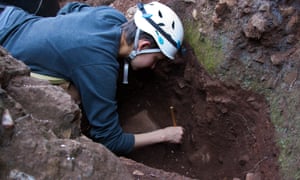
Alguns
fósseis de dois milhões de anos da África do Sul podem reorganizar a
árvore genealógica dos primeiros ancestrais humanos. Dois fósseis de uma espécie de hominídeo recentemente descoberta, chamada Australopithecus sediba, mostram características semelhantes às humanas, normalmente vistas em fósseis posteriores.
Lee
Berger da Universidade de Witwatersrand em Joanesburgo, África do Sul, e
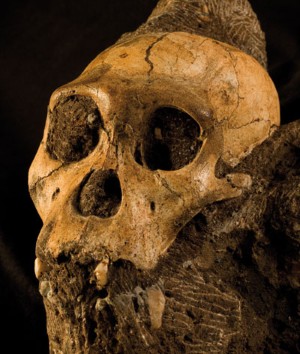
sua equipe descobriram os restos mortais (na foto) em uma caverna perto
de Joanesburgo em 2008.
Agora, uma olhada mais de perto em dois indivíduos A. sediba
, um menino e uma mulher, revela uma variedade de características
primitivas e modernas, como um pequeno cérebro com uma parte frontal em
forma de humano.
A pelve atarracada de A. sediba
parece moderna, lançando dúvidas sobre a ideia de que essa forma
evoluiu para dar à luz bebês com cérebros grandes. Seus braços longos,
semelhantes a macacos, sustentam mãos humanas com polegares longos,
adaptados para serem agarrados. A. sediba
caminhava sobre dois pés; seu tornozelo lembra o de um humano, mas o
calcanhar e os ossos da canela se parecem com os de um chimpanzé.
A equipe de Berger diz que A. sediba pode ser o ancestral direto do Homo erectus e, portanto, dos humanos modernos. Alternativamente, os fósseis podem marcar uma forma de sobrevivência tardia de Australopithecus que mais tarde foi extinta.
Crédito: B. ELOFF / L. BERGER / UNIV. WITWATERSRAND
Fósseis de macacos mostram indícios de ancestralidade humana
O hominídeo Australopithecus sediba era uma mistura de feições símias e humanas.
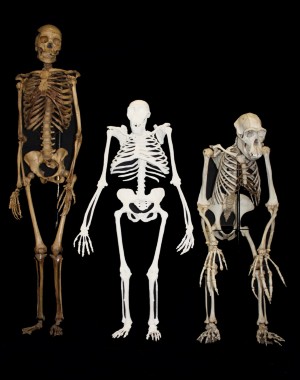
Uma reconstrução do esqueleto do
Australopithecus sediba (centro), em comparação com os de um ser humano moderno (esquerda) e um chimpanzé (
Pan troglodytes ; direita).
Crédito: Lee R. Berger / University of the Witwatersrand
Os
restos mortais de dois milhões de anos de um novo hominídeo descoberto
em agosto de 2008 são uma mistura estranha de características vistas
tanto nos primeiros humanos quanto nos australopitecinos que se presume
que os precederam. Uma bateria de seis estudos 1 , 2 , 3 , 4 , 5 , 6 publicados hoje na Science examina os fósseis do Australopithecus sediba
da cabeça ao calcanhar e produz uma visão sem precedentes de como a
criatura andava, mastigava e se movia. Juntos, os estudos sugerem que
este hominídeo era próximo à árvore genealógica dos primeiros humanos -
embora permaneça controverso se ele foi um de nossos ancestrais diretos.
“Vemos
a evolução em ação em todo esse esqueleto”, diz Lee Berger,
paleoantropologista da Universidade de Witwatersrand em Joanesburgo,
África do Sul. Por exemplo, enquanto os braços da criatura são
semelhantes aos de um macaco, suas mãos e pulsos são notavelmente
parecidos com os dos humanos. E embora a pélvis do hominídeo tenha a
forma da de um humano moderno, seu torso incluía uma estreita caixa
torácica superior como as encontradas nos macacos.
Um dos seis estudos enfocou Au. dentes de sediba 1
, comparando 22 aspectos diferentes em centenas de dentes de várias
outras espécies de australopitecinos e milhares de dentes humanos
primitivos. As semelhanças dentárias entre as espécies têm mais
probabilidade de significar ancestralidade comum do que evolução
independente em direção a um design benéfico, diz Debbie
Guatelli-Steinberg, antropóloga da Ohio State University em Columbus.
Isso porque a maioria das características que a equipe escolheu estudar,
como a curvatura sutil de uma parte da superfície do dente,
provavelmente não serão úteis do ponto de vista evolutivo.
Dos 22 traços dentais considerados por Guatelli-Steinberg e seus colegas, Au. sediba compartilhou 15 com o Australopithecus africanus e 15 com os primeiros humanos. Além disso, diz Guatelli-Steinberg, quatro das características compartilhadas por Au. sediba , Au. africanus
e os primeiros humanos não são vistos em hominídeos anteriores - outro
sinal da estreita relação evolutiva entre esses dois australopitecíneos e
os primeiros humanos, observa ela.
Uma das análises mais reveladoras do conjunto de estudos diz respeito a Au. as pernas de sediba e como a criatura deve ter andado 2
. Para que os modelos biomecânicos reconstruam adequadamente o passo e a
marcha de uma criatura, os pesquisadores precisam fornecer dados
anatômicos sobre cinco partes do corpo: calcanhar, tornozelo, joelho,
quadril e parte inferior das costas, diz Jeremy DeSilva, morfologista
funcional da Universidade de Boston em Massachusetts. “Com Au. sediba
, temos todos os cinco, e a anatomia é totalmente diferente da que
vemos em outros australopitecinos ”, observa. As peças individuais
parecem estranhas isoladas, mas juntas contam uma história, acrescenta
DeSilva.
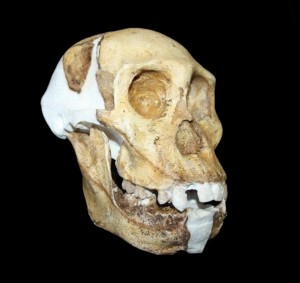
O crânio e a mandíbula reconstruídos do
Australopithecus sediba .
Crédito: Reconstrução: Peter Schmid / Foto: Lee R. Berger / University of the Witwatersrand
Baralhar e arrogar
Os modelos de sua equipe mostram que Au. sediba teria caminhado de maneira muito diferente dos humanos modernos. Em cada passada, a primeira parte do pé da criatura a entrar em contato com o solo seria a borda externa do pé. (Em
humanos modernos, o calcanhar atinge o solo primeiro.) À medida que o
peso se deslocava cada vez mais para esse pé, o pé teria rolado para
dentro, causando uma enorme rotação em cada uma das articulações das
pernas. O resultado, diz DeSilva, é uma marcha arrastada, arrogante, de pés chatos com passadas curtas. "Uau!" ele diz. “Nós não esperávamos isso.”
Au. O modo de caminhar de sediba
foi provavelmente um meio-termo, permitindo-lhe cambalear pelas
pastagens de um trecho de floresta a outro e, em seguida, escalar por
entre as árvores ao chegar à floresta, diz DeSilva.
Análises fisiológicas de Au. o torso de sediba apóia essa noção 3
. A estreita parte superior do corpo semelhante a um macaco sugere que a
criatura não teria grande capacidade pulmonar, diz o antropólogo Peter
Schmid, que liderou o trabalho do torso e recentemente se aposentou da
Universidade de Zurique, na Suíça. Além disso, a estrutura das
articulações dos ombros - um arranjo elevado e encolhido bem adequado
para subir em árvores e se pendurar em galhos - sugere que Au. sediba
não poderia ter balançado bem os braços ao caminhar. Juntos, observa
Schmid, esses fatores teriam limitado a capacidade da criatura de
respirar pesadamente ao caminhar ou correr.
Embora a maioria dos aspectos de Au. A anatomia de sediba sugere que ele é um parente próximo dos primeiros humanos do gênero Homo , exatamente onde a espécie se encontra na evolução humana ainda não está claro. “Estamos tentando ser cautelosos com nossas interpretações”, diz Berger.
No entanto, “pelo que estamos vendo, Au. sediba é um possível ancestral do Homo ”, diz Berger. “Mas se a criatura é um ancestral do Homo , então o gênero surgiu de uma maneira muito diferente da hipótese anterior.”
No
entanto, ancestralidade e parentesco próximo são duas coisas
diferentes, e alguns dentro da comunidade paleoantropológica contestam
que o hominídeo foi um ancestral humano direto. Um desses pesquisadores é
Donald Johanson, um paleoantropólogo da Arizona State University em
Tempe que não estava envolvido nos novos estudos. Na Etiópia, em 1974,
Johanson e seu colega Tom Gray descobriram os fósseis de “Lucy” ( Au. Afarensis ) - um hominídeo de 3,2 milhões de anos cujo esqueleto 40% completo é um dos fósseis mais renomados do mundo.
“Pelo que vi dos fósseis, acho que Au. sediba é outra espécie de Australopithecus que confirma a diversidade de espécies na evolução inicial dos hominídeos ”, diz Johanson. Embora Au. sediba
“demonstra abundantemente um conjunto único de características
anatômicas”, observa ele, a espécie era provavelmente um galho sem saída
na árvore genealógica dos hominídeos.
Referências
1
Irish, JD, Guatelli-Steinberg, D., Legge, SS, de Ruiter, DJ & Berger, LR Science 340 , 1233062-1–1233062-4 (2013).
2
DeSilva, JM et al. Science 340 , 1232999-1–1232999-5 (2013).
3
Schmid, P. et al. Science 340 , 1234598-1–1234598-5 (2013).
4
Williams, SA et al. Science 340 , 1232996-1–1232996-5 (2013).
5
De Ruiter, DJ et al. Science 340 , 1232997-1–1232997-4 (2013).
6
Churchill, SE et al. Science 340 , 1233477-1–1233477-5 (2013).
sábado, 4 de abril de 2020
Primeiro crânio conhecido do Homo erectus descoberto por equipe liderada pela Austrália
Fósseis mostram que o primeiro de nossos antepassados existia até 200.000 anos antes do que se pensava, dizem os pesquisadores - 02 de Abril de 2020
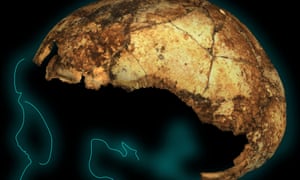
Contorno do crânio do Homo erectus. O crânio mais antigo conhecido do Homo erectus foi descoberto por uma equipe liderada pela Austrália na África do Sul. Fotografia: Fornecida pela Universidade La Trobe
O crânio mais antigo conhecido do Homo erectus foi descoberto por uma
equipe de pesquisadores liderada pela Austrália que datou o fóssil aos
dois milhões de anos, mostrando que o primeiro de nossos ancestrais
existia até 200.000 anos antes do que se pensava anteriormente.
O pesquisador principal, Andy Herries, disse que o crânio foi reunido
em mais de 150 fragmentos descobertos na pedreira principal de Drimolen,
localizada a cerca de 40 km ao norte de Joanesburgo, na África do Sul . Provavelmente tinha entre dois e três anos quando morreu.
Herries,
geocronologista e chefe de arqueologia da Universidade La Trobe, em
Melbourne, disse que "não podia enfatizar quão raro é" encontrar
fragmentos suficientes para reunir um caso cerebral intacto,
especialmente porque os crânios juvenis são finos e frágeis.
"Nesta idade, eles são tão suscetíveis a danos", disse ele.
“É tão emocionante, porque nosso fascínio pela evolução humana é porque
é a história de nós, e quando voltamos tão longe com uma descoberta
como essa, é a história de todas as pessoas que vivem no planeta.
"O grupo do qual essa criança de dois ou três anos fazia parte poderia ter sido a origem de todos os que vivem hoje."
Ele disse que, embora haja muitas divergências de opinião no campo da
arqueologia e da evolução humana, uma das razões pelas quais o Homo
erectus é significativo é porque todos concordaram: "Este é o começo de
nós, este é o começo de nosso gênero".
Herries disse que foi um de seus alunos de doutorado trabalhando com
ele no local da escavação, Richard Curtis, que encontrou os fragmentos
em 2015 durante sua primeira escavação. Curtis originalmente pensou que tinha descoberto as peças do crânio de um babuíno.
"Eu estava trabalhando um pouco mais além e você sabe que quando alguém
encontra algo porque um grande grito sobe, as pessoas chegam até você
com os olhos arregalados, alguns dos meus colegas começam a dançar",
disse Herries.
“Mas, ainda assim, encontramos muitos babuínos, e foi o que pensamos que provavelmente havíamos encontrado neste caso.
Então, só depois de limparmos os fragmentos e meus colegas da
Universidade de Joanesburgo começarem a trabalhar para reuni-los é óbvio
que o crânio era grande e redondo demais para ser um babuíno. ” Foram necessários cinco anos para reconstruir, datar e identificar o crânio.
"Pode parecer estranho que não possamos dizer o que é um babuíno e o
que não é imediato, mas é difícil quando você tem muitos fragmentos",
disse Herries.
Pesquisadores reuniram o crânio de mais de 150 fragmentos encontrados na pedreira de Drimolen, ao norte de Joanesburgo. Fotografia: Fornecida pela Universidade La Trobe
Um pedaço do crânio havia sido descoberto por arqueólogos em 2007, mas
como o fragmento foi encontrado por conta própria e era muito fino, os
pesquisadores não reconheceram que haviam encontrado o crânio de um
hominínio.
O fragmento foi colocado em uma bolsa e ficou em um cofre por cerca de
uma década, até que a equipe de Herries percebeu que era um pedaço do
crânio, que eles chamaram de DMH 134.
"Agora podemos dizer que o Homo erectus compartilhou a paisagem com outros dois tipos de seres humanos na África do Sul , Paranthropus e Australopithecus", disse ele.
"Isso sugere que uma dessas outras espécies humanas, Australopithecus
sediba, pode não ter sido o ancestral direto do Homo erectus, ou de nós,
como anteriormente foi proposto".
Herries disse que a descoberta foi particularmente especial porque, em
1924, o anatomista australiano Raymond Dart identificou o primeiro
fóssil já encontrado de Australopithecus africanus, um hominino extinto
intimamente relacionado aos seres humanos e descoberto na África do Sul.
"Ninguém acreditou nele na época porque eles pensavam que a origem dos seres humanos estaria na Europa", disse Herries.
“E agora, 100 anos depois, o DMH 134 ficará sentado na mesma sala que a
criança que ele identificou, provando ainda mais o que encontrou. É uma prova do trabalho dos australianos sobre a evolução humana. ”
Os resultados foram publicados na sexta-feira na revista internacional Science.
O arqueólogo Dr. Ceri Shipton, da Universidade Nacional Australiana,
não participou da pesquisa, mas examinou as descobertas, que ele disse
serem um bom argumento para o Homo erectus e várias outras espécies de
hominina e outros animais que emergem em tempos de clima seco. 2 milhões
de anos atrás.
"Isso se encaixa na ideia de nosso gênero ser adaptado à savana e, em
particular, explorar o grande jogo disponível nas pastagens, que eles
massacrariam usando ferramentas de pedra", disse Shipton.
“Essa descoberta está muito distante do Homo erectus mais antigo do
leste da África, confirmando que o Homo erectus foi amplo desde o
início, e é por isso que seus fósseis iniciais também foram encontrados
na Geórgia cerca de 1,8 milhão de anos atrás, e que provavelmente
atingiram a ilha de Flores, onde ficaram isolados e evoluíram para o
Homo floresiensis. ”
A geocronóloga e cientista quaternária da Universidade Macquarie,
professora associada Kira Westaway, disse que pesquisas recentes sobre
evolução humana estão descobrindo cada vez mais sobreposições entre
diferentes hominídeos que se separam espacial e temporalmente.
"Essas sobreposições bem datadas indicam que a árvore genealógica dos
hominídeos é muito mais diversificada e complexa do que a anteriormente
aceita", disse ela.
“A implicação mais fascinante desta pesquisa, alimentada pela
confirmação de uma sobreposição, é que a causa da extinção do
Australopithecus pode ser explorada com o novo potencial de que possa
ter havido concorrência do Homo ou do Paranthropus - essa é realmente
uma avenida nova e emocionante de pesquisa."
Fonte: https://www.theguardian.com
quarta-feira, 22 de maio de 2019
Temporal evidence shows Australopithecus sediba is unlikely to be the ancestor of Homo
Entender o surgimento do gênero Homo é um problema premente no estudo das origens humanas. O Australopithecus sediba foi recentemente proposto como a espécie ancestral do Homo, embora postergando o mais antigo Homo em 800.000 anos. Aqui, usamos modelos de probabilidade para demonstrar que a observação do horizonte fóssil de um ancestral que é pelo menos 800.000 anos mais jovem do que o horizonte dos descendentes é improvável (cerca de 0,09% em média). Corroboramos esses resultados buscando na literatura e descobrindo que, dentro de pares de supostas espécies descendentes de ancestrais hominídeos, em apenas um caso, o primeiro fóssil descoberto no antepassado datava do descendente, e a diferença de idade entre esses fósseis era muito menor. do que a diferença observada entre A. sediba e Homo mais antigo. Juntos, esses resultados sugerem que é altamente improvável que A. sediba seja ancestral do Homo, e a espécie ancestral candidata mais viável continua sendo Australopithecus afarensis.
INTRODUCTION
Understanding the origin of the genus Homo
is one of paleoanthropology’s most enduring questions. A key element in
resolving this question is determining which species may have been
ancestral to our genus. Because Australopithecus sediba has recently been proposed as a candidate ancestral species (1–3), it is essential that we critically evaluate this claim. Fossil specimens from A. sediba are currently only known from Malapa, South Africa, which is dated to 1.977 million years (Ma) ago (2). These fossils postdate by 800,000 years (0.8 Ma) the only known specimen from the oldest, and currently unnamed, species of Homo (hereafter, “earliest Homo”), which is dated to 2.8 to 2.75 Ma ago at Ledi-Geraru, Ethiopia (4, 5). Most recently, the argument for A. sediba being ancestral to Homo was continued by Robinson et al. (6),
who discussed how a fossil horizon from an ancestral species could be
much younger than a horizon from the descendant and claimed, “On
temporal grounds alone one cannot dismiss the possibility that A. sediba could be ancestral to the genus Homo” (p. 1).
Two conditions must both be met for A. sediba to be ancestral to Homo and for the recovery of an A. sediba fossil horizon that is much younger than an earliest Homo
horizon (barring severe postdepositional stratigraphic mixing or errors
in taxonomic assignment or dating): (i) Because an ancestor’s fossil
horizon can only postdate a descendant’s if there is some overlap in the
species’ temporal ranges (Fig. 1A), the descendant must have speciated from the ancestor via budding cladogenesis (Fig. 1B).
For our study, we assume that Homo cladogenetically budded from A. sediba because, otherwise, this analysis would be unnecessary, and the argument for A. sediba being ancestral to Homo would be illogical (because the A. sediba fossil horizon postdates the earliest Homo horizon). (ii) Given the large amount of time separating the fossil horizons of A. sediba and earliest Homo, there must have been substantial overlap between the two species’ temporal ranges, such that the end of the A. sediba range is able to postdate the beginning of the earliest Homo range by at least 0.8 Ma (Fig. 2). If range overlap is less than 0.8 Ma, then the A. sediba fossil horizon cannot be 0.8 Ma younger than the earliest Homo horizon (assuming A. sediba was ancestral to Homo) (Figs. 1A and 2). As range overlap increases, so does the probability of sampling the end and beginning of the A. sediba and earliest Homo ranges, respectively, such that their horizons are at least 0.8 Ma apart (Fig. 2A). This second condition forms the theoretical basis for our probability model.
Fig. 1Conditions where an ancestor’s fossil horizon can be younger than the descendant’s.
For both figures, “A” represents the ancestral species, and “D” represents the descendant species. (A)
When there is no overlap between the temporal ranges of an ancestor and
a descendant, an ancestor’s fossil horizon can never be younger than
the descendant’s. If ranges partially overlap (gray), then an ancestor’s
fossil horizon can postdate the descendant’s (fossil horizons are
represented by white circles). The maximum age difference between a
younger horizon from an ancestor and an older horizon from a descendant
is ultimately constrained by the amount of range overlap, such that the
age difference can never be greater than the amount of overlap. (B)
Three different ways a descendant can speciate from an ancestor.
Budding cladogenesis is the only speciation mode that produces ancestors
and descendants with overlapping temporal ranges and is therefore the
only mode where an ancestor’s fossil horizon can postdate the
descendant’s. “D1” and “D2” represent two sister lineages, which are
both descendants of “A.” (B) is modified after Fig. 1 in (25).
Fig. 2Schematic
used to derive the model for quantifying the probability that an
ancestor’s fossil horizon postdates the descendant’s by at least 0.8 Ma.
For both figures, “A” represents the ancestral species, and “D” represents the descendant species. (A).
The probability of sampling an ancestor’s fossil horizon that is at
least 0.8 Ma younger than the descendant’s is ultimately a function of
the amount of overlap between both species’ temporal ranges relative to
the age difference of interest (which here is 0.8 Ma). When range
overlap is less than 0.8 Ma, the ancestor’s horizon cannot postdate the
descendant’s by 0.8 Ma (represented by the Xs in the leftmost
example). In the middle example, there is enough range overlap where 0.8
Ma separates the end and beginning of the ancestor’s and descendant’s
ranges, respectively (black), and each species’ fossil horizon must be
sampled from these black regions.
As overlap increases (rightmost
example), so does the size of the black regions and the probability of
sampling an ancestor’s fossil horizon that is at least 0.8 Ma younger
than the descendant’s horizon. The rightmost example is used to
illustrate the three variables from our probability model (Eq. 5c): Td represents the age difference of interest (i.e., 0.8 Ma), To represents the amount of range overlap, and TR represents the duration of the entire temporal range (i.e., 0.97 Ma). (B)
Focusing on the black regions, a descendant’s fossil horizon (white
circles) can sample some time near the species’ age of origination
(leftmost example), which means that the ancestor’s horizon can be
sampled anywhere in its own black region and still be at least 0.8 Ma
younger than the descendant horizon (white-striped region). If the
descendant’s horizon is found in the middle of the black region (middle
example), the ancestor’s horizon must sample the younger half of its own
black region. If the descendant horizon samples the end of its black
region (rightmost example), the ancestor’s horizon must sample the end
of its temporal range. The rightmost example is used to illustrate the XA and XD
variables (Eq. 3), each of which represents the distance from the
beginning of the black region to the temporal location of the fossil
horizon in the ancestor’s and descendant’s range, respectively. For the
ancestor’s horizon to postdate the descendant’s by at least 0.8 Ma, XA must be greater than XD, and two iterations of this are shown.
While Robinson et al. (6)
are correct that it is possible for an ancestor’s fossil horizon to be
much younger than the descendant’s, a more informative question would
be, “How likely is this chronological pattern?” We build upon previous
work concerning the evolutionary relationships of A. sediba (1–3, 6) and construct a probability model, which serves as a null hypothesis test, to evaluate whether A. sediba is ancestral to Homo.
We assume that (i) A. sediba and earliest Homo each had temporal ranges of 0.97 Ma (6), (ii) the probability of recovering fossils throughout each species’ range is uniform through time (7, 8), and (iii) the probability of sampling an A. sediba fossil horizon does not affect the probability of sampling an earliest Homo
fossil horizon, i.e., these are independent events (see Materials and
Methods). From these assumptions, we quantify the probability of finding
one fossil horizon from A. sediba that is at least 0.8 Ma younger than one horizon from earliest Homo (i.e., the observed data), assuming A. sediba is ancestral to Homo (i.e., the null hypothesis).
The computed probabilities are equivalent to P values, and if they are exceptionally low, this would suggest that A. sediba is unlikely to be the ancestor of Homo (i.e., the null hypothesis is falsified). We calculate multiple P
values as a function of the overlap between the two species’ true
temporal ranges, which is currently unknown. We analyze temporal
evidence only (6) and do not consider morphological data concerning the evolutionary relationship between A. sediba and Homo (1, 9–11).
We also analyze the historical record of hominin discovery and
calculate the geological age difference between initial fossil
discoveries in purported ancestor and descendant species. The aim here
is to corroborate our theoretical probability results and to empirically
assess how likely it is for an ancestor’s fossil horizon to postdate a
descendant’s by at least 0.8 Ma.
RESULTS
The
probability of finding an ancestor’s fossil horizon that is at least
0.8 Ma younger than the descendant’s is, by definition, zero when
temporal range overlap is less than or equal to 0.8 Ma (Figs. 2A and 3 and Eq. 5c). This probability monotonically increases with range overlap when overlap is greater than 0.8 Ma (Fig. 3 and Eq. 5c) for reasons discussed above (Fig. 2A).
However, even when the two species’ ranges completely overlap, which is
impossible for ancestor-descendant species and is only presented as a
theoretical upper bound, the computed P value is only 0.016 (Fig. 3 and Eq. 5c). If we treat all possible values of range overlap as equally likely, the mean P value over all overlap values is 0.0009 (Eq. 6c). We have confirmed our probability model results with simulations (fig. S1 and data file S5).
Fig. 3Probability of finding an ancestor’s fossil horizon that is at least 0.8 Ma younger than the descendant’s fossil horizon (P value).
P
values are plotted as a function of the overlap between the two
species’ true, unknown temporal ranges, each of which is assumed to be
0.97 Ma in duration (6).
Reviewing the paleoanthropology literature, we
recorded 28 hypothesized ancestor-descendant species pairs (table S1).
There is only one instance where an ancestor’s first-discovered fossil
postdated the descendant’s: ancestor Homo erectus sensu lato (Kedung Brubus 1) dated to 0.8 to 0.7 Ma ago (12) and descendant Homo antecessor (ATD6-1) dated to 0.9 to 0.8 Ma ago (13). The age difference between these specimens (i.e., 0.1 Ma) is far less than the age difference observed between A. sediba and earliest Homo (i.e., 0.8 Ma) (Fig. 4). When the mean and SD of the 28 observed age differences are used to generate a normal distribution model (bell curve in Fig. 4), 0.8 Ma falls in the >99.9th percentile, which translates to a P value less than 0.001.
Fig. 4Histogram
of the geological age differences between first-discovered fossils in
purported hominin ancestor-descendant species pairs (n = 28).
Negative
age differences represent those species pairs where the ancestor’s
first-discovered fossil is older than the descendant’s, and positive age
differences indicate the opposite. The black arrow represents the
observed age difference between A. sediba (hypothesized ancestor) and earliest Homo
at Ledi-Geraru (hypothesized descendant). The bell curve represents a
normal distribution model, generated using the sample mean and SD of the
28 observed age differences.
DISCUSSION
We have demonstrated using probability models that the null hypothesis of A. sediba being ancestral to Homo can be falsified. That is, it is very unlikely (about 0.09% on average) to find an A. sediba fossil horizon that is at least 0.8 Ma younger than an earliest Homo
horizon, if the former species is actually ancestral to the latter. The
prior record of paleoanthropological discoveries also reflects the
rarity of cases in which this chronological pattern is observed, further
supporting that A. sediba is unlikely to be ancestral to Homo.
We can explore how strongly our assumptions influenced our modeling results. We calculated our P values, assuming the 2.8-Ma-old Ledi-Geraru mandible actually belongs to Homo (5). Some researchers dispute this (14), so we also ran our analyses assuming A.L. 666-1 (2.33 Ma-old)—a specimen widely regarded as Homo—represents the oldest Homo specimen (15). Although a handful of researchers argue that all pre–1.9-Ma-old specimens assigned to Homo are invalidly named or are poorly dated (2, 3), we view this assertion as unlikely [as does Robinson et al. (6)]. By selecting a younger fossil to represent the oldest Homo specimen, we are decreasing the observed age difference between A. sediba and earliest Homo, which should increase the P values overall (Eq. 5c).
We also explored whether our choice of 0.97 Ma to represent hominin
temporal durations might affect our results because using a longer
duration will increase the amount of time associated with a given
percentage of range overlap between two species, and this should
increase P values as well (Eq. 5c).
We therefore reran our analyses assuming hominin temporal durations of 2
Ma, which is at the larger end of estimated mean species durations in
African large mammals [all African large mammals: 2.3 Ma (16); eastern African bovids: 1.4 Ma (17); large mammals in the Omo-Turkana Basin, Ethiopia/Kenya: 1.4 Ma (17); Australopithecus anamensis-afarensis: 1.2 Ma (7, 8)]. Results show that calculated P values are still small even when relaxing the age of earliest Homo to 2.33 Ma ago or hominin temporal durations to 2 Ma. For example, P values exceed 0.05 only when range overlap is at least 70%, and the mean and maximum P values over all possible overlap values are only 0.04 and 0.20, respectively (Eqs. 5c and 6c, and fig. S2, A and B). When both assumptions are simultaneously relaxed, P values exceed 0.05 when overlap is at least 50%, and the mean and maximum P values are 0.093 and 0.34, respectively (Eqs. 5c and 6c, and fig. S2C).
For our model, we assumed that the probability of recovering a fossil horizon from each of the A. sediba and earliest Homo
temporal ranges is uniform through time. This assumption is a
parsimonious one given that only one horizon each has been sampled from A. sediba (1, 2) and earliest Homo (5),
and a uniform fossil recovery potential (FRP) (i.e., the probability of
finding a fossil horizon) is a good approximation for the one hominin
lineage where FRP has been explored, i.e., A. anamensis-afarensis (7, 8). However, we also have to consider the possibility that FRP is not uniform through time in the A. sediba and earliest Homo temporal ranges. Our P
values would only be biased downward if FRP is greater in South Africa
and eastern Africa during the geological time periods when A. sediba and earliest Homo are found, respectively. This is because if FRP is actually higher toward the end and beginning of the A. sediba and earliest Homo temporal ranges, respectively, then it is more likely that one will recover an A. sediba horizon that is much younger than an earliest Homo
horizon, even if the former species is ancestral to the latter. Using
the number of hominin fossil horizons—defined as midpoint ages of
hominin-bearing members with age duplicates removed (see data file S3) (7, 8)—as a proxy for FRP, we find that FRP is not appreciably higher during the times when A. sediba and earliest Homo
are found in their respective geographic regions (fig. S3). There is
the possibility that FRP might be slightly higher in South Africa around
the time of A. sediba (fig. S3), but even if we double the probability of recovering a fossil horizon in the last 25% of the ancestor’s (i.e., A. sediba) temporal range, the maximum P value is only 0.025 (fig. S4).
Regarding
our analysis of the historical record of first-discovered hominin
fossils, ancestor-descendant hypotheses might implicitly or explicitly
incorporate temporal information, which would potentially render our
analysis circular.
That is, if ancestor-descendant relationships are
proposed at least partly based on the fact that the ancestor’s fossil
predates the descendant’s, it should be no surprise that ancestors’
fossil horizons rarely postdate descendants’ horizons. However,
incorporating temporal data into ancestor-descendant hypotheses does not
necessarily mean that the ancestor’s first-discovered fossil must
predate the descendant’s first-discovered fossil (fig. S5). For example,
a newly discovered fossil from the ancestral species may sample the end
of its temporal range, and the rest of the range is revealed only after
subsequent sampling.
A second, more recently found fossil may be
proposed as the ancestor’s descendant based on the new fossil postdating
the ancestor’s first appearance, but the new descendant fossil can
still predate the younger, first-discovered fossil from the ancestor
(see fig. S5 for a discussion about the more complicated scenario when
the descendant fossil is found first). Regardless of whether the
ancestor or descendant was found first, none of the ancestor’s
first-discovered fossils ever postdated the descendants by more than 0.8
Ma (i.e., the observed age difference between A. sediba and earliest Homo) in our literature review (Fig. 4 and table S1).
Robinson et al. (6) write, “Until such time as additional data on its temporal range are available for A. sediba, any inferences about the evolutionary relationship between it and Homo
should be based primarily on morphological data” (p. 6). More fossils
will always strengthen any inference, but we have demonstrated here that
even with the scant data relevant to the question at hand (i.e., only
one fossil horizon each from A. sediba and earliest Homo),
we can still use temporal evidence to rigorously assess the proposed
ancestor-descendant relationship between these two species. This is
accomplished by modeling the process/question of interest to generate
the probability of obtaining the observed pattern (i.e., an ancestor’s
fossil horizon that is 0.8 Ma younger than the descendant’s), analogous
to a null hypothesis test. Our analyses demonstrate that strong
inferences can be made even with an incomplete fossil record, so
chronological data and tests should not be so quickly discarded.
The issue of the origin of Homo is one of the thorniest questions in paleoanthropology and one that has led to myriad proposals and, sometimes, speculations (2, 3, 18, 19).
Answers to the questions of how, when, and where the earliest
representatives of the genus emerged are still in flux, owing especially
to the dearth of fossil data from the relevant temporal range (3.0 to
2.5 Ma ago). It is therefore important to use all available lines of
evidence when addressing a question as data poor as this one. While
fossil remains from the 3.0- to 2.5-Ma-old interval are necessary to
reasonably document the morphological patterns surrounding the origin of
Homo, probabilistic methods such as the one used here are also
critical for assessing the chronological evidence for proposed
relationships between Homo and candidate ancestors. Hypothesized ancestor-descendant relationships must satisfy both temporal and morphological criteria (7, 20). We tested the first criterion here, and the second one has been tested elsewhere (11). A. sediba fails both benchmarks, and the most viable ancestral candidate for the genus Homo remains Australopithecus afarensis both on morphological (5) and temporal grounds (7, 8).
MATERIALS AND METHODS
Probability model
We are interested in the probability that an ancestor’s fossil horizon postdates the descendant’s by at least some amount, Td. Let us denote this probability as P(HA − HD > Td), where HA and HD
represent the ages of the ancestor’s and descendant’s fossil horizons,
respectively. To have an ancestor’s horizon postdate the descendant’s,
the fossils must come from the period of temporal range overlap (Fig. 1A). To get an ancestor’s horizon that postdates the descendant’s by at least Td,
the ancestor’s fossil must sample the younger end of the overlap
region, and the descendant’s fossil must sample the older end (Fig. 2A); let us designate these respective regions as endA and endD (i.e., black regions in Fig. 2A), and the probability of sampling these regions is P(endA) and P(endD). Because we assume that the ancestor and descendant species have equal temporal ranges, P(endA) = P(endD) (Fig. 2A).
Assuming sampling probability is uniform throughout a species’ temporal
range, the probability of sampling a fossil horizon from this region is
P(endA)=P(endD)=To−TdTR
(1)where To is the amount of range overlap and TR is the duration of the entire temporal range (Fig. 2A).
We assume here that the probability of selecting a fossil horizon from
the ancestor’s range is independent from selecting a fossil horizon from
the descendant’s range. This is a sensible assumption given that the
earliest Homo specimen is from eastern Africa (5), whereas the A. sediba specimens are from South Africa (1). Therefore, the probability of sampling one fossil horizon each from endA and endD is P(endA) × P(endD) or
P(endA∩endD)=(To−Td)2T2R
(2)where “∩” denotes the intersection, i.e., when two events both occur.
Once endA and endD are both sampled, Fig. 2B illustrates the necessary conditions that must occur for the ages of the ancestor’s and descendant’s fossil horizons (i.e., HA and HD, respectively) to be separated by at least Td. Let XD represent the age difference between the beginning of endD and HD (XA represents the same but for the ancestor) (Fig. 2B). For a given value of XD, which we will call t, XA must be greater than XD, so HA falls within the white-striped regions in Fig. 2B. The probability of this occurring for all possible values of t (i.e., from zero to infinity) is
P(XA>XD)=⌠⌡t=0∞P(XA>XD|XD=t)P(XD=t)dt
(3a)
Note that this is the law of total probability (21), which states P(A)=∑nP(A|Bn)P(Bn)
, i.e., the probability of event A occurring is equal to the probability of A given event Bn multiplied by the probability of Bn, and all these are summed (or integrated) over all possible instances of Bn in the sample space to get the total probability of A. Because we assume XA and XD are independent (i.e., the probability of XD taking on some value, t, does not affect the value of XA and whether it is greater than t), the first probability on the right-hand side in Eq. 3a can be simplified, so
P(XA>XD)=⌠⌡t=0∞P(XA>t)P(XD=t)dt
(3b)
Because
we assume that FRP is uniform throughout a species’ temporal range, the
probability of sampling a fossil can be modeled as a Poisson process,
where XA and XD are exponentially distributed (22, 23). The first probability in the integral (i.e., P[XA > t]; Eq. 3b) can be thought of as the probability that HA is not found within the interval (0, t) (or one minus the probability that HA is sampled in this interval). Using the exponential cumulative distribution function, this probability is
P(XA>t)=1−(1−e−λt)=e−λt
(3c)
The second probability in the integral (P[XD= t]; Eq. 3b) can be calculated using the exponential probability density function (i.e., the probability that XD takes on some value, t), so
Note
that because we are only concerned with sampling one fossil horizon
each from the ancestor’s and descendant’s range, both of which are of
equal duration, the sampling rate, λ, for each species is the same.
Solving Eq. 3e
The exponential term equals zero given that λ is positive, so
P(XA>XD)=λ2λ=12
(3g)
The same logic and result hold if the roles of XD and XA are reversed, i.e., if we instead solve P(XD<XA)=∫t=0∞P(XD<XA|XA=t)P(XA=t)dt
. Therefore, the probability of getting HA and HD separated by at least Td given that HA and HD come from endA and endD, respectively, is one-half, or using probability notation
P(HA−HD>Td|endA∩endD)=12
(4)
Putting all the above equations together using the law of total probability (21)
(5a)where the superscript “c” denotes the complement, i.e., when an event does not happen. We have already established that endA and endD need to both be sampled for an ancestor’s horizon to postdate a descendant’s by at least Td (Fig. 2A), so P(HA − HD > Td | [endA ∩ endD]c) = 0. Therefore, the second product in Eq. 5a equals zero and can be dropped. We have already solved the two probabilities in the first product of Eq. 5a with Eqs. 4 and 2, so
And because P(HA − HD > Td) must be zero when the age difference of interest (Td) is greater than the amount of range overlap (To) (Figs. 1A and 2A), the final model is
P(HA−HD>Td)={0(To−Td)22T2RTd>ToTd≤To
(5c)
For our main analysis (Fig. 3), Td = 0.8 Ma, we assume TR to be 0.97 Ma (6), and we explored multiple values for To, which is currently unknown.
Because To (i.e., how much the A. sediba and earliest Homo temporal ranges overlap) is currently unknown, we also applied uniform prior probabilities over all possible values of To to distill the P value function (Eq. 5c) into its mean value (i.e., the expected value) (24). To get the expected P value, we integrate Eq. 5c with respect to To over all possible values of To (i.e., from zero to TR) against the probability density function of our To uniform prior, which is defined as 1/TR between zero and TR. Therefore, the expected value is
Note that because P(HA − HD > Td) is a piecewise function (Eq. 5c), we break the integral into the sum of two integrals separated by Td (i.e., the value that separates the piecewise function in Eq. 5c). The first integral in Eq. 6a equals zero, and pulling out the 1/2TR2 constant in the second integral gives
(6c)which is the expected P value from Eq. 5c, treating all possible values of To as equally likely.
Analysis of published fossil ages
We
reviewed the literature and recorded the geological ages (lower and
upper bracketing ages) and year of discovery of the first fossil found
in each species in a hypothesized hominin ancestor–descendant pair [this
mirrors the situation in A. sediba and earliest Homo, both of which currently have only one fossil horizon each (2, 5)].
Because we were only interested in by how much the ancestor’s
first-discovered fossil postdated the descendant’s first-discovered
fossil, we were more inclusive than not in our selection (i.e., the
accuracy or widespread acceptance of an ancestor-descendant relationship
should have no bearing on the age difference between first-discovered
fossils). To calculate the age difference, we subtracted the midpoint
age of the ancestor’s first-discovered fossil from the midpoint age of
the descendant’s first-discovered fossil, where the midpoint age is
defined as (lower bracketing age + upper bracketing age)/2. Negative age
differences indicate that the ancestor’s first-discovered fossil is
older than the descendant’s, and vice versa, for positive differences.
Fig. S1. Confirming our probability model results (Fig. 3) with simulations.
Fig. S2. Same analysis as in Fig. 3 but assuming hominin temporal durations of 2 Ma, A.L. 666-1 (2.33 Ma old) represents the oldest Homo fossil, or both.
Fig. S3. Uniform probability plots for 4- to 1-Ma-old hominin fossil horizons in South Africa and eastern Africa.
Fig. S4. Same analysis as in Fig. 3, but the probability of sampling a fossil horizon (i.e., FRP) from the last 25% of the ancestor’s range is doubled.
Fig.
S5. Schematic illustrating how proposing an ancestor-descendant
relationship based on temporal evidence does not necessarily constrain
the first-discovered fossil in each species to be in the “correct” order
(i.e., where the ancestor’s first-discovered fossil predates the
descendant’s).
Table S1. Previously proposed ancestor-descendant hominin species pairs (n = 28), and the year discovered and geological ages of the first-discovered specimen in each species.
Data file S1. Hypothesized hominin ancestor–descendant species pairs.
Data file S2. Geological ages for first-discovered specimens of hominin species.
Data file S3. Four- to 1-Ma-old South African and eastern African hominin-bearing members and their geological ages.
Data file S4. Dataset references.
Data file S5. R code for analyses and creating figures.
This is an open-access article distributed under the terms of the Creative Commons Attribution-NonCommercial license, which permits use, distribution, and reproduction in any medium, so long as the resultant use is not for commercial advantage and provided the original work is properly cited.
,
Statistical estimates of hominin origination and extinction dates: a case study examining the Australopithecus anamensis-afarensis lineage. J. Hum. Evol. (in revision).
Z.
Alemseged, A. Du, J. Rowan, B. A. Wood, “Estimating the timing of and
placing confidence intervals on the origination and extinction of the Australopithecus anamensis-afarensis lineage,” Abstr. 2018 Paleoanthropology Soc. Meet. PaleoAnthropology 2018, A1 (2018).
,
Australopithecus sediba and the emergence of Homo: Questionable evidence from the cranium of the juvenile holotype MH 1. J. Hum. Evol.
107,
94–106 (2017).
,
New radiometric dates on the lowest stratigraphical section (TD1 to TD6) of Gran Dolina site (Atapuerca, Spain). Quat. Geochronol.
30,
535–540 (2015).
Acknowledgments: For
discussions about probability models, we thank A. Gordon (who
recommended substantive improvements), M. Foote, and E. Friedlander. We
thank S. Wang, M. Foote, and K. Hatala for comments on an earlier
version of the manuscript. We also thank The University of Chicago
Anthropology Journal Club for their helpful comments on the manuscript. Funding: No funding was received for this project. Author contributions:
A.D. and Z.A. designed the research. A.D. and Z.A. collected the data.
A.D. created the probability model and analyzed the data. A.D. wrote the
paper with contributions from Z.A. Competing interests: The authors declare that they have no competing interests. Data and materials availability:
All analyzed datasets and R code can be found in the Supplementary
Materials. Additional data related to this paper may be requested from
the authors.