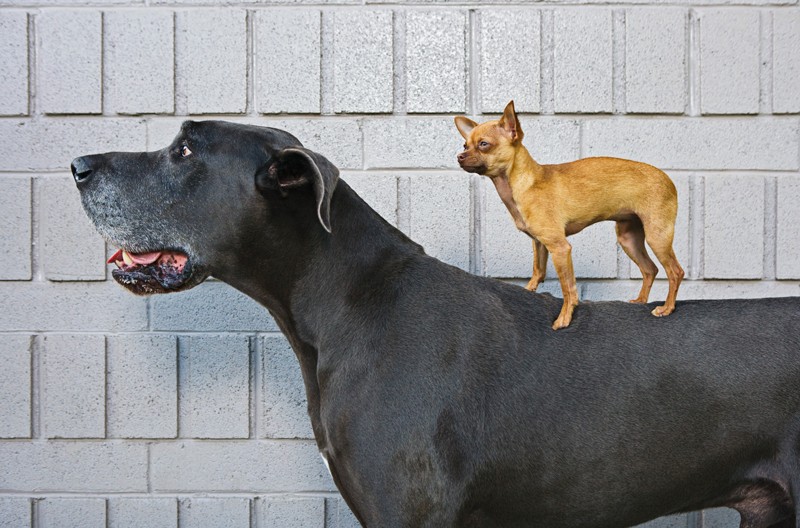
Os cães diferem em tamanho mais do que qualquer outro mamífero. Crédito: Brand-X Pictures/Getty
De chihuahuas a
grandes dinamarqueses, os cães diferem mais em tamanho do que qualquer
outra espécie de mamífero do planeta. Uma mutação por trás dessa
variação foi atribuída a uma fonte inesperada: lobos antigos 1 .
A mutação está perto de um gene chamado IGF1 ,
que os pesquisadores sinalizaram há 15 anos como tendo um papel
importante na variação de tamanho dos cães domésticos. Foi o primeiro de
cerca de duas dúzias desses genes identificados. Mas os esforços para
identificar a variante do gene responsável foram em vão.
“ O IGF1 tem
sido um espinho em nosso lado”, diz Elaine Ostrander, geneticista do
Instituto Nacional de Pesquisa do Genoma Humano dos EUA em Bethesda,
Maryland, que liderou o estudo de 2007 que identificou pela primeira vez
IGF1 do cão 2 , bem como o estudo de 27 de janeiro na Current Biology que agora cumpre a missão.
Cães
antigos, domesticados de lobos nos últimos 30.000 anos, diferiam em
tamanho até certo ponto. Mas as atuais diferenças extremas de tamanho –
as maiores raças são até 40 vezes maiores que as menores – surgiram nos
últimos 200 anos, quando os humanos estabeleceram raças modernas.
Ostrander
e seus colegas, incluindo a geneticista Jocelyn Plassais, do
INSERM-Universidade de Rennes, França, analisaram os genomas de mais de
1.400 canídeos, incluindo cães antigos, lobos, coiotes e 230 raças
modernas de cães.
Controle de crescimento
Quando compararam a variação na região ao redor do IGF1 com
o tamanho do corpo em cães e canídeos selvagens, uma variante se
destacou. Encontra-se em um trecho de DNA que codifica uma molécula
chamada RNA longo não codificante, que está envolvida no controle dos
níveis da proteína IGF1, um potente hormônio do crescimento.
Os
pesquisadores identificaram duas versões, ou alelos, da variante. Em
todas as raças, cães com duas cópias de um alelo tendiam a pesar menos
de 15 kg, enquanto duas cópias da outra versão eram mais comuns em cães
com peso superior a 25 kg. Cães com uma cópia de cada alelo tendem a
ter tamanho intermediário, diz Ostrander. Caninos com duas cópias do
alelo de corpo grande também apresentaram níveis mais altos da proteína
IGF1 no sangue, em comparação com aqueles com duas cópias do alelo
'pequeno'.
A mutação que causa a variação de tamanho dos cães foi atribuída a lobos antigos. Crédito: Alexander Sviridov/Shutterstock
Quando os
pesquisadores analisaram os genomas de outros canídeos, encontraram uma
relação semelhante. “Esta não era apenas uma história de cachorro.
Esta era uma história de lobo e uma história de raposa e uma história de
coiote e tudo mais. Foi em toda a canina”, diz Ostrander.
Ancestrais diminutos
Os
pesquisadores acham que o alelo ligado a corpos pequenos é,
evolutivamente, muito mais antigo do que a versão de corpo grande.
Coiotes, chacais, raposas e a maioria dos outros canídeos analisados
tinham duas cópias da versão 'pequena', sugerindo que essa versão
estava presente em um ancestral comum desses animais.
Não
está claro quando o alelo de corpo grande evoluiu. Os pesquisadores
descobriram que um antigo lobo que viveu na Sibéria cerca de 53.000 anos
atrás carregava uma cópia desta versão. Outros lobos antigos e lobos
cinzentos modernos tendem a ter dois, sugerindo que o alelo de corpo
grande pode ter sido benéfico para os lobos.
A
visão predominante entre os cientistas costumava ser que o tamanho do
corpo pequeno provavelmente estava ligado a mudanças genéticas
relativamente novas, potencialmente exclusivas dos cães domésticos, diz
Robert Wayne, biólogo evolucionário da Universidade da Califórnia, em
Los Angeles. “Isso vira toda a história de cabeça para baixo. Isso é o
que é maravilhoso sobre a coisa toda.”
O
estudo pode ser um sinal de que os cães foram domesticados de lobos de
corpo menor, diferente das populações atuais de lobos cinzentos, diz
Elinor Karlsson, geneticista da Escola de Medicina Chan da Universidade
de Massachusetts, em Worcester. “Não sabemos como eram os lobos que
levaram aos cães”, diz ela.
Os
pesquisadores também alertam que a história do tamanho do cão está
longe de ser completa. Plassais quer descobrir como as variantes
influenciam os níveis da proteína IGF1. E a variante não é o único
determinante do tamanho em cães: o IGF1 próprio gene
“Não
estamos falando de uma mutação que faz um lobo do tamanho de um
chihuahua”, diz Karlsson. “Estamos falando de uma das muitas mutações
que tendem a torná-lo um pouco menor.”
Natureza 602 , 18 (2022)
doi: https://doi.org/10.1038/d41586-022-00209-0
Referências
Plassais, J. et ai. atual Biol . https://doi.org/10.1016/j.cub.2021.12.036 (2021).
Researchers from Aarhus University, Denmark, and Copenhagen Zoo
have discovered that the human mutation rate is significantly slower
than for our closest primate relatives. This new knowledge may be
important for estimates of when the common ancestor for humans and
chimpanzees lived—and for conservation of large primates in the wild.
Over the past million years or so, the human mutation rate has been slowing down so that significantly fewer new mutations
now occur in humans per year than in our closest primate relatives.
This is the conclusion of researchers from Aarhus University, Denmark,
and Copenhagen Zoo in a new study in which they found new mutations in
chimpanzees, gorillas and orangutans, and compared them with
corresponding studies in humans.
Using whole-genome sequencing of families, it is possible to discover
new mutations by finding genetic variants that are only present in the
child and not in the parents.
"Over the past six years, several large studies have done this for
humans, so we have extensive knowledge about the number of new mutations
that occur in humans every year. Until now, however, there have not
been any good estimates of mutation rates in our closest primate
relatives," says Søren Besenbacher from Aarhus University.
The study looked at 10 families' fathers, mothers and offspring:
seven chimpanzee families, two gorilla families and one orangutan family.
In all the families, researchers found more mutations than would be
expected on the basis of the number of mutations that would typically
arise in human families with parents of similar age. This means that the
annual mutation rate is now about one-third lower in humans than in
apes.
Time of speciation fits better with fossil evidence
The higher rates in apes have an impact on the length of time estimated to have passed since the common ancestor
of humans and chimpanzees lived. This is because a higher mutation rate
means that the number of genetic differences between humans and
chimpanzees will accumulate over a shorter period.
If the new mutation rates for apes are applied, the researchers
estimate that the speciation that separated humans from chimpanzees took
place around 6.6 million years ago. If the mutation rate for humans is
applied, speciation should have been around 10 million years ago.
"The times of speciation we can now calculate on the basis of the new
rate fit in much better with the speciation times we would expect from
the dated fossils of human ancestors that we know of," explains Mikkel
Heide Schierup from Aarhus University. The reduction in the human mutation rate
demonstrated in the study could also mean that we have to change the
estimate for the split between Neanderthals and humans to be closer to
the present.
Furthermore, the results could have an impact on conservation of the
great apes. Christina Hvilsom from Copenhagen Zoo explains: "All species
of great apes are endangered in the wild. With more accurate dating of
how populations have changed in relation to climate over time, we can
get a picture of how species could cope with future climate change."
The study, "Direct estimation of mutations in great apes reconciles phylogenetic dating" has been published in Nature Ecology and Evolution.
Evolution is change over time. Under this broad
definition, evolution can refer to a variety of changes that occur over
time—the uplifting of mountains, the wandering of riverbeds, or the
creation of new species. To understand the history of life on Earth
though, we need to be more specific about what kinds of changes over time we're talking about. That's where the term biological evolution comes in.
Biological evolution refers to the changes over time that occur in living organisms.
An understanding of biological evolution—how and why living organisms
change over time—enables us to understand the history of life on Earth.
They key to understanding biological evolution lies in a concept known as as descent with modification.
Living things pass on their traits from one generation to the next.
Offspring inherit a set of genetic blueprints from their parents. But
those blueprints are never copied exactly from one generation to the
next. Little changes occur with each passing generation and as those
changes accumulate, organisms change more and more over time. Descent
with modification reshapes living things over time, and biological
evolution takes place.
All life on Earth shares a common ancestor. Another
important concept relating to biological evolution is that all life on
Earth shares a common ancestor. This means that all living things on our
planet are descended from a single organism. Scientists estimate that
this common ancestor lived between 3.5 and 3.8 billion years ago and
that all living things that have ever inhabited our planet could
theoretically be traced back to this ancestor. The implications of
sharing a common ancestor are quite remarkable and mean that we're all
cousins—humans, green turtles, chimpanzees, monarch butterflies, sugar
maples, parasol mushrooms and blue whales.
Biological evolution occurs on different scales.
The scales on which evolution occurs can be grouped, roughly, into two
categories: small-scale biological evolution and broad-scale biological
evolution. Small-scale biological evolution, better known as
microevolution, is the change in gene frequencies within a population of
organisms changes from one generation to the next. Broad-scale
biological evolution, commonly referred to as macroevolution, refers to
the progression of species from a common ancestor to descendent species over the course of numerous generations.
Life on Earth has been changing at various rates since our common ancestor first appeared more than 3.5 billion years ago.
To better understand the changes that have taken place, it helps to
look for milestones in the history of life on Earth. By grasping how
organisms, past and present, have evolved and diversified throughout the
history of our planet, we can better appreciate the animals and
wildlife that surround us today.
The first life evolved more than 3.5 billion years ago.
Scientists estimate that the Earth is some 4.5 billion years old. For
nearly the first billion years after the Earth formed, the planet was
inhospitable to life. But by about 3.8 billion years ago, the Earth's
crust had cooled and the oceans had formed and conditions were more
suitable for the formation of life. The first living organism formed
from simple molecules present in the Earth's vast oceans between 3.8 and
3.5 billion years ago. This primitive life form is know as the common
ancestor. The common ancestor is the organism from which all life on
Earth, living and extinct, descended.
Photosynthesis arose and oxygen began accumulating in the atmosphere about 3 billion years ago.
A type of organism known as cyanobacteria evolved some 3 billion years
ago. Cyanobacteria are capable of photosynthesis, a process by which
energy from the sun is used to convert carbon dioxide into organic
compounds—they could make their own food. A byproduct of photosynthesis
is oxygen and as cyanobacteria persisted, oxygen accumulated in the
atmosphere.
Sexual reproduction evolved about 1.2 billion years ago, initiating a rapid increase in the pace of evolution.
Sexual reproduction, or sex, is a method of reproduction that combines
and mixes traits from two parent organisms in order to give rise to an
offspring organism. Offspring inherit traits from both parents. This
means that sex results in the creation of genetic variation and thus
offers living things a way to change over time—it provides a means of
biological evolution.
The Cambrian Explosion is the term given to the time period between 570 and 530 million years ago when most modern groups of animals evolved.
The Cambrian Explosion refers to an unprecedented and unsurpassed
period of evolutionary innovation in the history of our planet. During
the Cambrian Explosion, early organisms evolved into many different,
more complex forms. During this time period, nearly all of the basic
animal body plans that persist today came into being.
The first back-boned animals, also known as vertebrates, evolved about 525 million years ago during the Cambrian Period.
The earliest known vertebrate is thought to be Myllokunmingia, an
animal that is thought to have had a skull and a skeleton made of
cartilage. Today there are about 57,000 species of vertebrates that
account for about 3% of all known species on our planet. The other 97%
of species alive today are invertebrates and belong to animal groups
such as sponges, cnidarians, flatworms, mollusks, arthropods, insects,
segmented worms, and echinoderms as well as many other lesser-known
groups of animals.
The first land vertebrates evolved about 360 million years ago.
Prior to about 360 million years ago, the only living things to inhabit
terrestrial habitats were plants and invertebrates. Then, a group of
fishes know as the lobe-finned fishes evolved the necessary adaptations
to make the transition from water to land.
Between 300 and 150 million years ago, the first land
vertebrates gave rise to reptiles which in turn gave rise to birds and
mammals. The first land vertebrates were amphibious tetrapods
that for some time retained close ties with the aquatic habitats they
had emerged from. Over the course of their evolution, early land
vertebrates evolved adaptations that enabled them to live on land more
freely. One such adaptation was the amniotic egg. Today, animal groups including reptiles, birds and mammals represent the descendants of those early amniotes.
The genus Homo first appeared about 2.5 million years ago.
Humans are relative newcomers to the evolutionary stage. Humans
diverged from chimpanzees about 7 million years ago. About 2.5 million
years ago, the first member of the genus Homo evolved, Homo habilis. Our species, Homo sapiens evolved about 500,000 years ago.
Fossils are the remains of organisms that lived in the distant past.
For a specimen to be considered a fossil, it must be of a specified
minimum age (often designated as greater than 10,000 years old).
Together, all fossils—when considered in the context of the
rocks and sediments in which they are found—form what is referred to as
the fossil record. The fossil record provides the foundation
for understanding the evolution of life on Earth. The fossil record
provides the raw data—the evidence—that enables us to describe the
living organisms of the past. Scientists use the fossil record to
construct theories that describe how organisms of the present and past
evolved and relate to one another. But those theories are human
constructs, they are proposed narratives describing what happened in the
distant past and they must fit with fossil evidence. If a fossil is
discovered which does not fit with current scientific understanding,
scientists must rethink their interpretation of the fossil and its
lineage. As science writer Henry Gee puts it:
"When people discover a fossil they have enormous
expectations about what that fossil can tell us about evolution, about
past lives. But fossils actually don't tell us anything. They are
completely mute. The most the fossil is, is an exclamation that says:
Here I am. Deal with it." ~ Henry Gee
Fossilization is a rare occurrence in the history of life.
Most animals die and leave no trace; their remains are scavenged soon
after their death or they decompose quickly. But occasionally, an
animal's remains are preserved under special circumstances and a fossil
is produced. Since aquatic environments offer conditions more favorable
to fossilization than those of terrestrial environments, most fossils
are preserved in freshwater or marine sediments.
Fossils need geological context in order to tell us valuable information about evolution.
If a fossil is taken out of its geological context, if we have the
preserved remains of some prehistoric creature but don't know what rocks
it was dislodged from, we can say very little of value about that
fossil.
Descent with Modification
A page from one of Darwin's notebooks depicting his first tentative
ideas about the branching system of descent with modification.
Public domain photo.
Biological evolution is defined as descent with modification.
Descent with modification refers to the passing on of traits from
parent organisms to their offspring. This passing on of traits is known
as heredity, and the basic unit of heredity is the gene. Genes
hold information about every conceivable aspect of an organism: its
growth, development, behavior, appearance, physiology, reproduction.
Genes are the blueprints for an organism and these blueprints are passed
from parents to their offspring each generation.
The passing on of genes is not always exact, parts of the blueprints
may be copied incorrectly or in the case of organisms that undergo
sexual reproduction, genes of one parent are combined with the genes of
another parent organism. Individuals that are more fit, better suited
for their environment, are likely to transmit their genes to the next
generation than those individuals that are not well-suited for their
environment. For this reason, the genes present in a population of
organisms is in constant flux due to various forces—natural selection,
mutation, genetic drift, migration. Over time, gene frequencies in
populations change—evolution takes place.
There are three basic concepts that are often helpful in clarifying how descent with modification works. These concepts are:
genes mutate
individuals are selected
populations evolve
Thus there are different levels at which changes are taking place,
the gene level, the individual level, and the population level. It is
important to understand that genes and individuals do not evolve, only
populations evolve. But genes mutate and those mutations often have
consequences for individuals. Individuals with different genes are
selected, for or against, and as a result, populations change over time,
they evolve.
"As buds give rise by growth to fresh buds ..." ~ Charles Darwin In 1837, Charles Darwin sketched a simple tree diagram in one of his notebooks, next to which he penned the tentative words: I think.
From that point on, the image of a tree for Darwin persisted as a way
to envision the sprouting of new species from existing forms. He later
wrote in On the Origin of Species:
"As buds give rise by growth to fresh buds, and these,
if vigorous, branch out and overtop on all sides many a feebler branch,
so by generation I believe it has been with the great Tree of Life,
which fills with its dead and broken branches the crust of the earth,
and covers the surface with its ever-branching and beautiful
ramifications." ~ Charles Darwin, from Chapter IV. Natural Selection of On the Origin of Species
Today, trees diagrams have taken root as powerful tools for
scientists to depict relationships among groups of organisms. As a
result, an entire science with its own specialized vocabulary has
developed around them. Here we'll look at the science surrounding
evolutionary trees, also known as phylogenetics.
Phylogenetics is the science of constructing and evaluating
hypotheses about evolutionary relationships and patterns of descent
among organisms past and present. Phylogenetics enables
scientists to apply the scientific method to guide their study of
evolution and assist them in interpreting the evidence they collect.
Scientists working to resolve the ancestry of several groups of
organisms evaluate the various alternate ways in which the groups could
be related to one another. Such evaluations look to evidence from a
variety of sources such as the fossil record, DNA studies or morphology.
Phylogenetics thus provides scientists with a method of classifying
living organisms based on their evolutionary relationships.
A phylogeny is the evolutionary history of a group of organisms.
A phylogeny is a 'family history' that describes the temporal sequence
of evolutionary changes experienced by a group of organisms. A phylogeny
reveals, and is based on, the evolutionary relationships among those
organisms.
A phylogeny is often depicted using a diagram called a cladogram.
A cladogram is tree diagram that reveals how lineages of organisms are
interconnected, how they branched and re-branched throughout their
history and evolved from ancestral forms to more modern forms. A
cladogram depicts relationships between ancestors and descendants and
illustrates the the sequence with which traits developed along a
lineage.
Cladograms superficially resemble the family trees used in
genealogical research, but they differ from family trees in one
fundamental way: cladograms do not represent individuals like family
trees do, instead cladograms represent entire lineages—interbreeding
populations or species—of organisms.
There are four basic mechanisms by which biological evolution
takes place. These include mutation, migration, genetic drift, and
natural selection. Each of these four mechanisms are capable of
altering the frequencies of genes in a population and as a result, they
all are capable of driving descent with modification.
Mechanism 1: Mutation. A mutation is a change in the
DNA sequence of a cell's genome. Mutations can result in various
implications for the organism—they can have no effect, they can have a
beneficial effect, or they can have a detrimental effect. But the
important thing to keep in mind is that mutations are random and occur
independent of the organisms' needs. The occurrence of a mutation is
unrelated to how useful or harmful the mutation would be to the
organism. From an evolutionary perspective, not all mutations matter.
The ones that do are those mutations that are passed on to
offspring—mutations that are heritable. Mutations that are not inherited
are referred to as somatic mutations.
Mechanism 2: Migration. Migration, also known as
gene flow, is the movement of genes between subpopulations of a species.
In nature, a species is often divided into multiple local
subpopulations. The individuals within each subpopulation usually mate
at random but might mate less often with individuals from other
subpopulations due to geographic distance or other ecological barriers.
When individuals from different subpopulations move easily from one
subpopulation to another, genes flow freely among the subpopulations and
the remain genetically similar. But when individuals from the different
subpopulations have difficulty moving between subpopulations, gene flow
is restricted. This may in the subpopulations becoming genetically
quite different.
Mechanism 3: Genetic Drift. Genetic drift is the
random fluctuation of gene frequencies in a population. Genetic drift
concerns changes that are driven merely by random chance occurrences,
not by any other mechanism such as natural selection, migration or
mutation. Genetic drift is most important in small populations, where
the loss of genetic diversity is more likely due to their having fewer
individuals with which to maintain genetic diversity.
Genetic drift is controversial because it creates a conceptual
problem when thinking about natural selection and other evolutionary
processes. Since genetic drift is a purely random process and natural
selection is non-random, it creates difficulty for scientists to
identify when natural selection is driving evolutionary change and when
that change is simply random.
Mechanism 4: Natural selection. Natural selection is
the differential reproduction of genetically varied individuals in a
population that results in individuals whose fitness is greater leaving
more offspring in the next generation than individuals of lesser
fitness.
In 1858, Charles Darwin
and Alfred Russel Wallace published a paper detailing the theory of
natural selection which provides a mechanism by which biological
evolution occurs. Although the two naturalists developed
similar ideas about natural selection, Darwin is considered to be the
theory's primary architect, since he spent many years gathering and
compiling a vast body of evidence to support the theory. In 1859, Darwin
published his detailed account of the theory of natural selection in
his book On the Origin of Species.
Natural selection is the means by which beneficial variations
in a population tend to be preserved while unfavorable variations tend
to be lost. One of the key concepts behind the theory of
natural selection is that there is variation within populations. As a
result of that variation, some individuals are better suited to their
environment while other individuals are not so well-suited. Because
members of a population must compete for finite resources, those better
suited to their environment will out-compete those that are not as
well-suited. In his autobiography, Darwin wrote of how he conceived this
notion:
"In October 1838, that is, fifteen months after I had
begun my systematic inquiry, I happened to read for amusement Malthus on
Population, and being well prepared to appreciate the struggle for
existence which everywhere goes on from long-continued observation of
the habits of animals and plants, it at once struck me that under these
circumstances favourable variations would tend to be preserved, and
unfavourable ones to be destroyed." ~ Charles Darwin, from his
autobiography, 1876.
Natural selection is a relatively simple theory that involves five basic assumptions.
The theory of natural selection can be better understood by identifying
the basic principles on which it relies. Those principles, or
assumptions, include:
Struggle for existence - More individuals in a population are born each generation than will survive and reproduce.
Variation - Individuals within a population are variable. Some individuals have different characteristics than others.
Differential survival and reproduction
- Individuals that have certain characteristics are better able to
survive and reproduce than other individuals having different
characteristics.
Inheritance - Some of the characteristics that influence an individual's survival and reproduction are heritable.
Time - Ample amounts of time are available to allow for change.
The result of natural selection is a change in gene frequencies
within the population over time, that is individuals with more favorable
characteristics will become more common in the population and
individuals with less favorable characteristics will become less common.
Sexual selection is a type of natural selection that acts on traits related to attracting or gaining access to mates.
While natural selection is the result of the struggle to survive,
sexual selection is the result of the struggle to reproduce. The outcome
of sexual selection is that animals evolve characteristics whose
purpose do not increase their chances of survival but instead increases
their chances of reproducing successfully.
There are two kinds of sexual selection:
Inter-sexual selection occurs between the sexes and acts on characteristics that make individuals more attractive to the opposite sex.
Inter-sexual selection can produce elaborate behaviors or physical
characteristics, such as the feathers of a male peacock, the mating
dances of cranes, or the ornamental plumage of male birds of paradise.
Intra-sexual selection occurs within the same sex and acts on characteristics that make individuals better able to outcompete members of the same sex for access to mates.
Intra-sexual selection can produce characteristics that enable
individuals to physically overpower competing mates, such as the antlers
of an elk or the bulk and power of elephant seals.
Sexual selection can produce characteristics that, despite increasing
the individual's chances of reproducing, actually diminish the chances
of survival. The brightly colored feathers of a male cardinal or the
bulky antlers on a bull moose might make both animals more vulnerable to
predators. Additionally, the energy an individual devotes to growing
antlers or putting on the pounds to outsize competing mates can take a
toll on the animal's chances of survival.
Coevolution
The relationship between flowering plants and their pollinators can offer a classic examples of coevolutionary relationships.
Photo courtesy Shutterstock.
Coevolution is the evolution of two or more groups of organisms together, each in response to the other.
In a coevolutionary relationship, changes experienced by each
individual group of organisms is in some manner shaped by or influenced
by the other groups of organisms in that relationship.
The relationship between flowering plants and their pollinators can
offer a classic examples of coevolutionary relationships. Flowering
plants rely on pollinators to transport pollen among individual plants
and thus enable cross-pollination.
The term species can be defined as a group of individual
organisms that exist in nature and, under normal conditions, are capable
of interbreeding to produce fertile offspring. A species is,
according to this definition, the largest gene pool that exists under
natural conditions. Thus, if a pair of organisms are capable of
producing offspring in nature, they must belong to the same species.
Unfortunately, in practice, this definition is plagued by ambiguities.
To begin, this definition is not relevant to organisms (such as many
types of bacteria) that are capable of asexual reproduction. If the
definition of a species requires that two individuals are capable of
interbreeding, then an organism that does not interbreed is outside of
that definition.
Another difficulty that arises when defining the term species is that
some species are capable of forming hybrids. For example, many of the
large cat species are capable of hybridizing. A cross between a female
lions and a male tiger produces a liger. A cross between a male jaguar
and a female lion produces a jaglion. There are a number of other
crosses possible among the panther species, but they are not considered
to be all members of a single species as such crosses are very rare or
do not occur at all in nature.
Species form through a process called speciation. Speciation takes
place when the lineage of a single splits into two or more separate
species. New species can form in this manner as a result of several
potential causes such as geographic isolation or a reduction in gene
flow among members of the population.
When considered in the context of classification, the term species
refers to the most refined level within the hierarchy of major taxonomic
ranks (though it should be noted that in some cases species are further
divided into subspecies).
sexta-feira, 15 de junho de 2018
What's Up with This 'Half-Fish, Half-Bird' in China?
O que há com esse 'meio peixe e meio pássaro' na China?
By Emma Bryce, Live Science Contributor |
When fishers recently hauled up their catch from a river in the province
of Guizhou in southern China, they weren't expecting to come
face-to-face with a fish that had a bird's head.
At least that's how people have been describing this unusual creature
since a video of the catch went viral online, showing the strange fish
gasping for air as onlookers exclaimed. China's Guizhou Urban Newspaper, which broke the news, identified the fish as the common freshwater carp (Cyprinus carpio).
But that hasn't stopped people from speculating that the creature could
even be some kind of half-fish, half-bird — with its beak-like mouth
and the small fins on its sides giving the appearance of wings.
To put these wild conjectures to rest, however, experts have come up
with a more likely explanation: The fish's unusually bulbous noggin,
which sort of resembles that of a dolphin or a bird, was probably caused
by a developmental problem early in its life. [Real or Fake? 8 Bizarre Hybrid Animals]
"Any talk of a fish-bird is way off the mark," said Andrew Cossins, an
animal physiologist at the University of Liverpool in the United
Kingdom, who has studied carp. Instead, the creature's shiny dome and
beaked, pigeon-like appearance can probably be explained by defective
cell growth. "A swelling caused by a deformity in the skeletal system of the head region likely forced the downward tilt of the mouth," Cossins told Live Science.
This odd-looking fish was pulled from a river in southern China.
Credit: Newsflare
Identifying the precise trigger of such a protrusion on its head is
difficult. "The causation for the deformity can't be determined from a
photo or even from looking at the body," Cossins cautioned. But it's
reasonable to assume that it would boil down either to a series of
genetic mutations, or environmental pollution in the form of waterborne chemical contaminants that could have disrupted the fish's regular cell growth, he said.
For instance, if harmful chemicals had come into contact with the fish
at the crucial larval stage of its development, the chemicals could have
intercepted the embryo's normal growth, triggering "a cascade of other
effects" within its cellular machinery, Cossins said. "It would have to
have a very specific effect at a particular stage of the larval growth
cycle in order to damage the head region, with the rest of the body
looking unaffected."
Identificar o gatilho preciso de tal protuberância em sua cabeça é difícil. "A causa da deformidade não pode ser determinada a partir de uma foto ou mesmo de olhar para o corpo", alertou Cossins. Mas é razoável supor que se resumiria a uma série de mutações genéticas, ou à poluição ambiental na forma de contaminantes químicos transmitidos pela água que poderiam ter prejudicado o crescimento regular das células do peixe, disse ele.
Por exemplo, se substâncias químicas nocivas tivessem entrado em contato com os peixes no crucial estágio larval de seu desenvolvimento, as substâncias químicas poderiam ter interceptado o crescimento normal do embrião, desencadeando "uma cascata de outros efeitos" dentro de sua maquinaria celular, disse Cossins. "Teria que ter um efeito muito específico em um estágio particular do ciclo de crescimento das larvas, a fim de danificar a região da cabeça, com o resto do corpo parecendo não afetado."
In the case of this carp, perhaps that developmental interruption
warped the normal process of cell division in the head's skeletal
structure, leading to accelerated cell production and potentially
explaining the carp's inflated crown, Cossins said. But again, it's
impossible to say for sure.
"We can't say that it was absolutely caused by a pollutant," Cossins
said. He pointed out that a similar phenomenon known as a "pughead
deformity" occurs in certain fish species. But researchers are still hotly debating the cause of that phenomenon, exploring dietary change, temperature shifts and chemical contaminants as potential triggers.
In the case of this carp, the fish's prominent crown might also signal
the presence of a rapidly growing tumor. However, "it is strange that it
is so limited to the head region," Cossins noted — why wouldn't this
prominent tumor have spread elsewhere?
He believes that, in any case, the growth probably didn't damage the
carp's general quality of life. Aside from the outsize head, it's
notable that the creature's body is a normal size for a carp and that it
seems to be in healthy condition. If the huge cranial growth had
interrupted the fish's central nervous system, Cossins said, the
creature may have had problems breathing or feeding, resulting in a
smaller body.
"Indeed, a downward-directed mouth might be OK for a bottom-feeder
grubbing around in the mud," Cossins told Live Science. "My guess is
that it had a decent life."
Despite its oddly shaped head, the fish had something else to be thankful for: the curious anglers reportedly returned it to the water, to swim freely once more. Originally published on Live Science.
quinta-feira, 17 de maio de 2018
Two-Headed Deer Found Dead in Minnesota Woods
Cervos de duas cabeças encontrados mortos na floresta de Minnesota
By Brandon Specktor, Senior Writer |
These conjoined twin fawns are the first known deer to be born with two heads, two hearts and a full coat of spots.
Credit: Gino D’Angelo et al/University of Georgia
In May 2016, a Minnesota man was hunting for mushrooms in a forest near
the Mississippi River when he stumbled upon something a little more
unusual than fungi. Nestled dead in the underbrush was what looked like a
single newborn baby fawn, carrying two heads on one body.
The baby deer was actually a pair of conjoined female twins
with a body about 23 inches (60 centimeters) long from tail to heads.
Their body was patterned with the telltale spots of other white-tailed
deer and appeared to have been recently groomed. Yet the fawns lay
alone, dry and freshly dead on the ground with no signs of their mother
in sight. [Photos: See the World's Cutest Baby Wild Animals]
The mushroom hunter delivered the deer to the nearby Minnesota
Department of Natural Resources, knowing he had discovered something
remarkable. Now, a new case study published in the April issue of the journal The American Midland Naturalist
explains just how remarkable the conjoined fawns truly are. According
to the new study, this discovery marks the first documented case of
two-headed white-tailed deer twins brought to full term and birthed.
"It's amazing and extremely rare," study author Gino D'Angelo,
assistant professor of deer ecology and management at the University of
Georgia, told The Independent. "We can't even estimate the rarity of this."
A CT scan of the fawns (A)
revealed where their shared spinal column split into two individual
necks and heads. A necropsy (B) showed twin sets of organs, including
two hearts nestled in the same sac (a).
Credit: Gino D’Angelo et al/University of Georgia
For their new study, D'Angelo and his colleagues conducted computed
tomography (CT) and magnetic resonance imaging (MRI) scans on the conjoined twins, then conducted a full necropsy.
The MRI scans revealed that the twins shared a single spinal column
that forked into two distinct necks and heads about halfway up. During
the necropsy, researchers found that the fawns had two hearts nestled
inside a single pericardial sac. They had two esophagi and forestomachs
(the first compartment of the stomach where food is partially digested
to be regurgitated as cud), one of which ended in a closed-off tube.
"Their anatomy indicates the fawns would never have been viable,"
D'Angelo told The Independent. "Yet, they were found groomed and in a
natural position, suggesting that the doe tried to care for them after
delivery. The maternal instinct is very strong."
D'Angelo said he suspects the fawns were likely delivered stillborn —
but the mere fact that they were delivered at all is a scientific first.
According to the new study, most female white-tailed deer carry twins,
but observations of conjoined twins are extremely rare in the scientific
literature. A 2008 review of studies looking as far back as 1671 found
only 19 cases of conjoined twins in nondomestic land mammals,
just two of which were white-tailed deer. In both cases, the mother doe
and her children all died while the twins were in utero. Originally published on Live Science.
quarta-feira, 7 de fevereiro de 2018
How the clumsy Galapagos cormorant lost its flight
Fernandina, the westernmost island in the Galapagos
archipelago, is a pristine spot. It is also a place regularly inundated
by lava flows that set its waters boiling. Yet that hasn’t stopped one
odd bird from calling Fernandina home: the world’s only flightless
cormorant. Now, a new study proposes an explanation for how the
stumpy-winged seabird lost its ability to fly—through more than a dozen
genetic anomalies that it shares with humans suffering from a variety of
rare skeletal disorders.
For most birds, flightlessness would be a severe problem. But, as
Charles Darwin concluded on his famous voyage to the Galapagos,
isolation can allow species with such seeming disadvantages to thrive.
The big question for modern scientists is how animals like the
flightless cormorant got to be this way in the first place. Unlike
penguins, ostriches, kiwis, and emus—which evolved into their flightless
forms more than 50 million years ago—the Galapagos cormorant (Phalacrocorax harrisi)
diverged from its soaring relatives a mere 2 million years ago. That
more recent split suggests a relatively small number of genetic changes
differentiate high-flying cormorants from their land-lubber cousins.
University of California, Los Angeles, geneticist Leonid Kruglyak
began looking into the evolution of flightless cormorants after visiting
the islands. Since he could find no conclusive studies on the
large-bodied bird, he set out to sequence its DNA, using samples from
the lab of Patricia Parker, an ecologist at the University of Missouri
in St. Louis and the St. Louis Zoo. Parker and her team have spent years
in the islands, sleeping outdoors and working from converted fishing
boats to collect more than 20,000 blood samples from Galapagos animals.
Kruglyak’s team then compared the Galapagos cormorant DNA to that of
three other related birds—the double-crested cormorant, the neotropical
cormorant, and the pelagic cormorant.
Since many developmental genes shoulder multiple roles, Kruglyak’s
team reasoned that a genetic factor for flightlessness would not be
found in a protein mutation, which could lead to a fatal outcome.
Instead, they began searching for irregularities in the vast segments of
DNA between genes called the noncoding regions, hoping to find clues
about how the same genes might be regulated differently.
But that comparison yielded no results, so they turned back to the
coding regions—the genes that produce proteins—to search for mutations
that would change a protein’s ability to function normally. They
discovered about a dozen mutated genes in the Galapagos cormorants known
to trigger rare skeletal disorders in humans called ciliopathies, often
characterized by misshapen skulls, short limbs, and small ribcages.
Since Galapagos cormorants have short wings and an unusually small
sternum, the researchers suspected this link was significant, they write today in Science.
Ciliopathies in humans arise from gene mutations affecting cilia—the
microscopic hairlike extensions used to convey chemical messages between
cells that control vertebrate development. When those signals go
off-kilter, the body can grow in a visibly abnormal way. Sensenbrenner
syndrome is one example, a rare condition reported in only a few dozen people
characterized by an elongated skull, short limbs and fingers, a narrow
chest, and respiratory problems. One of the genes linked to
Sensenbrenner, called Ift122, was similarly mutated in the Galapagos cormorant. Another gene responsible for cilia production, Cux1, seemed to play a role in the cormorant’s stubby wings.
Next, the researchers put Ift122 and Cux1 to the test. They inserted the mutated Ift122
gene into soil roundworms, which use cilia to detect their
surroundings. Compared to their regular counterparts, the mutated worms
clumped together instead of dispersing across their petri dish
environment, thanks to improperly functioning cilia. When they inserted
the cormorant’s Cux1 gene into cartilage-producing mouse cells growing in a dish, the cells showed stunted development.
But the connection between these genes and flightnessness is still a
hypothesis, Kruglyak notes. “The ideal experiment would make a Galapagos
cormorant fly or another cormorant not fly,” he says, which one day
could be done with a tool like CRISPR gene editing. “As technologies
improve, we can imagine testing these gene mutations in birds and
watching the wings develop.”
“This study is important and exciting for adding a mechanism for how
flightlessness might evolve,” says Natalie Wright, a biologist at the
University of Montana in Missoula who studies the evolution of
flightlessness on islands. She adds that most researchers suspect flight
is lost thanks to changes that cause birds to retain juvenile
characteristics into adulthood. The Galapagos cormorant—whose stubby
wings make it resemble an overgrown baby bird—is a perfect example.
But researchers caution that this isn’t the end of the story. “The
biggest caveat to this study is that the authors did only a relatively
basic screen for changes in noncoding regions,” says Tim Sackton, who
studies the genomics of flightless birds at Harvard University. No
single mutation alone caused the cormorants to lose their ability to
fly. So even though it is more straightforward to study the effects of
mutations in protein-coding genes, there are likely more, undiscovered
mutations that affect flightlessness in the noncoding regions, Sackton
suggests.
Do the Galapagos cormorants gain anything by their ungainliness?
Parker thinks not. “In fact, it might be possible that the Galapagos
cormorant is a little worse at catching fish, since they don’t have to
muster up the energy for flight,” she says. Granted, they might just be
freeloading off their largely predator- and pathogen-free island abode.
“That may be one reason why those bizarre clunky animals are able to
trundle along and do just fine,” Parker says.
sexta-feira, 23 de setembro de 2016
Mutação gera padrão em espiral no pelo de gatos e guepardos
Pelagem dos felinos é definida por alteração genética antes de o animal nascer
Mutação determina diferença entre guepardo pintado (esquerda) e sua versão real
Por que alguns gatos de estimação têm manchas escuras em forma de espiral no corpo, no lugar das listras comuns? Mutações em um único gene, o Taqpep, estão por trás da desorganização do padrão da pelagem dos bichanos e também do felino guepardo, segundo estudo publicado na Science sexta-feira (21). Essa alteração genética define o guepardo real, caracterizado por manchas semelhantes às dos gatos com mutação. O trabalho realizado por uma equipe internacional de pesquisadores poderá ajudar a desvendar como as características físicas evoluem nos felinos.
O gene chamado Taqpep, que regula esses padrões de cor no corpo de ambos os felinos, se manifesta – com ou sem mutação – quando o animal ainda está no útero. É aí que o padrão da pelagem começa a se formar. Depois, o gene Edn3 controla a cor do pelo, provavelmente também antes de o animal nascer. Ou seja, o Edn3 induz a produção de pigmento escuro (manchas, pintas e listras) nas áreas preestabelecidas pelo gene Taqpep.
“Até agora, não se conhecia o mecanismo por trás da formação de pintas e listras dos mamíferos”, conta Eduardo Eizirik, um dos autores do estudo e geneticista da Pontifícia Universidade Católica do Rio Grande do Sul (PUCRS). “O principal modelo estudado era em camundongos, mas eles não têm listras ou outros tipos de manchas padronizadas”, completa.
De acordo com Eizirik, manter e cruzar grandes animais selvagens listrados ou pintados, como zebras ou girafas, é uma das dificuldades desse tipo de estudo. “O gato pode ser um excelente modelo nesse caso”, afirma o geneticista. Para chegar a esse resultado, foram necessários mais de dez anos de trabalhos cruzando gatos, investigando a genética desses animais e comparando com o que observavam em camundongos e outros organismos.
O achado abre caminho para, futuramente, entender com mais detalhe como essas mudanças ocorrem no nível molecular, bem como os processos evolutivos que influenciam a sua formação. “Ainda não se sabe ao certo por que os animais têm cores diferentes e quais as vantagens e desvantagens dos tipos de pelagem”, explica Eizirik. Do ponto de vista evolutivo, o estudo poderá permitir a verificação de como as listras ou manchas, importantes para camuflagem no ambiente, podem favorecer ou desfavorecer a adaptação das espécies.
A partir desses resultados, os pesquisadores criaram um modelo para tentar explicar o desenvolvimento dos padrões de pelagem e cor de gatos domésticos e selvagens, que deve ser usado para investigar o que altera o tamanho das marcas tigradas durante o crescimento dos animais.


:max_bytes(150000):strip_icc():format(webp)/shutterstock_830195-56a006163df78cafda9fb0b4.jpg)
:max_bytes(150000):strip_icc():format(webp)/143047493-56a006183df78cafda9fb0b9.jpg)
:max_bytes(150000):strip_icc():format(webp)/iStock_000003703998Large-56a006195f9b58eba4ae8adc.jpg)
:max_bytes(150000):strip_icc():format(webp)/darwin-tree-56a006743df78cafda9fb161.jpg)
:max_bytes(150000):strip_icc():format(webp)/462218809-56a006753df78cafda9fb164.jpg)
:max_bytes(150000):strip_icc():format(webp)/479802227-56a0067d5f9b58eba4ae8bae.jpg)
:max_bytes(150000):strip_icc():format(webp)/108177757-56a0067e3df78cafda9fb170.jpg)
:max_bytes(150000):strip_icc():format(webp)/180699358-56a0067f3df78cafda9fb173.jpg)
:max_bytes(150000):strip_icc():format(webp)/shutterstock_140897-56a006773df78cafda9fb16a.jpg)
:max_bytes(150000):strip_icc():format(webp)/ligers-56a006763df78cafda9fb167.jpg)


