sexta-feira, 1 de janeiro de 2021


70 milhões de anos de evolução primata

A Evolução dos Primatas, do Purgatório ao Homo Sapiens

https://www.thoughtco.com/thmb/Dfy--z82Ng6Blu0w8yXlioRYHnY=/768x0/filters:no_upscale():max_bytes(150000):strip_icc()/GettyImages-114338181-5b58b48646e0fb00717f6389.jpg 

 Floridapfe de S.Korea Kim em cherl / Moment / Getty Images

Muitas pessoas têm uma visão compreensivelmente centrada no humano da evolução dos primatas , focalizando os hominídeos bípedes e de cérebro grande que povoaram as selvas da África alguns milhões de anos atrás. Mas o fato é que os primatas como um todo - uma categoria de mamíferos da megafauna que inclui não apenas humanos e hominídeos, mas macacos, macacos, lêmures, babuínos e társios - têm uma história evolutiva profunda que remonta à era dos dinossauros .

O primeiro mamífero que os paleontólogos identificaram como possuidores de características semelhantes às dos primatas foi o Purgatorius , uma minúscula criatura do tamanho de um camundongo do final do período Cretáceo (pouco antes do Evento de Impacto K / T que extinguiu os dinossauros). Embora parecesse mais com um musaranho-das-árvores do que com um macaco ou símio, o Purgatorius tinha uma dentição muito parecida com a de primata e (ou um parente próximo) pode ter gerado os primatas mais familiares da Era Cenozóica . (Estudos de sequenciamento genético sugerem que o ancestral primata mais antigo pode ter vivido espantosos 20 milhões de anos antes de Purgatório, mas ainda não há evidências fósseis para esta besta misteriosa.)

Os cientistas têm elogiado o Archicebus igualmente semelhante a um rato, que viveu 10 milhões de anos após o Purgatório, como o primeiro primata verdadeiro, e as evidências anatômicas em apoio a essa hipótese são ainda mais fortes. O que é confuso sobre isso é que o Arquicebu asiático parece ter vivido na mesma época que o Plesiadapis norte-americano e euro-asiático , um primata semelhante a um lêmure muito maior, com 60 centímetros de comprimento e com cabeça de roedor. Os dentes de Plesiadapis exibiram as primeiras adaptações necessárias para uma dieta onívora - uma característica chave que permitiu que seus descendentes, dezenas de milhões de anos depois, se diversificassem para longe das árvores e em direção aos campos abertos.

Evolução dos primatas durante a época do Eoceno

Durante a época do Eoceno - de cerca de 55 milhões a 35 milhões de anos atrás - pequenos primatas parecidos com lêmures assombraram florestas em todo o mundo, embora a evidência fóssil seja frustrantemente escassa. A mais importante dessas criaturas era Notharctus, que tinha uma mistura reveladora de traços símios: um rosto achatado com olhos voltados para a frente, mãos flexíveis que podiam agarrar galhos, uma espinha dorsal sinuosa e (talvez o mais importante) um cérebro maior, proporcional seu tamanho que pode ser visto em qualquer vertebrado anterior. Curiosamente, Notharctus foi o último primata a ser nativo da América do Norte; provavelmente descendeu de ancestrais que cruzaram a ponte de terra da Ásia no final do Paleoceno . Semelhante a Notharctus era o Darwinius da Europa Ocidental, o assunto de uma grande blitz de relações públicas alguns anos atrás, apregoando-o como o mais antigo ancestral humano; poucos especialistas estão convencidos.

Outro importante primata do Eoceno foi o asiático Eosimias ("macaco da madrugada"), que era consideravelmente menor que Notharctus e Darwinius, apenas alguns centímetros da cabeça à cauda e pesando um ou dois onças, no máximo. O Eosimias noturno, que habita as árvores - que era aproximadamente do tamanho de um mamífero mesozóico médio - foi postulado por alguns especialistas como prova de que os macacos se originaram na Ásia e não na África, embora isso esteja longe de ser uma conclusão amplamente aceita. O Eoceno também testemunhou os Smilodectes norte-americanos e o divertido Necrolemur da Europa Ocidental, ancestrais dos macacos pequeninos que eram remotamente aparentados com os lêmures e társios modernos.

Uma breve digressão: Os lêmures de Madagascar

Por falar em lêmures, nenhum relato da evolução dos primatas estaria completo sem uma descrição da rica variedade de lêmures pré-históricos que uma vez habitaram a ilha de Madagascar, no Oceano Índico, na costa leste da África. A quarta maior ilha do mundo, depois da Groenlândia, Nova Guiné e Bornéu, Madagascar se separou do continente africano há cerca de 160 milhões de anos, durante o final do período Jurássico , e depois do subcontinente indiano em qualquer lugar de 100 a 80 milhões de anos atrás, durante o período médio ao final do Cretáceo. O que isso significa, é claro, é que é virtualmente impossível para qualquer primata mesozóico ter evoluído em Madagascar antes dessas grandes divisões - então, de onde vieram todos esses lêmures?

A resposta, pelo que os paleontólogos podem dizer, é que alguns primatas do Paleoceno ou Eoceno sortudos conseguiram flutuar da costa africana para Madagascar em colmo emaranhado de madeira flutuante, uma jornada de 320 quilômetros que poderia ter sido realizada em questão de dias. Crucialmente, os únicos primatas que fizeram essa viagem com sucesso foram os lêmures, e não outros tipos de macacos - e uma vez instalados em sua enorme ilha, esses minúsculos progenitores ficaram livres para evoluir em uma ampla variedade de nichos ecológicos durante as dezenas de milhões de anos (ainda hoje, o único lugar na Terra onde você pode encontrar lêmures é Madagascar; esses primatas morreram há milhões de anos na América do Norte, na Eurásia e até na África).

Dado seu relativo isolamento e a falta de predadores eficazes, os lêmures pré-históricos de Madagascar estavam livres para evoluir em algumas direções estranhas. A época do Pleistoceno testemunhou lêmures gigantes como Archaeoindris, que era do tamanho de um gorila moderno, e o menor Megaladapis, que "apenas" pesava 45 quilos ou mais. Totalmente diferentes (mas, claro, intimamente relacionados) eram os chamados lêmures "preguiças", primatas como Babakotia e Palaeopropithecus que pareciam e se comportavam como preguiças, subindo preguiçosamente em árvores e dormindo de cabeça para baixo nos galhos. Infelizmente, a maioria desses lêmures lentos, confiantes e estúpidos foram condenados à extinção quando os primeiros colonos humanos chegaram a Madagascar, cerca de 2.000 anos atrás.

Macacos do Velho Mundo, Macacos do Novo Mundo e os primeiros macacos

Freqüentemente usada de forma intercambiável com "primata" e "macaco", a palavra "símio" deriva de Simiiformes, a infraordem de mamíferos que inclui macacos e macacos do velho mundo (ou seja, africano e eurasiano) e do novo mundo (ou seja, central e sul-americana ) macacos; os pequenos primatas e lêmures descritos na página 1 deste artigo são geralmente chamados de "prosímios". Se tudo isso parece confuso, o importante a lembrar é que os macacos do novo mundo se separaram do ramo principal da evolução símia há cerca de 40 milhões de anos, durante a época do Eoceno, enquanto a divisão entre macacos do velho mundo e macacos ocorreu há cerca de 25 milhões de anos mais tarde.

A evidência fóssil de macacos do novo mundo é surpreendentemente pequena; até o momento, o gênero mais antigo já identificado é Branisella, que viveu na América do Sul entre 30 e 25 milhões de anos atrás. Normalmente para um macaco do novo mundo, Branisella era relativamente pequena, com um nariz achatado e uma cauda preênsil (estranhamente, os macacos do velho mundo nunca conseguiram desenvolver esses apêndices ágeis e flexíveis). Como Branisella e seus companheiros macacos do novo mundo fizeram todo o caminho da África à América do Sul? Bem, o trecho do Oceano Atlântico que separa esses dois continentes era cerca de um terço mais curto 40 milhões de anos atrás do que é hoje, então é concebível que alguns pequenos macacos do velho mundo tenham feito a viagem acidentalmente, em colmo flutuante de troncos.

Justa ou injustamente, os macacos do velho mundo costumam ser considerados significativos apenas na medida em que eventualmente geraram macacos, e depois hominídeos, e depois humanos. Um bom candidato para uma forma intermediária entre macacos do velho mundo e macacos do velho mundo era Mesopithecus, um primata parecido com o macaco que, como os macacos, buscava folhas e frutos durante o dia. Outra forma de transição possível era Oreopithecus (chamado de "monstro do biscoito" pelos paleontólogos), um primata europeu residente na ilha que possuía uma estranha mistura de características de macaco e macaco, mas (de acordo com a maioria dos esquemas de classificação) quase não era um verdadeiro hominídeo.

A evolução de macacos e hominídeos durante a época do Mioceno

É aqui que a história fica um pouco confusa. Durante a época do Mioceno , de 23 a 5 milhões de anos atrás, uma variedade desconcertante de macacos e hominídeos habitou as selvas da África e da Eurásia (os macacos se distinguem dos macacos principalmente por sua falta de cauda e braços e ombros mais fortes, e os hominídeos são diferentes dos macacos principalmente por suas posturas eretas e cérebros maiores). O macaco africano não hominídeo mais importante foi o Pliopithecus , que pode ter sido ancestral dos gibões modernos; um primata ainda mais antigo, o Propliopithecus , parece ter sido ancestral do Pliopithecus. Como seu status não hominídeo indica, Pliopithecus e macacos relacionados (como o Proconsul) não eram diretamente ancestrais dos humanos; por exemplo, nenhum desses primatas andava sobre dois pés.

A evolução dos macacos (mas não dos hominídeos) realmente atingiu seu ritmo durante o Mioceno posterior, com o Dryopithecus , que vive em árvores , o enorme Gigantopithecus (que tinha cerca de duas vezes o tamanho de um gorila moderno) e o ágil Sivapithecus , que agora é considerado o mesmo gênero de Ramapithecus (descobriu-se que fósseis menores de Ramapithecus eram provavelmente fêmeas de Sivapithecus!) Sivapithecus é especialmente importante porque este foi um dos primeiros macacos a se aventurar a descer das árvores para as pastagens africanas, uma transição evolutiva crucial que pode foram estimulados pelas mudanças climáticas .

Os paleontólogos discordam dos detalhes, mas o primeiro hominídeo verdadeiro parece ter sido o Ardipithecus, que caminhava (embora desajeitadamente e ocasionalmente) sobre dois pés, mas tinha apenas um cérebro do tamanho de um chimpanzé; Ainda mais assustadoramente, não parece ter havido muita diferenciação sexual entre os machos e as fêmeas de Ardipithecus, o que torna este gênero assustadoramente semelhante aos humanos. Alguns milhões de anos depois do Ardipithecus vieram os primeiros hominídeos indiscutíveis: Australopithecus (representado pelo famoso fóssil "Lucy"), que tinha apenas cerca de quatro ou cinco pés de altura, mas andava sobre duas pernas e tinha um cérebro invulgarmente grande, e Paranthropus, que já foi considerado uma espécie de Australopithecus, mas desde então ganhou seu próprio gênero graças ao seu invulgarmente grande e musculoso cabeça e cérebro correspondentemente maior.

Tanto o Australopithecus quanto o Paranthropus viveram na África até o início da época do Pleistoceno; os paleontólogos acreditam que uma população de Australopithecus foi o progenitor imediato do gênero Homo, a linha que eventualmente evoluiu (no final do Pleistoceno) em nossa própria espécie, Homo sapiens .


10 fatos sobre primatas


A maioria das pessoas tem um interesse especial na ordem dos mamíferos conhecidos como primatas, pela simples razão de que a maioria das pessoas (bem, todas as pessoas, na verdade) são primatas.

01
de 10

A palavra primata significa "primeira classe"

foto de um bonobo

Getty Images

Quão egocêntricos são os seres humanos? Bem, é revelador que "primata", o nome empregado para essa ordem de mamíferos, significa "primeira classe" em latim, um lembrete não tão sutil de que o Homo sapiens se considera o pináculo da evolução. Cientificamente falando, porém, não há razão para acreditar que macacos, macacos, társios e lêmures - todos os animais da ordem dos primatas - são mais avançados de uma perspectiva evolucionária do que pássaros, répteis ou mesmo peixes; eles simplesmente se ramificaram em uma direção diferente milhões de anos atrás.

02
de 10

Existem duas subordens principais de primatas

Um pacote de lêmures
Getty Images

Até recentemente, os naturalistas dividiam os primatas em prossímios (lêmures, lorises e társios) e símios (macacos, macacos e seres humanos).  

Hoje, porém, a divisão mais amplamente aceita é entre primatas "strepsirrhini" (nariz molhado) e primatas "haplorhini" (nariz seco); o primeiro inclui todos os promissórios não-társios e o último consiste em társios e símios.  

Os próprios símios são divididos em dois grupos principais: macacos e macacos do velho mundo ("catarrinos", que significa "nariz estreito") e macacos do novo mundo ("platirríneos", que significa "nariz achatado"). Tecnicamente, portanto, todos os seres humanos são haplorrinos cattarrínicos, primatas de nariz seco e nariz estreito. Ainda está confuso?

03
de 10

Primatas têm cérebros maiores do que outros mamíferos

gorila olhando para a esquerda
Getty Images

Existem muitas características anatômicas que distinguem os primatas de outras ordens de mamíferos, mas o mais importante é seus cérebros: macacos, macacos e prosímios têm cérebros maiores do que a média em comparação com o tamanho de seu corpo, e sua massa cinzenta é protegida por crânios do que a média. E por que os primatas precisam de cérebros maiores? Processar as informações necessárias para empregar com eficácia (dependendo da espécie) seus polegares opostos, caudas preênseis e visão binocular nítida. 

04
de 10

Os primeiros primatas evoluíram no final da era mesozóica

Uma representação artística de plesiadapis
Plesiadapis é um dos primeiros primatas identificados. Getty Images

A evidência fóssil ainda é contestada, mas a maioria dos paleontólogos concorda que os primeiros primatas ancestrais evoluíram durante o período médio ao final do Cretáceo ; um bom candidato inicial é o Purgatório norte-americano , seguido dez milhões de anos depois pelo Plesiadapis mais reconhecidamente semelhante a primatas da América do Norte e da Eurásia. Depois disso, a divisão evolutiva mais importante foi entre macacos do velho mundo e macacos do novo mundo; não está claro exatamente quando isso aconteceu (novas descobertas estão constantemente mudando o wisdo aceito), mas um bom palpite é em algum momento durante a época do Eoceno .

05
de 10

Primatas são animais muito sociais

Dois chimpanzés sentados um ao lado do outro
Getty Images

Talvez porque confiem mais em seus cérebros do que em suas garras ou dentes, a maioria dos primatas tende a buscar a proteção de comunidades extensas, incluindo clãs dominados por homens ou mulheres, pares monogâmicos de homens e mulheres e até mesmo famílias nucleares (mãe, pai , algumas crianças) assustadoramente semelhantes às dos humanos. No entanto, é importante perceber que nem todas as comunidades de primatas são oásis de doçura e luz; assassinato e intimidação são terrivelmente comuns, e algumas espécies podem até matar os recém-nascidos de outros membros do clã.

06
de 10

Primatas são capazes de usar ferramentas

Um capuchinho usando uma ferramenta
Getty Images

Você pode escrever um livro inteiro sobre o que constitui "uso de ferramentas" no reino animal ; basta dizer que os naturalistas não afirmam mais esse comportamento apenas para primatas (por exemplo, alguns pássaros são conhecidos por usar galhos para arrancar insetos de árvores!). No geral, porém, mais primatas usam mais ferramentas do que qualquer outro tipo de animal, empregando gravetos, pedras e folhas para várias tarefas complicadas (como limpar as orelhas e raspar a sujeira das unhas dos pés). Claro, o último primata que usa ferramentas é o Homo sapiens ; é assim que construímos a civilização moderna!

07
de 10

Primatas se desenvolvem em um ritmo mais lento do que outros mamíferos

Um orangotango bebê em um orangotango pai
Getty Images

Cérebros maiores são tanto uma bênção quanto uma maldição: em última análise, ajudam na reprodução, mas também requerem um longo período de tempo para "invadir". Primatas recém-nascidos, com seus cérebros imaturos, seriam incapazes de sobreviver sem a ajuda de um ou de ambos os pais, ou do clã estendido, ao longo de meses ou anos. Além disso, como os humanos, a maioria dos primatas dá à luz apenas um recém-nascido por vez, o que implica um maior investimento de recursos parentais (uma tartaruga marinha pode se dar ao luxo de ignorar seus filhotes, em contraste, porque apenas um recém-nascido de um grupo de 20 precisa atingir a água para perpetuar a espécie).

08
de 10

A maioria dos primatas são onívoros

Um capuchinho comendo uma fruta
Getty Images

Uma das coisas que torna os primatas tão amplamente adaptáveis ​​é que a maioria das espécies (incluindo grandes macacos, chimpanzés e seres humanos) são onívoros, festejando-se oportunisticamente com frutas, folhas, insetos, pequenos lagartos e até mesmo mamíferos ocasionais. Dito isso, os társios são os únicos primatas inteiramente carnívoros, e alguns lêmures, macacos bugios e saguis são vegetarianos devotos. É claro que primatas de todas as formas e tamanhos também podem se ver no lado errado da cadeia alimentar, sendo predados por águias, onças e até mesmo por seres humanos.

09
de 10

Primatas tendem a ser sexualmente dimórficos

Gorila macho e fêmea na grama
Getty Images

Não é uma regra rígida e rápida, de forma alguma, mas muitas espécies de primatas (e a maioria das espécies de macacos e macacos do velho mundo) exibem dimorfismo sexual - a tendência dos machos serem maiores, mais desagradáveis ​​e mais perigosos do que as fêmeas. (Os machos de muitas espécies de primatas também têm pêlos de cores diferentes e dentes maiores.) Curiosamente, os seres humanos estão entre os primatas menos sexualmente dimórficos do planeta, os machos superando as fêmeas em uma média de apenas 15 por cento (embora você possa fazer os seus próprios argumentos sobre a agressividade geral dos machos humanos vis-à-vis as fêmeas).

10
de 10

Algumas espécies de primatas ainda precisam ser descobertas

Uma representação artística de diferentes primatas
Getty Images

De todas as ordens de mamíferos da Terra, você pensaria que os primatas seriam os mais bem contabilizados: afinal, eles estão longe de ser microscópicos em tamanho, e a maioria dos naturalistas humanos tem um interesse especial em rastrear as idas e vindas de nossos parentes mais próximos. Mas, dada a predileção dos primatas menores por selvas remotas e densas, estamos apenas nos enganando se pensarmos que coletamos todos eles. Em 2001, por exemplo, havia 350 espécies de primatas identificadas; hoje existem cerca de 450, o que significa que cerca de meia dúzia de novas espécies são descobertas a cada ano, em média.


Plesiadapis: Habitat, Comportamento e Dieta 

Plesiadapis

Matteo De Stefano / MUSE / Wikimedia Commons / CC BY-SA 3.0 


Nome:

Plesiadapis (grego para "quase Adapis"); pronunciado PLESS-ee-ah-DAP-iss

Habitat:

Bosques da América do Norte e Eurásia

Período Histórico:

Paleoceno tardio (60-55 milhões de anos atrás)

Tamanho e peso:

Cerca de dois pés de comprimento e 5 libras

Dieta:

Frutas e sementes

Características diferenciadoras:

Corpo semelhante a um lêmure cabeça de roedor; roendo dentes

Sobre Plesiadapis

Um dos primeiros primatas pré-históricos já descobertos, Plesiadapis viveu durante a época do Paleoceno , meros cinco milhões de anos ou mais depois que os dinossauros foram extintos, o que explica muito seu tamanho pequeno (os mamíferos do Paleoceno ainda tinham que atingir os tamanhos grandes típicos de a megafauna de mamíferos da Era Cenozóica posterior). 

O Plesiadapis, semelhante ao lêmure, não se parecia em nada com um humano moderno, ou mesmo com os macacos posteriores dos quais os humanos evoluíram; em vez disso, esse pequeno mamífero era notável pela forma e disposição de seus dentes, que já eram semi-adequados para uma dieta onívora. Ao longo de dezenas de milhões de anos, a evolução enviaria os descendentes de Plesiadapis das árvores para as planícies abertas, onde comeriam oportunisticamente qualquer coisa que rastejasse, pulasse ou escorregasse em seu caminho, ao mesmo tempo em que desenvolveriam cérebros cada vez maiores.

Levou um tempo surpreendentemente longo para que os paleontólogos entendessem o Plesiadapis. Este mamífero foi descoberto na França em 1877, apenas 15 anos depois que Charles Darwin publicou seu tratado sobre a evolução, On the Origin of Species , e numa época em que a ideia de humanos evoluindo de macacos e símios era extremamente controversa.  

Seu nome, grego para "quase Adapis", faz referência a outro fóssil de primata descoberto cerca de 50 anos antes. 

Podemos agora inferir a partir da evidência fóssil que os ancestrais de Plesiadapis viveram na América do Norte, possivelmente coexistindo com dinossauros, e então gradualmente cruzaram para a Europa ocidental por meio da Groenlândia.


Published on June 29th, 2020 | by Liz Martin-Silverstone

0

Episode 112: Extinction of the dinosaurs

The end-Cretaceous (or K-Pg) extinction is one of the best known mass extinctions in Earth’s history, primarily because that is when non-avian dinosaurs disappeared. Although the popular idea is that an asteroid impact was what caused the extinction, the science hasn’t actually been that clear. More recently, a second hypothesis has challenged the idea asteroid as the main culprit, suggesting that huge volcanic eruptions in what is now India called the Deccan Traps was responsible. It has also been suggested that dinosaurs were already in decline when these things happened, speeding up the inevitable.

In this interview, we speak with Dr Alessandro Chiarenza, a research associate at University College London about his new paper published today in PNAS showing that it really was the asteroid impact that killed the dinosaurs. This new study, based on research he did during his PhD at Imperial College London, uses a large amount of data put into climatic models to analyse different scenarios caused by an asteroid impact, the Deccan Traps volcanism, and a combination of the two. This study showed that the asteroid caused a prolonged impact winter, causing the extinction of the dinosaurs.

Paper: Chiarenza, A. A., Farnsworth, A, et al. 2020. Asteroid impact, not volcanism, caused the end-Cretaceous dinosaur extinction. Proceedings of the National Academy of Sciences.

An asteroid 10 to 12 km wide hits central America 66 million years ago: this catastrophic event affected global climate causing a cascading effect on ecosystems worldwide, the so called End-Cretaceous mass extinction.
An individual of Ankylosaurus magniventris, a large armoured dinosaur species, witnesses the impact of an asteroid falling on the Yucatán peninsula 66 million years ago. Not even its large size and thick armour sheltered its kind from the violence of this cosmic disaster. The global consequences of this event on Earth and the whole biosphere caused the End-Cretaceous mass extinction. Image by Fabio Manucci.
Despite this obvious, ‘smoking gun’, cause of the K-Pg extinction, massive volcanic eruptions in India could also have been a contributing factor. The Deccan Traps (Figured, purple) are a large volcanic province characterised by expansive flood basalts, estimates suggesting that over 10 million km³ of magma was erupted. Due to the continued expulsion of gasses, these eruptions would have had a detrimental effect on the climate.
A: Temperature through the K-Pg mass extinction. The timing of prolonged volcanic activity is indicated by black arrows. Dinosaur fossil deposits are recovered up until the end of the Cretaceous and are still present during times of volcanic activity. The localities and times from which these dinosaur remains can be found are numbered and correspond to the map in B.
B: Locations of dinosaur-bearing fossil deposits in the Maastrichtian (Latest Cretaceous). 1. Hell Creek (USA); 2, Lamenta Formation (India); 3, Tremp Formation (Spain); 4, Phosphorite beds (Morocco); 5, Marilia Formation (Brazil); 6, Nemegt Formation (Mongolia).
To test whether the impact or the volcanism had a greater impact, Dr Chiarenza produced model simulations of the two competing hypotheses and their effect on dinosaur habitable areas (in red). Only the asteroid impact causes an abrupt eradication (blue) of the climatic niche for dinosaurs, generating a “blue screen of death” for non-avian dinosaurs.
Maps of habitat suitability of non-avian dinosaurs for different extinction scenarios. Red = high suitability; blue = low suitability.
F & G shows the suitable habitats at the time of impact (F) and subsequent recovery (G) with volcanism discounted. H & I show the impact (H) and recovery (I) with active volcanism.
Whether modelled with (Sc13) or without (Sc11) volcanism, the impact left no suitable area for the non-avian dinosaurs to survive. It was the impact that killed the dinosaurs.
Over longer time scales, the volcanism did increase the suitability of habitats. Following the impact (left), the temperature rapidly dropped, however the volcanism helped return higher temperatures (green band) than would have been possible otherwise (blue band).
Dr Alessandro Chiarenza

Top image: Davide Bonadonna


Primate Origins and the Plesiadapiforms

By: Mary T. Silcox Ph. D (Associate Professor, University of Toronto Scarborough) © 2014 Nature Education 
Citation: Slicox, M. T. (2014) Primate Origins and the Plesiadapiforms. Nature Education Knowledge 5(3):1
Email
Sixty-five million years ago, as the last of the non-avian dinosaurs were going extinct, our earliest recognized ancestors appeared in the fossil record. When, where, and why did they evolve?
Aa Aa Aa
Silcox banner.

What is a primate?

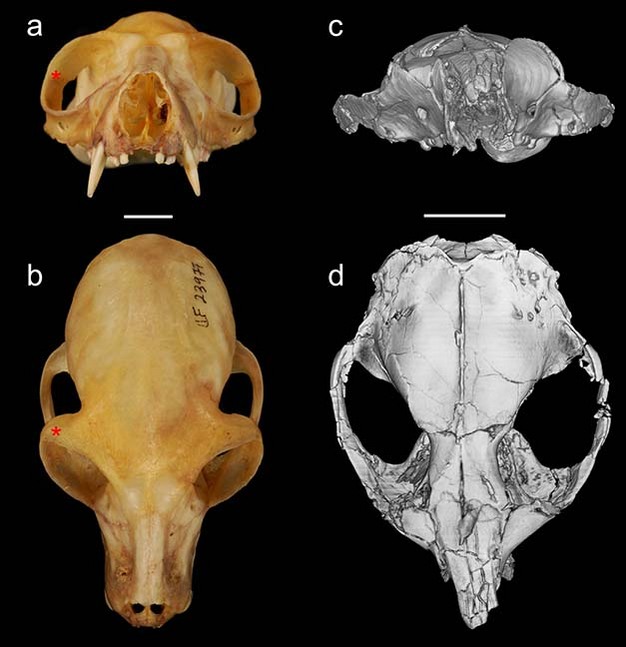
The first problem that one inevitably faces in thinking about primate origins is where to draw the line between primates and other types of mammals. If one considers only living primates (i.e., monkeys, apes, lemurs, lorises, and humans), then the Order Primates is not that difficult to define. Living primates are unusual in relying very heavily on vision — this is reflected in the skull by orbits that are close together (convergent) and bounded by a postorbital bar (Figure 1a). Primates also typically have hands and feet that are well designed for grasping (with long fingers, opposable thumbs and big toes, and nails rather than claws on most digits), and other skeletal traits that are beneficial for moving around in the trees. Finally, living primates eat a lot of fruit, and members of the order generally have features of the teeth that reflect this, including fat, round (bunodont) cusps and broad talonid basins, for squishing fruit in a mortar-and-pestle type arrangement.

Crania of a euprimate (a,b <i>Lemur catta</i>, FMNH 23977) and a plesiadapiform (c,d <i>Ignacius graybullianus</i>, USNM 421608) in rostral (a,c) and dorsal (b,d) views.
Figure 1: Crania of a euprimate (a,b Lemur catta, FMNH 23977) and a plesiadapiform (c,d Ignacius graybullianus, USNM 421608) in rostral (a,c) and dorsal (b,d) views.
Note the presence of the postorbital bar (red asterisk) and convergent orbits in the euprimate, missing in the plesiadapiform. Image of Ignacius graybullianus is based on a 3D reconstruction using high resolution X-ray computed tomography data (see Silcox, 2003). Scales = 1cm.
© 2013 Nature Education (a,b) Photos courtesy of Zachary Randall. All rights reserved. View Terms of Use
Species in the fossil record that exhibit all these features will be easy to recognize as primates. However, at some point primates must have evolved from ancestors that lacked these characteristics. And unless all of these features evolved in an evolutionary instant (which seems unlikely), there must have been some species more closely related to living primates than to any other mammalian group that nonetheless lacked some of these traits. Recognizing such forms as being related to primates is a much more difficult problem, but is critical to understanding where, when, and why primates branched off from the rest of Mammalia.

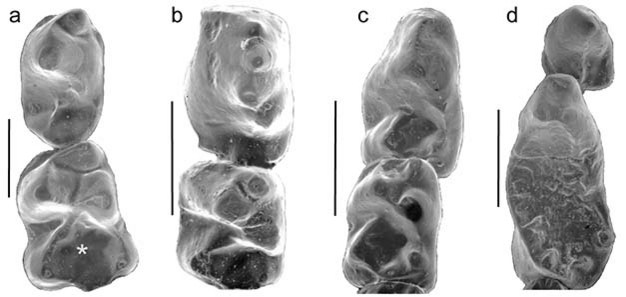
The group of fossils that is the focus of debates over primate origins is called the plesiadapiforms. This is an incredibly diverse group including more than 140 named species arranged into 11 different families. The first record of plesiadapiforms appears just as the non-avian dinosaurs were going extinct about 65 million years ago, near the beginning of the Paleocene. Some plesiadapiforms persist well into the Eocene, with the last species going extinct around 37 million years ago (Silcox & Gunnell, 2008). Over the course of its more than 25-million-year history, the group underwent an impressive adaptive radiation, producing forms with very distinctive dental adaptations including weird, multi-cusped upper incisors, and a diversity of very specialized lower premolars (Figure 2).

Scanning electron micrographs of plesiadapiform P4s and M1s in occlusal view:  a) <i>Purgatorius janisae</i> (UCMP 107406, image reversed); b) <i>Elphidotarsius florencae</i> (USNM 9411); c) <i>Tinimomys graybulliensis</i> (YPM 33895); d) <i>Picrodus silberlingi</i> (AMNH 35456).
Figure 2: Scanning electron micrographs of plesiadapiform P4s and M1s in occlusal view: a) Purgatorius janisae (UCMP 107406, image reversed); b) Elphidotarsius florencae (USNM 9411); c) Tinimomys graybulliensis (YPM 33895); d) Picrodus silberlingi (AMNH 35456).
Note the wide range of different P4 morphologies, reflecting the adaptive diversity of plesiadapiforms. The white asterisk indicates the broad talonid basin in Purgatorius. Scales = 1 mm.
© 2013 Nature Education All rights reserved. View Terms of Use
Plesiadapiforms share some traits with living primates, including long fingers well designed for grasping, and other features of the skeleton that are related to arboreality (Bloch & Boyer, 2002). One species, Carpolestes simpsoni, even had a divergent big toe with a nail (Bloch & Boyer, 2002). Dentally, plesiadapiforms look quite similar to definitive primates, with broad talonid basins and a similar pattern of cusps and crests. However, no known plesiadapiform exhibits the features of living primates associated with specialized vision, such as the postorbital bar or convergent orbits. Even though they exhibit some features for primate-like grasping, known plesiadapiforms still retain claws on most of their digits. These contrasts have led some workers (e.g., Martin, 1968; Cartmill, 1974) to suggest that plesiadapiforms do not belong in the Order Primates. Others (e.g., Kay et al., 1990; Beard, 1990) have further argued that plesiadapiforms are not most closely related to primates, but instead are closer kin to another order, Dermoptera.

The most comprehensive analysis to date of the relationships among plesiadapiforms, primates, and closely related mammals is by Bloch and colleagues (2007; Figure 3). The results of this analysis support the idea that plesiadapiforms are more closely related to primates than to any other group. These authors argued that plesiadapiforms should therefore be considered stem primates; they adopted the name Euprimates (Hofstetter, 1977) for living primates and any fossil forms that exhibit all of the features of modern primates listed above. It is worth noting, however, that not all researchers are convinced by Bloch et al.'s (2007) results. These workers generally equate the Order Primates with Euprimates, excluding plesiadapiforms from the order. This leads to a very different conception of what constitutes primate origins than discussed here (e.g., Soligo & Martin, 2007), with the order not appearing until nearly 10 million years later, when the first forms that share traits such as the postorbital bar and nails on most digits (e.g., adapoids and omomyoids) are first found in the fossil record (e.g., Rose et al., 2012).

The broader relationships of Primates in Mammalia

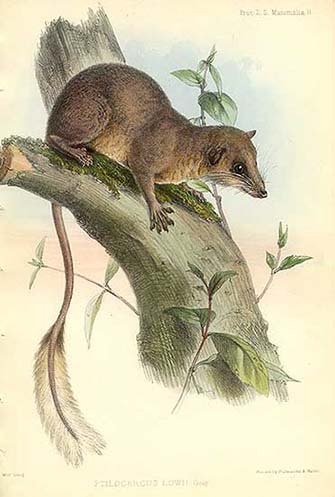
Although there are continuing disagreements about where to draw the primate/non-primate line in the fossil record, more consensus exists about the identity of the closest living relatives of primates. Molecular analyses of mammalian relationships have fairly consistently placed primates in a group called Euarchonta with two other living orders: Scandentia and Dermoptera (Springer et al., 2004). Scandentians are small, quadrupedal animals that live in Southeast Asia. They are more commonly referred to as treeshrews, although not all of them live in the trees, and taxonomically they are not shrews. From 1922 (Carlsson, 1922) until 1980, treeshrews were often classified as primates. This idea was effectively refuted in a landmark edited volume (Luckett, 1980) that assessed the primate hypothesis using multiple lines of evidence. Even though trees shrews are no longer considered to be primates, familiarity with them is very important for researchers interested in primate origins because they provide the best living models for the earliest members of the Order. Indeed, the most primitive plesiadapiform known from a reasonably complete skeleton (Dryomomys szalayi) closely resembles the pen-tailed treeshrew, Ptilocercus lowii (Figure 4), below the head (Bloch et al., 2007). These similarities suggest that the first primate probably looked quite a bit like Ptilocercus, and supports the idea (Szalay & Drawhorn, 1980) that primates evolved from an already arboreal ancestor.

<i>Ptilocercus lowii</i> (the pen-tailed treeshrew).
Figure 4: Ptilocercus lowii (the pen-tailed treeshrew).
Ptilocercus is the most primitive living treeshrew (Sargis, 2004) and represents the best extant model for the common ancestor of all Primates (including plesiadapiforms).
© 2013 Public Domain Zoological Society of London, 1848 Some rights reserved. View Terms of Use
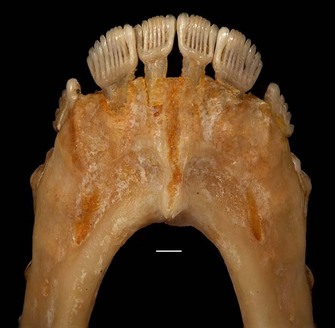
Part of what makes treeshrews so important to modeling early primates is that the other living group generally agreed to be closely related to primates, Dermoptera, is so profoundly weird. Dermopterans are gliding mammals also known from Southeast Asia. They are often referred to as flying lemurs (though they do not fly and taxonomically are not lemurs), but a better name for them is mitten gliders, because dermopterans have a very extensive gliding membrane (patagium) that extends between their fingers, creating the appearance of wearing mittens. In addition to numerous postcranial specializations for gliding, dermopterans also exhibit peculiar features of the teeth, including incisors that literally have tines like a comb (Figure 5). Unfortunately, neither Scandentia nor Dermoptera is known from very complete fossil material (see summary in Silcox et al., 2005), although there is one extinct family from the Paleocene and Eocene of North America (Plagiomenidae) which may be related to dermopterans (Bloch et al., 2007; but see MacPhee et al., 1989).

Labial view of the mandible of a dermopteran, <i>Galeopterus variegatus</i> (AMNH/Mammalogy: 106628).
Figure 5: Labial view of the mandible of a dermopteran, Galeopterus variegatus (AMNH/Mammalogy: 106628).
Note the distinctive, comb-like morphology of the first two lower incisors. Scale = 2 mm.
© 2013 Nature Education Photo courtesy of Zachary Randall. All rights reserved. View Terms of Use
Although most researchers agree that primates are closely related to dermopterans and scandentians, there are several other issues of debate with respect to the broader relationships of primates in Mammalia. Studies disagree on which of the two orders is primates' sister taxon. Three possibilities have been supported in different analyses: Dermoptera (e.g., Janečka et al., 2007), Scandentia (e.g., Novacek, 1992), or Sundatheria (which is Dermoptera + Scandentia; e.g., Bloch et al., 2007). Also in debate is the relationship of bats to primates—morphological studies generally position them in a group with euarchontans (Archonta; e.g., Novacek, 1992) while molecular results have consistently found them to be much more distantly related (Springer et al., 2004). Finally, molecular results generally place Euarchonta in a group with rodents and rabbits (Euarchontoglires; Springer et al., 2004) whereas this result is not usually found in morphological studies (but see Silcox et al., 2010).

Where, when, and why did primates evolve?

The earliest known plesiadapiforms are placed in the genus Purgatorius. Although there is a fragment of a tooth for this genus that has been described as coming from the same deposit as a Triceratops skeleton (Van Valen & Sloan, 1965), this deposit includes a mixture of material of different ages (Clemens, 2004). More firmly dated specimens are known from the earliest part of the Paleocene, however, so it is clear that even if Purgatorius did not overlap in time with the non-avian dinosaurs, it was one of the first groups to exploit the new opportunities created by their extinction (Johnston & Fox, 1984; Clemens, 2004).

Although the age and primitive morphology of Purgatorius would suggest an origin of primates around 65 million years ago, molecular dates for the origin of the order are generally at least 10 million years earlier, well before the Cretaceous-Tertiary boundary (Springer et al., 2003). If this is the case, we may be missing or not recognizing a significant part of the early history of the order. Alternatively, this discrepancy could reflect problems with the assumptions underlying molecular clock models, such as constancy of evolutionary rate (Ho, 2008), and the difficulty of calibrating the clock (e.g., see discussion in Stauffer et al., 2001).

While the Southeast Asian location of the closest living relatives of primates might suggest an Asian origin for the order (Beard, 2004), the North American location of most primitive plesiadapiforms supports a North American origin instead (Bloch et al., 2007). This may be a product, however, of much greater sampling of the fossil record in North America. Indeed, there is now a relatively primitive plesiadapiform known from Asia (Asioplesiadapis youngi Fu et al., 2002; see discussion in Silcox, 2008), which suggests that further discoveries on that continent may make it seem a more plausible place of origin for Primates.

In terms of why primates evolved, most of the scenarios for primate origins that discuss plesiadapiforms (rather than those restricted to Euprimates) suggest a relationship to diet. Szalay, in his landmark 1968 paper, "The beginnings of Primates," wrote: "It is only an increasing occupation of feeding on fruits, leaves, and other herbaceous matter that explains the first radiation of primates" (p. 32), and Sussman and Raven (1978) included plesiadapiforms in their proposed co-evolutionary scenario between primates and flowering plants. Eriksson et al. (2000) document an increase in the volume of fruit and proportion of animal-dispersed flowering plants through the late Cretaceous into the Paleocene; early primates may have been one of the forces driving this change. These suggestions may seem surprising in light of the small, rather pointy teeth of Purgatorius (Figure 2a). Certainly in comparisons with modern primates this morphology would suggest a diet richer in insects than in plant materials (Kay & Cartmill, 1977). However, it is important to note that the features we use to differentiate Purgatorius and the other early plesiadapiforms from contemporaneous small mammals (e.g., broad talonid basins) are precisely those which can be related to a more diverse diet. So while we still have much to learn about the ecological profile of the earliest primates, a shift to a more omnivorous diet may have been one part of their success. A diffuse co-evolutionary relationship with flowering plants may have subsequently played a critical role in shaping the diversification of plesiadapiforms throughout the Paleocene (Sussman, 1991; Bloch et al., 2007).

References and Recommended Reading


Beard, K. C. Gliding Behavior and palaeoecology of the alleged primate family Paromomyidae (Mammalia, Dermoptera). Nature 345, 340-341 (1990).

Beard, K. C. The Hunt for the Dawn Monkey: Unearthing the Origins of Monkeys, Apes, and Humans. Los Angeles: University of California Press, (2004).

Bloch, J. I. & Boyer, D. M. Grasping Primate Origins. Science 298, 1606-1610 (2002).

Bloch, J. I., Silcox M. T., et al. New Paleocene skeletons and the relationship of plesiadapiforms to crown-clade primates. Proceedings of the National Academy of Science 104, 1159-1164 (2007).

Carlsson, A. Uber die Tupaiidae und ihre Beziehungen zu den Insectivora und den Prosimiae. Acta Zoologica 3, 227-270 (1922).

Cartmill, M. Rethinking Primate Origins. Science 184, 436-443 (1974).

Clemens, W. A. Purgatorius (Plesiadapiformes, Primates?, Mammalia), a Paleocene immigrant into Northeastern Montana: stratigraphic occurrences and incisor proportions. In Fanfare for an Uncommon Paleontologist: Papers in Honor of Malcolm C. McKenna. eds. Dawson, M. R. & Lillegraven J. A. (Pittsburgh: Bulletin of the Carnegie Museum of Natural History, 36, 2004) 3-13.

Eriksson, O., Friis, E. M. et al. Seed size, fruit size, and dispersal systems in angiosperms from the Early Cretaceous to the Late Tertiary. American Naturalist 156, 47-58 (2000).

Fu, J.-F., Wang, J.-W. et al. The new discovery of the Plesiadapiformes from the early Eocene of Wutu Basin, Shandong Province. Vertebrata PalAsiatica 40, 219-227 (2002).

Ho, S. The molecular clock and estimating species divergence. Nature Education 1 (2008) http://www.nature.com/scitable/topicpage/the-molecular-clock-and-estimating-species-divergence-41971

Hoffstetter, R. Phylogénie des Primates. Bulletins et Mémoires de la Société d'Anthropologie de Paris t4, XIII, 327-346 (1977).

Janečka, J. E., Miller, W., et al. Molecular and genomic data identify the closest living relative of Primates. Science 318, 792-794 (2007).

Kay R. F. & Cartmill M. Cranial morphology and adaptations of Palaechthon nacimienti and other Paromomyidae (Plesiadapoidea, ?Primates), with a description of a new genus and species. Journal of Human Evolution 6, 19-53 (1977).

Kay, R. F., Thorington, R. W. et al. Eocene plesiadapiform shows affinities with flying lemurs not Primates. Nature 345, 342-344 (1990).

Luckett, W. P. Comparative Biology and Evolutionary Relationships of Tree Shrews. New York: Plenum Press (1980).

MacPhee, R. D. E., Cartmill, M. et al. Craniodental morphology and relationships of the supposed Eocene dermopteran Plagiomene (Mammalia). Journal of Vertebrate Paleontology 9, 329-49 (1989).

Martin, R. D. Towards a new definition of Primates. Man 3, 377-401 (1968).

Novacek, M. J. Mammalian phylogeny: shaking the tree. Nature 356, 121-125 (1992).

Rose, K.D. , Chew, A.E., et al. Earliest Eocene mammalian fauna from the Paleocene-Eocene thermal maximum at Sand Creek Divide, Southern Bighorn Basin, Wyoming. University of Michigan Papers on Paleontology 36, 1-122. (2012)

Sargis, E.J. New views on tree shrews: the role of tupaiids in primate supraordinal relationships. Evolutionary Anthropology 13, 56-66 (2004).

Silcox, M. T. New discoveries on the middle ear anatomy of Ignacius graybullianus (Paromomyidae, Primates) from ultra high resolution X-ray computed tomography. Journal of Human Evolution 44, 73-86 (2003).

Silcox, M. T. The biogeographic origins of Primates and Euprimates: East, West, North, or South of Eden? In Mammalian Evolutionary Morphology: a Tribute to Frederick S. Szalay. eds. Dagosto M. & Sargis, E. J. (New York: Springer-Verlag, 2008) 199-231.

Silcox, M. T. & Gunnell, G. F. Plesiadapiformes. In Evolution of Tertiary Mammals of North America Vol. 2: Marine Mammals and Smaller Terrestrial Mammals. Eds. Janis C. M., Gunnell, G. F. & Uhen, M. D. (Cambridge: Cambridge University Press, 2008) 207-238.

Silcox M. T., Bloch J. I., et al. Euarchonta. In The Rise of Placental Mammals: Origins and Relationships of the Major Extant Clades. Eds. Rose K.D. & Archibald J. D. (Baltimore: Johns Hopkins University Press 2005) 127-144.

Silcox M. T., Bloch J. I., et al. Cranial anatomy of Paleocene and Eocene Labidolemur kayi (Mammalia: Apatotheria) and the relationships of the Apatemyidae to other mammals. Zoological Journal of the Linnean Society 160, 773-825 (2010).

Soligo, C. & Martin, R.D. The first primates: a reply to Silcox et al. Journal of Human Evolution 53, 325-328 (2007).

Springer M. S., Murphy W. J., et al. Placental mammal diversification and the Cretaceous-Tertiary boundary. Proceedings of the National Academy of Science 100, 1056-1061 (2003).

Springer M. S., Stanhope M. J. et al. Molecules consolidate the placental mammal tree. Trends in Ecology and Evolution 19, 430-438 (2004).

Stauffer, R.L., Walker, A. et al. Human and ape molecular clocks and constraints on paleontological hypotheses. The Journal of Heredity 92,469-474 (2001).

Sussman R.W. Primate origins and the evolution of angiosperms. American Journal of Primatology 23, 209-223 (1991).

Sussman R. W. & Raven P. H. Pollination of flowering plants by lemurs and marsupials: a surviving archaic coevolutionary system. Science 200, 731-736 (1978).

Szalay, F. S. The beginnings of primates. Evolution 22, 19-36 (1968).

Szalay F. S. & Drawhorn G. Evolution and diversification of the Archonta in an arboreal milieu. In Comparative Biology and Evolutionary Relationships of Tree Shrews. ed. Luckett , W. P. (New York: Plenum Press ,1980) 133-169.

Van Valen L. M. & Sloan R. E. The earliest Primates. Science 150, 743-745 (1965).


Fossil apes from the vallès‐penedès basin

Atualmente restrito ao sudeste da Ásia e à África, os hominoides existentes são remanescentes de um grupo que era muito mais diverso durante o Mioceno. Os macacos diversificaram-se inicialmente na África durante o início do Mioceno, mas no Mioceno intermediário eles ampliaram sua distribuição geográfica até a Eurásia, onde experimentaram uma radiação evolutiva impressionante. 

A compreensão do papel dos hominoides eurasianos na origem e evolução do clado grande ‐ símio e humano (Hominidae) é parcialmente dificultada por incertezas filogenéticas, a escassez e incompletude de restos fósseis, a atual diversidade restrita do grupo e a homoplasia generalizada . 

No entanto, o conhecimento científico da radiação hominóide eurasiana melhorou significativamente durante a última década. No caso da Europa Ocidental, isso se deve à descoberta de novos vestígios da Bacia de Vallès ‐ Penedès (Catalunha, Espanha). Aqui, eu reviso o registro fóssil de macacos Vallès-Penedès e considero suas implicações. Embora persistam divergências significativas entre os estudiosos, algumas lições importantes podem ser aprendidas a respeito da história evolutiva dos parentes vivos mais próximos dos humanos. © 2012 Wiley Periodicals, Inc.


Fonte: https://onlinelibrary.wiley.com/doi/epdf/10.1002/evan.21312