Mostrando postagens com marcador Gigantopithecus. Mostrar todas as postagens

sábado, 25 de outubro de 2025


O DNA tem prazo de validade. Mas as proteínas estão revelando segredos sobre nossos ancestrais que nunca imaginamos serem possíveis.
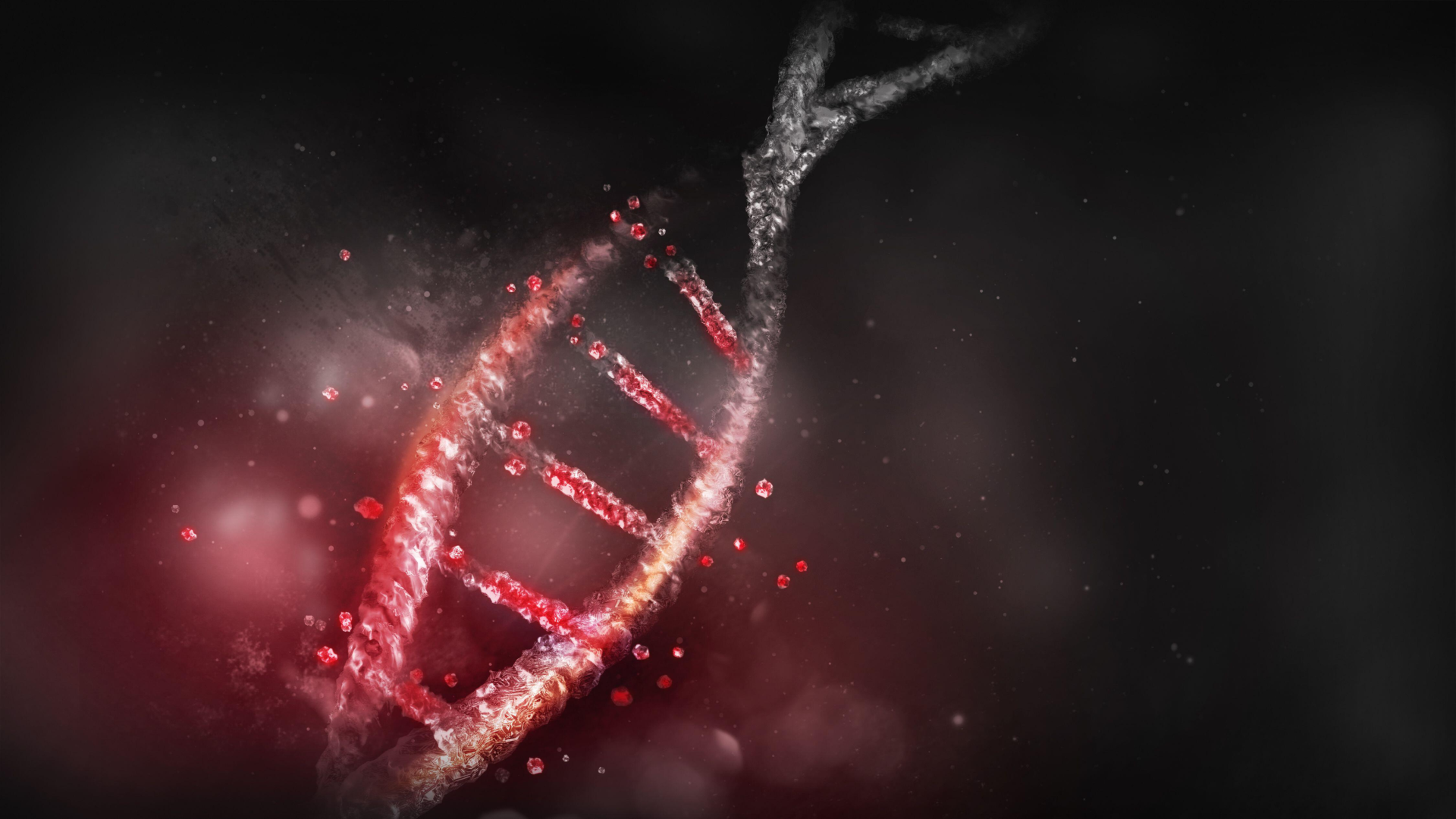
Uma fita de DNA de dupla hélice vermelha está se quebrando contra um fundo preto
DNA breaks down over time. (Image credit: Alamy)

No momento em que uma criatura morre, seu DNA começa a se decompor. Metade dele se degrada a cada 521 anos , em média. Em cerca de 6,8 milhões de anos, mesmo em condições ideais de preservação em ambientes frios e estáveis, todos os vestígios significativos desaparecem.

Esse é um enorme desafio quando se tenta compreender nossa história evolutiva mais profundamente: os primatas bípedes surgiram há 7 milhões de anos na África, e nosso gênero surgiu há cerca de 2,6 milhões de anos. Mas o DNA se decompõe rapidamente nos lugares por onde nossos ancestrais distantes vagaram. Como resultado, muitas das principais adaptações que nos tornam unicamente humanos datam de um período em que o DNA antigo era indecifrável.

"As proteínas são biomoléculas de longa duração, capazes de sobreviver por milhões de anos", escreveram Christina Warinner , arqueóloga biomolecular da Universidade Harvard, e seus colegas em um artigo de 2022. O DNA codifica as instruções para a produção de aminoácidos, que se combinam em longas cadeias para formar proteínas. Como as proteínas se decompõem mais lentamente do que o DNA, elas estão se tornando um recurso extremamente valioso para a compreensão da evolução humana.

Arqueólogos e a revolução do DNA

O interesse dos arqueólogos pelo DNA antigo disparou desde 2010, quando pesquisadores publicaram um rascunho do genoma neandertal , confirmando que os neandertais acasalaram com os ancestrais de muitos humanos modernos. Desde então, a técnica tem sido usada para responder a uma série de questões arqueológicas, como quando as Américas e a Austrália foram colonizadas, quando a agricultura foi inventada e como línguas e culturas podem ter se espalhado.

Mas há grandes desvantagens em confiar apenas em DNA antigo. Embora as técnicas de extração de DNA de ossos muito antigos tenham avançado significativamente ao longo dos anos, o DNA se decompõe em fragmentos menores ao longo de milênios devido aos efeitos da luz solar, calor e umidade. Como resultado, a análise de DNA dos ossos e dentes de nossos parentes antigos tem um limite de tempo que nos impede de aprender sobre nossa evolução mais distante por meio dessa técnica.

Relacionado: O DNA humano mais antigo revela um ramo misterioso da humanidadeuma coleção de pequenos ossos de Neandertal contra um fundo preto
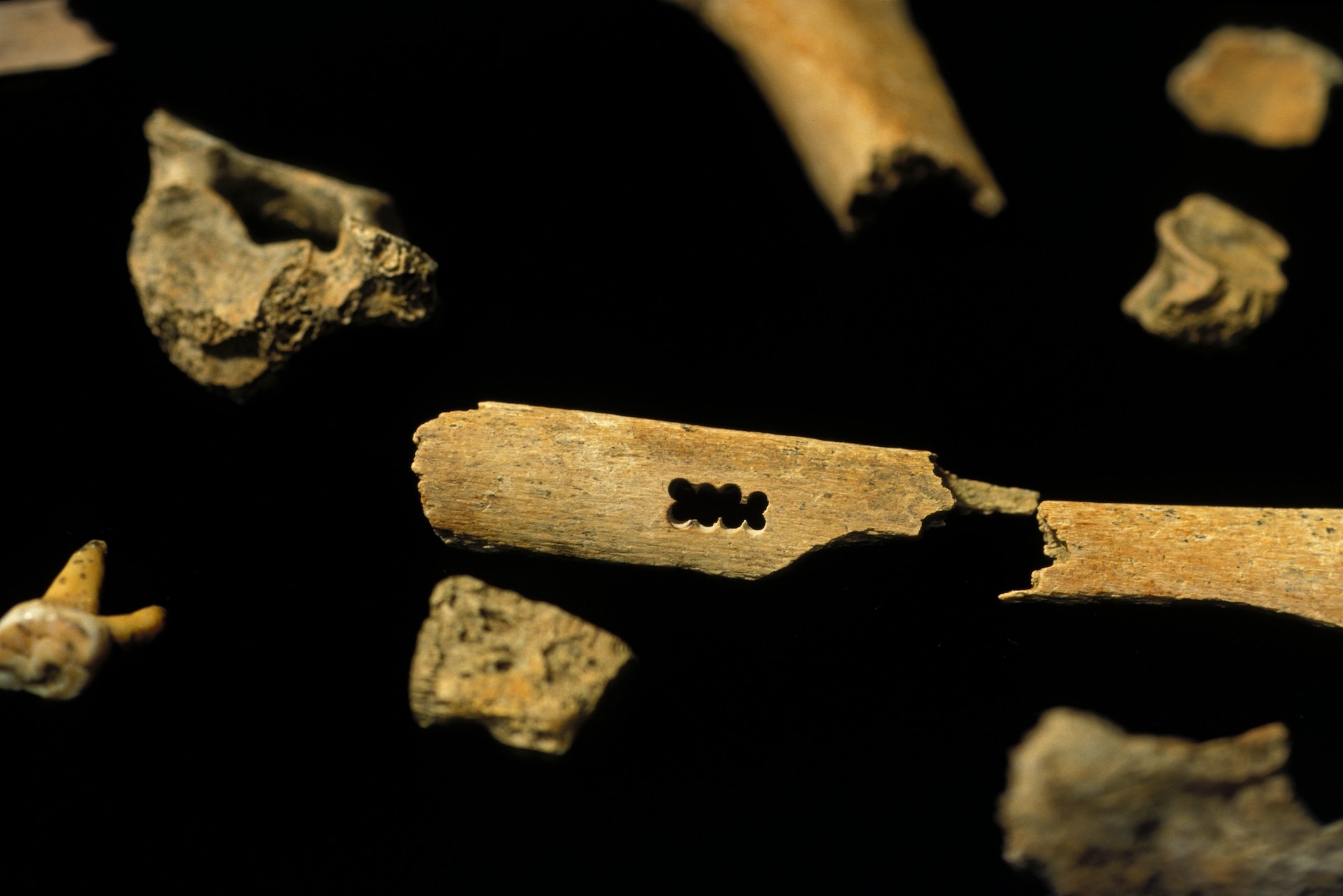
Uma coleção de ossos de neandertais. A análise de DNA desses ossos antigos só pode ser feita até certo ponto, pois o DNA se degrada com o tempo. (Crédito da imagem: Patrick AVENTURIER via Getty Images)

Esse é um problema ainda maior na África, onde ocorreu a maior parte da evolução humana.

"A África é o centro do nosso passado evolutivo, e não temos DNA antigo na África além de uma escala de talvez 20.000 anos neste momento", disse Adam Van Arsdale , antropólogo biológico do Wellesley College, à Live Science. Saber o que estava acontecendo biologicamente com nossos ancestrais distantes há milhões de anos no centro da África transformaria nossa compreensão da evolução humana, disse Van Arsdale.

Uma explosão na análise de proteínas

As proteínas são um alvo interessante para antropólogos porque podem sobreviver até mesmo ao DNA mais antigo. Elas têm menos átomos, menos ligações químicas e uma estrutura mais compacta, o que significa que são menos frágeis que o DNA, de acordo com Warriner e colegas.

O primeiro proteoma antigo — um grupo de proteínas expressas em uma célula, tecido ou organismo — foi extraído de um osso de mamute-lanoso de 43.000 anos em um estudo publicado em 2012. Em 2019, pesquisadores anunciaram o proteoma de mamífero mais antigo da época: o de um dente de 1,9 milhão de anos do extinto parente dos macacos Gigantopithecus

E em 2025, pesquisadores extraíram com sucesso as proteínas mais antigas até então, do Epiaceratherium , uma criatura extinta semelhante a um rinoceronte que viveu no Ártico canadense há mais de 21 milhões de anos.

À medida que aprimoramos os métodos de identificação de proteínas, os antropólogos estão começando a usar esses métodos para responder perguntas sobre a evolução humana.

Em um estudo de 2020 publicado na revista Nature , pesquisadores analisaram as proteínas do esmalte dentário do Homo antecessor , um parente humano extinto que viveu na Europa há 800.000 anos. Eles descobriram que as proteínas do Homo antecessor eram diferentes daquelas do Homo sapiens , dos neandertais e dos denisovanos, tornando-os um ramo separado da nossa árvore evolutiva, em vez de nossos ancestrais diretos.

Em um estudo publicado em abril na revista Science , a análise proteômica também foi usada para descobrir que uma mandíbula misteriosa encontrada pela primeira vez no início dos anos 2000 na costa de Taiwan estava relacionada aos Denisovanos, um grupo de parentes humanos extintos. Antes disso, os paleoantropólogos não sabiam se os Denisovanos haviam vivido naquela parte do mundo. A análise também demonstrou que é possível identificar as proteínas encontradas em fósseis de regiões quentes e úmidas.

Nossas raízes africanas

A paleoproteômica pode ser ainda mais transformadora para decifrar nossa evolução mais distante. Dois estudos recentes de ossos e dentes fósseis da África, onde estudos de DNA são quase impossíveis, destacam o potencial do método.

Relacionado: O genoma humano egípcio antigo mais antigo e completo já sequenciado revela laços com a Mesopotâmia

No primeiro estudo, publicado em maio na revista Science , arqueólogos recuperaram proteínas antigas dos dentes de quatro membros da espécie Paranthropus robustus , um parente humano que viveu entre 1,8 milhão e 1,2 milhão de anos atrás. Eles mostraram que dois dos indivíduos eram machos e duas eram fêmeas. Surpreendentemente, porém, os pesquisadores descobriram que um dos indivíduos de P. robustus que se pensava ser macho era, na verdade, fêmea. Isso sugere que alguns crânios previamente classificados como um sexo de uma espécie conhecida podem ter pertencido, na verdade, a grupos não identificados ou a espécies recém-descobertas.
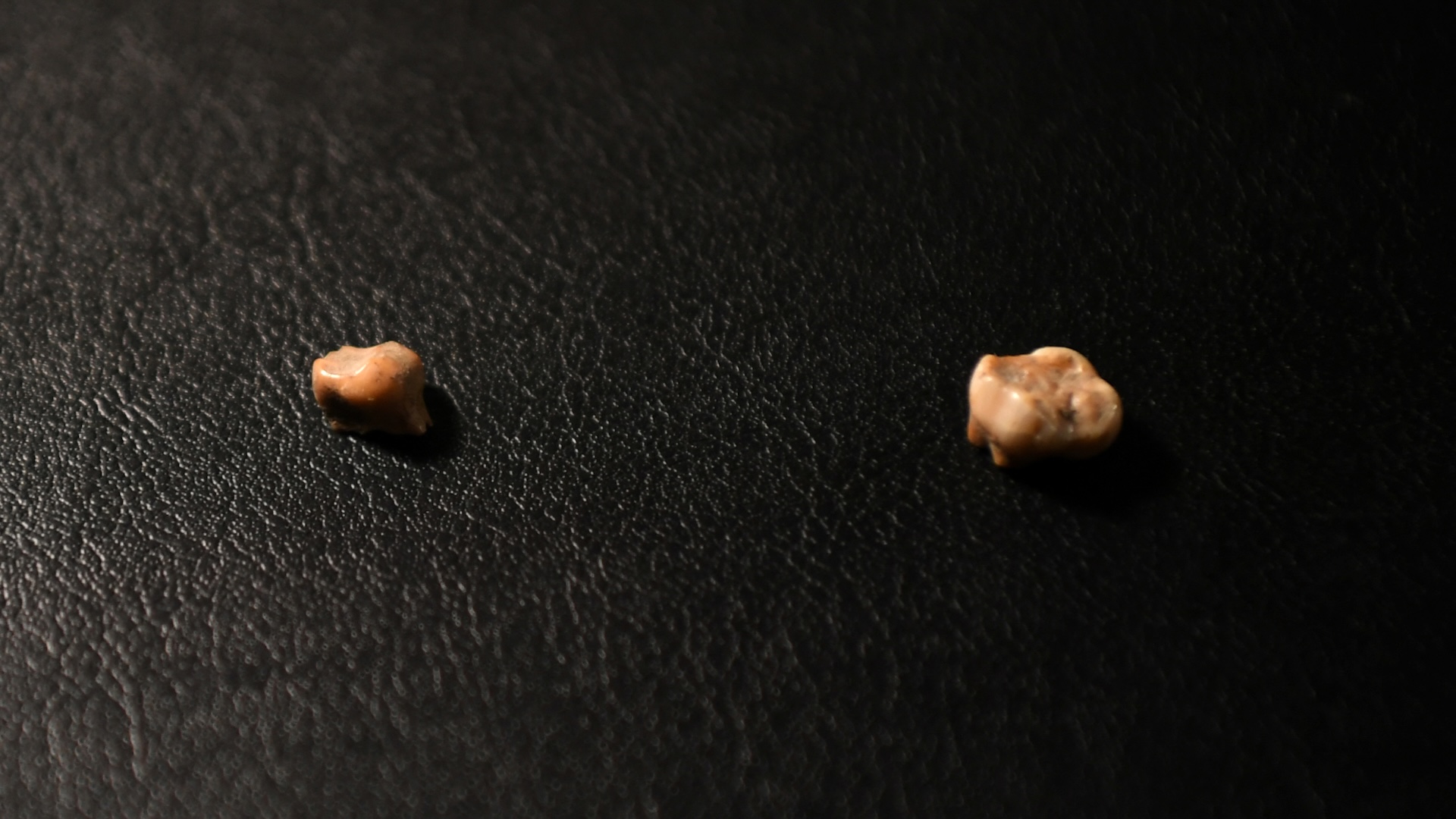
dois dentes em um fundo preto

Um dente de Homo sapiens e um dente de Neandertal. Pesquisadores estão analisando as proteínas em dentes como esses para entender melhor sobre os humanos antigos. (Crédito da imagem: MATTHIEU RONDEL via Getty Images)

No segundo estudo, publicado em fevereiro no South African Journal of Science , pesquisadores recuperaram o proteoma do esmalte dentário do Australopithecus africanus , um parente humano que viveu na África do Sul há 3,5 milhões de anos. Embora tenham conseguido identificar apenas o sexo biológico dos australopitecos , os pesquisadores escreveram que "todas essas são descobertas incrivelmente empolgantes que estão prestes a revolucionar nossa compreensão da evolução humana".

Uma questão que essa análise poderia ajudar a responder é se machos e fêmeas de nossos ancestrais e parentes diferiam drasticamente em tamanho ou características, disse Rebecca Ackermann , antropóloga biológica da Universidade da Cidade do Cabo, à Live Science. Por exemplo, a análise de proteínas e sexo poderia revelar que alguns ossos anteriormente interpretados como machos e fêmeas da mesma espécie eram, na verdade, indivíduos do mesmo sexo, mas de linhagens diferentes.

Até agora, porém, os cientistas analisaram com sucesso proteínas de apenas um pequeno número de ancestrais humanos antigos. No entanto, embora os humanos modernos possuam mais de 100.000 proteínas em seu corpo, o "proteoma" do esmalte é minúsculo; é composto por apenas cinco proteínas principais relacionadas à formação do esmalte. Ainda assim, a variação nas sequências de proteínas pode ser suficiente para diferenciar organismos relacionados.

Fronteiras do futuro

A análise das diferenças nessas proteínas provavelmente não fornece resolução suficiente para responder a questões-chave, como o parentesco entre ancestrais e parentes humanos antigos, disse Ackermann. Por exemplo, há milhões de anos, na África Oriental, várias espécies de primatas bípedes se sobrepuseram no tempo , mas não fica claro apenas com base em seus ossos se elas poderiam cruzar e criar híbridos férteis.

Relacionado: O DNA mais antigo do mundo revela segredos do ecossistema perdido do Ártico de 2 milhões de anos atrás

Proteínas antigas poderiam eventualmente ajudar a responder essa pergunta?

Ackermann está cautelosamente otimista de que a tecnologia avançará o suficiente para que a paleoproteômica esclareça as relações evolutivas entre grupos intimamente relacionados.

"Se podemos ou não dizer mais sobre hibridização é uma boa questão", disse ela.

Mesmo assim, os proteomas ósseos e do esmalte podem nunca ser detalhados o suficiente para distinguir indivíduos intimamente relacionados da mesma forma que os genomas, acrescentou Ackermann.

Mas há uma chance de que as técnicas melhorem o suficiente para que os cientistas extraiam proteínas de tecidos com milhões de anos, acrescentou Ackermann.

A maioria das proteínas produzidas pelos humanos, incluindo aquelas que fazem parte do "proteoma escuro", não foram analisadas, o que significa que temos pouca ideia do que elas fazem, escreveram Warriner e colegas.

"Os próximos 20 anos certamente nos reservarão muitas surpresas, à medida que começarmos a aplicar esse poder analítico para responder a perguntas antigas sobre o passado e inovar novas soluções para velhos problemas", escreveram eles.

  • quarta-feira, 15 de abril de 2020

    Gigantopithecus, orangutanes y paleoproteómica

    Este artículo resume nuestro conocimiento sobre el mayor primate que ha existido. El estudio de su morfología tradicionalmente relacionaba a este ser con los ponginos, cuyos únicos representantes actuales son los orangutanes (existen tres especies de ellos) y, gracias a la paleoproteómica, en 2019 se ha confirmado ese vínculo filogenético de Gigantopithecus con Pongo. Comencemos un pequeño viaje por el este asiático…

    Este artigo resume o novo conhecimento sobre o prefeito primata que existe. O estúdio de morfologia tradicionalmente relaciona-se a este com os ponginos, cukos únicos identificados reais nos orangotangos (existem espécies especiais de ellos) e, gracias à paleoproteómica, em 2019, se você confirmar o vínculo filogenético de Gigantopithecus com Pongo. Comece um passeio por este asiático…
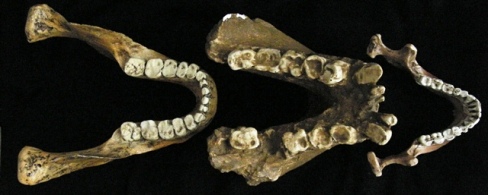
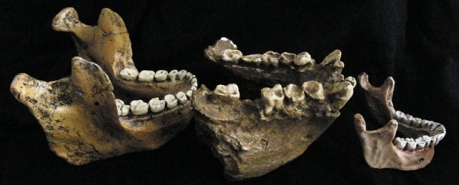
    Comparación Nutcracker Man (Paranthropus boisei, izda) vs. Gigantophitecus blacki (centro) vs. Humano moderno (dcha). Foto: Roberto Sáez

    Um pouco de história

    • El primer hallazgo fue en 1935, cuando el paleoantropólogo alemán Ralph von Koenigswald se topó con un molar fósil de gran tamaño en una farmacia de Hong Kong, que identificó como perteneciente a una especie primate desconocida. En los siguientes cuatro años encontró tres molares más en Hong Kong y Guangzhou. Con ellos, definió una nueva especie Gigantopithecus blacki.
    A primeira descoberta foi em 1935, quando o paleoantropólogo alemão Ralph von Koenigswald encontrou um grande molar fóssil em uma farmácia de Hong Kong, que ele identificou como pertencente a uma espécie desconhecida de primatas. Nos quatro anos seguintes, ele encontrou mais três molares em Hong Kong e Guangzhou. Com eles, ele definiu uma nova espécie Gigantopithecus blacki.
    • Liucheng
      Liucheng
      Tras la II Guerra Mundial en los años 50 se abordó la búsqueda del lugar de origen de los fósiles. Dos de los investigadores de Peking Man (1929, Zhoukoudian) encontraron a partir de 1957 en Liucheng (China) cientos de dientes y tres fragmentos de mandíbula inferior, además de varios fósiles de mamíferos enanos. Este yacimiento se estima en 1 Ma de antigüedad.
    • En los 60 se descubrieron dientes aún mayores pero en un yacimiento (Wuming) que es 300-400 Ka. más joven que Liucheng. Esto sugiere que Gigantopithecus siguió una tendencia similar a otros mamíferos que incrementaron su tamaño según evolucionaron durante el Pleistoceno.
    • Además en 1968 se descubrieron dientes y fragmentos de mandíbula mucho más antiguos (6,3 Ma) y de la mitad de tamaño, por lo que se asignaron a una especie distinta, Gigantopithecus giganteus.

    ¿Cómo era?

    Solo se conservan dientes y fragmentos de mandíbulas.
    Mandíbula
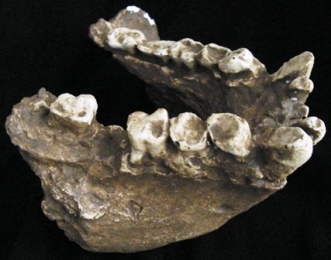
    Mandíbula de Gigantophitecus blacki. Foto: Roberto Sáez
    • Las mandíbulas son muy profundas verticalmente y gruesas.
    • Los molares son planos y de coronas bajas, con esmalte muy grueso para moler.
    • Los premolares son anchos y planos, semejantes a los molares.
    • Los caninos no tienen forma de punta sino que recuerdan a premolares, y los incisivos son pequeños y muy juntos. En conjunto, conforman una herramienta de corte parecida a la de algunas especies de perezosos actuales.
    • Todo indica la adaptación al corte, masticación y molienda de alimentos duros y fibrosos. Se han encontrado incrustaciones de fitolitos que sugieren el bambú como alimento básico, pero no exclusivo.
    • As mandíbulas são muito profundas verticalmente e grossas.
          Os molares são planos e têm coroas baixas, com esmalte muito grosso para retificação.
          Os pré-molares são largos e planos, semelhantes aos molares.
          Os caninos não são pontudos, mas lembram pré-molares, e os incisivos são pequenos e próximos. Juntos, eles formam uma ferramenta de corte semelhante à de algumas espécies de preguiças atuais.
          Tudo indica a adaptação ao corte, mastigação e moagem de alimentos duros e fibrosos. Inlays de fitólitos foram encontrados sugerindo bambu como alimento básico, mas não exclusivo
      .
    Reproducción
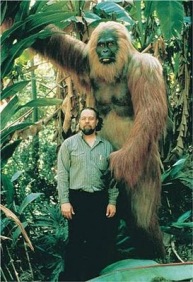
    Recreación de Gigantopithecus blacki. Foto: Bill Munns, paleoartista
    A partir del análisis de 735 dientes se sugiere una gran diferencia entre machos y hembras, mayor que la observada actualmente en gorilas y orangutanes, indicando una posible competición fuerte entre los machos.
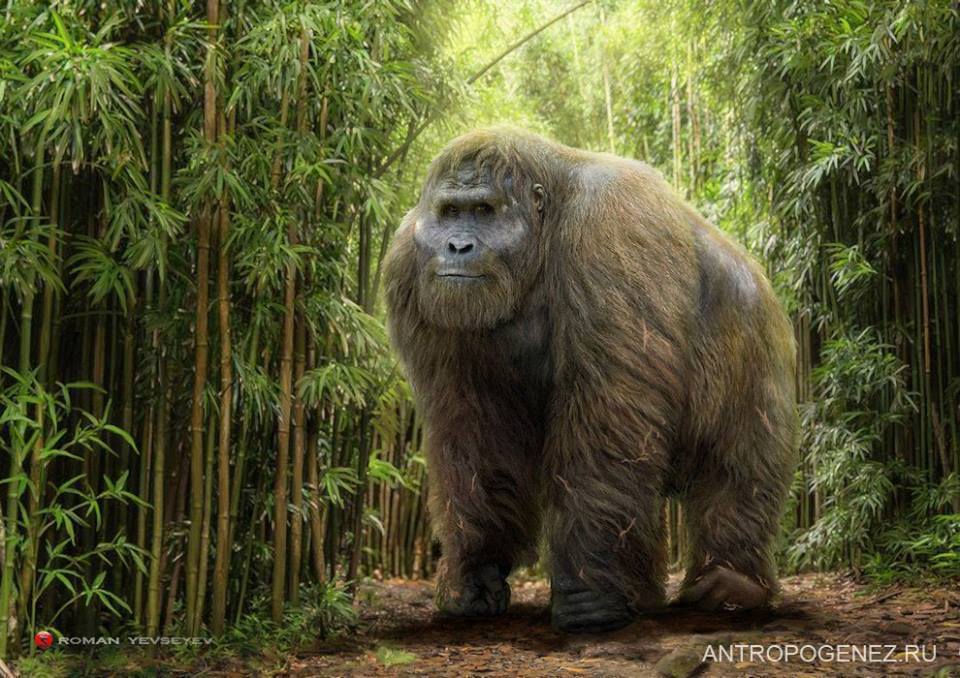
    Se han tratado de realizar reproducciones de Gigantopithecus blacki, tomando como referencias primates vivos (gorila) y extintos (babuino gigante). Se estima para “Giganto” una altura de 3 metros y un peso de 540 kg. Aunque se le representa en posición erguida, se considera que su esqueleto y musculatura corresponderían a un ser cuadrúpedo con algún desplazamiento erguido ocasional.
    Interpretación de Gigantophitecus. Foto: Antropogenez.ru

    El lugar de Gigantopithecus entre los primates

    Se han encontrado fósiles en China, India y Vietman. La estructura de la mandíbula inferior es muy similar a la de los orangutanes  por lo que, junto con ellos, se considera dentro de Ponginae y descendientes de Sivapithecus (8 Ma, descubierto en Pakistán).

    La relación de Gigantopithecus con los ponginos no solo se establece a partir de su morfología, sino que se ha confirmado en 2019 gracias al estudio de 6 proteínas preservadas en el esmalte y la dentina de un molar de G. blacki de 1,9 Ma encontrado en la cueva china de Chuifeng. La paleoproteómica es una disciplina que permite trazar relaciones evolutivas a partir de la secuenciación de las proteínas, moléculas que son más estables que el ADN y no se degradan tan rápidamente. Esta técnica permite confirmar que el pariente actual más cercano a Gigantopithecus es el orangután, y ambos linajes se separaron hace unos 10 Ma. Ese molar ha proporcionado los restos moleculares más antiguos que se han podido secuenciar de un fósil, superando al estudio de un hueso de rinoceronte de 1,7 Ma procedente de Dmanisi (Georgia), estudio también de 2019.

    Dado que Homo erectus llegó a Asia oriental hace 800 Ka. probablemente coexistió con Gigantopithecus durante medio millón de años. Se han encontrado especímenes de ambas criaturas prácticamente juntas en el mismo yacimiento, en Vietman (1965) y en China (1970 y 1987).

    La extinción de Gigantopithecus se estima alrededor de hace 100 Ka. Por tanto, como género sobrevivió unos 6 millones de años, considerando el conjunto de formas y especies por las que evolucionó. Como en otras especies de primates, su desaparición se asocia a una combinación de factores y no a un solo evento, si bien se considera que uno de ellos sería la competición por los recursos naturales con la llegada de Homo erectus.

    Otro factor determinante habría sido la falta de alimentos al convertirse en sabana el hábitat forestal donde solían vivir, y no adaptar su alimentación al nuevo entorno donde se iban encontrando, además agravado por las enormes cantidades que necesitaban.
    Comparación Nutcracker Man (Australopithecus boisei, izda) vs. Gigantophitecus blacki (centro) vs. Humano moderno (dcha)
    Comparación Nutcracker Man (Paranthropus boisei, izda) vs. Gigantophitecus blacki (centro) vs. Humano moderno (dcha). Foto: Roberto Sáez

    quarta-feira, 26 de abril de 2017

    Do Dinosaurs Still Roam the Earth?

    Why Cryptozoologists and Creationists Believe Dinosaurs Never Went Extinct 

    One issue that gives paleontologists (and scientists in general) fits is the impossibility of proving a negative. For example, no one can demonstrate, with 100 percent certainty, that every single Tyrannosaurus Rex vanished off the face of the earth 65 million years ago; there's an astronomically slim chance that some lucky individuals managed to survive, and are happily breeding even now on a remote, and still undiscovered, version of Skull Island.


    The same goes for any dinosaur you can name: Diplodocus, Velociraptor, the wishful-thinking list goes on and on.
    This isn't simply a rhetorical issue. In 1938, a living Coelacanth--a prehistoric lobe-finned fish believed to have gone extinct at the end of the Cretaceous period--was caught off the coast of Africa. To evolutionary scientists, this was as shocking as if a snorting, snarling Ankylosaurus had been discovered in Siberia, and caused some quick rethinking about the casual use of the word "extinct." (The Coelacanth isn’t technically a dinosaur, of course, but the same general principle applies.)

    "Living Dinosaurs" and Cryptozoology

    Unfortunately, the Coelacanth mixup has bolstered the confidence of modern-day "cryptozoologists," researchers and enthusiasts (not all of them scientists) who believe that the so-called Loch Ness Monster is actually a long-extinct plesiosaur, or that Bigfoot may be a living Gigantopithecus, among other fringe theories.
    Many creationists, too, are especially eager to prove the existence of living dinosaurs, since they believe this will somehow invalidate evolutionary theory (which it won't, even if that mythical Oviraptor is ever discovered wandering the trackless wastes of central Asia).

    The simple fact is that, every single time reputable scientists have investigated rumors or sightings of living dinosaurs or other "cryptids," they’ve come up completely dry.


    Once again, this doesn’t establish anything with 100 percent certainty--that old "proving a negative" bugaboo--but it is persuasive empericial evidence in favor of the total-extinction theory. (A good example of this phenomenon is Mokele-mbembe, a putative African sauropod that has yet to be conclusively glimpsed, much less identified, and probably only exists in myth.)

    Many of these same people also cling to the idea that the "dragons" mentioned in the bible (and in European and Asian folk tales) were actually dinosaurs--and that the only way the dragon myth could have arisen in the first place is if a human being witnessed a living, breathing dinosaur and passed the story of his encounter down through countless generations. This "Fred Flintstone theory" is complete nonsense, of course--for more, see this article about dinosaurs and dragons.

    Why Couldn't Dinosaurs Survive Into Modern Times?

    Is there any evidence, beyond the lack of reliable sightings, that small populations of dinosaurs couldn't be living somewhere on the earth today? As a matter of fact, yes. It's easiest to dispose of the biggest dinosaurs first: if Mokele-mbembe was really a 20-ton Apatosaurus, that would imply the existence of a sizable population: a sauropod could only live for about 300 years, max, and its continued survival down to the present day would require a breeding population of at least dozens or hundreds of individuals.


    If there were really that many dinosaurs roaming the Congo basin, someone would have taken a picture by now!
    A more subtle argument relates to the differences in the earth's climate and geology 100 million years ago compared to today. Most dinosaurs were adapted to living in extremely hot, humid conditions, of the type that are found in only a few modern regions--which have yet to produce any proof of living dinosaurs. Perhaps more tellingly, the herbivorous dinosaurs of the Mesozoic Era feasted on plants (cycads, conifers, ginkgoes, etc.) that are extremely rare today. These plant-munchers lay at the base of the dinosaur food chain, so what hopes could there be of anyone encountering a living Allosaurus?

    Are Birds Living Dinosaurs?

    On the other hand, a question like "Did the dinosaurs really go extinct?" may be missing the point.
    Any group of animals as numerous, diverse and dominant as dinosaurs were bound to pass off a huge chunk of their genetic material to their descendants, no matter what form those descendants took. Today, paleontologists have made an open-and-shut case that dinosaurs never really went extinct at all; they merely evolved into birds, which are sometimes referred to as "living dinosaurs."

    This "living dinosaurs" motif makes even more sense if you consider not modern birds--which are mostly a tiny, docile lot compared to their distant ancestors--but the gigantic "terror birds" that lived in South America during the Cenozoic Era. The biggest terror bird of them all, Phorusrhacos, measured about eight feet tall and weighed in the neighborhood of 300 pounds--and it also hunted like a middleweight theropod dinosaur of the Jurassic or Cretaceous periods.

    Granted, Phorusrhacos went extinct millions of years ago; there are no dinosaur-sized birds alive today. The point is, you don't need to posit the continued, mysterious existence of long-extinct dinosaurs; their descendants are in your backyard today, hopping around the bird feeder!


    domingo, 23 de outubro de 2011

    Prehistoric Primates - The Story of Primate Evolution

    65 Million Years of Primate Evolution, from Purgatorius to Homo s

    Many people take an understandably human-centered view of primate evolution, focusing on the bipedal, large-brained hominids that populated the jungles of Africa a few million years ago. But the fact is that primates as a whole--a category of megafauna mammals that includes not only humans and hominids, but monkeys, apes, lemurs, baboons and tarsiers--have a deep evolutionary history that stretches as far back as the age of dinosaurs. (See a gallery of prehistoric primate pictures.)

    plesiadapis
    Plesiadapis (Alexey Katz)

    Many people take an understandably human-centered view of primate evolution, focusing on the bipedal, large-brained hominids that populated the jungles of Africa a few million years ago. But the fact is that primates as a whole--a category of megafauna mammals that includes not only humans and hominids, but monkeys, apes, lemurs, baboons and tarsiers--have a deep evolutionary history that stretches as far back as the age of dinosaurs. (See a gallery of prehistoric primate pictures.)
    The first mammal that paleontologists have identified as possessing primate-like characteristics was Purgatorius, a tiny, mouse-sized creature of the late Cretaceous period (just before the K/T Impact Event that rendered the dinosaurs extinct). Although it looked more like a tree shrew than a monkey or ape, Purgatorius had a very primate-like set of teeth, and it (or a close relative) may have spawned the more familiar primates of the Cenozoic Era. (Genetic sequencing studies suggest that the earliest primate ancestor may have lived a whopping 20 million years before Purgatorius, but as yet there's no fossil evidence for this mysterious beast.)
    For the first genuine primate--rather than simply a small, quivering mammal with primate-like traits--you have to jump ahead five million years or so, to middle Paleocene North America and Eurasia. There, you would run across various species of Plesiadapis, a two-foot-long, tree-dwelling, lemur-like primate with a rodent-like head. The teeth of Plesiadapis displayed the early adaptations necessary for an omnivorous diet--a key trait that allowed its descendants tens of millions of years down the line to diversify away from trees and toward the open grasslands.

    The Primates of the Eocene Epoch

    During the Eocene epoch--from about 55 million to 35 million years ago--small, lemur-like primates haunted woodlands the world over, though the fossil evidence is frustratingly sparse. The most important of these creatures was Notharctus, which had a telling mix of simian traits: a flat face with forward-facing eyes, flexible hands that could grasp branches, a sinuous backbone, and (perhaps most important) a bigger brain, proportionate to its size, than can be seen in any previous vertebrate. Interestingly, Notharctus was the last primate ever to be indigenous to North America; it probably descended from ancestors that crossed the land bridge from Asia at the end of the Paleocene. Similar to Notharctus was the western European Darwinius, the subject of a big public relations blitz a few years back touting it as the earliest human ancestor; not many experts are convinced.
    Another important Eocene primate was the Asian Eosimias ("dawn monkey"), which was considerably smaller than both Notharctus and Darwinius, only a few inches from head to tail and weighing one or two ounces, max. The nocturnal, tree-dwelling Eosimias--which was about the size of your average Mesozoic mammal--has been posited by some experts as proof that monkeys originated in Asia rather than Africa, though this is far from a widely accepted conclusion. The Eocene also witnessed the North American Smilodectes and the amusingly named Necrolemur from western Europe, early, pint-sized monkey ancestors that were distantly related to modern lemurs and tarsiers.

    A Brief Digression - The Lemurs of Madagascar

    Speaking of lemurs, no account of primate evolution would be complete without a description of the rich variety of prehistoric lemurs that once inhabited the Indian Ocean island of Madagascar, off the east African coast. The fourth-largest island in the world, after Greenland, New Guinea and Borneo, Madagascar split off from the African mainland about 160 million years ago, during the late Jurassic period, and then from the Indian subcontinent anywhere from 100 to 80 million years ago, during the middle to late Cretaceous period. What this means, of course, is that it's virtually impossible for any Mesozoic primates to have evolved on Madagascar before these big splits--so where did all those lemurs come from?
    The answer, as far as paleontologists can tell, is that some lucky Paleocene or Eocene primates managed to float to Madagascar from the African coast on tangled thatches of driftwood, a 200-mile journey that could conceivably have been accomplished in a matter of days. Crucially, the only primates to successfully make this trip happened to be lemurs, and not other types of monkeys--and once ensconced on their enormous island, these tiny progenitors were free to evolve into a wide variety of ecological niches over the ensuing tens of millions of years (even today, the only place on earth you can find lemurs is Madagascar; these primates perished millions of years ago in North America, Eurasia and even Africa).

    Given their relative isolation, and the lack of effective predators, the prehistoric lemurs of Madagascar were free to evolve in some weird directions. The Pleistocene epoch witnessed plus-sized lemurs like Archaeoindris, which was about the size of a modern gorilla, and the smaller Megaladapis, which "only" weighed 100 pounds or so. Entirely different (but of course closely related) were the so-called "sloth" lemurs, primates like Babakotia and Palaeopropithecus that looked and behaved like sloths, lazily climbing trees and sleeping upside-down from branches. Sadly, most of these slow, trusting, dim-witted lemurs were doomed to extinction when the first human settlers arrived on Madagascar about 2,000 years ago.
    Next Page: The Evolution of Apes and Hominids, and a List of Important Primate Species

     Old World Monkeys, New World Monkeys and the First Apes
    Often used interchangeably with "primate" and "monkey," the word "simian" derives from Simiiformes, the infraorder of mammals that includes both old world (i.e., African and Eurasian) monkeys and apes and new world (i.e., central and South American) monkeys; the small primates and lemurs described on page 1 of this article are usually referred to as "prosimians." If all this sounds confusing, the important thing to remember is that new world monkeys split off from the main branch of simian evolution about 40 million years ago, during the Eocene epoch, while the split between old world monkeys and apes occurred about 25 million years later.


    The fossil evidence for new world monkeys is surprisingly slim; to date, the earliest genus yet identified is Branisella, which lived in South America between 30 and 25 million years ago. Typically for a new world monkey, Branisella was relatively small, with a flat nose and a prehensile tail (oddly enough, old world monkeys never managed to evolve these grasping, flexible appendages). How did Branisella and its fellow new world monkeys make it all the way from Africa to South America? Well, the stretch of Atlantic Ocean separating these two continents was about one-third shorter 40 million years ago than it is today, so it's conceivable that some small old world monkeys made the trip accidentally, on floating thatches of driftwood.
    Fairly or unfairly, old world monkeys are often considered significant only insofar as they eventually spawned apes, and then hominids, and then humans. A good candidate for an intermediate form between old-world monkeys and old-world apes was Mesopithecus, a macaque-like primate that, like apes, foraged for leaves and fruits during the day. Another possible transitional form was Oreopithecus (called the "cookie monster" by paleontologists), an island-dwelling European primate that possessed a strange mix of monkey-like and ape-like characteristics but (according to most classification schemes) stopped short of being a true hominid.

    The Apes and Hominids of the Miocene Epoch

    Here's where the story gets a bit confusing. During the Miocene epoch, from 23 to 5 million years ago, a bewildering assortment of apes and hominids inhabited the jungles of Africa and Eurasia (apes are distinguished from monkeys mostly by their lack of tails and stronger arms and shoulders, and hominids are distinguished from apes mostly by their upright postures and bigger brains). The most important non-hominid African ape was Pliopithecus, which may have been ancestral to modern gibbons; an even earlier primate, Propliopithecus, seems to have been ancestral to Pliopithecus. As their non-hominid status implies, Pliopithecus and related apes (such as Proconsul) weren't directly ancestral to humans; for example, none of these primates walked on two feet.

    Ape (but not hominid) evolution really hit its stride during the later Miocene, with the tree-dwelling Dryopithecus, the enormous Gigantopithecus (which was about twice the size of a modern gorilla), and the nimble Sivapithecus, which is now considered to be the same genus as Ramapithecus (it turns out that smaller Ramapithecus fossils were probably Sivapithecus females!) Sivapithecus is especially important because this was one of the first apes to venture down from the trees and out onto the African grasslands, a crucial evolutionary transition that may have been spurred by climate change.
    Paleontologists disagree about the details, but the first true hominid appears to have been Ardipithecus, which walked (if only clumsily and occasionally) on two feet but only had a chimp-sized brain; even more tantalizingly, there doesn't seem to have been much sexual differentiation between Ardipithecus males and females, which makes this genus unnervingly similar to humans. A few million years after Ardipithecus came the first indisputable hominids: Australopithecus (represented by the famous fossil "Lucy"), which was only about four or five feet tall but walked on two legs and had an unusually large brain, and Paranthropus, which was once considered to be a species of Australopithecus but has since earned its own genus thanks to its unusually large, muscular head and correspondingly larger brain.
    Both Australopithecus and Paranthropus lived in Africa until the start of the Pleistocene epoch; paleontologists believe that a population of Australopithecus was the immediate progenitor of genus Homo, the line that eventually evolved (by the end of the Pleistocene) into our own species, Homo sapiens.
    The following is a list of the most important prehistoric primates; just click on the links for more information.
    Afropithecus This African primate was discovered by Richard and Mary Leakey.
    Archaeoindris A gorilla-sized lemur from Madagascar.
    Archaeolemur This lemur only went extinct a thousand years ago.
    Ardipithecus This early hominid was unusually mild-tempered.
    Australopithecus The immediate predecessor of genus Homo.
    Babakotia A pint-sized "sloth lemur" from Madagascar.
    Branisella The oldest "new world" monkey yet identified.
    Darwinius Did this primate lay at the root of human evolution?
    Dryopithecus Guess where this "tree ape" spent most of its time.
    Eosimias This "dawn monkey" was only a few inches long.
    Ganlea Does it imply an Asian origin for anthropoids?
    Gigantopithecus This "giant ape" was twice the size of modern gorillas.
    Hadropithecus Yet another ancient lemur from Madagascar.
    Megaladapis This prehistoric lemur weighed over a hundred pounds.
    Mesopithecus This Pliocene monkey resembled a modern macaque.
    Necrolemur A big-eyed tarsier of the Eocene epoch.
    Notharctus This lemur-like primate lived 50 million years ago.
    Oreopithecus Paleontologists call it the "cookie monster."
    Ouranopithecus (Graecopithecus) This prehistoric ape was discovered in Greece.
    Palaeopropithecus This "sloth lemur" looked like a cross between...
    Paranthropus A bigger, smarter version of Australopithecus.
    Pierolapithecus Was this the common ancestor of great apes and lesser apes?
    Plesiadapis One of the earliest primates in the fossil record.
    Pliopithecus One of the first ancient primates ever to be identified.
    Proconsul Could this have been the first true ape?
    Propliopithecus (Aegyptopithecus) This early ape resembled a small gibbon.
    Purgatorius Could this have been the ultimate ancestor of human beings?
    Saadanius This primate "missing link" was discovered in Saudi Arabia.
    Sivapithecus (Ramapithecus) This primate may have been ancestral to modern orangutans.
    Smilodectes A lemur-like primate from North America.