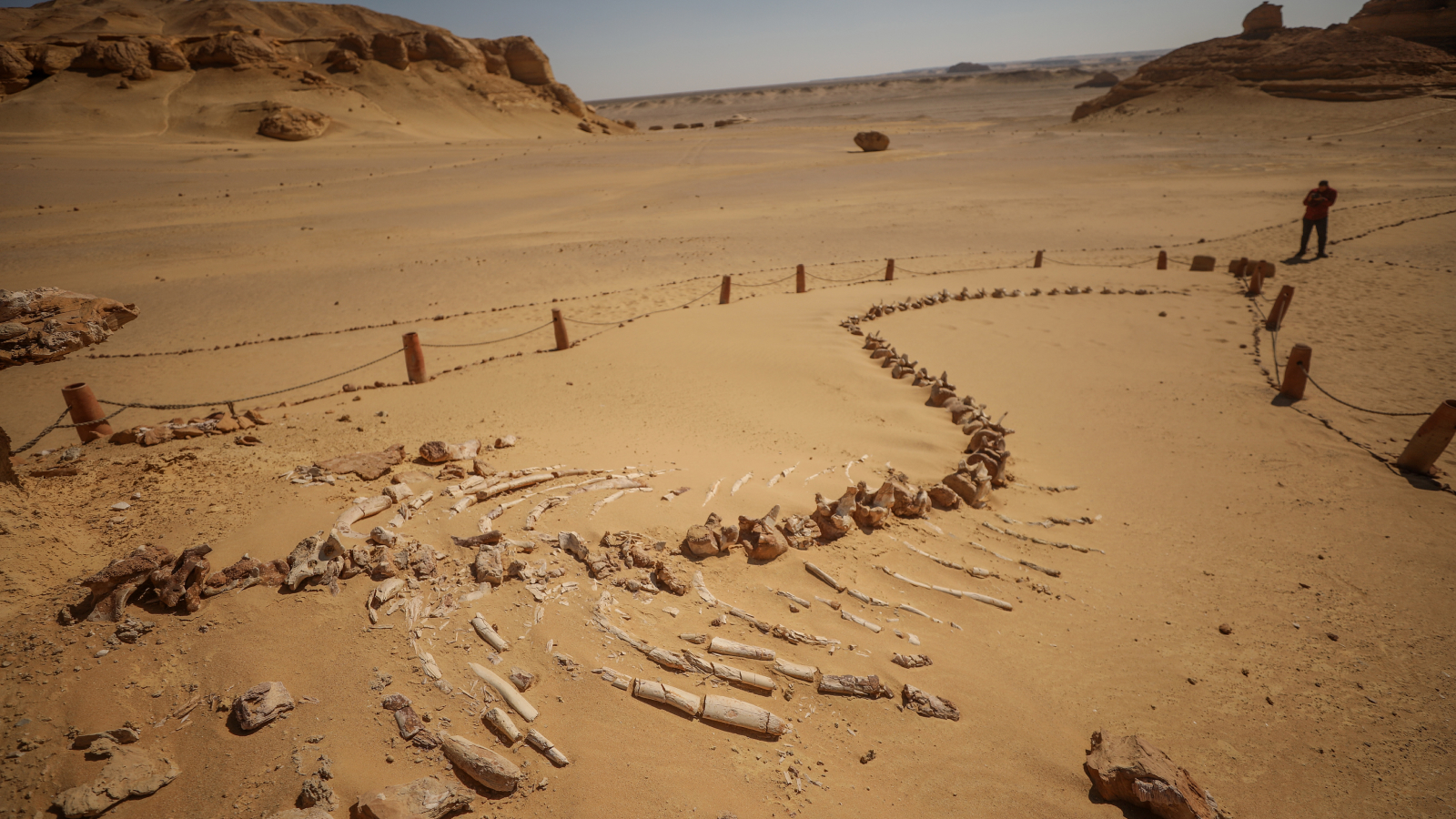
O Vale das Baleias do Egito, ou "Wadi Al-Hitan" em
árabe, abriga mais de 400 esqueletos primitivos de baleias que oferecem
um retrato da evolução dessas criaturas, de animais terrestres para
marinhos.
O Wadi El-Hitan, ou Vale das Baleias, no
Egito, já foi coberto por água e agora abriga muitos fósseis antigos de
baleias primitivas. (Crédito da imagem: Mohamed Elshahed/Agência Anadolu via Getty Images)
FATOS RÁPIDOS
Nome: Wadi Al-Hitan, que se traduz como "Vale das Baleias" ou "Vale das Baleias"
Por que é incrível: O vale abriga centenas de esqueletos primitivos de baleias, alguns dos quais têm "pés".
O Vale das Baleias é uma região do deserto do Saara egípcio repleta de esqueletos arcaicos de baleias, alguns dos quais têm pés e dedos preservados.
Esses
esqueletos e outros fósseis marinhos datam do final do Eoceno (55,8
milhões a 33,9 milhões de anos atrás), quando o atual Egito estava
submerso no Oceano Tétis e as baleias tinham acabado de evoluir para
criaturas marinhas, de acordo com a UNESCO .
"Esses
fósseis representam uma das maiores histórias da evolução: o surgimento
da baleia como um mamífero oceânico a partir de uma vida anterior como
um animal terrestre", diz o site da UNESCO.
Paleontólogos desenterraram mais de 400 esqueletos antigos de baleias no Vale das Baleias desde o início do século XX, de acordo com um vídeo da UNESCO .
A primeira descoberta, em 1902, revelou uma espécie de baleia nunca antes vista, chamada Basilosaurus isis (anteriormente Zeuglodon isis ). Essa baleia chegava a medir 18 metros de comprimento e provavelmente se alimentava de baleias menores, esmagando seus crânios antes de engoli-los , de acordo com um estudo de 2019 .
Evidências sugerem que o B. isis "tinha um focinho longo e estava armado com incisivos pontiagudos e dentes afiados nas bochechas", disse anteriormente à Live Science Manja Voss , especialista em mamíferos marinhos do Museu de História Natural de Berlim e principal autora do estudo de 2019.
Pesquisadores encontraram dezenas de esqueletos de B. isis
no Vale das Baleias, mas em 1989, paleontólogos fizeram uma descoberta
notável: uma equipe da Universidade de Michigan e do Museu Geológico
Egípcio desenterrou esqueletos de B. isis com membros posteriores, pés e dedos, de acordo com um artigo de revisão de 2023 .
As
baleias modernas não possuem membros posteriores, mas ainda possuem
ossos pélvicos, o que indica que já os tiveram, de acordo com a Universidade do Havaí
. Isso significa que os fósseis no Vale das Baleias são alguns dos mais
antigos arqueocetos conhecidos, um grupo de mamíferos do Eoceno que
posteriormente evoluiu para as baleias e os golfinhos modernos, de
acordo com a revisão de 2023.
incrivelmente preservado e quase completo Em 2005, paleontólogos descobriram um esqueleto de B. isis
, levando a UNESCO a declarar o Vale das Baleias Patrimônio Mundial.
Desde então, muitos outros fósseis surgiram, incluindo restos de antigas
tartarugas do Eoceno, peixes ósseos, tubarões, raias, crocodilos,
peixes-bois e mariscos, de acordo com a revisão.
O
Vale das Baleias funciona como um museu a céu aberto, com um centro de
visitantes e fácil acesso para turistas, mas o local é rigorosamente
protegido. Pesquisadores continuam encontrando novos fósseis e
aprendendo mais sobre a geologia da área, de acordo com a análise.
Observando o
corpo e a biologia de uma baleia, há muitas pistas de que seus
ancestrais viveram em terra. Elas respiram ar e amamentam seus filhotes
com seu próprio leite. Também possuem nadadeiras em forma de pá que
envolvem os ossos das mãos com cinco "dedos". Como embriões, as baleias
têm membros posteriores minúsculos que desaparecem antes do nascimento.
Como as baleias e os golfinhos evoluíram. Especialistas do WDC explicam.
Os hipopótamos são os parentes vivos mais próximos das baleias, mas
não são seus ancestrais. Tanto os hipopótamos quanto as baleias
evoluíram de ancestrais ungulados, quadrúpedes, com dedos pares e
cascos, que viveram em terra há cerca de 50 milhões de anos.
Os
ungulados modernos incluem hipopótamos, girafas, veados, porcos e vacas.
Ao contrário do ancestral do hipopótamo, os ancestrais das baleias
migraram para o mar e evoluíram para criaturas nadadoras ao longo de um
período de cerca de 8 milhões de anos.
Fósseis de baleias gigantes antigas, chamadas Basilosaurus, foram
inicialmente confundidos com fósseis de dinossauros, mas posteriormente
reconhecidos como mamíferos. Essas baleias pré-históricas eram mais
alongadas do que as baleias modernas e tinham patas traseiras e
nadadeiras dianteiras menores. Suas narinas situavam-se a meio caminho
entre a ponta do focinho e a testa, e possuíam ossos auriculares
semelhantes aos das baleias modernas. O Basilosaurus representa o elo ou
intermediário entre as baleias e seus ancestrais ungulados terrestres.
A teoria é que alguns ungulados terrestres preferiam mastigar plantas
à beira da água, o que tinha a vantagem adicional de permitir que se
escondessem facilmente do perigo em águas rasas. Com o tempo, seus
descendentes passaram a passar cada vez mais tempo na água e seus corpos
se adaptaram à natação. Suas patas dianteiras tornaram-se nadadeiras e
uma espessa camada de gordura chamada gordura substituiu seus casacos de
pele para mantê-los aquecidos e aerodinâmicos.
Eventualmente, suas
caudas ficaram maiores e mais fortes para nadar com força, e suas patas
traseiras encolheram. Gradualmente, suas narinas se moveram para o topo
de suas cabeças para que pudessem respirar facilmente sem a necessidade
de inclinar a cabeça enquanto nadavam. À medida que algumas dessas
criaturas começaram a se alimentar de uma dieta diferente, elas
evoluíram para de barbatanas e perderam seus dentes. filtradores
quarta-feira, 8 de janeiro de 2025
Translator
As baleias azuis recuperaram a pretensão de serem os maiores animais de todos os tempos?
Um
novo estudo refuta cálculos anteriores que argumentavam que uma baleia
extinta era quase duas vezes maior que os gigantes modernos
Para calcular o peso da criatura antiga, ambas as equipas modelaram
como os pedaços de carne do animal extinto teriam pendurado na sua
estrutura fossilizada, fazendo comparações com espécies vivas. Na sua
estimativa inicial, os investigadores por detrás do estudo de agosto
usaram os peixes-boi como base de comparação.
A dupla por trás do novo
artigo, por sua vez, usou dados coletados de carcaças de baleias caçadas
e colhidas. Comparar as baleias antigas com as contemporâneas faz mais sentido do que os peixes-boi , dizem eles ao The New York Times ( NYT ), já que as baleias são o único grupo que desenvolveu um gigantismo tão extremo. Embora esses cientistas tenham abandonado P. colossus
algumas classes de peso, os seus cálculos fósseis revelaram que as
maiores baleias azuis podem ter sido ainda maiores do que os cientistas
pensavam, pesando impressionantes 270 toneladas, 120 a mais do que as
estimativas anteriores. Ainda assim, os autores do estudo original dizem
ao NYT que mantêm os cálculos – e que o trabalho em curso provará que estão certos.
quarta-feira, 20 de março de 2019
What is Darwin's Theory of Evolution?
By
Ker Than, Live Science Contributor
|
The theory of evolution by natural selection, first formulated in
Darwin's book "On the Origin of Species" in 1859, is the process by
which organisms change over time as a result of changes in heritable
physical or behavioral traits. Changes that allow an organism to better
adapt to its environment will help it survive and have more offspring.
Evolution by natural selection is one of the best substantiated
theories in the history of science, supported by evidence from a wide
variety of scientific disciplines, including paleontology, geology,
genetics and developmental biology.
The theory has two main points, said Brian Richmond, curator of human
origins at the American Museum of Natural History in New York City. "All
life on Earth is connected and related to each other," and this
diversity of life is a product of "modifications of populations by
natural selection, where some traits were favored in and environment
over others," he said.
More simply put, the theory can be described as "descent with
modification," said Briana Pobiner, an anthropologist and educator at
the Smithsonian Institution National Museum of Natural History in
Washington, D.C., who specializes in the study of human origins.
The theory is sometimes described as "survival of the fittest,"
but that can be misleading, Pobiner said. Here, "fitness" refers not to
an organism's strength or athletic ability, but rather the ability to
survive and reproduce.
For example, a study on human evolution on 1,900 students, published online in the journal Personality and Individual Differences
in October 2017, found that many people may have trouble finding a mate
because of rapidly changing social technological advances that are
evolving faster than humans. "Nearly 1 in 2 individuals faces
considerable difficulties in the domain of mating," said lead study
author Menelaos Apostolou, an associate professor of social sciences at
the University of Nicosia in Cyprus. "In most cases, these difficulties
are not due to something wrong or broken, but due to people living in an
environment which is very different from the environment they evolved
to function in." [If You Suck at Dating, It's Not You — It's Evolution]
Origin of whales
In the first edition of "On the Origin of Species" in 1859, Charles
Darwin speculated about how natural selection could cause a land mammal
to turn into a whale. As a hypothetical example, Darwin used North
American black bears, which were known to catch insects by swimming in
the water with their mouths open:
"I can see no difficulty in a race of bears being rendered, by natural
selection, more aquatic in their structure and habits, with larger and
larger mouths, till a creature was produced as monstrous as a whale," he
speculated.
The idea didn't go over very well with the public. Darwin was so
embarrassed by the ridicule he received that the swimming-bear passage
was removed from later editions of the book.
Scientists now know that Darwin had the right idea but the wrong
animal. Instead of looking at bears, he should have instead been looking
at cows and hippopotamuses.
The story of the origin of whales is one of evolution's most
fascinating tales and one of the best examples scientists have of
natural selection.
The last shore-dwelling
ancestor of modern whales was Sinonyx, top left, a hyena-like animal.
Over 60 million years, several transitional forms evolved: from top to
bottom, Indohyus, Ambulocetus, Rodhocetus, Basilosaurus, Dorudon, and
finally, the modern humpback whale.
Credit: NOAA
Natural selection
To understand the origin of whales, it's necessary to have a basic
understanding of how natural selection works. Natural selection can
change a species in small ways, causing a population to change color or
size over the course of several generations. This is called
"microevolution."
But natural selection is also capable of much more. Given enough time
and enough accumulated changes, natural selection can create entirely
new species, known as "macroevolution." It can turn dinosaurs into
birds, amphibious mammals into whales and the ancestors of apes into
humans.
Take the example of whales — using evolution as their guide and knowing
how natural selection works, biologists knew that the transition of
early whales from land to water occurred in a series of predictable
steps. The evolution of the blowhole, for example, might have happened
in the following way:
Random genetic changes resulted in at least one whale having its
nostrils placed farther back on its head. Those animals with this
adaptation would have been better suited to a marine lifestyle, since
they would not have had to completely surface to breathe. Such animals
would have been more successful and had more offspring. In later
generations, more genetic changes occurred, moving the nose farther back
on the head.
Other body parts of early whales also changed. Front legs became
flippers. Back legs disappeared. Their bodies became more streamlined
and they developed tail flukes to better propel themselves through
water.
Darwin also described a form of natural selection that depends on an
organism's success at attracting a mate, a process known as sexual
selection. The colorful plumage of peacocks and the antlers of male deer
are both examples of traits that evolved under this type of selection.
But Darwin wasn't the first or only scientist to develop a theory of evolution. The French biologist Jean-Baptiste Lamarck
came up with the idea that an organism could pass on traits to its
offspring, though he was wrong about some of the details. Around the
same time as Darwin, British biologist Alfred Russel Wallace
independently came up with the theory of evolution by natural selection.
Modern understanding
Darwin didn't know anything about genetics, Pobiner said. "He observed
the pattern of evolution, but he didn't really know about the
mechanism." That came later, with the discovery of how genes encode
different biological or behavioral traits, and how genes are passed down
from parents to offspring. The incorporation of genetics and Darwin's
theory is known as "modern evolutionary synthesis."
The physical and behavioral changes that make natural selection
possible happen at the level of DNA and genes. Such changes are called
mutations. "Mutations are basically the raw material on which evolution
acts," Pobiner said.
Mutations can be caused by random errors in DNA replication or repair,
or by chemical or radiation damage. Most times, mutations are either
harmful or neutral, but in rare instances, a mutation might prove
beneficial to the organism. If so, it will become more prevalent in the
next generation and spread throughout the population.
In this way, natural selection guides the evolutionary process,
preserving and adding up the beneficial mutations and rejecting the bad
ones. "Mutations are random, but selection for them is not random,"
Pobiner said.
But natural selection isn't the only mechanism by which organisms
evolve, she said. For example, genes can be transferred from one
population to another when organisms migrate or immigrate, a process
known as gene flow. And the frequency of certain genes can also change
at random, which is called genetic drift.
A wealth of evidence
Even though scientists could predict what early whales should look
like, they lacked the fossil evidence to back up their claim.
Creationists took this absence as proof that evolution didn't occur.
They mocked the idea that there could have ever been such a thing as a
walking whale. But since the early 1990s, that's exactly what scientists
have been finding.
The critical piece of evidence came in 1994, when paleontologists found the fossilized remains of Ambulocetus natans,
an animal whose name literally means "swimming-walking whale." Its
forelimbs had fingers and small hooves but its hind feet were enormous
given its size. It was clearly adapted for swimming, but it was also
capable of moving clumsily on land, much like a seal.
When it swam, the ancient creature moved like an otter, pushing back with its hind feet and undulating its spine and tail.
Modern whales propel themselves through the water with powerful beats of their horizontal tail flukes, but Ambulocetus still had a whip-like tail and had to use its legs to provide most of the propulsive force needed to move through water.
In recent years, more and more of these transitional species, or
"missing links," have been discovered, lending further support to
Darwin's theory, Richmond said.
Despite the wealth of evidence from the fossil record, genetics and other fields of science, some people still question its validity.
Some politicians and religious leaders denounce the theory of
evolution, invoking a higher being as a designer to explain the complex
world of living things, especially humans.
School boards debate whether the theory of evolution should be taught alongside other ideas, such as intelligent design or creationism.
Mainstream scientists see no controversy. "A lot of people have deep
religious beliefs and also accept evolution," Pobiner said, adding,
"there can be real reconciliation."
Evolution is well supported by many examples of changes in various
species leading to the diversity of life seen today. "If someone could
really demonstrate a better explanation than evolution and natural
selection, [that person] would be the new Darwin," Richmond said.
Additional reporting by Contributor Alina Bradford and Staff Writer Tanya Lewis, Follow Tanya on Twitter. Follow us @livescience, Facebook & Google+.
Additional resources
The National Oceanic and Atmospheric Administration has a presentation on whale evolution.
• Maiabalaena nesbittae is 33 million year old fossil baleen whale from Oregon
• Maiabalaena has neither teeth, nor baleen
• Early whales lost teeth entirely before the evolutionary origin of baleen
• Despite no teeth or baleen, these whales were effective suction feeders
Summary
Whales use baleen, a novel integumentary structure, to filter feed;
filter feeding itself evolved at least five times in tetrapod history
but demonstrably only once in mammals. Living baleen whales (mysticetes)
are born without teeth, but paleontological and embryological evidence
demonstrate that they evolved from toothed ancestors that lacked baleen
entirely.
The mechanisms driving the origin of filter feeding in
tetrapods remain obscure. Here we report Maiabalaena nesbittae gen. et sp. nov., a new fossil whale from
early Oligocene rocks of Washington State, USA, lacking evidence of
both teeth and baleen. The holotype possesses a nearly complete skull
with ear bones, both mandibles, and associated postcrania. Phylogenetic
analysis shows Maiabalaena as crownward of all toothed mysticetes,
demonstrating that tooth loss preceded the evolution of baleen. The
functional transition from teeth to baleen in mysticetes has remained
enigmatic because baleen decays rapidly and leaves osteological
correlates with unclear homology; the oldest direct evidence for fossil
baleen is ∼25 million years younger than the oldest stem mysticetes (∼36
Ma). Previous hypotheses for the origin of baleen are inconsistent with
the morphology and phylogenetic position of Maiabalaena. The absence of both teeth and baleen in Maiabalaena is
consistent with recent evidence that the evolutionary loss of teeth and
origin of baleen are decoupled evolutionary transformations, each with a
separate morphological and genetic basis. Understanding these
macroevolutionary patterns in baleen whales is akin to other
macroevolutionary transformations in tetrapods such as scales to
feathers in birds.
Figure 1. Cranial Elements of the Holotype of Maiabalaena nesbittae, USNM 314627.
Systematics
Cetacea; Pelagiceti;
Neoceti; Mysticeti;
Maiabalaena nesbittae gen. et sp. nov.
Etymology:Maiabalaena combines Maia-, meaning mother, and -balaena, meaning whale. Named for its phylogenetic position as basal to baleen-bearing mysticetes. The specific epithet nesbittae honors Dr. Elizabeth A. Nesbitt for
her lifetime of contribution to paleontology of the Pacific Northwest
and her mentorship and collegiality at the Burke Museum of Natural
History and Culture in Seattle, Washington, USA.
3D models of select specimens in lateral view with artistic reconstructions of their feeding modes:
(B) Basilosaurus isis; (C) Coronodon havensteini; (D) Maiabalaena nesbittae; and (E) Balaenoptera musculus.
These panels illustrate the loss of a
functional dentition, the intermediate phase with neither teeth nor
baleen, and the subsequent origin of baleen. Illustrations are original
artwork by Alex Boersma (www.alexboersma.com).
Figure 2. Phylogenetic
Relationships of Stem Mysticetes Illustrating the Evolutionary Loss of
Teeth and Subsequent Origin of Baleen Figure illustrates a composite
phylogeny including results from this analysis (Figure S4) and recently
published analyses.
(A) Time calibrated simplified phylogeny, with collapsed clade
resolution for Mammalodontidae, Aetiocetidae and Eomysticetidae, and
crown Mysticeti.
(B–E) Colored bars indicate groups figured; gray bars indicate groups
not figured. Panels (b–e) represent 3D models of select specimens in
lateral view with artistic reconstructions of their feeding modes: (B) Basilosaurus isis; (C) Coronodon havensteini; (D) Maiabalaena nesbittae; and (E) Balaenoptera musculus.
These panels illustrate the loss of a functional dentition, the
intermediate phase with neither teeth nor baleen, and the subsequent
origin of baleen. Illustrations are original artwork by Alex Boersma (www.alexboersma.com).
This is an artistic reconstruction of a mother and calf of Maiabalaena nesbittae nursing offshore of Oregon during the Oligocene, about 33 million years ago. While Maiabalaena would
not have been able to chew or filter feed, muscle attachments on the
bones of its throat indicate it likely had strong cheeks and a
retractable tongue. These traits would have enabled it to suck water
into its mouth, taking up fish and small squid in the process. The
ability to suction feed would have rendered teeth, whose development
requires a lot of energy to grow, unnecessary. The loss of teeth, then,
appears to have set the evolutionary stage for the baleen, which the
scientists estimate arose about 5 to 7 million years later.
Carlos Mauricio Peredo, Nicholas D. Pyenson, Christopher D. Marshall
and Mark D. Uhen. 2018. Tooth Loss Precedes the Origin of Baleen in
Whales. Current Biology. DOI: 10.1016/j.cub.2018.10.047
A blue whale spotted off the coast of Monterey, California.
Credit: Chase Dekker/Shutterstock
The blue whale (Balaenoptera musculus) is the largest animal
known to have existed in history. These enormous marine mammals have
been known to reach up to 110 feet (34 meters) long, and the largest
individuals likely weigh at least 150 tons (136 metric tons), according
to the National Oceanic and Atmospheric Administration (NOAA) Fisheries. That's a little more than twice the length of a school bus and more than three times the weight of a semitrailer truck.
"You never cease to be impressed by the force and presence of these
animals," said Richard Sears, a marine biologist and founder of the Mingan Island Cetacean Study,
a nonprofit research organization that studies marine mammals. The full
enormity of a blue whale may not be obvious from above the water's
surface, but "when you're next to a blue whale underwater, it's
magnificent," Sears said. "That's when your heart gets pumping."
Taxonomy and evolution
Blue whales belong to a group of whales called rorquals, which are
baleen whales with folds or grooves in their skin that allow their
mouths to expand to swallow larger volumes of water when feeding. Many
scientists describe blue whales as belonging to one of three subspecies,
with groups found in the Northern Hemisphere and the Antarctic, and a
third, the pygmy blue whales (B. musculus brevicauda), in the Indian and Southwest Pacific oceans. Pygmy blue whales are smaller whales, but they may still grow to 79 feet (24 m) in length.
The distant ancestors of blue whales
had legs and walked on land, but ventured into the water to find food.
Over many generations, these creatures developed adaptations suitable
for living in water full time, such as fins, blubber and blowholes.
Although the fossil record is murky, research suggests
that some of these animals lost their teeth and fed by sucking their
prey into their mouths. These ancient, toothless whales are thought to
have eventually developed baleen — brush-like plates with small gaps —
to filter food out of the water they were sucking in.
Research published in 2017 revealed that blue whales likely began growing to such tremendous size only relatively recently, from an evolutionary standpoint — perhaps in just the past 3 million years.
Blue whales have been successful in reaching their humongous size
because their water environment supports most of their mass compared to
animals on land, and they've adapted to feed so efficiently on krill,
Sears said. [Whale Album: Giants of the Deep]
Diet and habitat
Blue whales are found in oceans around the globe. Scientists keep track
of populations in the North Pacific and Atlantic Oceans, as well as
whales throughout the Southern Hemisphere.
The whales migrate long distances to find food in cold waters and rear
calves in warmer areas during the coldest few months of the year. These
trips extend from the tropics to the polar circles and cover thousands
of miles.
Some whales have been spotted returning to the same locations year
after year, but not always. Searching for whales by boat has its
limitations, Sears said, so it often isn't clear to researchers if the
"missing" whales just went somewhere else that year, or simply weren't
seen by whale spotters.
Blue whales almost exclusively eat krill — small, shrimp-like
creatures. The whales seek out large concentrations of their tiny prey,
which they engulf in a large amount of water, sometimes spinning about
as they do it. The water in one of those massive gulps weighs as much
as the whale itself, Robert Shadwick, an animal biomechanics researcher
at the University of British Columbia, previously told Live Science.
The whales push the water back out across their baleen filter, which
catches the krill. Unlike toothed whales, blue whales lack teeth and
instead have baleen, which are thin, semirigid plates that grow down
from the top of the whale's mouth. The plates are lined up closely to
one another and are made of a protein called keratin — the same protein
that builds fingernails and hair. The amount of krill a blue whale
captures in one gulp of water may provide nearly half a million calories
of energy.
A blue whale engulfs krill off the coast of California.
Credit: Copyright Nicholas Pyenson/Silverback Films/BBC
Life cycle
Scientists estimate that blue whales may live as long as 80 to 90
years. Sears has been tracking blue whales in the North Atlantic Ocean
for over 40 years, and he continues to see some of the same individuals
that he saw when he first started.
One of the reasons blue whales are able to live so long is their lack
of predators. Blue whale calves are small enough that they're
occasionally targeted by orcas, but adult whales are so large that even
the most vicious ocean predators steer clear. Humans pose the biggest
threat to a blue whale's survival.
Blue whales can communicate over long distances with extremely loud, low-pitched calls that are below the range of human hearing. Scientists are still learning about the context for these calls and mating behavior.
Blue whales appear to reach sexual maturity
somewhere around 9 years old, but researchers and whale trackers have
been unable to determine if there are specific breeding-ground regions
for blue whales.
What scientists do know, however, is that mother blue whales usually
give birth to single calves, which are 20 to 23 feet (6 to 7 m) long,
and weigh up to 6,000 lbs. (2,700 kilograms). Calves nurse for six to
eight months and may stay with their mothers until they are around 2 to 3
years old.
Conservation status
The World Wildlife Fund
lists blue whales as endangered. Commercial whaling is no longer the
major threat it once was, but climate change, pollution, human-made
noise and shipping traffic are still concerns. Nonetheless, according to
the International Union for Conservation of Nature and Natural Resources (IUCN), the global population of blue whales is increasing.
Sears estimates there may be anywhere from 10,000 to 18,000 blue whales
worldwide. It's difficult for experts to determine a more exact
population size because blue whales traverse such vast portions of the
ocean, which makes them tough to track, Sears said. "We don't really
have a handle on it."
And although blue whales are gigantic creatures, they're still really
good at hiding from humans. The whales can frequently hold their breath
for 20 minutes at a time and travel long distances in that time, which
makes it difficult to follow them, even once they've been spotted, Sears
said. "The study areas we give ourselves can already be pretty broad in
terms of humans, but in the scale of blue whales, it's a joke," he
said.
Sears estimates that researchers may glimpse only 5 percent of the blue
whale's life when they come close enough for observation. The remaining
decades of a blue whale's life may become easier to document with
technology like drones and improved satellite tags. It may take two or
three generations of biologists, said Sears, before there is a
"comfortable" understanding of blue whale behavior and social
interactions. Further reading:
A new species of 30 million year old whale has been found near Charleston, South Carolina
•
This new species is a relative of modern baleen-bearing whales but retains teeth
•
Its molars are large, multi-cusped, and overlapping and were used for filter feeding
•
Filter feeding evolved before baleen; early whales had teeth and baleen
Summary
As
the largest known vertebrates of all time, mysticetes depend on
keratinous sieves called baleen to capture enough small prey to sustain
their enormous size [
].
The origins of baleen are controversial: one hypothesis suggests that
teeth were lost during a suction-feeding stage of mysticete evolution
and that baleen evolved thereafter [
]. Here we report a new species of toothed mysticete, Coronodon havensteini,
from the Oligocene of South Carolina that is transitional between
raptorial archaeocete whales and modern mysticetes. Although the
morphology and wear on its anterior teeth indicate that it captured
large prey, its broad, imbricated, multi-cusped lower molars frame
narrow slots that were likely used for filter feeding. Coronodon havensteini
is a basal, if not the most basal, mysticete, and our analysis suggests
that it is representative of an initial stage of mysticete evolution in
which teeth were functional analogs to baleen. In later lineages, the
diastema between teeth increased—in some cases, markedly so [
]—and
may mark a stage at which the balance of the oral fissure shifted from
mostly teeth to mostly baleen. When placed in a phylogenetic context,
our new taxon indicates that filter feeding was preceded by raptorial
feeding and that suction feeding evolved separately within a clade
removed from modern baleen whales.
Coronodon havensteini.
Genus is Greek for “crown tooth,” referring to the multi-cusped molars.
The species name recognizes Mark Havenstein, who discovered the
holotype.
Locality and Age
Wando River near Highway 41 Bridge, South Carolina, Berkeley County. Ashley Formation, Oligocene, uppermost Rupelian [
]. Additional locality information available upon request.
Diagnosis
Coronodon
has the following mysticete synapomorphies: supraoccipital level with
temporal fossa (character 25: state 1), broad basioccipital crests (39:
2), all cusps of posterior teeth subequal (99: 1), upturned antorbital
process of maxilla (100: 1), and splayed basal cusps on posterior teeth
(206: 1) (Figures 1, 2, S1, and S2; Data S1). Like some archaeocetes [
], its rostrum is twisted counterclockwise in anterior view (Figure 3). Coronodon havensteini is unique in having anterior lower molars labially overlapping posterior lower molars (Figure 2).
Feeding Behavior
Toothed
mysticetes evolved from archaeocetes, a paraphyletic group ancestral to
all extant cetaceans. Archaeocetes are interpreted as raptorial
feeders: they hunted and caught prey with their teeth, one at a time.
This inference is supported by fossilized stomach contents [
]. Raptorial feeding is also indicated in Coronodon by the caniniform incisors and the truncated and worn crown of the right P2 (Figure S1). Similar wear has been interpreted as being created by abrasion during feeding by the skeletons or other hard parts of prey [
By contrast, other features suggest that Coronodon
was less effective at raptorial feeding than archaeocetes. The latter
resemble raptorial odontocetes in having a long, narrow rostrum, which
likely allowed prey to be caught with only a turn of the head and
minimal drag [
]. The rostrum of Coronodon is wider, as indicated by the straight sides and shorter mandibular symphysis (Figures 1 and 2). In archaeocetes, the symphysis extends to p3, whereas the symphysis of Coronodon
terminates anterior to the canine. Importantly, a wider rostrum in
extant mysticetes is associated with a larger oral cavity, which is a
critical adaptation for filter feeding [
The premolars and molars of Coronodon differ from those of Basilosauridae (Figures 2A
and 2G), the closest relatives of mysticetes among archaeocetes. The
sides of the p4 in the latter are steeper: lines connecting the apices
of three central cusps form an angle of 82° or 98° in Cynthiacetus (MNHN.F.PRU 102) and Dorudon (UM 10122), respectively, as compared to 155° in Coronodon.
A smaller angle is more effective at puncturing prey because it
concentrates and sustains the bite force on the central cusp. Even
greater differences are seen in the molars. In Coronodon, the
first two molars are subequal to the p4 and resemble it in having mesial
and distal accessory cusps. By contrast, the molars of basilosaurids
are much smaller (e.g., p4/m1 = 1.59 for Dorudon), and the lower molars lack mesial cusps [
].
Large molars are often indicative of greater mastication, but the
pattern of wear makes this interpretation unlikely. Each lower molar has
a labial wear facet that extends apically onto the base of the crown
but remains far removed from the carinae (Figure 2C). As a result, the scissor-like shearing between upper and lower molars, as seen in protocetids like Georgiacetus,
is absent. Although the posterior molars could have been used to impale
prey, this behavior seems uncommon given the small size of most apical
wear facets (1.6–4 mm; Figures 2B and 2E) and the fact that the molars had reduced support from alveolar bone (Figure 2A).
For each double-rooted tooth, only the distal half of each root is
surrounded by alveolar bone, suggesting that the high occlusal pressures
associated with macrophagy were rarely encountered.
Early studies speculated that toothed mysticetes used their teeth to filter feed [
],
an idea later described as the “dental filtration hypothesis.” However,
the teeth of previously described toothed mysticetes are too few, too
small, too simplified, or too worn to be effective in filtering [
].
This led to a spate of recent studies that have developed a new
hypothesis: that filter-feeding mysticetes evolved from edentulous,
suction-feeding whales that lacked baleen [
]. The molars of Coronodon
are far larger than those of other toothed mysticetes and hearken back
to the dental filtration hypothesis. Unlike archaeocetes and most
neocetes, its upper teeth widely overlap its lower teeth instead of
interdigitating with them. As a result, when the mouth is opened, the
posterior teeth enclose diamond-shaped gaps (∼15 × 35 mm at m1 and m2)
that could filter out prey of varying size. When the mouth is closed,
the gaps in Coronodon would have been closed off by the crown
of the opposing dentition. Even so, narrow slots (0.5–3 mm wide) between
the imbricated lower molars remained open (Figure 2B),
allowing even smaller prey to be filtered. The serrate borders of these
slots are formed by small accessory cusps that point distally from the
tooth preceding the slot and mesially from the tooth following the slot.
In archaeocetes, the basal cusps are directed more apically, instead of
mesially or distally (Figure 2G). Many of the basal cusps in Coronodon have minor, but distinct, apical wear, indicating that they were exposed and not covered in gingiva (Table S2).
The wear on the fairly sheltered, mesially directed cusps is unexpected
and may have been formed by prey that accumulated along the slots
during filtering. Such passive wear is quite common in marine mammals,
with substrate being the best-documented culprit, particularly in
porpoises [
],
which impact their tusks upon entering the oral fissure. This can
result in strong wear on the mesial side of the tooth, specifically that
portion exposed during typical gape employed during feeding (Figure 2H).
Interestingly, the wear of baleen in extant mysticetes seems driven by
the intraoral flow of water and the prey and sediment carried with it [
], but we have come to a different interpretation because, in Coronodon,
that wear also occurs on cusps sheltered by the preceding tooth. One
unnamed aetiocetid (NMV P252567) has mesodistal grooves and large
patches of wear on the lingual sides of its crowns [
]. Importantly, no comparable wear or grooves exist in the only known specimen of Coronodon.
The
presence of interdental, filter-feeding slots, as we propose, is
consistent with the pattern of dental erosion on the crowns of the
posterior lower teeth. The p3-m2 (right) and p3-m1 (left) teeth have
ovoid pockets of dental erosion that emanate from the deep notches
between the apical-most three cusps (Figures 2C–2E), similar to caries that form in the carnassial notch of dogs [
].
The remaining three to four notches between accessory cusps lack dental
erosion, even though they are much further from the apex of the tooth.
This pattern is expected if, as we suggest, the filter-feeding slots
flushed this area with seawater, small prey, and/or other particulate
matter that could inhibit plaque formation or abrade it off the tooth.
The closest extant analog for the feeding behavior we reconstruct for Coronodon is the leopard seal (Hydrurga leptonyx), which uses its anterior teeth to secure prey and its postcanine dentition to filter out smaller prey, mostly krill [
]. These traits characterize Coronodon as well, but filter-feeding seals primarily use gaps between cusps of the same tooth to filter out crustaceans [
], whereas we interpret that Coronodon utilized gaps between teeth.
Evolution of Baleen and Filter Feeding
There is little evidence for baleen in Coronodon.
The only osteological correlates for baleen are laterally positioned
palatal foramina, which, in the gray whale and presumably all other
extant mysticetes, convey branches of the superior alveolar artery to
supply the baleen-bearing, oral epithelium [
]. In Coronodon,
there are only three to four minute, palatal foramina, most of which
are clustered around the P3. This contrasts with the six widely
distributed foramina and sulci in Aetiocetus weltoni, which indicates the presence of baleen in this taxon [
]. Although Coronodon
probably lacked baleen, its morphology is suggestive of the following
hypothesis. The first mysticetes, and their descendants like Coronodon,
filter fed by funneling water through interdental slots whose dorsal
margins were rimmed by thickened gingiva. If proto-baleen evolved from
the gingiva at the lateral ends of these slots, then proto-baleen would
not have been disturbed by the lower dentition (contra [
])
and selection could have favored smaller teeth and larger,
baleen-filled diastema. In fact, there is evidence of thick gingiva in Coronodon. Broad zones of dental erosion, which typically form in gingival pockets, occur on the labial side of P4 and M2 (Figures 1D and 1F) and suggest a maximal gingival thickness of 5 cm (distance from alveolus to apical edge of erosion).
We
tested this scenario by tracing the evolution of tooth size,
morphology, and spacing on the most parsimonious tree for a modified
mysticete supermatrix [
] (Figures 4 and S4; Table S3). Coronodon and the unnamed taxon ChM PV5720 from the Charleston area are the most basal mysticetes, followed by Metasqualodon symmetricus from Japan. This topology broadly supports our hypothesis that Coronodon
is representative of a pre-baleen dental stage of filter feeding.
Molars having mesially oriented, basal denticles, which encroach into
the interdental slots, are optimized as evolving at the base of
Mysticeti and then persisting until molars are lost in mysticetes (Figure 4).
Apical orientation of basal cusps in the clade including aetiocetids
and mammalodontids is interpreted as a reversal of the archaeocete
condition. The evolution of molar diastema is complicated, but the base
of Mysticeti is characterized by two or more successive widenings of
diastema that culminate in the exceptionally broad diastema of Llanocetus denticrenatus, followed by the loss of posterior teeth in eomysticetids (Figure 4) [
],
we infer that filter feeding evolved shortly after odontocetes and
mysticetes diverged. Across extant vertebrates, filter feeding is
associated with a large body size [
], a cetacean this long should be about 175 kg. Coronodon is much larger: an equation that estimates body length from width across the zygomatic process results in a length of 4.9 m [
]. Determining whether Coronodon
simply retained the body size of archaeocetes or represents a dramatic
increase over a small ancestral neocete will be difficult. Llanocetus was undoubtedly very large, whereas Metasqualodon was much smaller; however, the skull of neither taxon is well known or fully described.
Although
our findings support the dental filtration hypothesis, are they also at
odds with the suction-feeding hypothesis? The two are not mutually
exclusive, because filter feeding can coexist with suction feeding, as
demonstrated by leopard and crabeater seals [
]. The MBI for Coronodon
is 0.41, in line with extant raptorial feeders; however, there are
exceptions. Many odontocetes with long, narrow rostra occasionally
suction feed, and others, like ziphiids, rely almost exclusively on this
behavior [
].
In fact, the only study to test associations of suction-feeding traits
in a phylogenetic context inferred that basal neocetes used a
combination of teeth and suction for capturing and ingesting prey [
],
it is critical to develop more methods to distinguish degrees of
suction feeding in fossil taxa. Otherwise, the suction-feeding
hypothesis for the origin of baleen will remain a speculative scenario,
instead of a hypothesis corroborated by testing.
In reconstructing the behavior of Coronodon,
we take a more conservative view by suggesting that it primarily
employed ram feeding, whereby an aquatic predator opens its mouth and
then thrusts its body onto prey. Ram feeding is one of the simplest
forms of aquatic predation [
].
If our interpretation is correct, then suction feeding in aetiocetids
and mammalodontids is not representative of an early stage through which
the ancestor of all extant mysticetes passed, but instead evolved after
their ancestor diverged from other mysticetes. Ram feeding is
associated with positive allometry of the skull, mandibles, and buccal
cavity in rorquals, and similar allometric relationships apply to other
extant mysticetes as well [
].
These differences are likely the result of positive feedback in filter
feeders: larger mouths can capture more prey, and more prey can sustain a
larger body size. Thus, we predict that future studies on skeletal
proportions of the most basal mysticetes will find that they had
proportionally larger mandibles and rostra than archaeocetes. This
prediction, as well as others we have made involving body size, tooth
size, and dental morphology, provide clear direction for further testing
of the dental filtration hypothesis. In the meantime, we encourage
those with differing views on the origin of baleen to do the same.
STAR★Methods
Key Resources Table
REAGENT or RESOURCE
SOURCE
IDENTIFIER
Deposited Data
Morphological partition of dataset for phylogenetic analysis
Further
information and requests for resources and reagents should be directed
to and will be fulfilled by the Lead Contact, Jonathan Geisler (jgeisler@nyit.edu).
Method Details
Internal Anatomy
The internal cranial morphology of Coronodon
was studied with CT scans and 3D visualizations of that data. CT scans
were acquired using a Siemens SOMATOM sensation 64 at the Medical
University of South Carolina, with voxels 0.9765 × 0.9765 × 0.6 mm in
size. The rostrum, mandibles, and braincase were scanned separately and
then articulated in virtual space using the program Amira 5.4.3.
Phylogenetic Analyses
We based our phylogenetic analysis on a modified version of a published supermatrix [
]. To that matrix we added 109 characters from other studies, 17 taxa, and made several changes to characters and codings (Methods S1). Codings for Llanocetus denticrenatus were taken from published matrices [
]
as well as our own observations of the described mandibular fragment.
The supermatrix was analyzed using unweighted parsimony, with implied
weighting (k = 2 −10), and with molecular data excluded (k = 3) using
the application TNT [
].
A “New Technology” search was conducted using default values, except
searches were terminated after the best tree was found 1000 times. Gaps
in sequence data were read as missing data.
Character Evolution
Two
different optimizations of diastema size were conducted on the tree
derived from our k = 3 analysis. First the variation was divided into 4
equal states and modeled using likelihood with a Mk1 model and equal
branch lengths in Mesquite [
].
The fragment ZMT-62 was previously interpreted as including p2-p4, but
here we reinterpret this specimen as including p4-m2. An undescribed
specimen, ChM PV4745, which was included in some previous studies [
Conceptualization,
J.H.G. and B.L.B.; Formal Analysis, J.H.G.; Investigation, all authors;
Resources, M.B.; Writing, J.H.G., B.L.B., and R.W.B; Funding
Acquisition, J.H.G., B.L.B., and M.B.
Acknowledgments
During
this project we benefitted from discussions with M. Churchill, M.
Mihlbachler, and A. Sanders. We thank S. Boessenecker (Mace Brown Museum
of Natural History), M. Gibson, J. McCormick, and A. Sanders (The
Charleston Museum) for access to specimens. We acknowledge the
Department of Radiology, Medical University of South Carolina, for CT
scans of the holotype. Use of the application TNT was provided by the
Willi Hennig Society. This research was supported by the National
Science Foundation (NSF EAR-1349607 to J.H.G. and B.L.B.).
Data
S1. Details on Systematics, Morphology, and Paleobiological
Interpretations of Coronodon havensteini gen. et sp. nov., Related to
Figures 1, 2, and 3
Methods S1. Character List Used for Phylogenetic Analysis, Related to Figure 4 and STAR Methods
References
Goldbogen J.A.
Calambokidis J.
Croll D.A.
McKenna M.F.
Oleson E.
Potvin J.
Pyenson N.D.
Schorr G.
Shadwick R.E.
Tershy B.R.
Scaling
of lunge-feeding performance in rorqual whales: mass-specific energy
expenditure increases with body size and progressively limits diving
capacity.
Anatomy,
feeding ecology, and ontogeny of a transitional baleen whale: a new
genus and species of Eomysticetidae (Mammalia: Cetacea) from the
Oligocene of New Zealand.
A
new genus and species of eomysticetid (Cetacea: Mysticeti) and a
reinterpretation of ‘Mauicetus’ lophocephalus Marples, 1956:
Transitional baleen whales from the upper Oligocene of New Zealand.
Mandible
allometry in extant and fossil Balaenopteridae (Cetacea: Mammalia): the
largest vertebrate skeletal element and its role in rorqual lunge
feeding.





30704-2&id=gr1.jpg)
30704-2&id=gr2.jpg)
30704-2&id=gr3.jpg)
30704-2&id=gr4.jpg)