Fósseis de cobras gigantes, com 47 milhões de anos,
retirados de uma mina na Índia, podem ser as maiores cobras de todos os
tempos, potencialmente superando a Titanoboa em cerca de 4,5 metros.
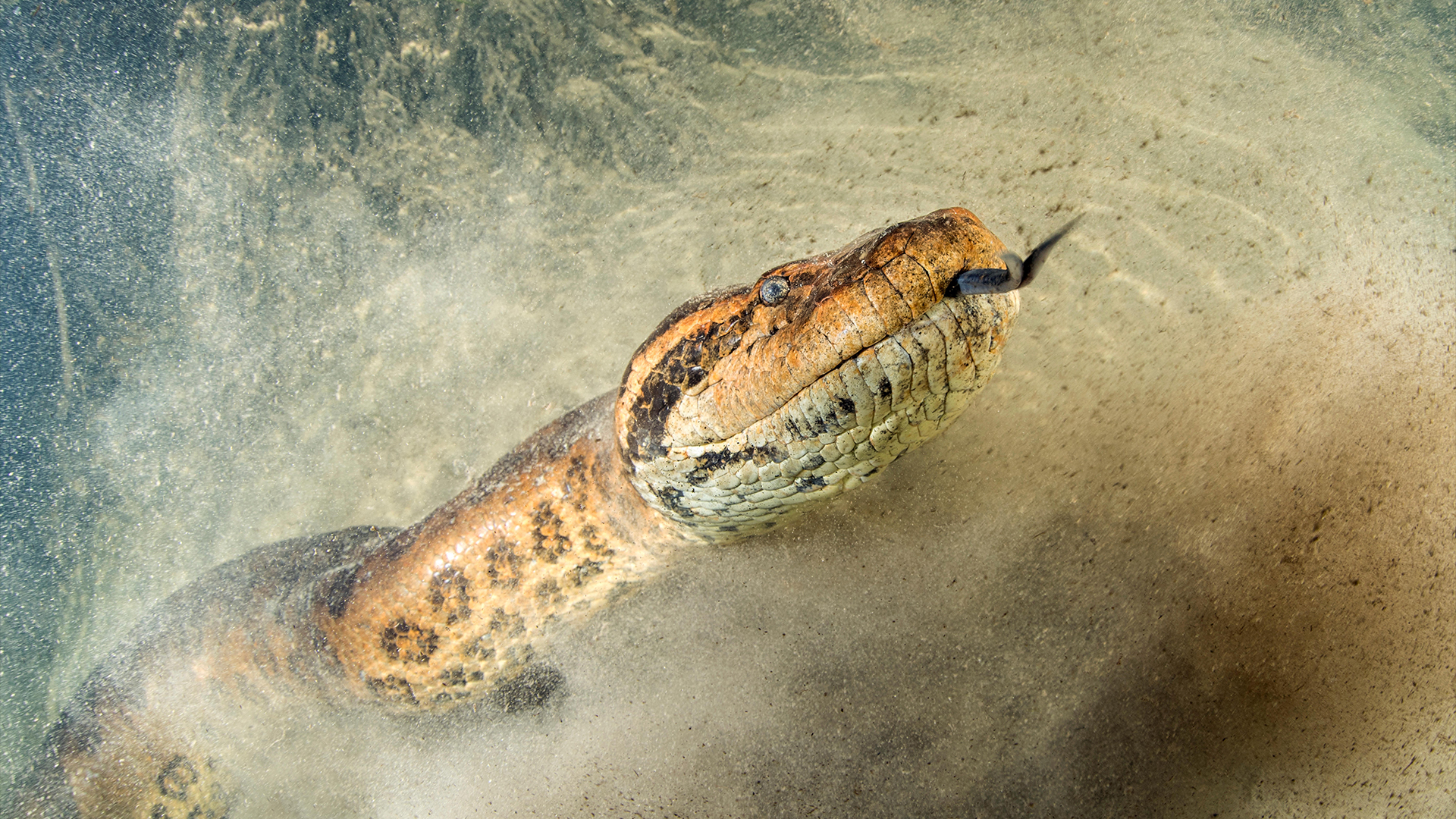
A cobra recém-descoberta era muito mais comprida do que qualquer cobra viva, incluindo esta anaconda verde. (Crédito da imagem: WaterFrame / Alamy Stock Photo)
Um total de 27 vértebras
fossilizadas da enorme serpente foram desenterradas na Mina de Lignito
de Panandhro, no estado de Gujarat. Os fósseis datam de cerca de 47
milhões de anos atrás, durante o período Eoceno (entre 56 milhões e 33,9
milhões de anos atrás). Os autores acreditam que os fósseis pertenciam a
um indivíduo adulto completamente desenvolvido.
A equipe estimou o comprimento total do corpo da serpente usando a largura dos ossos da coluna vertebral e descobriu que a V. indicus
poderia ter entre 11 e 15 metros de comprimento, embora reconheçam que
pode haver uma margem de erro associada à sua estimativa. Eles
publicaram suas descobertas na quinta-feira (18 de abril) na revista Scientific Reports .
Os pesquisadores utilizaram dois métodos para chegar a possíveis faixas de comprimento corporal de V. indicus
. Ambos usaram serpentes atuais para determinar a relação entre a
largura das vértebras de uma serpente e seu comprimento — mas diferiram
nos conjuntos de dados utilizados.
Um dos conjuntos de dados utilizou informações de serpentes modernas
da família Boidae, que inclui jiboias e pítons e contém as maiores
serpentes vivas atualmente. O outro conjunto de dados utilizou todos os
tipos de serpentes vivas.
" Vasuki
pertence a uma família extinta de cobras, distantemente relacionada às
pítons e sucuris, e, portanto, ao usar cobras existentes para estimar o
comprimento do corpo, podem existir incertezas", disse ao Live Science o
coautor do estudo, Debajit Datta , pesquisador de pós-doutorado no Instituto Indiano de Tecnologia de Roorkee.
O limite superior de suas estimativas tornaria a V. indicus ainda maior que a Titanoboa cerrejonensis
, a maior cobra já descoberta até agora, que viveu há cerca de 60
milhões de anos e foi desenterrada em 2002 no nordeste da Colômbia.
A espécie V. indicus
pertence a um grupo de serpentes conhecido como Madtsoiidae, que surgiu
no final do período Cretáceo (entre 100,5 milhões e 66 milhões de anos
atrás), na América do Sul, África, Índia, Austrália e sul da Europa.
Ao analisar os locais onde as costelas se ligavam às vértebras, os pesquisadores acreditam que a V. indicus
tinha um corpo largo e cilíndrico e vivia principalmente em terra. As
serpentes aquáticas, em comparação, tendem a ter corpos muito achatados e
hidrodinâmicos.
Devido
ao seu grande porte, os pesquisadores afirmam que a cobra provavelmente
era uma predadora de emboscada, subjugando suas presas por constrição,
de forma semelhante às sucuris modernas.
Os cientistas estimam que a V. indicus
prosperou em um clima quente, com uma média de cerca de 28 graus
Celsius (82 graus Fahrenheit) — significativamente mais quente do que
nos dias atuais.
"Ainda
há muitas coisas que não sabemos sobre Vasuki. Não sabemos sobre seus
músculos, como os utilizava ou o que comia", disse Datta.
Sunil Bajpai
, coautor do estudo e paleontólogo de vertebrados do IIT Roorkee, disse
que a equipe espera que os fósseis sejam analisados quanto ao seu
teor de carbono e oxigênio, o que pode revelar mais sobre a dieta da
cobra.
Cientistas na Índia descobriram os restos fossilizados de uma cobra ancestral que pode ser a maior serpente conhecida que já existiu.
A serpente gigantesca pode ter medido 15 metros de comprimento — superando a atual detentora do recorde, a Titanoboa, em cerca de 2 metros.
A espécie recém-identificada, denominada Vasuki indicus
, recebe seu nome genérico do rei mítico das serpentes no hinduísmo,
que é frequentemente representado enrolado no pescoço de uma das
principais divindades do hinduísmo, Shiva.
terça-feira, 17 de dezembro de 2024
Translator
Fósseis indianos podem ser da maior cobra de todos os tempos
Vasuki era quase tão grande quanto o Titanoboa retratado. Crédito: Warpaintcobra/iStock/Getty Images Plus.
19 de abril de 2024
Novos fósseis sugerem que uma das maiores cobras do mundo deslizou pela Índia há 47 milhões de anos.
Vasuki indicus teria entre 11 e 15 metros de acordo com um artigo publicado na revista Scientific Reports que descreve a antiga criatura pela primeira vez.
Os fósseis foram encontrados em uma mina de lenhite no estado de
Gujarat, no oeste da Índia, cerca de 670 km a noroeste de Mumbai.
O imenso tamanho da cobra antiga rivaliza com a Titanoboa , a maior cobra de todos os tempos, que viveu há cerca de 60 milhões de anos, logo após o desaparecimento dos dinossauros. Acredita-se que Titanoboa , descrita pela primeira vez em 2009, tenha atingido cerca de 14 metros de comprimento e pesasse mais de uma tonelada.
Hoje, a cobra mais longa é a píton reticulada. Essas serpentes vivem não muito longe dos antigos terrenos escorregadios de V. indicus, no sul e sudeste da Ásia. Grandes pítons foram medidas em quase 7 metros.
As sucuris verdes, nativas da América do Sul, também podem chegar a 7 metros e pesar mais de 200 kg.
Comparadas com Vasuki e Titanoboa , as cobras modernas são peixinhos.
Vasuki indicus é conhecido por 27 vértebras. Sua estrutura indica que eles vieram de um animal adulto.
As vértebras medem entre 37,5 mm e 62,7 mm de comprimento e
62,4–111,4 mm de largura. Os paleontólogos foram capazes de extrapolar a
partir disso, usando a anatomia conhecida da cobra, uma estimativa do
tamanho total da antiga fera.
Os autores da pesquisa – Debajit Datta e Sunil Bajpai, ambos
paleontólogos do Instituto Indiano de Tecnologia Roorkee – descartam um
estilo de vida aquático ou baseado em árvores para Vasuki .
“ Vasuki é visto como uma cobra lenta”, escrevem os
autores. Eles dizem que “talvez fosse grande demais para ser uma
forrageadora ativa e era mais provável que fosse um predador de
emboscada que subjugaria suas presas por meio de constrição, semelhante
às sucuris modernas e aos pitinídeos de grande porte”.
A cobra gigante viveu durante o período Eoceno (56–34 milhões de anos
atrás). Nessa altura, as temperaturas médias globais eram mais de
6–10°C mais altas do que hoje. Estava muito mais húmido e novas formas de floresta estavam a surgir, incluindo grandes florestas tropicais que cobriam áreas da Ásia, África e Europa.
V. indicus é identificado como pertencente a um grupo de
cobras chamado madtsoiidae que existiu por cerca de 100 milhões de anos
desde o final da “Era dos Dinossauros” no Cretáceo Superior.
Madtsoiidae viveu onde hoje é Madagascar, América do Sul, Índia, África e Europa.
A descoberta de V. indicus , escrevem os autores, sugere
que grandes cobras deste grupo possivelmente evoluíram devido às altas
temperaturas em meados do Eoceno, antes de se espalharem pela Ásia e
Norte da África, quando a placa continental indiana colidiu com a placa
asiática há cerca de 50 milhões. anos atrás – uma fusão que também viu a
ascensão do Himalaia.
Reconstituição da Portugalophis lignites: cobras surgiram 70 milhões de anos antes do estimado
Fósseis atribuídos inicialmente a formas extintas de lagartos foram reclassificados e alçados ao status
de as cobras mais antigas de que se tem registro. Resultado: as quatro
novas espécies de serpentes descritas acrescentaram 70 milhões de anos à
história evolutiva dessa forma de réptil. Até hoje, os herpetólogos
dispunham de evidências de que as cobras tinham surgido cerca de 100
milhões de anos atrás, mas as novas espécies indicam que sua origem é
mais remota. Os fósseis agora apresentados por uma equipe internacional
de paleontólogos sinalizam que essas serpentes viveram entre 167 milhões
e 143 milhões de anos atrás em diferentes hábitats (pântanos, poças,
sistemas ribeirinhos e marinhos) durante o Jurássico Médio. A maior
delas, a Portugalophis lignites, com cerca de 1 metro de comprimento, foi encontrada em Portugal. Outra, a Diablophis gilmorei, foi resgatada no estado americano do Colorado. Os vestígios da Parviraptor estesi e da Eophis underwoodi, a mais velha de todas, foram achados em distintas localidades da Inglaterra (Nature Communications,
27 de janeiro). “O estudo explora a ideia de que a evolução dentro do
grupo que chamamos de “cobras” é muito mais complexa do que se pensava
anteriormente”, diz Michael Caldwell, da Universidade de Alberta
(Canadá), principal autor do trabalho.
quinta-feira, 26 de abril de 2018
Photos: Weird 4-Legged Snake Was Transitional Creature
By Laura Geggel, Senior Writer |
Snakes used to have four legs, according to a roughly
120-million-year-old fossil from northeastern Brazil. These legs likely
weren't used for movement, but perhaps helped the snake mate or grasp
prey, the researchers of the new study said. Like other snake fossils
from the Cretaceous, this one is from Gondwana, suggesting that snakes
originated on the southern supercontinent. [Read the full story on the four-legged snake] Wrestling match
An artist's interpretation of the four-legged snake, dubbed Tetrapodophis amplectus,
just after it caught a small mammal for its next meal. Paleontologists
have yet to find fossil remains of mammals in the Crato Formation in
northeastern Brazil, but "we know that they're in South America" during
the Early Cretaceous, said co-researcher David Martill, a professor in
paleobiology at the University of Portsmouth. It's likely that Tetrapodophis fed on lizards and small frogs in the tropical forests of Gondwana, he added. (Image credit: Julius T. Csotonyi.) Stunning snake
The entire skeleton of Tetrapodophis, with its head ending in a
curly-q on the left. The specimen was on exhibit at the Solnhofen
Museum in Germany, but its stunning feet escaped the notice of the
scientific community until Martill spotted them during a visit to the
museum. (Image credit: Dave Martill | University of Portsmouth.) Foot photo
This close-up photo shows Tetrapodophis' rear feet. (Image credit: Dave Martill | University of Portsmouth.) Little hands
The hands of Tetrapodophis. (Image credit: Dave Martill | University of Portsmouth.) Ancient battle
An illustration of Tetrapodophis capturing an ancient lizard in the genus Olindalacerta. (Image credit: James Brown | University of Portsmouth.) Digestion central
The fossilized stomach contents of Tetrapodophis contain bits
of bones, suggesting that the 7.8-inch-long (20 centimeters) critter ate
ancient vertebrates. (Image credit: Helmut Tischlinger.) Skull shot
The skull of Tetrapodophis. Notice its short snout and long braincase. (Image credit: Dave Martill | University of Portsmouth.)
Mistaken identity? debate over ancient 4-legged snake heats up
Identidade equivocada? Aquece o debate sobre a antiga serpente de 4 patas
By Laura Geggel, Senior Writer |
The, entire skeleton of Tetrapodophis with its head ending in a curly-q on the left. Credit: Dave Martill | University of Portsmouth
SALT LAKE CITY — A critter heralded as the first four-legged fossil
snake on record may actually not be a snake, according to new research.
Instead, the 120-million-year-old creature is likely a dolichosaurid, an
extinct four-legged marine lizard with an elongated, snake-like body, a
new analysis of the specimen finds.
"Tetrapodophis doesn't show any of those features that you would expect to see in a snake,"
said Michael Caldwell, a professor and chair of biological sciences at
the University of Alberta in Edmonton, Canada, who is leading the new
investigation into the enigmatic fossil.
For instance, Tetrapodophis amplectus doesn't have hooked
teeth like a snake does, nor does it have a snake-like skull and
skeleton, Caldwell said. Other anatomical details that have been found
in ancient and modern snakes are also missing, including the subdental
ridge in the mouth and zygosphenes, which are special joints that are
found between snake vertebrae, he said. [See Photos of the Four-Legged, Snakelike Creature]
Rather, the creature is likely a dolichosaurid, which falls under the
squamate (scaly reptile) umbrella, he said. It's unclear exactly how
dolichosaurids are related to snakes, but some evidence suggests they
are a sister group to the slithery reptiles, Caldwell said.
Uma criatura anunciada como a primeira cobra fóssil de quatro patas registrada pode na verdade não ser uma cobra, de acordo com uma nova pesquisa. Em vez disso, a criatura de 120 milhões de anos é provavelmente um dolichosaurid, um extinto lagarto marinho de quatro patas com um corpo alongado semelhante a uma cobra, uma nova análise dos achados do espécime.
"Tetrapodophis não mostra nenhuma das características que você esperaria ver em uma cobra", disse Michael Caldwell, professor e presidente de ciências biológicas da Universidade de Alberta, em Edmonton, Canadá, que está liderando a nova investigação sobre o assunto. fóssil enigmático.
Por exemplo, Tetrapodophis amplectus não tem dentes como uma cobra, nem tem um esqueleto e uma caveira, disse Caldwell. Outros detalhes anatômicos que foram encontrados em cobras antigas e modernas também estão faltando, incluindo a crista subdental na boca e os ziggosfénos, que são articulações especiais que são encontradas entre as vértebras de serpentes, disse ele. [Veja as fotos da criatura de quatro patas e uma cobra]
Em vez disso, a criatura é provavelmente um dolichosaurid, que cai sob o guarda-chuva squamate (escamosa réptil), disse ele. Não está claro exatamente como os dolichossaurídeos estão relacionados às cobras, mas algumas evidências sugerem que eles são um grupo irmão dos répteis escorregadios, disse Caldwell.
Paleontologist Michael Caldwell took a selfie with his finger next to Tetrapodophis amplectus to illustrate the specimen's small size.
Credit: Michael Caldwell
He even pointed to the bones of prey that were preserved in the specimen's gut — the animal's last meal before it died.
These are likely fish bones — a theory that fits the dolichosaurid
interpretation, because dolichosaurids lived in the water, Caldwell
said.
Brazilian fossil
T. amplectus made a big splash last year when a study published in the journal Science
in July 2015 announced that the fossil was the so-called missing link,
which showed that snakes evolved from four-legged lizards. The
researchers reported that the 7.8-inch-long (20 centimeters) specimen
probably descended from terrestrial burrowers (rather than marine
animals), and that it likely used its tiny limbs for grasping prey for
hunting and holding mates while reproducing.
David Martill, a co-researcher of the 2015 study and a professor of
paleobiology at the University of Portsmouth in England, came across the
fossil while he was on a field trip with his students at the Solnhofen
Museum (formerly known as the Bürgermeister-Müller-Museum) in Germany.
The exhibit featured fossils from the Crato Formation in northeastern Brazil, and one specimen, titled "Unknown fossil," caught Martill's eye.
It looked like a snake, but it had four exquisitely small limbs — a
feature that had never before been seen in a snake. Martill asked the
museum if he could study it, and eventually he and his colleagues named
it Tetrapodophis amplectus (which means, literally, four-legged snake).
Brewing controversy
Within two months of the 2015 study's publication, Caldwell and his
colleague Robert Reisz, a paleontologist at the University of Toronto,
traveled to Germany to see the specimen for themselves. [7 Shocking Snake Stories]
They brought two microscopes with them — a digital and a dissecting
microscope — so that they could take photos of the small critter at 200
times the magnification of the naked eye, Caldwell said.
The specimen comprises a part and counterpart — which are basically the sides of the two rocks that held the creature.
When the rock was split in two, the "part" retained some pieces of the
skull and most of the creature's body, and the "counterpart" retained
the other part of the skull. When they were studied together, there were
myriad clues that the animal was not a snake, Caldwell said.
However, Caldwell and Reisz may be the last scientists to examine the
specimen in person. The fossil is privately owned, and it has since been
removed from the museum, meaning other paleontologists can't study it,
Caldwell said.
An image taken at 200x magnification showing the teeth of Tetrapodophis amplectus.
A new analysis suggests that the teeth were not recumbent (pointing
backward) like a snake's, but were simply displaced after the animal
died. In contrast, the original analysis describes the teeth as
recumbent.
Credit: Michael Caldwell
Moreover, the specimen doesn't have a reported provenance, so it's
unknown when and where it was found, as well as who sold and bought it,
he said. In Brazil, it has been illegal since 1942 to remove holotype fossils
(holotypes are the first described specimen of a newfound species) from
the country, and there's also a ban on removing paratypes (subsequently
found specimens of a known species) without a permit. It's unclear
whether T. amplectus was discovered before or after
that law went into effect, Caldwell and his colleagues said. However, if
it was discovered after 1942, it was likely smuggled out of the
country, Caldwell said.
Tiago Simões, a doctoral candidate of vertebrate paleontology at the
University of Alberta, who is working with Caldwell, noted that the
fossil is from a region containing limestone that was quarried in the
1960s and 1970s for commercial purposes. Some fossils were found before
then, but the vast majority were discovered after the 1942 ruling, said
Simões, who is from Brazil.
"It's highly likely that the material was collected after the 1960s and 1970s," Simões told Live Science. [6 Strange Species Discovered in Museums]
When placed together, the part
and counterpart fossils (top two) form an entire skull (bottom) that is
not snakelike, the authors of the new research said.
Credit: Michael Caldwell
Given its mysterious past and current out-of-reach status, it might be best to "strike Tetrapodophis from the record of snake evolution
until more specimens can be found or that specimen comes back [from the
private collector] and can be put in the public trust," said Jason
Head, a lecturer in zoology and curator of vertebrate paleontology at
the University Museum of Zoology at the University of Cambridge in
England, who was not involved with either the 2015 study or the new
research.
"[In] the original description, the analysis was not very convincing to
begin with," Head said. "It was a very problematic study. Certainly the
work that Dr. Caldwell presented today illustrates a lot of the
ambiguities of the animal."
But, whether the specimen is a snake remains a mystery.
"We're never going to know whether or not the original analysis was
right or wrong, or whether or not Dr. Caldwell's work was right or
wrong, because we can't replicate either observation," Head said.
Supersnake
The authors of the original study are defending their work, and said that it's clear that T. amplectus is a four-legged snake.
"I don't think Caldwell has made a case for Tetrapodophis not
being a snake," Martill told Live Science in an email. "Some of his
observations, such as saying that the teeth are not recumbent [pointing
backward], are plain wrong."
He added that, "Tetrapodophis has a single row of belly scales; Tetrapodophis has
snake vertebral articulations (although a couple of lizard groups do
have these). There are many more snake features, too, based on skull
anatomy."
Martill's colleague and co-author Nicholas Longrich, a senior lecturer
in evolutionary biology at the University of Bath, in England, said, "I
would happily bet a million dollars it’s a snake." Longrich contested
the assessment that the specimen didn't have a subdental ridge or
visible zygosphenes, as well as myriad other features that Caldwell and
his colleagues listed as missing. Moreover, the prey in the animal's gut
likely aren't fish bones, unless it's a Tiktaalik (a fish with limbs), "because the bones in the gut include leg bones," Longrich said.
"I’m as confident of Tetrapodophis being a snake as I have ever been of anything in my scientific career," Longrich wrote in an email to Live Science.
Questions about snake limbs remain a popular subject among scientists. Two studies published last week
found that snakes likely sported limbs up until about 150 million years
ago, when genetic mutations caused them to lose the ability to develop
arms and legs. But, if T. amplectus loses its snake status,
there will be zero fossil evidence that snakes once had four limbs,
"which is a real bummer," Caldwell said.
The research, which has yet to be published in a peer-reviewed journal,
was presented Wednesday (Oct. 26) at the 2016 Society of Vertebrate
Paleontology meeting. Original article on Live Science.
Unexpected Step: Snake Ancestor Had Four Feet
Passo inesperado : antepassado de cobra tinha quatro pés
By Laura Geggel, Senior Writer |
The, entire skeleton of Tetrapodophis with its head ending in a curly-q on the left.
Credit: Dave Martill | University of Portsmouth
The oldest snake fossil on record looks almost like a modern snake,
except for one glaring difference: It has four feet, each with five
digits, a new study finds.
The roughly 120-million-year-old snake, dubbed Tetrapodophis amplectus (literally, four-legged snake), likely didn't use its feet for walking. Instead, the appendages may have helped Tetrapodophis
hold onto a partner while mating, or even grip unruly prey, said study
co-researcher David Martill, a professor of paleobiology at the
University of Portsmouth in the United Kingdom.
Previous research has detailed two-legged snake fossils,
but this is the first known snake ancestor to sport four legs, he said.
It likely evolved from terrestrial-burrowing creatures, and was a
transitional animal that lived during the shift from ancient lizards to
modern-day snakes, he added. [See Photos of the Four-Legged Snake Fossil]
"We've found the ancestor of all snakes," Martill told Live Science.
"We have found the missing link between four-legged lizards and snakes."
'Jaw-dropping' discovery
Martill happened upon the fossil during a field trip with his students
to the Solnhofen Museum (formerly known as the
Bürgermeister-Müller-Museum) in Germany. As they were looking at an
exhibit of fossils from the Crato Formation, in northeastern Brazil,
Martill noticed the 7.8-inch-long (20 centimeters) snake. It had a
plaque that said "Unknown fossil."
An artist's interpretation of the four-legged snake, dubbed Tetrapodophis amplectus, just after it caught a small mammal for its next meal.
Credit: Julius T. Csotonyi
"My jaw just dropped," he said. "I thought, 'Bloody hell, that's a fossil snake.'"
The Crato Formation happens to be one of Martill's prime subjects. He
is the author of "The Crato Fossil Beds of Brazil: Window into an
Ancient World" (Cambridge University Press, 2008), so he knew that a
snake from the Crato Formation would be "about 20 million years older than any other fossil snake," he said.
Intrigued, he leaned in closer to the display to get a better look.
"I thought, 'Bloody hell, it's got back legs!'" Martill said. "It had
front legs. Nobody had ever seen a snake before with four legs, and yet
evolutionary theory predicts that there should be an animal that is
transitional between four-legged lizards and snakes, and here it was."
Martill asked the museum if he could study the fossil, and recruited
Helmut Tischlinger, a German paleontologist, and Nicholas Longrich, a
senior lecturer in evolutionary biology at the University of Bath, to
help him decipher the fossil.
Snake scrutiny
The researchers found several indications that the fossil is, in fact, a transitional snake. Unlike lizards and crocodiles, Tetrapodophis has faint impressions of a single row of belly scales, a signature still seen on snakes today.
When the researchers used ultraviolet photography to examine Tetrapodophis' gut,
they found partly digested bone fragments that the camera highlighted
in different colors. These remnants suggest the snake ancestor ate
vertebrates, just as modern carnivorous snakes do.
It's likely that Tetrapodophis used its long body to constrict prey, such as lizards and frogs, Martill added.
This close-up photo shows Tetrapodophis' rear feet.
Credit: Dave Martill University of Portsmouth
Moreover, the fossil had other classic snake features, including a
short snout, long braincase, elongated body, fanged teeth and a flexible
jaw that could swallow large prey, the researchers said. It also has a
similar vertebrae column that allows the snake to be extremely flexible,
they said.
However,Tetrapodophisdoesn't have a long, laterally
compressed tail that is usually seen in marine animals, which suggests
that it descended from burrowing terrestrial, and not marine, creatures,
the researchers said.[Image Gallery: Snakes of the World]
Tetrapodophis and other ancient snakes hail from Gondwana, the
ancient supercontinent that covered the Southern Hemisphere. (A January
study reported snake specimens that were from the Northern Hemisphere, but Martill says it's unclear whether these are snakes or lizards.)
"Snakes are all over the planet now, and it would be nice to know where
they actually started," Martill said. "If you look at the distribution
of fossil snakes, they're all Gondwanan. So it does look as though snake
evolution began in the southern continents."
Allison Hsiang, a postdoctoral researcher of geology and geophysics at
Yale University who was not involved in the study, called the newly
identified fossil "really cool and important."
"It fills in the picture that we always kind of knew was there, but
here's the evidence of snakes evolving from lizards with four legs," she
said.
Pensar em viver sem braços e pernas é desesperador para qualquer ser humano. E, pela nossa lógica, centrada nos nossos próprios parâmetros, ter membros cada vez mais sofisticados é um sinal de evolução. Mas, na natureza, nem tudo é assim. As cobras, por exemplo, já tiveram patas. "Os ancestrais das serpentes eram lagartos", conta o pesquisador Sávio Stefanini Sant`Anna, do Laboratório de Herpetologia do Instituto Butantan, em São Paulo Arte UOL
Pensar em viver sem braços e pernas é desesperador para qualquer ser humano. E, pela nossa lógica, centrada nos nossos próprios parâmetros, ter membros cada vez mais sofisticados é um sinal de evolução. Mas, na natureza, nem tudo é assim. As cobras, por exemplo, já tiveram patas.
"Os ancestrais das serpentes eram lagartos. Não se sabe exatamente qual grupo de lagarto, mas se acredita que faça parte dos Iguania ou dos Anguimorphas", conta o pesquisador Sávio Stefanini Sant`Anna, do Instituto Butantan, em São Paulo.
Embora existam teorias afirmando que esses ancestrais fossem animais aquáticos, atualmente a hipótese mais aceita no meio científico é que as primeiras serpentes teriam tido sua origem no meio terrestre, segundo o especialista.
Em 2006, foi publicada na revista "Nature" a descoberta de uma serpente terrestre que possuía patas posteriores, batizada de Najash rionegrina. O texto teve coautoria, inclusive, de outro pesquisador brasileiro: Hussam Zaher, do Museu de Zoologia da USP (Universidade de São Paulo).
Outro estudo, publicado no mês passado no periódico "BMC Evolutionary Biology", também revela que os ancestrais das serpentes eram predadores noturnos com minúsculos membros posteriores que continham tornozelos e dedos nos pés. A pesquisa, realizada na Universidade de Yale (EUA) foi feita com análise de fósseis, genes e anatomia de 73 espécies diferentes de serpentes e lagartos. E, também de acordo com o principal autor, Allison Hsiang, as cobras evoluíram da terra, e não do mar.
As primeiras cobras, segundo Hsiang, teriam surgido nas florestas do antigo supercontinente conhecido como Laurásia (que envolvia a América do Norte, a Europa e a norte da Ásia), há cerca de 128 milhões de anos, no Cretáceo Inferior.
Os resultados do estudo sugerem que o fato de as cobras terem se espalhado pelo mundo, ocupando uma enorme gama de habitats diferentes, pode ter a ver - acredite - com o fato de que a ausência das pernas lhes conferiu agilidade. O autor diz que as cobras são capazes de viajar por até 110 mil quilômetros quadrados, área quatro vezes maior que a percorrida pelos lagartos. E, muitas vezes, ao longo de sua história evolutiva, esses bichos ainda foram capazes de se adaptar a meios aquáticos.
De dez centímetros a dez metros
Pesquisadores estimam que hoje existam cerca de 3.500 espécies de serpentes no mundo. Só no Brasil, conta o pesquisador do Butantan, existem 381.
"A maior espécie de serpente do mundo é o píton reticulado (Phyton reticulatus), que pode alcançar até dez metros de comprimento. No Brasil, a maior é a sucuri (Eunectes murinus)", continua Sant`Anna. Já a menor serpente é uma cobra-cega de dez centímetros (Leptotyphlops carlae), que vive na Ilha de Barbados, no Caribe.
O pesquisador explica que todas as serpentes são carnívoras, mas as dietas diferem bastante entre as espécies. Enquanto algumas comem um único tipo de alimento, outras são menos "frescas" e, por isso, são chamadas de generalistas.
"Algumas espécies de jararacas, quando jovens, se alimentam basicamente de anfíbios e, quando adultas, comem roedores", comenta Sant`Anna.
Estrategistas
Para subjugar e matar suas presas, as serpentes contam com sofisticados aparatos sensoriais e táticas bem elaboradas, conforme ressalta o pesquisador. Além da visão, que nem sempre é muito boa, existe uma estrutura chamada órgão de Jacobson, que identifica partículas químicas que a língua capta do ar. É por isso que elas estão sempre colocando a língua para dentro e para fora da boca.
As serpentes podem matar suas presas por constrição ou envenenamento. "A jiboia e a sucuri são exemplos de serpentes constritoras: elas se enrolam nas suas presas e apertam até que a mesma morra por parada cardíaca ou respiratória", descreve o especialista.
Já a cascavel e a jararaca contam com um aparato eficiente para injetar o veneno nas vítimas. A serpente parelheira e a falsa-coral também fazem isso, mas, felizmente, o sistema de injeção não é eficiente para matar humanos. Não que isso deixe muita gente animada para brincar com essas cobras.
Cobras têm orelhas? Conheça essa e outras curiosidades sobre os bichos23 fotos
7 / 23
Embora as cobras não tenham orelhas, as ondas de som provenientes do ar atingem sua pele e são transferidas dos músculos para os ossos. Quando o som atinge o osso do ouvido sob o crânio, envia vibrações para o ouvido interno, e o som é processado. Saiba mais sobre esse fascinante animal Leia maisSXC
sexta-feira, 24 de julho de 2015
SERPENTE DE QUATRO PATAS
Four-legged fossil snake is a world first
‘Hugging’ creature from Brazil shakes up picture of snake evolution.
The first four-legged fossil snake ever found is forcing scientists to rethink how snakes evolved from lizards.
Although it has four legs, Tetrapodophis amplectus
has other features that clearly mark it as a snake, says Nick Longrich,
a palaeontologist at the University of Bath, UK, and one of the authors
of a paper describing the animal in Science1.
The
creature’s limbs were probably not used for locomotion, the researchers
say, but rather for grasping prey, or perhaps for holding on to mating
partners. Such speculation inspired the snake’s name, which loosely
translates as ‘four-legged hugging snake’.
Tetrapodophis was
originally found in the fossil-rich Crato Formation in northeastern
Brazil several decades ago. But its legs can be difficult to see at
first glance, and it languished in a private collection after its
discovery, assumed to be unremarkable.
“I was
confident it might be a snake,” says David Martill, a palaeobiologist at
the University of Portsmouth, UK, who came across the find in 2012. “It
was only after getting the specimen under the microscope and looking at
it in detail that my confidence grew. We had gone to see Archaeopteryx, the missing link between birds and dinosaurs, and discovered Tetrapodophis, the missing link between snakes and lizards.”
Scientists have long argued over whether snakes evolved from land or marine animals. Tetrapodophis lacks
adaptations for marine life, such as a tail useful for swimming. But
its skull and body proportions are consistent with adaptations for
burrowing. Longrich says that the finding unequivocally shows that
snakes originated in the Southern Hemisphere and strongly supports a
terrestrial origin.
Another striking feature of the fossil is its relative length. Tetrapodophis has
272 vertebrae, 160 of which are in its main body, not its tail. This
number is more than twice the limit that researchers thought elongated
bodies could reach before starting to lose their limbs.
Martin
Cohn, an evolutionary developmental biologist at the University of
Florida, Gainesville, says that the animal’s limbs must have been
repurposed by evolution instead of simply dwindling away as its body
became longer. This insight contradicts some assumptions about snake
evolution. As Cohn explains, the paradigm about elongation of the trunk
leading to limb loss now has to be adjusted. "This fossil shows that the
two processes can be decoupled,” he says.
The
discovery comes in a major year for snake evolution research, Cohn
says. In January, the snake fossil record was pushed back by some 70
million years to the Middle Jurassic, around 160 million years ago, with
the report of the oldest snake ever found2. Although Tetrapodophis
is not the oldest snake, Cohn says, “from a developmental perspective,
this could be one of the most important fossils ever found. The
combination of a snake-like body with complete forelimbs and hindlimbs
is like a snake version of Archaeopteryx.”
Julius T. Cstonyi
An artist's impression of Tetrapodophis putting its legs to work subduing its prey.