Understanding the peopling of the Americas remains an important and challenging question. Here, we present 14C
dates, and morphological, isotopic and genomic sequence data from two
human skulls from the state of Minas Gerais, Brazil, part of one of the
indigenous groups known as ‘Botocudos’. We find that their genomic
ancestry is Polynesian, with no detectable Native American component.
Radiocarbon analysis of the skulls shows that the individuals had died
prior to the beginning of the 19th century. Our findings could either
represent genomic evidence of Polynesians reaching South America during
their Pacific expansion, or European-mediated transport.
Main Text
A
recent study of skeletal remains from Brazil belonging to the
indigenous Botocudo peoples found that two male individuals presented a
combination of mitochondrial DNA (mtDNA) variants common in present day
Oceanian populations [
].
Although it was argued that these genetic traits were likely to be
derived from runaway slaves brought to Brazil by Europeans, no
direct-dating or genomic analyses were used to support this conclusion.
The Botocudos, named after the wooden disks (‘botoques’) in their lower
lips and ear lobes, were an indigenous group with presumably Native
American origins occupying the coast and the interior of Eastern-Central
Brazil until the late 18th century, when most were
exterminated by European colonists after decades of violence. The
population size and origin of the Botocudos remain unclear, but they are
likely to have comprised several tribes who spoke a common Macro-Jê
language at the time of European contact [
].
We conducted a variety of genomic, morphological and isotopic analyses
of skeletal remains attributed to the Botocudos of Brazil.
We confined our analyses to four Botocudo individuals (Bot13, Bot15, Bot17 and Bot65; Supplemental information)
after careful review of all available records at the Museu Nacional in
Rio de Janeiro, Brazil, including an extensive archival study that
pointed to the four crania being bona fide Botocudo, a designation which is also corroborated by the labels on the skulls (Figure 1A).
Figure 1Radiocarbon and genetic evidence for Polynesian ancestry among Botocudos.
We
performed an initial DNA screening by shotgun sequencing the four
individuals, finding that only Bot15 and Bot17 yielded a endogenous
human DNA content higher than 1% (5.6% and 12.5%, respectively), thus
allowing for whole genome sequencing (Supplemental information).
In total, we obtained genetic data from the following experiments:
mtDNA capture for Bot15; single nucleotide polymorphism (SNP) capture
for 6,000 ancestry informative markers (AIMs) for Bot15; and whole
genome shotgun sequencing for Bot15 and Bot17 (to an average genomic
depth of 1.2X and 1.5X, respectively). We found features in the data
characteristic of ancient DNA (Supplemental information).
All the genetic data point towards two individuals with Polynesian
ancestry and no detectable Native American ancestry. For example, when
conducting a classical multidimensional scaling (MDS) analysis on
identity-by-state (IBS) distance-of-genotype data of worldwide
populations, including the Botocudo whole genome data, we found that the
ancient genomes fall within the Polynesian populations (Figure 1C).
Moreover, clustering analyses suggest that Bot15 and Bot17 have no
detectable Native American ancestry and share the same components as the
Polynesian population. When assuming seven ancestral populations (K
= 7), the Polynesians form their own cluster and more than 99.9% of the
genomes of Bot15 and Bot17 were assigned to this Polynesian cluster (Figure 1D).
Accelerator
mass spectrometry (AMS) radiocarbon dating of five teeth from the four
Botocudo individuals was carried out in two independent laboratories.
When calibrating the 14C dates with the Southern Hemisphere curve [
],
the 95% highest posterior density regions (HPD) were 1452–1510 AD and
1579–1620 AD for Bot15 (bimodal distribution), and 1419–1477AD for
Bot17. While there is a general lack of baseline isotope data for the
relevant areas and from archaeological remains, the combined evidence
from the δ13C, δ15N and δ34S values
when compared to Brazilian fauna and flora, as well as archaeological
and modern human bone samples, suggests that a marine reservoir effect
cannot be fully excluded (Supplemental information). The 95% HPDs of the marine corrected dates are 1479–1708 AD and 1730–1804 AD for Bot15, and 1496–1842 AD for Bot17 (Figure 1B).
More work on foodwebs and carbon cycling in the Minas Gerais area is
needed to determine if a marine reservoir correction for the 14C
dates is indeed required; hence, the marine-corrected age estimates
presented must be considered highly conservative. Strontium analysis and
craniometry results are detailed in the Supplemental information.
Several
scenarios have been previously proposed that are of potential relevance
for explaining our result that two Botocudo individuals have Polynesian
ancestry for both the mitochondrial and nuclear genomes [
],
the Madagascar–Brazil slave trade, voyaging on European ships either as
crew, passengers, or stowaways, and Polynesian voyaging. Regardless,
the scenario must necessarily invoke a certain number of Polynesian
migrants — presumably more than two, as we detected Polynesian ancestry
in two out of 35 Botocudo individuals in the Museu Nacional collection. A
detailed investigation of these possibilities can be found in the Supplemental information. The 1862–1864 AD Peru–Polynesia slave trade can be excluded, given that the 14C
calibrated dates for the skulls predate the beginning of this trade.
The Madagascar–Brazil slave trade is of relevance, as Madagascar is
known to have been peopled by Southeast Asians [
].
However, we can further exclude this hypothesis as recent genomic data
have demonstrated that the Malagasy ancestors admixed with African
populations prior to the slave trade [
], and no such ancestry is detected in our Botocudo sample (Supplemental information). Furthermore, Madagascar was peopled by Southeast Asian and not Polynesian populations.
While
Fernão de Magalhães (Magellan) first spotted some seemingly uninhabited
Polynesian islands in 1521 AD, the lack of precise navigational
techniques [
],
as well as war between European nations, meant that many of those
islands were not visited by Europeans again for at least another 200
years. Therefore, trade involving Euroamerican ships in the Pacific only
began after 1760 AD [
]. By 1760 AD, Bot15 and Bot17 were already deceased with a probability of 0.92 and 0.81, respectively (Supplemental information),
making this scenario unlikely. Although improbable also because it
would involve both individuals making it to the interior of Brazil, we
cannot exclude this scenario.
Polynesian
ancestors originated from East Asia and on their migration eastwards
interacted with and admixed with local New Guineans before colonizing
the Pacific. In recent years, evidence has continued to accumulate in
favor of a Polynesian and South American contact [
]).
It has been established that the Polynesian Pacific expansion from
Southeast Asia covered distances of thousands of kilometers, reaching
New Zealand, Hawaii and Easter Island — an area approximately the size
of North America — between ca. 1200 and 1300 AD [
].
It is hard to explain how the first possible genomic evidence of such
Polynesian contact with South America would be found in Brazil rather
than on the west coast of South America, yet we cannot exclude this
scenario either.
Whether brought by
Europeans or the result of the Polynesian expansion, the fact remains
that some Brazilian Botocudos carried distinctive Polynesian genetic
signatures. We hope that further sampling will provide a more definitive
answer to this intriguing finding.
Acknowledgments
We
would like to thank the laboratory technicians at the Danish National
High-throughput DNA Sequencing Centre for technical assistance; Martin
Kircher, Thorfinn Sand Korneliussen, Johannes Krause, David Reich, Erik
Thorsby for helpful discussion; Toomas Kivisild, Jinchuan Xing, Andreas
Wollstein, David Reich for early access and/or assistance with their
data. GeoGenetics members were supported by the Lundbeck Foundation, the
Danish National Research Foundation (DNRF94) and the European Union
(FP7/2007-2013/317184 and 319209). A.S.M. was supported by a fellowship
from the Swiss National Science Foundation (PBSKP3_143529); M.D. by the
US National Science Foundation (grant DBI-1103639); P.L.J. by the
National Institutes of Health (grant K99 GM104158); V.F.G. by a
Strategic Training for Advanced Genetic Epidemiology (STAGE) fellowship,
University of Toronto.
Cientistas encontram evidências de 'população fantasma' de humanos antigos Traços de ancestral desconhecido surgiram quando pesquisadores analisaram genomas de populações da África Ocidental
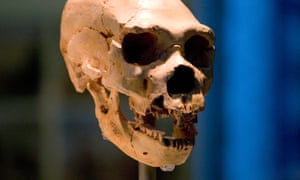
A Homo neanderthalensis skull:The ghost population split from the ancestors of Neanderthals and modern humans between 360,000 and 1 million years ago.
Photograph: The Natural History Museum/Alamy Stock Photo .Traços do ancestral desconhecido surgiram quando os pesquisadores analisaram genomas de populações da África Ocidental e descobriram que até um quinto do seu DNA parecia ter vindo dos parentes desaparecidos.
Os geneticistas suspeitam que os ancestrais dos modernos ocidentais africanos cruzaram com os humanos arcaicos ainda a serem descobertos dezenas de milhares de anos atrás, assim como os europeus antigos já acasalaram com os neandertais.
"Nos africanos ocidentais que olhamos, todos têm ascendência dessa população arcaica desconhecida", disse Sriram Sankararaman, biólogo computacional que liderou a pesquisa na Universidade da Califórnia em Los Angeles. Ao contrário de hoje, o mundo já foi o lar de muitas espécies ou subespécies relacionadas humanas. E quando eles tropeçaram, o acasalamento não estava fora de questão. Como resultado, os europeus modernos carregam um punhado de genes neandertais, enquanto os australianos, polinésios e melanésios indígenas carregam genes de denisovanos, outro grupo de humanos arcaicos.
Estudos anteriores sugeriram que outros seres humanos antigos já percorreram a África, mas sem fósseis ou DNA para examinar, os pesquisadores lutaram para aprender mais sobre eles.
Arun Durvasula e Sankararaman obtiveram 405 genomas de quatro populações da África Ocidental e usaram técnicas estatísticas para determinar se um influxo de genes provenientes de cruzamentos provavelmente teria ocorrido no passado distante. A análise sugeriu que tinha em todos os casos.
Os cientistas passaram a vasculhar os genomas africanos em busca de pedaços de DNA que pareciam diferentes dos genes humanos modernos. Isso lhes permitiu extrair sequências que provavelmente vieram de um parente antigo. Ao compará-los com genes de neandertais e denisovanos, eles concluíram que o DNA tinha que vir de um grupo desconhecido de humanos arcaicos.
"Eles parecem ter tido um impacto bastante substancial nos genomas dos indivíduos atuais que estudamos", disse Sankararaman. "Eles respondem por 2% a 19% de sua ascendência genética." As quatro populações estudadas vieram de três países: dois da Nigéria e um da Serra Leoa e da Gâmbia.
As descobertas estão longe de serem definitivas, mas de acordo com as melhores estimativas dos cientistas, a população fantasma se separou dos ancestrais dos neandertais e dos humanos modernos entre 360.000 e 1 milhão de anos atrás. O grupo de talvez 20.000 indivíduos foi criado com os ancestrais dos modernos africanos ocidentais em algum momento nos últimos 124.000 anos. Mas outras explicações são possíveis, disse Sankararaman. Pode ter havido várias ondas de acasalamento ao longo de muitos milhares de anos. Ou várias populações diferentes de parentes humanos arcaicos até agora desconhecidos. "É muito provável que a imagem verdadeira seja muito mais complicada", disse ele. Detalhes do trabalho estão publicados em Science Advances.
Os pesquisadores agora estão interessados em investigar os genes antigos e descobrir o que eles fazem. Uma possibilidade é que os africanos ocidentais tenham retido o DNA porque isso os ajudou a sobreviver e se reproduzir.
"É sempre interessante e útil ver pesquisadores aplicando novos métodos para tentar ter uma ideia melhor de como seriam as populações antigas", disse John Hawks, antropólogo da Universidade de Wisconsin-Madison, que não estava envolvido no processo. estude.
"É um momento emocionante, porque esses estudos abrem uma janela mostrando que há muito mais do que pensávamos aprender sobre nossos ancestrais. Mas, na verdade, saber quem eram esses ancestrais, como eles interagiam e onde eles existiam exigirá trabalho de campo para encontrar seus restos fósseis e arqueológicos.
“Não sabemos o que essa população africana pode ter sido. É tentador especular. Mas tenho que dizer que é muito cedo para saber. Não descobrimos fósseis suficientes na maior parte da África para dizer que sabemos o que havia lá. " Fonte: https://www.theguardian.com/science/2020/feb/12/scientists-find-evidence-of-ghost-population-of-ancient-humans
terça-feira, 17 de dezembro de 2019
Como os moais da Ilha de Páscoa foram construídos?
Ainda é um mistério. O próprio fim da cultura do povo da ilha, os
rapanuis, não foi inteiramente decifrado. A maioria dos especialistas
diz que uma catástrofe ambiental os exterminou. Certo, os europeus
contribuíram bastante e aceleraram o processo, já que escravizaram os
ilhéus e trouxeram doenças mortais. Mas, quando isso aconteceu, os
rapanuis já estavam em decadência. Os holandeses chegaram na Páscoa de
1722, e viram uma civilização com menos de 2 mil pessoas que passavam
fome em uma ilha empobrecida e muito desmatada. A população local cairia
para 100 em 1877.Nenhum moai foi feito desde então.
A IIha de Páscoa é o ponto habitado mais isolado do mundo. Fica a 3,6
mil km da América do Sul e a 2 mil km da ilha mais próxima, Pitcairn.
Ela tem apenas 163 km2, metade da área de Belo Horizonte. O nome dado
pelos rapanuis, Te Pito o Te Henua, significa algo como “o umbigo do
mundo”
ilha de páscoa Fábrica de Cabeças
ilha de páscoa Fábrica de Cabeças (/)
FÁBRICA DE CABEÇAS
As estátuas eram esculpidas com ferramentas de basalto, mais duro que
a rocha vulcânica, aos pés do vulcão Rano Raraku. O trabalho era
conduzido por um mestre e um time de assistentes, e durava até um ano
PARA A ETERNIDADE
Ainda há 300 estátuas inacabadas próximas à cratera do vulcão. Em
toda a ilha, existem cerca de 600 moais. Cada um deles representava um
espírito de alguém importante que havia morrido
ilha de páscoa frango e batata
ilha de páscoa frango e batata (/)
FRANGO E BATATA-DOCE
Polinésios chegaram à ilha, que era coberta de palmeiras, por volta
do ano 1000. Os vilarejos mais ricos tinham galinheiros de pedra (as
galinhas eram moeda). O solo vulcânico propiciava o plantio de
batata-doce. Os pescadores iam atrás de golfinhos, mas eles também
comiam focas e aves
ilha de páscoa intocáveis
ilha de páscoa intocáveis (/)
OS INTOCÁVEIS
Uma teoria diz que as estátuas eram transportadas em trilhos de
madeira. Enquanto uns puxavam, outros usavam hastes, como se remassem. O
método teria contribuído para a devastação da ilha. Além disso, os
moais não podiam tocar o solo. Se isso acontecesse, era preciso fazer um
outro
ilha de páscoa enfeites
ilha de páscoa enfeites (/)
ENFEITES
Ao chegar à vila, o moai era erguido com um tipo de guindaste. Os
mais antigos, talvez, eram levantados com suportes de madeira e rampas
de pedra. Eles ficavam sobre um altar de pedra, o ahu. Na aldeia, o moai
ganhava olhos, feitos de coral. Os mais recentes também tinham pukao,
um adorno na cabeça feito de rocha avermelhada, que representava o
cabelo do falecido
ilha de páscoa gigantes de pé
ilha de páscoa gigantes de pé (/)
GIGANTES DE PÉ
Outra teoria explica que as figuras eram transportadas em pé. Os
rapanuis as levantavam com cordas e tábuas e as puxavam com movimentos
giratórios, mais ou menos como se transportassem uma enorme geladeira. O
método tinha um visual impactante, já que, visto de longe, parecia que o
moai caminhava sozinho pela ilha
ilha de páscoa Crescimento
ilha de páscoa Crescimento (/)
CRESCIMENTO
Em 1100, as primeiras estátuas tinham 2 ou 3 m de altura. Em 1400, chegaram a 10 m e 80 toneladas
CAOS ECOLÓGICO
O maior consumidor de madeira da ilha foi o aumento da população, que
usava a matéria-prima também nas casas e canoas. Entre os séculos 16 e
17,Páscoa tinha de 15 a 20 mil habitantes. As áreas de cultivo ficaram
cada vez maiores, devastando as árvores e o solo. A terra escassa abriu
caminho para as guerras tribais. Nessa época, outro moai, kavakava,
ficou popular. Era pequeno e de corpo esquelético. Os grandes foram
abandonados
Understanding the peopling of the Americas remains an important and challenging question. Here, we present 14C
dates, and morphological, isotopic and genomic sequence data from two
human skulls from the state of Minas Gerais, Brazil, part of one of the
indigenous groups known as ‘Botocudos’. We find that their genomic
ancestry is Polynesian, with no detectable Native American component.
Radiocarbon analysis of the skulls shows that the individuals had died
prior to the beginning of the 19th century. Our findings could either
represent genomic evidence of Polynesians reaching South America during
their Pacific expansion, or European-mediated transport.
Main Text
A
recent study of skeletal remains from Brazil belonging to the
indigenous Botocudo peoples found that two male individuals presented a
combination of mitochondrial DNA (mtDNA) variants common in present day
Oceanian populations [
].
Although it was argued that these genetic traits were likely to be
derived from runaway slaves brought to Brazil by Europeans, no
direct-dating or genomic analyses were used to support this conclusion.
The Botocudos, named after the wooden disks (‘botoques’) in their lower
lips and ear lobes, were an indigenous group with presumably Native
American origins occupying the coast and the interior of Eastern-Central
Brazil until the late 18th century, when most were
exterminated by European colonists after decades of violence. The
population size and origin of the Botocudos remain unclear, but they are
likely to have comprised several tribes who spoke a common Macro-Jê
language at the time of European contact [
].
We conducted a variety of genomic, morphological and isotopic analyses
of skeletal remains attributed to the Botocudos of Brazil.
We confined our analyses to four Botocudo individuals (Bot13, Bot15, Bot17 and Bot65; Supplemental information)
after careful review of all available records at the Museu Nacional in
Rio de Janeiro, Brazil, including an extensive archival study that
pointed to the four crania being bona fide Botocudo, a designation which is also corroborated by the labels on the skulls (Figure 1A).
Figure 1Radiocarbon and genetic evidence for Polynesian ancestry among Botocudos.
We
performed an initial DNA screening by shotgun sequencing the four
individuals, finding that only Bot15 and Bot17 yielded a endogenous
human DNA content higher than 1% (5.6% and 12.5%, respectively), thus
allowing for whole genome sequencing (Supplemental information).
In total, we obtained genetic data from the following experiments:
mtDNA capture for Bot15; single nucleotide polymorphism (SNP) capture
for 6,000 ancestry informative markers (AIMs) for Bot15; and whole
genome shotgun sequencing for Bot15 and Bot17 (to an average genomic
depth of 1.2X and 1.5X, respectively). We found features in the data
characteristic of ancient DNA (Supplemental information).
All the genetic data point towards two individuals with Polynesian
ancestry and no detectable Native American ancestry. For example, when
conducting a classical multidimensional scaling (MDS) analysis on
identity-by-state (IBS) distance-of-genotype data of worldwide
populations, including the Botocudo whole genome data, we found that the
ancient genomes fall within the Polynesian populations (Figure 1C).
Moreover, clustering analyses suggest that Bot15 and Bot17 have no
detectable Native American ancestry and share the same components as the
Polynesian population. When assuming seven ancestral populations (K
= 7), the Polynesians form their own cluster and more than 99.9% of the
genomes of Bot15 and Bot17 were assigned to this Polynesian cluster (Figure 1D).
Accelerator
mass spectrometry (AMS) radiocarbon dating of five teeth from the four
Botocudo individuals was carried out in two independent laboratories.
When calibrating the 14C dates with the Southern Hemisphere curve [
],
the 95% highest posterior density regions (HPD) were 1452–1510 AD and
1579–1620 AD for Bot15 (bimodal distribution), and 1419–1477AD for
Bot17. While there is a general lack of baseline isotope data for the
relevant areas and from archaeological remains, the combined evidence
from the δ13C, δ15N and δ34S values
when compared to Brazilian fauna and flora, as well as archaeological
and modern human bone samples, suggests that a marine reservoir effect
cannot be fully excluded (Supplemental information). The 95% HPDs of the marine corrected dates are 1479–1708 AD and 1730–1804 AD for Bot15, and 1496–1842 AD for Bot17 (Figure 1B).
More work on foodwebs and carbon cycling in the Minas Gerais area is
needed to determine if a marine reservoir correction for the 14C
dates is indeed required; hence, the marine-corrected age estimates
presented must be considered highly conservative. Strontium analysis and
craniometry results are detailed in the Supplemental information.
Several
scenarios have been previously proposed that are of potential relevance
for explaining our result that two Botocudo individuals have Polynesian
ancestry for both the mitochondrial and nuclear genomes [
],
the Madagascar–Brazil slave trade, voyaging on European ships either as
crew, passengers, or stowaways, and Polynesian voyaging. Regardless,
the scenario must necessarily invoke a certain number of Polynesian
migrants — presumably more than two, as we detected Polynesian ancestry
in two out of 35 Botocudo individuals in the Museu Nacional collection. A
detailed investigation of these possibilities can be found in the Supplemental information. The 1862–1864 AD Peru–Polynesia slave trade can be excluded, given that the 14C
calibrated dates for the skulls predate the beginning of this trade.
The Madagascar–Brazil slave trade is of relevance, as Madagascar is
known to have been peopled by Southeast Asians [
].
However, we can further exclude this hypothesis as recent genomic data
have demonstrated that the Malagasy ancestors admixed with African
populations prior to the slave trade [
], and no such ancestry is detected in our Botocudo sample (Supplemental information). Furthermore, Madagascar was peopled by Southeast Asian and not Polynesian populations.
While
Fernão de Magalhães (Magellan) first spotted some seemingly uninhabited
Polynesian islands in 1521 AD, the lack of precise navigational
techniques [
],
as well as war between European nations, meant that many of those
islands were not visited by Europeans again for at least another 200
years. Therefore, trade involving Euroamerican ships in the Pacific only
began after 1760 AD [
]. By 1760 AD, Bot15 and Bot17 were already deceased with a probability of 0.92 and 0.81, respectively (Supplemental information),
making this scenario unlikely. Although improbable also because it
would involve both individuals making it to the interior of Brazil, we
cannot exclude this scenario.
Polynesian
ancestors originated from East Asia and on their migration eastwards
interacted with and admixed with local New Guineans before colonizing
the Pacific. In recent years, evidence has continued to accumulate in
favor of a Polynesian and South American contact [
]).
It has been established that the Polynesian Pacific expansion from
Southeast Asia covered distances of thousands of kilometers, reaching
New Zealand, Hawaii and Easter Island — an area approximately the size
of North America — between ca. 1200 and 1300 AD [
].
It is hard to explain how the first possible genomic evidence of such
Polynesian contact with South America would be found in Brazil rather
than on the west coast of South America, yet we cannot exclude this
scenario either.
Whether brought by
Europeans or the result of the Polynesian expansion, the fact remains
that some Brazilian Botocudos carried distinctive Polynesian genetic
signatures. We hope that further sampling will provide a more definitive
answer to this intriguing finding.
Acknowledgments
We
would like to thank the laboratory technicians at the Danish National
High-throughput DNA Sequencing Centre for technical assistance; Martin
Kircher, Thorfinn Sand Korneliussen, Johannes Krause, David Reich, Erik
Thorsby for helpful discussion; Toomas Kivisild, Jinchuan Xing, Andreas
Wollstein, David Reich for early access and/or assistance with their
data. GeoGenetics members were supported by the Lundbeck Foundation, the
Danish National Research Foundation (DNRF94) and the European Union
(FP7/2007-2013/317184 and 319209). A.S.M. was supported by a fellowship
from the Swiss National Science Foundation (PBSKP3_143529); M.D. by the
US National Science Foundation (grant DBI-1103639); P.L.J. by the
National Institutes of Health (grant K99 GM104158); V.F.G. by a
Strategic Training for Advanced Genetic Epidemiology (STAGE) fellowship,
University of Toronto.







01274-3&id=gr1.jpg)