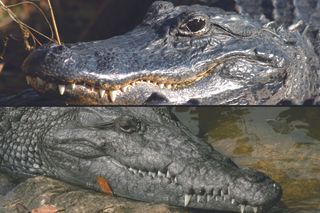
Ficando cara a cara com um crocodilo ou um jacaré, você veria uma boca
cheia de dentes serrilhados que provavelmente assustariam. Os dois grupos de répteis são parentes próximos, portanto suas semelhanças físicas são esperadas. Após uma inspeção mais detalhada, não recomendada na natureza, você perceberia diferenças gritantes:
Forma do focinho: os jacarés têm focinhos mais largos em forma de U, enquanto as extremidades frontais dos crocodilos são mais pontiagudas e em forma de V.
Sorriso aberto: quando os focinhos estão fechados, os crocodilos
parecem estar exibindo um sorriso cheio de dentes, pois o quarto dente
de cada lado da mandíbula inferior fica preso no lábio superior.
Para os jacarés, a mandíbula superior é mais larga que a inferior;
portanto, quando fecham a boca, todos os dentes ficam ocultos.
Base: os crocodilos tendem a viver em habitats de água salgada, enquanto os jacarés ficam em pântanos e lagos de água doce.
Eles pertencem ao subgrupo Eusuchia , que inclui cerca de 22 espécies divididas em três famílias: os gavials ou gharials que comem peixe, que pertencem aos Gavialidae ; crocodilos de hoje ou os Crocodylidae ; e os Alligatoridae , ou jacarés. Eusuquianos apareceram em cena durante o final do Cretáceo, cerca de 100 milhões de anos atrás.
sexta-feira, 10 de maio de 2019
Max Langer: Como classificar a vida pré-histórica
Paleontólogo explica o que faz de um réptil um dinossauro e fala das discussões sobre a origem desses animais
Pesquisador da USP em afloramento da região de Santa Maria
Arquivo pessoal
O paleontólogo Max Langer, da Universidade de São Paulo (USP), campus
de Ribeirão Preto, acaba de voltar de uma viagem de 10 dias à província
de La Rioja, no noroeste da Argentina. Ao lado de pesquisadores locais e
de colegas brasileiros, participou de coletas em sítios importantes da
formação Ischigualasto, de onde, ao lado da formação Santa Maria, no Rio
Grande do Sul, tem saído os dinossauros mais antigos do mundo.
Langer, de 45 anos, conhece ainda mais profundamente os fósseis
gaúchos. Fez mestrado na Universidade Federal do Rio Grande do Sul
(1996), doutorado na Universidade de Bristol (2001), no Reino Unido, e
já perdeu a conta de quantas vezes realizou trabalhos de campo na parte
central do território gaúcho. Ele participou da descoberta de dois
fósseis de dinossauros encontrados em rochas da idade Carniana (por
volta de 230 milhões de anos atrás) da formação Santa Maria. É também
coautor de cinco dos seis trabalhos científicos que descreveram essas
espécies. Nesta entrevista, ele fala sobre as evidências que favorecem a
hipótese de que os dinossauros podem ter surgido na América do Sul.
O que torna um réptil um dinossauro e o diferencia de outros répteis contemporâneos?
Não é simples responder essa pergunta. Há diferentes formas de fazer
essa distinção. Atualmente, a definição do que é um dinossauro tem mais a
ver com a sua árvore genealógica, a história evolutiva de seus membros,
do que com algumas características anatômicas que seriam típicas desse
grupo, como ter o quadril perfurado para o encaixe do fêmur ou as patas
posicionadas diretamente abaixo do corpo. As classificações modernas se
baseiam no conceito de clados, grupos de organismos que têm uma história
evolutiva comum. Os dinossauros são definidos com base na posição
filogenética de três gêneros classicamente vistos como representantes de
suas principais linhagens: o terópode (bípede carnívoro) Megalosaurus, o ornitísquio Iguanodon e o saurópode (quadrúpede herbívoro) Cetiosaurus.
Partimos desses três animais e percorremos sua árvore genealógica até
chegar em um ancestral comum. Por essa definição, todos os descendentes
desse ancestral comum são considerados dinossauros. É dessa forma, por
exemplo, que as aves são classificadas como dinossauros. Elas descendem
desse ancestral comum.
Que importância os paleontólogos atribuem à discussão sobre o local em que os dinossauros devem ter surgido?
Esse debate tem um pouco a ver com certo orgulho em dizer que os
dinossauros teriam surgido em seu país ou, na pior das hipóteses, em seu
continente ou hemisfério. Mas a questão não se resume a isso. Como
paleontólogos, estudamos os padrões de diversidade e distribuição
geográfica das espécies ao longo da história geológica. Trata-se de
ciência básica. É importante entender como se deu a irradiação das
diferentes linhagens de dinossauros, que são animais muito populares e
despertam a atenção. Os fósseis são frágeis e seu registro é incompleto.
Sabemos que uma nova descoberta pode mudar tudo, mas, com base nas
evidências que temos hoje, o mais provável é que os dinossauros tenham
surgido no Gondwana, a metade sul do supercontinente Pangea que existia
há cerca de 230 milhões de anos. Para ser mais preciso, o mais provável é
que tenham surgido no oeste do Gondwana, onde hoje fica o sul da
América do Sul e da África. Incluo aqui a África, que estava unida à
América do Sul no Gondwana, pois estamos trabalhando na descrição de um
dinossauro africano mais ou menos da mesma idade dos nossos.
Os dinossauros mais antigos das formações Santa Maria e Ischigualasto podem ter mantido algum tipo de contato?
É provável que sim. Alguns dinossauros, como Chromogisaurus novasi, da Argentina, e Saturnalia tupiniquim,
são muito parecidos. Há até quem sugira que eles seriam uma única
espécie. Também há outros animais que ocorriam tanto lá como aqui. Os
rincossauros [um tipo de réptil herbívoro] do gênero Hyperodapedon apresentam duas espécies, H. mariensis e H. sanjuanensis, cujos fósseis são igualmente achados nas duas formações.
A paleontologia nos Estados Unidos e na Europa é mais
desenvolvida do que aqui. Por que eles não encontraram até agora
dinossauros mais antigos do que os da América do Sul?
Não basta ter dinheiro. Quase todas as rochas do Triássico Superior dos
Estados Unidos com registro fóssil de tetrápodes, grupo que inclui os
atuais anfíbios, répteis, aves e mamíferos, foram datadas. Algumas são
mais antigas que as de Santa Maria e de Ischigualasto, mas não têm
dinossauros. Claro que é possível que tenha havido dinossauros tão
antigos quanto os nossos ali, mas, possivelmente por não terem sido tão
abundantes nessas regiões, eles não foram preservados. Essa é uma das
hipóteses. Ou eles podem mesmo não ter existido na América do Norte. Na
Europa, há duas localidades, uma na Polônia e outra na Escócia, que
parecem ter rochas da mesma idade que as de Santa Maria e de
Ischigualasto. Mas nelas também não foram achados dinossauros. Por isso,
digo que, por ora, as evidências indicam que os dinossauros devem ter
surgido na América do Sul.
Mas o fato de se ter encontrado na África o fóssil de um
réptil de 245 milhões de anos não enfraquece a hipótese a favor da
América do Sul?
Sim, enfraquece um pouco, mas nem de longe derruba essa hipótese. O fóssil desse possível dinossauro achado na Tanzânia, Nyasasaurus parringtoni,
é muito mal preservado. Foram encontrados apenas algumas vértebras e um
úmero parcial. Não dá para saber se é realmente um dinossauro. Até pode
ser. Mas, a partir apenas dele, não dá para dizer que os dinossauros
surgiram em outro lugar e não na América do Sul. Seria necessário um
conjunto mais completo de fósseis de dinossauros de outras partes do
mundo em rochas da mesma idade ou mais velhas que as de Santa Maria e
Ischigualasto para se refutar a ideia da origem sul-americana desses
animais.
quinta-feira, 2 de agosto de 2018
Como os lagartos têm seus grandes pés
Criaturas que sobreviveram ao clima selvagem no Caribe oferecem um vislumbre da seleção natural em ação.
Big-footed lizards are more likely than their smaller-footed counterparts to hang on and survive when wild winds blow.Credit: Colin Donihue.
Quando Charles Darwin viu
pela primeira vez uma orquídea estrela de Madagascar - recebida por ele
por um entusiasta - ele previu a existência de um polinizador de língua
longa que poderia alcançar o néctar dentro dos longos tubos das flores. A
descoberta da traça da esfinge de Morgan, que tinha uma língua longa o
suficiente (e não mais), provou que Darwin estava certo - cerca de duas
décadas depois de sua morte.
É uma das grandes demonstrações da
evolução pela seleção natural. Mas o que os naturalistas realmente
querem é pegar a seleção natural no ato, como está fazendo a seleção.
Isso é muito mais difícil e um pouco de sorte é necessário.
Oportunidade
bateu na porta do biólogo Colin Donihue na Universidade de Harvard em
Cambridge, Massachusetts, um ano atrás, logo depois que ele e seus
colegas haviam retornado de Pine Cay e Water Cay, duas pequenas ilhas no
arquipélago de Turks e Caicos ao norte do Caraíbas, onde estudavam as
vidas e os tempos dos seus lagartos anole residentes (Anolis scriptus).
Em
8 de setembro do ano passado, o furacão Irma atingiu as ilhas,
golpeando-as com ventos de até 265 quilômetros por hora. Irma foi o
primeiro furacão de categoria 5 a atingir a região, mas mais estava por
vir: duas semanas depois, o furacão Maria varreu as ilhas com ventos de
até 200 quilômetros por hora. Dezenas de pessoas na região morreram. Os
esforços de reconstrução e reconstrução continuam.
Três semanas
depois de os ventos terem diminuído, os pesquisadores estavam de volta a
Pine Cay e Water Cay para avaliar os danos e ver como (ou até mesmo se)
seus lagartos haviam sobrevivido. Seu estudo, publicado esta semana na
Nature, é o primeiro a usar uma comparação imediata antes e depois para
avaliar os impactos dos furacões na seleção evolucionária. (C. M. Donihue et al.Naturehttp://doi.org/csgp; 2018).
Serendipity
pode ir apenas até agora. Os pesquisadores não marcaram os lagartos,
por isso não puderam identificar e rastrear o destino dos indivíduos.
Mas eles encontraram tendências claras da seleção natural em ação. Em
geral, os anoles encontrados após as tempestades tinham blocos maiores,
membros anteriores mais longos e membros posteriores mais curtos do que
os lagartos coletados antes da tempestade.
O que esses traços têm
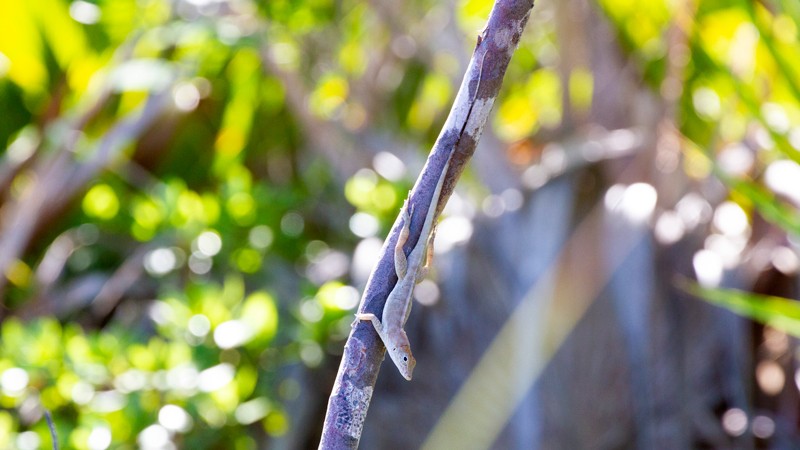
a ver com furacões? Os lagartos vivem em arbustos e outras vegetações
de baixo crescimento. Os blocos de notas permitem que eles comprem nos
galhos enquanto se movem, e é justo apostar que as proporções dos
membros também ajudam a manter um lagarto em contato com um galho,
resistindo a movimentos de predadores, outros lagartos - ou, como se
viu, furacões - para derrubá-los.
Os pesquisadores levaram a ideia adiante com um simples experimento de laboratório, no qual
permitiram que os lagartos se instalassem em um poleiro e depois os
explodiram usando um soprador de folhas comercial, registrando a
velocidade com que os lagartos foram desalojados. (Os lagartos voaram
confortavelmente e não ficaram feridos nos experimentos.)
Este
experimento apoiou a hipótese dos pesquisadores. Em particular, mostrou
que quando os lagartos são submetidos a uma forte brisa, eles se agarram
firmemente aos membros anteriores e deixam os membros posteriores
soltos. Os membros posteriores mais longos, então, oferecem mais compra
aos ventos, explicando porque os lagartos encontrados após as
tempestades tendem a ter membros posteriores mais curtos, mas com
membros anteriores mais longos.
Esses blocos maiores, membros
posteriores mais curtos e membros anteriores mais longos não evoluíram
como uma resposta direta aos furacões, mas mostram como essa evolução
ocorre. A seleção natural interferiu na maneira como essas
características se espalharam pela população. Especificamente, aqueles
lagartos incapazes de resistir quando as tempestades explodiram -
aqueles com blocos menores, membros posteriores mais longos e membros
anteriores mais curtos - foram (presumivelmente) levados embora e
morreram.
Aqueles lagartos mais capazes de aguentar firme teriam
sobrevivido para passar outro dia. Em termos técnicos, os valores médios
das características cruciais medidas antes das tempestades mudaram.
Essas mudanças são fenotípicas - características meramente observáveis.
Eles não dizem nada sobre a assimilação genética de tais mudanças, que
presumivelmente acontecerão quando os lagartos sobreviventes e novos
lagartos forem recrutados para a população. É improvável que essas
mudanças sejam as últimas, dados os aumentos esperados no clima extremo
que o futuro trará.
doi: 10.1038/d41586-018-05821-7
domingo, 3 de junho de 2018
Facts About Lizards
By Alina Bradford, Live Science Contributor |
A 3-foot-long (1 meter) green
iguana appeared one day when Will Jenkins was relaxing with his family
in Costa Rica. Jenkins quickly grabbed his camera.
Credit: Will Jenkins / Wildlife Photographer of the Year 2014
Lizards are reptiles. There are over 4,675 species of lizard, according to the San Diego Zoo.
Others sources say there are about 6,000 species. Included in this
large number are lizards with four legs, some with two legs and some
with no legs at all; lizards with frills, horns or wings; and lizards in
nearly every color imaginable.
Size
Lizards generally have small heads, long bodies and long tails. With so
many species of lizard, it's understandable that they come in a wide
variety of sizes. The largest lizard is the Komodo dragon.
It grows up to 10 feet (3 meters) long and weighs up to 176 lbs. (80
kilograms). The smallest lizard is the tiny dwarf gecko, which grows to
0.6 inches (1.6 centimeters) long and weighs .0042 ounces (120
milligrams).
Habitat
Lizards are found all over the world in almost every type of terrain.
Some live in trees; others prefer to live in vegetation on the ground,
while others live in deserts among rocks. For example, the Texas horned lizard
is found in the warm areas with little plant cover in southern North
America. The northern fence lizard, on the other hand, likes to live in
cool pine forests in northern North America.
Komodo dragons have long, forked tongues that they use to help smell and taste.
Most lizards are active during the day. Lizards are cold-blooded
animals, which means they rely on their environment to help warm their
bodies. They use the heat of the sun to raise their body temperatures
and are active when their bodies are warm. The sun also helps lizards produce vitamin D. Their days are spent sun-bathing on rocks, hunting for food or waiting for food to come their way.
Some lizards are territorial, while others can easily live with dozens
of other lizards of many different species. Other than mating times,
most lizards are not social, though. There are some exceptions. For
example, the desert night lizard lives in family groups, according to
research by the University of California.
A lizard's scaly skin does not grow as the animal ages. Most lizards
shed their skin, or molt, in large flakes. Lizards also have the ability
to break off part of their tails when a predator grabs it.
Diet
Many lizards are carnivores, which means they eat meat. A typical diet
for a lizard includes ants, spiders, termites, cicadas, small mammals
and even other lizards. Caiman lizards eat animals with shells, such as
snails.
Other lizards are omnivores, which means they eat vegetation and meat.
One example of an omnivore lizard is Clark's spiny lizard. These lizards
like fruits, leaves and vegetables.
Some lizards are herbivores and only eat plants. The marine iguana,
which lives in the Galapagos Islands, eats algae from the sea. Iguanas and spiny-tailed agamids also eat plants.
Offspring
Many lizards lay eggs while others bear live young. For example, frilled lizards lay eight to 23 eggs, according to National Geographic, while some skinks have live young. The gestation for a lizard egg can last up to 12 months.
Most baby lizards are self-sufficient from birth and are able to walk,
run and feed on their own. The young reach maturity at 18 months to 7
years, depending on the species. Some lizards can live up to 50 years.
A wild brown basilisk
(Basiliscus vittatus), photographed in Guatemala. The animal is
nicknamed Jesus lizard for its ability to run across water.
Credit: Ana Balcarcel
Classification/taxonomy
Here is the classification of lizards according to Integrated Taxonomic Information System (ITIS): Kingdom: Animalia Subkingdom: Bilateria Infrakingdom: Deuterostomia Phylum: Chordata Subphylum: Vertebrata Infraphylum: Gnathostomata Superclass: Tetrapoda Class: Reptilia Order: Squamata Suborders: Amphisbaenia, Autarchoglossa, Gekkota, Iguanias, Serpentes
The suborder Dibamidae, with the genera Anelytropsis and Dibamus, may also be included, though ITIS says these categories have "uncertain position."
Conservation status
Lizards vary in their conservation status, much like their traits vary.
Many, according to the International Union for Conservation of Nature's
Red List of Threatened Species, are endangered or critically
endangered, meaning they may be close to extinction. Some lizards that
are critically endangered include Campbell's alligator lizard, St. Croix Ameiva, Frost's arboreal alligator lizard, Be’er Sheva fringe-fingered lizardand the Doumergue's fringe-fingered lizard.
Other facts
Frill neck lizards have a large, round collar of skin that pops up when they are trying to intimidate attackers.
The green basilisk lizard can run on water at about 5 feet (1.5 m) per second for 15 feet (4.5 m), or more according to National Geographic.
Their special feet give them more surface area to hold them up and as
they run, they create air bubbles that keep them afloat.
Chameleons' tongues are longer than their bodies, and their eyes can look in two different directions at once.
You can shine a light in a banded gecko's ear and the light will come out the other side, according to the American Museum of Natural History.
Two species — the Mexican beaded lizard of western Mexico and the Gila
monster of the southwestern United States and northwestern Mexico, are
venomous, according to Encyclopedia Britannica. Additional resources
This 240-Million-Year-Old Reptile Is the "Mother of All Lizards"
By Mindy Weisberger, Senior Writer |
About 240 million years ago, Megachirella wachtleri trod the vegetation in what is now the Dolomites region of northern Italy.
Credit: Davide Bonadonna
HBO's "Game of Thrones" features a "Mother of Dragons," but a fossil
that's hundreds of millions of years old was recently identified as the
"mother of all lizards" (and snakes, too).
This ancient lizard was the direct ancestor of approximately 10,000
species alive today that have inhabited the planet for more than 240
million years.
Paleontologists initially described the tiny reptile, Megachirella wachtleri, in 2003. But recent scans revealed features in the fossil that were hidden, enabling scientists to identify Megachirella as the oldest known ancestor in the squamate lineage — the reptile group that includes lizards and snakes. Megachirella, which predates the fossils previously thought to
belong to the earliest squamates by around 75 million years, bridged
the gap between the oldest known squamates and the estimated origins of
this reptile group derived from molecular data, researchers reported in a
new study. [In Photos: Amber Preserves Cretaceous Lizards]
The Megachirella fossil was found in the Alps in northern
Italy. It was estimated it to be about 240 million years old and
scientists thought it belonged to a lepidosaur, a type of primitive
reptile. But certain lizard-like features
hinted that the fossil might provide valuable and unique clues about
squamates, lead study author Tiago Simões, a doctoral candidate in
biological sciences at the University of Alberta in Edmonton, Canada,
told Live Science in an email.
"It deserved further attention — especially in the form of CT [computed
tomography] scanning — to provide greater anatomical details and an
improved data set, to understand its placement in the evolutionary tree
of reptiles," Simões said.
Scientists found a preserved specimen of Megachirella wachtleri in northern Italy and described it in 2003.
Credit: MUSE Science Museum
The researchers used CT scans to build 3D computer models of the fossil reptile, and found a number of features linking Megachirella
to squamates. Two of those features were unique to the squamate group: a
part of the braincase and a collarbone structure. Together, those
elements identified Megachirella as "the first unequivocal squamate from the Triassic," according to the study published online today (May 30) in the journal Nature.
Molecular and skeletal clues also indicated that geckoes, rather than
iguanians (which includes iguanas, anoles and chameleons), made up the
earliest squamate group to arise, the researchers reported.
Their evidence provided a critical and "really satisfying" missing
piece of an evolutionary puzzle, by providing fossil evidence to support
what molecular data suggests about squamate origins,
Chris Raxworthy, curator-in-charge of the Department of Herpetology at
the American Museum of Natural History in New York City, told Live
Science.
"Scientists always love it when we see different types of data coming
up with the same answer," said Raxworthy, who was not involved in the
study.
However, a large gap persists in the fossil record between Megachirella, which lived 240 million years ago, and other fossil squamates
that appeared no earlier than 168 million years ago. This leaves much
to be unraveled about the diversity of these ancient snakes and lizards
and what they may have looked like, Simões said.
"What we are discovering is the tip of the iceberg, and much further
work needs to be done to understand the early evolution of squamates,"
he said. Original article on Live Science.
The origin of squamates revealed by a Middle Triassic lizard from the Italian Alps
Modern squamates (lizards, snakes and amphisbaenians) are the world’s most diverse group of tetrapods along with birds1
and have a long evolutionary history, with the oldest known fossils
dating from the Middle Jurassic period—168 million years ago2,3,4.
The evolutionary origin of squamates is contentious because of several
issues: (1) a fossil gap of approximately 70 million years exists
between the oldest known fossils and their estimated origin5,6,7;
(2) limited sampling of squamates in reptile phylogenies; and (3)
conflicts between morphological and molecular hypotheses regarding the
origin of crown squamates6,8,9.
Here we shed light on these problems by using high-resolution
microfocus X-ray computed tomography data from the articulated fossil
reptile Megachirella wachtleri (Middle Triassic period, Italian Alps10).
We also present a phylogenetic dataset, combining fossils and extant
taxa, and morphological and molecular data. We analysed this dataset
under different optimality criteria to assess diapsid reptile
relationships and the origins of squamates. Our results re-shape the
diapsid phylogeny and present evidence that M. wachtleri is the oldest known stem squamate. Megachirella
is 75 million years older than the previously known oldest squamate
fossils, partially filling the fossil gap in the origin of lizards, and
indicates a more gradual acquisition of squamatan features in diapsid
evolution than previously thought. For the first time, to our knowledge,
morphological and molecular data are in agreement regarding early
squamate evolution, with geckoes—and not iguanians—as the earliest crown
clade squamates. Divergence time estimates using relaxed combined
morphological and molecular clocks show that lepidosaurs and most other
diapsids originated before the Permian/Triassic extinction event,
indicating that the Triassic was a period of radiation, not origin, for
several diapsid lineages.
quinta-feira, 31 de maio de 2018
The origin of squamates revealed by a Middle Triassic lizard from the Italian Alps
Modern squamates (lizards, snakes and amphisbaenians) are the world’s most diverse group of tetrapods along with birds1
and have a long evolutionary history, with the oldest known fossils
dating from the Middle Jurassic period—168 million years ago2,3,4.
The evolutionary origin of squamates is contentious because of several
issues: (1) a fossil gap of approximately 70 million years exists
between the oldest known fossils and their estimated origin5,6,7;
(2) limited sampling of squamates in reptile phylogenies; and (3)
conflicts between morphological and molecular hypotheses regarding the
origin of crown squamates6,8,9.
Here we shed light on these problems by using high-resolution
microfocus X-ray computed tomography data from the articulated fossil
reptile Megachirella wachtleri (Middle Triassic period, Italian Alps10).
We also present a phylogenetic dataset, combining fossils and extant
taxa, and morphological and molecular data. We analysed this dataset
under different optimality criteria to assess diapsid reptile
relationships and the origins of squamates. Our results re-shape the
diapsid phylogeny and present evidence that M. wachtleri is the oldest known stem squamate. Megachirella
is 75 million years older than the previously known oldest squamate
fossils, partially filling the fossil gap in the origin of lizards, and
indicates a more gradual acquisition of squamatan features in diapsid
evolution than previously thought.
For the first time, to our knowledge,
morphological and molecular data are in agreement regarding early
squamate evolution, with geckoes—and not iguanians—as the earliest crown
clade squamates. Divergence time estimates using relaxed combined
morphological and molecular clocks show that lepidosaurs and most other
diapsids originated before the Permian/Triassic extinction event,
indicating that the Triassic was a period of radiation, not origin, for
several diapsid lineages.
domingo, 8 de maio de 2016
Palleon,Archaius,Kinyongia,Nadzikambia--The Last Chameleons, Part 3
In
the two previous articles in this series–devoted to the living
chameleons of the world–we’ve looked at the full spread of chameleon
diversity (Part 1, Part 2).
There are the small, short-tailed leaf chameleons and pygmy chameleons,
the little heartland-dwelling African dwarf chameleons, the sometimes
giant Calumma chameleons, the ornate, sometimes horned Trioceros chameleons, and so on.
In
this, the third and final article in this series, we look at the few
taxa not discussed so far. I’ve left them until last for two reasons.
One is that they include the most recently named members of the group.
Two is that the places they occupy in chameleon phylogeny are
particularly informative as goes what we think about the evolutionary
history of these remarkable lizards. What am I getting at? Read on… Palleon from Madagascar. We’ll begin with Palleon, named in 2013 (Glaw et al. 2013) for two distinctive Madagascan species (P. nasus and P. lolontany, the latter only named in 1995) previously included within Brookesia.
They’re small (c 4-9 cm in total), short-tailed, laterally compressed
in the body and with a wave-like dorsal crest and beak-like nasal
appendage in males. In fact these chameleons are so distinctive that
some studies have hypothesised that they might be the sister-group of
all other chameleons (Raxworthy et al. 2002). More recent analyses have found them to be part of the Brookesia lineage, though outside the clade that contains all definite Brookesia species (Townsend et al. 2011, Tolley et al. 2013).
The name Palleon is a contracted version of ‘Palae-leon’ and refers to the inferred ancient origin of this little group (Glaw et al. 2013). If Palleon-lineage
chameleons really have been around for 50 or 60 million years or more
(as suggested by molecular divergence data) you’d expect there to be
more than two species: are they another of those lineages that’s been a
chronic ‘slow evolver’ relative to their close kin? It seems so, though
we should of course be on the lookout for additional member of the
lineage.
Close-up of P. nasus. Check out those details of head ornamentation as well as the spines along the back. Photo by Heinonlein, CC BY-SA 4.0.
Anyway… the genetic and morphological support putting these animals close to Brookesia (Townsend et al. 2011, Glaw et al. 2013, Tolley et al. 2013) means that Brookesiinae currently contains both Palleon and Brookesia. Archaius of the Seychelles. Next up is Archaius – a name used solely for the Seychelles tiger chameleon A. tigris. Yes, a chameleon endemic to the Seychelles – what gives? Archaius isn’t a new name (it was published by Gray in 1865), but it’s only recently been resurrected, having long been subsumed into Chamaeleo, and more recently into Calumma.
The Tiger chameleon is small (total length = c 16 cm) and with a
pointed projection on its chin. Its parietal crest (the one that runs
sagitally along the upper surface of the braincase) is forked, as is
also the case in some Trioceros species.
Archaius tigris, the Seychelles Tiger chameleon. Photo by Hans Stieglitz, CC BY-SA 3.0.
While Archaius might not be especially remarkable from a
morphological point of view, the really interesting thing about it is
where it sits in the phylogeny. For, despite looking enough like a
‘conventional’ chamaeleonine chameleon that it has often been regarded
as one, molecular data indicates that Archaius is actually most closely related to Rieppeleon, and hence is outside the clade that includes Rhampholeon and remaining chamaeleonines (Townsend et al. 2011, Tolley et al. 2013). Why is this a big deal?
A more complex depiction of chameleon phylogeny (relative to versions shown in the previous two articles), based on Tolley et al. (2013). Brookesia by Frank Wouters, CC BY-SA 2.0; Palleon by Axel Strauß, CC BY-SA 3.0; Rieppeleon by R. J. Blach, CC BY-SA 3.0; Archaius by Hans Stieglitz, CC BY-SA 3.0; Rhampholeon by Martin Nielsen, CC BY-SA 4.0; Bradypodion by Javier Abalos Alvarez, CC BY-SA 2.0; Chamaeleo by Raju Kasambe, CC BY-SA 3.0; Furcifer by Gunnar M. Kvifte, CC-BY; Calumma by Steve Wilson, CC BY 2.0 Kinyongia by Ales Kocourek, CC BY 2.0; Trioceros by Benjamint444, CC BY-SA 3.0.
You’ll recall that Rieppeleon and Rhampholeon are
both ‘leaf chameleons’: small, short-tailed, cryptic chameleons that
lack some of the key anatomical and lifestyle features associated with
‘conventional’ chameleons. Furthermore, brookesiines are ‘leaf
chameleons’ of a sort, as well. Look at the phylogeny, employ your
Dawkinsian powers of concestor reconstruction, and it would look as if
chameleons were all ‘leaf chameleons’ right up to the origin of the clade that includes Bradypodion, Chamaeleo and kin.
This tree-based hypothesis has some interesting ramifications. It
would suggest that key chameleon traits evolved within the context of
especially small size, a cryptic lifestyle and an ecology that mostly
involved leaf litter, low herbage and twiggy shrubs. It would also mean
that we might seek to explain why, at some point during the leafy,
tropical Eocene, chameleons suddenly evolved larger size, prehensile
tails, and morphed into (relatively) giant, flamboyant, ornamented
beasts associated with tall trees.
Here is where Archaius saunters in and says “No... probably”
to the above. Its position suggests that the ‘leaf chameleon’ way of
doing things was not retained across chameleonhood until late in the
game: the position of Archaius makes it at least as
likely that the ‘conventional’ chameleon ecotype is the ancestral one,
and that the ‘leaf chameleon’ ecotype is the weird, divergent one, at
least within Chamaeleoninae. This would mean that the ‘leaf chameleon’
ecotype shared by Rieppeleon and Rhampholeon is convergent.
The presence of this species on the Seychelles is presumably the
result of a single over-water dispersal event from Africa (Townsend et al. 2011), and likely not from Madagascar as argued by Raxworthy et al.
(2002). In fact, chameleons as a whole – well, the crown-chameleon
clade, anyway – seem to have originated on Africa and dispersed from
here multiple times. Why this ‘eastwards from Africa’ hypothesis, rather
than one invoking long-time residence on various broken fragments of
Gondwana? The reason is that crown-chameleons aren’t old enough for
Gondwanan fragmentation to explain their presence in such places as
Madagascar or the Seychelles. Crown-chameleons might be 60 million years
old or so, but a group would need to have originated more than 80
million years ago to get stranded on the Seychelles as a consequence of
Gondwanan fragmentation (Raxworthy et al. 2002, Townsend et al. 2011).
Two of the most familiar of Kinyongia chameleons. Left: K. fischeri, photo by Denise Chan, CC BY-SA 2.0 [UPDATE: no, this is K. matschiei: see comment below by CVAnderson]. Right: K. xenorhina, photo by David Udvardy, CC BY-SA 3.0.
Kinyongia, kin of Trioceros. Next up is Kinyongia, an east African taxon named in 2006 for a group of 10 species previously included in Bradypodion (see the previous article for more on Bradypodion) (Tilbury et al. 2006). The number of species has about doubled since then. Kinyongia
chameleons tend to be mid-sized animals of highland habitats in Kenya,
Tanzania, the eastern Democratic Republic of the Congo and so on.
They’re usually sexually dimorphic, the males possessing short, robust
rostral protuberances. The most familiar of the lot is probably
Fischer’s chameleon K. fischeri, a species sometimes said to
have the longest tongue of any chameleon. I have no idea whether this is
true or not [UPDATE: it's not. See comment below by CVAnderson]. Front cover of Spawls et al. (2004), featuring Kinyongia xenorhina.
Some Kinyongia species are especially odd. Among these is the Strange-nosed chameleon or Single welded-horn chameleon K. xenorhina,
males of which are equipped with a laterally compressed, oval rostral
projection that’s similar in size and shape to the casque. A great photo
of one of these chameleons adorns the cover of Spawls et al.’s A Field Guide to the Reptiles of East Africa (Spawls et al. 2004). Then there’s the Uluguru one-horned chameleon or Sharp-nosed chameleon K. oxyrhina of the Tanzanian Uluguru and Udzungwa Mountains, males of which have a long, blade-like horn. And there are others…
You might have noted that these animals sound Trioceros-like overall (Trioceros
being the mostly Afromontane chameleon group that famously includes
several horned species). Indeed, some molecular phylogenetic studies
find the two to be sister-groups (Tolley et al. 2013).
K. fischeri in Tanzania, most familiar of the Kinyongia chameleons [UPDATE: no, this is K. multituberculata: see comment below by CVAnderson]. Photo by Jjgodox, CC BY-SA 4.0.
Nadzikambia. Finally, we come to another recently named taxon: Nadzikambia, named in 2006 in the same study that also named Kinyongia (Tilbury et al. 2006). Only two Nadzikambia species are currently known: the Mlanje Mountain chameleon N. mlanjensis from Malawi, named in 1965, and the Mount Mabu chameleon N. baylissi
from Mozambique, named in 2010. What appears to be a third species was
reported (but is as yet unnamed, so far as I can tell) in 2014. All are
fairly conservative, mid-sized chameleons with a low casque and finely
heterogenous scalation (Tilbury et al. 2006). N. baylissi
is famous because its discovery (by Julian Bayliss) resulted from a
targeted search involving the identification of the right kind of forest
via Google Earth (for more on this amazing story, go here).
Juvenile N. baylissi: a screengrab from a short film available here.
It’s always been thought that Nadzikambia is close to, or even part of, Chamaeleo. And some recent molecular studies finds the two to be sister-taxa (Tilbury & Tolley 2009, Tolley et al. 2013), the two perhaps diverging at the start of the Oligocene, about 30 million years ago (Tolley et al. 2013). Another study (Townsend et al. 2011) found Nadzikambia to be closest to Bradypodion,
the inferred divergence date of the two being put at over 40 million
years ago. At the risk of repeating myself, consider these inferred
divergence dates relative to the divergence dates of other, more
familiar tetrapod groups. These rather similar chameleon lineages have
been distinct for longer than deer have been distinct from antelopes and
cattle, or walruses have been distinct from seals.
There aren't any Nadzikambia images online that are widely available for use, so here's another picture of a Kinyongia: this is K. vosseleri (based on a photo by Jan Stipala). I initially prepared this illustration because I thought it was a depiction of Nadzikambia, sigh...
Maybe there are two ways of looking at this. One is to say that
chameleons are fairly conservative, relatively little morphological and
ecological change having accrued in the timeframe concerned. Another is
to say that the lineages are really far more disparate, ‘more distinct’
than we’ve conventionally assumed, and that we’ve understated how much
evolution and diversification might actually have evolved.
That’s it, for now. And with that, we’ve done it:
looked briefly at all major, named lineages within the crown-chameleon
radiation. There is, of course, so much more to say. Much could be said
of chameleon anatomy and functional morphology, of the fossil history
and broader affinities of chameleons within the lizard clade Iguania,
and of chameleon ecology, behaviour and lifestyle. Plus there are an
enormous number of species – a great many of them recently named – that
really warrant a more detailed look. But, for now, this will do. I hope
you’ve enjoyed this look at chameleon diversity and I’m sure we’ll be
returning to them in time.
For previous Tet Zoo articles on iguanian lizards, see...
Refs - -
Glaw, F., Hawlitschek, O. & Ruthensteiner, B. 2013. A new genus
name for an ancient Malagasy chameleon clade and a PDF-embedded 3D model
of its skeleton. Salamandra 49, 237-238.
Raxworthy, C. J., Forstner, M. R. J. & Nussbaum, R. A. 2002. Chameleon radiation by oceanic dispersal. Nature 415, 784-787.
Tilbury, C. R. & Tolley, K. A. 2009. A re-appraisal of the systematics of the African genus Chamaeleo (Reptilia: Chamaeleonidae). Zootaxa 2079, 57-68.
Tilbury, C. R., Tolley, K. A. & Branch, W. R. 2006. A review of the systematics of the genus Bradypodion (Sauria: Chamaeleonidae), with the description of two new genera. Zootaxa 1363, 23-38.
Tolley, K. A., Townsend, T. M. & Vences, M. 2013. Large-scale
phylogeny of chameleons suggests African origins and Eocene
diversification. Proceedings of the Royal Society of London B, 280, 20130184.
Townsend, T.M., Tolley, K. A., Glaw, F., Böhme, W. & Vences, M.
2011. Eastward from Africa: palaeocurrent-mediated chameleon dispersal
to the Seychelles islands. Biology Letters 7, 225-228.
segunda-feira, 25 de janeiro de 2016
Destaque
www.veterinariaiguatemi.com.br
Teiú consegue manter temperatura corpórea 10º acima do ambiente
Professor da Unesp participa de artigo publicado na revista Science Advances
[24/01/2016]
Denis
Andrade, professor do Departamento de Zoologia do Instituto de
Biociências (IB) da Unesp de Rio Claro, é um dos autores de artigo
publicado na importante revista Science Advances de 22 de janeiro.
O artigo, escrito com pesquisadores de universidades canadenses e do
Brasil, como Augusto Abe, também do IB, pioneiro nos estudos que
culminaram com a publicação deste trabalho, lembra que, com apenas
algumas exceções notáveis, vertebrados ectotérmicos (aqueles que
dependem do ambiente externo para regular temperatura corpórea, como os
répteis) de pequeno tamanho são incapazes de sustentar endogeneamente
uma temperatura corpórea substancialmente acima da temperatura ambiente.
Este paradigma foi contestado pelas observações de que lagartos teiús
(~2 kg) mantêm temperaturas corpóreas consideravelmente acima (até 10oC) da temperatura ambiente, o que ocorre notadamente durante o período noturno da estação reprodutiva.
Isso levou os pesquisadores a sugerir que esses lagartos possuem a
capacidade de aumentar substancialmente a produção de calor endógeno,
termogênese, e, conservá-lo.
O aumento da taxa de produção de calor metabólico conjugado à
diminuição da condutância termal do corpo do animal (ou seja, da taxa
com que ele perde calor para o ambiente) são os mesmos mecanismos
envolvidos na regulação da temperatura corpórea daqueles vertebrados
tradicionalmente reconhecidos como “verdadeiros endotérmos”: as aves e
os mamíferos.
O reconhecimento de que um ectotérmico atual - cujo tamanho é similar
àquele dos ancestrais dos mamíferos - pode sustentar temperaturas
corpóreas elevadas às custas do metabolismo pode ajudar a esclarecer o
debate sobre as origens da endotermia.
As observações expostas no artigo também indicam que, ao contrário da
noção amplamente difundida, organismos ectotérmicos podem exibir uma
endotermia facultativa, o que fornece uma base fisiológica para estágios
transicionais prováveis na evolução da endotermia completa.
Acesse o artigo completo em
- Turtles and Eunotosaurus construct their shells in a uniquely similar fashion
- Phylogenetic and ontogenetic acquisitions of shell features are closely mirrored
- Initial transformations of the turtle shell occurred by the Middle Permian
Summary
The origin of the turtle shell has perplexed biologists for more than two centuries. It was not until Odontochelys semitestacea was
discovered, however, that the fossil and developmental data could be
synthesized into a model of shell assembly that makes predictions for
the as-yet unestablished history of the turtle stem group.
We build on
this model by integrating novel data for Eunotosaurus africanus—a Late Guadalupian (∼260 mya) Permian reptile inferred to be an early stem turtle. Eunotosaurus expresses a
number of relevant characters, including a reduced number of elongate
trunk vertebrae (nine), nine pairs of T-shaped ribs, inferred loss of
intercostal muscles, reorganization of respiratory muscles to the
ventral side of the ribs, (sub)dermal outgrowth of bone from the
developing perichondral collar of the ribs, and paired gastralia that
lack both lateral and median elements.
These features conform to the
predicted sequence of character acquisition and provide further support
that E. africanus, O. semitestacea, and Proganochelys quenstedti
represent successive divergences from the turtle stem lineage. The
initial transformations of the model thus occurred by the Middle
Permian, which is congruent with molecular-based divergence estimates
for the lineage, and remain viable whether turtles originated inside or
outside crown Diapsida.
___________________
Evolutionary Developmental Model for the Origin of the Turtle Shell
“Results of a phylogenetic analysis of shelled reptiles and characters
important in constructing a shell are plotted against the ontogeny of
pleurodire turtles. Thin sections through turtle embryos show the
initial outgrowth of (sub)dermal bone through the costals first
(carapace length [CL] = 13.0mm in the pleurodire Emydura subglobosa) and
then the neurals (CL = 18.0 mm in the pleurodire Pelomedusa subrufa).
The timing of ontogenetic transformations of those features (in red)
important in the construction of the shell (i.e., the number of dorsal
vertebrae or ribs does not change through ontogeny) is congruent with
the phylogenetic transformation of those same features based on our
recovered tree topology. Our model makes explicit morphological and
histological predictions for the lineage prior to the most recent common
ancestor of Eunotosaurus africanus and turtles that are met by the
morphology found in Milleretta rubidgei. Numbers above each node
represent bootstrap frequencies obtained in the phylogenetic analysis.”
Lyson, Tyler R.; Bever, Gabe S.; Scheyer, Torsten M.; Hsiang, Allison
Y.; Gauthier, Jacques A. 2013. Evolutionary Origin of the Turtle Shell. Current Biology. DOI: dx.doi.org/10.1016/j.cub.2013.05.003
Paleontólogos acabam de descrever um lagarto fóssil
procedente do Brasil. ‘Gueragama sulamericana’ é o primeiro registro de
acrodontes na América do Sul, modificando a história evolutiva desse
grupo, apresenta Alexander Kellner.
Por: Alexander Kellner
Publicado em 26/08/2015
|
Atualizado em 27/08/2015
.
– Ei, cuidado com essa rocha! O que é essa parte clara? – Não sei. Mas parecem... dentes!
Um diálogo semelhante ocorreu, de fato, no ano passado (2014) entre
dois pesquisadores durante uma escavação paleontológica que estava sendo
realizada nas proximidades de Cruzeiro do Oeste, município situado no
noroeste do Paraná. Quase dez pessoas estavam sentadas à beira de uma
estrada, no que seria um breve intervalo para descansar em um dia de
intensa atividade na recuperação de vestígios de organismos de milhões
de anos. Brincando com um colega, Everton Wilner (Universidade do
Contestado) havia pego uma rocha que se partiu em sua mão, revelando a
arcada inferior de um réptil com menos de dois centímetros: acabava de
ser descoberta uma nova espécie de lagarto fóssil do Brasil, uma
verdadeira raridade!
Os Squamata
Lagartos, cobras e anfisbênias (também conhecidas como cobras-cegas)
compõem os Squamata, grupo de répteis bastante diversificado que hoje
possui aproximadamente 9 mil espécies. Entre estas, o ramo mais
diversificado é o dos iguanídeos, com mais de 1.700 espécies, divididas
em dois agrupamentos de acordo com características dos seus dentes. Nos
primeiros, os dentes tendem a se fusionar na parte mais alta (apical)
das arcadas dentárias, condição denominada acrodonte. Já nos lagartos
iguanídeos não acrodontes, os dentes estão fusionados na parte lateral
interna (lingual) das arcadas, uma condição denominada pleurodonte.
Lagartos, cobras e anfisbênias
compõem os Squamata, grupo de répteis bastante diversificado que hoje
possui aproximadamente 9 mil espécies.
Considerando-se as formas recentes desses lagartos, os dois grupos
ocupam áreas bem distintas. Os acrodontes são tipicamente encontrados no
chamado Velho Mundo (Ásia, Europa e África), enquanto os não acrodontes
são predominantes no Novo Mundo, que inclui as Américas, Madagascar e
algumas ilhas do Pacífico. Tanto a origem desses dois grupos quanto os
motivos que levaram a essa distribuição das espécies recentes são muito
discutidos no meio científico. O maior problema está no escasso registro
fossilífero de lagartos procedentes de depósitos formados durante a Era
Mesozoica. Essa raridade é ainda mais pronunciada no supercontinente
Gondwana, que, no passado, reunia as massas continentais das atuais
América do Sul, África, Austrália, Antártica e Índia: menos de dez
espécies válidas, contrastando com cerca de 150 presentes na Laurásia
(Europa + Ásia).
Contribuição brasileira
Quando o colega Luiz Weinschütz (Universidade do Contestado) me
mostrou o diminuto exemplar, fiquei bastante animado. Sabia que era algo
importante, pois lagartos do Cretáceo são raros. O material seguiu para
o Museu Nacional, onde foi preparado pelo habilidoso Helder de Paula
Silva.
Quando a remoção da rocha sedimentar da peça já estava quase
finalizada, um antigo aluno meu, Tiago Simões – que está desenvolvendo
seu doutorado na Universidade de Alberta em Edmonton, Canadá, sob
orientação do colega Michael Caldwell (diga-se de passagem, com uma
bolsa do Canadá e não do Brasil – o que já é outra história) – estava
passando no museu. Eu já o havia informado sobre a descoberta e ele
estava muito entusiasmado. Nasceu, assim, a parceria que resultou na
descrição do Gueragama sulamericana, publicada hoje em uma das principais revistas científicas do mundo, a Nature Communications. Trata-se do primeiro lagarto acrodonte, fóssil ou recente, encontrado não apenas no Brasil, mas em toda América do Sul.
Mandíbula de ‘Gueragama
sulamericana’. As arcadas dentárias caracterizam a espécie
recém-descrita como pertencente ao grupo dos lagartos acrodontes,
geralmente encontrados no Velho Mundo. Esta é a primeira vez que se
encontra um animal do grupo (fóssil ou vivo) na América do Sul. (foto:
Tiago Simões e Adriano Kury)
Os fósseis mais antigos de lagartos acrodontes foram encontrados em
rochas formadas entre 180 e 160 milhões de anos atrás na Índia (que era
parte de Gondwana). Com base nessa ocorrência e na distribuição desses
lagartos, havia a hipótese de que eles se dispersaram pela Ásia durante o
Cretáceo Superior, entre 83 e 66 milhões de anos atrás, e apenas no
Cenozoico chegaram ao restante do Velho Mundo. No entanto, Gueragama
mostra que a dispersão dos acrodontes para a América do Sul aconteceu
bem antes disso, sugerindo que já no Cretáceo eles alcançaram uma
distribuição global.
Cabe destacar que, mesmo não contribuindo para uma melhor elucidação da origem dos acrodontes, Gueragama
embaralha um pouco a história evolutiva e de diversificação do grupo,
já que a nova espécie é mais proximamente relacionada a formas que estão
presentes em outros continentes do que às espécies que atualmente vivem
no Brasil ou em outros pontos da América do Sul. Em algum momento da
história evolutiva desse grupo de lagartos, as formas acrodontes se
extinguiram na América do Sul e foram substituídas por formas não
acrodontes, que passaram a ser dominantes nessa parte do mundo.
Toda vez quando se encontra um novo depósito fosslífero em áreas
geográficas e idades diferentes, o potencial para a descoberta de
organismos surpreendentes é muito grande.
Para mim, é sempre interessante observar que, toda vez quando se
encontra um novo depósito fosslífero em áreas geográficas e idades
diferentes, o potencial para a descoberta de organismos surpreendentes é
muito grande. Ainda mais nessa região de Cruzeiro do Oeste, onde as
camadas representam um oásis em um deserto existente na região há 80
milhões de anos. Ali, já foram encontradas centenas de restos de
pterossauros da espécie Caiuajara dobruskii – uma forma frugívora, que vivia em bandos nesse oásis.
Falei bastante sobre como o material foi encontrando e do que ocorreu
até a publicação para que as pessoas possam ter uma ideia de como esse
tipo de estudo é realizado. Pode até parecer que a ‘sorte’ esteve, mais
uma vez, presente. Porém, ao meu modo de ver, o resultado é devido ao
financiamento contínuo à pesquisa (no caso, da Fundação Carlos Chagas
Filho de Amparo à Pesquisa do Estado do Rio de Janeiro e da Universidade
do Contestado), do apoio imprescindível da Prefeitura de Cruzeiro do
Oeste e da atuação construtiva entre pesquisadores. E que venham mais
descobertas!
Alexander Kellner Museu Nacional/UFRJ Academia Brasileira de Ciências